Help With Strings Attached?

A grounded look at family help with strings attached, relevant tarot cards, and tarot reading insights from similar pressures.

Transactional Family Support
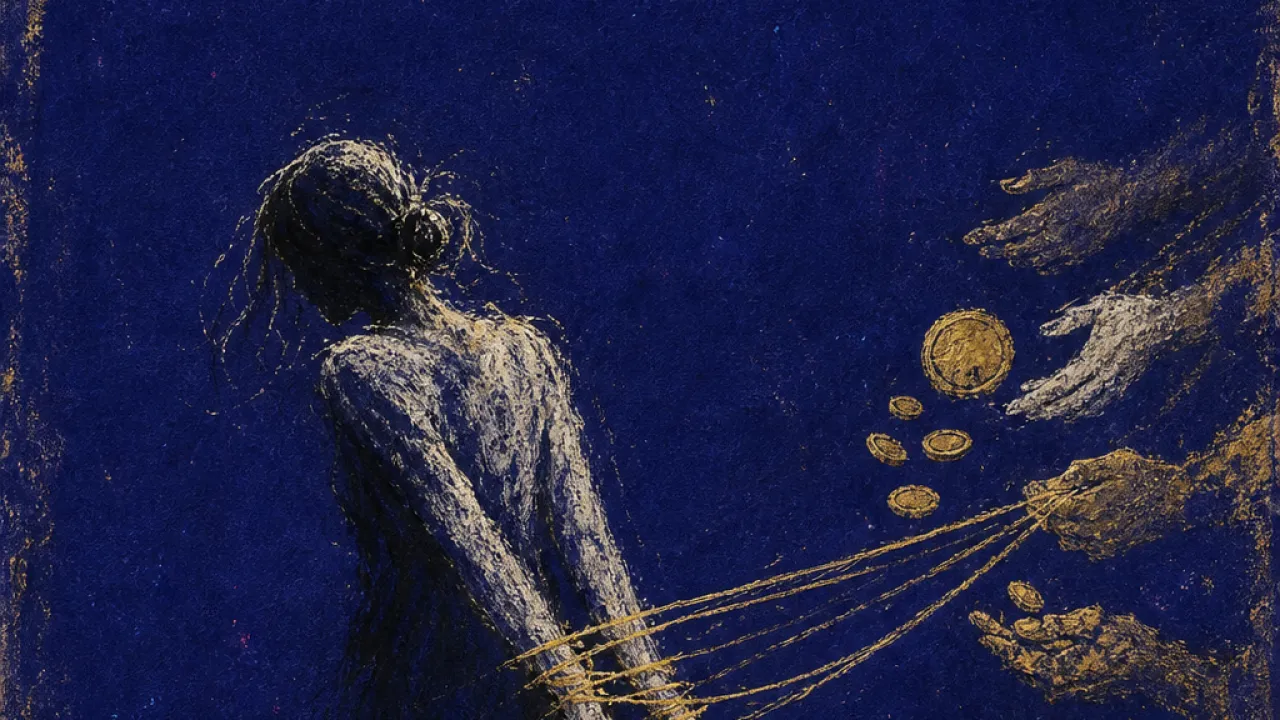
A solitary figure with drawn-in shoulders, accepting coins as thin strings pull at the wrists and door behind them

What is this situation?

Transactional Family Support — you accept help because the practical need is right in front of you: rent is due, tuition is short, your car needs fixing, or moving out would not be possible without someone stepping in. At first, the offer sounds simple, maybe even casual, like “we’re family” or “don’t worry about it,” so you say yes and try to keep things normal. Then the terms begin to appear after the fact. A parent asks why you spent money on takeout if they helped with groceries. A relative who covered part of your deposit now expects updates on who you’re seeing, where you’re working, what time you came home, or why you haven’t called enough. Every favor seems to come with a receipt that can be pulled out later, sometimes in the middle of an argument, sometimes in a joking comment at dinner, sometimes in a text that starts with “after everything I’ve done.” The support is not only about the bill being paid; it becomes a way to keep a hand on the door, the phone, the calendar, the choices you are trying to make for yourself. You learn to calculate what each offer might cost before accepting it, to soften your answers, to over-explain normal decisions, to avoid mentioning anything that could be turned into evidence. Even when you are grateful for the material help, you can feel the exchange changing the shape of the relationship: one side gets to give, monitor, and remind, while the other side has to stay agreeable enough to keep the help from turning into leverage. It leaves you carrying a quiet debt that is never fully named and never fully cleared, much like the Six of Pentacles, where one figure holds the scales and controls the coins while others wait below for what is given.

Why it's not you?

The problem is not that you are ungrateful or difficult to help. Support that comes with surveillance, reminders, hidden conditions, or control is not neutral support; it is a transaction with power attached. When help can be used later to limit your choices, the pressure belongs to the arrangement, not to your reaction.

Transactional Family Support in Tarot Cards

Transactional Family Support turns help into a ledger, so even an offer that looks generous can arrive with conditions attached. The way your shoulders tighten before opening a family text is part of the contact point between you and that setup. This is an environmental and structural dynamic, built through who controls the resource, who is expected to answer, and what gets counted afterward. The Tarot Cards below reflect the shape of that unequal exchange without telling you what you have to do next.

The Emperor
Reversed
The armoured ruler sits on a rigid stone throne decorated with ram heads, holding the symbols of authority inside a barren, tightly controlled landscape. Reversed, that protective structure hardens into overreach: a parent or senior relative treats financial provision as jurisdiction over another adult’s choices. You may be helped with housing, tuition, or transport and then expected to submit your work, dating, travel, or communication habits for approval. The armour shows why disagreement can be framed as disobedience rather than ordinary negotiation. The provider may understand support as proof that they remain responsible for you and therefore entitled to command you, even when the actual arrangement was never stated that way. Your adult role is compressed back into a dependent position whenever money is used to revive parental authority beyond the practical issue being funded.
Justice
Reversed
The scale, upright sword, pillars, and veil create a visual model of terms that should be measurable, explicit, and open to review. Reversed, the scene reveals a faulty underlying model in which accepting help is treated as blanket consent to future family authority. You may have learned to classify every boundary as ingratitude because the provider controls both the evidence and the standard of fairness. The missing procedural balance supports a more precise cognitive distinction. Acknowledging the value of rent, tuition, or repair money does not itself define an unlimited repayment obligation, and family closeness does not make retroactive conditions mutually agreed. Your growth edge is represented here as a change in classification: the arrangement can be recognised as an informal contract with unequal rule-setting rather than as a moral referendum on whether you deserve support.
The Devil
Upright
The chained pair, elevated pedestal, and loose collars present dependency as a system that is powerful without being identical to permanent ownership. The image exposes a bottom-level belief often installed by transactional support: because the family resource is necessary, the family’s authority must also be necessary. You may then label compliance as gratitude and treat the provider’s access to your choices as an unavoidable feature of receiving care. The physical separation between chain, collar, figures, and pedestal allows that fused belief to be decomposed. Material need explains why the bond exists, but it does not automatically validate every condition attached to it; affection explains the relationship, but it does not erase the power difference. Your developmental shift is represented by seeing the arrangement as constructed from separable parts rather than as a single natural law of family loyalty.
Four of Pentacles
Upright
The figure clamps one pentacle to his chest, fixes another over his head, and keeps two beneath his feet, physically preventing the resources from circulating beyond his control. In a family system, that posture resembles a provider who gives access without relinquishing ownership. You may receive money or use a family asset, but the giver continues to treat it as a basis for monitoring, vetoes, or future claims. The closed body position shows how fear of losing control can hide beneath the language of care. A parent may insist that scrutiny is simply responsible stewardship, while every purchase, visit, relationship, or schedule change becomes subject to review because their resources are involved. Your role remains dependent because the help is held around you rather than transferred with a clear boundary.
Six of Pentacles
Reversed
The giver holds the scale above the recipients while deciding how many coins each person receives. Reversed, that external imbalance can become an internal accounting system: every purchase, disagreement, delayed reply, or private decision is mentally checked against what the family has provided. You may carry gratitude as if it were an unlimited debt because no mutually recognised endpoint was ever established. The scale remains in someone else’s hand, which explains why self-auditing cannot reliably produce closure. Even perfect agreeableness cannot settle an account whose balance the provider can revise after the fact. Your guilt and over-explanation are therefore understandable adaptations to an unstable exchange, while the image keeps the source of instability located in the arrangement rather than in your character.
Ten of Pentacles
Reversed
The older figure, younger couple, child, dogs, and pentacles share an archway filled with signs of accumulated family security. Reversed, that multigenerational resource network no longer functions as a stable commons; money and access become disputed instruments of belonging. You can be included through rent help, tuition, a deposit, or housing while discovering that inclusion depends on following the family’s preferred script. The pentacles suspended across the scene resemble an inherited system that surrounds every relationship within it. Support may carry expectations about career status, partners, location, contact frequency, or public loyalty, allowing a practical contribution to regulate far more than the original expense. Your place in the family can feel materially protected and relationally conditional at the same time.
King of Pentacles
Reversed
The king sits amid vines, carved bulls, and visible property while keeping a large pentacle close to his body. Reversed, material competence ceases to function as stewardship and becomes dominance through ownership. A family member with greater income, savings, credit, or housing access can solve your immediate problem while positioning themselves as the final authority on how you should live afterward. The castle behind the throne makes the asymmetry concrete: the provider owns the infrastructure from which the offer is made, while you negotiate from immediate need. Their ability to fund a deposit, sign a lease, repair a car, or cover tuition can be treated as proof that their judgement outranks yours. Your gratitude is then recruited to legitimise a family power gap that already existed before the particular favour.
Two of Swords
Upright
The blindfolded figure holds two swords in a perfectly crossed position while the rocky sea sits behind her. The image captures a decision held in suspension because both available options protect one need and endanger another. You can accept help and protect immediate housing, education, or mobility, or refuse it and protect decision-making freedom while absorbing a cost you may not currently be equipped to carry. The blindfold represents missing terms as much as missing information. A casual offer framed as “we’re family” may not disclose how much access, contact, explanation, or obedience will later be expected, so the decision cannot be evaluated as a simple yes or no. Your hesitation reflects an option set in which the financial amount is visible but the relational price remains partly concealed.
Eight of Swords
Upright
The blindfolded figure stands bound inside a loose enclosure of swords, with wet ground underfoot and a distant structure behind her. The image captures how family leverage can narrow your field of view until every future route appears to threaten something essential. You may be able to imagine moving, changing jobs, dating openly, or reducing contact, yet each route is surrounded by the possible loss of money, housing, transport, or approval. The swords form a restrictive environment rather than a sealed wall, which matters for an objective reading of the situation. Some constraints are materially real, while others are reinforced by incomplete information about what support can be replaced, reduced, or separated from family authority. Your sense of direction is stalled by the combined weight of actual dependency and a system that benefits when alternatives remain difficult to see.
Page of Swords
Reversed
The Page grips a raised sword while turning into turbulent wind, with bent trees, moving clouds, and birds amplifying the atmosphere of alert observation. Reversed, that watchfulness becomes intrusive information gathering rather than clear communication. A family member who paid a bill may begin requesting constant updates about where you are, who you are seeing, how work is going, or why you did not respond quickly enough. The raised sword shows how information can be collected for later use in conflict. You may start editing what you disclose, anticipating follow-up questions, or avoiding subjects that could be connected back to the support you received. The family relationship becomes organised around surveillance and defensive explanation, even though the original offer concerned a practical expense rather than unrestricted access to your private life.

Transactional Family Support in Tarot Card Reading Insights

Transactional Family Support is something people often bring into readings when help starts to feel tied to access, approval, or control. The shift here is from the cards themselves to how this situation appears when someone sits with a spread. Tarot Reading Insights from sessions involving this kind of family pressure are gathered below.

Psychological Contexts Related to Transactional Family Support