The 10:45 p.m. Apology Draft: Family-Boundary Guilt and Self-Sacrifice
I met Maya (name changed for privacy) on a rainy Toronto evening and told her, “You are the Toronto product-ops person who can untangle a launch plan at work but rewrites a family text until the sentence about your own hurt is gone, a classic case of family-boundary guilt.” I said it gently, so recognition would feel like an open door rather than a verdict.
She had brought me back to 10:45 p.m. in her shared apartment. The family group chat was still open after a tense video call. Her phone glow warmed her fingertips, the radiator hummed beneath the silence, and her thumb hovered over Send while one shoulder lifted toward her ear. She had deleted the sentence explaining why she was hurt and replaced it with a brief apology, followed by an offer to handle an upcoming family errand.
“I keep calling it compromise, but I am usually the one who disappears,” she told me. During family fights, she retracted requests, apologized before the actual issue had been addressed, and took on extra emotional or practical repair work so contact would return to normal. She wanted meaningful family closeness, but every firm boundary felt like a possible threat to belonging.
Guilt moved through her like a browser with ten tabs open, every one labeled urgent, each demanding an apology, an explanation, or another favor while the original problem stayed hidden underneath. I could hear the tightness in her chest when she described it, the restless energy in her hands, the jaw that kept setting itself as if bracing for the next message.
I did not ask her to care less about her family, and I did not treat the conflict as proof that anyone was doomed to repeat it. I said, “Let us use the cards as a structured map of responsibility, fear, and choice. Our Journey to Clarity is not about predicting what your family will do. It is about finding the part of the next move that belongs to you, while leaving the rest where it belongs.”

Choosing a Map That Can Hold Both Shores
Before I shuffled, I invited Maya to place both feet on the floor, take one slow breath, and name the question without trying to solve it. I shuffled at an ordinary pace. The purpose was focus and transition, a way to move from the speed of the family chat into a room where each responsibility could be examined separately.
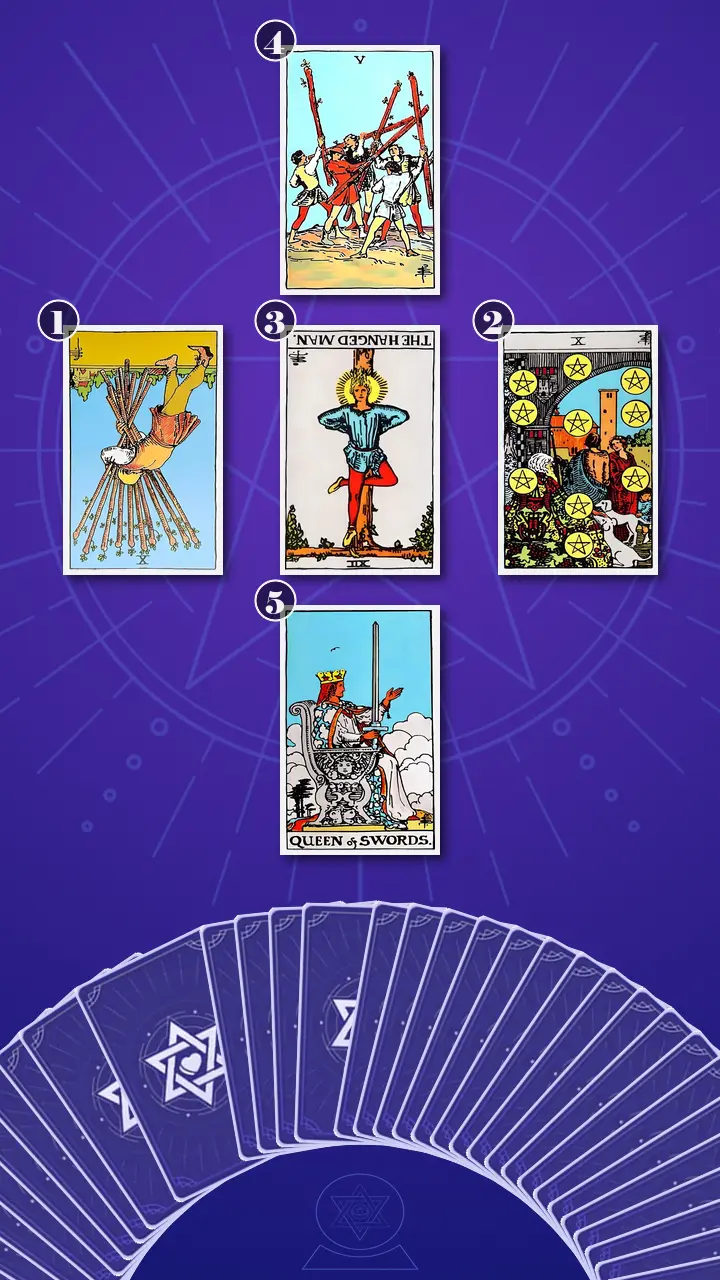
I used the Relationship Spread · Context Edition, a five-card relationship tarot spread for understanding family conflict, self-sacrifice, and boundary guilt. I chose it because this was not really a simple stay-or-leave decision. A Celtic Cross would add more breadth than the question needed, while a decision spread would flatten a complicated relationship into two opposing doors.
For you reading this, the structure matters. The five positions distinguish Maya’s visible stance, the family system’s collective pull, the pattern connecting them, the conflict pressure point, and a conscious response. Card one would show the behavior she could observe after a fight. Card two would show why shared history made the bond feel so consequential. Card three would uncover the self-suspension underneath the sacrifice. Card four would show how competing needs activated guilt. Card five would turn all of that into a boundary practice, not a prophecy.
I placed the first card to the left of the center, the second to the right, the third in the middle, the fourth above it, and the fifth below. The layout looked like a bridge between two relational shores, with the pressure above and a new foundation waiting underneath.
When the Burden Blocks the View
The Load She Mistakes for Proof
Now I turn over the card representing position 1, Maya’s observable self-sacrificing behavior and contracted emotional stance during family fights. The card is the Ten of Wands, reversed position. Its standard meaning concerns burden, over-responsibility, and reaching the limit of what one person can carry.
The bent figure’s view is blocked by the bundled wands. I connected that obstructed sightline to Maya’s late-night repair routine: rereading the argument, drafting the apology, planning the next errand, and monitoring whether everyone had started speaking normally again. In modern life, the ten wands were every emotional and practical task she had picked up so that the family group chat could stop feeling like an incident queue.
Reversed Fire here was not a prediction of collapse. It was blocked release. Maya could see that the load was too heavy, yet after each fight she gripped it more tightly. By taking sole responsibility for restoring the mood, she received short-term relief and taught the relationship that her limits could be negotiated away. Carrying all ten responsibilities was not evidence that she was the only person who cared.
I asked, “After the next tense exchange, what do you automatically offer before anyone asks: an apology, an errand, a longer explanation, or a promise to make the mood better?”
Maya gave a short laugh with no humor. “That is almost rude,” she said. I let the reaction stand. Her laugh was not resistance to the card; it was the moment the pattern became concrete enough to recognize. She looked at the bundle again, then rubbed the side of her thumb against the phone case.
I told her that the first experiment did not need to be dramatic. After one tense exchange, she could wait thirty minutes before offering help or sending an apology, then write down which portion of the conflict was actually hers to repair. A pause would not be silent punishment. It would simply interrupt the automatic handoff.
The Archive Under the Argument
Now I turn over the card representing position 2, the family’s collective relational pull and the shared history that makes sacrifice feel protective. The card is the Ten of Pentacles, upright position. Its standard meaning is continuity, inherited structure, long-term security, and established belonging.
I used the multigenerational family beneath the stone arch as a visual explanation. Maya was not reacting to a random disagreement. She was seeing one current limit through birthdays, regular visits, shared stories, rituals, old roles, and the comfort of being part of something enduring. The ten pentacles resembled a family photo archive full of messages, traditions, and inside jokes. That is why a single no could feel as if it threatened the entire structure.
But the stone arch was a structure, not a court order. The card did not tell Maya to reduce her family to a problem, and it did not tell her to abandon the bond. It asked her to separate continuity from compliance. A meaningful connection can be real without requiring one person to absorb every conflict cost.
I said, “The family bond matters. That is exactly why your boundary feels so large. But contact resuming is not the same as the original issue being resolved. Everyone speaking again may mean the channel is open; it does not prove that your missing sentence has finally been heard.”
Maya looked toward the rain-streaked window and nodded slowly. Her shoulders stayed high, but her hands stopped searching for the next helpful task. I could see the beginning of a distinction: protecting belonging was not necessarily the same thing as protecting every family member from the discomfort of her honest participation.
The Pause That Became a Place
Now I turn over the card representing position 3, the psychological mechanism connecting family conflict to self-suspension, especially the belief that Maya must give up more to preserve the bond. The card is The Hanged Man, reversed position. Its standard meaning includes stalled suspension, resistance to a necessary perspective, or sacrifice that no longer produces insight.
The bound ankle translated immediately into Maya’s personal calendar, where plans became tentative forever after a family disagreement. Her workday, rest, friendships, and honest wording were placed on hold while she waited for everyone else to feel comfortable. The pause might have begun as a chosen attempt to gain perspective, but reversed, it had hardened into a role she occupied whenever belonging felt uncertain.
I returned to the 10:45 p.m. bedroom scene and compared the suspended ankle with a calendar event she could never confirm or cancel. Then I said, “A useful pause creates perspective. Self-suspension postpones your need until the relationship feels calm, and the relationship may never become calm in the exact way you are waiting for.”
The sentence that surfaced in the room was the one beneath the apology: “If I soften it one more time, maybe nobody will leave.” I did not frame that fear as irrational. It explained why care had become overwork. It also showed why the pattern kept reinforcing itself: retract the request, watch the tension drop, see contact resume, and conclude that sacrifice must have been what saved the bond.
Maya’s breath stopped halfway into her chest. Her fingers froze around the edge of her phone, and her eyes lost focus as if she were replaying several old messages at once. Then she pressed her palm against her jaw, released a long breath, and let one shoulder fall. “I do not even notice that I am waiting forever,” she said.
I mentioned the familiar pressure in Encanto carefully, not to cast Maya as a family savior or make her story into a diagnosis, but to name the role of being useful, quiet, and endlessly dependable as a role that can outlive its original purpose. The task was not to defeat her family. It was to reclaim adult choice over what she paused, what she gave, and what she could allow to remain unresolved for the moment.
The Group Chat Collision
Now I turn over the card representing position 4, the way competing needs and fights trigger guilt, over-responsibility, and pressure to restore harmony quickly. The card is the Five of Wands, upright position. Its standard meaning is friction, competition, competing aims, and energy colliding without coordination.
The five crossed staves looked like an iMessage or WhatsApp family thread when several replies arrive at once, one person sends a voice note, another asks a practical question, and one conspicuously unanswered message changes the mood of the entire screen. Maya’s inner operating system translated the overlap into an emergency: “If everyone is upset, someone has to make this stop.”
I offered a different reading. Several people could be protecting different needs at the same time. The collision did not automatically mean the family bond was ending, and it did not appoint Maya as the person who had to drop her own position and carry all five concerns. The card’s Fire was active and uncomfortable, but it could be met by differentiated participation rather than surrender.
I asked her to identify what each person in one low-stakes disagreement might be trying to protect before deciding whether any sacrifice was required. Maya exhaled, and her thumb moved away from the imaginary Send button. “I can name their concern without making it my job,” she said. The possibility sounded unfamiliar, but it was no longer abstract.
That was the catalyst in the spread. The Ten of Wands had shown Fire turned into private overwork. The Ten of Pentacles had shown why the bond carried real weight. The Hanged Man had exposed indefinite suspension. The Five of Wands made the suppressed conflict visible so that a different element could arrive: Air, in the form of clear language.
When the Queen’s Sword Met an Open Hand
The room grew quiet before I turned to the final card. Outside, the rain softened against the window. Then the radiator clicked off, and the silence felt clean rather than threatening.
The Boundary That Keeps the Door Honest
Now I turn over the card representing position 5, the agency-based boundary practice that allows Maya to seek repair without assuming sole responsibility. The card is the Queen of Swords, upright position, and this is the spread’s Antidote. Her standard meaning includes clear perception, independent judgment, honest communication, and boundaries shaped by experience.
I showed Maya the Queen’s vertical sword beside her extended open hand. The sword was one clear limit. The open hand was continued relational availability. Together, they offered an adult voice that was firm without becoming cold: “I want to stay connected, and I am not agreeing to that.” The Queen did not withdraw from relationship, but she also did not volunteer to erase the disagreement.
I asked her to picture the original scene again: Maya at 10:45 p.m. on the edge of her bed, phone warm in her hand, deleting the sentence about being hurt and typing an apology instead. The family chat going quiet felt more dangerous than the missing need, so she offered to take the next errand.
“A boundary is information about how you can remain in relationship, not proof that you are abandoning it. You can care about the bond without becoming responsible for erasing every disagreement.”
“You do not have to erase yourself to prove loyalty; name the limit that keeps connection honest, holding the Queen’s upright sword beside her open hand.”
For a second, Maya’s thumb stopped above her phone and her breath paused halfway into her chest. Her eyes moved from the sword to the open hand, then unfocused as if a week of replayed messages had begun running again. I watched her jaw tighten once more, the old reflex arriving before her words. She looked down, pressed her fingertips together, and slowly let them separate. Her shoulders dropped a fraction. When she spoke, her voice was low and rough: “But if I do not fix the reaction, will that mean I was wrong?” I told her that another person’s disappointment could be real without becoming her assignment. A longer breath left her, shaky at first and then steadier. The room seemed larger after the radiator clicked off. She blinked hard, not crying exactly, but close to the place where relief and grief share a doorway. Then she laughed quietly at the responsibility she had been carrying. “I can leave the sentence there,” she said. The freedom did not make her certain; it made a little space around the next choice.
I asked her immediately, “Now, use this new lens to remember last week. Was there a moment when this insight could have let you feel different, even before anyone else changed their response?”
I named the crossing clearly: this was a first movement from guilt-driven appeasement and sole responsibility for repair to self-respecting connection with clear limits and shared responsibility. Maya was not required to become fearless. She was beginning to replace self-suspension with adult relational choice, keeping one need and one limit visible while allowing the other person to own their reaction.
The Queen’s Air did not cancel the Earth of family continuity or pretend that Fire would never flare again. It gave the friction names, edges, and choices. A boundary could be information about how she could stay in relationship, not a verdict on whether she loved the people involved.
One Need, One Limit, One Share of Repair
When I wove the spread together, I saw two Tens separating two things Maya had fused together: an exhausted burden cycle and an enduring family bond. The reversed Ten of Wands explained why help and emotional follow-up had become a one-person workload. The Ten of Pentacles explained why the bond mattered enough to make one limit feel enormous. The reversed Hanged Man showed the hidden mechanism: she kept her own life marked tentative until everyone else seemed settled. The Five of Wands showed the trigger as several legitimate concerns colliding, not automatic evidence that the relationship was breaking. The Queen of Swords supplied the missing practice: clear language with the door still open.
This answered the question beneath the question. When practical family help carries an implied price tag, refusing the task can begin to feel like refusing the relationship. Then an apology or favor lowers the immediate tension, contact resumes, and the relief looks like proof that sacrifice worked. The long-term cost is that the original need disappears, resentment collects, and the family learns that Maya will pay for closeness with time, sleep, plans, and silence.
My old Wall Street training surfaced as I looked at the repeated risk in the spread. An account can be valuable and still be overexposed when one person is carrying every open position. I used that commercial logic to protect Maya from unnecessary friction, not to turn her family into a market. The question was simply: which responsibility is hers, which reaction belongs to someone else, and which resource has been made to feel like a condition of belonging?
Auditing the Invisible Invoice
This was where I used my Family Power Dynamic Decoding lens. I asked Maya to audit, without making accusations, whether help had ever become linked to money, housing, inheritance, access, favors, or the status of being the dependable one. I was not declaring that her family was manipulative. I was asking her to distinguish a request from the leverage attached to it. If a practical resource is used to make a reasonable limit feel morally impossible, that is information about a power dynamic, not proof that Maya owes compliance.
Then I used Guilt-Debt Neutralization. I treated guilt as an unverified psychological debt claim, not an invoice that had already been approved. Guilt could signal that she cared, feared disconnection, or disliked someone’s disappointment. It could not, by itself, establish that she had caused harm or that she was responsible for repairing every emotional consequence. That audit did not dismiss her feelings. It stopped them from being entered automatically as evidence against her.
The Strategic Disengagement Plan
I gave Maya my Strategic Disengagement Plan, a calculated protocol for minimizing the leverage points that kept her overfunctioning while preserving the possibility of respectful contact. It was not a dramatic cutoff. It was a way to slow the repair reflex, keep the boundary visible, and make each response proportional to the part she genuinely owned.
The plan had three small next steps. I told her that tarot had provided the map, but she remained the decision-maker. The useful outcome was not dependence on another reading; it was a repeatable practice she could use in the next family group chat, call, visit, or holiday conversation.
- Take the 30-minute family conflict pauseAfter one tense family exchange this week, set a 30-minute timer before sending an apology or offering an errand. Draft in Notes instead of the family chat, then decide whether you want contact, clarification, or no reply.If 30 minutes feels impossible, start with 10 minutes or one unanswered notification. Pausing is not silent punishment, and you do not have to promise a later reply.
- Write one need, one limit, and one repair noteWithin those 30 minutes, write three short lines: “My need is...” “My limit is...” and “The part of repair that is actually mine is....” Do not send anything until you can see which words belong to your experience and which words manage someone else’s reaction.If the exercise tightens your chest, reduce it to one word or stop. The exercise is an option, not another task you have to perform perfectly.
- Keep one low-stakes preference visibleIn one family interaction this week, state a small preference without defending it, such as choosing a call time or declining an extra task. When the request is safe enough to answer directly, use: “I want to stay connected, and I am not agreeing to that.” Let the sentence stand for at least five minutes.If the conversation feels unsafe or a resource is being used as leverage, do not send the script. Preserving distance or waiting longer can also be a valid boundary.
These were ownership-sized repairs, not promises to solve a whole family system. They gave Maya a way to test whether connection could hold difference without asking her to erase herself first. She could choose closeness, distance, or a pause in each situation. Nothing in the spread removed that choice from her.

A Week Later, the Plan Stayed in the Calendar
Four days later, I received a message from Maya: “I used the three lines before replying. I kept my Saturday plan and said I could not take the errand.” She had slept a full night, though her first morning thought was, “What if I am wrong?” She smiled, left the plan in her calendar, and made coffee.
I thought of that as the first quiet proof, not because the family had suddenly become easy, but because Maya had participated without disappearing. The tarot spread had helped her move from fixing every reaction to separating her actions from other people’s reactions. Her clarity was cautious, practical, and still in progress.
I want to stay close without paying for closeness with myself is not a demand for distance. It is an invitation to let care, honesty, and self-respect occupy the same room. That is how the Journey to Clarity returned the narrative to its rightful author: Maya, not the cards, chose what happened next.
If a family fight has ever left your chest tight and your jaw clenched, making it seem safer to erase your own position than risk being left out, noticing that pattern is already a change. Connection does not have to be purchased with your disappearance.
If staying connected did not require you to disappear, what is one need or limit you might let remain visible in your mind tonight, perhaps beside the Queen’s upright sword and open hand, without deciding what anyone else has to feel?
Every reading at AceTarot is a journey to connect with inner wisdom and empower the path ahead. This reading shared here is a psychological mirror, not a private record—crafted to reflect universal emotional loops and help restore personal clarity. Please note that these insights do not replace professional psychological, medical, legal, or financial advice, and should not serve as the sole basis for major life decisions.
Learn more about our Journey to Clarity.
How did this insight land for you?
🫂 This Resonates Deeply
🌀 Living This Story
✨ Now I See Clearly
🌱 Seeing New Possibilities
🧰 Useful Framework
🔮 The Confirmation I Needed
💪 Feeling Empowered
🚀 Ready for My Next Step
Author Profile
 AI
AI Lucas Voss
951 readings | 561 reviews
“I spent years in the intense, high-stakes world of Wall Street. I know exactly how isolating and heavy the weight of uncertainty can feel in the dead of night. I use strategic, commercial logic not to be cold, but to protect you from unnecessary friction. Think of me as a fellow traveler who has walked the same rocky path—offering sharp but deeply supportive wisdom to help you clear the fog and confidently win your narrative back.”
In this Family Tarot Reading :
Core Expertise
- Family Power Dynamic Decoding: Uncovering how resources (money, housing, inheritance) are weaponized by elders to maintain hierarchical control.
- Guilt-Debt Neutralization: Treating parental emotional blackmail as unverified psychological 'bad debt' that needs to be audited and dismissed.
Service Features
- The Strategic Disengagement Plan: A calculated protocol to establish clear financial and emotional boundaries, systematically minimizing the leverage points your family uses against you.
Also specializes in :
Explore Related Patterns:
Defensive OverfunctioningAfter a family fight, Maya rereads the exchange, drafts the apology, plans the next errand, and monitors whether everyone has started speaking normally. When uncertainty is converted into tasks, doing more can create a temporary sense of control: there is always another message to refine or another practical contribution to offer. Defensive Overfunctioning makes action serve as protection from unresolved relational discomfort. You may look highly capable while your effort quietly expands beyond your actual share of responsibility. Because the extra labor sometimes restores contact, the system can adapt around your overwork and leave little pressure for repair to become mutual.
Emotional Hyper-ResponsibilityThe crowded family thread becomes an emergency in Maya's mind: if several people are upset, someone has to stop it, and she assumes that someone is her. When you move from owning your conduct to owning the entire emotional field, other people's disappointment, silence, or continued frustration can feel like evidence that you have left a responsibility unfinished. Emotional Hyper-Responsibility turns care into an unlimited assignment. It keeps you scanning for the next apology, explanation, favor, or mood repair even after you have addressed the part that belongs to you. The crucial distinction is not whether other people's reactions are real; it is whether their reactions automatically become your work.
Family Role RegressionMaya can untangle a complex launch plan at work, yet in the family chat she deletes her hurt, becomes useful, and takes responsibility for restoring contact. That contrast shows how a familiar relationship context can narrow the range of adult responses available to you, even when you demonstrate clear judgment elsewhere. Family Role Regression brings an established position back online: be quiet, dependable, and valuable through service. The role can feel protective because it is connected to shared history and belonging, but it also makes current disagreement harder to evaluate on its own terms. You begin responding from the old assignment rather than choosing how much responsibility this specific conflict actually requires.
Guilt-Driven People-PleasingMaya deletes the sentence about her hurt, sends an apology before the issue is resolved, and adds an offer to handle an errand. When you repeatedly exchange your own position for a faster return to normal contact, guilt stops functioning as information and starts functioning as an instruction to become agreeable, useful, and easy to reconnect with. The immediate reduction in tension makes Guilt-Driven People-Pleasing self-reinforcing. You receive short-term reassurance that the family bond is intact, but the relief can hide the longer-term cost: your request remains unresolved, your limit becomes negotiable, and sacrifice begins to look like the price of belonging rather than one possible choice.
Self-AbandonmentMaya describes compromise as a process in which she is usually the one who disappears, and her calendar, rest, friendships, and honest wording remain suspended until the family feels settled. When you protect connection by repeatedly removing your own needs and plans from the equation, the sacrifice extends beyond one apology into how much of your life is allowed to remain active. Self-Abandonment is the coping mechanism of leaving yourself out so the relationship can feel safer. It may preserve short-term contact, but it also prevents your needs from participating in the repair. The pattern becomes visible when care for the bond consistently requires your time, voice, or limit to be treated as the expendable part.
Self-SilencingAt 10:45 p.m., Maya removes the sentence explaining her hurt and leaves behind an apology and an offer of help. When you edit out the part of a message that might sustain conflict, the communication may become easier for others to receive, but it no longer contains an accurate record of your experience. Self-Silencing works as a protective filter: it lowers the immediate risk of disagreement by making your needs less visible. Repeated across family fights, that filter can make restored contact look like successful repair even though the central issue has disappeared from the conversation along with your voice.
Anxious AttachmentEvery firm family boundary feels to Maya like a possible threat to belonging, and the sentence beneath her apology is, "If I soften it one more time, maybe nobody will leave." When you experience ordinary disagreement as a warning that connection may be withdrawn, preserving the bond can take priority over preserving the content of your own request. Anxious Attachment fits the way relational uncertainty drives reassurance-seeking through appeasement here. The pattern is not simply that you value closeness; it is that resumed contact becomes the evidence used to judge whether your boundary was safe. Sacrifice can then feel protective because it produces the reassurance your nervous system and attention are urgently seeking.
Guilt ConditioningMaya retracts a request, the tension drops, contact resumes, and the relief appears to confirm that sacrifice protected the family bond. When that sequence repeats, your mind can learn a powerful association: guilt signals relational danger, and compliance is the action that makes the danger recede. Guilt Conditioning explains why the pressure can persist even when you intellectually know that a limit is reasonable. The feeling arrives before the responsibility audit and presents itself like proof of debt. Separating guilt from verified responsibility interrupts the learned sequence without requiring you to care less about the relationship.
Boundary DiscernmentMaya separates one need, one limit, and one share of repair, then later keeps her Saturday plan and declines the family errand. These actions distinguish what she can choose from what another person may feel, allowing both sides of the relationship to remain psychologically real. Boundary Discernment is not withdrawal or indifference. It is the capacity to identify where your responsibility ends without denying that the bond matters. You can acknowledge another person's concern, remain available for respectful contact, and still decline the task that does not belong to you.
Explore Related Struggles:
Autonomy Guilt BindMaya leaves her thumb above Send after removing the line about her hurt and substituting an apology plus an errand. She is still reaching for family closeness, yet the same reach pulls her away from a limit she wants to keep. When a boundary seems capable of disturbing belonging, you can hold autonomy and guilt inside the same decision. Keeping your position risks relational discomfort, while surrendering it restores contact at your expense. The bind is not a lack of care; it is the pressure to treat self-direction as a threat to connection. Her thirty-minute pause creates room to identify which part of repair is actually hers. You can let another person's reaction remain real without using it as the measure of whether your limit is legitimate.
Belonging-Authenticity SplitMaya's family chat returns to normal after she apologizes, but the sentence naming her hurt is no longer on the screen. The channel is open while her honest participation has been edited out. When shared history makes membership deeply consequential, you can be pulled between being known and remaining securely included. Speaking plainly protects your presence in the relationship, while softening the message promises quicker acceptance. Either direction touches something valuable, which is why the choice carries more weight than a routine disagreement. Keeping one need visible allows connection and authenticity to occupy the same exchange. You are not demanding that the family respond perfectly; you are refusing to make your own disappearance the admission price for belonging.
Connection-Repair LoopAfter each fight, Maya rereads the exchange, retracts her request, sends an apology or offers an errand, and watches for everyone to start speaking normally again. Contact returns, but the issue that initiated the conflict remains underneath the resumed conversation. The immediate drop in tension feeds back as evidence that sacrifice worked. When you receive relief directly after taking responsibility for everyone else's comfort, the sequence can become self-confirming: repair more, regain contact, and conclude that repair was the condition that saved the bond. The loop stays locked because its short-term reward arrives before its long-term cost becomes visible. Distinguishing an open channel from a resolved issue exposes the point where choice can re-enter. You can seek repair without automatically supplying the apology, labor, and silence required to make every reaction disappear.
Self-Erasure ReliabilityAt 10:45 p.m., Maya removes the sentence about her hurt and replaces it with an apology and an offer to handle an errand. The family can still see her as helpful and dependable, but it can no longer see the position she originally tried to express. When reliability is repeatedly proven by making your needs, plans, sleep, and words negotiable, usefulness remains visible while your participation becomes progressively thinner. You may keep fulfilling the role even after recognizing that the load is too heavy because the role has become the established route back to normal contact. What looks like compromise from the outside then functions as your absence inside the relationship. Leaving one sentence, preference, or limit intact interrupts that disappearance at a concrete point. You can remain dependable in the responsibilities you consciously choose without making unlimited access to yourself the proof that you care.
Guilt-Evidence FusionMaya asks whether failing to fix another person's reaction would mean that she was wrong. Her guilt arrives like an already approved invoice, carrying demands for an apology, an explanation, or another favor before responsibility has been examined. When guilt is accepted as evidence, you can lose the distinction between caring about someone's disappointment and having caused harm that you must repair. The feeling becomes both accusation and verdict, so the safest available response appears to be surrendering the limit that triggered it. This keeps the original issue hidden beneath a debate about whether you are allowed to cause discomfort. Checking what you actually did, what impact is supported by the exchange, and which reaction belongs to someone else restores a more reliable standard. Guilt can remain present without being granted sole authority over your next move.
Inherited Repair BurdenMaya sees one current limit through birthdays, regular visits, rituals, inside jokes, and the old role of being useful and dependable. A disagreement in the present therefore arrives carrying the accumulated weight of the family archive. When you have repeatedly occupied the dependable position, a family system can begin routing repair toward you before anyone explicitly assigns it. You may then carry several people's concerns as though maintaining continuity depends on your willingness to absorb the conflict cost. The burden persists because the role feels older and larger than the single exchange in front of you. Separating continuity from compliance does not require rejecting the history that matters to you. It lets you examine whether an inherited role still deserves authority over your time, words, and share of responsibility now.
Explore Related Emotions:
Boundary GuiltAt 10:45 p.m., you delete the sentence explaining why you were hurt and replace it with an apology and an offer to handle an upcoming family errand. Your shoulder is lifted, your jaw is set, and your attention is already tracking whether the family chat will return to normal. The sequence makes a limit feel like a charge you must settle before you are allowed to belong. When the tension drops after you apologize, the relief can be mistaken for evidence that the boundary itself was wrong, keeping guilt attached to every attempt to stay connected with your own position.
Martyrdom FatigueAfter a tense exchange, you reread the argument, draft the apology, plan the next errand, and monitor the family chat for signs that normal contact has returned. The work is emotional and practical at once, so there is no clean point where you can set it down and return to your own evening. The fatigue comes from treating your capacity as the bridge everyone else crosses. Each repair may bring short-term quiet, but the repeated workload teaches you to measure love by how much discomfort, time, sleep, and planning you can absorb. That is why sacrifice continues even when you already recognize that the load is too heavy.
Self-Betrayal AcheAt the edge of the bed, you remove the sentence about being hurt and put an apology in its place, then add a practical offer so the conversation can settle. The relationship remains present on the screen, but your actual position has been taken out of the message. That creates a particular ache because your care is expressed through your own disappearance. You are not refusing connection; you are preserving it by withholding evidence of what the conflict did to you, which leaves the original need unresolved even when everyone begins speaking normally again.
Usefulness-Based Belonging FearDuring a family fight, you move toward being useful before you have decided whether the task is yours, offering an errand and another round of emotional labor to make contact feel stable again. The archive of birthdays, visits, rituals, and inside jokes gives that usefulness the weight of a membership condition. The fear is not simply about completing a favor. It is about whether the relationship can continue to hold you when you are no longer quiet, dependable, and immediately available. That makes the question of family help emotionally larger than the task itself, because saying no can feel like stepping outside the structure you still want to belong to.
Voice Erasure DreadYour thumb hovers over Send while the sentence explaining your hurt vanishes from the draft. The family chat going quiet feels more dangerous than the fact that your need is no longer represented, so the message becomes smoother as your voice becomes harder to find. The dread gathers around what might happen if the honest sentence remains visible. You soften it one more time, not because the hurt has disappeared, but because silence seems like the most controllable way to protect contact. The cost is that the relationship receives your apology while never receiving the information it would need to understand your boundary.
Grounded AgencyFour days later, you use the three lines before replying, keep your Saturday plan, and say that you cannot take the errand. The decision is small enough to live in your calendar, yet it shows that you can participate in the relationship without handing over every part of the outcome. Your agency becomes grounded when you separate what you chose from what another person may feel about it. You can name a concern, offer an honest limit, and leave the other reaction with the person who owns it, making the next move a deliberate choice rather than an automatic payment for connection.
Quiet Self-RespectYou leave the sentence there, keep the Saturday plan in the calendar, and make coffee after saying no to the errand. Nothing dramatic announces the choice, but your own time and experience remain present in the ordinary shape of the morning. That quietness matters because self-respect does not require you to withdraw from the family or win the argument. It lets you remain available without editing yourself out, allowing care and a visible limit to occupy the same relationship.
Obligation DreadAfter the disagreement, you offer to handle another family errand while the original issue is still open. The task is no longer just a task because it sits beside shared history, access, favors, and the status of being the dependable one. When practical help feels tied to continued belonging, declining it can carry a heavy sense of consequence before anyone has explicitly stated one. You begin responding to the imagined price of refusal, which keeps sacrifice in place even when the story has not established that compliance is actually required.
Explore Related Contexts:
Conditional Family BelongingMaya describes every firm boundary as a possible threat to belonging, and the quiet family chat becomes more urgent than the sentence about her own hurt. After she retracts the request, apologizes, or offers help, tension drops and contact returns. That recurring sequence attaches a condition to relational normality: difference becomes expensive, while compliance produces immediate access to the group again. The story does not need to establish deliberate coordination by the family for the condition to operate; the repeated consequences are enough to train the interaction around Maya's surrender. When you encounter this structure, the pressure is larger than a single request because the apparent stake is continued membership in the relationship. Separating belonging from automatic agreement helps you examine whether connection can accommodate your visible position instead of requiring payment through silence, time, or labor.
Designated Peacekeeper BurdenDuring family fights, Maya retracts her requests, apologizes before the issue has been addressed, offers another errand, and monitors whether everyone has started speaking normally again. These are concrete repair duties, not simply private reactions to disagreement. Repeatedly taking those duties turns her into the family's default peacekeeper. The arrangement lets collective tension become one person's workload, while everyone else's concerns and responses remain outside the same level of responsibility. When you occupy this position, sacrifice can look like the practical requirement for getting the relationship operational again. Naming the role makes it possible to distinguish genuine care from work that has been silently assigned to you because you have reliably performed it before.
Family Boundary CreepAt 10:45 p.m., Maya deletes the sentence explaining why she was hurt, replaces it with an apology, and adds an offer to handle an upcoming errand. The same contraction appears after other fights when she retracts requests and performs extra repair work before the issue has been addressed. Her boundary is therefore not defeated by one dramatic demand. It loses territory through small, repeated edits: one omitted sentence, one premature apology, one additional task, and one more plan left tentative until everyone else is comfortable. When this kind of creep surrounds you, each individual concession may look minor while their cumulative effect changes your position in the relationship. Tracking what disappears from the conversation gives you a factual way to identify where accommodation has stopped being mutual and begun expanding at your expense.
Inherited Family Role Lock-InMaya approaches each current disagreement through birthdays, regular visits, shared stories, rituals, inside jokes, and old family roles. The story specifically identifies the established position of being useful, quiet, and endlessly dependable, a role that reappears whenever belonging becomes uncertain. Because that position is embedded in a long relational history, stepping outside it can register as more than declining one errand. It disrupts the familiar division of labor through which Maya protects continuity and other people rely on her to absorb conflict costs. When an inherited role organizes your family contact, sacrifice can continue long after its original purpose has stopped serving the adult relationship. Identifying the role as a social position, rather than as proof of who you must be, creates room to decide which responsibilities still belong to you now.
Transactional Family SupportThe story explicitly describes practical family help as carrying an implied price tag: refusing a task can begin to resemble refusing the relationship itself. Maya then supplies apologies and favors after conflict, and renewed contact makes those contributions appear to have purchased relational stability. This arrangement blurs three separate things: practical assistance, affection, and agreement. Once they circulate as a single package, a reasonable limit can be treated as a failure of gratitude or loyalty even when no concrete harm has been established. For you, the useful distinction is not whether family help has value, but whether receiving or providing it creates an unspoken claim over later decisions. Seeing the transaction clearly allows each request to be evaluated on its actual terms rather than automatically accepted as the cost of staying connected.
Family Boundary NegotiationFour days after the session, Maya keeps her Saturday plan and says she cannot take the family errand. She reaches that response by writing one need, one limit, and one share of repair instead of immediately deleting her position and supplying an apology. The boundary remains part of an active relationship rather than becoming an exit announcement. This makes the situation a negotiation over participation, responsibility, and access: Maya is testing whether family contact can continue while another adult owns their own response to her limit. When you are in this stage, progress is measured by whether your position remains present long enough to be evaluated, not by whether every reaction becomes comfortable. The negotiation gives you observable information about which forms of connection can hold difference and which still depend on your immediate concession.
Family Peacemaker Role ResetMaya says she can name each relative's concern without making it her job, and she later separates her own action from other people's reactions. Instead of restoring the entire family mood, she identifies the limited portion of repair she can genuinely own. This repositions her inside the family system. She remains available for honest contact while stepping out of the role that required her to absorb every competing concern, smooth every disagreement, and return the group to normal. When your peacemaker role is being reset, the first changes may look modest because the wider family arrangement is still familiar. Keeping one plan, declining one task, or leaving one accurate sentence intact provides concrete evidence that participation and total responsibility are not the same social role.
Family Support RenegotiationMaya interrupts the automatic offer of help, keeps an existing plan, and declines one family errand while continuing to value the relationship. She is no longer treating practical availability as the only credible evidence that she cares. That change renegotiates the terms under which support moves through the family. Help can still be offered, but its timing and scope are becoming choices rather than immediate payments for reducing conflict or preserving access. For you, this transition creates a way to examine each favor independently: whether it is freely chosen, whether you have the capacity, and whether declining it is being loaded with consequences that belong to the wider relationship. The outcome is still developing because mutual acceptance has not yet been established, but the old transaction is no longer operating invisibly.