Colour-Coding Until 4:28, Then Nine Minutes Inside Office Hours

The Join Button at 3:45: When Falling Behind Makes Help Feel Impossible
I met Maya, a 20-year-old Toronto commuter student who fully intended to use office hours until an overdue problem set turned the Join button into a referendum on whether she belonged in the course.
I asked her to take me through the last fifteen minutes before the session. At 3:45 p.m. in a quiet corner of Robarts Library, she had question three open beside the office-hours video link. The laptop fan whirred under the fluorescent hum, and burnt coffee left a bitter film on her tongue as she typed, “I’m a little behind and need help starting this,” deleted it, and began colour-coding headings instead.
By 4:28, the yellow highlighter was squeaking across a page she had not actually reviewed. Her shoulders were near her ears, her leg was bouncing under the desk, and the meeting had two minutes left. She closed the tab and felt her chest release for a moment.
“I don’t skip because I don’t care,” she told me. “I skip because I care, and I feel too behind to be seen. I keep trying to earn the right to ask for help.”
The contradiction was painfully clean: she wanted office hours because she was behind, but being behind was exactly what made office hours feel impossible. Her anticipatory shame behaved like a subway turnstile locking across her ribs whenever she moved toward the route she actually needed.
“You’re not avoiding the work,” I said. “You’re avoiding being witnessed before the work looks redeemable. That is shame-driven procrastination, and it makes sense as a short-term protection strategy. It just happens to keep you outside the support that could make the work smaller.”
I told her I was not going to use tarot to decide whether she was capable, disciplined, or destined to pass. “We’re going to make a map of the loop,” I said, “then find the smallest place where you can change it without having to become fearless first.”

Choosing the Four-Layer Insight Ladder
I moved our coffee cups away from the reading space and invited Maya to take one slow breath while holding a single question in mind: “Why do I keep skipping office hours when I fall behind?” I shuffled slowly, using the few quiet seconds as a transition from rehearsing explanations to observing the pattern.
This is how I use tarot: not as a prediction machine, but as a structured cognitive tool. A spread can separate a problem into parts that shame tends to collapse together. For this academic procrastination loop, I chose the Four-Layer Insight Ladder because it follows the exact chain we needed to examine without adding irrelevant complexity.
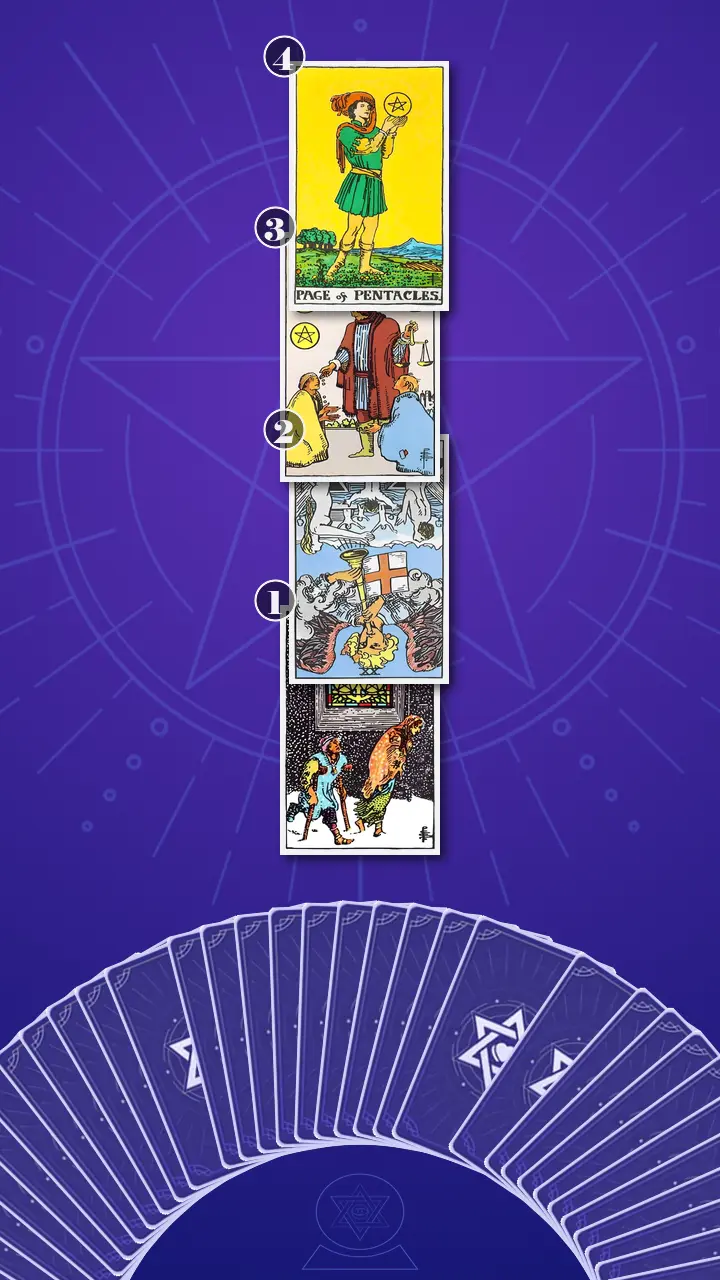
I laid four cards in a vertical column. The first position would show the visible symptom: skipping support and trying to repair the coursework alone. The second would reveal the underlying mechanism: the feared verdict about competence and worth. The third would identify the transforming resource, and the fourth would translate that resource into an integrated next step.
I explained that the layout worked like a simple ladder. We would begin at the bottom, where Maya felt shut outside help, and move upward one reachable rung at a time. The goal was not an instant academic comeback montage. It was to understand why the doorway felt blocked and identify one action small enough to take while the discomfort was still present.
The Lit Window and the Distorted Call
Position One: The Window Beside Question Three
I turned the card representing the visible symptom: Maya skipping office hours after falling behind and continuing to repair the coursework alone. It was the Five of Pentacles, upright.
I pointed to the two figures moving through the snow beneath an illuminated stained-glass window. “This image is not telling me that help is absent,” I said. “It is showing me what happens when hardship changes your sense of eligibility. The window is lit, but the people outside do not experience it as an entrance.”
I connected the image directly to 3:45 p.m. in Robarts Library. The office-hours link remained available beside Maya’s unfinished problem set. No instructor had refused her, yet admitting that she needed the resource now felt like confirmation that she should not enter. She stayed in the academic equivalent of the Five of Pentacles snow, close enough to see support while continuing the manual workaround alone.
The upright orientation expressed Earth in a state of deficiency: too little felt support, too little psychological shelter, and a contracted belief that every unfinished task had to be carried privately. It did not predict ongoing isolation. It showed how isolation was being maintained in the present.
“The help is right there,” I said, giving voice to the loop, “but if I use it, I’ll have to admit how much help I need.” The session was technically accessible while shame made Maya feel personally excluded from it.
I watched her breath pause. Her index finger stopped against the coffee sleeve, her eyes returned to the illuminated window, and then she gave a short, bitter laugh. “That’s so accurate it’s almost rude,” she said. “I literally keep the link open while acting like it isn’t meant for me.”
I did not rush to turn that recognition into a lesson. “Skipping makes sense if joining feels like public evidence against you,” I said. “The card helps us see the protection without confusing it with your character. You are not indifferent, and you are not incapable. You are staying beside an available resource because being seen unfinished has started to feel more dangerous than remaining confused.”
Position Two: When a Calendar Chime Becomes a Trial
I turned the card representing the underlying mechanism: the fear that showing unfinished work would expose a lack of competence or worth, turning honest self-review into another reason to delay. It was Judgement, reversed.
The traditional image shows an angel sounding a trumpet while people rise openly to answer its call. Reversed, I read that energy as a blockage. Maya heard the call, but her inner critic translated “Here is a place to reassess and begin again” into “Report everything you failed to do and prove that you deserve another attempt.”
I asked her what happened when the routine fifteen-minute reminder appeared. She described mentally staging a disciplinary hearing: the instructor would ask why she had waited, she would have no acceptable answer, and one basic question would expose every missed lecture behind it. She would draft an exhaustive defence, attempt one last catch-up sprint, and miss the session while preparing to be allowed into it.
For a moment, I remembered a reading years earlier beside a café printer that kept releasing order tickets. The sound itself was neutral, but under pressure every new ticket had felt like evidence of failure. Judgement reversed carried that same distortion: a notification delivered information, while an overloaded internal system heard accusation.
“A status update describes the backlog,” I told her. “Shame turns it into a character reference.”
I could see the distinction land physically. Her chest lifted on a shallow inhale; her gaze moved away as though she were replaying several imaginary conversations; then her shoulders lowered with a long exhale. “I’ve written an opening statement for a trial no professor has actually scheduled,” she said.
I told her that responsibility and condemnation were not the same thing. “You can say, ‘I have not completed this unit,’ and still refuse the extra sentence, ‘therefore I am not a capable student.’ The first statement identifies work. The second turns temporary academic facts into an identity.”
The private repair attempt reminded me of The Sorcerer’s Apprentice: the wish to control an escalating problem without being seen needing instruction creates more disorder than the original mistake. Maya’s over-preparation was not useless because organisation is inherently bad. It was protective procrastination because it had no finish line and repeatedly consumed the route into direct support.
When the Scales Left the Courtroom
Position Three: The Six of Pentacles and a Bounded Exchange
The café grinder stopped, and the small room became noticeably quieter as I reached the position representing the key transformation: reframing office hours from an evaluation that had to be earned into a bounded exchange available during recovery. I turned over the Six of Pentacles, upright.
The card showed balanced scales in one hand and coins falling from the other. In this position, its energy was Balance rather than excess or deficiency: one defined need could meet one measured form of guidance. As the spread’s antidote, it invoked reciprocal help-seeking, permission to receive, bounded vulnerability, and Maya’s continued agency.
I placed the Six of Pentacles beside Judgement reversed. “These scales are not courtroom scales,” I said. “They measure what would be useful now. They do not measure your worth as a student.”
I gave her the modern version. Maya could enter with question three open and say, “I’m behind on this unit. I tried setting up the equation this way, but I don’t understand the next step.” The instructor might clarify one prerequisite and suggest one example to review. Maya would neither hide the gap nor hand over her whole academic life. One question would go in, one usable resource would come back, and she would choose what to do with it.
This was where I used a framework I call Syllabus Deconstruction. When a backlog has absorbed shame, I strip away the emotional charge and reduce it to mechanical parts: topic, attempted step, exact point of failure, next available resource. “Am I a good student?” is impossible to solve at 3:45. “Which concept do I need before I can finish the first line of question three?” is a task with edges.
I asked Maya to picture the original scene again: office hours in one tab, an unfinished problem in another, a basic question typed and deleted while the clock moved. Her mind was still insisting that she had to explain the entire backlog before she could ask about one line.
Being behind is not evidence that you must stay outside; make one bounded request, and let the Six of Pentacles' open hand turn support into a practical exchange.
I left a few seconds around the sentence before making it plainer. “Office hours are not proof that you have already caught up; they can be one of the ways you catch up. You only need one unfinished question to enter the exchange. Support does not have to be earned by no longer needing it.”
I watched Maya’s breath stop halfway in. Her fingers, still holding the coffee cup, froze against the cardboard sleeve; then her eyes moved from the scales to Judgement reversed as though she were replaying every missed Tuesday between them. Her jaw tightened. “But doesn’t that mean I made all of this worse for no reason?” she said, sharper than she had spoken all afternoon. The anger arrived before relief, and I let it. A few seconds later, her lower lip pressed inward, her grip loosened, and the cup settled onto the table. Her shoulders dropped by perhaps an inch. She drew a shaky breath that sounded almost like a laugh, then looked briefly lost, as people sometimes do when a familiar burden is removed and the open space feels like responsibility. “So I could have gone while still behind,” she said quietly. Her eyes had reddened, but her voice was steadier. “That feels obvious and somehow completely new.”
“The strategy was not pointless,” I replied. “It gave you a few minutes of relief from being seen. It also increased the backlog and made the next session harder to enter. We can respect what the strategy was trying to protect without letting it keep choosing for you.”
I invited her to test the insight against reality. “Now, using this new perspective, think back to last week. Was there a moment when this insight could have made you feel different?”
She remembered 3:56 p.m., with the Join button visible and her question already written. “I thought the question was too basic,” she said. “But it was still the exact place I was stuck.”
I set a seven-minute timer and opened a blank note. Maya wrote: “I’m behind on setting up this type of equation, and I’ve reached the point where I don’t know which formula applies.” Under it, she added: “Could you help me identify the next step?”
I reminded her that she did not have to explain the entire backlog, disclose private circumstances, or send the note that day. Saving the draft still counted as practising a lower-pressure entrance. That limit mattered: bounded support would only restore confidence if Maya remained free to choose what she shared, which advice she used, and when she left.
I named the shift I was witnessing. This was not a leap from panic to perfect confidence. It was the first movement from anticipatory shame and self-condemnation toward bounded help-seeking: the possibility of being visibly unfinished without treating that visibility as a verdict.
Position Four: The Page Holds One Thing
I turned the final card, representing the integrated next step: attending as a learner with one unfinished question, a brief factual status update, and one manageable follow-up task. It was the Page of Pentacles, upright.
The Page stood steadily in a cultivated field, holding one pentacle at eye level. I read the upright energy as focused, balanced Earth: curiosity made tangible through contact with one task. The Page did not claim mastery, and that was precisely why the card restored dignity to Maya’s position. A serious learner is allowed to be in the middle of learning.
I showed Maya how the image mapped onto the day after office hours. She could return to the library, write the instructor’s clarification above question three, and set a twenty-minute timer. She would work only on the first step, record the next point of confusion, and stop without turning the session into an “academic comeback” performance.
“Think of the Page as a Notion board with one card in ‘In Progress,’” I said. “The rest of the backlog still exists, but it does not get to crowd the screen while you work on this piece. The useful question is no longer ‘Do I look advanced enough?’ It is ‘What am I ready to learn next?’”
Maya looked at the two-sentence note and then at the single pentacle. Her thumb stopped rubbing the edge of her phone. “One problem feels almost embarrassingly small,” she said, “but I can actually picture doing it.”
“Small is not embarrassing here,” I replied. “Small is what makes the next action observable. The Page builds confidence from completed contact with reality, not from a promise to repair an entire semester overnight.”
The One-Unfinished-Question Entry
I gathered the four cards into one story. Several delayed starts had created a real backlog around a full course load, café shifts, and a long commute. The Five of Pentacles showed how that difficulty became self-isolation beside a lit resource. Judgement reversed explained why: Maya’s mind turned a routine invitation into a verdict, so rearranging notes delivered safer, temporary relief. The Six of Pentacles reopened circulation through one bounded exchange, and the Page of Pentacles returned responsibility to Maya through one focused act of study.
The ladder also showed why the loop kept strengthening. Skipping reduced the immediate pressure in Maya’s chest, but it left the confusing concept unresolved. The larger backlog then appeared to confirm that the next office hour would be even more exposing. What felt like evidence of incapability was actually the predictable result of a protection loop receiving repeated reinforcement.
I pointed out the cognitive blind spot: Maya had been treating readiness as a prerequisite for support when support was part of the infrastructure for becoming ready. She had also mistaken the feeling of exposure for proof that the instructor was judging her. The transformation direction was specific: stop waiting to be caught up, and join the next office hour with one unfinished question and a two-sentence factual status update.
I wanted the next steps to remain practical enough for a difficult week, so I combined the spread with my Desktop Reset Ritual. I made one boundary explicit: this reset was not permission to rebuild a Notion dashboard or colour-code every lecture. It was a fifteen-minute Study Environment Audit with a hard stop, designed to reduce visual demands before Maya opened the one problem she intended to bring.
- Run the 15-minute Desktop Reset. At 3:30 p.m. before the next advertised office hour, clear cups, receipts, unrelated books, and extra browser tabs from the immediate workspace. Leave only the laptop, the unfinished problem, and a drink. When the timer ends, open Notes and write: “I’m behind on [topic]. I tried [specific step] and got stuck at [exact point]. Could you help me identify the next step?” Keep the hard stop. If the urge to reorganise notes appears, name it as protective procrastination and return to the two-sentence update.
- Use a ten-minute participation target. Label the calendar alert “Open link + read status update.” When it appears, keep the full backlog out of view, enter the online or in-person office hour, and ask the prepared question. Plan to stay for ten minutes rather than requiring yourself to feel ready for the whole session. Preserve an exit route. Maya could leave after asking, use audio, or send the question by email if the instructor permitted it; work, illness, accessibility needs, and personal boundaries still mattered.
- Complete the apprentice follow-through. Within twenty-four hours, set a twenty-minute timer at the library or kitchen table. Write the clarification in your own words, apply it to the same unfinished problem, and finish with one sentence: “The next thing I need to learn is…” If twenty minutes feels unrealistic, use five: open the problem, write the first line, and record the next question. The goal is one visible contact with the task, not a total recovery plan.

A Week Later: Nine Minutes Inside
Six days later, I received a message from Maya. She had done the Desktop Reset, stopped when the timer rang, and joined the next office hour with question three open. Her voice shook while she read the status update, but the instructor did not ask for a defence of the semester. They clarified one prerequisite concept and pointed her toward a single example.
“I stayed for nine minutes,” she wrote. “Nothing dramatic happened. That might be the best part.”
The following evening, she completed the twenty-minute follow-through. She did not clear the full backlog, and she found another point she did not understand. This time, she wrote it down as the next question instead of treating it as proof that the first conversation had failed.
She slept through the night after the session, then woke thinking, “What if I get behind again?” She told me she smiled, made coffee, and opened the next small task anyway. The doubt had not disappeared; it had stopped holding the door.
I saw the quiet proof of our Journey to Clarity in those nine minutes. The cards had not rescued Maya or made the decision for her. They had helped us separate a factual backlog from a verdict, but Maya was the one who cleared the desk, carried the unfinished question through the doorway, and chose what to do with the answer.
I know that when a Join button is glowing, your chest is tight, and an explanation is already running in your head, the very fact that you need support can feel as though it has disqualified you from being seen as capable. I would not ask you to erase that feeling. I would ask you to notice that the lit window is still an entrance, and noticing the difference means you are no longer standing at the beginning of the pattern.
If the next office hour had to hold only one unfinished question instead of your whole academic record, what might you be willing to carry through that lit doorway?