When Two Calendars Turn a Side-Hustle Crossroads into Role Overload
I recognized the scene immediately: a 29-year-old Toronto marketing coordinator closes the work laptop at 6 p.m., opens a freelance content-studio board, and sees a day-job Slack deadline arrive beside a client request. Jordan sat across from me with a cooling mug of coffee near their elbow. The hallway light hummed; their phone warmed their palm as their fingers moved between apps. I watched their shoulders lift before either message was answered.
"What should lead when my side hustle and day job both need me?" Jordan asked. "I want the studio to grow, but if I let it lead, the day job will show that I cannot reliably hold both. If I choose one, I am already failing the other." They had been moving the same tasks between two calendars, answering one stream late into the evening, then reopening both whenever a new request appeared. The pressure looked to me like a browser with every tab marked Today: the fan whining, the screen bright, and no clear window left for the page that mattered.
I am Esmeralda Glen. As the seventh generation of a Highland healing family, I have spent 67 years watching lived seasons change, and I have learned not to confuse a dormant field with a dead one. I told Jordan, "I am not here to tell you which identity wins or to make a frightening prediction. We can use the cards as a mirror, separate capacity from character, and draw a small map toward clarity."

A Compass for the Career Crossroads
I asked Jordan to set both phones face down, take one slower breath, and name only the question, not the whole future. I shuffled slowly. The small ritual created a boundary between reacting to notifications and observing the pattern; no mystical force was required for attention to become useful.
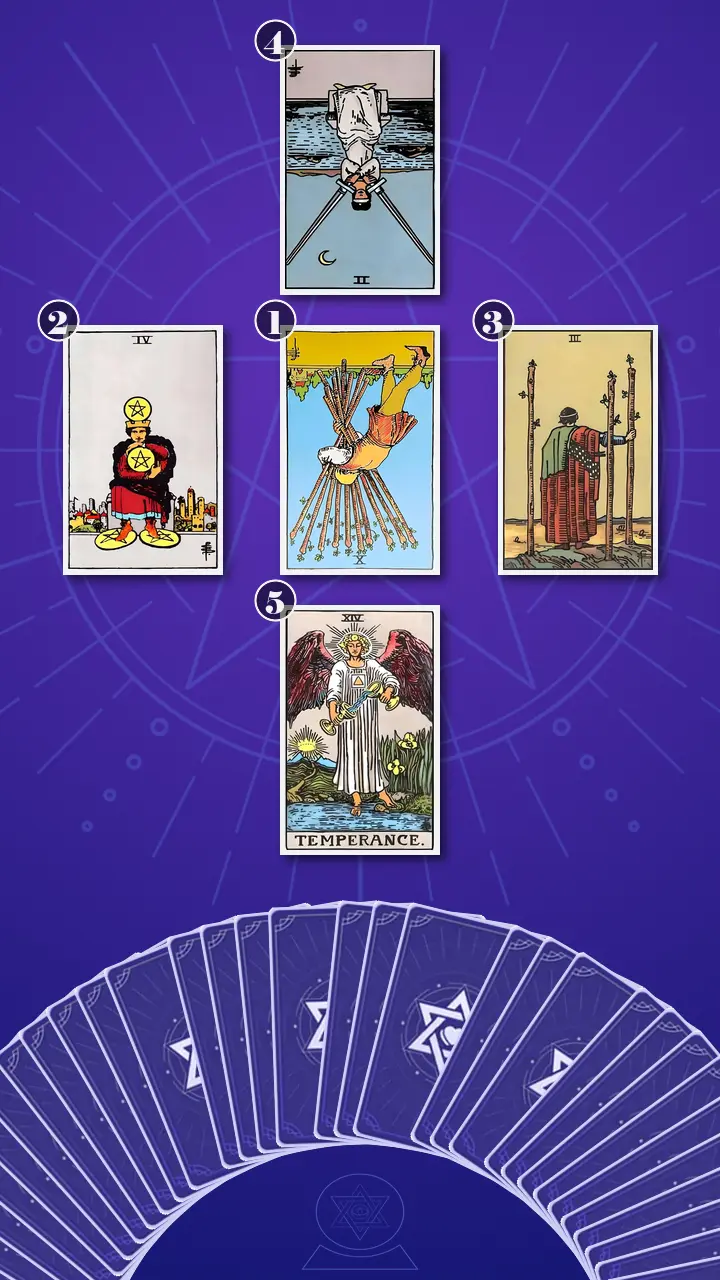
I chose the Decision Cross · Context Edition, a five-card tarot spread for career trade-offs. I use it when two legitimate commitments are pulling at limited capacity: it places the present pattern in the center, compares the day job's stability with the side hustle's expansion, reveals the hidden pressure behind the choice, and ends with a non-predictive integration experiment. This is how tarot works in this room: image, question, context, and the querent's own evidence, not a verdict from outside.
For anyone following a question like Jordan's, the first card shows the observable role-overload pattern; the left card names the day job's current claim; the right card gives the side hustle's claim a fair hearing. Above the center sits the hidden Inner Conflict, and below it Temperance offers a practical principle: what can be tested for seven days, with a review date.
The Bundle That Hid the Road
Position 1: The Present Role-Overload Pattern
"Now I am turning over the card for the present role-overload pattern: the observable behavior of switching between day-job demands and side-hustle growth tasks while treating every request as urgent." It was the Ten of Wands, in reversed position.
In the Rider-Waite-Smith image, a figure bends under ten bundled wands, and the load blocks the destination. I saw Jordan's 6 p.m. routine in it: closing the full-time marketing laptop, opening the studio board, adding a new proposal before finishing an older deliverable, and keeping Slack, Gmail, and the client inbox open until midnight. The modern translation was not "you need to work harder." It was that carrying every request as personally urgent prevented either role from receiving a protected block or a clear direction.
Reversed, the fire was in excess and beginning to buckle. It could signal a needed release, but I also named the overcorrection risk: dropping a day-job responsibility without communicating or declaring an all-in studio sprint would create fresh missed follow-through. I asked, "Which commitment can be reduced, delegated, or bounded for one week before you add more effort?"
Jordan gave a short laugh with no amusement in it. Their breath paused, their fingers hovered over the phone, and their eyes flicked toward the two calendars; then their hand settled flat on the table. "That is exactly me," they said. "It is almost rude how accurate that is." I replied, "Accuracy here is not blame. It gives us something we can change."
Position 2: What the Day Job Is Protecting
"The next card represents the day job's current claim: the specific stability, income, professional responsibility, or boundary you are trying to protect." I turned over the Four of Pentacles, in upright position.
In the Rider-Waite-Smith image, the figure presses one pentacle to the chest, pins others beneath the feet and on the crown, and closes the body around every resource. I connected it to payday Friday, rent and automatic payments leaving Jordan's account, and the stable paycheque that made the studio's possible future less terrifying. A late Slack request could make any reduction in availability feel like a threat to income and credibility, even when the actual duty could be bounded.
This was protective Earth in a useful form: security, stewardship, and a professional baseline. In excess, the grip became the only decision rule. I asked Jordan to separate what the day job genuinely required during the next seven days from the fear that every message had to be answered immediately. The card did not call stability cowardice; it asked for a boundary strong enough to hold it.
Jordan rubbed the edge of the mug and looked down. I waited. The silence made room for a less dramatic question than "Should I quit?": "What does reliable actually mean at work this week, in observable terms?"
Position 3: The Horizon the Studio Can Actually Test
"On the other side is the side hustle's current claim: the growth opportunity, enterprise, or forward movement you want to honor without turning scaling into an all-or-nothing identity decision." The Three of Wands appeared, in upright position.
The figure on the shoreline watches ships move across open water, one hand resting near three planted wands. I saw the Thursday afternoon client inquiry in that horizon: a recurring content package, a referral, or a retainer that could make the freelance studio more viable. I also heard the comparison trap in the LinkedIn post about another young founder's rapid growth. A stranger's highlight reel was not a capacity forecast.
This was expansion in balance when it became observable: send one proposal, test one retainer offer, or complete one useful growth action and let the response provide evidence. In excess, the Three of Wands could turn a real horizon into a demand to rebuild the entire business overnight. I said, "The card gives the studio a legitimate future-facing claim. It does not ask you to accept every ship that appears."
Jordan's mouth lifted briefly, ambition and apprehension sharing the same expression. They wrote "one observable test" in the margin, then underlined it once. I could see the first distinction forming: desire for growth was not the same as an order to expand without limits.
Position 4: The Blindfold Behind the Switching
I placed the fourth card above the center. "This is the hidden Inner Conflict behind Role Overload: the fear, blind spot, or decision-avoidance pattern that makes both roles feel equally urgent." The Two of Swords, in reversed position, faced us.
The Rider-Waite-Smith figure is blindfolded, two swords crossed defensively over the chest, with still water and a moon behind them. I compared that blocked sight with Jordan's Sunday coffee-shop scene near Dundas West: Google Calendar, Notion, and a notes app open; the same tasks dragged from Monday to Wednesday and back whenever a client notification arrived. The plan looked organized, but the decision stayed suspended.
I asked, "What sentence begins after 'If I choose, then...'" Jordan's chest tightened. Their hand moved toward the phone and stopped; their eyes went unfocused as if replaying the last three schedule edits; then they let out a small breath and said, "I am keeping things fair." I answered, "Maybe. Or you are keeping the decision suspended." That contrast was the card's reversed Air: information existed, but guarded thinking turned neutrality into a costly habit. In the language of Jordan's inner operating system, "I am keeping things fair" competed with "I am keeping the decision suspended."
I also offered the image of Severance: separate rooms for work identities. Jordan's problem was the inverse. Both rooms remained open after hours, and neither received a door. Choosing a temporary lead would not expose a personal flaw; it would close one door long enough for attention to become whole.
Jordan's fingers tightened once more, then released. Their gaze moved from the phone to the card, and the question changed shape in the room. "So rewriting the plan is not proof that I am being careful?" they asked. "It can be a way of avoiding the discomfort of naming a priority," I said, "without making indecision a character flaw."
Equal urgency is not equal importance. I let the sentence sit between the two colour-coded calendars.
When Temperance Turned the Verdict into a Rhythm
Position 5: The Bridge Beneath the Cross
The room grew quiet as I turned the card for the non-predictive integration point: the decision principle and one-week experiment that can establish a temporary lead, protect a minimum for the other role, and generate clearer self-knowledge. Temperance, in upright position, was the bridge.
In the Rider-Waite-Smith image, an angel actively blends liquid between two cups, with one foot on land and one in water and a path running toward distant mountains. The card's energy was measured integration: stability and growth did not need identical access to every hour. Its real-life translation was a focused side-hustle growth block, a contained day-job minimum, and a date to review what actually happened.
Here I used one of my signature diagnostic lenses, Seasonal Trajectory Alignment. I asked Jordan to notice whether they were trying to force a spring harvest during a winter dormancy phase. The studio's growth energy was real; the soil around it - a full-time schedule, a Toronto commute, rent, existing client commitments, and a body already kept alert by late-night notifications - had limited moisture. My Environmental Friction Sensing helped me name that mismatch without making it a moral failure. A season is not a sentence. It is information about what can be supported now.
I told Jordan, "Temperance is not asking you to choose between ambition and stability forever. It is asking you to blend them in a proportion you can actually live inside. One foot can stay on the secure ground of the day job while the other steps toward the studio's horizon."
I traced the visual progression aloud: the hot, heavy bundle of the reversed Ten of Wands, the closed grip of the Four of Pentacles, the open horizon of the Three of Wands, and now the cool, deliberate hand moving between two cups. "The change begins when I stop asking both roles to prove their importance tonight," I said. "They can each have a container without demanding the whole evening."
I asked Jordan to picture the most ordinary version of the loop: "At 8:47 p.m. on the TTC Line 1, you are toggling between a client brief and a day-job Slack thread, while the phone warms your palm and your shoulders stay lifted. Both calendars are open, but neither role has your full attention."
Stop treating the question as a permanent verdict about which identity deserves you; let Temperance's two cups turn the conflict into a measured rhythm that you can test, observe, and revise.
Jordan's first reaction was not relief. Their breath stopped halfway, thumb frozen above the screen; their eyes lost focus as the remembered train, Slack ping, and client brief seemed to replay. Their jaw tightened. "But doesn't that mean I have been doing it wrong?" I kept my voice steady. "It means you built a protection loop around a real constraint. We can learn from it without prosecuting you." The radiator clicked off, and in the new quiet I watched their fists loosen one finger at a time. Their shoulders dropped, then lifted again in a smaller, uncertain version of the old tension. Their eyes reddened, not with a promised answer, but with the shock of having a choice become smaller. A shaky exhale left their chest. They looked at the two cups, then at me. "A lead can be the container for this week," they said, testing the words. "Yes," I said. "A current lead is a time box, not a life sentence."
"Now, use this new perspective to recall whether there was a moment last week when this insight might have made you feel different," I invited. Jordan touched the client brief and the day-job thread, considering. This was the move from guilt-driven role switching and fear of disappointing one commitment toward grounded, values-based prioritization through a reviewable temporary lead. Not a permanent identity decision: a first piece of evidence.
Jordan did not need to solve everything in that moment. I set a 10-minute timer and wrote three lines on a clean page: "Lead role for the next seven days," "Minimum commitment for the other role," and "Review date." I told them that if the exercise felt too activating, we could shorten it to two minutes or leave it for later. The arrangement remained theirs to revise.
From Insight to Action: The Seven-Day Lead Experiment
When I laid the five cards together, they told a coherent story. The reversed Ten of Wands showed the visible cost of carrying every demand; the Four of Pentacles explained the legitimate need to protect income and professional reliability; the Three of Wands gave the studio a real horizon without demanding an irreversible leap; and the reversed Two of Swords revealed the hidden pressure beneath the schedule edits. Temperance did not crown a permanent winner. It created a bridge.
I saw Jordan standing at a crossroads with both hands full, trying to walk down two roads at once. The cognitive blind spot was treating a temporary allocation of attention as an identity verdict. Capacity is a planning fact, not a character test. The key shift was to choose a time-bounded lead based on current capacity and values, define a minimum viable commitment for the other role, and review the arrangement on a set date. Lived evidence, not panic, could shape the next allocation.
I offered my Winter Dormancy Protocol as the practical framework. For seven days, Jordan would pause directionless expansion, gather resources, protect sleep and fixed responsibilities, and stop forcing a new decision every time Slack or a client notification lit up. This was not quitting, surrendering ambition, or declaring the studio dormant forever. It was a deliberate pause around the growth impulse until the climate aligned. The side hustle could still receive one focused test; the day job could still receive its genuine baseline. The point was to stop spending energy pretending that every seed needed to become a harvest tonight.
After checking the week's actual capacity, Jordan chose the side hustle as the temporary lead for one protected growth block. The day job kept its essential work-hours responsibilities and a clearly bounded response window. I wrote the following actionable advice beneath the cards:
- Name the lead and review date.On Sunday evening, spend 10 minutes reviewing fixed day-job hours, paid client commitments, sleep and recovery needs, and one value you want the coming week to protect. Write one sentence such as "The side hustle leads for one protected growth block" or "The day job leads while I stabilise delivery," then add a review date seven days away.Tip: Choose seven days instead of trying to solve your career permanently. Do not reopen the arrangement before the review unless a real contractual, financial, or wellbeing need appears.
- Set a minimum viable commitment.For the role that is not leading, define observable care in the same note or calendar event: one essential client update, one paid deliverable, or two priority day-job follow-ups completed during work hours. Stop at the agreed limit rather than quietly turning it into another full workload.Tip: A smaller commitment may feel embarrassing because it is smaller than your ambition. Treat completion at the agreed boundary as reliability, not failure.
- Protect one single-window block.Choose one 25- to 45-minute block for the lead role. Close or mute the other role's Slack, email, and client tabs, and place incoming tasks in a note titled "Later, not lost." If someone needs a response, send a factual message such as "I can review this during my next availability on Thursday afternoon," only when that timing is accurate.Tip: Start with 25 minutes if the full block feels too large. A short protected block is valid evidence, and a real deadline can be handled without allowing every loud request to change the plan.
I reminded Jordan that the five-card Decision Cross was not an external authority choosing a career for them. It was a structured way to compare stable employment and freelance growth, expose the cost of two-calendar switching, and make a one-week integration experiment visible. The owner of the decision remained Jordan.

A Week Later, the First Quiet Proof
A week later, I received a message from Jordan: "I sent the recurring-package proposal in the 35-minute block, kept two essential day-job follow-ups inside work hours, and parked three nonurgent requests. I did not solve my career, but I stopped answering both roles at once."
When we checked in, Jordan told me they had slept a full night. The first thought the next morning was still, "What if I am wrong?" This time, they smiled, checked the review date, and completed the planned block instead of reopening both calendars. The clarity was real, and so was the question.
I told Jordan that the cards had not selected the side hustle or protected the day job on their behalf. Jordan had named a proportion, tested it, and gathered evidence. That was the Journey to Clarity: not the removal of every competing demand, but the return of choice to the person living inside the schedule.
Let the week produce evidence before you ask it to prove your identity. When both calendars stay open past midnight, with your shoulders tight and your hands restless, it can feel safer to keep every role equally urgent than risk one of them showing that you cannot control the whole future. Noticing that protective loop is already a change in position.
If one role could hold the highlighted cup and lead for only the next seven days without becoming a verdict about who you are, what small change in your attention would you be curious to notice in the role that is not leading?
This story is adapted from psychological research, written so that those in a similar struggle can see their own pattern in it — and find their next step clearly.These insights are not a substitute for professional psychological, medical, legal, or financial advice.
Learn more about our Journey to Clarity.
How did this insight land for you?
🫂 This Resonates Deeply
🌀 Living This Story
✨ Now I See Clearly
🌱 Seeing New Possibilities
🧰 Useful Framework
🔮 The Confirmation I Needed
💪 Feeling Empowered
🚀 Ready for My Next Step
Author Profile
 AI
AI“As the seventh generation of a Highland healing family, I see modern anxieties as a simple, temporary disconnection from nature's rhythm. I bring 67 years of lived seasons not to instruct you, but to hold space for you. Using tarot as a mirror, I want to gently guide you out of the chaos, helping you breathe deeply and rediscover the organic, steady heartbeat of your own life.”
In this Direction Tarot Reading :
Core Expertise
- Seasonal Trajectory Alignment: Diagnosing your deep sense of being 'stuck' as a structural mismatch—trying to force a spring harvest during a winter dormancy phase.
- Environmental Friction Sensing: Identifying the profound mismatch between your internal growth energy and the 'soil' of your current macro environment.
Service Features
- Winter Dormancy Protocol: A deliberate grounding ritual to actively pause, gather resources, and stop forcing directionless movement until the 'climate' aligns.
Also specializes in :
Explore Related Patterns:
Boundary DiscernmentJordan gives the studio one protected 35-minute growth block, keeps two essential day-job follow-ups inside work hours, and parks three nonurgent requests. These actions create observable distinctions between what must be done, what can wait, and which role has access to a specific period. When you make those distinctions explicit, a boundary stops being a vague intention and becomes a decision rule that can survive the next notification. The nonleading role is not abandoned. It receives a defined minimum and a truthful response window, while the lead role receives uninterrupted attention. This is boundary discernment because it preserves responsibility without granting every demand unlimited access. The pattern lets you remain connected to both commitments while retaining authority over when and how each one enters your time.
Urgency BiasJordan keeps Slack, Gmail, and the client inbox open until midnight, reopening both work streams whenever a new request appears. When you treat the newest visible demand as the most important one, notification salience replaces deliberate prioritization. Immediate responsiveness can then function as a defense against the fear of appearing unreliable, even when no evidence shows that every message requires an immediate answer. The result is not simply a busy schedule. Urgency begins to overrule importance, boundaries, and existing commitments, so each attempt to protect both roles fragments the attention available to either one. Jordan's decision to park three nonurgent requests shows the corrective shift clearly. You regain choice when an alert becomes information to assess rather than a command that automatically rewrites the plan.
Values-Based Decision MakingJordan reviews fixed work hours, paid client commitments, sleep and recovery needs, and one value for the coming week before choosing the side hustle for a protected growth block. The lead is therefore selected through relevant evidence rather than through the volume of the latest request. When you bring values and capacity into the same decision, ambition and stability become criteria to weigh instead of identities forced to compete for permanent control. The seven-day review date keeps the choice accountable without pretending it must settle the whole career. The nonleading role still receives an observable minimum, so the decision reflects both aspiration and responsibility. Values-based decision making becomes visible here as a repeatable process. You identify what matters now, allocate attention accordingly, and let lived evidence inform the next choice.
Zero-Sum ThinkingJordan says, "If I choose one, I am already failing the other," and imagines that letting the studio lead will prove an inability to hold both roles. This turns a temporary allocation of attention into a winner-loser verdict. When you interpret one role's priority as the other role's defeat, unequal access to your time can feel morally or personally unacceptable even when unequal access is exactly what limited capacity requires. That frame keeps both calendars open because divided attention appears safer than naming a trade-off. In practice, it makes each role less likely to receive focused follow-through. The one-week container introduces a more flexible equation. One commitment can lead while the other remains protected by a defined minimum, allowing you to distinguish proportion from abandonment and prioritization from failure.
Cognitive FlexibilityJordan reframes the lead role as a one-week container rather than a permanent verdict, then notices the next morning's thought, "What if I am wrong?" without reopening both calendars. Checking the review date and completing the planned block shows that uncertainty can remain present without dictating immediate reversal. When you hold a decision as testable rather than final, doubt becomes information to observe instead of proof that the choice must be undone. The recurring-package proposal, bounded day-job follow-ups, parked requests, and full night's sleep provide several kinds of lived evidence. This allows the next allocation to be updated from outcomes rather than panic or imagined identity consequences. Cognitive flexibility is operating when you can revise later without refusing to commit now, preserving both responsiveness to reality and continuity of action.
Decision DeferralJordan repeatedly drags the same tasks from Monday to Wednesday and back, with Google Calendar, Notion, and a notes app all open. The planning activity looks careful, but it protects Jordan from the immediate discomfort of declaring which commitment will lead. When you keep reorganizing the available options without changing their priority, planning becomes a defensive ritual that suspends the decision rather than supporting it. Calling the suspension fair also reduces short-term guilt because neither role is explicitly deprioritized. The longer-term cost is that both roles continue competing inside every work period, so the decision is made reactively by whichever notification arrives next. A seven-day lead interrupts this loop by replacing permanent certainty with a bounded decision, an observable minimum for the other role, and a date when reconsideration is actually useful.
Achievement-Based Self-WorthJordan fears that allowing the studio to lead will show the day job that they cannot reliably hold both roles, then keeps multiple work channels open late and adds a new proposal before finishing an older deliverable. The workload is therefore carrying more than practical responsibility. It is being used to defend an identity organized around competence, reliability, and the ability to absorb competing demands. When you read a capacity limit as evidence about your character, reducing a commitment can feel like exposure rather than planning. Overextension then offers short-term protection because continued effort postpones the feared conclusion that you are failing. Separating capacity from character changes the audit. Completing the agreed boundary can count as reliability, while working beyond it no longer has to serve as proof that you deserve both ambitions.
Explore Related Struggles:
Identity Verdict LockJordan drags the same tasks across several days and reopens both calendars because naming a lead does not feel temporary. The choice carries the larger question of which identity wins, making a one-week allocation feel like a permanent judgment on the day-job professional or the studio builder. You remain unable to test a proportion when the test is forced to prove who you are for the whole future. Identity Verdict Lock captures that compression of time: a limited, reviewable decision becomes loaded with permanent meaning, so repeated planning feels safer than allowing lived evidence to revise the next choice.
Urgency-Compass FusionAt 8:47 p.m. on the train, Jordan toggles between a client brief and a day-job Slack thread while both calendars remain open. Google Calendar, Notion, and the notes app contain plenty of information, but each new notification is still allowed to reset the direction of the evening. When immediacy becomes the main signal for what deserves attention, your priorities do not disappear; they lose authority over the next action. Urgency-Compass Fusion names the lock in which incoming volume supplies the direction that current capacity, actual importance, and chosen values would otherwise provide.
Capacity-Identity FusionJordan says that allowing the studio to lead would reveal that they cannot reliably hold both roles, and that choosing either one would mean already failing the other. Full-time hours, commuting, existing clients, and late-night messages are measurable constraints, yet those constraints are being read as evidence about Jordan's character. When your available capacity becomes fused with who you believe you must be, reducing a workload no longer feels like an allocation decision. It feels like admitting inadequacy. Capacity-Identity Fusion names the resulting bind: the week cannot honestly contain every demand, but acknowledging that fact appears to threaten the reliable identity you are trying to protect.
Growth-Stability SplitFriday's paycheque protects Jordan's rent and automatic payments, while the recurring-package inquiry gives the studio a concrete horizon worth testing. The day job is not an empty obligation, and the studio is not a disposable fantasy; each represents a legitimate future that requires access to the same week. You can become stuck when protecting stability appears to postpone growth, while pursuing growth appears to weaken the ground supporting it. Growth-Stability Split captures this live opposition between preservation and expansion, where the task is not to discredit either need but to see that equal access to every hour is not the only way both can remain real.
Boundary Ambiguity LockSlack, Gmail, the client inbox, and two calendars remain active as Jordan moves from the day job into the evening. The roles occupy the same phone, the same attention, and the same hours, so crossing from one commitment to the other does not create a meaningful end point for either. A boundary cannot guide you when it is present only as a vague intention and every new request can reopen the other role. Boundary Ambiguity Lock names the resulting enclosure: both roles stay accessible, neither receives whole attention, and your schedule has no stable threshold from which a deliberate choice can hold.
Explore Related Emotions:
Agency ReliefJordan sends the recurring-package proposal in one 35-minute block, completes two essential day-job follow-ups during work hours, and parks three nonurgent requests. Their message does not claim that the career question has vanished. It says, 'I stopped answering both roles at once,' marking the moment when the schedule stops making every decision on their behalf. Agency Relief comes from discovering that you can choose a proportion without erasing either commitment. The visible review date protects your right to reconsider, while the full night's sleep shows what changed when constant switching ended. Relief arrives through restored authorship: you named the experiment, kept the boundaries, and remained the person who decides what the evidence means.
Capability ShameJordan worries that allowing the studio to lead will show the day job that they cannot reliably hold both, then asks whether needing a different plan means they have been doing everything wrong. Limited hours are no longer functioning as neutral information about workload. They have become evidence in an internal case about competence. When capacity becomes a character test, you may experience every reduction as exposure rather than calibration. Even completing a smaller, agreed commitment can feel embarrassing because it does not resemble limitless capability. Capability Shame describes that inward collapse from 'I cannot fit all of this into the week' to 'something about me is inadequate,' making it possible to separate the planning constraint from your worth.
Choice Paralysis OverwhelmJordan sits in a coffee shop with Google Calendar, Notion, and a notes app open, dragging the same tasks from Monday to Wednesday and back whenever another notification arrives. The schedule appears active and organized, but the central choice remains suspended. You can keep refining a plan when the emotional cost of naming a priority feels larger than the practical decision itself. A temporary allocation has become fused with a permanent judgment about which work identity deserves you. That makes every available option carry the imagined loss of the other, leaving thought crowded but action stalled. Choice Paralysis Overwhelm captures the subjective pressure of having enough information to choose while feeling unable to tolerate what choosing appears to say about you.
Contained OverwhelmJordan writes three lines on a clean page: a lead role for seven days, a minimum commitment for the other role, and a review date. During the protected block, the non-leading role's tabs are muted and incoming tasks are placed in 'Later, not lost.' The demands still exist, but they no longer receive identical access to your attention. Contained Overwhelm describes pressure that remains real while gaining edges, sequence, and a place to stop. You can feel the weight of two commitments without letting every request occupy the present moment. The container does not deny the workload; it makes capacity visible enough for you to work within it and revise the arrangement from lived evidence.
Productivity GuiltJordan adds a new studio proposal before finishing an older deliverable, answers one stream late into the evening, and then reopens both when another request appears. Working on either role leaves the unattended one visible, so switching offers a brief sense that nothing has been abandoned. You can stay in motion not because every transition is useful, but because stopping would make the uncompleted obligations harder to ignore. The agreed minimum initially feels embarrassing precisely because it asks you to end work while more could still be done. Productivity Guilt turns a boundary into evidence of neglect and makes completion at a realistic limit feel morally insufficient. Naming that feeling allows reliability to be measured by the commitment you deliberately made, rather than by whether you exhausted every available hour.
Wrong Choice PanicJordan says that choosing either role means they are already failing the other, and the next morning still begins with the question, 'What if I am wrong?' A seven-day lead is therefore experienced less like a reversible test and more like a decision that could expose unreliability. When you attach that much consequence to a temporary allocation, each ordinary boundary can feel dangerously final. The pressure comes from anticipating self-reproach before any result exists. You remain available to both roles because continued switching seems safer than discovering that one choice had costs. Wrong Choice Panic names the urgent inner alarm around committing, while the review date restores the missing fact that you can observe the outcome and choose again.
Cautious Self-TrustA week later, Jordan wakes after a full night's sleep and still thinks, 'What if I am wrong?' Instead of reopening both calendars, they check the review date and complete the block they had already chosen. You do not need the old question to disappear before your own decision becomes usable. Cautious Self-Trust grows through a modest act of follow-through rather than a dramatic declaration of certainty. The plan remains yours to revise, and that reversibility makes room for judgment without demanding perfection. Each completed boundary becomes evidence that you can notice doubt, retain authorship, and let actual results inform what happens next.
Clarity ShockJordan's breath stops, their thumb freezes above the screen, and their eyes redden when the choice is reduced from an entire career decision to one lead for one week. Their shoulders drop, then rise again in a smaller version of the old tension. Clarity reaches the body before it becomes comfortable because you are suddenly seeing how much pressure came from the frame around the decision, not only from the workload. The new distinction is precise: wanting the studio to grow is not an instruction to expand without limits, and protecting the day job is not an instruction to remain continuously available. Clarity Shock captures the jolt of having a seemingly enormous crossroads become a smaller, revisable allocation. That impact can interrupt an old conclusion without demanding that you feel instantly settled.
Scattered OverwhelmJordan closes the work laptop at 6 p.m., opens the studio board, and then keeps Slack, Gmail, the client inbox, and both calendars active into the night. Their shoulders rise before either message is answered, while the same tasks keep moving between days. When every channel reaches you at once, your attention can break into fragments before any single responsibility feels fully entered or completed. The resulting inner weather is larger than an unusually busy evening. You can feel crowded by unfinished starts, bright screens, and competing claims until even deciding where to look requires effort. Scattered Overwhelm identifies that loss of an intact field of attention, helping separate the total volume of incoming demand from the smaller portion you can actually hold at one time.
Horizon HungerA Thursday client inquiry presents Jordan with a recurring content package, a referral, or a retainer that could make the studio more viable. They write 'one observable test' in the margin and later send the proposal inside a protected 35-minute block. The studio's future is not abstract to you when there is a real opportunity capable of answering back. Horizon Hunger is the forward pull created by seeing a larger working life that might genuinely be available. Its strength does not require accepting every request or rebuilding the business overnight. By giving that longing one bounded experiment, you can honor the future it points toward while allowing evidence, rather than urgency or comparison, to determine the next step.
White-Knuckle SecurityPayday Friday, rent, automatic payments, and a stable paycheque sit behind Jordan's response to each late Slack request. Their body braces before the message has even been assessed, because reduced availability appears capable of threatening income and professional credibility. You may hold a secure baseline so tightly that protecting it begins to consume the very recovery and attention it was meant to support. The day job's claim is legitimate, but continuous access turns stewardship into a clenched internal posture. White-Knuckle Security describes the feeling of having something stable while being unable to experience it as safely held. Distinguishing the job's observable requirements from the demand for immediate responsiveness lets you protect security through clear commitments instead of constant bodily readiness.
Explore Related Contexts:
Career Stability Lock-InPayday arrives before rent and automatic payments leave Jordan's account, making the full-time paycheque the material baseline beneath both daily life and the studio experiment. At the same time, a late Slack request makes any reduction in workplace availability appear capable of damaging professional credibility. Stable employment therefore carries more than one claim: it supplies income, protects an established role, and indirectly funds the ability to test freelance growth. Career Stability Lock-In emerges when those protections become the dominant rule for every allocation decision. You are not weighing two abstract ambitions on equal terms when one role carries current housing costs and established credibility while the other still needs market evidence. Naming that asymmetry makes the constraint visible, allowing you to protect the genuine employment baseline without automatically granting every workplace message control over the studio's remaining growth capacity.
Bounded Commitment TrialJordan writes three lines on a clean page: a lead role for seven days, a minimum commitment for the other role, and a review date. The studio receives one protected growth block, while the day job keeps its essential work-hours responsibilities and a defined response window. Muting the nonleading role's channels turns those written limits into an observable test rather than another revised plan. A Bounded Commitment Trial places you inside an active negotiation with competing obligations, not at the end of that negotiation. Each role receives a specific container, and the review date prevents the temporary allocation from hardening into an irreversible career decision. You retain authority to examine what was completed, what interrupted the boundary, and whether the agreed minimum protected reliability before deciding how the next week should be structured.
Overcommitment SpiralJordan moves directly from the full-time laptop to the studio board, starts a new proposal before an older deliverable is finished, and keeps Slack, Gmail, and the client inbox open until midnight. The same tasks are then moved between two calendars whenever another request arrives. Two legitimate workloads have been placed inside one continuously revisable queue, with no rule determining which demand can wait. When you are caught in an Overcommitment Spiral, additional effort does not reliably produce additional completion because each new claim can displace work already underway. The external problem is the accumulation of commitments across separate professional systems without protected capacity for either one. Seeing that workload architecture clearly gives you a basis for reducing, sequencing, or bounding commitments before measuring yourself against the impossible standard of answering both roles at once.
Work Life Integration TrialJordan uses one 35-minute block to send the recurring-package proposal, completes two essential day-job follow-ups inside work hours, and parks three nonurgent requests. Both professional roles remain active, but their work now moves through separate windows with observable outputs. The arrangement generates evidence about how stable employment and freelance growth can coexist under the week's actual capacity. During a Work Life Integration Trial, you are testing a proportion between roles that carry different forms of value and obligation. The key external change is that neither work system receives unrestricted access to every hour, while neither is required to disappear. Completion records, interruptions, and the scheduled review give you concrete information for adjusting the next allocation instead of relying on whichever notification is loudest.