At 8:30 p.m., Course Replanning Gives Way to One Saved Figma Draft

Finding Clarity in the Sunday Night Course Dashboard
When Maya, a 27-year-old junior digital product designer in Toronto, sat across from me, she described the version of Sunday Scaries that arrives disguised as productivity. At 8:30 p.m., after a full week of making orderly product decisions for other people, she would open a self-paced design course and see forty modules with no suggested route. The kitchen light hummed behind her. A mug of tea cooled beside the laptop. The course dashboard glowed on one side of the screen while Notion waited on the other.
She would watch a lesson, then another. When the practice prompt appeared, she would switch tabs, rename columns in her board, add colour-coded labels, move a Google Calendar block, and search for a better module sequence. An hour later, the Figma practice file was still unopened.
"I can follow a roadmap," she told me, pressing her thumb into the edge of her phone case. "But I freeze when I have to draw it. When the course says to work at my own pace, I hear that I should already know what to do."
I could see the cost of that sentence in her body: her jaw held tight as if she were biting down on a question, and her shoulders sat high beneath her sweater, ready for a hit that never came. The blank course sequence had become like a Figma file where every layer is called Frame 23, and she had begun blaming herself for not seeing the user flow.
"A missing syllabus can create real confusion without creating a verdict about your ability," I said. "You want the freedom of self-directed learning, but when the course leaves the route blank, your body braces and your mind turns that blankness into evidence against you. Today, I want us to draw a map for the fog without pretending the fog is your fault."
The Four-Layer Insight Ladder for a Course With No Roadmap
I invited Maya to put both feet on the floor, take one unforced breath, and hold a single question in mind: why does an open-ended course make her doubt that she can learn? I shuffled slowly, not to summon a verdict, but to give the question a clean boundary. That is how tarot works best in a situation like this: as a visual framework for noticing the story we are attaching to the available evidence.
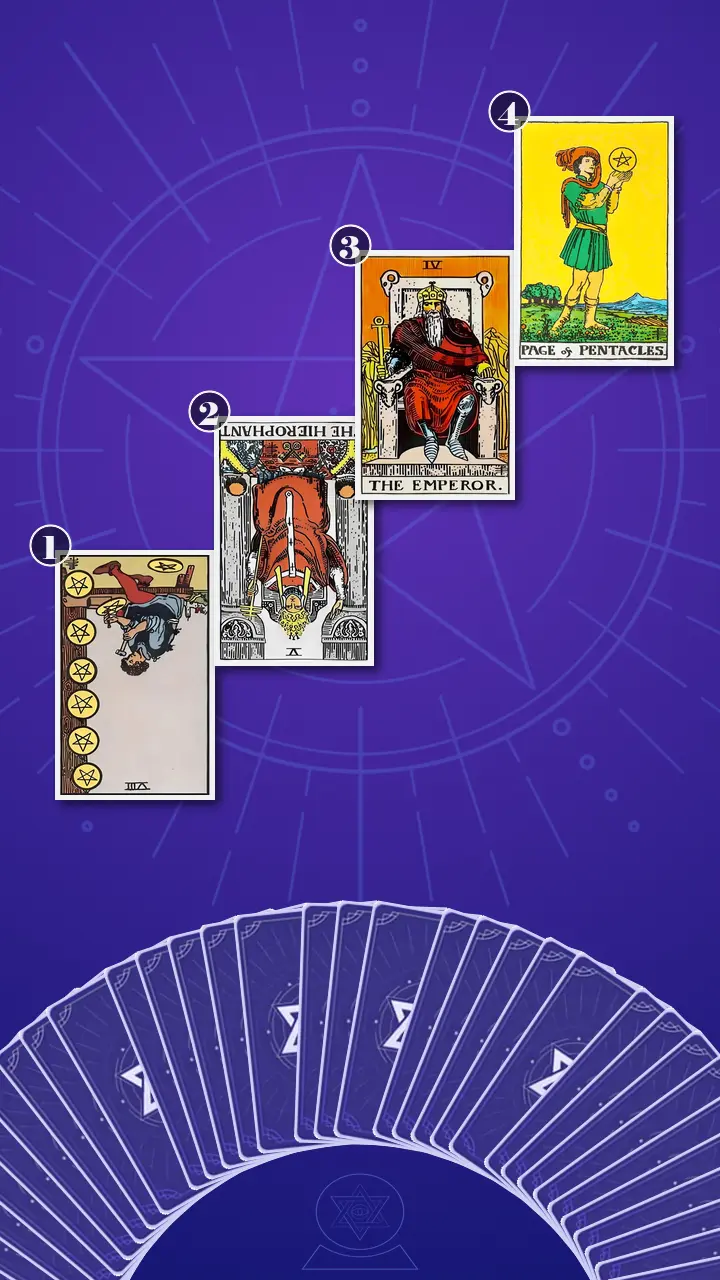
I chose the Four-Layer Insight Ladder, a tarot spread for diagnosing self-directed learning blocks. It was the smallest useful map for her question. Rather than forecasting an outcome or dragging in unrelated details, it would move from the visible pattern, to the inherited rule beneath it, to the resource that could interrupt it, and finally to one grounded action.
I laid the cards in a rising diagonal, like a compact staircase coming out of mist. The first position would show the present pattern of replanning instead of practising. The second would uncover the root belief that legitimate learning needs an instructor-approved sequence. The third would identify the transforming resource, and the fourth would turn that insight into one workable experiment.
The Workbench Left Untouched
Now I turned over the card for the Present layer: the observable course-jumping, repeated replanning, and incomplete practice through which Maya currently interprets an unstructured learning environment as personal inability.
Eight of Pentacles, reversed.
The image is an artisan at a wooden bench, making one pentacle at a time, with completed work displayed where it can be counted. Reversed, the card did not say Maya lacked effort. It showed effort being broken apart before it could become a full learning cycle. Her workbench was the unopened Figma file. The row of pentacles was the list of completed exercises she wished she had. The distant town was every polished LinkedIn case study that looked finished, easy, and somehow closer to everyone else than her own draft.
"You are touching every tab in the project," I told her, "but you are not letting one file reach a reviewable first version. Watching lessons and rebuilding Notion creates motion. It does not yet create evidence."
The reversed Earth energy here was scattered rather than absent. Planning gave her a brief illusion of control, but it also kept her from the only part of the evening that could answer whether she was learning: making an imperfect attempt, seeing what happened, and adjusting from there.
Maya gave a short laugh that caught at the end. "That is painfully accurate. I spend more time designing the study system than studying." Her fingers slid across the tabletop, then stopped. I watched her look down at the card as though the unfinished work had finally been described without being turned into a character flaw.
The Password Called the Right Way
Next, I turned over the card for the Root layer: the limiting belief and core fear that legitimate learning requires an externally authorized sequence, and that needing support diminishes Maya's worth as a learner.
The Hierophant, reversed.
The traditional Hierophant is a teacher seated above two students, one hand raised in instruction and crossed keys resting below. Reversed, he did not tell me that teaching, mentors, or formal structure were bad. He showed a painful mismatch: Maya had selected an unconventional self-paced course while still waiting for a formal authority to certify which route would count.
I asked her what happened when an assignment said, choose any topic or format. Her answer came quickly. She opened instructor announcements, then course reviews, then student examples in the community forum. A polished case study would appear on LinkedIn, and her stomach would seem to drop away from the rest of her body. Somewhere in that scrolling, she began looking for the crossed keys, a password called the right way to learn.
"If nobody has approved the route," she said quietly, "how will I know my attempt counts?"
That was the blockage. The authority energy of this card had become inverted: external scaffolding, which can be genuinely useful, had turned into a requirement for personal legitimacy. She wanted independence, but she had quietly defined independence as needing no sequence, no examples, no deadline, and no feedback. That standard would make almost anyone feel stranded.
I thought briefly of Dorothy searching for the Wizard, not because Maya needed to discover that she had never needed support, but because the proof she wanted could only emerge through actual steps. A mentor can offer direction. A rubric can reduce noise. Neither has to issue a certificate declaring that her first rough prototype is allowed to exist.
"You may not be failing to learn," I said. "You may be trying to learn inside a container that never defined the next step." Maya's gaze moved from the card to the rain tracing a thin line down the studio window. Her jaw loosened once, then tightened again. The distinction landed, but it also exposed how long she had been treating a course design problem as a private referendum on her intelligence.
When The Emperor Offered a Stone Throne
The room became noticeably quieter as I reached for the third card. This was the hinge in the spread, the card that could answer the authority conflict without asking Maya to become harder on herself.
Now I turned over the card for the Transformation layer: the resource that can separate the course's missing structure from Maya's ability by establishing supportive, self-authored boundaries and completion criteria.
The Emperor, upright.
The Emperor sits on a stone throne, red robe over armour, mountains behind him. I read this as balanced authority, not rigid control. For Maya, the stone throne was not a twelve-week productivity regime or a colour-coded system she had to obey perfectly. It was one current module, one realistic thirty-minute study block, one practice output, and one definition of done. A boundary can protect attention without turning learning into punishment.
My years on Wall Street made this image feel practical to me. In a high-stakes room, an unclear mandate could waste an entire day, but nobody sensible concluded that an analyst had become incapable because the brief had no acceptance criteria. We clarified the scope, named the owner, set a decision point, and reviewed the evidence. I use the same lens in my Academic ROI Auditing: the useful question is not whether an investment proves someone's worth. It is whether the next bounded effort can create information worth having.
"The structure you did not receive is not proof that you cannot learn," I said. "It is a design variable you can test. A missing syllabus is a design problem in the learning container, not a verdict on your ability to learn. Build one temporary route, give it one finish line, and let the completed attempt tell you what needs changing."
Stop treating a missing syllabus as a verdict on your ability; set one firm boundary, define one finish line, and take your seat on The Emperor's stone throne.
At first, Maya did not relax. Her breath paused halfway in, and her index finger hovered above the edge of the card as if she had forgotten what it was reaching for. Then her eyes lost focus for a beat, replaying Sundays of rearranged Notion boards, moved calendar blocks, and unopened files. Her brows pulled together. "But doesn't that mean I was wrong all this time?" she asked, with a small sharpness under the question.
"It means the conclusion was harsher than the evidence," I said. "You were trying to solve uncertainty with more planning, because planning was the only lever you thought you had. That made sense as protection. It just stopped being useful." Her shoulders lowered in increments, not all at once. She exhaled with a faint shake, then went still in the strange, weightless pause that can follow a burden being set down. There was relief there, and also the brief dizziness of real responsibility: if she could build the container, she could no longer wait for the course to rescue her from choosing.
"Now, with that new perspective, think back to a moment last week when this could have made you feel differently," I asked. She looked at the Emperor again. "Sunday," she said. "I did not need the perfect route. I needed a route I could inspect."
That was the first movement from contracted self-doubt and external permission-seeking toward evidence-based, grounded self-trust. Structure is a tool you can build, not a certificate you have to earn.
One Pentacle at Eye Level
I turned the final card for the Action layer: the one-week experiment that translates the new structure into one practical output, one reflection, and one targeted feedback request.
Page of Pentacles, upright.
The Page stands in a green field, holding one pentacle at eye level. This was upright Earth energy at its most useful: beginner focus, curiosity, and contact with one real object. Not the whole course. Not mastery of a future role. One saved screen, one small prototype, one completed exercise that could be inspected with a calmer mind.
"The Page does not try to conquer the mountain behind him before he starts," I said. "He looks closely at what is in his hands. For you, that might be one mobile checkout screen from the course prompt. Save a complete first version, write down two things the attempt taught you, and ask one bounded question such as, 'Does the hierarchy read clearly on the first screen?'"
The card's energy was steady because it narrowed the field. One finished loop can tell you more than three hours of feeling almost ready. Maya did not need to decide whether she was a naturally independent learner before beginning. She needed a small piece of work that could speak back.
She nodded, this time without looking away from the card. "I keep treating a rough file like it will expose me," she said. "But a rough file might also give me something to learn from."
The One-Week Learning Scaffold
I gathered the reading into one plain story. The Eight of Pentacles reversed showed that Maya's effort was real but fragmented before practice could become visible evidence. The Hierophant reversed showed why: when an instructor did not supply a sequence, she searched for hidden permission and mistook the missing route for missing ability. The Emperor returned rule-making to her hands, and the Page of Pentacles reduced the task to one inspectable beginning.
Her cognitive blind spot was not that she wanted structure. It was the belief that needing structure disqualified her from self-directed learning. The direction of change was simpler and kinder: build a temporary container, test it, and revise it from what actually happens. Do not make the whole course make sense before you let one exercise teach you something.
I offered Maya a small plan, designed to be useful after a tiring workday rather than impressive on a productivity feed.
- Write the four-line Emperor brief.On Monday, open a plain Google Doc and write only: one current module, one practice output, one Thursday deadline, and one person or rubric for a feedback check. Block one thirty-minute session in Google Calendar, and define done as "a complete first version saved," not "a polished result."Cap planning at fifteen minutes. If thirty minutes feels too large, use a ten-minute minimum: open the exercise, make one rough move, and save the file.
- Run the Evidence-First Learning Loop.Before opening another lesson, set a six-minute timer and make the smallest usable version of the current practice task. Save it with the date in the filename, write two neutral observations about what became clearer and what remains uncertain, then send one trusted colleague, course community member, or rubric one specific question.Name the thought "this draft proves I cannot do this" as a prediction, not a fact. Sharing is optional; a private saved draft is already evidence.
- Use a Research Sunk-Cost Audit before buying another roadmap.When the course receipt or a bookmarked alternative makes Maya want to start over, she can ask whether the next thirty minutes in the current course could produce one useful learning signal. The money already spent is information, not an order to finish or quit.Make no permanent decision about the course this week. Let one completed output show whether the current container needs a smaller adjustment, more feedback, or a different kind of support.
This was not a promise that every open-ended online course would suddenly feel easy. It was a way to stop using mood as the only measurement. Maya could seek examples, deadlines, mentors, and better course design when those would help. She no longer had to turn that need into a verdict on herself.

A Saved File, Not a Final Verdict
Four days later, I received a message from Maya. She had made one rough mobile checkout prototype, saved it before watching another lesson, and sent a colleague one question about visual hierarchy. She wrote that the screen was not good yet, but it was real enough to revise.
That night, she slept through until morning. Her first thought was still, "What if I chose the wrong module?" Then she looked at the saved file, smiled a little, and moved the same small task to her next available study block.
That was Maya's Journey to Clarity. The cards had not handed her certainty or made the course better designed. They helped her separate the empty map from the strength in her legs, then return authority to the person who could make the next honest move: her.
When you want the freedom to choose but your jaw tightens at every open-ended option, it is easy to mistake the absence of a map for proof that you are not capable of getting anywhere. But one finished exercise can become a small handrail, something solid enough to show you the next step without demanding that you see the whole staircase.
If one small finished exercise could be allowed to teach you what comes next, what would you be curious to make or notice this week?