The Brightspace Tab: When Mandatory College Coursework Feels Like a Stolen Hour
I was sitting with Jordan, a third-year student in Toronto who could focus for hours on a portfolio project, yet the moment Brightspace labeled a task required, their shoulders dropped and the Sunday Scaries became a debate about whether the work deserved their time. I recognized the pattern as autonomy-protective avoidance of mandatory college coursework that felt irrelevant, not a lack of ability.
At 10:40 p.m., in the narrow kitchen of a shared Toronto apartment, I watched Jordan open the required module, read the first paragraph, and leave the notes page blank. The radiator clicked behind us, the laptop fan hummed, and yesterday's coffee tasted cold while the blue-white screen made their eyes ache. Their phone felt warm in one hand as they searched advanced electives with the other.
Jordan told me, I could do the work, but I cannot make myself care about it. Every hour on this course feels stolen from something that actually matters. I keep waiting for motivation and then using panic instead.
I could see the resentment lying over their body like a wet winter coat, heavy at the shoulders but impossible to ignore once the deadline began closing in.
I did not ask Jordan to pretend the course was valuable or to treat compliance as a virtue. I said, It makes sense that this feels bigger than a boring assignment. You want to finish the degree, but you do not want starting this module to mean that someone else gets to decide what matters. Let us give the conflict a shape, then draw a map through it.

Choosing The Shadow Spread for a Repeating Avoidance
I invited Jordan to take one slow breath and name the question without trying to solve it. Then I shuffled slowly. I use that small pause as a psychological transition, not a supernatural test: it moves attention from the open tabs and deadline noise toward the pattern that is actually asking to be understood.
I explained that I would use the five-card Shadow Spread. I chose it because this was not a simple decision between finishing and quitting. The course was a fixed graduation requirement, while the real question was why the same avoidance kept returning. The spread lets me examine the visible behavior, the trigger, the protected fear, the perspective that can loosen the pattern, and the practical action that makes change observable. This is how tarot works in context for me: card meanings become a structured conversation about choices, not a verdict about the future.
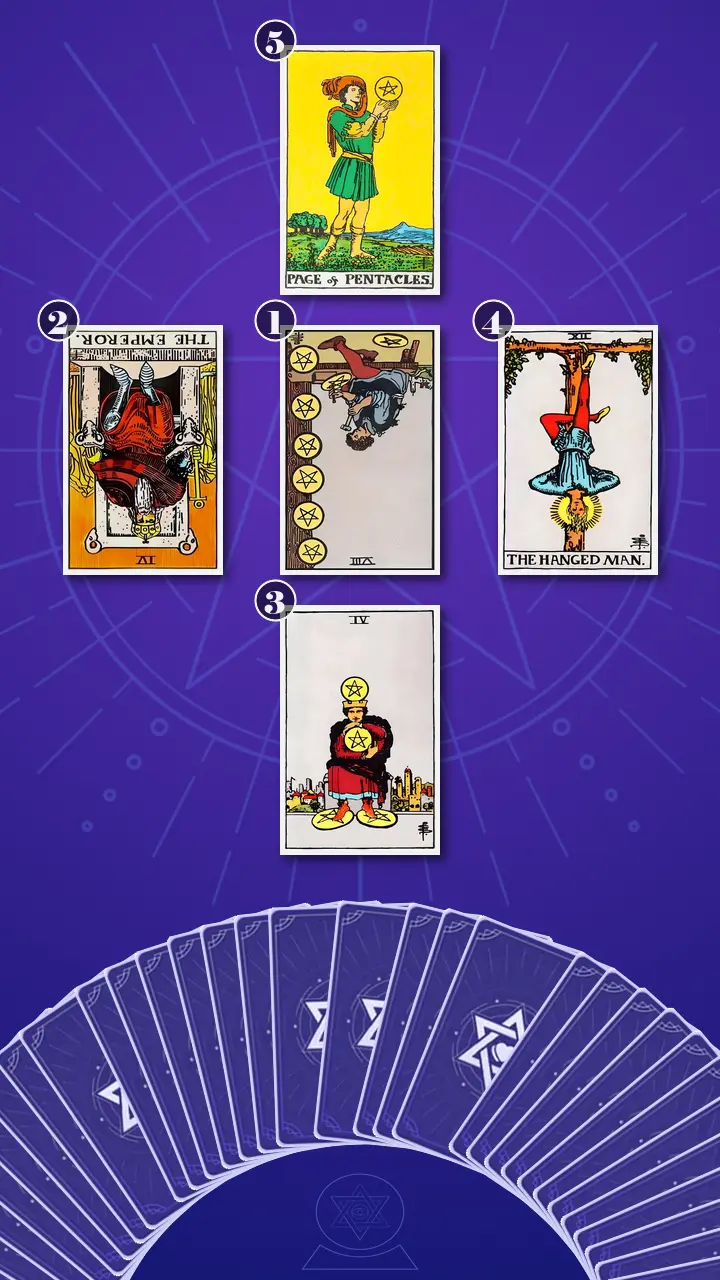
I told Jordan that the first card would show the conscious avoidance pattern, the second would identify what mandatory structure activated, the third would reveal what the resistance was protecting, the fourth would carry the key perspective shift, and the fifth would turn that insight into a manageable next step.
The Blank Notes Page
Position 1: The Visible Avoidance Pattern
I said, The card I am turning now represents the diagnosis's observable avoidance pattern: opening the required coursework, withholding sustained effort, and postponing until external pressure takes over.
I turned over the Eight of Pentacles, in reversed position.
The artisan's tools mirrored Jordan's laptop, syllabus, available study block, and blank notes page. At 10:40 p.m., the module and rubric were ready, but Jordan switched to an elective project after one paragraph. Three preferred tasks were already checked off beside the untouched requirement. In energy terms, this was blocked earth: the capacity and tools were present, but deliberate attention kept withdrawing because the work had failed Jordan's relevance test. I said, Calling the course pointless may be accurate; making relevance a condition for starting is what keeps the portal open and the notes page blank.
Jordan gave a rueful half-laugh rather than nodding. That is too accurate. I can spend forty-five minutes proving the course is badly designed and still not answer question one.
I saw their mouth tighten, then their shoulders lower slightly. I told them the card was describing a strategy, not judging their intelligence or character: productive procrastination could still be avoidance when it repeatedly protected preferred work from contact with the requirement.
Position 2: The Autonomy Trigger
I said, The card I am turning now identifies the trigger behind the pattern: required structures and mandatory language being experienced as threats to autonomy.
The Emperor appeared in reversed position.
The locked prerequisite chain in Jordan's degree audit echoed the stone throne. When Brightspace used the word mandatory, Jordan did not only hear a course description; they heard an institution claiming the right to direct their hours. In energy terms, the reversed Emperor showed an excess of resistance to external structure and a deficiency of self-authored structure. Jordan removed the task from the calendar to avoid letting it win, but the automated deadline eventually decided the start time, pace, and bedtime.
I asked what happened internally when Jordan scheduled the assignment. Their jaw tightened, and one hand moved toward the phone before they answered, If I put it in my calendar, I am admitting they get to decide what deserves my time.
I replied, That reaction is not boredom alone. It is a fight over internal authority. But postponement feels like autonomy until the deadline starts making every decision.
Position 3: The Fear Beneath the Grip
I said, The card I am turning now reveals the underlying fear: that giving time to work judged pointless means losing control over personal direction.
The Four of Pentacles appeared upright.
The pentacle pressed against the figure's chest became an hour guarded as personal property. The two pentacles beneath the feet showed the unintended cost: by refusing to move that hour, Jordan made every later route narrower. I described the calendar as a bank account. Each required-course block had been treated like an unauthorized charge, so time was withheld and guarded while the unfinished module continued occupying the background of the commute, campus job, dinner, and preferred coursework. This was the spread's deepest blockage: short-term ownership had become long-term immobilization.
Jordan's breath stopped first. Then their eyes lost focus, as if a week of half-open tabs were replaying at once, and their fingers tightened around the phone. Finally, their hand loosened and a quiet breath came from deep in their chest. If I give them this hour, I lose a piece of the life I am trying to build,
they said. I answered, And if the hour remains untouched, the course keeps collecting more of the week. The fear is trying to protect your direction, but the protection is reducing your choices.
When The Hanged Man Changed the Angle
Position 4: The Integrating Perspective
The radiator clicked once, and the kitchen fell unusually quiet. I said, The card I am turning now carries the key shift: the place where you can change your relationship to a fixed constraint without pretending that the constraint is good.
I turned over The Hanged Man, in upright position.
The calm face and halo separated chosen perspective from helpless submission. Jordan did not need to approve of the course. Before opening the portal, they could decide what this particular study block was for: clearing the prerequisite, protecting Friday evening, or carrying out one useful question. In energy terms, The Hanged Man brought flexible agency through deliberate suspension. It interrupted the defensive grip without demanding surrender.
At this point I used my Academic ROI Auditing lens. In my former Wall Street life, I learned to distinguish the total value of an investment from the strategic yield of the next move. I was not asking Jordan to prove that the entire course deserved a positive return. I was asking whether one bounded session could produce a usable outcome: one completed unit, one preserved evening, one less deadline-controlled decision. The audit changed the scale of the question from Is this course worth my life?
to What can this limited participation unlock for me?
At 10:40 p.m., the required-course tab was open, the notes page was blank, and the phone was already showing electives. Jordan wanted to graduate, but also refused to let one unloved module define whose time this was. I let that conflict remain visible instead of smoothing it over.
You do not have to call the course meaningful to engage with it; choose a new angle and a bounded purpose, as The Hanged Man turns suspension into perspective.
Jordan did not relax immediately. Their breath paused, their pupils widened, and their hand froze above the phone. Then their gaze moved away from the card and seemed to replay every time starting had felt like surrender. A faint flush rose around their eyes. Their clenched fingers slowly opened, their arms uncrossed, and a shaky exhale softened the last word of their response: So I can still think it is badly designed and choose what my participation is for.
I asked, Now, with that angle, can you revisit last week's reminder and notice what might have felt different?
Jordan looked down at the spread. The requirement fixes the what, but it does not automatically own my why, how, or how long.
I nodded. This was the movement from defensive resentment and deadline-driven avoidance to flexible agency and bounded engagement. Completing the requirement was not surrendering autonomy when Jordan chose the purpose, boundary, and next step of participation.
Position 5: Practical Embodiment
I said, The card I am turning now shows how that new perspective becomes visible in daily life: one clearly defined unit approached with practical curiosity.
The Page of Pentacles appeared upright.
The Page held one pentacle at eye level while the wider landscape stayed present but secondary. I connected that image to one module, one 25-minute timer, and one note titled Worth Keeping. In energy terms, earth had become balanced and usable again. Jordan did not need a final verdict on the whole course before beginning. They needed one fact, skill, example, or unanswered question worth carrying out of the next block. Jordan opened the calendar and typed a module number rather than Finish the course. That small change in wording was the first visible sign of self-directed action.
The One-Page Boundary Around the Requirement
I laid the five cards beside one another and told Jordan the story they formed. The reversed Eight showed capable attention turning away from repetitive work. The reversed Emperor showed why: mandatory structure had started to feel like an institutional claim on identity and time. The Four of Pentacles revealed the protected fear beneath that reaction, the belief that one planned hour would hand over the steering wheel. The Hanged Man opened a different angle, and the Page of Pentacles brought that angle down to one observable task.
The blind spot was not a failure to understand the course's value. It was treating personal relevance as a permission slip for beginning. Jordan had been protecting autonomy by withholding effort, yet the withholding gave the deadline control over more time, sleep, and choice. The toll gate could be unfair, and refusing to pass through it could still cost more than the fee. The key shift was to separate the fixed requirement from the choices that remained personal, define one useful outcome, and complete one bounded study block.
I adapted my Research Sunk-Cost Audit for the situation. I use that framework when an academic project has consumed time without producing clear progress, because it asks whether the next move should be a strategic pivot or a bounded continuation. Here, the sunk cost was the hours already spent arguing with the course. The pivot was changing the study method, not abandoning the degree. The continuation was limited to one module with a chosen stop time. That gave Jordan actionable advice without pretending that the requirement had earned wholehearted commitment.
- Run the Fixed / Mine / Next checkBefore opening Brightspace at the shared kitchen table, spend seven minutes writing one fixed fact, such as Module 3 is required; one choice that remains personal, such as I will stop after 25 minutes; and one visible next step, such as answer questions 1 to 3.If seven minutes feels too loaded, use the minimum version in a phone note: Fixed, Mine, Next. The exercise does not make the course meaningful; it only separates acceptance from agreement.
- Try a One-Module Curiosity SprintOn one weekday, sit in a campus library or quiet study area, set a 25-minute timer, close the degree-audit and elective tabs, and open only one required-course module. Record one fact, skill, example, or question under Worth Keeping before the timer ends.Stop when the timer rings unless choosing another block feels genuinely free. On a low-energy day, reduce the experiment to five minutes, one paragraph, or one quiz question; the smaller version still counts as useful data.
I reminded Jordan that the purpose was not to win an argument with the institution. It was to restore authorship inside a fixed condition. The requirement might fix the what; it did not automatically own the why, how, or how long.

A Quiet Proof of Finding Clarity
Four days later, I received a message from Jordan. I did the seven-minute check. Fixed: Module 3 is required. Mine: I am doing this to clear the prerequisite and protect Friday evening. Next: answer questions 1 to 3. I stopped at 25 minutes. I still think the course is badly designed, but it did not take my whole night.
That evening, Jordan submitted the discussion post and sat alone in the library cafe for fifteen minutes, watching rain bead on the window. The result was light but not perfect. The next morning, they still woke with the thought, What if I am doing this wrong?
This time, they opened the calendar, saw the next bounded block, and smiled before making coffee.
I did not call that a solved degree or a transformed personality. I called it evidence. Jordan had moved from guarded time to chosen engagement, from deadline control to flexible agency. The cards had not taken over the decision; they had helped Jordan see the decision clearly enough to take it back.
When I see a mandatory task make someone's shoulders drop and their mind start building a case against it, I know the fight may be about more than boredom. It may also be the fear that one scheduled hour will prove their time was never really theirs.
If accepting the constraint did not mean agreeing with it, what is one tiny part of your participation you might choose for yourself: a stop time, a purpose, or one module to examine?
This story is adapted from psychological research, written so that those in a similar struggle can see their own pattern in it — and find their next step clearly.These insights are not a substitute for professional psychological, medical, legal, or financial advice.
Learn more about our Journey to Clarity.
How did this insight land for you?
🫂 This Resonates Deeply
🌀 Living This Story
✨ Now I See Clearly
🌱 Seeing New Possibilities
🧰 Useful Framework
🔮 The Confirmation I Needed
💪 Feeling Empowered
🚀 Ready for My Next Step
Author Profile
 AI
AI“I spent years in the intense, high-stakes world of Wall Street. I know exactly how isolating and heavy the weight of uncertainty can feel in the dead of night. I use strategic, commercial logic not to be cold, but to protect you from unnecessary friction. Think of me as a fellow traveler who has walked the same rocky path—offering sharp but deeply supportive wisdom to help you clear the fog and confidently win your narrative back.”
In this Study Tarot Reading :
Core Expertise
- Academic ROI Auditing: Objectively evaluating the strategic yield of a specific degree, major pivot, or high-investment research direction.
- Institutional Resource Leverage: Treating mentor relationships and university networks as strategic assets requiring proactive upward management.
Service Features
- The Research Sunk-Cost Audit: A rigorous decision framework to calculate whether to strategically pivot or persevere in a stalled academic project.
Also specializes in :
Explore Related Patterns:
Control CopingJordan removes the task from the calendar because scheduling it would feel like letting the requirement take control. The protected hour is treated like personal property, yet the unfinished module then occupies the commute, campus job, dinner, preferred coursework, and eventually bedtime. A strategy designed to defend time ends up expanding the task's reach. When you use refusal or withholding to recover control, non-action can become a control ritual. It provides short-term relief because no external demand has been visibly obeyed, but the unresolved obligation keeps narrowing later choices. Control Coping captures that reversal of function. The issue is not that you value autonomy too much; it is that the chosen defense gives you less usable autonomy over time. A bounded, self-authored commitment can protect control more effectively than leaving the deadline to impose one.
Psychological ReactanceWhen Brightspace marks the coursework as required, Jordan's shoulders drop, the notes page stays blank, and the assignment disappears from the calendar so it cannot seem to "win." Those reactions show that the mandatory cue is doing more than signaling an unpleasant task. It is being interpreted as an external claim over whose priorities should govern the next hour. When you experience a fixed demand as a threat to authorship, resisting it can provide an immediate sense of psychological control. The catch is that postponement eventually transfers practical control to the deadline, which then dictates when you start, how fast you work, and when you sleep. Psychological Reactance explains why avoidance can persist despite clear ability and serious costs. The resistance is trying to protect autonomy, but noticing that function lets you choose forms of agency that do not hand the entire schedule to external pressure.
Meaning-Driven ProcrastinationJordan can focus for hours on a portfolio project, yet one paragraph of the required module is enough to leave the notes page blank. They wait to care, spend forty-five minutes establishing why the course is badly designed, and eventually rely on panic. The contrast shows that the bottleneck is not a general absence of focus or ability. Sustained action has become conditional on the work passing a personal meaning test. When you require a task to feel relevant before you permit yourself to begin, motivation becomes a gatekeeper rather than one possible source of energy. That can create Meaning-Driven Procrastination, where a valid need for purpose gets converted into a rule that blocks action on any obligation that feels empty. The pattern repeats because deadline panic can temporarily override the rule, but it does not change it. Recognizing the gate allows you to choose a limited purpose for participation without pretending the whole course deserves your interest.
Zero-Sum ThinkingJordan describes every course hour as stolen from the life they are trying to build and interprets a calendar entry as proof that the institution gets to decide what matters. In that frame, the course and personal direction cannot coexist. Any time given to one must be taken from the other, even when refusing a single planned hour causes the requirement to consume much more of the week. When you calculate participation as a total loss of self-authorship, Zero-Sum Thinking hides forms of agency that remain available inside the constraint. It turns a limited transaction into an identity-level defeat and makes resistance feel like the only way to protect what matters. The story exposes the hidden cost in that calculation. Choosing the purpose, duration, and stopping point of one block can serve your larger direction without requiring the course to become meaningful or worthy of endorsement.
Boundary DiscernmentJordan writes down what is fixed, what remains theirs, and what comes next. Module 3 is required, but the purpose of clearing the prerequisite, the choice to answer questions one through three, and the 25-minute stop time remain personal. The exercise turns an undifferentiated fight over control into a visible boundary between the institution's requirement and Jordan's authorship. When you distinguish what another system can require from what it cannot own, engagement no longer has to dissolve your sense of self. Boundary Discernment allows you to say yes to a limited outcome without granting unlimited access to your time, values, or identity. The boundary is not created by avoiding the task altogether; it is created by specifying the exact terms under which you will participate and then honoring both the commitment and the stopping point.
Purpose AnchoringBefore opening Brightspace, Jordan chooses a purpose for the block that belongs to them, such as clearing the prerequisite, protecting Friday evening, or carrying one useful question out of the module. Four days later, that purpose is concrete enough to support a 25-minute session and a submitted discussion post even though Jordan's opinion of the course has not improved. When you cannot borrow meaning from the task itself, you can still author the reason for your participation. Purpose Anchoring shifts motivation from "this course deserves my care" to "this limited action serves something I have chosen." That distinction preserves internal authority while making action possible. The task does not need to become part of your identity or receive wholehearted commitment; it only needs a bounded function connected to a direction you recognize as your own.
RationalizationJordan can spend forty-five minutes proving that the course is badly designed while question one remains unanswered. The critique may be accurate, and the advanced electives may genuinely deserve more interest. The psychological function of the analysis is still visible because it repeatedly replaces contact with the required task and makes continued non-action feel intellectually justified. When you build a compelling argument around avoidance, reasoning can become a defense against the conflict underneath it. Rationalization does not require the argument to be false; it means the argument is also being used to protect you from an unwanted experience, here the feeling that starting equals surrender. Separating factual criticism from the function it is serving lets you keep your judgment about the course while auditing whether another round of analysis is increasing your choices or merely delaying the same encounter.
Explore Related Struggles:
Freedom-Structure ConflictJordan wants to finish the degree, yet the word "mandatory" makes one scheduled module feel like an institutional claim on their hours. Opening the required tab moves them toward a chosen outcome, while switching to elective work protects the sense that their attention still belongs to them. The same moment therefore carries forward movement and self-protective retreat. You can become stuck when structure feels necessary for your goal but participation feels like surrendering the authority to decide what matters. The conflict is not resolved by pretending the course is worthwhile, because the deeper friction concerns whether you can operate inside a fixed condition without treating that condition as the owner of your purpose, boundaries, and direction.
Internal Authority CollapseJordan removes the assignment from the calendar because scheduling it feels like allowing the institution to decide what deserves their time. The study block remains unclaimed, but it does not remain free: the automated deadline eventually determines the start time, pace, and bedtime. External pressure takes over the exact directing function Jordan was trying to protect. You can lose practical authorship when every form of self-imposed structure is interpreted as obedience to someone else. In that locked arrangement, action becomes possible only after urgency removes most of your remaining choices. The struggle is not an absence of agency; it is agency becoming unusable because the tools that could express it have been mistaken for evidence of surrender.
Academic Meaning OverloadJordan can spend forty-five minutes proving that the course is badly designed while question one remains unanswered. A single module is no longer being assessed as a limited requirement; it has become a referendum on whether the institution deserves any part of the life Jordan is trying to build. The decision to begin must carry a level of meaning that the task was never capable of supplying. You can remain highly capable and still stall when every required action has to justify itself against your larger purpose before it receives effort. The overload lies in asking a bounded piece of coursework to settle questions about relevance, authorship, and life direction all at once. Seeing that scale mismatch lets you preserve your judgment of the course without making total meaningfulness the admission price for action.
Protection-Progress SplitJordan guards the required study hour like an unauthorized charge against the future they are building. Withholding that hour initially preserves a visible sense of ownership, but the untouched module then follows them through the commute, campus job, dinner, preferred coursework, and bedtime. The act meant to protect personal direction progressively narrows the available routes forward. You can encounter this split when the strategy that protects your freedom also blocks progress toward a goal you chose for yourself. Resistance is carrying a legitimate boundary concern, yet its current form makes the requirement larger, more invasive, and less negotiable. The struggle becomes visible when protection and progress stop being allies and begin competing for the same limited time.
Explore Related Emotions:
Authority ClaustrophobiaThe locked prerequisite chain echoed the stone throne, and the word mandatory turned a calendar entry into an institutional claim. You can feel the room tighten around Jordan when scheduling the assignment seems to hand over the right to determine what matters. Removing the task from the calendar creates a brief opening, yet the automated deadline then decides the start time, pace, and bedtime. The claustrophobic quality comes from a fixed structure pressing into choices Jordan still wants to own, leaving the task experienced as a narrowing enclosure rather than a neutral requirement.
Autonomy Loss DreadWhen Brightspace used the word mandatory, Jordan heard an institution claiming the right to direct their hours; putting the assignment in the calendar felt like admitting that someone else decided what deserved time. You can see the dread in the sentence, "If I give them this hour, I lose a piece of the life I am trying to build." The untouched hour briefly feels like protected ownership, but it keeps collecting the commute, campus job, dinner, preferred coursework, and bedtime in the background. The feeling is therefore about the possible loss of personal direction, not just dislike of a module, and avoidance becomes a way to defend a boundary that the deadline later crosses.
Meaning HungerJordan's phone was already showing electives while the required notes page stayed blank, and they said they could do the work but could not make themselves care. You can hear a demand for relevance in the insistence that an hour should connect to something that actually matters. The Worth Keeping note and the search for one useful fact, skill, example, or question give that demand a smaller place to land. The hunger is not for a perfect course or wholehearted approval; it is for a usable thread of meaning that lets participation remain connected to Jordan's chosen direction.
Anticipatory ResentmentBefore the assignment even began, the Sunday Scaries had turned the week into a debate about whether the work deserved Jordan's time, and the resentment sat on their shoulders like a wet winter coat. You can see the feeling arrive ahead of the deadline, before any difficult question has been answered. Because Jordan waits for motivation and then uses panic, the resentment has no direct outlet and gathers around the calendar, the screen, and the phrase stolen hour. It makes starting feel like cooperation with an unwanted claim, so postponement carries the charge of refusing that claim even while it increases the eventual cost.
Grounded AgencyJordan typed a module number instead of "Finish the course," set a 25-minute block, stopped when it ended, and later submitted the discussion post. You can see agency in those observable decisions because the next action is selected and bounded rather than extracted by panic. The deadline remains real, but it no longer supplies every decision about when to start, how long to continue, or what counts as enough for this block. The small sequence gives Jordan evidence that accepting a fixed condition can coexist with taking the decision back.
Cautious AutonomyFour days later Jordan wrote, "Fixed: Module 3 is required. Mine: I am doing this to clear the prerequisite and protect Friday evening." You can see autonomy returning through the exact choices that remain personal, even while the course is still judged badly designed. The requirement fixes what, but Jordan now chooses the purpose, the pace, and the stopping point. This is a careful form of self-direction because participation does not require approval; the hour can be used strategically without being handed over wholesale.
Academic DreadJordan repeatedly opened the required module, left the notes page blank, and waited until the closing deadline supplied enough pressure to act. You can locate the dread in the Sunday debate, the cold late-night screen, and the knowledge that the deadline may decide the pace and bedtime. The course does not merely create one unpleasant moment; it returns as a recurring approach-avoid-pressure loop around the week. That makes the dread part of why a task labeled required becomes harder to begin, even though Jordan has already shown they can focus for hours on preferred work.