When Helpful Career Advice Feels Like Criticism at 1:12 p.m.
When Maya, a 27-year-old marketing professional between roles in Toronto, sat across from me, the first thing she said was, "I know she's trying to help, but it never feels like help." If you're in your late 20s, between roles in a city where rent already makes every career wobble feel louder, and a midday text from your mom with a job link hits harder than most rejections, I have learned not to look at the link first. I look at the bruise it lands on.
She described a Tuesday at 1:12 p.m. so clearly I could almost see it on the table between us: LinkedIn open, a resume document waiting in another tab, an oat latte gone lukewarm at her elbow, the radiator humming in a small apartment that never really stops feeling like an office. Then her phone lit up with a text from her mother: "Maybe this one?" The screen glow felt suddenly too bright. Her thumb hovered over the link. Her chest tightened. Her stomach dropped before she had even opened the posting.
That was the contradiction in plain view: she did want help with job leads, but the second help arrived, it seemed to imply a verdict about her. She did not scan the role for fit first. She scanned it for what it said about her. Then came the thought she hated and believed at the same time: if I were doing okay, she would not need to send this. Shame moved through her like an elevator dropping half a floor—small, metallic, immediate—followed right behind by irritation, guilt, and that lonely sadness that makes a person want to answer defensively or not at all.
I told her gently, "That reaction makes sense. A practical gesture can land like criticism when your worth already feels shaky." Then I added the line I have had to say to many bright, overwhelmed people in exactly this kind of season: "Sometimes the link isn't the wound. It's the speed with which it becomes a verdict." We were not there to prove whether her mother was right or wrong. We were there to map the space between the phone buzz and the story it woke up. That was our journey to clarity.

Choosing the Compass: a Five-Card Relationship Spread for Support vs. Judgment
I asked Maya to place both feet on the floor and take one slow breath before she touched the deck. I shuffled slowly, not for mystique, but because a little ritual can do what endless overthinking cannot: it gives the nervous system a clean threshold to cross.
For a question like this—why does help feel like criticism, why do job links from my mom make me feel judged—tarot works best as a mirror, not a sentence. It helps me separate layers that arrive all at once in real life: the body reaction, the other person's likely intent, the private interpretation, the older wound, and the next usable response.
That is why I chose the Relationship Spread · Context Edition, a five-card relationship spread for family tension around job hunting. The question lives inside an interaction, yes, but the real leverage is in how that interaction gets interpreted. Five cards are enough to trace the whole loop—symptom, perceived intention, projection, root fear, and boundary-based response—without turning the reading into another overcomplicated project.
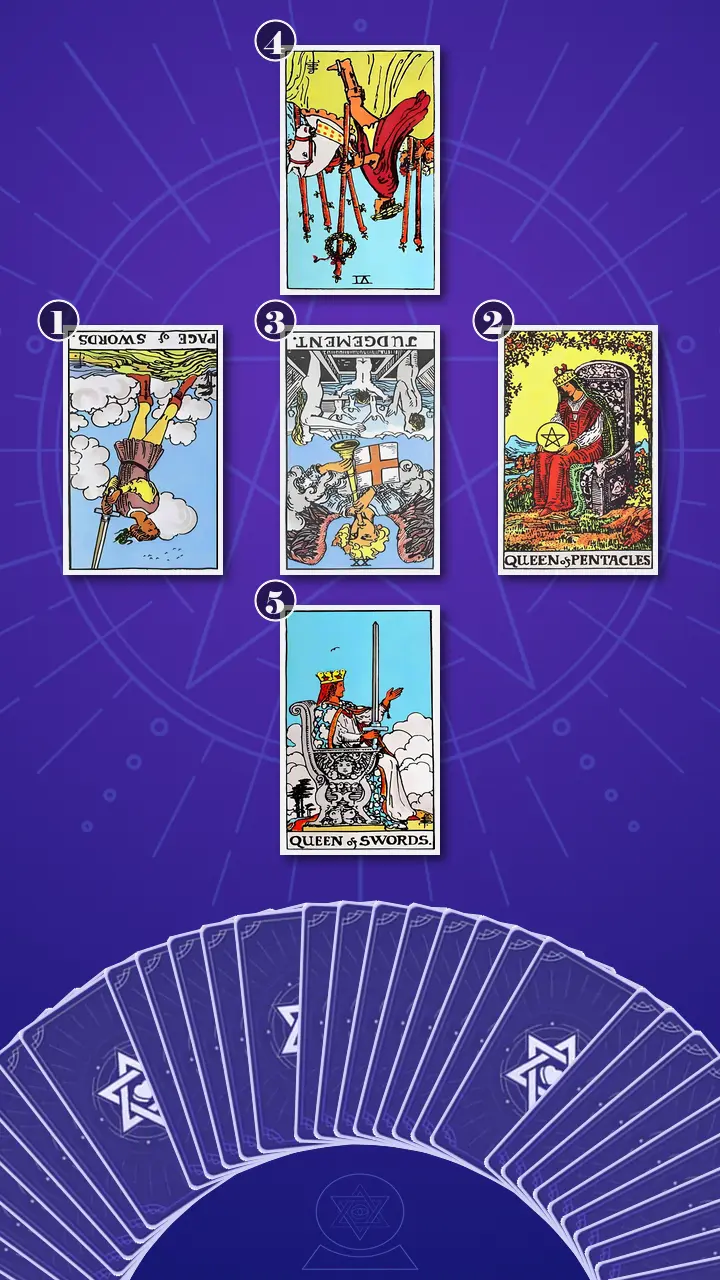
I showed her the cross as I laid it down. The card on the left would show her immediate self-state when the text lands. The card on the right would show her mother's likely care style. The center card would reveal the meaning-making filter that turns help into judgment. Above it would sit the deeper wound underneath the reaction. Below it, the clearest next response. Read together, the layout looked like a compass: two people on the horizontal line, inner truth on the vertical one.
Reading the Cross: Where the Thread Turns Into a Courtroom
The First Flinch
The first card I turned was the one showing Maya's immediate self-state and observable reaction when the job link lands. It was the Page of Swords, reversed.
I told her this was the exact energy of a mind that does not receive information neutrally because it is already braced for impact. In modern life, it looks like this: your phone buzzes in the middle of a job-search morning, you reread the wording, notice the time stamp, wonder why this role, draft two replies in Notes, and somehow twenty minutes pass before you even open the actual posting. It has the same nervous-system spike as a Slack message that says "quick question" when you are already afraid you are underperforming.
Energetically, this is Air thrown off balance. Thought is not helping you think clearly; it is threat-scanning. The raised sword on the card becomes the posture of your whole body with the phone in your hand—jaw set, ribs tight, shoulders slightly forward, ready to defend before there is a real attack to defend against.
Maya let out one short laugh that had more sting in it than amusement. "So basically," she said, "I'm doing FBI analysis on punctuation instead of reading the role." I nodded. "Yes," I said. "And that doesn't make you dramatic. It means your mind is trying to protect you by getting ahead of the pain. The trouble is, it starts treating information like a threat."
The Care Package in Link Form
The second card showed the likely care style or practical intention being perceived from the other person, without pretending that intent automatically cancels impact. It was the Queen of Pentacles, upright.
Whenever this Queen appears in a relationship reading, I pay attention to how love is being expressed through usefulness. Some people send soup, weather alerts, apartment listings, grocery coupons, or an article they think will help. Some send job links. This card felt very much like, "I found something tangible and wanted to place it in your hands." A care package in link form.
That did not mean Maya had to like the timing or the format. It did mean the likely mode behind the text was provision, not a hidden indictment. I told her, "Intent and impact are not the same thing. Neither are support and surveillance." Then I asked the softer question that often opens a door without forcing forgiveness: "What if this was clumsy care, not coded criticism?"
I watched the tension shift by a degree. Her jaw loosened. Not all the way, but enough. That is often how the Queen of Pentacles works in real readings: not as instant peace, but as the first possibility that the practical gesture may not be saying what shame insists it says.
The Loudspeaker in the Middle
The next card was the center of the spread, the place that reveals the meaning-making filter between message and meaning. It was Judgement, reversed.
This was the choke point. I told Maya that this card was not really about her mother at all; it was about the inner system that turns a neutral prompt into a verdict. The pattern sounded like this: "She sent a link" becomes "She thinks I'm not doing enough" becomes "I need to defend myself or disappear." A normal text thread becomes an invisible review panel. One small notification and suddenly your stalled applications, your current title, your whole search history feel like they are on a bright projector.
The radiator in my room knocked once against the wall just then, sharp as a gavel, and I remember thinking how perfectly the environment had joined the reading. When I see Judgement reversed, I often think of old Highland fog: a fence post can look uncannily like a person watching you from the hill. The landscape has not accused you. Visibility has changed. In this card, a phone notification becomes that fence post—ordinary, but loaded by the body before the facts catch up.
I asked her quietly, "How many times has the conversation become a courtroom before anyone else has said a single critical word?" She looked straight at the card and gave a small, pained nod. "That fast," she said. "Every time." That was the moment of deep recognition. Not because the card judged her, but because it finally named the speed of the pattern.
The Invisible Audience
The fourth card sat above the center, where the deeper wound and underlying fear live. It was the Six of Wands, reversed.
This card showed me that the pain was not only about her mother's texts. Underneath them sat a much older and more exhausting question: what will this say about me if this is where I am now? The Six of Wands reversed is what happens when healthy pride gets tangled with visibility. Instead of asking, "Do I want this role?" you start asking, "Will this sound respectable enough on a family call?" It is LinkedIn used as a scoreboard instead of a tool. It is feeling like your job search has an invisible audience even when you are alone in your apartment.
In elemental terms, this was blocked Fire. The part of the self that should move with direction and self-belief had been outsourced to applause, status, momentum, being seen as on track. No wonder every outside suggestion stung. If worth is already fragile, practical input lands on the fear of public exposure. And with so little Water in the spread, the feeling itself is not being felt cleanly; it is being translated straight into thought, defense, and performance.
Her throat moved before her words did. She looked away toward the window, then back to me. "The invisible audience part got me," she said. I answered exactly as I felt: "Of course it did. If the search already feels public inside your own mind, every text is going to sound like it comes with a microphone attached."
When the Queen of Swords Cleared the Thread
The Antidote Beneath the Cross
When I turned the final card, the room went noticeably quieter. A pale strip of afternoon light slid across the table and caught the blade in the image, and for a second the whole spread seemed to sharpen around it.
This was the card in the position that points to the key shift and the next response that supports stronger self-trust. It was the Queen of Swords, upright.
I love this card when someone has been living inside distorted Air, because she does not ask you to become less intelligent, less sensitive, or instantly more grateful. She asks you to become cleaner. In modern terms, she is the difference between treating every notification like an emergency and finally putting a filter on your inbox. She replaces, "What does this say about me?" with, "Is this useful, not useful, or a boundary moment?" That is the developmental arc in the spread: from the Page of Swords reversed, the vigilant scout turned threat detector, to the Queen of Swords upright, the adult mind that can tell fact from projection and speak without collapsing into shame.
Here I used one of the tools my clients know me for: Body Signal Interpretation, part of my Nature Empathy Technique. I have spent a lifetime watching weather on the hills, and bodies are not so different. A tight chest, a dropping stomach, a locked jaw—these are first alerts, not final truths. They tell me a wound has been activated before the mind starts testifying. The Queen of Swords does not ask Maya to ignore her body. She asks her to read it correctly. The message is this. The story is that. My choice is here.
I asked Maya to picture the exact moment again: LinkedIn open, coffee cooling beside her, her mother's text arriving before she had clicked a single role. Her body had already clenched before the information had even landed. That mattered, because the verdict was arriving faster than the facts.
The sentence that changed the room
The link is information. The verdict is the story.
This is not a courtroom sentence; it is your cue to lift the Queen's sword, cut your inner critic out of the text thread, and answer from clean truth.
She went still first. Her fingers, which had been tapping softly against her mug, froze in mid-motion. Then came that second phase I know well—the eyes unfocusing, not with distance, but with memory replaying at high speed. I could almost feel her mind pulling up every unread link, every clipped "I'll look later," every late-night draft in Notes that never got sent. When she finally spoke, relief did not come alone. It arrived with resistance. "But if that's true," she said, her voice low and a little sharp, "doesn't that mean I've been doing this to myself?"
I shook my head. "No," I told her. "It means you've been protecting a sore place with the fastest tool you had: analysis, defense, disappearance. That isn't moral failure. It's an old strategy. We are just updating it." Her shoulders dropped then, all at once, like a coat slipping off a hook. She took one long breath. Then another, steadier one. I asked her, "Now, using this new perspective, can you think of a moment last week when this insight would have changed what you felt?" She nodded before she answered. "Tuesday," she said. "I would have saved the link for later instead of acting like I needed to build a case." That was the real crossing in the reading: from shame-triggered defensiveness to self-trusting clarity and cleaner boundaries, from bracing to sorting.
From Fact / Story / Need to Cleaner Boundaries
When I stepped back from the full spread, the story was remarkably clear. On one side sat Maya's reactive, overclocked mind, already scanning for danger. On the other sat a mother likely speaking in the language of practical care. Between them, dead center, was Judgement reversed—the inner evaluator hijacking the exchange and converting a simple job link into evidence of failure. Above it sat the deeper wound: self-worth tied to looking competent, visible, and on track. Below it sat the antidote: the Queen of Swords, asking for discernment, truthful language, and respectful boundaries.
Her blind spot was not that she needed to be more grateful. It was that she had been treating the first sting in her body as proof that the story was true. In my Elemental Balance lens, the spread was all dry weather: Air everywhere, Earth trying to help, Fire blocked around recognition, and almost no Water at all. In ordinary language, that means there were plenty of thoughts and plenty of practical inputs, but very little room to simply feel the hurt without cross-examining it. That is why unsolicited career advice felt invasive so quickly. The path forward was not to accept every job link. It was to stop letting shame translate it for her.
I gave her three small steps, because actionable advice works better than grand speeches when somebody has been living with decision fatigue.
- Fact / Story / Need FilterThe next time her mother sends a role, Maya is to open a pinned note on her phone, copy the exact text message into it, and spend five minutes writing one line under three headings: Fact, Story, Need. Fact is what was literally said. Story is what her inner critic added. Need is the clean next option: reply, save, decline, or ask for space.If her chest is already tight, I asked her to use my five-minute balcony energy awakening practice first: step onto a balcony, stoop, or open window, feel the air on her face, soften her jaw, and name one fact out loud before touching the thread. A pause is not rudeness.
- Boundary-First ReplyIn one calm moment this week—not right after a trigger—she is to text her mother one honest boundary. The script I suggested was: "I know you mean well, and I appreciate that. Job links feel overwhelming unless I ask for them first. Could you check with me before sending?" If that felt too exposed, the lighter version was: "Please batch them for Fridays, and I'll review when I'm in job-search mode."Keep it to two sentences. Draft it in Notes first if that feels safer. Clear is kinder than clipped.
- Unseen Win PracticeOnce this week, she is to choose one career task nobody else will see—tailor one resume bullet, clean up portfolio file names, or research salary ranges for a single role—and do only that for fifteen minutes with her phone on Do Not Disturb.When the timer ends, she is to write one sentence that begins, "This mattered because it helped me..." not "This will make me look..." If fifteen minutes feels heavy, five minutes still counts.
These steps were small on purpose. When someone is searching for how to set boundaries with parents about job hunting, the answer is rarely a dramatic confrontation. More often, it is one cleaner response, practiced enough times that the inner courtroom begins to lose its authority.

A Week Later, the Quiet Proof of Finding Clarity
A week later, Maya sent me a screenshot. She had texted, "Please ask before sending roles, or batch them for Friday and I'll look then." Her mother replied, "Okay, love." Maya celebrated alone in a coffee shop with one solid application sent—lighter, still a little shaky, but no longer rehearsing a defense.
That is how clarity usually arrives. Not as perfect certainty. Not as a magically friction-free relationship. The five-card relationship spread had not changed her mother into a different person. It had given Maya her steering wheel back. She could now tell the difference between support and projection, between contact and condemnation, between a body alarm and the truth.
If tonight you recognize that chest-locking moment, remember this: when one small text can send your mind straight into building a defense case, you are usually not reacting to the link alone; you are reacting to the fear that other people can see you as not enough.
If the next job link did not have to become a courtroom, what would you want to do with it instead—ignore it, save it for later, or lift your own Queen's sword and answer with one honest boundary?
This story is adapted from psychological research, written so that those in a similar struggle can see their own pattern in it — and find their next step clearly.These insights are not a substitute for professional psychological, medical, legal, or financial advice.
Learn more about our Journey to Clarity.
How did this insight land for you?
🫂 This Resonates Deeply
🌀 Living This Story
✨ Now I See Clearly
🌱 Seeing New Possibilities
🧰 Useful Framework
🔮 The Confirmation I Needed
💪 Feeling Empowered
🚀 Ready for My Next Step
Author Profile
 AI
AI“As the seventh generation of a Highland healing family, I see modern anxieties as a simple, temporary disconnection from nature's rhythm. I bring 67 years of lived seasons not to instruct you, but to hold space for you. Using tarot as a mirror, I want to gently guide you out of the chaos, helping you breathe deeply and rediscover the organic, steady heartbeat of your own life.”
In this Introspection Tarot Reading :
Core Expertise
- Somatic Shadow Sensing: Identifying where chronic mental fatigue and unexpressed emotions are physically trapped within your body's architecture.
- Ecosystem Bandwidth Restoration: Using the metaphor of nature's self-cleansing cycles to diagnose and clear the 'mental static' of an overstimulated nervous system.
Service Features
- The Grounding Transmutation Ritual: A sensory, physical practice designed to literally discharge excessive mental rumination into the earth, instantly restoring bodily presence.
Also specializes in :
Explore Related Patterns:
Conditional Self-WorthMaya's pain intensifies because the job search is not only a practical task. It has become tied to whether she looks competent, visible, and on track. A role is no longer just a role; it becomes possible evidence in a larger question about whether she is doing adulthood correctly. Conditional Self-Worth appears when personal value gets attached to performance markers. In this case, career momentum, family perception, and public competence become the measuring stick. That makes a job link feel less like help and more like a score update. This pattern explains why the text lands so sharply. If You already feel that worth depends on being seen as successful, any outside suggestion can feel like exposure. The mother may be offering a practical lead, but the inner system hears a threat to status, identity, and enoughness.
Emotional ReasoningMaya's body reacts before the facts arrive. Her chest tightens, her stomach drops, and the posting has not even been opened yet. That sequence matters because the body alarm becomes the first witness in the case against the message. Emotional Reasoning turns "this feels bad" into "this must mean something bad is happening." The sensation is real, but the conclusion may be premature. In Maya's thread, the physical sting gets mistaken for proof that her mother is judging her, even though the explicit text only offers a job lead. The work is not to ignore the body. It is to read it with more precision. The tight chest can mean a wound has been activated, not that the message is a verdict. When You can separate the signal from the story, the link becomes information again instead of an emotional conviction.
Mind ReadingThe job link arrives as a short message, but Maya's mind fills in the missing script almost instantly. "She sent a link" becomes "She thinks I'm not doing enough," and then the body prepares to defend, disappear, or build a case before the role has even been opened. Mind Reading shows up when an inferred motive becomes more powerful than the actual words on the screen. The brain tries to protect You by predicting criticism early, but it starts treating its prediction as fact. In this story, that turns a small family text into a courtroom where nobody else has formally accused You of anything. The emotional charge makes the inference feel convincing, especially because the job search already touches status, independence, and adult competence. The pattern is not stupidity or drama; it is an overactive interpretation system trying to get ahead of possible pain and accidentally creating the pain in advance.
Personalization BiasMaya's first move is not to evaluate the job posting; it is to evaluate what the posting might imply about her. The message says, "Maybe this one?" but her attention moves straight to the hidden verdict: if she were doing okay, her mother would not need to send it. That is the mechanism of Personalization Bias. A practical cue gets pulled into the self-concept and treated as evidence about personal adequacy. The job link stops being information and becomes a mirror that seems to say something about whether You are competent, behind, or visibly failing. The pattern matters because the pain is not only in the text itself. It is in the speed with which the text is converted into a private accusation. Once that happens, You are no longer responding to a role; You are defending against a verdict that was generated inside the meaning-making filter.
ProjectionMaya wants help with job leads, but when the help arrives, it feels contaminated by judgment. The explicit message is small, yet the emotional meaning expands until support and surveillance start to blur. Projection is the mechanism that places an internal fear onto an external cue. Maya's fear of being seen as not enough gets assigned to her mother's text, so the job link starts carrying a criticism that the message itself has not stated. The point is not to decide that the mother is perfect or that impact does not matter. It is to notice where the inner critic enters the thread. When You can identify the projection, You get more choice: open the link, save it, decline it, or set a boundary without having to fight an accusation that may not be present.
Visibility Shame LoopMaya's job search feels public even when she is alone with her laptop and a cooling coffee. LinkedIn starts acting like a scoreboard, and her mother's text feels as if it comes with an audience attached. Visibility Shame Loop captures the way exposure and self-evaluation keep feeding each other. The more visible the career search feels, the more shame attaches to being between roles; the more shame attaches, the more every practical suggestion feels like public evidence that You are not where You should be. That loop is why the job link does not land as a neutral option. It touches the fear of being seen at an unfinished stage. The reaction is not only to the mother's message; it is to the imagined audience that seems to watch the message arrive.
Reality TestingMaya's turning point is the line, "The link is information. The verdict is the story." That sentence gives her a way to separate the literal text from the meaning her shame attaches to it. Reality Testing is the practice of checking interpretation against observable fact. The body may tighten, the mind may predict criticism, and the old story may appear quickly, but those reactions are not the same as evidence. In Maya's case, the filter moves her from automatic certainty to a cleaner question: what was actually said? This pattern directly answers why the link feels like judgment. The judgment is produced in the gap between fact and story. When You test the story instead of obeying it, the same message can become a choice point rather than a sentence.
Boundary DiscernmentMaya's clearer response does not reject help entirely. It defines the conditions under which help can actually be received: ask before sending roles, or batch them for Friday so she can look when she is in job-search mode. Boundary Discernment is the ability to separate contact from intrusion and support from pressure. It does not require making her mother wrong. It asks what kind of structure lets You stay connected without letting every job link override Your nervous system. That is why the boundary works as a psychological pattern rather than just a communication tip. Maya is learning to sort the moment before reacting to it. The link can be useful, not useful, or a boundary moment, and that distinction gives her self-trust back.
Explore Related Struggles:
Identity Verdict LockMaya does not open the job posting first. She opens the implied meaning of it, scanning the link for what it says about her before she checks whether the role fits. The text saying, "Maybe this one?" becomes the thought she both hates and believes: if I were doing okay, she would not need to send this. That is the lock: information gets converted into a verdict before it can become a choice. When you are between roles and your worth is already sitting close to the surface, a practical lead can feel like proof that someone has silently reviewed your life and found it lacking. The struggle is not whether the link is useful. It is the speed with which your inner evaluator takes custody of the thread, making you defend your competence instead of deciding what you actually want to do with the information.
Inner Tribunal LockThe text thread turns into a courtroom before anyone has said a critical word. Maya receives one job link, and the exchange rapidly becomes evidence, testimony, defense strategy, and possible withdrawal. You can see the tribunal in the speed of the sequence. The message arrives, the body tightens, the mind builds a case, and the actual role becomes almost secondary. The problem is no longer the posting; it is the imagined panel reviewing whether you are trying hard enough, moving fast enough, and looking competent enough. Inner Tribunal Lock names the moment when self-protection becomes cross-examination. Instead of letting you sort the link calmly, the inner court demands a defense, which keeps you stuck proving your innocence to a judgment that has not actually been spoken.
Support Access SplitMaya has LinkedIn open, a resume waiting in another tab, and a real need for job leads. The contradiction begins when the exact kind of help she could use arrives and her body treats it like exposure instead of support. Support becomes hard to access because receiving it seems to cost her agency. If you recognize this pattern, the issue is not that you secretly want no help at all; it is that help starts to feel like proof that someone else has taken control of your search, your timing, and the story of whether you are doing enough. The struggle sits in that split between needing input and needing to stay self-authored. Until the support has a clearer boundary around it, every useful link can arrive carrying two messages at once: here is an opportunity, and here is a silent question about your competence.
Intention-Impact SplitMaya's mother sends something tangible, the kind of practical care that says, "I found something and wanted to place it in your hands." Maya receives the same gesture through a different channel, where usefulness sounds like surveillance and timing sounds like criticism. This split matters because neither side has to be entirely wrong for the exchange to hurt. You can be looking at one message while living inside two realities: the possible intention to help and the actual impact of feeling assessed. Intention-Impact Split names the friction between what was sent and where it landed. The clarity move is not to force yourself into gratitude or make the other person the villain; it is to name the impact clearly enough that support can become usable again.
Performance-Worth FusionMaya stops asking, "Do I want this role?" and starts asking whether it would sound respectable enough on a family call. LinkedIn turns from a tool into a scoreboard, and the job search feels watched even when she is alone in her apartment. When performance and worth fuse, career movement stops being simple information about work. A role, a gap, a title, or a suggestion can start functioning as evidence of whether you are acceptable, impressive, and on track. That is why the job link lands with such force. It presses on a place where visibility already feels loaded, making practical input feel like public measurement. The way out begins when you can separate career data from personal worth long enough to ask what actually serves your next step.
Explore Related Emotions:
Capability ShameMaya does not scan the role for fit first; she scans it for what it says about her. The thought arrives before the job description does, that if she were doing okay, her mother would not need to send it. Capability Shame is the sting of having your competence feel exposed at the exact moment you already feel in-between. In this case, the job link lands on the sore place where being between roles, being visible to family, and needing practical help all get tangled with the fear that you are no longer looking capable.
Self-Audit AnxietyTwenty minutes disappear into rereading the wording, noticing the timestamp, and drafting replies in Notes before Maya even opens the actual posting. The mind is not evaluating the role; it is evaluating the self through the role. Self-Audit Anxiety names that inward swivel, where every neutral detail becomes material for a private performance review. You start searching the message for evidence of what someone thinks of you, and the useful question, 'Could this role fit me?' gets replaced by 'What does this prove about me?'
Verdict DreadMaya's phone lights up at 1:12 p.m. with 'Maybe this one?' while LinkedIn is open, a resume tab is waiting, and her latte has gone lukewarm. Before she opens the posting, her chest tightens and her stomach drops, so the link stops behaving like information and starts behaving like evidence. Verdict Dread names the moment a practical gesture gets routed through an inner review panel. You are not reacting only to the job link; you are reacting to the speed with which a small piece of help becomes a ruling on whether you are doing enough, moving fast enough, or allowed to trust yourself while you are between roles.
Defensive LonelinessAfter the body sting comes irritation, guilt, and a lonely sadness that makes Maya want to answer defensively or not at all. The person sending the link is trying to connect through usefulness, but the format makes contact feel like exposure. Defensive Loneliness is the ache of wanting support while preparing to protect yourself from it. You end up alone inside the reaction, drafting explanations, delaying replies, or building a case, because accepting the help as help would require a softer place than the moment seems to give you.
Cautious Self-TrustA week later, Maya texts, 'Please ask before sending roles, or batch them for Friday and I'll look then,' and her mother replies, 'Okay, love.' She celebrates alone in a coffee shop with one solid application sent, still a little shaky, but no longer rehearsing a defense. Cautious Self-Trust is not a sudden personality change; it is the small proof that you can sort contact from condemnation and choose a cleaner response. You get your steering wheel back by making one precise boundary, then letting the next action be useful instead of performative.
Visibility PressureUnder the job link sits the question Maya can barely separate from the posting: what will this say about me if this is where I am now? The search stops being only a private task and starts feeling like LinkedIn, family calls, current title, and stalled applications are all watching at once. Visibility Pressure names the weight of feeling observed even when you are alone in your apartment. You are not just deciding whether to click a role; you are carrying the imagined audience that measures whether you look respectable, on track, and still impressive enough to be left alone.
Clarity ReliefThe line that changes the room is simple: the link is information, and the verdict is the story. Maya's shoulders drop because the body alarm finally has somewhere to go besides cross-examination. Clarity Relief is the easing that comes when the inner courtroom loses some authority. You can still feel the first sting, but it no longer has to be treated as final truth; the text can be sorted as useful, not useful, or a boundary moment.
Hypervigilant AnxietyThe first response is physical: thumb hovering, chest tight, stomach dropping, jaw set, shoulders slightly forward. Her body is already braced before the link has supplied any facts to interpret. Hypervigilant Anxiety is the keyed-up feeling of trying to get ahead of pain by scanning everything too fast. You are not being dramatic; your system is treating information like it might become an attack, so punctuation, timing, and tone start to feel like clues that must be solved immediately.
Explore Related Contexts:
External Scorecard PressureMaya does not open the posting and ask whether the role fits; she first asks what the link says about her. The story repeatedly places her job search under an invisible audience, with LinkedIn becoming a scoreboard and family calls becoming imagined status checks. That turns ordinary career movement into a public performance metric. You are not only looking for work; You are trying to avoid being read as behind, unproductive, or not respectable enough while the search is still unresolved. The judged feeling comes from that external scorecard pressing into a private process. A job link becomes painful because it seems to update the scoreboard before You have had a chance to define progress on your own terms.
Job Search LimboMaya is 27, between roles in Toronto, with LinkedIn open, a resume waiting, and applications still unresolved. The story does not place her in a stable role or a completed transition; it places her inside the in-between stage where every signal can feel louder than it is. That limbo matters because job-search information has no neutral floor to land on. When the next role is not secured yet, even a helpful lead can be absorbed into the broader uncertainty of timing, competence, money, and direction. You are dealing with a stage where action is happening but the outcome is not visible yet. The mother’s link becomes charged because it arrives inside a suspended career chapter, where outside input can feel like a verdict on how long the transition is taking.