The Prestige-Passion False Binary: Four Values, One 30-Day Audio Test

The 11:40 p.m. Prestige-Passion False Binary
If you are a 28-year-old Toronto professional who keeps a respected tech employer's careers page open beside unfinished creative ideas, one more LinkedIn promotion can turn career pivot anxiety into a late-night spreadsheet.
At 5:55 on a Thursday afternoon, Maya (name changed for privacy) sat across from me at a quiet table in a downtown Toronto cafe and showed me a screenshot from 11:40 p.m. the previous Tuesday. In it, a recognizable technology company's careers page occupied one half of her laptop. On the other sat a folder of unfinished audio-story outlines, voice memos, and microphone research.
She described the laptop fan humming into her apartment, the phone screen warming her palm, and the blue-white light sharpening the edges of a spreadsheet that already had columns for salary, title, employer reputation, meaning, and future options. She had just checked a former classmate's promotion post and added another weighting formula. Then she had closed everything without applying for the job or recording a draft.
"I know what excites me, but it doesn't sound impressive enough," she said. "If I choose the respected path, I'm afraid I'll disappear inside it. I want permission to want both."
I watched her jaw tighten on the word permission. Her shoulders rose as if they were trying to hold up two incompatible futures. What she called confusion felt less like being lost and more like trying to breathe while a dozen browser tabs pressed inward against her ribs.
She wanted meaningful work without losing financial adulthood, public credibility, or the sense that she had used her potential well. But she feared that choosing creative attention would make respect impossible, while choosing prestige would make aliveness impossible. That was the prestige-passion false binary in its most convincing form: two legitimate needs turned into rival identities.
"Wanting recognition does not make your passion less real," I told her. "Wanting passion does not make your need for stability less adult. I don't think we need to decide your entire career today. I think we need to understand why the choice has become so absolute, then find one piece of evidence the spreadsheet cannot give you."
I explained that I would not use tarot to predict whether she should stay in tech or become an audio creator. My role was to help her see the structure of the knot without judging why it had formed. Our Journey to Clarity would begin by mapping the pattern, then return the decision to the only person who could live it: Maya.

Choosing the Descent: The Shadow Spread
I invited Maya to place both feet on the floor, let one breath take its full time, and hold a single question in mind: "Why do I treat prestige and passion like I can only choose one?" I shuffled slowly, using the movement as a transition from comparison mode into sustained attention rather than as a mystical performance.
I chose a five-card layout called The Shadow Spread. For anyone wondering how tarot works in a career reading, this spread does not compare two jobs or announce a predetermined future. Through a Jungian psychological lens, I use it to examine the disowned belief beneath a conscious conflict, the protection that belief provides, the capacity available for reclamation, and the practical action that can turn insight into lived evidence.
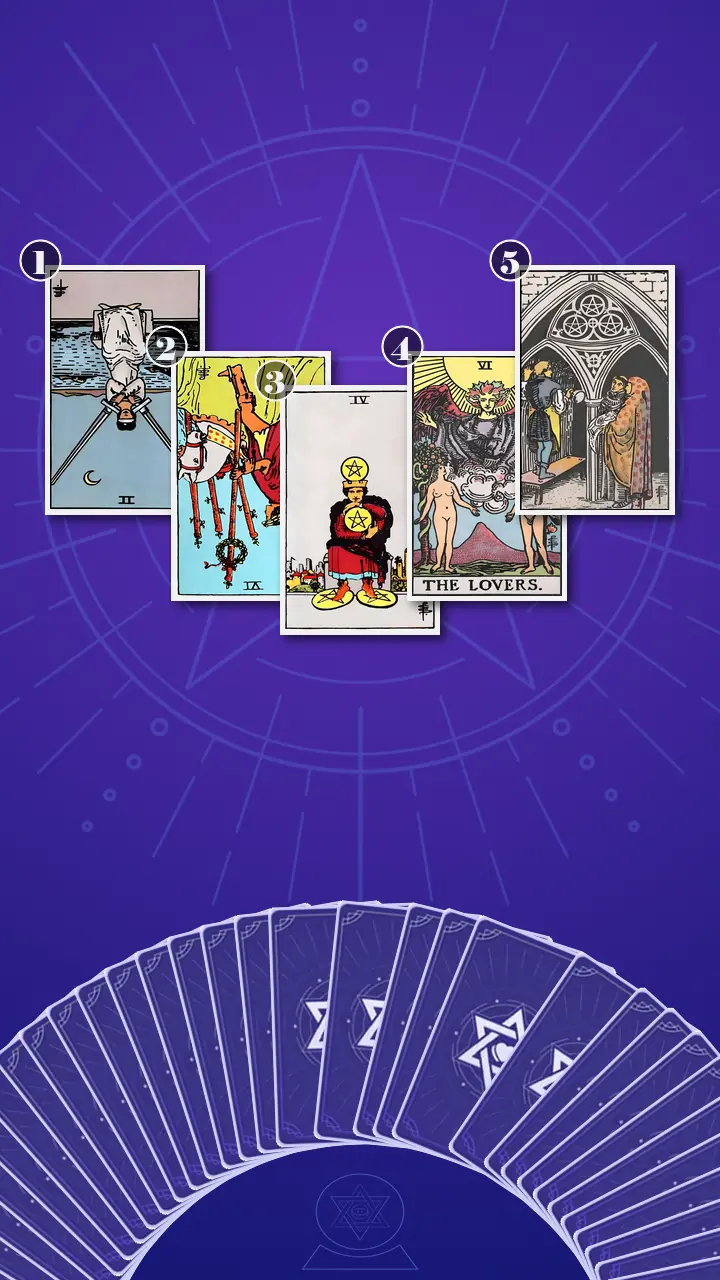
I arranged the cards in a shallow V. The first card would show Maya's visible prestige-versus-passion split. The second would reveal the worth-based fear beneath her LinkedIn comparison. The third, at the lowest point, would identify what keeping the binary protected. The fourth would offer an integrative truth, and the fifth would bring us back into daily life through a bounded 30-day experiment.
The layout looked like a descent into a Toronto underpass and an ascent on the other side. I told Maya that this mattered: we were not searching for a final life verdict. We were looking for a route she could actually walk.
Reading the Armor in the Open Tabs
Position One: The Decision That Never Leaves the Screen
"Now I am turning over the card that represents the visible prestige-versus-passion split and the comparison behaviors keeping it in place," I said.
The first card was the Two of Swords, in reversed position.
I pointed to the blindfolded figure and the two blades crossed defensively over her chest. In Maya's life, this was the respected technology careers page, salary data, LinkedIn profiles, and unfinished audio ideas all open at once. She could see every option at screen distance, but she did not allow any of them to become emotionally revealing through an application, a conversation, or a rough recording.
The reversed card showed blocked Air tipping into excess. Thought, which should help discriminate between options, had become an overloaded security system. Every new criterion briefly reduced the discomfort of choosing, but it also created another reason to postpone contact with the work itself.
"The spreadsheet isn't useless," I said. "It can compare information. It just cannot tell you how your attention behaves during an ordinary hour of audio editing, or whether the prestigious role feels more engaging after a real conversation with someone inside it. What has the spreadsheet allowed you to avoid finding out?"
Maya gave a short laugh, but there was no amusement in it. "That's so accurate it feels a bit brutal." Her fingers tightened around the warm coffee cup, then loosened one at a time.
"I hear that," I said. "The point is not to shame the protection. It has been trying to keep you from making a choice that feels exposing. We can respect that function without letting it run the whole decision."
Position Two: The Applause Hidden Inside the Question
"Now I am turning over the card that represents the worth-based fear that meaningful work may not count unless it receives recognizable status or public validation," I said.
The second card was the Six of Wands, in reversed position.
The card's rider normally enters beneath a laurel wreath while a crowd witnesses the victory. Reversed, its Fire was blocked: confidence had been outsourced to an audience that could never provide permanent security. Maya saw a former classmate's promotion, checked the title, employer, and reaction count, and only then opened her own creative notes. The unspoken question was not merely, Would audio work succeed? It was, If nobody can immediately recognize this, does it count?
I made a careful distinction. Wanting useful feedback, fair pay, and professional recognition was legitimate. The problem began when applause was asked to certify personal worth. That demand turned a LinkedIn headline into something like a verified identity badge while Maya's private creative practice remained, in her mind, an unconfirmed account.
I used one of my diagnostic lenses, Hidden Cost Deconstruction. I asked Maya to rate the emotional bills attached to each imagined path from zero to five. The prestigious role carried a disengagement bill, an overwork bill, and the possibility of disappearing inside a legible identity. The creative path carried an exposure bill, a financial uncertainty bill, and the fear of being seen as ordinary before she had become skilled.
"Your logic has been pricing salary and status," I said, "but leaving those emotional bills off the spreadsheet. An option can look efficient because its hidden costs have not been entered yet."
Maya's gaze moved away from the card and held on the rain-dark window. Her breathing paused, her eyes lost focus as if she were replaying the TTC platform and the promotion post, and then a low breath left her chest.
"I keep telling myself I envy their jobs," she said. "Maybe I envy how easily everyone understands what their jobs mean."
"That is useful information," I replied. "Envy can point to recognition, coherence, or belonging. It does not automatically mean you want the other person's daily work."
Position Three: The Coin Pressed Over the Heart
"Now I am turning over the card that represents the defensive payoff of keeping the binary intact: control, material security, and a socially legible identity without the risk of a real test," I said.
The third card was the Four of Pentacles, upright.
The figure held one pentacle tightly over the heart, balanced another over the head, and pinned two beneath the feet. I connected the image to Maya's salary, title, employer reputation, Toronto rent, student-loan payments, and calendar. Those were not trivial concerns. They were real structures supporting her adult life.
But the Earth energy had become excessive consolidation. A weekend audio pilot felt as dangerous as a resignation letter. Staying late at her current job protected income and credibility, but it also kept every evening full enough that no creative test could begin. The lack of progress then appeared to prove that the project was not viable.
"This card is not telling you to release financial security," I said. "It is asking whether you have made the security perimeter so wide that even a controlled experiment cannot enter. What does keeping the binary intact protect this week: your salary, your reputation, or the possibility that neither path has to be tested yet?"
Maya looked down at the pentacle over the figure's heart. She pressed her thumb briefly against the center of her own palm.
"If I make the audio work real, it might start asking something real from me," she said. "And then I can't keep calling it a nice idea."
As I listened, I remembered conversations from my years of traveling across cultures. Prestige changed costumes from city to city, but the underlying bargain was often the same: if an identity could be explained quickly, it felt safer to inhabit. The card reminded me that safety was not the enemy. Unexamined safety was simply expensive.
The first three images had all protected the center of the body: crossed swords over the chest, an imagined victory requiring a crowd, and a coin clutched over the heart. Maya's career optimization was also emotional armor. The next card would ask what became possible when the armor opened.
When The Lovers Turned the Duel into a Dialogue
Position Four: The Values Waiting Beneath the Labels
"Now I am turning over the card that represents the integrative truth that prestige and passion can be examined through consciously chosen values rather than treated as mutually exclusive identities," I said.
The fourth card was The Lovers, upright, the key card and bridge of the reading.
The espresso machine hissed and then stopped. In the brief quiet that followed, I pointed to the two unarmored figures facing one another beneath the angel. Unlike the crossed swords and clutched coin, nothing here prevented contact. The card's balanced energy did not remove difficulty; the mountain remained between the figures. It offered honest encounter, value alignment, and conscious choice.
At 11:40 p.m., Maya had been changing the weighting in her career spreadsheet while an unfinished audio story waited in the next tab. The laptop hummed, her phone remained warm, and nothing became more knowable because she had compared it again.
I used Fear-Driven Logic Decoupling, my way of separating an authentic desire from the subconscious fear of failure embedded in the same argument. I asked Maya to divide each label into the needs underneath it. Prestige contained competence, fair recognition, financial stability, and being taken seriously. Passion contained curiosity, contribution, creative attention, and the energy to remain present while working.
Then I asked her to open a blank Notion page. She typed two headings: What I want people to respect and What I want to keep doing when nobody is watching. Beneath those, she added four separate variables: meaning, skill growth, recognition, and material viability.
The old decision had functioned like a binary toggle marked prestige or passion. The Lovers replaced it with four adjustable sliders. No single move had to maximize all four immediately. Maya only had to identify which values mattered in this season and what kind of experiment could provide honest evidence.
You are not trapped between two career labels; choose by your values, and let The Lovers' facing figures turn prestige and passion into a conversation rather than a duel.
Maya's breath stopped first. Her fingers remained suspended above the keyboard, and her pupils widened as she stared at the four headings. Then her focus drifted past the screen, as though she were replaying every time she had asked a friend which option sounded smarter. Her mouth tightened. A faint flush reached her cheeks, and her eyes shone before she looked down.
"But doesn't that mean I've been doing all of this wrong?" she asked, sharper than before. "I've lost so much time trying to find one answer."
I let the resistance have room. Her shoulders did not release immediately. One hand closed into a fist against her thigh, opened halfway, then closed again. When I told her the old strategy had been protective rather than foolish, the fist finally softened. She exhaled with a small tremor, and both shoulders dropped. The relief was followed by a moment of blankness, almost a light-headed pause: clarity had removed the impossible verdict, but it had also returned responsibility for the next choice to her.
"Now, using this new perspective, can you recall one moment last week when this insight might have changed how you felt?" I asked.
Maya described a smaller organization whose role offered more creative ownership but carried an unimpressive title. She had rejected it from the job title alone, without speaking to anyone about the actual work.
"I thought I needed one answer," she said more slowly. "Maybe I need to name the values underneath both answers. I could have asked what I would learn there instead of deciding what the title said about me."
I told her this was the key emotional shift: not instant certainty, but movement from comparison-driven paralysis toward grounded self-trust. Prestige and passion were not two identities fighting for the same body. They were two needs asking for a more honest plan.
The Finished Piece on the Other Side
Position Five: Credibility Built Through Craft
"Now I am turning over the card that represents a bounded 30-day craft experiment, one that can gather evidence about meaning, skill, recognition, and material viability without demanding an irreversible career decision," I said.
The fifth card was the Three of Pentacles, upright.
I showed Maya the craftsperson working from a plan while two other people observed and contributed. This was balanced Earth, no longer gripping resources to prevent movement but using structure to build something. In modern terms, it was a clear brief, a deadline, one finished audio story, and a relevant feedback conversation.
The card did not ask Maya to quit her stable job, publish a dramatic career-pivot announcement, or prove that audio storytelling could replace her salary. It asked her to give herself 30 days to finish one small piece, review what the process felt like, and invite a craft-specific response from someone who understood the medium.
"Credibility can be built in public, one finished piece and one relevant conversation at a time," I said. "A three-minute story will not settle your career. It can tell you more about your attention, discipline, skill gaps, and appetite for repetition than another month of creator-income interviews."
Maya traced the edge of the card without touching it. "So the bridge isn't choosing the creative identity," she said. "It's finishing something."
"Exactly. An imperfect next step is data about a path, not a verdict on your potential."
The spread had moved from Air turned against itself, through Fire blocked by comparison, into Earth held too tightly. The Lovers changed the organizing principle from defense to values. The Three of Pentacles then returned Maya to Earth as craft, collaboration, and earned evidence.
I also noted that no Cups appeared. Feeling had remained in the distance, much like the water behind the blindfolded figure in the first card. That absence did not predict emotional emptiness. It highlighted the missing question in her decision process: What does the work feel like while I am actually doing it?
One Page, Thirty Days, No Life Verdict
I gathered the five cards into one coherent story. Maya had learned to read visible credentials as reliable markers of competence, progress, and safety. When creative work could not offer those markers immediately, the reversed Six of Wands translated uncertainty into a threat to worth. The Four of Pentacles responded by protecting salary, status, and a defensible identity. The reversed Two of Swords kept the protection running through more analysis.
The blind spot was not simply overthinking. It was treating the absence of direct evidence as proof that prestige and passion could not coexist, while maintaining habits designed to prevent direct evidence from being gathered. Her career algorithm had been trained on other people's LinkedIn outcomes. It recommended recognizable titles because it had almost no lived data from her own creative practice.
The transformation direction was precise: move from choosing a permanent identity label to running a bounded experiment. Maya could evaluate meaning, skill growth, recognition, and material viability separately, then revise her plan without interpreting an imperfect result as evidence of personal failure.
When I proposed a 45-minute recording block, Maya's mouth twisted. "But I genuinely don't have 45 minutes. I keep getting pulled into evening work, and when I'm done, my brain is fried."
"Then the first version is ten minutes," I replied. "A useful experiment has to fit the life you actually have. We are testing a path, not testing how much exhaustion you can tolerate."
- Run the 48-Hour Shadow Choice ExperimentTonight, on paper only, write: "For the next 30 days, I choose to treat one audio story as serious practice while keeping my current job." For 48 hours, note every objection the sentence triggers. Label each one as a practical constraint, a fear of failure, or a fear of how the choice would look to other people.Tip: Make no public announcement and no financial commitment. This is a paper exercise designed to reveal defense mechanisms, not force a decision. Stop if it creates more pressure than useful information.
- Build the Four-Column Evidence CheckWithin seven days, set a 20-minute timer and create four Google Sheets columns: meaning, skill growth, recognition, and material viability. Score one audio idea and one career opportunity from one to five using current evidence. Under each score, write one fact you know directly and one assumption based on titles, salaries, or imagined reactions.Tip: Stop when the timer ends, even if the sheet feels unfinished. Do not use another person's LinkedIn outcome as evidence. The scorecard is a decision aid, not a verdict on your worth.
- Complete the 30-Day Craft-and-Credibility SprintBlock one 45-minute evening this week, or use a 10-minute version if energy is low. Record and export one complete three-minute audio story with the equipment already available. Immediately note what held your attention, what skill improved, and what felt draining. Before day 30, ask one relevant peer a single craft question about the draft.Tip: Define finished as exported, not polished. Choose a helpful person who understands the craft, not the most prestigious person available. Maya retains the right to share nothing, ignore unsuitable feedback, or stop the experiment.
I reminded Maya that tarot had not selected a career for her. The cards had made her decision structure visible. She would decide which values to prioritize, which risks were workable, and whether the evidence justified another step.

A Week Later: The Quiet Proof
Eight days later, I received a message from Maya. She had used the ten-minute version, which became twenty-seven minutes once she stopped researching and began recording. She exported a rough three-minute audio story and wrote three notes about the process: editing held her attention, narration felt exposed, and finishing gave her more useful information than studying another successful creator.
She had also sent a short excerpt to a former colleague and asked one specific question about pacing. The reply did not declare her brilliant or resolve her future. It identified one strong transition and one section that needed space. That was enough to turn private excitement into the first small evidence of craft.
She slept through the night, but her first thought in the morning was still, "What if I'm wrong?" She told me she smiled, opened the exported file, and listened again.
I did not read that as a perfect transformation. I read it as the first credible movement from conditional self-worth toward grounded self-trust. Maya still cared about recognition and stability, but she had stopped requiring them to approve the experiment before it existed. The clarity came from her willingness to gather evidence, not from any power I or the cards held over her life.
When a promotion post makes your jaw lock and a creative idea makes your chest lift with embarrassment, I know how much safer it can feel to protect a respectable identity than to discover that the work you want may not be applauded yet. Noticing that protection already changes your position: you are no longer only inside the old algorithm; you are able to examine what it has been trained to recommend.
If you allowed your next step to resemble The Lovers' facing figures, a small conversation between recognition and aliveness rather than a permanent identity choice, what three-minute piece of lived evidence would you feel curious to gather this week?