Open Tabs, a Blank Doc, and One Study Question for Twenty Minutes

The 7:40 p.m. Study Spiral
If you are a final-year undergraduate in London who can understand the subject once you are inside it, but a broad learning outcome sends you into study-planning mode, you may know ambiguous-task procrastination firsthand.
At 7:40 p.m., Alex, a 22-year-old final-year student, appeared in my video window from a bookable room in their university library. Fluorescent lights humm above them. Their laptop was warm beneath their wrists, and the screen held a module page, three PDF readings, a colour-coded Notion dashboard, and one immaculate, completely blank Google Doc. I watched their fingers move through the same three-beat sequence: open, compare, reorganise.
“I can study once I know what counts as the beginning,” Alex said. “But no one says which reading comes first. If I choose the wrong one, I have wasted the only quiet hour I had. Everyone else seems to have found the hidden instructions.”
I saw their jaw tighten as another course notification appeared. The uncertainty did not look like a lack of interest. It looked like standing on a Tube platform and refusing to board until the display could show every stop, delay, and connection for the entire journey. Alex wanted to make academic progress, but the absence of a named starting point had made choosing feel more dangerous than waiting.
“I do not think we need to force motivation into this,” I told them. “You already want to learn. I think we need to understand what happens between opening the portal and touching the material. Let us draw a map through that fog, then find a first move small enough to test.”

Choosing the Switchback Map
I asked Alex to take three unhurried breaths and hold one question in mind: “Why do I keep putting off studying when no one says where to start?” I shuffled slowly while they closed the course chat. The pause was not a mystical performance. It was a practical transition, a way of giving one problem our full attention before the next notification could split it again.
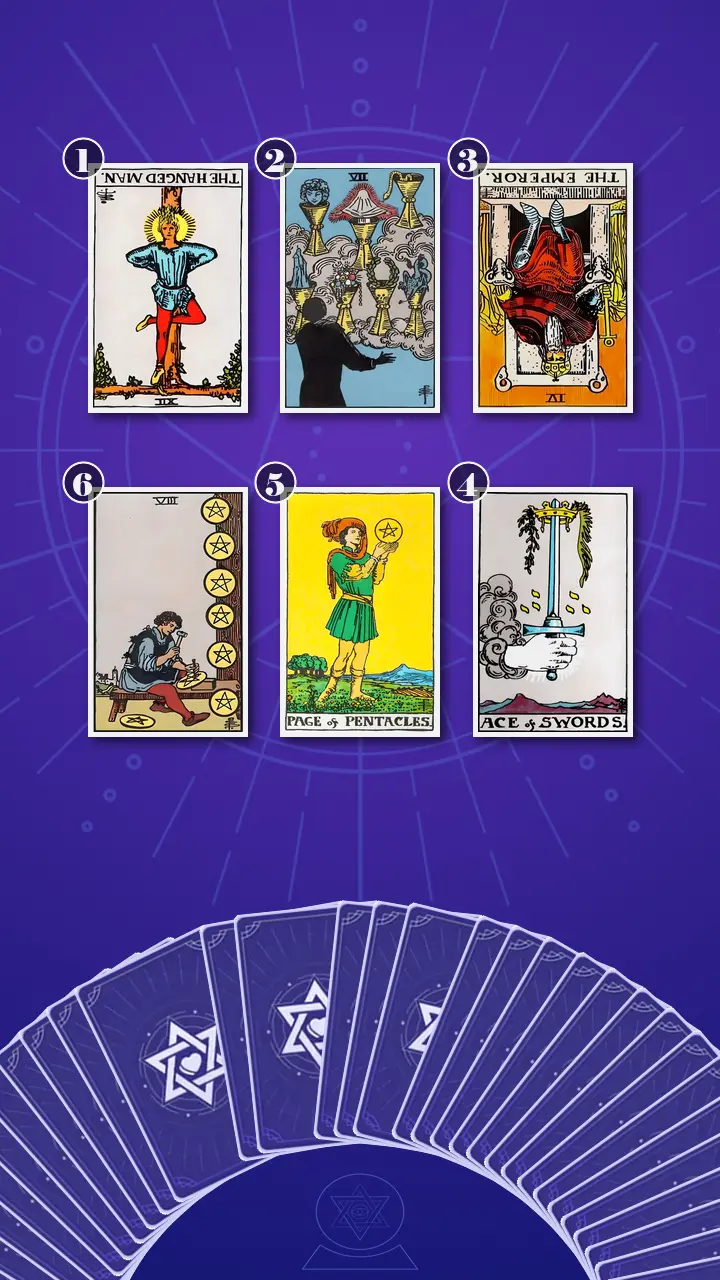
I chose the Transformation Path Grid · Context Edition, a six-card RWS tarot spread arranged like a switchback staircase. I use it when a problem is maintained by a sequence rather than a single feeling. In Alex's case, vague instructions triggered comparison; comparison led to overplanning and reassurance seeking; those behaviours created short-term relief but consumed the study block; the blank page then became apparent proof that independent study was unmanageable.
A larger Celtic Cross would have produced more information than this question needed. This grid gave me the smallest useful structure for separating the visible symptom, the environmental blockage, the belief underneath it, the leverage point, the practical experiment, and the pattern that could develop through repetition. Its shape mattered too. A switchback reaches the other side by taking the next available turn, not by revealing the entire route from the entrance.
I told Alex that the first position would show what their study paralysis looked like in observable terms. The third would reveal why an externally supplied sequence felt necessary. The fourth, our pivotal position, would identify the smallest intervention capable of restoring movement. The final pair would show how that insight could become something visible and repeatable.
Reading the Map of a Blank Page
Position One: A Mind Working While the Page Stays Empty
The card I turned over for the position showing the observable present symptom was The Hanged Man, reversed.
I pointed to the golden halo around the figure's lowered head and then to the suspended body. “There is a lot of thought here,” I said. “The mind is active, but none of that activity is travelling into the hands.”
At 7:40 p.m. in the library, Alex had three readings, the syllabus, and a blank notes document open. They were comparing resources, changing dashboard headings, and searching announcements for a sequence. No paragraph was read closely and no note was produced. The reversed Hanged Man captured a session in which preparation kept movement suspended while still feeling intellectually busy.
I read this reversal as a blockage. A useful pause had hardened into resistance because Alex was waiting for certainty that the environment could not supply. Thought was in excess, direct contact with the subject was in deficiency, and the tab-switching protected them from the risk of making an unsanctioned choice.
“The inner line sounds something like this,” I said. “I am doing a lot, so why is there still nothing done?”
Alex gave one short laugh, but there was no amusement in it. Their hand stopped above the trackpad, their eyes moved to the blank Doc, and their shoulders dropped by a fraction. “That is so accurate it feels a bit brutal,” they said.
“Then let us be precise without being cruel,” I replied. “This card is not calling you lazy. You may not be avoiding the subject; you may be avoiding an undefined first move. The difference matters because it changes what might actually help.”
I also warned against the reversal's overcorrection: scheduling a punishing multi-hour study marathon to compensate for the lost evening. That would only make the next beginning larger. A fifteen-minute contact with two pages could generate more usable information than another ambitious timetable.
Position Two: Seven Browser Tabs Floating in the Cloud
The next card occupied the position identifying the immediate blockage created by an unscaffolded environment: too many possible starting points with no trusted hierarchy. It was the Seven of Cups, upright.
The dark figure on the card faced seven cups suspended above a cloud, each offering a different promise, warning, or distraction. I asked Alex to count what was open on their screen. There was a recorded lecture, three readings, the assessment brief, a revision video, the course chat, and the notes page. The card had arrived looking remarkably like a browser window.
“This is the endless Netflix browse screen, except every tile looks academically urgent,” I said. “This reading might contain the key theory, but the recording might explain what the lecturer expects. The assessment brief might change your priorities, but the group chat might reveal what everyone else has started. Keeping every option open feels responsible, yet none becomes useful until one is tested against a specific question.”
The upright energy was an excess of possibility combined with a deficiency of usable priority. The Seven of Cups did not suggest that Alex lacked resources. It showed that abundance without a selection rule could maintain study choice paralysis just as effectively as having nothing available.
I asked, “Which three resources competed hardest for first place last time?”
Alex counted them on their fingers: the core reading, the lecture recording, and a classmate's recommended explainer video. Their breath shortened, their gaze moved between the tabs, and then their fingers curled into their palm. “Each one feels like it could be the thing I will regret not choosing,” they said.
“That makes sense,” I replied. “But comparison cannot create a reliable hierarchy while every option remains hypothetical. A plan can look like progress while keeping the page blank. At some point, one cup has to come down from the cloud and become an object you can examine.”
Position Three: The Timetable That Needed Permission
The third position revealed the root mechanism beneath the procrastination: treating an externally supplied sequence as a prerequisite for legitimate action, then trying to replace the missing sequence with total control. The card was The Emperor, reversed.
I showed Alex the massive stone throne, the armour beneath the robes, and the barren mountains behind it. Upright, the Emperor can provide dependable boundaries. Reversed, that structure may be absent, located entirely outside the self, or rebuilt so rigidly that it becomes unusable.
In Alex's life, the module offered broad learning outcomes but no recommended order. They waited for a lecturer or classmate to identify the legitimate first reading. When that guidance did not arrive, they constructed a minute-by-minute Notion timetable. One late train, one difficult paragraph, or one tired evening could then break the plan and send them back into redesign mode.
I read the energy as a blockage compounded by excess control. The missing external structure was real, but Alex's protective response treated a complete roadmap as the only acceptable substitute. The plan was being asked to eliminate uncertainty rather than support one encounter with the material.
As I looked at the reversed stone throne, I thought of the hundreds of conversations I have held over coffee during the past twenty years. I have watched people quietly build an entire institution inside a planner because one simple decision felt too exposed. Yet a table does not need the floor plan of the whole building to hold one cup securely. Study structure can be light enough to serve the next action.
“So the line underneath the planning may be: if nobody has authorised a first step, choosing one myself feels reckless,” I said.
Alex's jaw locked. Their eyes lost focus as if they were replaying several evenings at once, and their thumb pressed against the side of their mug. Then they released a long breath and lowered the mug to the desk. “I keep asking the group chat because I want someone else's answer to make my choice legitimate,” they said. “And when nobody replies, I make a timetable so detailed that it feels official.”
“The course could be scaffolded more clearly,” I told them. “Self-direction does not mean pretending poor guidance is fine or never asking for support. It means recognising that you can request clarification and still create a temporary starting rule when waiting would consume the whole session. Your rule does not have to impersonate the lecturer. It only has to help you test one thing.”
When the Ace Cut One Door into the Cloud
Position Four: A Question Sharp Enough to Begin
The fourth position held the smallest leverage point capable of interrupting the cycle: defining one provisional question or selection criterion before choosing a study resource. I turned over the Ace of Swords, upright.
For a moment, the room on Alex's side went unusually still. A library announcement ended, the fluorescent hum returned, and a notification faded from their screen. On the card, one hand raised a single sword through a crown above distant mountains. The landscape remained difficult, but the blade gave the eye one clean line to follow.
The spread had moved from the diffuse water of the Seven of Cups into concentrated air. I did not read the Ace as an excess of certainty. I read it as balanced, sufficient clarity: one distinction sharp enough to support action while the larger route remained unresolved.
Its modern translation was immediate. Before opening another tab, Alex could type one question at the top of the blank page: “What is the central argument of this week's topic?” They could then choose the source most directly connected to that question and give it twenty minutes. The question would not certify the whole plan. It would create a reason for opening one source.
At 7:40 p.m. in the library, Alex had the course portal, three readings, and a blank document open. Forty minutes later, their dashboard looked cleaner, their jaw felt tighter, and there was still nothing they could point to as learned.
This was where I brought in a tool I call Syllabus Deconstruction. I use it to strip the emotional weight from a massive, ambiguous workload and reduce it to a mechanical sequence that does not require inspiration: one question, one source, one visible output. The whole module did not need to fit inside the next block. Alex only needed a testable question that could turn an unordered reading list into a temporary filter.
A starting point does not have to be correct to be useful; it only has to produce enough evidence to help you choose the next one.
You are not waiting for a perfect hidden syllabus; choose one clear question and use the Ace's raised sword to cut a workable entry point from the cloud of options.
Alex's breath stopped for a beat. Their right hand, which had been rubbing the trackpad, froze with two fingers suspended above it. Their gaze slipped past the card and went unfocused, as though the previous week's blank evenings were replaying behind their eyes. Then their mouth tightened.
“But does that mean I was just doing it wrong all this time?” they asked. Anger sharpened the last word before their voice dropped. “I lost so many hours trying to be responsible.”
I let the anger have room. Clarity can hurt when it reveals the cost of a strategy that once felt protective. “No,” I said. “It means your planning was trying to protect limited time from a bad choice. The strategy made sense, but it stopped giving you what you needed. We are updating the strategy, not putting you on trial.”
Their fingers slowly opened. Their brow softened, their eyes brightened at the edges, and a shaky exhale left their chest. Their shoulders lowered, but the release carried a brief, unsteady silence, the kind that arrives when a familiar burden has gone and responsibility suddenly feels more visible.
I asked, “Now, with this new perspective, think back to last week. Was there a moment when this insight might have made you feel different?”
Alex looked at the core reading already open behind our call. “Tuesday,” they said. “I had twenty minutes before the flat got noisy. I thought twenty minutes was useless because I could not work out what deserved the whole evening. But I could have asked one question and tested two pages.”
“Exactly,” I said. “The first step is a probe, not a verdict. Use one question as a filter, not a full syllabus as permission.”
I named the emotional shift plainly. This was not a leap from uncertainty to perfect confidence. It was one movement away from external-permission seeking and towards provisional, self-authored direction. Alex did not need to trust every future decision. They needed enough trust to run one bounded experiment and review what actually happened.
Bringing the Question Down to Earth
Position Five: One Source, One Visible Output
The fifth position translated the Ace's turning point into a bounded study action that could create direct contact with the material. I turned over the Page of Pentacles, upright.
The Page held one pentacle at eye level while the wider landscape remained present but secondary. I read this as balanced earth energy: attention grounded in one tangible object rather than scattered across every possible task. The card did not ask Alex to prove expertise. It invited them to behave like an apprentice who learns by handling something real.
In practical terms, Alex could select one assigned reading and decide in advance that the block would produce five margin notes, one solved practice question, or a four-sentence explanation of one concept. The output might be small or incomplete. It would still count because it created contact with the subject and left evidence that could be inspected.
“This is small, but it is real and it can teach me something,” I said, giving voice to the Page's quieter logic. “You do not have to monitor the entire workload while making five annotations. For twenty minutes, one object can sit at the centre of the screen.”
Alex's shoulders eased. They closed two PDFs without being prompted, watched the tabs disappear, and gave a tentative smile when only the core reading remained. “Five notes feels almost suspiciously small,” they said.
“That suspicion is the old measurement system,” I replied. “It measures progress by how much of the whole route you control. The Page measures whether you touched the material and made something observable. Which output feels most usable tonight?”
“Four sentences explaining the central argument,” Alex said. This time, the decision arrived without a search through the group chat.
Position Six: Letting Practice Build the Structure
The final position depicted the integrated direction available through repetition: a self-directed study rhythm in which completed actions generate enough information to choose subsequent steps. The card was the Eight of Pentacles, upright.
I drew Alex's attention to the craftsperson working on one pentacle while completed pieces remained displayed beside the bench. The card's upright earth energy showed balance through focused repetition. One object received attention; earlier pieces stayed visible; the next piece did not have to be imagined from nothing.
In Alex's life, that could look like a folder gradually filling with dated one-page summaries, annotated extracts, and completed practice questions. Each short block could end with three lines: what became clearer, what remained confusing, and what might be useful to test next. The last completed action would give the following session a starting point grounded in evidence rather than another search for hidden instructions.
I was careful not to present the Eight as a prediction of grades or perfect discipline. It offered a model of practice, not a guaranteed outcome. A missed block would not erase the others. A source that turned out to be unhelpful could still produce useful evidence. Stopping after the timer could be part of competent self-direction rather than proof of failure.
Alex looked from the Hanged Man's hidden hands to the working hands on the Eight. Their knee stopped bouncing, their eyes returned to the cards, and a modest relief settled across their face. “I still cannot see the entire route,” they said, “but the last piece could tell me what to try next.”
“That is the integrated pattern,” I said. “Let evidence from twenty minutes design the next twenty.”
A Route Built from One Question at a Time
When I read the spread as one story, the logic was clean. The Hanged Man reversed showed effort suspended inside preparation. The Seven of Cups revealed the immediate cause: unranked resources competing for attention. The Emperor reversed exposed the root: a belief that structure had to arrive from authority or be rebuilt in complete, rigid form before action could be legitimate. The Ace of Swords replaced the demand for a whole roadmap with one local criterion. The Page of Pentacles turned that criterion into one visible learning object, and the Eight of Pentacles showed structure emerging from repeated contact with the work.
I used the image of carrying one thread through a maze. Alex had been waiting at the entrance for an aerial map, but the spread suggested a more workable form of navigation. The question was the thread. Each annotation, explanation, or attempted problem became a marker showing where they had been and what the next turn might require.
The cognitive blind spot was not simply “I need structure.” That need was reasonable. The blind spot was the assumption that structure had to be complete, externally authorised, and correct before it could support any learning. The transformation direction was smaller and more practical: create enough structure to test one action, let the material answer back, and revise from evidence.
I also noted the absence of Wands. This reading did not frame Alex's problem primarily as low enthusiasm. Their interest often returned once they were inside the subject. The missing ingredients were a usable selection criterion and a fast route from thought into physical evidence.
Before we ended, I turned the spread into three low-pressure actions. I began with my Study Environment Auditing lens because visual clutter was quietly draining Alex's limited decision-making bandwidth. The aim was not an aesthetic desk makeover. It was to remove enough competing signals for one question, one source, and one output to remain visible.
- The Desktop Reset RitualAt the university library or during a quiet window in the shared flat, set a timer for no more than fifteen minutes. Clear cups, loose papers, and unrelated browser windows. Leave only a blank document, one assigned source, and the timer visible. Do not edit the Notion dashboard or reorganise digital folders during the reset.If fifteen minutes could become another delay, use the three-minute version: clear one hand-sized space, close three tabs, and stop.
- The One-Question, One-Source TestBefore one study block this week, type one provisional question at the top of the page, such as “What is this source mainly claiming?” Choose the assigned source whose title most directly matches that question. Write one sentence explaining the selection rule, set a twenty-minute timer, and produce either five annotations, one solved problem, or a four-sentence explanation.The question does not need to sound impressive. If twenty minutes feels too loaded, test one paragraph for five minutes and make one note.
- The Learned-Confused-Next DebriefAt the end of the block, write three short lines: what became clearer, what remains confusing, and what appears useful to try next. Save the file with the date and topic. At the next block, begin with that final line before checking WhatsApp, searching Reddit, or rebuilding the timetable.Cap the experiment at three short blocks this week. If three lines feel like too much, record one possible next step. A missed block does not invalidate the evidence already created.
I told Alex that the Transformation Path Grid was not assigning homework or declaring a fixed future. It had helped us separate an unclear environment from a protective behavioural loop and identify a reversible experiment. The cards supplied a language for the pattern. Alex retained the authority to decide whether the method fit, whether to reduce it, whether to stop, and whether to ask their lecturer for clearer guidance.
“The important part is not obeying the Ace,” I said. “It is recognising that you can define a temporary starting point, test it, and change your mind without turning the first choice into a judgment on your ability to learn.”

A Week Later: Four Sentences in the Folder
A week later, I received a message from Alex with a screenshot attached. At the top of a plain Google Doc, they had typed, “What does this author think the current model fails to explain?” Beneath it were four imperfect sentences, two highlighted quotations, and a final line naming the next source they wanted to check.
“I nearly opened the group chat first,” Alex wrote. “Then I did the three-minute desk reset, chose the reading already open, and gave it twenty minutes. I did not finish it. But I finally had something in the folder that was not another plan.”
Alex also told me they slept through that night. Their first thought the next morning was, “What if I chose wrong?” They smiled at the thought, opened the dated note, and used its unanswered question to choose the next source.
Their life was not suddenly organised, and unclear module design had not disappeared. The change was quieter: uncertainty no longer had exclusive control of their hands. Curiosity had somewhere concrete to land, and grounded confidence had acquired its first piece of evidence.
I think of that as the real Journey to Clarity. Tarot did not reveal a hidden correct syllabus, and it did not make the decision for Alex. It helped us place the pattern on the table, where Alex could see it clearly enough to choose a different next move.
When your hands keep switching between tabs while the notes page stays blank, the tightest part may be the fear that choosing without permission will expose that you cannot steer your own learning. I have come to see clarity not as possession of the whole map, but as the moment the fog thins enough for you to recognise one workable line and decide whether to follow it.
If your next study block did not need to prove that you had the right map, what small question could become your Ace's clear line through the first twenty minutes?