The 12:40 a.m. Story Spiral
I met Maya, a 27-year-old account executive from East London, after she described a loop that had begun to feel embarrassingly familiar: she would leave a polished Shoreditch dinner early, then spend midnight zooming into everyone’s Instagram Stories to work out who was actually close.
At 12:40 a.m. on the Tuesday before our consultation, she had been lying under a too-warm duvet with her phone glass hot against her thumb. Traffic hissed over wet pavement outside, and the taste of cheap red wine still sat at the back of her mouth. She enlarged a photo of three friends with their arms around one another, studied who was leaning toward whom, and thought, It’s staged. They only act like this for the photo. Then she checked the Story again.
At my table, Maya’s shoulders stayed lifted as though she were still bracing beneath that duvet. Her jaw tightened when she said, “If it needs to be posted, I don’t trust it. But I hate how much I notice when they leave me out.”
I heard the contradiction clearly: she craved her circle’s closeness while calling that closeness fake. Her longing did not feel like a soft ache. It felt like an empty chair hooked behind her ribs, tugging whenever a photo frame seemed to close without her. Suspicion, resentment, and shame arrived quickly afterward, almost as if her mind were throwing coats over the chair so no one could see it.
“I’m not going to use tarot to tell you whether the group is secretly genuine or secretly deceptive,” I said. “The cards cannot verify other people’s motives. What I can do is help us map the moment where observation becomes a verdict, find what that verdict protects, and identify a safer way to gather real evidence. We’re not trying to force trust. We’re looking for clarity without asking you to surrender your standards.”

Choosing the Compass: A Five-Card Shadow Spread
I asked Maya to put both feet on the floor and take one unhurried breath while holding the consultation question in mind. I shuffled slowly, using the pause as a transition out of the group-chat spiral rather than treating it as a mystical performance.
I chose The Shadow Spread, a five-card shadow-work tarot spread for friendship suspicion, projection, and belonging. For readers wondering how tarot works in my practice, I use the cards as structured psychological mirrors. Their images give form to a pattern, but card meanings in context must still be tested against lived experience, direct communication, and observable behaviour.
The spread was especially suitable because Maya’s question was not simply, “Are my friends fake?” It was, “Why do I keep discrediting the closeness I still want?” A relationship spread could have tempted us into speculating about everyone else. The Shadow Spread kept the attention where Maya had agency: her protective persona, the longing pushed out of sight, the situations receiving her projections, the quality that could integrate both sides, and one embodied practice through which a real relationship could provide new information.
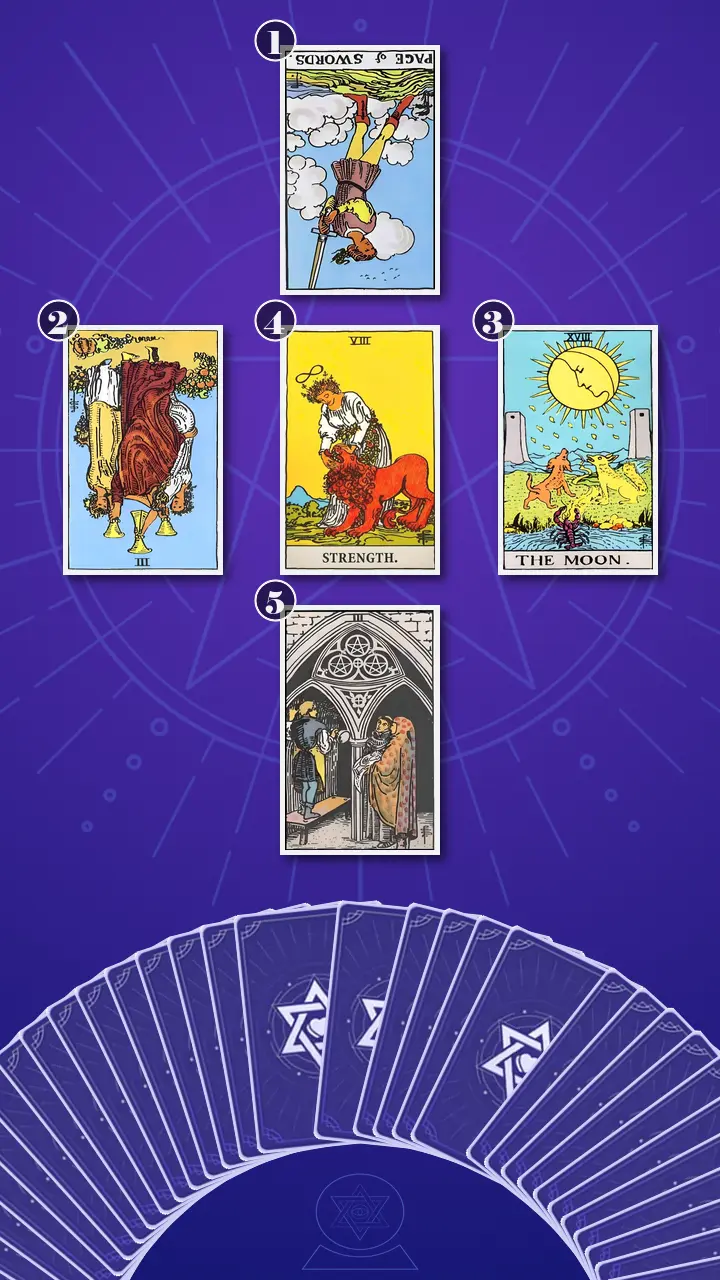
I arranged the cards as a cross. The first position would show the stance behind Maya’s social monitoring and outsider identity. The second would reveal the need she found difficult to admit. The third would identify the projection mirror where incomplete information became a complete story. At the centre, the fourth card would offer an integrating quality. The final card below it would translate that insight into a bounded next step.
The Watcher at the Edge of the Chat
Position One: When Discernment Becomes Surveillance
I began with the card representing the presenting stance behind Maya’s habit of calling the circle fake, monitoring social cues, and protecting an oppositional outsider identity. I turned over the Page of Swords, in reversed position.
The Page’s body appeared ready to move, but the head looked back while both hands kept the sword raised. I saw a precise image of Maya moving toward connection while keeping her attention fixed on possible betrayal. Curiosity had not disappeared; it had been recruited into defence.
I connected the image to a pattern Maya recognised from her commute. After a dinner, she could sit on the Overground with WhatsApp, Instagram Stories, and an old message thread open at once. She would compare timestamps, captions, heart reactions, and missing follow-up questions until uneven care became certainty that all the affection was staged. By the time she considered asking about the interaction that had actually hurt, she had already drafted a dry joke instead.
“The inner sequence sounds something like this,” I said. “I saw a brief reply; therefore they must not care. If I decide what it means first, I can’t be embarrassed by asking later.”
I described the reversed Page as an excess and misdirection of Air. Maya’s intelligence was working hard, but it was circulating inside a closed evidence system. Every new tab supplied more material without necessarily supplying more truth. The scroll was not giving her certainty; it was giving her fear more exhibits.
I used my Persona Fatigue Diagnosis to audit the energy cost of the role rather than criticise Maya’s personality. The social mask was the Unfooled Outsider: quick, funny, difficult to impress, and always ready to notice the contradiction before anyone else did. The mask had once helped her avoid looking naive. Now it was turning ordinary social contact into a detective shift she could never clock out of.
Maya gave a short laugh with no amusement in it. “That is so accurate it’s almost rude.” Her mouth curved for a second, but her jaw stayed locked and two fingers pressed against the rim of her mug.
“I’m not asking you to become less perceptive,” I said. “I’m asking whether surveillance is still producing the accuracy it promises. Discernment observes and stays open to new evidence. Surveillance starts with a conclusion and keeps searching until the screen agrees.”
Position Two: The Cup She Pretended Not to Want
I moved to the card representing Maya’s disowned longing for belonging, the pain of feeling peripheral, and her discomfort with the performative side of group intimacy. I turned over the Three of Cups, in reversed position.
Three figures raised their cups inside a closed celebratory triangle. Reversed, their shared rhythm looked disrupted. The image resembled a tightly framed birthday photo: coordinated, affectionate, and difficult to enter from outside.
I brought Maya back to a recent birthday dinner she had dismissed as performative. She had declined, partly because another expensive night out did not fit her budget or energy, and partly because sarcasm felt safer than saying she wanted something smaller. Later, she watched the photo dump from bed. She counted who stood together, who wrote the longest caption, and who failed to mention her. The legitimate need to protect her money and nervous system became tangled with a wish to be missed.
“I wouldn’t even want that kind of closeness,” she had told herself. “So why am I still looking?”
I read the reversal as blocked Water: belonging was wanted, but the feeling could not move cleanly into a request, a preference, or even an honest private admission. Some of the group’s warmth might genuinely have lacked follow-through. The card did not cancel that observation. It showed how quickly Maya condemned the entire display because wanting any part of it felt humiliating.
“Contempt can be longing in protective clothing,” I said.
Her breath caught first. Then her fingers stopped moving around the mug, and her eyes rested on the reversed cups as though she were replaying the photo dump behind them. Finally, a low exhale left her chest and her shoulders dropped by a fraction.
“I want something real,” she said, quieter now. “I just don’t want to be the only person treating it as real.”
I used my Group Archetype Decoding carefully here. I did not assume the circle had consciously assigned anyone a part. I mapped the unconscious roles that seemed to recur in its social ecosystem: the Organizer, the Public Best Friend, the Fast Confessor, and Maya’s role as the Sceptical Quality Controller. Each role performed a function, but none described a whole person. Maya’s outsider role let her challenge shallow behaviour, yet it also demanded that she distrust every warm moment or risk losing credibility with herself.
Having travelled across cultures, I have seen affection expressed publicly, privately, loudly, minimally, sincerely, conventionally, and sometimes superficially. The memory that came to me was not a universal rule about friendship but a caution: style is not proof of depth, and style is not proof of emptiness either. A polished group Story is a shop window. It can reveal a selected display, but it cannot show me the entire stockroom of each relationship.
The Moonlit Gap Between Read and Meant
Position Three: The Story Inside a Two-Word Reply
I turned to the position representing the projection mirror: the place where ambiguous, publicly displayed affection became a screen for Maya’s fear of being optional. The card was The Moon, upright.
The path between the two towers existed, but moonlight did not reveal all of it. A dog and a wolf called from opposite sides while something older emerged from the water. I told Maya that The Moon did not mean her friends were lying. It did not mean they were innocent, either. It meant the available information was partial and emotionally charged.
She immediately recognised the modern version. On the Overground after a brutal workday, she had sent one friend, “Rough day, honestly.” Twenty-five minutes later, the response arrived: “Ah babe, sorry x.” No question followed. Under the buzzing carriage lights, Maya’s shoulders rose toward her ears. By the time she reached her stop, she had built a complete explanation that the friend enjoyed performing care but had never actually cared.
I read The Moon’s energy as an excess of emotional projection around a genuine deficiency of information. The thin reply was observable. Maya’s disappointment was real. The friend’s motive remained unknown. Treating uncertainty as uncertainty did not require Maya to excuse the weak follow-through; it allowed her to choose a proportionate question or boundary instead of making one brief message carry the weight of the entire friendship.
I drew three lines on a page and read them aloud: “What I know is: the reply was brief and there was no follow-up. What I filled in is: I am optional and the previous care was fake. What I wish had happened is: she asked what went wrong and made time to hear the answer.”
Maya stared at the final line. Her grip on the mug loosened, her gaze shifted toward the rain-dark window, and then she released a breath that sounded almost surprised.
“I actually don’t know what the reply meant,” she said. “I know it felt thin. That’s not quite the same thing.”
“Exactly,” I said. “Ambiguity is not proof of innocence, but it is not proof of motive either. The Moon is the gap between a read receipt and an explanation. The gap is real; the autocomplete filling it with your oldest fear is not verified evidence.”
For Maya, this was the catalyst. She did not have to replace suspicion with forced optimism. She only had to stop presenting one possible interpretation as the only available fact.
When Strength Met the Lion
Position Four: Wanting the Warmth Without Handing Over Her Standards
The rain against the window softened as I returned to the centre of the cross. The radiator clicked off, and the room became quiet enough for me to hear Maya place her mug on the table. I turned over the card representing the quality that could let scepticism and longing coexist without either controlling her whole response: Strength, upright.
I centred the woman’s steady hands on the lion. She did not silence the animal, obey it, or force its jaws apart. I read this as balanced energy: courage expressed through sustained contact rather than conquest. The lion could hold Maya’s fierce longing, suspicion, pride, and fear of rejection. Strength did not ask her to destroy any of them. It asked her to stay present long enough to decide what each feeling knew and what it did not know.
I brought her back to 12:40 a.m.: the dinner Story enlarged beneath her thumb, the declined invitation still waiting in the chat, and the hollow pull in her stomach. She wanted the warmth, distrusted herself for wanting it, and believed she had to produce the correct verdict before anyone could make her feel foolish.
I returned to the Persona Fatigue audit. The Unfooled Outsider had been working overtime, and the cost was visible in Maya’s jaw, sleep, work attention, and inability to make a direct relational move. Strength offered a different use of power: she could let the mask step back without throwing away the discernment it had tried to protect.
Calling every bond fake does not keep your judgment pure; hold discernment and longing together, as the woman in Strength meets the lion without silencing or obeying it.
I let the sentence remain between us.
Maya’s eyebrows pulled together. A flash of anger crossed her face before anything softened. “But doesn’t that mean I’ve been wrong this whole time? Like I created the distance and now I’m supposed to fix it?”
“No,” I said. “It means a protective method has had consequences. It does not mean every concern was invented, and it does not make you responsible for other people’s poor follow-through. You are not being ordered to repair the circle. You are being offered a way to gather cleaner evidence about one relationship, if that relationship feels worth testing.”
You do not have to call your longing naive to keep your discernment. Make one bounded bid, then let reciprocity give you better evidence than surveillance ever could.
First, Maya’s breathing stopped. Her fingers hovered above the table, and her pupils widened as though the words had interrupted a familiar internal script mid-sentence. Then her gaze lost focus. I watched her mentally replay old invitations, sarcastic exits, thoughtful coffees she had discounted, and brief replies she had turned into final judgments. Her eyes shone, but she did not cry. The tension left her hands before it left her face; one palm opened, then the other, and her shoulders slowly lowered. A long breath followed, shaky at the end. For a few seconds she looked relieved. Then came the slight disorientation that often follows real clarity: the old argument was quieter, but the open space made her responsible for choosing what to do next. “I could ask,” she said. “But then I might get an answer I don’t like.”
“That is possible,” I said. “A disappointing response would be information about the bond, not proof that wanting closeness made you weak or that you are optional everywhere.”
I asked, “Now, with this new perspective, think back to last week. Was there a moment when this insight might have changed how the situation felt?”
Maya remembered typing, “Not really into the whole staged-besties thing,” after a friend invited her to brunch. She had deleted the line and sent only, “Can’t make it.” What she had wanted to say was simpler: big group dinners drained her, money was tight, and she would have liked a quiet coffee with that particular friend.
I introduced my Mask Detachment Protocol as a boundary exercise, not an order to become vulnerable. I asked Maya to imagine placing the Unfooled Outsider mask beside her rather than ripping it away. The role could still flag risk, but it would no longer write every message. Her core identity did not depend on remaining cynical, and the group’s expectations did not decide how much she had to disclose.
I gave her a seven-minute version of the exercise: choose one person who had shown at least one concrete act of care, then write three lines headed What I want, What I can ask, and What I will observe. The bid could be a quiet coffee or one honest sentence. Drafting it would count as a complete first step. Sending it was optional, and stopping was valid if the contact did not feel safe or proportionate.
I named the shift plainly. This was not a leap from mistrust to trust. It was one step from guarded contempt and group-chat surveillance to emotional ownership and evidence-based friendship discernment. Maya could say, “I want this, and I still get to watch what they do next.”
Position Five: From Raised Cups to a Working Plan
I turned over the final card, representing the bounded relational experiment through which Maya could evaluate reciprocity without deciding in advance that the circle was wholly authentic or wholly false. It was the Three of Pentacles, upright.
The card showed an artisan on a workbench while two people consulted him beside a visible plan. Unlike the reversed Three of Cups, this group was not simply being seen together. It was building something together. I read its Earth energy as balanced, practical, and incremental.
I translated the scene into Maya’s life: she could ask one friend for a short coffee, name one recent uncertainty, listen without cross-examining, and observe what both people contributed over the next two weeks. Did the friend show curiosity, remember what Maya had said, initiate later, respect a limit, or repair a missed connection? Did Maya communicate directly enough for the other person to respond to the real issue?
“Trust works more like a shared Notion board than a launch photo,” I said. “Its value appears in updates, ownership, responses, and follow-through. Affection may be the pitch, but reciprocity is the delivery history.”
I pointed to the two threes in the spread. The reversed Three of Cups showed togetherness as blocked display; the upright Three of Pentacles showed connection as shared construction. The question had moved from Do they look convincing together? to What are Maya and this particular person repeatedly willing to build?
“Do not grade the whole circle; test one bond,” I said.
Maya unlocked her phone and opened Notes. She did not send a message at the table. She simply typed the name of one friend who had once remembered a difficult client problem two weeks after Maya mentioned it. Her thumb paused, then she added: I do not need a verdict on everyone. I need evidence from this bond.
The One-Bond Reality Test
I drew the five cards into one coherent story. The Page of Swords reversed showed the protective logic Maya had carried into the present: seeing through people before they could make her feel naive. The Three of Cups reversed revealed what the persona guarded: a real wish to be included in warmth that sometimes looked more polished than dependable. The Moon showed how incomplete digital cues became projection screens. Strength supplied the missing courage to own longing without self-abandonment. The Three of Pentacles turned that courage into practical, observable participation.
The core metaphor was the warmly lit room Maya watched from outside while insisting the gathering inside was only a set. Her criticism might identify real staging, but judging the entire room before testing one relationship also protected the outsider position. The protection reduced immediate exposure while keeping Maya close enough to the window to monitor everyone inside.
I named her cognitive blind spot carefully. It was not that she had imagined every inconsistency. It was that she treated a global verdict as if it were neutral observation, while sarcasm and withdrawal helped shape the distance she later examined as evidence. If she declined before naming the real preference, other people could respond only to the refusal or joke, not to the wish hidden underneath it.
The transformation direction was therefore specific: move from issuing a verdict on the circle to testing one relationship through one small, honest bid. Maya would judge the response by respect and repeated reciprocity, not by the intensity of one conversation or the optics of one photo. A warm response would not obligate her to trust more quickly. A limited response would not diminish her worth. Either could improve the quality of her information.
I wrote three pieces of actionable advice for her:
- Use the Observed / Inferred SplitAfter one activating group message or social post this week, Maya would open Notes and spend no more than five minutes making two headings: Observed and Inferred. She would record a maximum of two exact words or actions on the left and two explanations she had assigned on the right. She would then wait ten minutes before opening another platform to search for supporting evidence.Tip: The exercise would not require Maya to dismiss her instinct or excuse poor behaviour. If writing felt heavy, a 30-second voice note would be enough.
- Run the Seven-Minute Mask Detachment ProtocolAt home, before messaging the one friend who had previously shown concrete care, Maya would write “Unfooled Outsider” on a slip of paper and place it beside her phone. For seven minutes, she would complete three lines: What I want, What I can ask, and What I will observe. Her draft could read: “I value our friendship. I felt a bit outside things after Friday, and I wanted to check in rather than make assumptions.”Tip: Drafting would count. Sending would remain optional. One feeling, one recent moment, and one modest request would be enough; no deep disclosure or immediate reply was required.
- Choose Two Reciprocity CriteriaFor the following two weeks, Maya would assess only that specific bond using two observable criteria, such as whether both people initiated and whether a missed connection received a respectful repair. After each relevant interaction, she would note what each person actually contributed: curiosity, listening, remembering, accountability, practical follow-through, or a clear limit.Tip: This was an information-gathering period, not a friendship scorecard. Repeated mockery, pressure, manipulation, or one-sided effort would remain valid reasons to step back.

A Week Later: Clarity Without a Verdict
Six days later, I received a message from Maya. She had used the seven-minute exercise, left the draft overnight, and sent it the following morning. The friend replied without dramatic reassurance: “I’m glad you said something. I thought your jokes meant you wanted distance. I was also pretty checked out after Friday, and I should have followed up.”
They met for a 30-minute coffee near London Fields. The friend remembered the client problem Maya had mentioned earlier, listened when Maya explained why big group plans often felt draining, and admitted that she did not always have the capacity for long emotional conversations. The exchange contained care, a limit, and an awkward piece of accountability. It was more useful than either a perfect apology or another polished caption.
Maya did not decide that the entire circle was authentic. She also did not need to. Over the next few days, that friend initiated one check-in and suggested a cheaper Sunday walk. Maya recorded both actions without inflating them into proof of permanent trust.
That night, she slept through. Her first thought the next morning was still, What if I read it wrong? This time, she smiled faintly, checked her two criteria, and got out of bed without opening Instagram.
I saw the result as a small but meaningful proof of the Journey to Clarity. The cards had not repaired the friendship or revealed anyone’s hidden motives. They had helped Maya separate observation from projection, name the longing beneath the mask, and choose a proportionate experiment. Maya created the change by deciding what to ask, what to protect, and which behaviour would count as evidence.
I leave readers with the same gentle recognition I offered Maya: when the wish to step toward warmth makes the jaw tighten and the mind begin building a case against it, the deepest fear may be that admitting care will make it easier for someone to confirm that the connection is optional. Noticing that fear does not require anyone to enter the room, excuse inconsistency, or abandon a boundary. It simply means the outsider mask no longer has to pretend the door never mattered.
If you did not need a verdict on the whole circle tonight, which one small, bounded knock might let one relationship show you what it can actually hold?
This story is adapted from psychological research, written so that those in a similar struggle can see their own pattern in it — and find their next step clearly.These insights are not a substitute for professional psychological, medical, legal, or financial advice.
Learn more about our Journey to Clarity.
How did this insight land for you?
🫂 This Resonates Deeply
🌀 Living This Story
✨ Now I See Clearly
🌱 Seeing New Possibilities
🧰 Useful Framework
🔮 The Confirmation I Needed
💪 Feeling Empowered
🚀 Ready for My Next Step
Author Profile
 AI
AI“Having traveled across cultures... I've learned that what we often lack isn't a simple answer, but a moment of being truly understood. I use a Jungian psychological lens to help you deconstruct your subconscious patterns—not to prove anything, but to be the gentle companion who helps you unravel your knots, free of judgment, so you can reconnect with your inner wisdom.”
In this Social Tarot Reading :
Core Expertise
- Persona Fatigue Diagnosis: Auditing the massive energy drain caused by maintaining an artificial 'social mask' in mismatched groups.
- Group Archetype Decoding: Identifying the unconscious roles you are forced to play (e.g., The Caretaker, The Scapegoat) within your social ecosystem.
Service Features
- The Mask Detachment Protocol: A psychological boundary exercise to safely separate your core identity from group expectations, recovering baseline social energy.
Also specializes in :
Explore Related Patterns:
Confirmation BiasMaya decides that the photographed closeness is staged and then checks the Story again, giving every caption, reaction, and omission another chance to support that verdict. Thoughtful coffees, remembered concerns, and invitations receive less weight because they complicate the conclusion her mind has already selected. When you gather evidence after deciding what it must prove, observation becomes confirmation bias rather than open discernment. The pattern protects you from the uncertainty of hoping for care, but it also makes the belief that closeness is fake increasingly resistant to any evidence that does not fit.
Defensive MinimizationAfter declining the birthday dinner, Maya tells herself that she would not want that kind of closeness anyway, yet she continues inspecting the photos to see who appears connected and whether anyone mentions her. Sarcasm and a bare "Can't make it" reduce the visible importance of what she privately wants: a smaller, more affordable form of contact with a particular friend. When you use defensive minimization, discrediting the desire lowers the immediate shame of admitting that it matters. The defence protects you from appearing needy or naive, but it also prevents other people from seeing the actual preference they would need in order to respond to you.
Fearful-Avoidant AttachmentMaya stays close to the circle through invitations, chats, Stories, and detailed monitoring, but she withdraws or drafts a dry joke when direct contact could reveal what she wants. Her behavior creates an approach-withdrawal rhythm in which connection remains highly important but emotionally dangerous. When you use a fearful-avoidant strategy, distance reduces the immediate risk of rejection while monitoring preserves a sense of connection and control. The conflict is not that you secretly want indiscriminate closeness; it is that the protective move against possible disappointment also blocks the bounded, reciprocal contact that could tell you whether a particular bond is trustworthy.
Reality TestingMaya separates the observable facts of the brief reply from the conclusion that the friend has never cared, then evaluates one bond through initiation, remembering, listening, repair, and respect for limits. She records the later check-in and suggested walk without turning either action into proof of permanent trust. When you practise reality testing, you do not have to dismiss intuition or excuse weak behavior. You give observations, interpretations, wishes, and repeated follow-through separate places in the evidence system, allowing discernment to become more accurate without forcing trust.
Relational HypervigilanceAt 12:40 a.m., Maya enlarges the same friendship photo, checks it again, and moves among Instagram, WhatsApp, and an old message thread to compare social cues. The behavior is more than ordinary curiosity: it turns attention into a defensive surveillance system designed to detect betrayal before a direct question can expose how much the relationship matters. When you crave closeness but associate uncertainty with the risk of looking naive, monitoring can feel safer than participation. Relational hypervigilance keeps you psychologically close enough to watch while preventing the reciprocal contact that could produce better evidence, so the search for protection also keeps the threat system active.
Self-Fulfilling ProphecyMaya sends "Can't make it" instead of explaining that the large plan drains her and that she would value a quieter coffee. Her friend later reveals that the cynical jokes looked like a genuine request for distance, showing how the protective signal helped produce the very separation Maya then examined as evidence of superficiality. When you expect exclusion and communicate detachment to avoid being rejected first, other people can respond only to the distance they can see. A self-fulfilling prophecy develops when that response is folded back into the original belief, while the unspoken wish never receives a fair relational test.
Black-and-White ThinkingOne thin reply becomes evidence that a friend has never cared, while one polished photo is made to represent the truth of the whole circle. Mixed evidence is compressed into a binary verdict in which closeness must be either fully genuine or entirely staged. When you rely on black-and-white thinking, certainty arrives faster because you do not have to remain inside the uncomfortable middle where care and inconsistency can coexist. The cost is that ordinary relational complexity becomes impossible to evaluate, leaving condemnation or idealisation as the only available positions.
Mind ReadingThe reply "Ah babe, sorry x" is brief and contains no follow-up, but Maya turns that observable limitation into a complete account of the friend's inner motive. She does the same with the group photo, treating a polished display as proof that the affection behind it exists only for the camera. When you use mind reading to close an information gap, you avoid the exposure of asking what another person meant or whether they can offer more. The interpretation may contain a valid warning about weak follow-through, but presenting an inferred motive as fact prevents you from distinguishing a limited response from an entirely false bond.
Shadow IntegrationMaya places the imagined Unfooled Outsider mask beside her phone instead of trying to destroy it, allowing the role to flag risk without writing every message. She can then acknowledge both that she wants closeness and that trust still requires evidence. When you practise shadow integration, the sceptical protector and the longing for belonging no longer have to defeat each other. Holding both parts consciously lets you use discernment as information rather than identity, making room for contact without asking you to abandon your standards.
Shadow ProjectionMaya studies who is leaning toward whom in the group photo while insisting that the visible closeness is staged. The judgment may register genuine performance, but its emotional force also grows from the belonging she wants and finds humiliating to admit. When you use shadow projection, a disowned need is easier to inspect when it appears to belong entirely to other people. Condemning their display protects you from confronting your own wish, yet it leaves you watching the connection from outside because the desire can be criticised but not directly owned or negotiated.
Uncertainty ToleranceMaya acknowledges that the reply felt thin while admitting that she does not know what it meant, and she later accepts a conversation containing care, limited capacity, and awkward accountability. She neither clears the whole circle after one coffee nor uses one limitation to condemn every bond. When you build uncertainty tolerance, ambiguity stops demanding an immediate verdict. You can protect your standards, respond to disappointing behavior, and wait for repeated evidence without using forced optimism or catastrophic certainty to escape the discomfort of not yet knowing.
Boundary DiscernmentMaya recognises that an expensive birthday dinner does not fit her budget or energy and later tells one friend that large group plans can feel draining. Instead of treating attendance or total withdrawal as her only options, she asks for a smaller form of contact and evaluates it through reciprocity and respect. When you use boundary discernment, wanting closeness does not cancel your limits, and keeping limits does not require you to discredit the connection first. You can choose the scale of contact, decide what evidence matters, and let repeated behavior determine whether further trust is proportionate.
Strategic VulnerabilityMaya chooses one friend who has already remembered a difficult client problem, drafts one honest message, leaves it overnight, and then meets for a 30-minute coffee. The bid is narrow enough to protect her agency while giving the other person a real opportunity to respond to the concern hidden beneath earlier jokes. When you use strategic vulnerability, openness becomes a bounded experiment rather than an emotional surrender. You decide what to disclose, whom to approach, and what follow-through you will observe, so a disappointing answer can inform your boundary without becoming a verdict on your worth.
Explore Related Struggles:
Belonging-Authenticity SplitAt the birthday dinner and in the 12:40 a.m. Story loop, Maya wants access to the warmth in the frame while treating the frame itself as proof that the warmth cannot be real. You can recognise the friction when closeness matters deeply but only an unpolished form of it feels safe to count as sincere; every visible display then becomes both an invitation and a reason to remain outside. That split positions belonging and personal standards as rival demands. You do not have to lower your standards or force yourself to trust the group, but you can assess public style and private follow-through separately. That distinction lets you acknowledge wanting connection without declaring the whole display either authentic or empty before individual relationships have shown what they can sustain.
Clarity-Exposure SplitOn the Overground, Maya compares timestamps, reactions, and old messages until she has a conclusion, then drafts a dry joke instead of asking about the interaction that hurt. The digital search appears to pursue clarity, but the form of clarity that could actually change the picture requires another person to answer, disappoint, clarify, or set a limit. You can want accurate information and still resist the exposure required to obtain it. A private verdict closes that opening before anyone else can define what the bond can hold. The struggle is not a choice between suspicion and blind trust; it is learning to pursue clarity in a bounded way without demanding protection from every possible answer.
Desire-Shame BindMaya declines the birthday dinner, watches the photo dump from bed, and quietly wants to know whether anyone noticed her absence. She would prefer a smaller coffee, yet sarcasm feels safer than saying so because the wish itself seems to expose how much the relationship matters. When you make desire answer for your dignity before it can become a request, longing becomes something to hide or discredit. Calling the closeness fake can then protect you from feeling foolish for wanting it, but it also prevents your real preference from meeting an observable response. Owning the wish does not make the friendship worthy of trust; it simply keeps your desire from being used as evidence against you.
Monitoring-Safety FusionAt 12:40 a.m., Maya enlarges the same photo, studies who is leaning toward whom, decides the affection is staged, and checks again. On the commute, several apps and an old message thread remain open at once, yet each added trace supplies material for the same case rather than direct knowledge of anyone's motives. When monitoring becomes the condition for feeling socially protected, stopping can seem more dangerous than the exhaustion of continuing. You remain close enough to detect exclusion but do not gain the safety that reciprocal contact, a clear limit, or a proportionate question could provide. The loop stays locked because the method promising certainty can collect endless cues without producing the kind of evidence it promises.
Outsider Identity LockMaya's Unfooled Outsider is quick to spot contradictions, leave early, and turn an uncertain interaction into a dry joke. The role protects her from appearing naive, but it also requires each warm moment to remain suspect; taking care seriously would disrupt the identity that has made distance feel principled. Once scepticism carries your credibility, changing your assessment can feel like betraying yourself rather than updating the evidence. You may keep defending the outsider position even while watching the room closely enough to reveal how much entry matters. Letting the role step back does not erase discernment; it allows your judgement to change without making cynicism the price of self-respect.
Projection-Connection SplitThe message “Ah babe, sorry x” is brief and contains no follow-up, but by the time Maya reaches her stop it has become proof that the friend enjoys performing care and has never actually cared. The thin response is observable; the complete history and motive attached to it are constructed before the friend is asked anything further. When you turn incomplete evidence into a closed relational story, the story begins directing your next move. Sarcasm and withdrawal reduce the chance of receiving new information, and the resulting distance can look like confirmation of the original verdict. The connection remains trapped inside an interpretation that protects you from uncertainty while preventing the bond from showing whether it can clarify, repair, or reciprocate.
Read Receipt Worth LockA brief reply with no question becomes more than evidence of weak follow-through for Maya; it becomes evidence that she is optional and that earlier care was staged. One digital response is made to speak for the whole friendship, then for her place across the wider circle. When responsiveness becomes fused with worth, each read receipt, delayed reply, or missing question carries an identity verdict that the interaction itself cannot support. You can still treat poor follow-through as meaningful information about a bond's present capacity. The distinction is that another person's limited response describes what they offered in that moment; it does not determine whether wanting connection was foolish or whether you are optional everywhere.
Expression-Reception GapMaya types a joke about “staged besties,” deletes it, and sends only “Can't make it,” although what she wants is a cheaper, quieter coffee with one particular friend. The message received by the other person contains distance; the wish Maya later hopes they will recognise never reaches them. When you protect a relational need by translating it into refusal or irony, other people can respond only to the protected version. Their response may still reveal limited care, but it cannot answer a request they were never given. This gap leaves you judging whether closeness is available while the form of closeness you would actually accept remains outside the interaction.
Explore Related Emotions:
Ambiguity DreadA two-word reply with no follow-up becomes, by the end of Maya's train journey, a complete explanation that the friend only performs care. On other nights, timestamps, captions, reactions, and body angles are assembled into the same kind of closed case. When you cannot verify what another person meant, a painful certainty may feel easier to hold than an unanswered question. Ambiguity Dread captures the pressure inside that gap: the urge to settle the meaning immediately, even when the available facts support disappointment but not a final verdict on the relationship.
Guarded LongingMaya leaves a polished dinner early and then lies awake enlarging photos of the closeness she has physically withdrawn from. Her jaw stays tight as observation turns into a verdict that the warmth is staged, allowing the outsider role to remain intact while her attention stays fixed on the group. When you discredit closeness before admitting that you wanted some part of it, desire can remain present without becoming openly vulnerable. Guarded Longing names that protected pull: the connection still matters, but calling it fake creates distance from the possibility of looking naive, needy, or rejectable.
Liberating UncertaintyMaya looks at the line separating what she knows from what she filled in and says, 'I know it felt thin. That's not quite the same thing.' She does not excuse the weak reply or declare the friend innocent; she simply stops treating an unverified motive as established fact. When you allow incomplete information to remain incomplete, you regain choices that a global verdict had removed. Liberating Uncertainty is the unexpected spaciousness in that position: you can ask, observe, set a limit, or step back without forcing yourself to trust and without making suspicion your only form of protection.
Longing Exposure DreadMaya finally says, 'I could ask, but then I might get an answer I don't like.' That sentence reveals why sarcasm, early exits, and bare refusals have felt safer than letting one friend know that the bond matters. When you name a longing, the other person gains an opportunity to meet it, limit it, or fail to reciprocate it. Longing Exposure Dread is the fear surrounding that moment of visibility: not only that the answer may disappoint you, but that caring openly may seem to give the answer power over your dignity.
Cautious TrustThe friend remembers Maya's difficult client problem, listens during coffee, acknowledges that she should have followed up, initiates a later check-in, and proposes a cheaper walk. She also names a real limit on her capacity, so the exchange contains neither perfect reassurance nor total availability. When you let several observable acts matter without turning them into a guarantee, trust can grow in proportion to the evidence. Cautious Trust holds warmth and discernment together: the bond receives credit for what it has repeatedly shown, while your boundaries remain available if the pattern changes.
Cautious VulnerabilityMaya chooses one friend with a concrete history of care, writes a modest message, leaves the draft overnight, and sends it the next morning. She names one recent uncertainty without disclosing everything, demanding reassurance, or promising that the response will earn immediate trust. When you make a bounded bid while preserving the right to stop, openness no longer has to equal self-abandonment. Cautious Vulnerability is the exposed but measured feeling of allowing something true to be seen while your standards, pace, and ability to revise remain fully yours.
Social Exclusion DreadMaya zooms into a photograph of three friends with their arms around one another and studies who is leaning toward whom. The frame feels closed without her, and each missing mention begins to carry more weight than the single post can reasonably hold. When you already fear being optional, public evidence of other people's closeness can land as a warning about your own place. Social Exclusion Dread is the atmosphere created by that possibility: every arrangement at the centre of the group seems capable of confirming that you belong at its edge.
Belonging ShameMaya declines a birthday dinner without naming that money is tight, large groups drain her, and she would prefer a quiet coffee with one friend. Later, she studies the photo dump from bed and condemns the display even as she counts who mentioned her and who appeared closest. When you experience the wish to be included as something humiliating to reveal, criticism can cover the wish before anyone else sees it. Belonging Shame is the sting attached to caring at all: the need is not absent, but admitting it seems capable of lowering your status in your own eyes.
Clarity ReliefMaya's grip on the mug loosens after she separates the brief reply from the motive she assigned to it, and a surprised breath leaves her chest. Later, after using the same distinction in real life, she sleeps through the night instead of reopening Instagram. When you reduce a totalising story to the facts it can actually support, the body no longer has to defend an entire worldview at once. Clarity Relief is the release that follows a smaller and cleaner conclusion: something felt thin, more information may be needed, and no universal verdict is required tonight.
Cautious Self-TrustThe morning after the coffee, Maya still thinks, 'What if I read it wrong?' She checks the two reciprocity criteria she chose, notices the friend's actual follow-through, and gets out of bed without opening Instagram. When you can revise an interpretation without treating revision as humiliation, your judgment no longer depends on being instantly or permanently correct. Cautious Self-Trust is the tentative steadiness of relying on your own process: you can notice, ask, evaluate, and change course while keeping both discernment and self-respect.
Defensive LonelinessMaya exits the dinner, withholds the quiet coffee she actually wants, and then remains attached to the group through Instagram, WhatsApp, and old message threads. She has left the room, but the room continues to occupy her commute, bed, sleep, and work attention. When you replace a direct bid with surveillance, you reduce the immediate chance of hearing an unwelcome answer while also losing access to a real response. Defensive Loneliness describes the resulting inner weather: protected from open exposure, yet stranded close enough to watch the connection you still want.
Explore Related Contexts:
Social Proof PressureAfter leaving dinner, Maya opens WhatsApp, Instagram Stories, and an old message thread together, then compares timestamps, captions, heart reactions, body positions, and missing questions. Each platform supplies another visible unit that appears capable of measuring who matters to whom, even though none contains the full history or private context of the friendships. Social proof pressure turns closeness into a public scorecard built from selected moments and engagement signals. When you are exposed to that scorecard after every gathering, the external architecture encourages you to treat visibility as evidence of relational rank, placing your sense of inclusion inside a system designed to display attention more readily than sustained care.
Care Reciprocity TestMaya chooses one friend who had remembered a difficult client problem, then observes that bond through a message, a short coffee, a later check-in, and a proposed Sunday walk. The friend's contributions are concrete: remembering, listening, acknowledging a missed follow-up, initiating contact, and adapting the next plan to Maya's budget. A care reciprocity test makes the friendship legible through repeated contribution across a defined period. You can examine whether both people initiate, remember, respect limits, and repair missed contact, giving the bond room to establish its actual capacity without requiring a permanent verdict after one conversation.
Friendship Role RenegotiationMaya has repeatedly occupied the edge of the group as its Sceptical Quality Controller, leaving early, making dry jokes, and inspecting the warmth displayed after she goes. Her message and one-to-one coffee place her in a different social position: she states a preference, asks about one interaction, and contributes information that a friend can answer directly. Friendship role renegotiation means your place in the relationship is being rebuilt through participation, limits, and observable exchange. You do not owe the entire circle immediate access or trust; you are establishing whether one bond can recognise you as a direct participant whose standards and wish for closeness are both legitimate parts of the relationship.
Performative Intimacy CircleMaya sees three friends holding one another in a polished Story, revisits the image, and later studies a birthday photo dump for captions, positioning, and omissions. The circle's intimacy is therefore encountered through coordinated public displays, while private care can look much thinner, as when a disclosure about a brutal workday receives "Ah babe, sorry x" with no follow-up question. When your social environment makes affection highly visible but its follow-through inconsistent, calling the display performative can be grounded in a real mismatch without proving that every bond is empty. The external problem is that group optics compress several different friendships into one convincing image, leaving you to assess an entire circle through a display that cannot show the private reliability of each relationship.
Unspoken Expectations GapMaya wants a quiet coffee with one particular friend, yet the group receives "Can't make it" after she deletes a sarcastic line about staged closeness. Six days later, that friend explains that Maya's jokes had looked like a request for distance, revealing that the message received by the relationship was materially different from the preference Maya hoped someone would notice. When your need for smaller plans, curiosity, or follow-up remains unspoken, other people can respond only to the refusal or humour placed in front of them. The resulting expectations gap becomes an external relationship problem: you wait for the bond to recognise a need it cannot clearly see, while its response to your visible distance appears to confirm that the closeness was never substantial.