The Mediator Who Kept Editing Themself Out
“You are the person people tag when the group chat gets complicated.” I said that when Jordan, a twenty-seven-year-old junior product designer in Toronto, appeared on my screen after their ride home. Their mouth lifted in recognition, but their jaw stayed set.
I listened as they described 8:47 p.m. on the TTC Line 1 train: fluorescent lights buzzing overhead, brakes squealing against the rails, their phone warm in their palm. A tense group chat had asked them to explain what two friends “really meant.” Jordan typed, “That felt unfair,” read three new replies, moved the message into Notes, and replaced it with, “I can see where everyone is coming from.”
“I can tell you what everyone means,” they told me, “but I cannot tell you what I mean. Why do I lose my own truth whenever my group asks me to mediate?”
I heard the central contradiction immediately. Jordan wanted to preserve connection and their own truth, yet the request to keep the peace activated a belief that the two could not survive in the same room. Their self-doubt felt like a compass placed between several magnets: the needle snapped toward every new speaker until it trembled without pointing anywhere. Their breathing had gone shallow, and after speaking for everyone else, they were left with a hollow space behind the ribs where their own judgment should have been.
“I am not going to tell you which side to choose,” I said. “I want us to see the exact moment your voice disappears, why that strategy once felt protective, and how you might keep your truth visible without turning empathy into a loyalty test. Let us draw a map through the fog.”

Six Seats Around an Unheard Truth
I asked Jordan to place both feet on the floor, take three unforced breaths, and hold one question in mind: “What happens to my voice when I am asked to mediate?” I shuffled slowly. I use this pause as a change of pace, not as a performance of mystery; it helps move attention away from the speed of a Slack thread and toward deliberate observation.
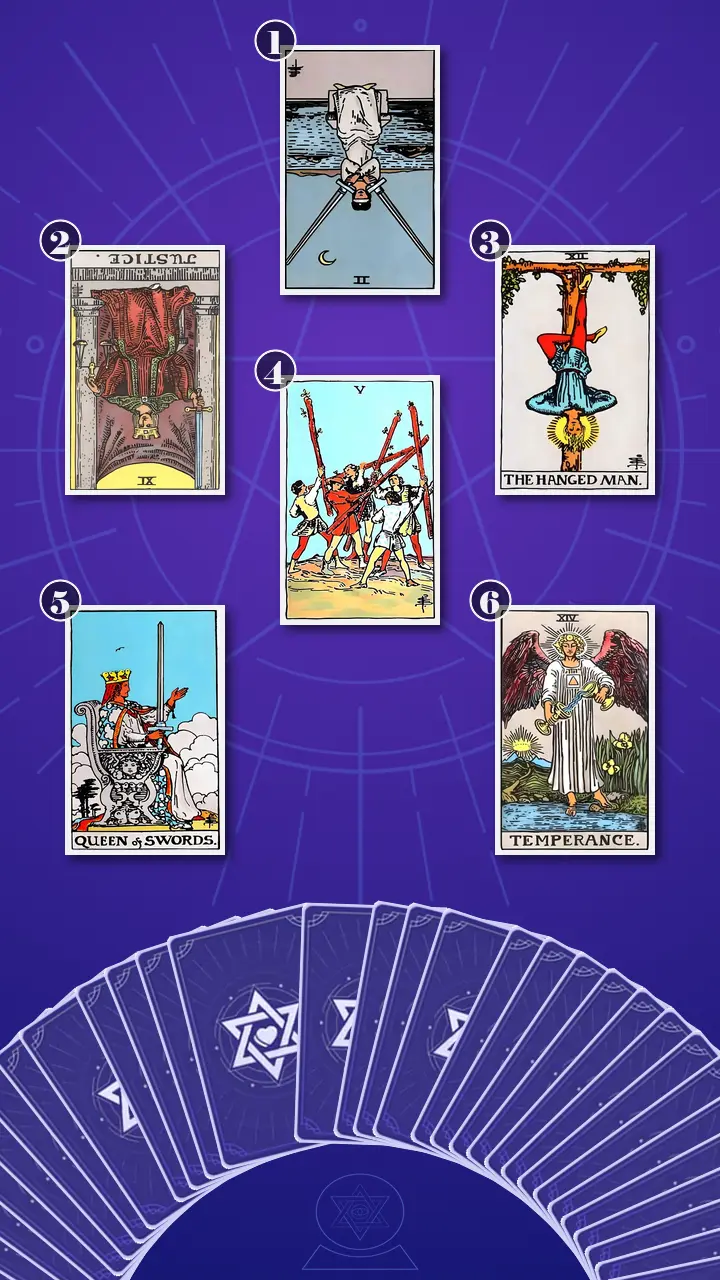
I chose the Relationship Spread · Context Edition, a six-card relationship tarot spread adapted for group mediation. I use it here because Jordan's problem was neither a solitary decision nor a prediction about whether their friendships would last. It was a relational pattern: a capable perspective-taker entered a group field, accepted a designated role, and lost access to personal judgment while trying to regulate everyone else's discomfort.
I laid the cards like a small meeting table. The first seat would show Jordan's observable stance when conflict appeared. Two side seats would reveal the group's expectations and Jordan's interaction pattern. A central card would expose the hidden fear beneath the peacekeeping. The final pair would offer a truth-preserving response and a sustainable way to integrate it. That structure is how tarot works best for me: not as a fixed verdict, but as a set of visual prompts that separates one tangled experience into parts we can examine.
The Blindfold in the Group Chat
Position 1: The Calm Message That Contained Everyone Else
“Now I am turning over the card representing your immediate stance: the behaviour of summarising every side and removing your own position,” I said. The card was the Two of Swords, reversed.
I pointed to the blindfolded figure and the swords crossed defensively over the chest. In Jordan's life, this was the group-chat sequence they had just described. They began with a clear reaction, read several competing replies, opened Notes, and drafted three versions. Each sentence that sounded partial or emotionally invested was deleted. The final message, “I can see both sides,” was acceptable to everyone but recognisable to no one, including Jordan.
I read the reversal as Blockage. Their mind was not empty; it was working at extraordinary speed. But its energy had turned inward. Instead of helping a personal judgment become speakable, thought was being used to test every sentence against imagined reactions. The private rule sounded like, “Before I answer, I need to know how everyone will receive it.” What Jordan wanted was an honest position. What they believed they should provide was a conflict-proof sentence.
“What did you believe before you edited your answer for the group?” I asked.
Jordan gave a short, bitter laugh. Their fingers tightened around their mug and then released it. “That is so accurate it is almost brutal. I keep calling this careful communication, but I am literally editing myself out.”
“The precision matters, but the blame does not belong here,” I replied. “This strategy protected connection by reducing visible friction. It makes sense that you kept using something that often calmed the room. We are simply noticing that the cost is now too high.”
Position 2: The Scales Everyone Handed to One Person
“Now I am turning over the card representing the group field and what others implicitly ask you to carry when they name you the reasonable one,” I said. The card was Justice, reversed.
I asked Jordan to picture a Tuesday product review near King Street. The researcher could defend one priority. The engineer could defend another. The product lead could ask for a decision. Jordan, meanwhile, was expected to move the competing Figma comments into neat columns, explain everyone's intent, soften the next message, recommend a compromise, and remain responsible for the emotional temperature afterward. Everyone else could be partial. Only Jordan had to perform neutrality.
I read an Excess of assigned accountability and a Deficiency of shared ownership. Justice reversed was not accusing Jordan of being unfair. It was revealing a distorted balance in which fairness had become a service they provided instead of a process the entire group practised. Fair does not mean voiceless.
This was where I used what I call Group Dynamic Rewriting. I listened for the invisible social script beneath the compliments. The script gave everyone else speaking roles, but it assigned Jordan stage management: translate the lines, absorb the tension, repair the scene, and never introduce a need of their own. Once I made that script visible, their resentment stopped looking like a personal flaw. It looked like information about unequal emotional labour.
Jordan's shoulders dropped by a fraction. Their gaze moved away from the card, as though they were replaying a meeting. “If someone thinks I am biased, I feel like I have failed at being trusted.”
“Then let us divide the responsibility accurately,” I said. “Which part is yours: listening, stating your view, or offering limited help? And which parts belong to the people who created the disagreement, hold their own positions, and choose how they respond?”
Position 3: The Perspective Review That Never Ended
“Now I am turning over the card representing your interaction pattern: the way perspective-taking changes the conversation and postpones your own answer,” I said. The card was The Hanged Man, upright.
The upside-down figure wore a calm expression, and I recognised Jordan's genuine gift. Like a product designer reviewing the same flow from every user's point of view, they could mentally switch seats until they understood each person's motives, constraints, and likely reaction. That insight was real. The problem was that the review never ended. By the time Jordan spoke, their own view had become one more stakeholder comment to evaluate rather than a position they were permitted to hold.
I read the card's perspective-changing energy as a gift that could exist in Balance, but in this pattern it had become a Blockage through indefinite suspension. A pause can create wisdom. A pause with no boundary can become self-postponement.
“How long do you usually spend inside everyone else's viewpoint before naming one observation of your own?” I asked.
Jordan's thumb stopped rubbing the edge of their phone. Their eyes lost focus for a moment, then returned to the card. “Until I can imagine nobody being hurt by it,” they said. “Which means forever, basically.”
“You do not need less empathy,” I told them. “You need an end point for the perspective review. Listening for five or ten minutes can be a choice. Remaining suspended until every possible reaction feels safe is an impossible job description.”
Position 4: The Fire Alarm of Ordinary Disagreement
“Now I am turning over the card representing the hidden driver beneath this pattern: the fear that a personal position will threaten belonging,” I said. The card was the Five of Wands, upright.
Five figures raised their wands in different directions. No single person had clearly won, and no image suggested that the group had been destroyed. I connected it to a product meeting or group chat where several voices overlapped and Jordan immediately began translating. The visible friction felt like a fire alarm, even when it might have been an ordinary exchange between people with different priorities.
I read the card's Fire as social heat that could remain in Balance: active, uncomfortable, and potentially useful. Jordan's pattern showed a Deficiency in permission to tolerate that heat. They rushed toward compromise because a few minutes of awkwardness felt like evidence that connection was already failing.
“When you imagine saying, ‘My view is different,’ what happens next in the version your body expects?” I asked.
Jordan inhaled and held it. Their fingers hovered over the dark phone screen; their eyes seemed to replay a private sequence before their breath finally left. “Someone pulls away. I find out plans happened without me. I become the difficult person instead of the useful one.”
“I cannot promise that every group will welcome a clearer boundary,” I said. “The cards cannot guarantee another person's response, and I would not ask you to speak in a situation that feels unsafe or simply not worth entering. But ordinary disagreement is not automatic proof of rejection. If belonging requires you to erase every difference, the calm was already costing you something real.”
When the Queen of Swords Recast the Reasonable One
The room on my screen seemed to grow quieter as I reached the fifth card. Rain traced a narrow line down Jordan's window, and the radiator clicked once behind them, as if the space itself had marked a cut between the old scene and the next.
Position 5: A Blade in One Hand, an Invitation in the Other
“Now I am turning over the card representing the truth-preserving response: the personal position or boundary you can state before offering mediation,” I said. The card was the Queen of Swords, upright.
Her sword was raised, but her other hand remained open. I read those gestures as simultaneous rather than contradictory. The blade separated personal judgment from emotional pressure. The open hand remained available for dialogue. In Jordan's world, the card sounded like, “I understand why you see it that way, and my view is still different.” In a design review, it meant naming a recommendation and then inviting critique. A point of view was not a final verdict.
The Queen's energy restored Balance to Air: thought became precise language instead of endless internal editing. Self-trust, discernment, compassionate directness, and a boundary could all exist without Jordan withdrawing from relationship.
I asked Jordan to picture 8:47 p.m. on the TTC again, their phone warm in their palm as they rewrote the group message for the third time. They could explain what everyone meant. Their jaw was tight. The sentence that said what they thought had quietly vanished.
What I saw next through my Typecasting Analysis was not a lack of courage. Jordan had been cast as “the reasonable one” so consistently that the group already knew which character they expected before Jordan entered the scene. I thought of an edit suite from my own work as an artist: if every difficult reaction shot is preserved but the central character's objective is removed, the film can look polished while the story becomes impossible to follow. Jordan did not need to leave the cast. They needed permission to play beyond the role.
Stop treating neutrality as the price of belonging; let the Queen of Swords' raised blade separate clear self-knowledge from the impulse to absorb every voice.
You do not have to become neutral to stay connected. Perspective-taking is a skill, not a loyalty test; your truth is one of the perspectives that belongs in the room.
I let the words sit without rescuing the silence.
Jordan's breath stopped first. Their fingers froze above the mug, and their pupils widened slightly as if several old conversations had begun replaying at once. Then their brow tightened. The recognition did not arrive as immediate relief; it came with heat. “But doesn't that mean I have been getting this wrong for years?” they asked, their voice low and edged with anger. I watched the anger give way to a shine around their eyes, then to a long exhale that seemed to come from below the ribs. Their shoulders lowered. One hand opened on the desk, but their face held the unsteady look of someone who had put down a heavy object and had not yet adjusted to the new weight of choice. “No,” I said. “It means a skilled protective role stayed in production past the scene where it helped. You are allowed to rewrite it now.” Then I invited them: “With this new perspective, think back to last week. Was there a moment when this insight could have made you feel different?”
Jordan described a product review in which they believed a feature should not ship yet. They had translated the research and engineering concerns, then said, “Either option could work.” After a pause, they tried the Queen's sentence aloud: “My current read is that we should wait. I understand the timeline pressure, and my view is still that the user risk is too high.”
“I would still have been nervous,” they said. “But I would not have been absent.”
I named the crossing I had just witnessed: a first movement from self-doubt and conflict-driven neutrality to clear self-trust while making room for other perspectives. It was not certainty, and it did not require Jordan to win. It was the moment they included themselves among the people being considered. Their inner line had changed from “How will everyone receive this?” to “I can hold your perspective without handing it the steering wheel.”
Two Cups, Three Sentences, One Limit
Position 6: Participation With a Defined Shape
“Now I am turning over the card representing self-directed integration: how you might include your truth in mediation without treating the card as a prediction of what the group will do,” I said. The card was Temperance, upright.
I showed Jordan the angel pouring between two cups, with one foot on land and one in water. The image did not blend everything into a colourless middle. Both cups remained visible. Feeling and practical limits remained present. For Jordan, the modern translation was a three-part response: “Here is what I hear, here is what I think, and here is what I can help with.”
I read Temperance as Balance made repeatable. Listening did not have to mute self-expression. Help did not have to become an unlimited, always-on service. Mediation could resemble a defined calendar block with a beginning and an end: ten minutes of listening, one summary, or one clarifying question. Jordan could participate without promising to make the whole room feel resolved.
They tested the sentence slowly. “Here is what I hear: both of you think the other dismissed you. Here is what I think: one message did cross a line. Here is what I can help with: I can listen for ten minutes, but I cannot decide how either of you should feel.”
Their jaw tightened on the middle sentence, their eyes moved briefly toward the window, and then their shoulders settled. “That feels exposed,” they said. “But it also feels honest.”
“That is enough for this reading,” I replied. “Temperance is not asking you to become a perfect mediator with better wording. It is offering proportion. You can choose how much to say, how much to help, when to pause, and whether to participate at all.”
Rewriting the Next Scene
I gathered the spread into one coherent story. Repeated praise for being calm and fair had trained Jordan to treat flexibility as an expected service. The reversed Two of Swords showed the present cost: a mind processing every voice while blocking its own conclusion. Justice reversed revealed the uneven group contract. The Hanged Man showed how a genuine strength, perspective-taking, became an indefinite delay. Five of Wands exposed the hidden assumption that friction meant belonging was in danger. The Queen of Swords and Temperance restored the missing resources: a distinct voice, an open hand, and a limit.
I compared the pattern to a Figma file in which every stakeholder comment had been accepted until the original design direction could no longer be found. Jordan's cognitive blind spot was the belief that removing their preference made the outcome neutral. It did not. Their absence changed the decision, concealed useful information, and often returned later as numbness or resentment.
The direction was specific: keep a one-sentence personal position visible before paraphrasing anyone else, then mediate from that anchor rather than treating neutrality as the entrance fee for belonging. I reminded Jordan that the sentence could be provisional, revised, kept private, or withheld when participation did not feel right. The goal was not forced disclosure. It was restoring choice.
“But sometimes I do not even get two minutes,” Jordan said. “A message appears, everyone starts replying, and I am already in translator mode.”
“Then we make the first version smaller,” I said. “Three words in Notes. Ten seconds before replying. The practice should interrupt the script, not become another standard you can fail.”
The Recasting Exercise for Truth-Preserving Mediation
- Recast the Reasonable One Before one low-stakes group chat, social plan, or team discussion this week, take up to two minutes to write one sentence beginning, “My honest position is...” Keep it visible while listening. At the next natural opening, intentionally break the old social character by stating that position before offering a compromise: “My view is X. I also hear Y and Z.” Tip: Label it provisional with “My current read is...” If a full sentence feels too exposed, write three words, keep them private, or choose not to mediate.
- Use Bounded Hear-Think-Help When a friend or colleague asks for mediation, first ask whether they want help understanding, choosing next steps, or venting. Choose one role and one limit, then use: “Here is what I hear, here is what I think, and here is what I can help with.” Offer ten minutes of listening, one summary, or one message draft, not unlimited emotional follow-up. Tip: Save the template in Notes or a phone shortcut. A valid ending is, “I can help hold part of this, but I cannot be the place where every reaction goes.” You may also decline or return later.
I told Jordan that these were experiments, not commandments. Tarot had made the social mechanics visible, but the cards would not perform the boundary or decide whether a conversation deserved their energy. The pen was back in Jordan's hand.

The Sentence That Stayed on the TTC Ride Home
A week later, I received Jordan's message. In a Tuesday review, they said their design recommendation first. An engineer disagreed; their jaw still tightened. On the TTC home, the old question, “What if I was wrong?” returned, but it no longer erased the sentence they had said.
I did not read that as a life solved or a personality transformed overnight. I read it as quiet proof that clarity can exist beside discomfort. The cards had not handed Jordan a hidden truth or predicted a perfect response from the group. They had helped Jordan notice the truth already present before the editing began, and Jordan chose to give it a line in the next scene.
I know how it can feel when everyone trusts you to name what they mean: the jaw locks, the breath thins, and your own position disappears while you keep belonging intact. If that is your scene tonight, I hope you remember that noticing where your sentence vanished means you are no longer standing at the first frame.
I will leave you with the question I left beside the Queen's raised sword and open hand: if your own view could stay at the meeting table without having to win or protect anyone from discomfort, what is the smallest sentence you might let yourself notice first?
This story is adapted from psychological research, written so that those in a similar struggle can see their own pattern in it — and find their next step clearly.These insights are not a substitute for professional psychological, medical, legal, or financial advice.
Learn more about our Journey to Clarity.
How did this insight land for you?
🫂 This Resonates Deeply
🌀 Living This Story
✨ Now I See Clearly
🌱 Seeing New Possibilities
🧰 Useful Framework
🔮 The Confirmation I Needed
💪 Feeling Empowered
🚀 Ready for My Next Step
Author Profile
 AI
AI“I’ve always felt our lives are films currently in production. As an artist, I know that when you feel stuck, it’s often because you’ve bravely stayed in a painful scene for just a little too long. I’m not here to coldly analyze you. I want to sit closely with you, look at those difficult moments with profound empathy, and gently hand you the pen so you have the courage to write your next beautiful act.”
In this Social Tarot Reading :
Core Expertise
- Typecasting Analysis: Identifying how your social circle has boxed you into a specific, restrictive character arc that no longer serves your growth.
- Group Dynamic Rewriting: Analyzing the invisible script that forces you to conform to groupthink out of a fear of isolation.
Service Features
- The Recasting Exercise: A creative behavioral challenge to intentionally break your established 'social character' at the next gathering, reclaiming your narrative freedom.
Also specializes in :
Explore Related Patterns:
Approval-Driven Decision ParalysisJordan opens Notes, drafts three versions, and removes every sentence that sounds partial or emotionally invested. The review continues until they can imagine nobody being hurt, an endpoint Jordan recognises is effectively unreachable. When you require advance certainty about everyone's reaction before permitting yourself a conclusion, reflection becomes an approval test rather than a decision process. Each additional viewpoint creates another condition to satisfy, so thought works harder while action becomes less possible. Approval-Driven Decision Paralysis captures this self-cancelling loop: intense analysis produces a socially cautious sentence but blocks the judgment the analysis was meant to clarify.
Approval-Driven Self-SilencingJordan first types, 'That felt unfair,' then moves the sentence into Notes after three new replies and replaces it with, 'I can see where everyone is coming from.' The same sequence appears at work when a clear recommendation not to ship becomes, 'Either option could work.' The defense is not an absence of thought; Jordan's mind is producing a judgment and then screening it against anticipated approval. When you make universal acceptability the entry requirement for speech, self-censorship protects connection in the short term while removing the very information that would make your participation authentic. That repeated exchange of personal truth for social safety is Approval-Driven Self-Silencing.
Compulsive PeacekeepingAcross the group chat and the product review, Jordan translates competing positions, softens the next message, and moves toward compromise before stating a personal view. A few minutes of ordinary friction are treated as a problem that requires immediate emotional repair. When you experience group calm as your assignment, peacekeeping stops being a freely chosen contribution and becomes a compulsory defense against disconnection. The room may become quieter, but the calm is purchased by suppressing useful disagreement and your own participation. Compulsive Peacekeeping names that repeated attempt to preserve belonging by making conflict disappear faster than it can be understood.
Emotional Hyper-ResponsibilityIn the product review, the researcher can defend one priority and the engineer another, while Jordan is expected to organise every comment, explain everyone's intent, soften the next message, recommend a compromise, and monitor the emotional temperature afterward. Responsibility for the disagreement remains distributed, but responsibility for making it feel resolved concentrates on one person. When you treat other people's discomfort and responses as outcomes you must personally control, empathy expands into emotional overfunctioning. Emotional Hyper-Responsibility keeps you scanning, translating, and repairing long after your fair share of participation has ended, leaving too little psychological space for your own judgment to register.
Rejection SensitivityWhen asked what follows the sentence, 'My view is different,' Jordan pictures someone pulling away, plans happening without them, and a trusted role being withdrawn. Ordinary disagreement is therefore processed less like a temporary difference and more like an early signal of exclusion. When you anticipate rejection at the first sign of social heat, your body and attention begin solving for belonging before the group has actually rejected anything. A tight jaw, shallow breath, and urgent compromise narrow the available choices, making self-erasure feel preventative rather than optional. Rejection Sensitivity is the threat filter that gives neutrality its protective urgency in this story.
Usefulness-Based Self-WorthJordan says that being seen as biased would feel like failing at being trusted, and imagines becoming 'the difficult person instead of the useful one' after expressing a different view. Repeated praise for being calm and fair has therefore become more than feedback; it defines the role Jordan expects to occupy in order to remain valued. When you tie belonging to usefulness, a personal need or partial viewpoint can feel like a threat to your social function. The mediator role then protects conditional self-worth by keeping you helpful, reasonable, and available, even when the cost is resentment or absence from your own decisions. Usefulness-Based Self-Worth explains why losing neutrality can feel larger than changing communication style: it risks changing the basis on which you believe the group trusts you.
Boundary DiscernmentJordan's three-part response, 'Here is what I hear, here is what I think, and here is what I can help with,' gives mediation a defined shape. The later product recommendation does the same thing: Jordan states a current view, acknowledges timeline pressure, and leaves other people free to disagree. When you distinguish understanding from agreement and support from total responsibility, your psychological boundary becomes observable in language and action. Boundary Discernment does not require emotional distance; it allows empathy, a personal judgment, and a practical limit to remain visible at the same time.
Explore Related Struggles:
Inner Compass OverloadJordan mentally switches seats until they understand every person's motives, constraints, and likely response. The review continues until they can imagine nobody being hurt, which Jordan acknowledges could take forever. During that suspension, their own position loses its status as a usable judgment and becomes one more stakeholder comment awaiting evaluation. Your inner compass can become overloaded when every new voice is granted immediate magnetic force. You remain highly perceptive, but the volume of external reference points prevents any one direction from stabilizing long enough to guide a sentence. The struggle lies in preserving perspective-taking as a real strength while giving it an endpoint, so your judgment can remain part of the evidence you consider.
Internal Authority CollapseJordan can explain what every person means but cannot say what they mean once mediation begins. Their first judgment is available before the replies accumulate; after cycling through each person's motives and possible reactions, it is demoted to one more comment requiring group-facing review. Outside viewpoints receive the authority to approve the sentence before Jordan can authorize it personally. Your judgment does not need to be absent for access to it to collapse. It can remain somewhere in the process while competing perspectives occupy every available decision point, leaving no stable place from which you can say, "This is my current read." The struggle is the loss of internal authorization under relational pressure, and clarity begins with noticing the moment your own evidence stops counting as evidence.
Self-Editing ExhaustionAt 8:47 p.m., Jordan moves "That felt unfair" into Notes, drafts three versions, and deletes each sentence that sounds partial or emotionally invested. Their mind is producing language at speed, yet every pass is governed by the imagined reception of the group. The final message is polished enough to reduce friction and emptied of the conclusion that initiated the writing. You may spend enormous mental energy trying to manufacture a sentence no one can object to. Because each edit removes another trace of your stake in the situation, the work cannot deliver the clarity it promises; it keeps consuming attention while moving you farther from a speakable position. The exhaustion belongs to this locked production cycle, where more precision creates less personal presence.
Self-Erasure ReliabilityJordan is repeatedly trusted to be calm, fair, and reasonable, and the group can rely on them to translate every position without introducing a need of their own. In the product review, that reliability produces "Either option could work" even though Jordan's actual assessment is that shipping would create too much user risk. The meeting receives a dependable mediator but loses the designer's relevant judgment. When being dependable requires you to leave no visible trace of yourself, reliability becomes structurally tied to disappearance. You keep the conversation functional by making your own stake harder to detect, and the group's continued reliance can reinforce the same arrangement. Recognizing this structure lets you distinguish genuine support from a role that only works when your perspective remains absent.
Truth-Connection SplitOn the Line 1 train, Jordan begins with a distinct judgment, reads three new replies, and replaces it with a sentence that contains everybody's position except their own. The edit is carrying two active commitments at once: keeping the connection intact and keeping personal truth visible. Because Jordan expects an honest difference to trigger withdrawal, the two commitments become difficult to hold in the same message. You may recognize this split when your clearest sentence starts to feel socially expensive before you have even said it. The struggle is not a lack of empathy or an inability to find your truth; it is the pressure to choose between truth and connection at the exact moment both matter. Seeing that pressure clearly gives you a point from which to include your view without requiring it to defeat anyone else's.
Utility-Belonging FusionWhen Jordan imagines stating a different view, the anticipated sequence ends with someone pulling away, plans happening without them, and Jordan becoming "the difficult person instead of the useful one." Being seen as biased also feels like failing at the role through which the group has learned to trust them. Usefulness is therefore carrying more than a practical function; it is carrying access to belonging. If your place in a group feels secured by how effectively you absorb tension, a personal limit can register as a threat to the relationship contract. You may keep providing translation and calm because the role appears to answer the deeper question of whether you will still be included. Seeing that fusion clearly restores a distinction the role has compressed: what you contribute can matter without becoming the price of your place.
Fairness-Agency SplitAt the product review, the researcher can defend one priority, the engineer another, and the product lead can request a decision. Jordan is expected to organize every position, explain each person's intent, soften the next message, recommend a compromise, and remain responsible for the temperature afterward. Everyone else is allowed a standpoint; the person performing fairness is expected to have none. When you carry fairness this way, your agency becomes the resource used to make the room feel balanced. You can work harder and harder at being reasonable while gaining less permission to affect the outcome as an equal participant. The strain sits in that unequal contract: you are accountable for the quality of the process, yet your own judgment is treated as a threat to it.
Triangulated BelongingThe group chat asks Jordan to explain what two friends "really meant," even though those friends own their words and their disagreement. The same geometry appears at work: other people defend their positions from separate seats, while Jordan is placed in the middle and asked to carry meaning, compromise, and emotional follow-up between them. You can become central to a group without being fully present as yourself when belonging is organized around this intermediary position. Each conflict confirms your usefulness as the route between other people, but it also makes leaving the middle feel socially consequential. The struggle is located in that relational placement: you are included because you bridge the disagreement, while your own standpoint has nowhere uncomplicated to stand.
Explore Related Emotions:
Cautious Self-TrustJordan states the design recommendation first, an engineer disagrees, and the old question "What if I was wrong?" returns on the ride home without erasing the sentence they already said. When you let a provisional view remain visible beside uncertainty, trust no longer depends on feeling completely sure or receiving immediate agreement. Cautious Self-Trust describes that measured inner shift. Your body may still tighten and your position may later change, but your first judgment is allowed to exist long enough to be examined rather than automatically surrendered to the loudest response.
Performative CalmJordan's jaw remains set as they replace "That felt unfair" with "I can see where everyone is coming from," and the same polished neutrality appears in product reviews. When you keep a room smooth by removing every trace of your own position, composure becomes something you stage for other people while your body continues to carry the social heat. The calm has a strained inner texture because it depends on staying unreadable. Naming Performative Calm helps you distinguish a useful communication skill from the pressure to disappear inside it, restoring your ability to decide when steadiness serves you and when it is costing you visibility.
Preference Exposure DreadJordan's jaw tightens on the sentence that names what they think, and their body anticipates a sequence in which someone withdraws and the group leaves them out. When you have learned to make neutrality the entrance fee for trusted participation, a visible preference can feel far more exposing than the words themselves would suggest. Preference Exposure Dread is the inner weather of becoming personally legible in a room that expects impartiality from you. Naming it preserves agency: you can notice the exposure, choose the amount of disclosure that is right for the situation, and stop treating the feeling as proof that your view does not belong.
Self-Betrayal AcheJordan's first response is clear, but the message that reaches the group no longer contains it; afterward, they describe a hollow space behind the ribs where their judgment should have been. When you knowingly remove your own perspective to preserve connection, the immediate social smoothness can leave a more private sense of having abandoned yourself. Self-Betrayal Ache captures the hurt after the editing is complete. It does not assign blame for a strategy that once protected connection; it identifies the cost precisely enough for you to choose a different response before your position disappears again.
Usefulness-Based Belonging FearJordan imagines that saying "My view is different" will lead someone to pull away, exclude them from plans, or recast them as difficult instead of useful. When you have been consistently welcomed as the person who translates, softens, and repairs, belonging can start to feel attached to the service you provide. Usefulness-Based Belonging Fear captures the pressure beneath the mediator role: the sense that connection may weaken if you stop being endlessly accommodating. Seeing that condition clearly allows you to ask whether the group can know you as a participant with preferences, not only as the person who makes everyone else easier to hold.
Voice Erasure DreadJordan knows "That felt unfair" before the group replies arrive, but the sentence is moved into Notes and replaced by language that contains everyone except Jordan. When you repeatedly enter mediation with a view and leave without one you can recognise, being asked to help can begin to carry the expectation of your own disappearance. Voice Erasure Dread names the inner alarm attached to that sequence. It reflects the felt prospect of losing access to your truth inside a role that rewards translation, and it makes visible the exact point where you can begin protecting your voice as one legitimate perspective in the room.
Cautious VulnerabilityJordan tries the sentence "Here is what I think" with a tightened jaw, briefly looks toward the window, and then lets the statement remain. When you make your own position visible without demanding that anyone agree, openness can feel exposed while still being deliberate and bounded. Cautious Vulnerability holds both parts of that experience: the personal risk of being known and the freedom to choose how much you reveal. The Hear-Think-Help structure gives your openness a defined shape, allowing honesty and continued dialogue to occupy the same interaction.
Hidden ResentmentJordan is expected to organise competing comments, explain everyone's intent, soften the next message, recommend a compromise, and remain responsible for the emotional temperature afterward. When everyone else is allowed to be partial while you must provide neutrality, the imbalance can produce a private protest that has nowhere acceptable to go. Hidden Resentment names that protest without turning it into a character flaw. It points to the part of you registering that too much responsibility has been assigned to one person, making the feeling useful information about limits, reciprocity, and shared ownership.
Cognitive OverwhelmThree new replies send Jordan into Notes, where one honest sentence becomes three drafts tested against every reaction they can imagine. When you process each person's motives, likely response, and level of discomfort at once, your mind can feel crowded even though it is functioning with remarkable speed. The overwhelm comes from carrying too many simultaneous social calculations, not from having no opinion. Recognising Cognitive Overwhelm lets you treat the internal volume as separate from your judgment, leaving room to notice the sentence that existed before the review cycle took over.
Explore Related Contexts:
Designated Peacekeeper BurdenJordan is the person tagged when the group chat becomes complicated, and the product team similarly expects them to translate priorities, soften messages, recommend compromises, and manage the emotional temperature afterward. Other people retain the right to be partial while Jordan is assigned responsibility for making the whole interaction workable. That uneven assignment turns mediation from a chosen contribution into a standing social role. When you are positioned as the designated peacekeeper, your own view can start to look like a disruption of the service you are expected to provide, so preserving your voice requires first separating your responsibility from the responsibilities that belong to the other participants.
Mutual Friend Neutrality TrapAt 8:47 p.m. on the TTC, Jordan types "That felt unfair," reads three replies, moves the sentence into Notes, and replaces it with "I can see where everyone is coming from." The final message protects their appearance of neutrality, but it no longer tells the two friends what Jordan actually observed. The trap is built into the mediator position: credibility appears to depend on having no visible stake of your own. When you accept that rule, every sentence must survive an impossible test against everybody's likely reaction, and a truthful position is treated as evidence of bias rather than one legitimate perspective within the conversation.
Praise as Performance ContractJordan has been praised so consistently for being calm, fair, and reasonable that the group already knows which version of them it expects when conflict starts. Jordan explicitly links appearing biased with failing at being trusted, showing how recognition has become attached to continued performance of neutrality. A compliment becomes a performance contract when it carries recurring duties that were never openly negotiated. You may still value the skill being recognised, but the contract becomes costly when access to trust seems to require endless flexibility, emotional cleanup, and the removal of any position that might complicate the role.
Friend Group TriangulationTwo friends ask Jordan to explain what each of them "really meant," placing Jordan between people who own the original disagreement. Instead of clarification remaining entirely between the speakers, messages, interpretations, and responsibility for repair are routed through a third person. That structure gives you more than one conversation to manage at once: each person's position, each person's likely reaction, and your own relationship with both. Your judgment can disappear because the group has turned you into the communication channel, while the participants who created the conflict retain greater distance from its immediate social cost.
Office Emotional LaborDuring the Tuesday product review, the researcher can defend one priority, the engineer another, and the product lead can request a decision. Jordan, a junior designer, is additionally expected to organise competing comments, explain intentions, soften the next message, recommend a compromise, and remain responsible for the meeting's emotional temperature. The workplace is distributing interpersonal maintenance unevenly alongside the formal project work. When you become the person expected to make colleagues' disagreement socially manageable, your own professional recommendation can be displaced by translation and repair duties that are useful to the team but insufficiently shared or defined.
Soft Skills TaxJordan can mentally switch seats, understand competing motives, and translate a complicated exchange with unusual precision. That genuine skill repeatedly attracts extra work: more drafts, more interpretation, more compromise-building, and more responsibility for what happens after everyone else has spoken. The tax appears when a capability becomes an unbounded expectation rather than a contribution you can choose and scope. Because the group receives the benefit of your perspective-taking, it can overlook the time, attention, and substantive voice being spent to produce that benefit; recognising the surcharge lets you decide when the skill is available and what it will no longer replace.