Deleting the Honest Text, Then Naming Hurt Without Managing Reactions

The Honest Text That Vanished at 11:40 p.m.
If you are the calm friend who can summarize everyone else’s feelings but deletes your own sentence when the group chat turns tense, you may recognize relational self-silencing before you know what to call it. Maya gave me the exact timestamp of hers: 11:40 p.m. on a Tuesday in her Toronto apartment.
As she described it, I could picture the blue phone light washing the ceiling, the radiator clicking into the silence, and the screen growing warm against her palm. A disagreement had sharpened in the group chat. Maya typed, I was actually hurt by that too. Her thumb hovered. Then she deleted the sentence and sent, I think everyone is stressed, so maybe we should pause. Before anyone replied, she opened three private chats to check on each friend separately.
“I know exactly how everyone else feels,” she told me when she sat across from my reading table, “but I cannot find a safe way to say how I feel. I keep calling it maturity when I’m actually disappearing.”
The apprehension ran through her like a drawstring pulled tight through her throat, jaw, and ribs: one visible disagreement, and her whole body cinched shut. Underneath that contraction, I heard resentment collecting, guilt for having needs at all, and a simple longing to belong without performing the role of the reasonable one.
“I want to tell them when something hurts,” she said, rubbing the side of her thumb, “but if I say it and the group falls apart, I’ll feel like I caused it. I’d rather absorb the awkwardness than watch everyone split.”
I told her I was not going to use tarot to predict whether her friends would stay, expose anyone else’s motives, or tell her that confrontation was mandatory. Our task was more grounded: to understand why honesty felt like a threat to connection, and to find one choice that did not require her to control the entire outcome.
“Let’s make a map of the fog,” I said. “Not so the cards can choose for you, but so you can see the pattern clearly enough to choose for yourself.”

Choosing the Compass: A Five-Card Relationship Spread
I invited Maya to place both feet on the floor, let one full breath leave her body, and hold the question in mind: Why do I swallow my feelings to keep everyone connected? I shuffled slowly, using the small ritual as a transition from reacting to observing. Nothing supernatural had to be forced; the pause itself gave her attention somewhere steadier to stand.
I chose a five-card Relationship Spread. This is how tarot works in my practice: I use the images through a Jungian psychological lens, as mirrors for roles, attachments, defenses, and capacities that may be difficult to see from inside the situation. The cards do not prove what another person thinks. They help organize what the querent is already living.
This spread was proportionate to Maya’s question because it separated five things she had fused together: her own posture, the value of the friend group, the rule binding her to the peacekeeper role, the communication stalemate created by that rule, and the capacity that could move her forward. A larger spread would have produced more information, but not necessarily more clarity.
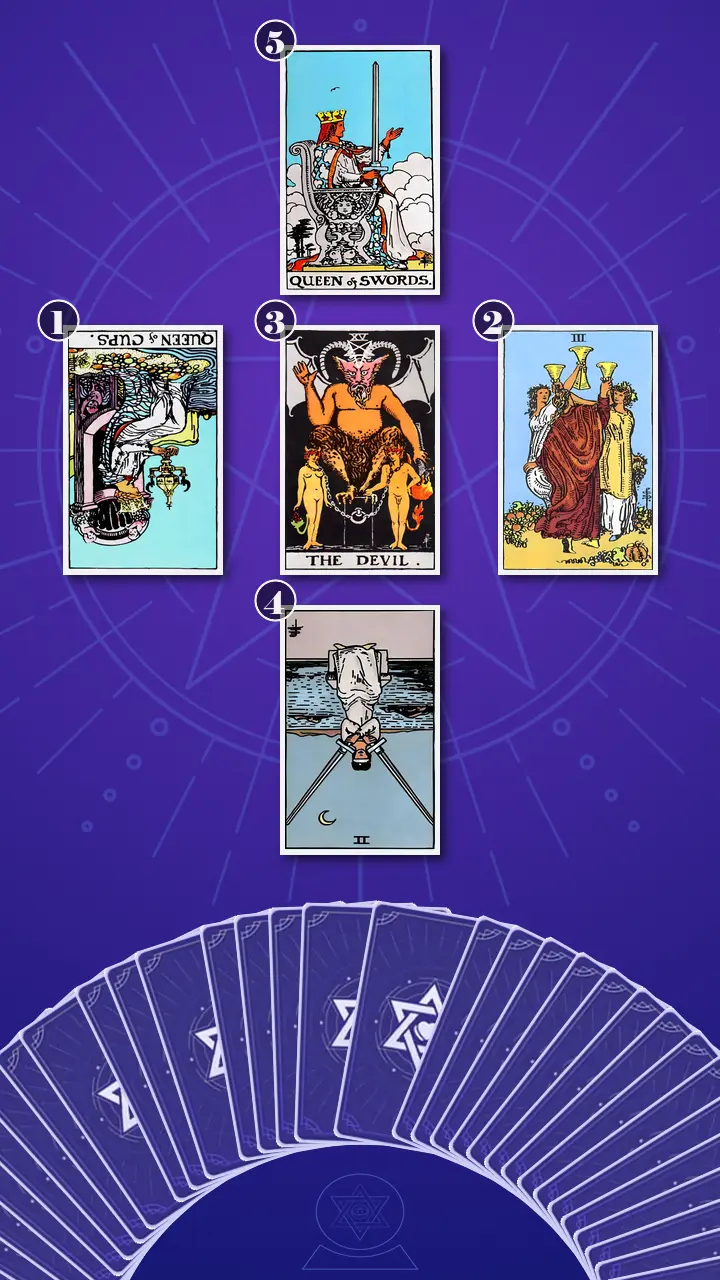
I placed the first card on the left for Maya’s current role and the second on the right for the companionship she wanted to preserve. The central card would expose the hidden rule governing the bond. Below it, the challenge position would show the cost of the pattern; above it, the final card would offer an integrating direction. On the table, the layout resembled a bridge crossed by a vertical opening: the relational knot in the center, the stalemate below, and a possible way of participating more honestly above.
I reminded Maya that every card meaning would be read in context. The Devil would not automatically mean toxic friends. A reversed card would not mean punishment. Guidance would describe an available capacity, not an inevitable future.
The Lidded Cup and the Circle Worth Keeping
Position One: The Feeling Kept Under Review
The first card I turned was the one representing Maya’s current peacekeeper posture: what she visibly did when tension appeared, and which part of her own reaction disappeared while she monitored the group. It was the Queen of Cups, reversed.
I drew Maya’s attention to the Queen’s ornate, lidded cup. Unlike an open vessel passed between people, this cup is held under close inspection. The Queen sits beside the sea, surrounded by feeling, yet her gaze remains fixed on what is contained. Reversed, her receptive water energy was not absent; it was blocked and overextended. Maya had considerable emotional intelligence, but she was using it to study everyone’s signals while sealing her own experience inside.
“This is the 11:40 p.m. scene,” I said. “You read the punctuation. You notice the delayed reply. You draft the neutral summary and open separate DMs. Internally, the sentence is: I know what everyone else feels, but I cannot find a version of my feeling that seems safe enough to send.”
The card’s modern-life image was almost painfully ordinary: an honest message kept like a Notes app draft behind Face ID. The feeling existed, but nobody in the relationship could acknowledge, clarify, or respond to information they never received. Maya’s empathy had quietly become a support inbox where every ticket was assigned to her, including the ticket describing her own hurt.
“You keep calling it maturity when the price is your disappearance,” I said. “Emotional skill includes listening to other people. It also includes keeping yourself in the conversation.”
Maya gave one short, bitter laugh rather than the nod I expected. Her fingers stopped against the cup in front of her. “That’s so accurate it feels a little brutal.”
I let the reaction have room. “Then let’s make an important distinction. The card is not criticizing your care. It is showing where care became a survival strategy. You found a way to reduce immediate disruption, and it probably worked often enough to become automatic. We’re here to add choice, not shame you for adapting.”
Her jaw remained tight, but her hand moved away from her throat. The first defense had not vanished; it had loosened enough for curiosity to enter.
Position Two: Three Separate Cups at One Table
The next card I turned represented the companionship and belonging Maya was trying to preserve, without claiming access to what any friend privately thought or intended. It was the Three of Cups, upright.
The energy here was balanced, communal water: three figures lifting three separate cups inside one circle. I asked Maya what she saw when she looked past the abstract word friendship and remembered the actual relationship.
She told me about birthday candles in a cramped apartment, moving boxes borrowed at the last minute, airport pickups, daily memes, and voice notes that had revived bad commutes on Line 1. As she spoke, the pressure around her mouth softened. I could see why she protected the group so fiercely. I was not looking at a meaningless attachment that could be dismissed with “just cut them off.” I was looking at companionship that had genuinely nourished her.
“I’m not protecting nothing,” she said quietly. “These people have mattered to me.”
“Exactly,” I replied. “The Three of Cups validates that. But notice the image: separate cups, separate hands, shared celebration. Connection is not the same as emotional sameness. A group dinner still belongs to one table when people order different things. The card asks whether the circle you value might be allowed to contain different reactions, including yours.”
I watched Maya release a long breath through her nose. The question carried some relief and some grief. If individuality could belong inside the circle, then her years of self-editing had not been the only possible form of loyalty. That possibility felt liberating, but it also exposed how much effort she had already spent.
The Loose Chains Beneath the Calm
Position Three: The Auto-Renewing Peacekeeper Role
The third card I turned represented the deeper relational rule beneath Maya’s pattern: the belief that continued belonging depended on her preventing disruption. It was The Devil, upright.
I saw her shoulders rise as soon as she recognized the card. I addressed the fear before it could harden into a verdict. “I am not reading this as proof that your friends are evil, manipulative, or destined to leave. Here, The Devil represents attachment and compulsion: a rule that feels absolute because it has been obeyed repeatedly.”
I pointed to the loose chains around the figures. The card translated directly into Maya’s ordinary life. Two friends would message her separately after the same disagreement and ask what the other person “really meant.” Her stomach would drop, but she would accept the assignment: translator, private listener, tone editor, mood restorer. Each conflict generated another unpaid shift as the group-chat administrator.
The Devil showed excess and blockage at once. Care had become compulsory, while Maya’s freedom to decide whether a problem was hers had been blocked. The internal terms and conditions read: You may belong only while you remain easy, useful, and calm. Nobody had verified that contract, but Maya responded to it as fact.
“Being needed can feel like belonging, especially when you are afraid to test the difference,” I said.
Her breathing paused. Her gaze drifted from the card as if an old sequence were replaying behind her eyes: a cutting joke, two private complaints, her softened translations, the visible return of group-chat banter. Then her shoulders dropped by a fraction.
“If I stop managing it, they might leave,” she said. Her voice was barely above the radiator’s click. “And if they leave, it proves I was never secure there.”
This was where I used what I call a Shadow Integration Audit. I explained that the shadow is not an evil part of the self; it is often the set of feelings a person has learned not to display. I asked Maya to map what her peacekeeping kept out of view and what each suppressed emotion had been doing with its energy.
Her anger said, I should not have to carry every conversation. Her shame said, Needing anything makes me difficult. Her grief said, I want to know whether they would choose me if I stopped being useful. None of those feelings was a command to explode, accuse, or end a friendship. They were information covertly draining her psychological bandwidth because they had no recognized place at the table.
I thought of the many names I had heard for this role while working across cultures: the diplomat, the sensible one, the designated adult, the friend-group HR department. The label often sounded affectionate. The hidden assignment beneath it was remarkably consistent: Everyone else may react; you must regulate.
I returned Maya’s attention to the loose chain. “The first movement is not a dramatic confrontation. Imagine a friend asking you to pass along a complaint. You wait ten minutes before answering. In that pause, you say to yourself: This request feels urgent, but urgency does not automatically make it mine.”
She looked at the chain again. This time, she did not recoil. “So the card isn’t saying the friendship is doomed.”
“No. It is saying the rule is visible enough to examine. That restores choice.”
Position Four: Honest_Final and KeepEveryoneCalm_Final2
The fourth card I turned represented the communication stalemate created when Maya withheld information, analyzed every possible reaction, and accumulated resentment. It was the Two of Swords, reversed.
The blindfold and crossed blades reflected two incompatible scripts held defensively over the chest. In Maya’s Notes app, one draft named what hurt. The other protected every possible interpretation. She revised both until after midnight, sent neither, and told the group she was fine. Days later, when the original issue had fused with three other disappointments, she cancelled plans because the conversation now felt too large to begin.
Reversed, the Swords energy was congested and destabilized. The delay no longer created even temporary balance; it produced twenty mental browser tabs analyzing tone while the one message containing useful information remained unsent. Maya’s apparent neutrality required active internal combat.
“Silence does not remove conflict; it changes where the conflict lives,” I said. “The awkwardness disappears from the chat and relocates into your jaw, your sleep, your resentment, and the unexplained withdrawal your friends can see but cannot interpret.”
Maya winced. Her teeth pressed together, then released. “Last Saturday I cancelled dinner because I couldn’t stand the idea of being cheerful. But I’d said yes three days earlier because saying no felt too noticeable.”
I asked what she had been waiting for before naming the original hurt.
“A version that wouldn’t upset anyone.”
“And did that version exist?”
She looked at the crossed swords for several seconds. “No. I was trying to write everyone’s reaction in advance.”
That recognition mattered. Maya did not lack the right vocabulary. She was attempting an impossible form of quality control: honesty permitted only after every emotional outcome had been pre-approved.
When the Queen of Swords Raised One Blade
Position Five: A Boundary With an Open Hand
The final card represented the capacity most able to support healthier participation: naming one proportionate truth, setting a boundary, and allowing connection to include disagreement. As I turned it, the room seemed to narrow around the soft scrape of cardstock on wood. It was the Queen of Swords, upright.
I pointed first to her single vertical sword and then to her extended hand. The sword gave one truth a clear direction. The open hand remained available for dialogue. This was balanced air energy: discernment without coldness, receptivity without unlimited availability, and directness without aggression.
In ordinary life, the card sounded like this: I care about staying connected, and that comment hurt me. I’m open to talking, but I cannot mediate this for everyone. One feeling. One event. One boundary. No closing argument, no psychological profile of each friend, and no guarantee about how the conversation would end.
The image reversed the familiar Little Mermaid bargain. Maya did not have to abandon connection in order to recover her voice, nor did she have to trade away her voice as an admission price for the circle. The Queen offered a third possibility: remain in relationship as a distinct participant.
I brought Maya back to 11:40 p.m.: the chat quiet, the phone warm, and the sentence naming her hurt disappearing under her thumb. She had sent the reasonable pause message and waited for friendly replies as though the group’s pulse were her responsibility.
When connection feels safe only after you go silent, calm has become proof of belonging. One clear truth lets you find out whether the bond can hold two realities.
I let the words settle before giving her the central message of the reading.
You do not have to keep the peace by disappearing; practice one clear boundary, like the Queen of Swords raising a single upright blade while keeping her other hand open to connection.
For two beats, Maya did not move. Her breath stopped high in her chest, and her fingers remained suspended over the edge of the card. Then her pupils widened slightly, her gaze losing focus as if she were replaying years of softened texts and private mediation. Her eyebrows drew together. What surfaced first was not relief but anger.
“But doesn’t that mean I’ve been doing friendship wrong this whole time?” she asked. Her voice sharpened, then caught. Her eyes reddened before she looked down. One hand closed into a fist against her knee.
“No,” I said. “It means you used a strategy that protected connection from visible disruption, and the strategy became too expensive. Seeing the cost now does not make your past self foolish. It makes a different choice available to your present self.”
Her fist opened one finger at a time. Her shoulders lowered, and a long breath left her with a faint tremor. The release was real, but it was not simple. I could see the slight dizziness that comes when a person puts down a responsibility and realizes the space must now be filled by choice. She sat straighter, then admitted, “That’s almost scarier. If I speak clearly, I can’t tell myself I had no option.”
I used my Inner-Critic Neutralization lens to separate responsibility from self-punishment. Maya’s inner critic had disguised itself as discipline: Find the perfect wording. Anticipate every response. Prevent discomfort. If anyone is upset, you failed. I asked her to revise the rule into something observable: My responsibility is to speak proportionately and choose a reasonably safe time and channel. Their reactions belong to them.
“A clear boundary is not a closed door; the Queen keeps one hand open,” I said. “The sword is not there to win. It separates what is yours from what is not.”
I then asked, “With this new perspective, think back to last week. Was there a moment when this insight could have made you feel different?”
Maya remembered the cutting joke at dinner and the private messages that followed. “I could have said the joke hurt me before I started explaining it for everyone else. Or I could have told the two people messaging me to speak directly to each other.”
To make the insight experiential rather than merely convincing, I invited her to set a seven-minute timer and open a private note. I asked her to write three lines only: I felt ___.When ___ happened.What I need now is ___. I told her not to explain anyone else’s motives, solve the whole conflict, or send the note yet. If three lines felt like too much, one feeling word would count.
When the timer ended, Maya chose to shorten the note and save it for later. That choice mattered as much as sending would have. The practice was not a demand for disclosure. It was evidence that her feeling could exist without immediately becoming a group-management project.
I named the shift plainly: this was one step from contracted vigilance and peacekeeping through self-silencing toward grounded self-respect, compassionate candor, and cautious trust in reciprocal connection. Not certainty. Not a promise that every bond would respond well. Just a growing ability to remain present without becoming the entire group’s regulator.
One Feeling, One Event, One Request
When I read the full spread as one story, the sequence was coherent. The reversed Queen of Cups showed Maya’s sensitivity turning into self-containment. The Three of Cups confirmed that she was protecting real companionship. The Devil revealed the shadow contract that made peacekeeping feel compulsory. The reversed Two of Swords showed how visible calm became private overload. The Queen of Swords gathered all that scattered thought into one clear statement while keeping the possibility of dialogue open.
The elemental pattern reinforced the same message. Maya had plenty of water: feeling, empathy, relational awareness. She also had plenty of air: analysis, wording, interpretation. What the spread lacked was fire and earth, the elements of modest assertion and repeatable structure. Insight alone would leave her with a beautifully understood pattern and another unsent draft. The practical bridge had to be one small act anchored by one simple rule.
Her cognitive blind spot was the assumption that restored calm meant resolution, and that her silence was what had successfully kept everyone connected. The cards offered a more objective distinction: calm could be the temporary absence of visible conflict, while resolution required usable information. Maya’s transformation direction was therefore specific: within twenty-four hours of one low-stakes tense interaction, name one feeling and one boundary without first securing everyone’s agreement.
I gave her three options. None required public disclosure, immediate confrontation, or contact with anyone who felt unsafe. She retained control over timing, channel, amount, and whether an outward conversation happened at all.
The Active Imagination Protocol for the Unsent Feeling
- Give the hidden feeling seven private minutes.Before offering mediation, open a private note and write: “I felt ___. When ___ happened. What I need now is ___.” Then ask the peacekeeper part, “What are you afraid will happen if this feeling is known?” Let one uncensored sentence answer. Nothing has to be sent.Keep the scope to one event. If the dialogue feels too intense, stop after one feeling word; stopping is a valid use of the exercise.
- Try the twenty-four-hour honest sentence.After one low-stakes interaction, write to the relevant person: “I felt ___ when ___, and I need ___.” Choose a private message or direct conversation rather than presenting a case to the entire group.If the full sentence feels too blunt, use the minimum version: “That didn’t sit right with me, and I need some time before I respond.” The twenty-four-hour window is a support, not a deadline that overrides safety, sleep, or capacity.
- Use the loose-chain pause before mediating.When a friend asks you to interpret or carry a complaint, wait ten minutes. Then answer once: “Have you told them directly? I can speak for my experience, but I cannot carry messages between you.” If you have already sent an honest boundary, put your phone on Do Not Disturb for twenty minutes.During the pause, take three slow breaths before adding an explanation. Silence after a boundary is not proof that the bond is breaking; it is simply a period in which other people are managing their own responses.
This was the practical form of the Queen’s sword and open hand. Maya could be precise without becoming cruel, and available without being permanently on call. She could care about the circle without becoming its entire nervous system.
I also reminded her that the cards could not guarantee a particular response. A friend might listen, become defensive, need time, or reveal a limit in the relationship. Clarity meant seeing where Maya’s responsibility ended, not gaining control over what happened next. The authority remained with her, including the authority to draft privately, delay, change the channel, or decide not to communicate.

Three Days Later: The Quiet Proof
Three days later, I received a message from Maya. She had used the seven-minute note after another tense exchange. She did not send the first draft, which was nearly a page long. She shortened it to: I care about us, and that comment hurt me. I’m open to talking, but I can’t mediate the whole group’s reaction.
She set a twenty-minute timer, placed her phone face down, and made tea. One friend replied quickly; another took several hours. The conversation was not magically smooth, but nobody asked Maya to translate between them. One response simply said, I didn’t realize it landed that way. I need a little time, but I hear you.
That night, Maya slept through. In the morning, the old thought arrived first: What if I made it worse? She told me she smiled, left the phone untouched, and made coffee before checking. Clarity had not erased fear; it had changed who took instructions from it.
I did not regard the message as proof that tarot had fixed her friendships. The cards had made a pattern visible, and Maya had chosen one proportionate experiment. That was the quiet proof of her Journey to Clarity: she had stayed connected to herself while allowing the relationship to become a shared responsibility.
When a chat turns terse and your throat tightens, it can feel as if one honest sentence might cost you the whole circle. If you hold everyone together by quietly stepping out of it, simply noticing that exchange means you are no longer standing at the beginning.
If your circle were allowed to hold one small difference, what single honest sentence would you place beside the Queen’s upright sword before reaching for everyone else’s response?