The Hot Phone on the Northern Line
I often begin friendship tarot consultations with a recognition check: if someone can make any public-facing sentence sound harmless but still spends twenty minutes rewriting a friend's WhatsApp reply, I may be looking at conflict avoidance in friendships rather than simple kindness.
That was how I met Alex, a 28-year-old communications coordinator at a small London nonprofit. They arrived at my studio with rain stippling the shoulders of their coat and set their phone face down on my table as carefully as if it contained something volatile.
They took me back to 7:12 p.m. on the Northern line. The brakes had squealed against the rails, the carriage smelled of wet coats, and their phone had grown hot in their palm as they moved between a tense group chat and two private threads. They had written reassurance for both friends, deleted their own opinion, and checked the read receipts before the train reached the next station.
“I can explain what each of them meant,” Alex told me. Their jaw tightened before the rest came out. “But the second someone asks what I think, I start editing. If I phrase it perfectly, no one will take it personally. I just don't know whether I'm helping or making myself necessary.”
The apprehension in their body reminded me of a smoke alarm wired directly to punctuation: a full stop, a delayed reply, or an unusually quiet chat could set off the same tight chest, clenched jaw, and restless hands. Underneath that alarm sat guilt, resentment, and the loneliness of being useful to everyone while remaining unseen. Being the calm one can become a way of disappearing in plain sight.
“I don't think we need to decide whether your care is good or bad,” I said. “Let's look at what the role costs, what it helps you avoid, and where your actual responsibility ends. Our journey to clarity is not about predicting which friendship will last. It is about handing you back the pen for your part of the story.”

Choosing the Bridge Across the Middle
I invited Alex to place both feet on the floor, take one unforced breath, and hold the question in mind: What am I avoiding by always keeping the peace between friends? I shuffled slowly, using the small ritual as a transition from reacting to observing rather than as a performance of mystery.
I chose the Relationship Spread · Context Edition. This six-card relationship tarot spread suited the problem because it could separate Alex's behavior from the group atmosphere, the shared pattern, the avoided truth, the available resource, and one actionable next step. A broad forecast would have blurred those responsibilities together again.
That distinction is central to how tarot works in my practice. I do not treat cards as verdicts or instructions from an authority. I use their images as a structured reflection tool. Card meanings in context can place a familiar behavior outside the person long enough for both of us to examine its logic, its cost, and its alternatives.
I arranged the first two cards opposite each other: Alex's visible role and the relational field they were trying to manage. The third and fourth formed a central axis, moving from the group's repeated peacekeeping pattern to the truth hidden underneath it. The fifth and sixth opened outward into a relational resource and a communication experiment. On the table, the layout resembled a bridge with a pressure point at its center. A bridge can connect people, I explained, but it does not have to carry them on its back.
“None of these cards will tell your friends how to respond,” I said. “They can help us identify what belongs to you. You remain free to decide what, when, and whether to communicate.”
The Emotional Support Budget
Position 1: The Cost Hidden Inside Generosity
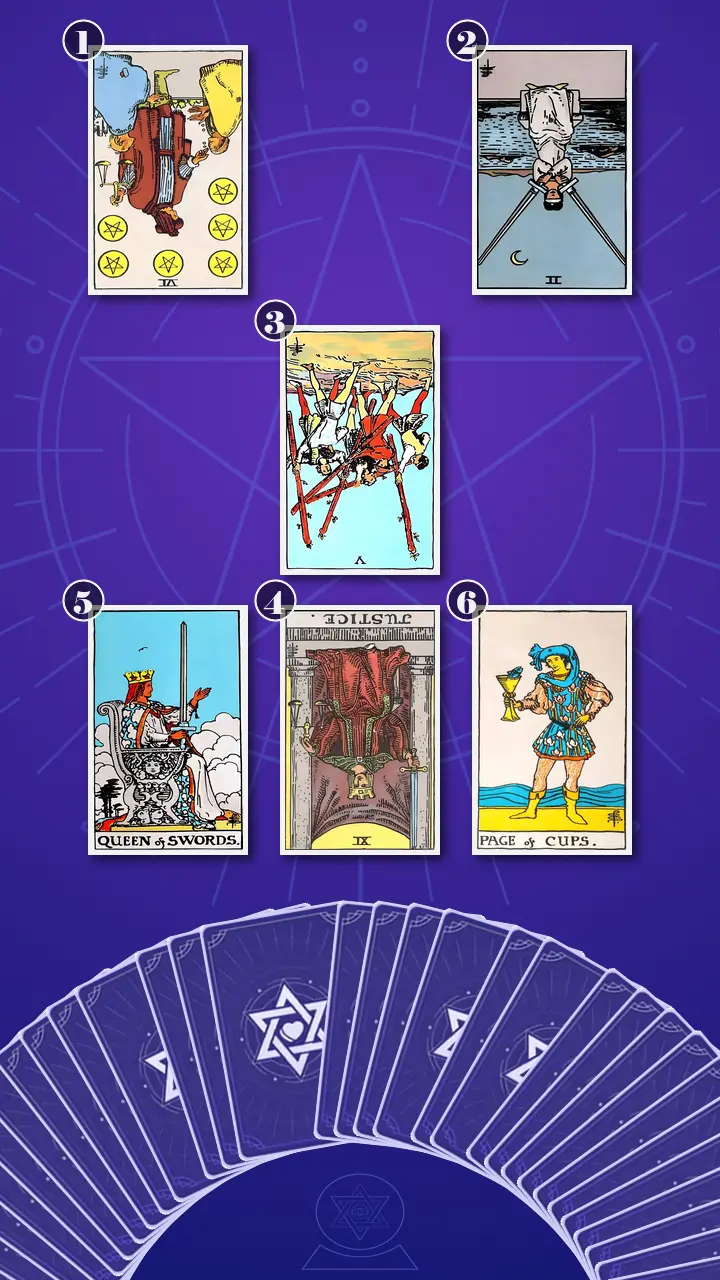
“Now I'm turning over the card representing your present peacekeeping behavior: how you visibly enter friend-to-friend tension and what you do to calm the atmosphere,” I said. The card was the Six of Pentacles, reversed.
I pointed to the scales and the unevenly distributed coins. In Alex's life, the image looked like an emotional support budget managed through WhatsApp. One carefully balanced reassurance message went to each friend. Read receipts became a private mood dashboard. Alex tracked who had received enough comfort while leaving their own hurt entirely outside the exchange.
“Everyone gets a careful answer except you,” I said. “The problem is not that you give. It is that the exchange has stopped being reciprocal.”
Energetically, I read the reversal as an excess of giving combined with a deficiency of receiving. Care had become emotional overfunctioning: the more Alex distributed calm, the less anyone else had to ask what the situation was doing to them. The short-term reward was visible quiet. The unrecorded cost was a clenched jaw, a reheated dinner going cold again, and another personal sentence deleted before sending.
I asked, “When a disagreement lands in the chat, what do you actually do first: say what you think, or start allocating reassurance?”
Alex gave a small laugh, but there was no amusement in it. Their fingers pressed into the edge of the table, then released. “That's so accurate it feels a bit brutal. I literally message them both separately.”
“Accurate does not have to mean condemning,” I replied. “This behavior probably protected connection at some point. We are only asking whether it still gives you an equal place in the friendship.”
Position 2: Two Drafts Guarding the Chest
“Now I'm turning over the card representing the relational field you are managing: the pressure you read from both friends before you allow yourself to respond,” I said. It was the Two of Swords, reversed.
The blindfolded figure held two swords crossed over the chest. I connected it to a scene Alex knew immediately: two unsent drafts open on the phone, one for each friend, with every line revised until neither message could be mistaken for choosing a side. Like switching between two browser tabs until the original task disappears, Alex kept moving between competing obligations until their own answer vanished.
I read the reversed Air energy as a blockage. Thought was not absent; it was working overtime. Alex could already see the destination, but they kept standing on the platform trying to predict which friend would dislike the route. Neutrality had become self-silencing rather than balanced judgment.
“What pressure do you feel to understand both sides before you're allowed to answer from your own experience?” I asked.
Alex's hand rose to their sternum. Their gaze dropped to the crossed swords. “It feels like having a view is the same as rejecting somebody. At work, I can call it stakeholder management. With friends, I think I'm using the same skill to avoid being a person in the room.”
I let that sentence settle. A communications skill that served Alex professionally had leaked into their closest relationships, where every difficult exchange now sounded like a reputational risk requiring careful management.
The Quiet That Pretended to Be Peace
Position 3: The Argument Edited Out of the Scene
“Now I'm turning over the card representing the shared peacekeeping pattern: what the friendships reward, repeat, or leave unspoken when you mediate,” I said. The card was the Five of Wands, reversed.
The raised staffs crossed in different directions, but no single figure controlled the field. In Alex's group chat, several opinions would appear, Alex would soften every sharp phrase, send a meme or practical question, and ask whether everyone was okay before the people involved had spoken directly. When the thread went quiet, the private thought arrived: If nobody says anything else, maybe it is fixed.
The reversal showed blocked and suppressed Fire. Ordinary friction had been pushed underground, where it did not disappear; it returned as private venting, slow replies, logistical avoidance, and Alex's exhaustion. Visible tension and genuine resolution were being treated as opposites, even though a friendship can sometimes need a manageable amount of the first to reach the second.
As an artist, I thought of an editing room where every difficult line is cut before the character reveals what matters. The resulting scene may be quieter, but it is not necessarily more truthful. Alex had become the editor of the friendship's emotional footage, removing conflict so efficiently that nobody could see the story underneath it.
I used a lens I call Clique Power Dynamics. I was not assuming anyone in the group was secretly malicious. I was asking who was allowed to be messy, who could vent privately, who was expected to translate, and whose time was treated like group infrastructure. The micro-aggression here was subtle: the repeated assumption that Alex's neutrality and emotional bandwidth were always available for communal use.
“What does the group learn each time you lower every raised staff?” I asked.
Alex's mouth opened, then closed. Their eyes moved from one figure on the card to the next. “That they don't have to talk to each other. They can both talk to me.” Their shoulders lifted toward their ears before slowly dropping. “I hate admitting that because part of me likes being the person they trust.”
“Both things can be true,” I said. “Being trusted can feel meaningful, and the role can still leave you carrying conversations that are not yours.”
Position 4: The Internal Court That Never Adjourned
“Now I'm turning over the card representing the avoided truth beneath the calm: the expression or responsibility you postpone by keeping the peace,” I said. It was Justice, reversed.
I placed the reversed scales beside the upright sword in the image. The card translated into Alex opening Notes after a tense exchange and creating two columns, only to keep moving every item into the one labeled mine: one friend's disappointment, the other's silence, the awkwardness in the group, and the fact that nobody had made plans. Someone else's reaction became a performance review of Alex's friendship skills.
I read this as an imbalance in the energy of accountability. Alex was postponing the manageable responsibility of stating what they believed while assuming the impossible responsibility of producing equal emotional outcomes. In their internal court, every friend's discomfort was entered as evidence against their character.
“Think of the last time you tried to make two friends feel equally okay,” I said. “What truth about your own hurt, anger, preference, or limit did you postpone so the situation would look fair?”
Alex inhaled, held the breath, and stared at the table as if a recent conversation had started replaying across the wood. Their thumb rubbed the side of their index finger. Then the breath left in a long stream. “I was angry that both of them assumed I'd pass messages. But I apologised for not explaining each person better. I made their choice my failure.”
“That is the avoided truth,” I said. “Not that you secretly want the friendship to collapse, but that you are angry about being assigned responsibility without being asked. Peace is an outcome a friendship may find; it is not a job you have to perform.”
I watched sadness move across Alex's face before recognition settled behind it. The distinction did not instantly make the situation comfortable. It did, however, separate fairness from control. You can care about both friends without carrying the conversation for both of them.
When the Queen Lifted Her Sword
Position 5: From Referee to Participant
The radiator clicked once and went quiet. I turned over the card at the lower left, and the room seemed to narrow around its clean vertical line.
“Now I'm turning over the card representing your available relational resource: the quality you can bring without controlling how either friend responds,” I said. It was the Queen of Swords, upright, the key card of the reading.
Her gaze was direct and unsheltered. Her sword was visible rather than crossed defensively over her chest. In Alex's life, she sounded like this: “I care about both of you, but I am not going to carry messages or decide who is right. My own view is that you need to speak directly.” The crucial detail was what came next: no three-paragraph apology designed to make the boundary painless.
I read her upright Air as balance: discernment without punishment, honesty without control, and self-trust without a guarantee of approval. Her blade was not aggression. It was the line separating what Alex could offer from the work that belonged to their friends.
I brought in another of my diagnostic lenses, Sidekick Syndrome Diagnosis. I use that phrase as narrative shorthand, not as a clinical label. Friend groups often assign stable characters: the chaotic one, the blunt one, the therapist, the clown, the calm mediator. Alex had been cast as the supporting character who translated everyone else's emotional plot. The role kept the group's status quo intact because Alex's reliability allowed other people to avoid direct conversation.
“The Queen is not asking you to become cold or leave the scene,” I said. “She is asking you to stop confusing your assigned character with your whole identity. You get to participate as a friend with a position, not only as the referee who makes everyone else's position easier to hear.”
At that point I could almost see the Northern line scene returning behind Alex's eyes: the hot phone, two private threads, and the old equation that said a correct sentence could guarantee belonging. They were still searching for the perfect decision that would leave nobody disappointed.
Do not confuse peacekeeping with fairness; use the Queen of Swords' upright blade to name your position, set a boundary, and let the relationship hold honest difference.
For a beat, I watched Alex's breath stop. Their fingers stayed suspended above the table, then slowly curled into their palm. Their gaze slipped past me as if the Northern line messages were replaying against the studio wall. Colour rose along their cheekbones. “But doesn't that mean I've been doing friendship wrong for years?” they asked, sharper than before. The anger arrived first; beneath it I heard grief for every evening spent on emotional shift work. “No,” I said. “It means a strategy that once helped you feel secure has become too expensive. We're not putting your care on trial. We're changing the job description.” Their jaw moved as if testing the idea. Their fist opened. Their shoulders lowered, although the release left them briefly unsteady, blinking into the responsibility that clarity brings: nobody else could choose the sentence, and no card could promise the response. Then came a long, trembling exhale. “Oh,” they said. “I can be kind without being the infrastructure.”
“Now, using this new view, think back to last week,” I said. “Was there a moment when this insight could have made you feel different?”
Alex remembered a friend asking them to explain what the other person had “really meant” after dinner. “I wanted to say, ‘I don't know. You need to ask them, and I don't want to be in the middle.’ I thought that would sound hostile.”
“The Queen gives you another interpretation,” I said. “That sentence can be accurate, bounded, and caring. Directness is not the same thing as rejection.”
I named the crossing we had reached: from hypervigilant peacekeeping and self-erasure toward grounded connection that could tolerate honest difference. It was not the end of the discomfort. It was the first moment Alex could see discomfort without automatically reading it as an instruction to mediate.
I asked them to spend ten minutes writing one sentence beginning with My view is... and another beginning with I can offer... They did not have to send either sentence. If their body became overwhelmed, or if the situation felt coercive or unsafe, the Queen's boundary could mean putting the phone down and choosing not to engage.
The Fish That Interrupted the Script
Position 6: A Tender Message, Not a Verdict
“Now I'm turning over the card representing integrative advice: one small communication or boundary experiment you can try this week,” I said. The final card was the Page of Cups, upright.
A fish rose unexpectedly from the Page's cup. A passing bus sent a strip of pale light across the studio window, and for a second it caught the cup on the card. I read the image as the moment Alex noticed a personal feeling before converting it into a task.
In practical terms, the Page offered a small message rather than a complete resolution: “I felt caught in the middle yesterday, and I need you both to speak directly to each other.” No summary of either friend's case. No verdict. No apology for having an experience. No request for immediate reassurance.
The upright Water carried a balanced form of emotional openness. Feeling could be shared as information without becoming a demand, and vulnerability could exist without controlling the outcome. One honest sentence is not the same thing as starting a fight.
“What happens if I let that be true without fixing it?” Alex said quietly. Their hand moved toward the phone, paused, and returned to their lap. I saw nerves in the small movement, but I also saw curiosity. The Page was not promising a comfortable response. It was making room for Alex's feeling to enter the friendship at all.
The Role Resignation Act
I gathered the cards into one connected story. A professional skill from Alex's past and present had become a private survival strategy: they could control language, so they tried to control relational fallout through language. The reversed Six showed care distributed unevenly. The reversed Two held their position behind competing drafts. The reversed Five made quiet look like repair. Reversed Justice then moved every emotional consequence into Alex's column. The Queen and Page opened another route: one clear boundary followed by one sincere feeling.
The spread's bridge metaphor mattered here. Alex had been acting like a human buffer between two live wires, absorbing tension so other people could remain comfortable. Their cognitive blind spot was the belief that another person's disappointment proved Alex had failed, and that being needed was the safest evidence of belonging. The transformation direction was not from caring to detachment. It was from controlling the atmosphere to stating a position once and returning responsibility to its proper owners.
I called the practical framework The Role Resignation Act. In film terms, it was not Alex storming off the set. It was a graceful refusal to keep playing the restrictive character of “the calm one” whenever the group needed unpaid emotional direction.
“But if I suddenly send one short sentence, won't it look dramatic?” Alex asked. “They know me as the person who explains everything.”
“Then we make the first experiment small and specific,” I said. “You do not need to unveil a new personality. You only need to decline one piece of work that was never yours.”
- Use the Role Resignation Act.The next time either friend asks you to carry a message, set a ten-minute timer and write: “My view is...” followed by “What I can offer is...” End with one boundary, such as “I care about you both, but carrying messages is outside my role.” Send it in the existing chat or direct conversation only if you choose.Choose the shortest version that remains true. If sending feels unsafe or coercive, keep it as a private note or disengage; the boundary still counts.
- Make the Mine-or-Theirs Ownership Split.After the next tense exchange, spend five minutes creating two phone notes titled “Mine to own” and “Theirs to own.” Put one item in your column, such as your feeling, availability, or boundary. Put each friend's reaction and next decision in their column.Act on only one item from your column. When guilt tries to move their reactions back to you, read the headings aloud once.
- Try the No-Second-Repair Pause.After sharing one Page of Cups-style message of fewer than 25 words, place the phone face down for 30 minutes. Record three body sensations instead of checking read receipts or drafting another explanation.Begin with five minutes if 30 feels too activated. If the exchange becomes abusive, discriminatory, or unsafe, end the experiment and seek appropriate support rather than tolerating harm.
“State your position once, then let the response belong to the person receiving it,” I said. “That does not guarantee harmony. It creates the conditions for reciprocity, which is more honest than calm produced by your disappearance.”

Six Days Later, the Phone Stayed Face Down
Six days later, I received a message from Alex. One friend had asked them to explain the other person's silence. Alex had used the Role Resignation Act: “I care about you both, but I won't carry messages. I felt caught in the middle, so please speak directly.”
One friend replied, “Okay, that's fair.” The other remained quiet until the following afternoon. Alex's chest had tightened, and their hands had buzzed with the urge to send a second repair message. They wrote tight chest, hot hands, held breath in Notes, turned the phone over, and made dinner.
I read their final line twice: “I slept through the night. This morning my first thought was, ‘What if they're annoyed?’ Then I laughed, made coffee, and waited before checking.” The friendship was not magically settled. Alex had simply stopped treating uncertainty as an alarm requiring immediate labour.
That was the quiet proof of this Journey to Clarity. The tarot had not fixed the group or issued a prediction. It had made an invisible role visible, separated care from control, and helped Alex identify a choice that had always been theirs.
I think of our lives as films still in production. Alex did not need to erase the difficult scene or force every character into agreement. They changed one line, declined one assigned role, and discovered that grounded connection could begin before certainty arrived.
When a group chat goes quiet after an argument, I know the chest can still tighten because staying useful may feel safer than discovering whether friendship can survive without an unofficial referee. Noticing that reflex does not make it vanish, but it does put the pen back in your hand.
If you let one disagreement remain with the people who had it, what is the smallest honest line you could write for your own next scene?
This story is adapted from psychological research, written so that those in a similar struggle can see their own pattern in it — and find their next step clearly.These insights are not a substitute for professional psychological, medical, legal, or financial advice.
Learn more about our Journey to Clarity.
How did this insight land for you?
🫂 This Resonates Deeply
🌀 Living This Story
✨ Now I See Clearly
🌱 Seeing New Possibilities
🧰 Useful Framework
🔮 The Confirmation I Needed
💪 Feeling Empowered
🚀 Ready for My Next Step
Author Profile
 AI
AI“I’ve always felt our lives are films currently in production. As an artist, I know that when you feel stuck, it’s often because you’ve bravely stayed in a painful scene for just a little too long. I’m not here to coldly analyze you. I want to sit closely with you, look at those difficult moments with profound empathy, and gently hand you the pen so you have the courage to write your next beautiful act.”
In this Friendship Tarot Reading :
Core Expertise
- Clique Power Dynamics: Deconstructing the subtle jealousy, micro-aggressions, and implicit hierarchies hidden within tight-knit friend groups.
- Sidekick Syndrome Diagnosis: Identifying how your friend group has boxed you into a specific, restrictive role (e.g., the clown, the therapist) to maintain their status quo.
Service Features
- The Role Resignation Act: A creative conversational pivot designed to gracefully but firmly refuse your assigned 'character' during your next group interaction.
Also specializes in :
Explore Related Patterns:
Conflict AvoidanceWhen opinions rise in the group chat, Alex softens the sharpest phrases, sends a meme or practical question, and checks whether everyone is okay before the people involved have spoken directly. The quiet that follows can feel like proof that the conflict has been resolved. That response reduces visible friction, but it also edits out the information the friction carries. The group can avoid a direct conversation, while Alex absorbs the unresolved tension as exhaustion, monitoring, and private responsibility. You are avoiding not only an argument, but the possibility that honest difference can exist without being repaired by you. Conflict Avoidance becomes visible when calm is produced by suppressing the conversation rather than by reaching mutual clarity. A boundary does not create the conflict; it stops asking your silence to conceal it.
Defensive OverfunctioningOn the Northern line, Alex moves immediately between a tense group chat and two private threads, offering reassurance to both friends while deleting their own opinion. This turns an interpersonal disagreement into a task that can be managed through careful wording, speed, and emotional labour. The strategy creates a brief sense of order because Alex can see themselves doing something useful. But when both friends learn to bring their conflict to Alex rather than to each other, Alex becomes necessary to a system that has stopped being reciprocal. You are not avoiding care here; you are avoiding the uncertainty of letting other people carry their own part of a difficult conversation. Defensive Overfunctioning names the point where helping becomes a protective role. Seeing the role clearly gives you room to offer care by choice, rather than automatically becoming the infrastructure whenever tension appears.
Emotional Hyper-ResponsibilityAlex opens a mental account after tense exchanges and moves one friend's disappointment, the other's silence, and the awkwardness in the group into the column marked mine. When Alex is angry about being asked to pass messages, they apologise for not explaining each friend better. This is more than empathy. It is a responsibility distortion in which another person's reaction becomes evidence about your character and competence as a friend. Trying to make both people feel equally okay can then seem safer than stating the manageable truth that you do not want to be in the middle. Emotional Hyper-Responsibility keeps the focus on outcomes you cannot control. The Mine-or-Theirs split restores a more accurate boundary: you can own your feeling, availability, and words without taking ownership of each friend's response or next decision.
Self-SilencingAlex can explain what each friend meant, but begins editing as soon as anyone asks what they think. Their own opinion is deleted while two carefully neutral replies remain open, because having a view feels too close to rejecting somebody. This protects Alex from the immediate exposure of being seen as partial, angry, or disappointing. Yet the protection has a cost: Alex's actual hurt and limit never enter the friendship, so neutrality gradually becomes a form of disappearance rather than balanced judgment. Self-Silencing names the habit of removing your position to keep connection predictable. The sentence Alex wanted to say, that they do not know and do not want to be in the middle, is not hostility. It is evidence that their perspective has a place in the relationship.
Assertive CommunicationAlex's message is concise and specific: they care about both friends, felt caught in the middle, will not carry messages, and want the two people involved to speak directly. It does not decide who is right, summarise either person's case, or include a long apology to remove all discomfort. That is a shift from managing the group atmosphere to communicating a personal position. Alex remains caring while allowing both friends to have independent reactions, which restores a more equal relationship dynamic than private translation and reassurance can provide. Assertive Communication makes room for directness without turning directness into aggression. It gives you a way to be visible in the friendship while leaving the outcome where it belongs: with the people receiving and responding to your words.
Boundary DiscernmentSix days later, Alex says that they care about both friends but will not carry messages, then asks them to speak directly. The statement identifies what Alex can offer without taking over the work that belongs to the people in conflict. The boundary is not a verdict about either friend and does not demand an immediate response. By placing their own feeling and availability in one column, while leaving each friend's reaction and next choice in another, Alex creates a workable distinction between care and control. Boundary Discernment is the capacity to recognise where your responsibility ends while remaining connected to your values. It lets you participate in friendship as a person with limits, rather than as the buffer responsible for keeping every interaction smooth.
Control CopingAlex treats wording as a way to control relational fallout. If every sentence is phrased perfectly, no one will take it personally; if both drafts are balanced enough, no one will feel rejected. This converts a real interpersonal uncertainty into a solvable communications problem. Alex's professional skill at stakeholder management becomes a defensive strategy in friendship, where the search for the perfect response postpones the more vulnerable act of having a position without a guarantee of approval. Control Coping is not a failure of intelligence or care. It is the attempt to purchase safety through precision when other people's feelings remain outside anyone's control. A short, truthful boundary interrupts that bargain by allowing clarity to matter more than perfect emotional management.
Relational HypervigilanceFor Alex, a full stop, delayed reply, read receipt, or quiet group chat can trigger a tight chest, clenched jaw, and restless hands. These ordinary communication signals become an early-warning system for possible relational fallout. Scanning closely makes sense when uncertainty has come to feel like a problem that needs immediate labour. The pattern then turns neutral or incomplete information into a cue to draft, reassure, check, or send a second repair message before there is evidence that repair is needed. Relational Hypervigilance narrows attention around signals of possible disconnection. Alex's choice to note the body sensations, put the phone down, make dinner, and wait creates a different response to the same uncertainty: awareness without automatic intervention.
Explore Related Struggles:
Agreement-Agency SplitAlex keeps two drafts open until neither can be mistaken for choosing a side, then deletes the sentence that would reveal what they actually think. The wording becomes safer as their authorship disappears, making agreement the price of remaining acceptable to both friends. You are caught here between relational continuity and personal agency. The struggle is not simply finding better language; it is allowing your position to exist when no perfect sentence can guarantee approval, and recognizing that a friendship's response to difference cannot be decided entirely from your side of the screen.
False Responsibility LoopAlex opens two columns after a tense exchange and keeps moving each friend's silence, disappointment, and next decision into the one marked mine. Even punctuation and delayed replies become evidence that another explanation or apology may still be required. You are caught in a responsibility system with no natural endpoint. Because other people's reactions remain variable, each reaction can generate another duty, and each repair attempt confirms that the duty was yours. Returning those reactions to their actual owners does not cancel your care; it restores the distinction between the impact you can consider and the outcome you cannot personally manufacture.
Performative HarmonyAlex softens every sharp phrase, sends a meme or practical question, and reads the resulting silence as possible repair. The disagreement has not been worked through; it resurfaces as private venting, slow replies, and plans that quietly fail to happen. You can create a calmer surface without creating a more honest relationship. That difference is the center of this struggle: visible tension is removed so efficiently that the people involved never have to reveal or negotiate what divided them. The quiet then depends on your continued editing, leaving you responsible for maintaining an appearance that cannot resolve the underlying conflict.
Responsibility-Authority SplitAlex carries messages, balances reassurance, and tries to make two friends feel equally okay, even though neither friend's response belongs to them. The group hands Alex responsibility for the emotional result without handing them control over the people whose choices create that result. You can state what you believe, decide what support you can offer, and decline the intermediary role. You cannot produce matching reactions on command. The struggle remains locked while responsibility is measured by an outcome you have no authority to deliver, because every imperfect response can then be treated as unfinished work on your side.
Self-Erasure ReliabilityEveryone receives a careful answer from Alex while Alex's own sentence is deleted, their dinner goes cold, and their attention remains fixed on read receipts. The behavior proves that they are dependable, but it does so by removing the person whose dependability is being used. You become visible as a function and increasingly difficult to see as a participant. Reliability then carries a hidden condition: you must remain calm, available, and positionless for the role to keep working. Reclaiming clarity means noticing that care which requires your repeated disappearance is not giving you an equal place in the friendship.
Triangulated BelongingBoth friends stop speaking to each other and begin speaking through Alex, who translates each side in separate private threads. Every successful intervention confirms that Alex is trusted while also teaching the group that direct conversation can be deferred again. Your place in the middle can feel like evidence that both relationships need you. It also makes belonging dependent on preserving the triangle that consumes your time. The struggle becomes visible when stepping out is not merely a boundary decision but a test of whether connection can survive after you stop functioning as its compulsory route.
Utility-Belonging FusionAlex admits that being the person both friends trust feels meaningful, and later recognizes the old equation linking a perfectly managed response with secure belonging. The mediator role is expensive, but it offers repeated proof that the group still has a reason to reach for them. You are not only deciding whether to perform another task; you are confronting what remains of connection when usefulness is withdrawn. When being needed has become the safest evidence that you belong, a simple refusal can feel larger than the request itself. Clarity begins by separating the relationship's value from the amount of emotional infrastructure you provide.
Explore Related Emotions:
Approval AnxietyTwo unsent drafts remain open while Alex revises every line until neither friend could interpret it as taking a side. Even a carefully considered response feels unfinished if it cannot guarantee that both people will approve of how it lands. When you make flawless phrasing the price of remaining acceptable, another person's disappointment starts to resemble a verdict on your character. Approval Anxiety captures the resulting pressure to engineer a harmless response, while clarity begins with recognizing that respectful communication and universal approval are not the same outcome.
Boundary GuiltWhen a friend asks Alex to explain what the other person really meant, Alex wants to say, "You need to ask them, and I do not want to be in the middle." They withhold the sentence because it sounds hostile to them, and they later worry that a shorter boundary will look dramatic. If a limit is automatically registered as harm, protecting your capacity can produce guilt before anyone has accused you of doing something wrong. Boundary Guilt describes that internal accusation, while the story supplies a clearer measure of responsibility: you can decline work that was never yours without withdrawing care from the people involved.
Hidden ResentmentReassurance goes to both friends while Alex's own hurt remains outside the conversation. Their jaw tightens, their fingers press into the table, and they eventually admit they were angry that both people assumed they would pass messages. Repeated one-way care can leave an unspoken protest beneath a reliable and helpful surface. Hidden Resentment names the feeling that accumulates when your availability is treated as communal property, and bringing it into view allows it to function as information about an overused limit rather than as evidence that your care was false.
Hypervigilant AnxietyA full stop, a delayed reply, or an unusually quiet chat sets off Alex's tight chest, clenched jaw, and restless hands. The phone becomes a live dashboard of relational risk, and every small cue is checked for evidence that someone may be upset. When your body treats ordinary ambiguity as an urgent warning, keeping the peace can become an attempt to silence the alarm before you have identified what actually belongs to you. Hypervigilant Anxiety names that braced inner weather while preserving an important distinction: noticing tension does not make you responsible for removing it.
Liberating UncertaintyThe phone stays face down while one friend remains quiet, and Alex makes dinner instead of drafting another explanation. The next morning, they still wonder whether someone is annoyed, but they laugh, make coffee, and wait before checking. The outcome has not become certain; its uncertainty has stopped controlling the entire evening. Liberating Uncertainty captures the opening that appears when you allow other people to own their responses, leaving your time and attention available for a life that can continue before every relationship question is settled.
Preference Exposure DreadThe moment someone asks what Alex thinks, they begin editing, and their own opinion disappears beneath reassurance for both sides. They say directly that having a view feels equivalent to rejecting somebody. Once a personal preference is experienced as a threat to connection, self-expression carries the atmosphere of social exposure rather than ordinary difference. Preference Exposure Dread names the fear attached to becoming visible as a person with a position, and it also reveals where your agency can return: a view can be honest without functioning as a rejection.
Profound LonelinessEveryone receives a careful answer except Alex. They are present in the group chat, active in both private threads, and central to the flow of information, yet their own opinion and hurt never become part of what the friends are asked to hold. Being central to communication is not the same as being personally known. Profound Loneliness captures the isolation of being useful to everyone while remaining unseen, and it clarifies why speaking as yourself matters: connection cannot become reciprocal while only your function is allowed into the room.
Protective AngerAnger arrives when Alex admits that both friends assumed they would carry messages without asking. Their voice sharpens again when the cost of years spent as the calm mediator becomes visible. That sharpness identifies a crossed limit rather than a wish to punish or destroy the friendships. Protective Anger gives your objection a legitimate place in the emotional picture, helping you distinguish accurate boundary information from aggression and choose a response that protects participation instead of forcing disappearance.
Unresolved Outcome AnxietyOne friend remains quiet until the following afternoon after Alex sends a clear boundary. Their chest tightens, their hands buzz, and the urge to send a second repair message appears even though nothing more belongs to them in that moment. Without an immediate response, an open outcome can feel like an unfinished assignment that still requires your labour. Unresolved Outcome Anxiety captures the strain of not knowing whether someone is annoyed, while Alex's pause demonstrates an available choice: uncertainty can remain unresolved without becoming an instruction to explain again.
Unspoken GriefColour rises across Alex's face when they ask whether they have been doing friendship wrong for years. The anger comes first, followed by grief for every evening spent on emotional shift work and for the personal sentences removed before anyone could receive them. Recognizing the cost of an old strategy can expose sorrow that had no room while the strategy was still running. Unspoken Grief holds the loss without condemning the care behind it, giving you permission to acknowledge what the role took while deciding which parts of it no longer deserve your time.
Usefulness-Based Belonging FearBoth friends trust Alex with private messages, and Alex admits that part of them likes being the person everyone turns to. The role offers visible proof that they matter, even as it leaves their own feelings outside the exchange. When being needed becomes the safest evidence of belonging, stepping out of the mediator role can feel like risking your place in the friendship itself. Usefulness-Based Belonging Fear identifies the deeper question beneath the peacekeeping: whether you can still be valued when you are present as a friend rather than indispensable as emotional infrastructure.
Cautious VulnerabilityA one-sentence message allows Alex to say they felt caught in the middle and need the two friends to speak directly. It contains no verdict, no summary of either person's case, and no apology for having an experience. Letting a personal feeling enter the relationship without controlling its reception creates a measured form of exposure. Cautious Vulnerability names the openness in that experiment: you remain free to choose your timing and level of engagement, while giving the friendship a chance to encounter the person behind the mediator role.
Grounded AgencyTwo phone notes titled "Mine to own" and "Theirs to own" give Alex a concrete way to separate their feeling, availability, and boundary from each friend's reaction. They state their position once, put the phone down, and allow the next decision to belong to the people receiving it. Control becomes smaller but more real when it is located in your own words and actions rather than in the atmosphere of an entire group. Grounded Agency names that steady authorship: you cannot guarantee harmony, but you can decide what you will say, what you can offer, and which responsibility you will no longer absorb.
Self-Betrayal AcheAlex deletes their opinion, leaves their hurt outside the exchange, and apologizes for failing to explain each friend better even though the decision to communicate indirectly was not theirs. Every emotional consequence is moved into the column marked "mine." Each edit purchases temporary quiet by removing part of your lived experience from the friendship. Self-Betrayal Ache names the cumulative pain of repeatedly abandoning your own position to protect the atmosphere, while recognizing that cost gives you a concrete place to intervene: the next truthful sentence does not have to be deleted.
Truth ReliefAlex's fist opens and their shoulders lower after they say, "I can be kind without being the infrastructure." Six days later, the boundary still leaves room for dinner, sleep, coffee, and a laugh before checking the phone. An accurate distinction between care and control releases pressure that perfect wording could never resolve. Truth Relief describes the bodily and emotional easing that follows when you stop treating other people's reactions as your assignment and recover a definition of kindness that includes your own place in the relationship.
Explore Related Contexts:
Designated Peacekeeper BurdenAlex spends twenty minutes rewriting a WhatsApp reply, sends separate reassurance to both friends, and deletes their own opinion before the train reaches the next station. You can see the role in the concrete allocation of labour: Alex monitors read receipts, softens the group chat, and absorbs each friend's silence while neither direct conversation belongs to Alex alone. That arrangement turns care into an ongoing service the group can draw on, with Alex responsible for keeping the atmosphere quiet but unable to control either friend's response. The avoided territory is the ordinary risk of being a participant with a position, where a clear sentence may leave someone disappointed and the friendship must carry that difference without your unpaid intervention.
Emotional Labor ImbalanceAlex sends one carefully balanced reassurance message to each friend while leaving their own sentence outside the exchange, and the group treats visible quiet as a successful result. The work is measurable in drafts, read receipts, separate check-ins, and the later urge to send a second repair message; the return is not a shared process of speaking directly. When care moves outward in that pattern, you can avoid finding out whether anyone will make room for your experience without being managed into doing so. The question is not whether you should stop caring, but whether the friendship has a reciprocal channel for your view, your limit, and your time.
Friend Group TriangulationThe tense group chat is paired with two private threads, and Alex moves between them explaining what each friend meant. When one friend later asks Alex to interpret the other's silence, the route remains the same: information and responsibility travel through the mutual friend instead of reaching the person who can answer. You can recognize the external structure in the repeated relay, not in a private flaw. Keeping the peace lets you postpone the direct exchange where your own position would become visible, while the two friends are allowed to keep their disagreement at a distance through you.
Responsibility Without AuthorityAlex opens Notes after a tense exchange and moves one friend's disappointment, the other's silence, group awkwardness, and missing plans into the column labelled mine. Alex also apologises for not explaining each person better, even though the friends, not Alex, decide whether to speak and how to respond. That is a concrete mismatch between the outcome being assigned to you and the authority available to produce it. Keeping everyone comfortable can therefore shield you from the harder admission that your anger about being recruited is legitimate information and that you cannot make equal emotional outcomes happen by editing yourself.
Mutual Friend Neutrality TrapAlex says that having a view feels like rejecting somebody, then revises two drafts until neither can be mistaken for choosing a side. The communications skill that works as stakeholder management at the nonprofit has entered the friend group as a demand for perfect neutrality, so Alex appears as the translator of every position rather than one person in the conversation. You can keep that neutral position intact to avoid the social consequence of being seen as partial, difficult, or disappointing. The cost is that your own preference, hurt, or boundary remains unspoken, leaving you protected from a clear disagreement but also untested as a friend who can be known directly.