The 10:47 P.M. Group-Chat Freeze
I met Jordan, a 24-year-old junior UX designer in Toronto, over a video call on a Tuesday night. At 10:47 p.m., their group chat was part friendship and part social infrastructure, and one friend’s vulnerable message sat unanswered above twelve new posts about a meme. The radiator ticked beside the window. Blue screen light washed over Jordan’s small apartment, and the phone glass looked warm against their palm. I watched them type, “I don’t want us to skip over this,” change don’t to shouldn’t, delete the sentence, check the active-user dots, and tap a laughing reaction on the safer thread instead.
The relief lasted about ten seconds. Then Jordan’s jaw tightened. Social apprehension moved through their body like perfume released in a crowded lift: invisible, immediate, and suddenly present in every breath. Their inner truth compass had registered the exclusion, but the group’s momentum was pulling their hand in the opposite direction.
“I can write the message in ten seconds and spend twenty minutes not sending it,” Jordan said. “I keep calling it ‘waiting for context,’ but I know what I’m doing. Why do I stay silent whenever my group chat freezes someone out?”
“I don’t hear a character flaw in that sequence,” I told them. “I hear a protection strategy that gives you immediate cover and leaves you carrying the cost afterward. I’m not going to use tarot to predict whether the chat will approve of you. I want us to map what happens between seeing the freeze and deleting your response, then find the smallest choice that puts you back in charge of your own participation.”

Choosing the Compass: The Relationship Spread
I asked Jordan to place the phone face down, put both feet on the floor, and take one ordinary breath while holding the consultation question in mind. I shuffled slowly. The movement was not a test of fate; it gave their attention a clean transition away from the live chat and toward the pattern underneath it.
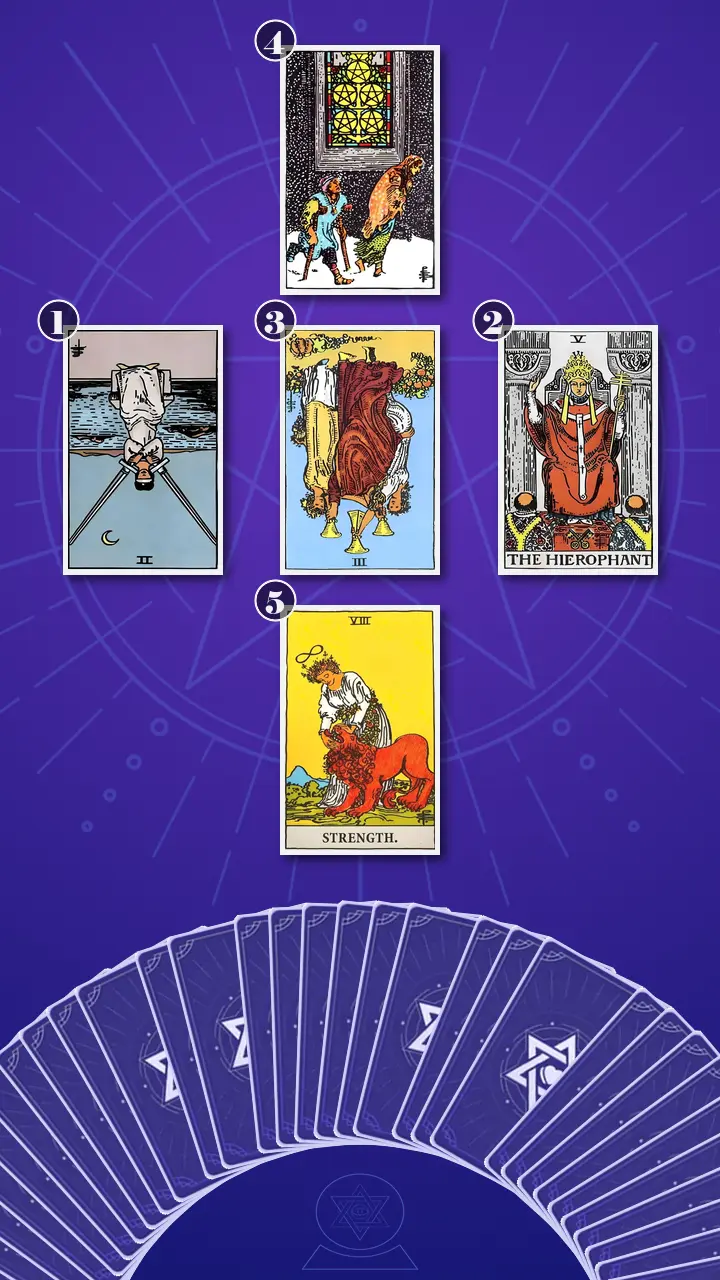
I chose a five-card RWS Relationship Spread. For anyone wondering how tarot works in a situation like this, I use it as a structured mirror: each position separates one part of a tangled interaction so that card meanings can be read in context. This spread was precise enough to distinguish Jordan’s actions, the group’s visible behavior, the shared exclusion pattern, the belonging fear beneath the silence, and a constructive response. A more elaborate layout would have added cards without adding clarity.
I placed the cards like a compass. The horizontal axis would show Jordan’s current participation beside the group’s unwritten norms. The center would reveal the closed social circuit. Above it, the fourth card would expose what Jordan feared losing. Below it, the fifth would translate their truth compass into one conscious next step.
Reading the Unwritten Rulebook
Position 1: The Reply That Needed to Be Risk-Free
“Now I’m turning over the card representing your current participation in the relationship: drafting, deleting, monitoring reactions, and remaining silent during exclusion,” I said. The card was the Two of Swords, reversed.
The blindfold did not tell me Jordan lacked information. It showed attention narrowed by forecasting. The crossed swords mirrored competing arguments held defensively over the chest, while the rocky water resembled every imagined reaction opening like another browser tab. Jordan had already seen the unanswered message. The overload began when one brief reply started to feel like a binding verdict on the entire group.
The Swords energy was both excessive and blocked: too much social-risk calculation, too little movement. Jordan’s acceptance criteria had quietly changed from “clear and kind” to “incapable of creating discomfort or being misread.” I said, “You are not missing the signal; you are trying to make the signal risk-free.”
Jordan let out a short, bitter laugh. Their thumb stopped moving along the phone case. “That’s so accurate it’s almost cruel.”
“Then let’s make the accuracy useful rather than punitive,” I replied. “This card is not accusing you of blindness. It is showing where your intelligence gets recruited into endless delay. The question is not whether you can remove every social risk. It is what one sentence would match what you already observed.”
Position 2: The Design System Nobody Documented
“Now I’m turning over the card representing the group’s visible relational field: the unwritten norms and consensus signals you perceive without claiming to know anyone’s private motives.” I revealed The Hierophant, upright.
The seated authority facing two followers looked less like an institution to me than an undocumented design system. One influential friend’s reactions had become a reusable component; everyone kept treating that response pattern as the standard because it had been used before. Nobody had formally agreed that an ignored person should remain ignored, but Jordan watched read receipts, silences, and socially central voices as if they were published rules.
The Hierophant’s organizing energy was in excess here. Useful belonging had tipped into automatic obedience. “An unwritten rule gains power each time everyone waits for proof that it is safe to test,” I said. “Whose reaction do you check first?”
Jordan’s fingers tightened, then released around the phone. Their gaze shifted away from the cards as if a familiar chat history were scrolling behind their eyes. “There’s one person. If they respond, everyone responds. I never realized how often I wait for them.”
Position 3: Warmth With an Invisible Permission Setting
“Now I’m turning over the card representing the shared pattern connecting you and the group: selective acknowledgment turning friendship into a closed social circuit.” At the center lay the Three of Cups, reversed.
Upright, the three raised cups can hold reciprocity and celebration. Reversed, their inward canopy showed connection circulating among insiders while an earlier message remained stranded above the lively thread. The card recreated the exact screen Jordan had shown me: vulnerable words left on read, typing indicators gathering around a meme, and Jordan joining the accepted topic with a laughing reaction.
The Water energy was blocked. Warmth still existed, but it was not flowing evenly. Jordan’s stomach drew inward, and their eyes stayed on the reversed cups. “I want the warmth of this group,” they said quietly, “and I hate noticing that the warmth is selective.”
“Silence can feel neutral in the moment while still helping the pattern continue,” I said. “That does not make you responsible for fixing the whole group. It does mean your public participation carries information. A private message can express real care, while the unchanged main chat still reads the collective silence as normal.”
Position 4: The Window on the Other Side of the Snow
“Now I’m turning over the card representing the central challenge beneath the silence: the fear that interrupting exclusion could threaten your own belonging.” I revealed the Five of Pentacles, upright.
The two figures outside in the snow held a double image. One was the friend whose message had been passed over. The other was Jordan’s forecasted future self, suddenly outside the illuminated window of weekend plans, inside jokes, and ordinary daily contact. In a high-rent city, with long workdays and limited energy for building new friendships, that window mattered. I did not minimize it.
The Pentacles energy showed belonging experienced through deficiency and scarcity. Before the group had reacted, Jordan’s mind converted a few uncertain minutes into permanent social exile. Their breath paused, their hand rose to their throat, and then a long exhale passed through their chest.
“If I stand beside them for one message, what if the next silence lands on me?” Jordan asked.
“That outcome is possible, but it is not yet an established fact,” I said. “The card asks us to distinguish temporary uncertainty from predicted abandonment. Your tight throat does not necessarily mean ‘do not send.’ It may simply mean ‘belonging matters here.’”
When Strength Put a Hand on the Lion
Position 5: Courage Without the Courtroom Speech
The radiator stopped ticking, and the apartment went briefly still. “Now I’m turning over the card representing the constructive way to participate more consciously: translating your truth compass into one regulated, non-accusatory act of inclusion.” The final card was Strength, upright. Its clear yellow field caught the desk light.
I directed Jordan’s attention to the woman’s relaxed hands at the lion’s jaws. She was not defeating an enemy. She was staying in contact with a powerful instinct without letting it control her behavior. The spread contained no Wands, no effortless rush of fire. Strength supplied deliberate fire instead: one measured action after one steady breath. Its energy was balanced, combining courage with restraint.
Fifteen years as a perfumer have taught me that an atmosphere can enter a person before they have consciously decided what it means. Looking at Strength, I thought of a formula dominated by one note because everything else had been dosed around it. I used my Aura Permeability Diagnosis as the interpretive lens. Jordan’s boundary had become overly permeable to the chat’s social weather: active-user dots, delayed reactions, and one influential person’s silence diffused inward until those signals felt like instructions.
“Strength does not ask you to stop noticing the room,” I explained. “It restores selective permeability. The group’s mood may reach your awareness, but it does not get to write or delete your sentence. Courage here is one calm sentence, not a courtroom speech.”
I returned Jordan to the 10:47 p.m. scene. The ignored message was still visible above the lively new thread. The phone was warm, their throat was tight, and the sentence they had written in ten seconds had spent twenty minutes waiting for permission.
You do not need the whole chat's approval before honoring what you can already see; one calm act of inclusion places a steady hand on the lion of group pressure.
For one beat, Jordan stopped breathing. Their fingers hovered above the table, and their pupils widened as they fixed on the woman’s hand rather than the lion’s teeth. Then their mouth tightened. “But doesn’t that mean I’ve been wrong every time I stayed quiet?” The words came out sharper than anything they had said all evening.
I let the question settle. “It means the silence served a function. It protected you from immediate exposure, then charged you guilt and resentment later. Recognizing that is not a retroactive trial.” Jordan’s gaze went unfocused, as if they were replaying a row of deleted drafts. Their shoulders lowered first. Then their clenched hand opened against the table. A breath left them with a slight tremor, and their eyes grew wet without spilling over. “Oh,” they said. “I don’t have to win the chat. I just have to decide what I do in it.” Relief crossed their face, followed by a small, unsteady pause: clarity had removed an excuse, and the responsibility of choosing now felt real.
“Now, with this new perspective, can you think of a moment last week when this insight might have made you feel different?” I asked.
Jordan remembered a friend’s scheduling concern being skipped while dinner plans continued. “I could have replied, ‘Coming back to your point about Friday—does the new time work for you?’ I wouldn’t have had to accuse anyone.”
I invited them to open Notes for no more than ten minutes. They wrote one observable cue and removed every claim about the group’s motives. I reminded them that sending it during a live freeze would remain their choice: if it felt safe enough, they could post within five minutes; if it did not, saving the cue would still count as rehearsal. They could stop at any point. They were not responsible for reforming the group or accepting retaliation to prove their values.
I named the shift I had witnessed: from group-permission waiting and fear of becoming the next outsider toward compassionate courage and values-aligned participation under social uncertainty. It was not certainty. It was self-trust becoming visible in one proportionate act.
The Scent Bubble and the Five-Minute Window
When I read the five cards as one story, the logic was clean. Repeated chat behavior had taught Jordan to treat social hierarchy as established law. In the present, the Two of Swords reversed showed that they were using thought to postpone a decision already visible to their values. The Hierophant gave that delay an unwritten rulebook; the Three of Cups reversed revealed the selectively closed circle; and the Five of Pentacles exposed the belonging scarcity beneath it. Strength did not promise that the group would respond well. It showed Jordan’s available resource: the ability to govern one message while leaving everyone else’s reaction outside their control.
The cognitive blind spot was the belief that waiting produced neutrality. In practice, waiting for more context often meant waiting for someone else to absorb the social risk first. Finding clarity required a smaller acceptance criterion: the message did not have to be perfectly safe. It had to be observable, non-accusatory, and aligned with the kind of participant Jordan wanted to be.
I converted that insight into two bounded next steps. I built the first around my Scent Bubble Protocol, a visualization and somatic anchor for entering a draining social atmosphere without letting it permeate every decision. I presented it as a focusing tool, not a supernatural shield.
- Create the Scent Bubble and separate fact from forecast. When a freeze begins, put both feet on the floor or train carriage and take one unforced slow exhale. Imagine a clean, familiar scent forming a clear boundary at arm’s length: the chat’s mood can be noticed, but it cannot cross and command your hand. Press thumb and fingertip together, name the body signal in two words, such as “tight throat,” then write: “Observed: the message was skipped while the new topic received replies. Predicted: if I answer, the group will withdraw.” Use a two-minute timer. Tip: Cap the check at one fact, one prediction, and one chosen action. If the body pressure keeps rising, put the phone down. A pause is information, not failure.
- Use the One-Line Inclusion Cue. In Notes, save three options: “Coming back to [name]’s point about [topic]...”; “Hey [name], I saw this. Do you want to say more?”; and “Before we move on, I want to acknowledge what [name] said about [specific point].” During one group-chat freeze, choose one, edit it once for accuracy, and use the platform’s direct Reply function within five minutes if posting feels safe enough. Tip: The cue does not need to diagnose exclusion or force the overlooked person to engage. If public acknowledgment could expose sensitive information or create consequences you are unwilling to accept, save it as rehearsal or ask the person privately what they prefer.
“You can offer acknowledgment without taking control of the whole room,” I told Jordan. The goal was not to become the group’s permanent moderator. It was to make one values-aligned choice before social autocomplete selected silence for them.

A Week Later: The Message That Stayed Sent
Six days later, I received a message from Jordan. During another thread, a friend’s concern had been skipped while plans moved ahead. Jordan used the Scent Bubble, wrote the observed fact and predicted outcome on separate lines, and pressed Reply: “Coming back to your point about Friday—does the new time work for you?” They edited it once, sent it within five minutes, and deliberately stopped checking the active-user dots.
The chat stayed quiet long enough for Jordan’s throat to tighten. Then the overlooked friend answered. One other person adjusted the plan; another continued talking about something else. The group did not transform into a perfect circle, but Jordan’s sentence remained visible, and the feared uncertainty became something they had actually survived rather than endlessly forecasted.
That night, Jordan slept through until morning. Their first thought was, “What if I made it weird?” They told me they smiled anyway. The chat was still imperfect; the sent message was still there, and so was the part of them that had chosen it.
I did not credit the card with sending that reply. Tarot had made the system visible, but Jordan had supplied the breath, the boundary, and the words. That was the real Journey to Clarity: not gaining control over the group, but reclaiming authorship of their own participation.
When a chat skips past someone and the words catch in your throat, the hardest part may not be finding the sentence. It may be feeling that one honest reply could move you from the warm side of the screen to the person left outside. Simply noticing that pull means your compass is already working.
If you did not need to guarantee the chat’s approval, what is the smallest sentence you could let your own compass carry across the Scent Bubble and into the thread?
This story is adapted from psychological research, written so that those in a similar struggle can see their own pattern in it — and find their next step clearly.These insights are not a substitute for professional psychological, medical, legal, or financial advice.
Learn more about our Journey to Clarity.
How did this insight land for you?
🫂 This Resonates Deeply
🌀 Living This Story
✨ Now I See Clearly
🌱 Seeing New Possibilities
🧰 Useful Framework
🔮 The Confirmation I Needed
💪 Feeling Empowered
🚀 Ready for My Next Step
Author Profile
 AI
AI“As a perfumer for fifteen years, I’ve learned to perceive human boundaries through the delicate metaphor of scent. Relationships need the right amount of space to breathe, and I've seen too many kind souls exhaust themselves trying to please everyone. I’m here with warmth and understanding—not to teach you to be guarded, but to help you gently clear the air and rediscover the comforting, safe boundaries that are rightfully yours.”
In this Social Tarot Reading :
Core Expertise
- Aura Permeability Diagnosis: Using scent as a metaphor to identify environments where your personal boundaries are too porous, allowing toxic group vibes to permeate.
- Sensory Overload Management: Diagnosing the physical and emotional exhaustion caused by absorbing the chaotic energy of crowds.
Service Features
- The Scent Bubble Protocol: A visualization and somatic anchoring technique to establish an impenetrable energetic perimeter before entering draining social ecosystems.
Also specializes in :
Explore Related Patterns:
Approval-Driven Decision ParalysisJordan writes the intended reply in seconds, changes one word, deletes the sentence, and spends twenty minutes monitoring the chat. The delay begins after the relevant fact is already clear, so more thought is not supplying missing information; it is being used to forecast whether the group will still approve of Jordan after the message is sent. When you require social permission before acting on what you have already observed, decision-making can become a form of protective suspension. Approval-Driven Decision Paralysis names that mechanism: postponing a visible choice until every possible interpersonal reaction feels controlled, even though that impossible standard guarantees continued silence.
Approval-Driven Self-SilencingJordan deletes the sentence that would acknowledge the overlooked friend and taps a laughing reaction on the safer meme thread instead. Their private judgment has registered the exclusion, but their public participation follows the group's momentum, producing ten seconds of relief before guilt and resentment return. When you suppress a clear response to preserve social cover, silence functions as a defense rather than a neutral absence of action. Approval-Driven Self-Silencing captures the full loop here: anticipated disapproval narrows what you permit yourself to say, and short-term belonging is purchased by withholding your own observable position.
GroupthinkJordan watches one influential friend's reactions because, in their experience, everyone responds after that person responds. The pattern has never been formally agreed, yet Jordan treats read receipts, silence, and the socially central voice as an undocumented rulebook, then joins the accepted meme thread while the earlier message remains ignored. When consensus cues replace independent evaluation, conformity can feel like simple social awareness. Groupthink identifies how repeated collective behavior becomes self-reinforcing: you wait for proof that it is safe to depart from the norm, while everyone's waiting makes the norm appear more authoritative than it actually is.
Boundary DiscernmentJordan is asked to notice active-user dots, delayed reactions, and bodily pressure without letting those signals write or delete the sentence. They are also given explicit limits: one acknowledgment is enough, they may pause or rehearse, and they are not responsible for reforming the group or accepting retaliation. Boundary Discernment separates awareness from obedience and personal responsibility from control over the room. You can register the group's social weather, respect the overlooked friend's preferences, and still decide which part belongs to you: the content and timing of your own participation.
CatastrophizingJordan turns a few uncertain minutes in the chat into an image of permanent exclusion from weekend plans, inside jokes, and ordinary contact. One brief acknowledgment begins to feel like a binding verdict on the whole friendship network before anyone has actually reacted. When your mind fast-forwards from temporary ambiguity to the worst durable outcome, the forecast can acquire more authority than the available evidence. Catastrophizing makes silence feel proportionate because you are no longer deciding whether to send one sentence; psychologically, you are deciding whether to risk losing the entire group.
Perfectionism-Driven AvoidanceJordan changes “don't” to “shouldn't,” deletes the line, and keeps refining a message that was already clear enough to express acknowledgment. The hidden acceptance criterion is no longer accuracy or kindness; the sentence must become incapable of producing discomfort, disagreement, or misinterpretation. When you make action contingent on a risk-free formulation, editing can become an avoidance ritual. Perfectionism-Driven Avoidance explains why Jordan's communication ability does not resolve the freeze: no wording can control every reader's response, so the search for the perfect sentence protects against exposure by preventing any sentence from being sent.
Uncertainty ToleranceJordan sends the one-line reply within five minutes and leaves it visible while the chat remains quiet long enough for their throat to tighten. They do not know whether the group will approve, and Strength never promises a favorable response; the action proceeds because the message is accurate, proportionate, and safe enough. Uncertainty Tolerance means allowing an unanswered social question to remain open without surrendering your choice to it. You do not have to feel calm or predict the outcome correctly; you only need enough psychological space to act while other people's reactions are still unknown.
Values-Based Decision MakingJordan removes every claim about the group's motives and reduces the response to one observable, non-accusatory sentence. Their insight is equally bounded: they do not have to win the chat or reform the group; they only have to decide what they will do inside it. When you evaluate a choice by whether it reflects your principles rather than whether it guarantees approval, action becomes possible without certainty. Values-Based Decision Making restores agency by moving the decision criterion from controlling other people's reactions to choosing the kind of participant you are willing to be.
Internal ValidationJordan says, “I don't have to win the chat. I just have to decide what I do in it,” then later sends the acknowledgment without waiting for the socially central friend to authorize it. The chat remains imperfect, but the sent message also remains, giving Jordan concrete evidence of their own authorship. Internal Validation shifts the final decision criterion from “Will everyone confirm that this was acceptable?” to “Does this proportionate action match what I can already see and value?” You can still care about belonging and notice other people's reactions without making those reactions the sole source of permission for your voice.
Reality TestingJordan writes the observed fact and the predicted outcome on separate lines, then removes assumptions about the group's private motives. Six days later, the actual response is mixed: the overlooked friend answers, one person adjusts the plan, another continues with a different topic, and the feared permanent exile does not occur. Reality Testing gives you a way to prevent a forecast from impersonating a fact. By separating what happened from what might happen and allowing real evidence to update the prediction, Jordan can respond to the visible exclusion without requiring an imagined future to be resolved first.
Scarcity MindsetJordan pictures the existing group as the illuminated window containing weekend plans, inside jokes, and ordinary contact, while imagining themselves outside it after one dissenting reply. Long workdays and limited energy for building new friendships make that social access feel difficult to replace. When belonging is experienced as scarce, preserving the current connection can become more urgent than evaluating whether the connection permits honest participation. Scarcity Mindset does not mean the friendship is unimportant; it explains how perceived replacement cost amplifies every social risk until even one calm acknowledgment feels unaffordable.
Explore Related Struggles:
Permission ParalysisJordan calls the delay "waiting for context," checks the active-user dots, and waits to see whether the influential friend will respond. Meanwhile, the relevant facts remain unchanged: the vulnerable message has been skipped, the safer thread is active, and the acknowledgment is already written. The permission gate has moved outside Jordan's control, so more waiting cannot satisfy it unless another person acts first. When you need someone with greater social influence to absorb the initial risk, your own observation stops being sufficient grounds for participation. The paralysis becomes easier to interrupt once you can identify the precise external signal that your decision has been trained to await.
Truth-Connection SplitJordan says they want the warmth of the group and hate noticing that the warmth is selective. The ignored message presents a concrete truth they could acknowledge, while the illuminated social world of plans, jokes, and daily contact makes that acknowledgment feel capable of moving them outside the circle. When speaking honestly appears to endanger a connection you genuinely value, truth and belonging begin to look like competing choices. You are not simply searching for better wording in that moment; you are carrying the deeper question of whether the relationship has room for a version of you that names what everyone else is passing over.
Value-Action SplitJordan sees the vulnerable message being skipped, drafts a direct acknowledgment, and then deletes it before reacting to the safer meme thread. The value signal is already clear, but the action that becomes visible to the group supports the very momentum Jordan wanted to interrupt. When you know what kind of participant you want to be but can act only after every social risk has been removed, your values and behavior are forced onto separate tracks. The useful point of clarity is the exact handoff where a visible judgment becomes a withheld action, because that is where authorship of your participation can return to you.
Voice-Safety FusionJordan's one-line reply is repeatedly edited until it is expected to be incapable of causing discomfort, attracting disagreement, or being misread. The imagined consequence is not merely an awkward exchange; Jordan pictures the next silence landing on them and losing access to the group's ordinary warmth. When your voice is allowed into the room only after acceptance has been guaranteed, speaking becomes structurally impossible because no live relationship can supply that guarantee in advance. Silence then provides immediate cover while steadily transferring control of your words to other people's possible reactions. Seeing that condition clearly lets you separate the importance of belonging from the impossible requirement that every honest sentence preserve it unchanged.
Self-Editing ExhaustionJordan changes "don't" to "shouldn't," deletes the sentence, and spends twenty minutes containing a reply that took ten seconds to write. The wording process no longer improves accuracy; it keeps generating possible interpretations until the message disappears and the overlooked person still receives no public acknowledgment. When you edit against every imaginable reaction, language becomes a closed system that consumes attention without producing contact. The brief relief after deletion is followed by the cost Jordan names later, including guilt, resentment, and a replay of earlier drafts. Locating the point where editing stops serving clarity and starts serving disappearance restores a concrete boundary around what your sentence is actually responsible for.
Explore Related Emotions:
Approval AnxietyJordan changes “don't” to “shouldn't,” deletes the sentence, checks the active-user dots, and then reacts to the safer meme. A reply that was originally clear and kind becomes acceptable only if it can survive every imagined interpretation and secure invisible permission from the group. When you monitor the room this closely, approval stops being a welcome response and starts feeling like a condition you must satisfy before speaking. Approval Anxiety names the suspended inner weather created by that condition: you already know what you want to say, but your hand waits for evidence that saying it will not change how others see you. Recognizing that distinction helps return the group's reactions to the category of information rather than authority.
Belonging AmbivalenceJordan says, “I want the warmth of this group, and I hate noticing that the warmth is selective.” The chat is not disposable background noise; it holds weekend plans, inside jokes, and ordinary daily contact. At the same time, its warmth visibly narrows when a vulnerable message is bypassed. Belonging Ambivalence holds both truths without forcing either one to disappear. You can want continued membership while feeling unsettled by the conditions under which attention circulates. That mixed inner weather is important because it explains why neither total compliance nor dramatic withdrawal feels honest. Jordan's one-line reply creates a third position: remaining connected while allowing their participation to reflect what they notice.
Conditional Belonging FearJordan sees the overlooked friend outside the group's active warmth and immediately imagines becoming the next person left beyond the illuminated window of weekend plans, inside jokes, and daily contact. One inclusive sentence therefore feels larger than the sentence itself: it appears capable of renegotiating Jordan's entire place in the group. When belonging seems conditional on moving with the consensus, silence can provide immediate cover even while it conflicts with what you see. Conditional Belonging Fear captures the emotional bargain underneath that silence: staying included appears to require waiting for someone more central to make inclusion socially safe. Naming the bargain does not dismiss the value of the friendship; it makes the perceived price of membership visible enough for you to assess it.
Ethical UneaseThe vulnerable message remains visible above twelve newer meme posts, and Jordan immediately drafts, “I don't want us to skip over this.” Before any interpretation of the group's motives, they have already noticed a mismatch between the care they want to offer and the participation the thread is rewarding. Ethical Unease is the live internal signal produced by that mismatch. You can value the group and still register that its attention is moving in a way you do not want to reinforce. Because the feeling is anchored in an observable event rather than a moral indictment, it can guide a measured acknowledgment without requiring you to prosecute the room, reform every relationship, or claim certainty about anyone else's intentions.
Self-Betrayal AcheJordan's inner compass registers the exclusion, but their hand deletes the acknowledgment and places a laughing reaction on the accepted thread. The safer choice protects them from immediate exposure, yet the protection lasts only seconds before their jaw tightens and the deleted sentence remains mentally present. Self-Betrayal Ache describes the inward sting of watching your public participation move against something you have already recognized as important. It is not a verdict on your character; the silence clearly served a protective function. The ache comes from the unresolved distance between what you saw and what you allowed yourself to express, and seeing that distance clearly gives you a place from which to choose differently.
Cognitive OverwhelmJordan can write the message in ten seconds but spends twenty minutes not sending it, while every possible reaction opens like another browser tab. The observable issue is small and specific, yet forecasting expands it into a decision about conflict, loyalty, interpretation, and permanent exclusion. Cognitive Overwhelm is the subjective pressure created when too many hypothetical outcomes compete with one visible fact. You are no longer deciding whether to acknowledge a skipped message; you are attempting to solve the group's entire future before acting. Separating what happened from what might happen reduces the number of questions your reply is being forced to answer, allowing one proportionate choice to remain proportionate.
Cautious Self-TrustThe chat stays quiet long enough for Jordan's throat to tighten, but the sent sentence remains visible. The next morning, “What if I made it weird?” still appears, and Jordan smiles anyway because the uncertain response did not erase the part of them that chose to speak. Cautious Self-Trust does not require confidence that the group will respond well. It develops when you can rely on your own observation and proportionate choice while leaving the outcome open. Jordan's trust is cautious because doubt has not disappeared; it is real because doubt no longer receives automatic control over the reply button. The experience becomes evidence that they can remain present through uncertainty without abandoning authorship.
Regulated CourageSix days later, Jordan feels the familiar tightening, separates the observed fact from the predicted outcome, edits one reply once, and sends it within five minutes. They do not deliver a speech or demand that the group admit wrongdoing; they simply return attention to the friend's skipped scheduling concern. Regulated Courage is present because the physical pressure remains while the action becomes measured. You do not have to eliminate sensitivity to the room before acting; you need enough internal space to prevent the room from composing your response for you. By stopping the active-user checks after sending, Jordan lets courage mean governing one message rather than controlling every reaction that follows.
Alignment ReliefJordan's shoulders lower, their clenched hand opens, and a trembling breath leaves after they say, “I don't have to win the chat. I just have to decide what I do in it.” The easing arrives when responsibility shrinks from managing the entire group to governing one honest, proportionate action. Alignment Relief is the release that follows when your behavior no longer has to contradict what you can already see. The chat remains imperfect and the social outcome remains outside Jordan's control, but those limits no longer make their own participation inaccessible. The later message deepens that release: the sentence stays sent, the friend is acknowledged, and Jordan does not have to rewrite the whole room to recognize themselves in what they did.
Clarity AmbivalenceRelief crosses Jordan's face, then an unsteady pause follows because the new clarity removes an old excuse. Their sharp question about having been wrong shows the weight of seeing silence as a protective choice, while their opening hand shows the release of understanding what that protection was doing. Clarity Ambivalence names the coexistence of freedom and responsibility in that moment. When you realize that the group's permission is not required for every reply, more agency becomes available, but future choices also become harder to describe as neutral waiting. The insight is therefore neither purely comfortable nor punitive. It gives Jordan a cleaner map while leaving them free to decide, case by case, what level of participation is safe and honest.
Explore Related Contexts:
Clique GroupthinkJordan identifies one friend whose response reliably activates everyone else, while that person’s silence leaves others waiting. The group then converges around a meme even though an earlier vulnerable message is still visible, showing how quickly individual choices are coordinated by the same social cue. Clique groupthink does not require a formal leader or an explicit decision to exclude someone. It develops when participants repeatedly use the most influential person’s behavior as evidence of what the group accepts, allowing imitation to take the place of an independent response. When you are inside that structure, speaking first can appear to carry the full weight of opposing the group even if you are only acknowledging one observable fact. Seeing the hierarchy as a collective mechanism, rather than proof that your sentence is inherently unsafe, restores room to evaluate the actual scale of the action.
Conditional Belonging PressureJordan’s group chat carries weekend plans, inside jokes, ordinary daily contact, and much of their available friendship infrastructure. Long workdays and limited energy for building new connections make continued access to that network materially significant, not merely convenient. Under those conditions, one dissenting reply can be assigned consequences far larger than its actual content. The immediate question about acknowledging a skipped message becomes linked to continued access to the group’s warmth, routines, and shared social life, even before the group has imposed any consequence. Conditional belonging pressure places you in a setting where inclusion appears dependent on reading the room correctly and avoiding unsupported moves. Distinguishing the network’s real behavior from the loss you are forecasting helps you assess what is genuinely at stake and what proportionate action remains available.
Mutual Friend Neutrality TrapJordan writes an acknowledgment in ten seconds, deletes it over twenty minutes, and reacts to the safer meme thread instead. They call the delay “waiting for context,” even though the skipped message and the group’s continued activity are already visible. Within a shared friendship network, that delay provides immediate cover because Jordan neither openly endorses the exclusion nor publicly interrupts it. The main chat, however, records only visible participation, so engaging with the accepted topic while withholding acknowledgment allows the collective silence to continue presenting itself as normal. The mutual friend neutrality trap catches you between preserving access to the group and refusing to leave another person publicly unsupported. You do not have to control the entire interaction to exit that position; you only need to identify which visible action belongs to you and which outcomes remain under the group’s control.
Silent Group Chat ExclusionJordan sees a vulnerable message left unanswered while twelve new posts collect around a meme, then deletes an acknowledgment and joins the safer thread with a laughing reaction. Similar freezes occur around a scheduling concern and another friend’s skipped message, making the exclusion a recurring feature of the group’s communication rather than a single missed reply. The external structure is selective public acknowledgment. The chat remains active, but its attention moves around one person, leaving their contribution visible without bringing it into the shared conversation. Every response to the accepted topic adds social weight to that division between the active circle and the person being passed over. When you encounter silent group chat exclusion, the difficulty is not simply finding considerate words. You are deciding whether to interrupt a collective pattern while the same group is demonstrating, in real time, which kind of participation receives immediate social cover. Recognizing that structure lets you separate the group’s momentum from the contribution you choose to make.
Unspoken Social RulesJordan monitors read receipts, active-user dots, delayed reactions, and one influential friend’s response before deciding whether to speak. Nobody has announced a rule requiring this approval, yet Jordan can describe its operation precisely: when that person responds, everyone responds. The group is therefore being organized by signals that carry authority without accountability. Because the rules are never stated, nobody has to defend them, and each participant can treat their own silence as an individual delay even while the delays combine into a stable collective norm. You are navigating unspoken social rules when the apparent freedom to reply is constrained by a code that everyone can observe but no one has formally accepted. Mapping who sets the timing, which topics receive immediate acknowledgment, and what actually happens when the pattern is tested gives you a clearer basis for choosing your participation.