At Family Dinner, 'Fine' Gives Way to One Bounded Opinion

The 7:42 P.M. Disappearing Act
I met Jordan, a 27-year-old communications coordinator in Toronto who could challenge a campaign brief in a Tuesday meeting and then answer “How is work?” with “Fine” at Sunday dinner. She gave me the contradiction in one line: “I can talk to anyone until my family looks at me.”
As Jordan described the previous Sunday, I could see the scene as clearly as if I had been sitting beside her. At 7:42 p.m. in a North York dining room, the ceiling light hummed above a table that smelled of rosemary and warm bread. Her phone was tucked beneath her thigh, still warm against her palm, while her fork pressed a pale groove into the mashed potatoes.
A relative had asked what she really thought about changing careers. The table went quiet for half a second. Jordan already had an answer, but her throat tightened, her breathing climbed into the top of her chest, and her shoulders became unnaturally still. She looked down and said, “Work is going fine.” Then she reached for the water jug before anyone could ask what she meant.
“Why do I go quiet again when my family sits around the table?” she asked me. “I am an adult everywhere except at that table. I keep waiting for someone to make it okay to speak.”
I heard apprehension in the careful way she arranged those words. It felt less like ordinary nervousness and more like a thin wire running from her throat to every eyebrow around the table: one visible reaction, and the wire would pull tight. Beneath it, I could also hear shame, frustration, and the quieter longing to be known without having to risk her place in the room.
“Going quiet does not mean you lack an adult voice,” I told her. “It may mean an old protective response is arriving before you have time to choose. I am not going to use tarot to tell you what your family thinks or what you must disclose. I want us to map the few seconds between having an opinion and editing it away. That is where we may find some room.”
The safest answer is the shortest one, until safety starts to feel like absence. Jordan gave a small nod when I said that. I placed the deck between us and told her our Journey to Clarity would not be about forcing a confrontation. It would be about restoring choice: the choice to speak, pause, set a boundary, keep something private, or leave a conversation when that was the most self-respecting response.

Choosing a Map for the Unwritten Table Rule
I invited Jordan to put both feet on the floor and take one unforced breath. I shuffled slowly while she held the question in mind. The movement was not a mystical performance; it was a transition from replaying the whole family history to examining one recurring interaction with care.
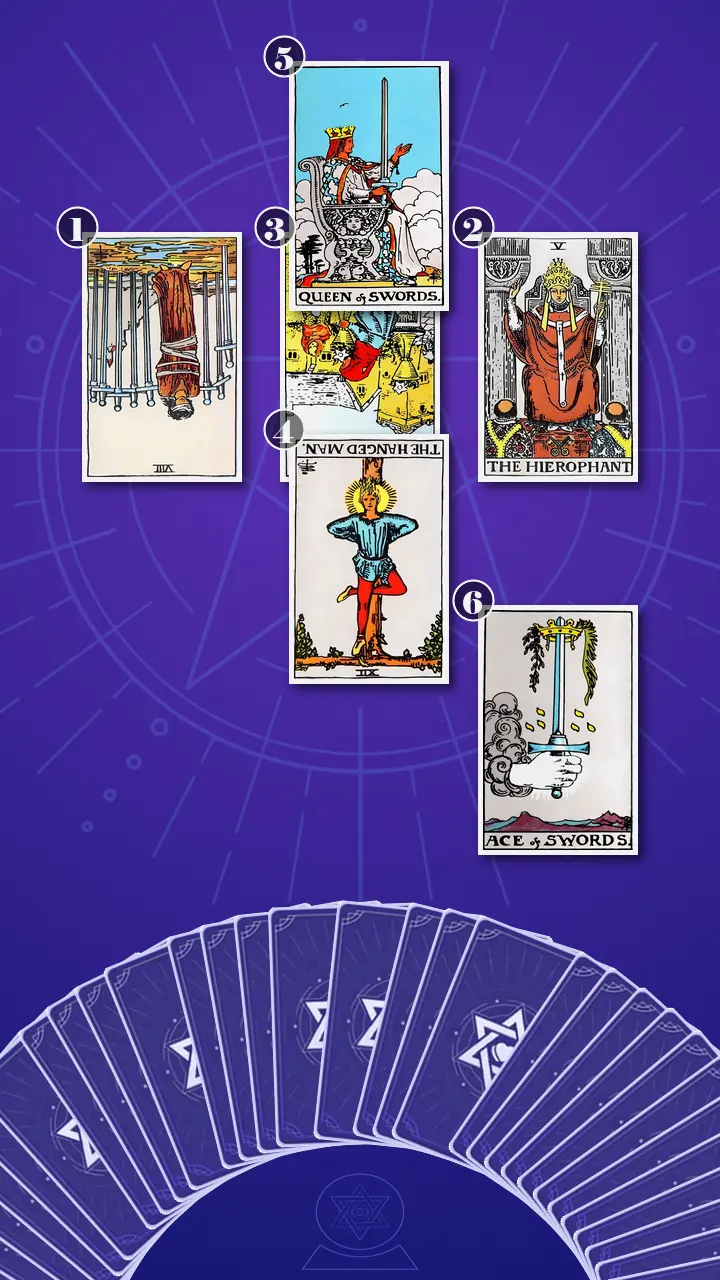
I chose the Relationship Spread · Context Edition, a compact six-card relationship tarot spread. The question concerned a repeated behaviour inside a shared family setting, so a general future reading or a simple yes-or-no spread would have been too blunt. I needed a structure that could separate Jordan's own response from the atmosphere around her, trace the old role beneath the silence, identify the waiting loop, and then turn insight into one bounded next expression.
For anyone wondering how tarot works in a session like this, I treat the cards as visual prompts and competing hypotheses, not as verdicts. Card meanings in context help me ask better questions: What is observable? What is remembered? What is predicted? What remains within the querent's control? Jordan would decide which interpretation matched her experience and which did not.
I laid the first two cards opposite each other like two sides of the dinner table. Position one would show Jordan's present relational stance: the lowered gaze, one-word answers, and physical stillness. Position two would show the family table field, including the customs and predicted reactions that formed its invisible permission system.
The third card sat in the centre to reveal the interaction pattern and its emotional root. Beneath it, position four would identify the stagnation lock, the place where a useful pause became suspended agency. Above it, position five would reveal the adult resource available to Jordan. The sixth card extended down and to the right as the next bounded expression, a practical route out of the loop.
The layout resembled a table with a narrow central passage. I told Jordan that the spread could show us the architecture of the scene, but it could not decide what she owed anyone. The cards were the map. She remained the person choosing where, whether, and how far to travel.
The Blindfold, the Keys, and the Held Breath
Position 1: The Answer Behind the Blindfold
“Now I am turning over the card representing your present relational stance,” I said. “This is the part of the pattern we can observe in your body and behaviour before we interpret anyone else's motives.”
The card was the Eight of Swords, in reversed position.
I pointed to the loosened blindfold, the crossed wrists, and the narrow perimeter formed by the swords. “At the family table, you have a complete answer in your head, but you look at the plate and scan faces for approval before speaking. Then you replace the answer with something neutral. This reversal asks a practical question: are you literally unable to answer, or is a learned restriction making every available answer feel dangerous?”
The Eight of Swords often depicts perceived restriction. Reversed, its energy can show a Blockage beginning to loosen: the blindfold is no longer invisible from the inside. Jordan did not need to pretend the consequences were imaginary. Her body had learned from repeated interactions. But the card separated a history of caution from the conclusion that she had no present-day options at all.
“The first opening is not a dramatic speech,” I said. “It is noticing that there is already a sentence behind ‘Fine.’ If the silence is a learned constraint rather than proof that you have no voice here, what is the one sentence being edited out?”
Jordan gave one short laugh, but it held no amusement. “That is so accurate it feels a little cruel.”
I let the reaction stand instead of rushing to make the card sound positive. “I understand. Recognition can sting when the pattern has been protecting you. We are not going to shame the protection or rip the blindfold off. We are only checking whether it still needs to control every answer.”
I also named the reversal's overcorrection risk. Jordan might feel tempted to prove she was no longer restricted by disclosing too much, speaking abruptly, or challenging the entire family system at once. That could leave her exposed and make silence feel even safer next time. The card offered space, not a demand to perform courage.
Position 2: The Invisible Access Code
“Now I am turning over the card representing the family table field,” I said. “This position shows the repeated customs, tones, and anticipated reactions that shape participation before anyone explicitly announces a rule.”
The card was The Hierophant, upright.
I traced the two acolytes, the raised teaching hand, and the crossed keys at the figure's feet. The Hierophant can represent tradition, shared values, and the structures through which a group learns how to belong. Those structures can offer continuity in Balance. In Excess, inherited convention can begin acting like unquestionable authority over a person's present voice.
“Every Sunday meal seems to take the same route,” I said. “There are practical updates, a few approved opinions, and then a pause or quick subject change around something more personal. No one has to post the rules on the fridge. You have learned the access code through repetition.”
I compared it to joining a family group chat where one topic always receives warm reaction emojis while another is repeatedly left on read. After enough repetitions, a person starts editing messages before pressing send. The cultural reference made Jordan smile, but the underlying distinction remained serious: a predicted response is not identical to a response happening now.
“Which rule has actually been stated?” I asked. “And which rule are you enforcing through prediction because you already know the table's usual choreography?”
Jordan rubbed her thumb along the edge of the card. “No one has said, ‘You are not allowed to disagree.’ It is more like somebody goes quiet, or makes a joke, or says I am overthinking. Then everyone moves on.”
“That is still meaningful relational data,” I replied. “I am not asking you to deny it. I am asking us to distinguish the table's observable behaviour from the much larger conclusion that belonging requires you to have no separate view.”
The Hierophant did not tell Jordan to reject tradition or closeness. It asked which customs she genuinely valued and which had acquired authority only because they had been repeated without review. In my reading, the family field was real, but it was not the sole author of her participation.
Position 3: The Old Role Enters the Room First
“Now I am turning over the card representing the interaction pattern and its root,” I said. “This is where we look for the earlier emotional role that may be entering the current exchange before your adult self checks what is happening now.”
The card was the Six of Cups, in reversed position.
I showed Jordan the smaller child offering a flower-filled cup inside an enclosed courtyard. Upright, the Six of Cups can hold memory, familiarity, and early emotional exchange. Reversed, the Water energy may flow backward. In this reading, it formed a Blockage by carrying a remembered expectation into a present adult conversation.
“A relative uses a tone you remember from adolescence,” I said, “and before you check what you believe today, you become the person who avoids correction by saying, ‘It does not matter.’ The useful question is not whether that younger response once made sense. It probably did. The question is whether that role still gets to write every answer.”
This was where I introduced one of my core lenses, Family Casting Analysis. I explained that I was not assigning Jordan a fixed psychological label, and I was not diagnosing her relatives. I was looking at the role she appeared to be cast in whenever the familiar scene began.
“At this table, your forced role seems to combine the Quiet Child and the Peacemaker,” I said. “Your lines are brief. Your blocking sends you toward the sink. Your job in the scene is to keep the emotional continuity smooth. Becoming useful protects you from being visible.”
Jordan's fingers tightened around her water glass, then eased. Her gaze moved away from the card as if she were replaying several dinners at once. Finally she exhaled from low in her chest. “I always thought clearing the plates meant I was being considerate. Sometimes it is. But sometimes I am halfway to the kitchen before I realize I am escaping.”
“Both things can be true,” I told her. “A caring action can also become an exit. We are not putting the gesture on trial. We are restoring your ability to notice which function it is serving in that moment.”
I asked Jordan to imagine two lines in her Notes app: Old table rule and Present-day choice. The old rule might read, “Keep it smooth by becoming smaller.” The present-day choice did not need to be its dramatic opposite. It could simply read, “Today, I think differently.”
Position 4: The Pause That Never Ends
“Now I am turning over the card representing the stagnation lock,” I said. “This position shows where a deliberate pause becomes continued silence and prevents you from testing an adult voice.”
The card was The Hanged Man, in reversed position.
I pointed to the suspended body, the bound ankle, and the halo. Upright, the Hanged Man's pause can be chosen and illuminating. Reversed, that pause may become Excess suspension and Deficiency of agency. It no longer creates perspective; it becomes a holding pattern.
“A direct question arrives,” I said. “You wait for someone else to soften the room. One person speaks, then another. Two or three conversational turns pass. When the subject changes, you treat the missed opening as evidence that speaking was impossible.”
I placed the reversed Six of Cups beside the reversed Hanged Man. The enclosed childhood courtyard seemed to narrow into the suspended figure's unmoving position. Together, they made the loop visible: an old tone activated the younger role, and the younger role waited for permission from the same atmosphere that had taught her to wait.
“The inner argument sounds like this,” I said. “‘I am waiting for the room to make this possible.’ But beneath it is another sentence: ‘I am using the room's silence as proof that it is impossible.’”
Jordan's breath caught. Her hand hovered above her phone, stopped, and returned to the table. Her eyes lost focus for a few seconds before she said, very quietly, “I remember exactly when it happened on Sunday. I had the words. I just kept waiting for the right tone.”
“That recognition matters,” I said. “Not because you should have forced yourself to speak, but because a missed opening and an unavailable voice are not the same thing. You can pause without disappearing.”
I offered a replacement for indefinite suspension: after a direct question, Jordan could take no more than ten seconds and say, “I want to answer that. Give me a moment.” She could then answer, decline, or change the subject. The goal was not immediate speech at any cost. It was turning the pause back into a conscious adult choice.
When the Queen of Swords Opened Her Hand
Position 5: The Clear-Sighted Adult
The room became unusually still as I reached for the card above the spread's central bottleneck. Rain that had been ticking against the window softened, and a stripe of late light fell across the card as I turned it. I knew this was the bridge card, the one that could connect Jordan's recognition of the old script to a different way of entering the next scene.
“Now I am turning over the card representing your adult voice resource,” I said. “This position identifies the quality that can interrupt the child role while preserving your boundaries and your freedom to choose connection.”
The card was the Queen of Swords, upright.
I centred Jordan's attention on the Queen's vertical sword and open left hand. The sword offered precise language. The open hand offered receptivity without surrender. In Balance, this Queen does not confuse clarity with attack or openness with unlimited access. She can hear another person's reaction without handing that reaction authorship over her own view.
I named the setup plainly: Sunday dinner is nearly over in a Toronto dining room. Jordan has answered three questions with “fine,” carried two plates to the sink, and watched a sentence disappear while her fork presses a pale mark into the mashed potatoes.
At work, Jordan could say, “I see it differently,” and then explain the relevant evidence. At the family table, the same four words triggered an internal demand for a five-sentence apology, a defence brief, and advance management of everybody's feelings. The Queen removed that extra labour. She did not ask Jordan to win the table. She asked, “Is this accurate for me now?”
As an artist, I often understand a stuck life through the language of scenes and casting. Looking at the Queen, I thought of an actor who has grown beyond a role while the rest of the production keeps handing her the old pages. The solution is not necessarily to burn down the set. Sometimes it begins when she stops reading the line assigned to her.
I deepened the Family Casting Analysis through a second lens I call Narrative Enmeshment Diagnosis. I use that phrase as a storytelling framework, not a clinical diagnosis. It helps me recognise when a person's current plot has been recruited to complete an inherited one.
“Your personal story keeps getting hijacked by the family's unfinished plotline about smoothness,” I told Jordan. “In that plot, your silence proves everyone is still close because nothing disruptive is spoken. But that is not the only possible definition of connection. The Queen recasts you, not as the prosecutor and not as the rebellious child, but as the clear-sighted adult who can stay present without disappearing.”
Silence may have once kept the old child role protected, but the Queen of Swords invites Jordan to use calm discernment and one precise boundary as an adult choice.
I left a deliberate pause, then gave her the central insight in its simplest form.
The family table does not have to become a permission slip for your adult voice. One calm, bounded sentence can express what is true for you now without requiring anyone else to agree.
Jordan's breathing stopped first. Her fingers remained curved around the glass, but the grip froze rather than tightened. Then her pupils widened and her eyes moved past me, as though an old reel of Sunday dinners had started playing against the wall. Her mouth opened, closed, and tightened at one corner. “But does that mean I have been doing it wrong all this time?” she asked, anger briefly sharpening her voice. “Does it mean I let this happen?” I told her no. Protection was not a mistake merely because it had become costly. Her anger softened into a trembling exhale. Her fist opened on the table, her shoulders dropped, and her eyes reddened with relief and a new, less comfortable vulnerability: if she had a choice now, even a small one, she would have to decide how to use it. I asked, “Now, using this new perspective, think back: was there a moment last week when this insight might have made you feel different?”
Jordan looked at the Queen again. “When they asked about work, I thought I had to explain my entire plan or say nothing. I could have said, ‘I am still deciding, but I do have a view.’ That would have been true. I would still have been nervous, though.”
“Yes,” I said. “Clarity does not require your body to feel completely calm first. This is the key movement from permission-seeking silence and old-role activation toward adult self-trust, bounded speech, and relational choice. It is a beginning, not a personality transplant.”
I asked Jordan to write one sentence beginning with “Today, I think...” and read it aloud once with both feet on the floor. I invited her to notice her throat, shoulders, and breath without forcing them to relax. If the exercise felt too exposing, she could shorten it, keep it private, or stop. She controlled the pace and whether the sentence would ever reach the table.
“A boundary can be one sentence long,” I reminded her. “The Queen's open hand means you can remain receptive. Her sword means receptivity does not require surrendering the boundary.”
I also named the risk of using the sword as armour. Adult speech did not have to become blunt disclosure or a dramatic reckoning with the whole family history. Jordan could say one accurate thing and still decline a debate. She could choose privacy if a topic felt intrusive. The Queen represented discernment precisely because she could decide what not to share.
Position 6: The Sentence That Enters the Room
“Now I am turning over the card representing your next bounded expression,” I said. “This position translates the reading into one small sentence or behaviour you can try without predicting or controlling anyone else's response.”
The final card was the Ace of Swords, upright.
A hand emerged from a cloud holding a crowned sword. Leaves fell around the blade. I read the image as a private thought crossing into shared space with clean edges. The Ace offered concentrated Air in Balance: one clear idea, stated once, without apology, padding, or a demand for validation.
“Before dinner, you write one sentence in your Notes app,” I said. “When the topic appears, you put your phone face down and say it. Then you let any silence exist without softening the statement into a neutral update. This is not a prediction that your family will respond well. It is a small experiment in participation.”
The spread had moved from constricted Air in the reversed Eight of Swords, through Water flowing backward in the reversed Six of Cups, and finally into the clean Air of the Queen and Ace. Fire and Earth were missing from the suit cards, which told me the reading needed an embodied action to become useful. Jordan did not need to wait for confidence to ignite. Both feet on the floor, one hand on the table, one chosen sentence: those modest physical details could ground the insight.
“The question changes here,” I said. “Before, it was ‘Will they approve?’ The Ace asks, ‘Is this sentence accurate for me now?’ Their reply is information about the relationship. It is not the certificate that makes your perspective real.”
Jordan placed her phone face down beside the spread and rested one palm on the table. “I see it differently,” she said. She immediately inhaled as if preparing to add an explanation, then stopped. The sentence remained between us, ordinary and complete.
“What do you notice?” I asked.
“My throat is still tight,” she said, “but I do not feel absent.”
That distinction was the Ace's actionable clarity. Tarot had not supplied Jordan with a magical voice or promised a changed family. It had helped her see the sequence clearly enough to locate the part she could author.
Rehearsing the Next Scene, Not the Whole Life
I drew the six cards into one coherent storyline for Jordan. The reversed Eight of Swords showed the present restriction becoming visible. The Hierophant showed the repeated social script that organised the table's sense of belonging. The reversed Six of Cups revealed why an old child role could feel current before Jordan checked the facts. The reversed Hanged Man showed how waiting for permission preserved the silence. The Queen restored adult discernment, and the Ace gave that discernment a simple verbal form.
The reason the pattern kept repeating was not that Jordan had nothing to say. She entered a familiar scene, anticipated the old direction, and performed the role most likely to keep the atmosphere smooth. The short reply reduced exposure. Because she left without testing an adult response, the unchanged silence then looked like proof that the script still controlled the table. The loop protected the moment while keeping her absent from her own family life.
I named the cognitive blind spot directly: Jordan had been treating anticipated disapproval as present evidence, and she had reduced her choices to two extremes. Either she stayed quiet, or she delivered a complete explanation of her life and survived everyone's reaction. The Queen and Ace revealed a third option: one present-day sentence, bounded by what she did and did not want to discuss.
The transformation was not from quiet to outspoken. It was from involuntary permission-seeking to deliberate relational choice. Conscious privacy could still be an adult boundary. Leaving an intrusive or hostile conversation could still be wise. The change lay in Jordan deciding, rather than an old role making the decision before she arrived.
To make the insight usable, I brought in my Script-Flipping Rehearsal. I played the relative asking, “So, are you finally going to make a decision about work?” Jordan first delivered her usual line: “It is fine.” We paused, reset the scene, and rehearsed an intentionally out-of-character response: “I am still deciding, and I do not want advice about it tonight.”
Jordan winced. “That sounds rehearsed. And if somebody jumps in immediately, I will lose the whole ten seconds.”
I adjusted the rehearsal instead of defending the exercise. “Then we shorten it. Your first line can be, ‘I want to finish this thought.’ A rehearsed sentence is not fake; it is support for a nervous system that tends to delete the sentence under pressure. We are not trying to overpower the table or guarantee a permanent change in its dynamics. We are interrupting your automatic choreography long enough for you to make a choice.”
I gave Jordan three practical next steps. Each one was deliberately small enough to test present-day reality without turning the next family dinner into a referendum on the whole relationship.
- Run the Script-Flipping Rehearsal. Within ten minutes tonight, open the Notes app and write one line beginning with “Today, I think...” Add one boundary line you could use if someone presses, such as “I am not looking to debate it.” Read both lines aloud once with both feet on the floor. Keep the topic low-stakes and the practice private if needed. If one line feels too exposed, shorten it to four or five words.
- Use the Ten-Second Adult Voice Pause. At the next family meal, when one ordinary personal question arrives, put the phone face down, feel the chair beneath you, and pause for no more than ten seconds. Then say the prepared sentence, ask for a moment, or consciously choose not to answer. Missing the first opening is not failure. If the interaction becomes invasive or hostile, changing the subject, keeping information private, or leaving is a valid boundary.
- Separate Facts from Replay. On the TTC ride home or during three quiet minutes in the apartment, write two lines: “What I said” and “What I was tempted to edit out.” Then note one observed response and one response you had predicted in advance. Keep the note descriptive. Do not use one dinner as a verdict on your courage, your family, or the future of the relationship.
“The table does not have to agree for your sentence to be real,” I told Jordan. “And you do not owe the table a sentence merely because you prepared one. The point of the exercise is ownership, not disclosure.”

A Week Later: One Sentence on the Table
Six days later, Jordan sent me a message after Sunday dinner. She had chosen an ordinary opinion about a possible move within Toronto rather than the most emotionally loaded subject. When a relative dismissed the neighbourhood she liked, Jordan placed both feet on the floor and said, “I see it differently. I like being able to walk to things.”
Someone frowned. Another person began talking about rent. The table did not transform, and no cinematic score rose behind her. Jordan took one sip of water, kept her hand on the table, and did not rush to turn her preference into a neutral update. She also did not explain her entire housing plan.
On the Line 1 ride home, she still replayed the moment. This time, however, her Notes app contained two factual lines instead of an unsent defence brief: “I said what I thought. I stayed for the reply.”
She slept through the night, then woke with the thought, “What if they think I was difficult?” She told me she smiled at the thought, not because the fear had vanished, but because it was no longer the only voice in the room.
I did not see that small change as proof that tarot had altered Jordan's fate. I saw it as evidence that she had used the reading as an objective mirror, recognised an inherited script, and chosen one line of her next act for herself. Her throat had still tightened. The family had remained imperfect. Yet she had moved from self-erasure toward relational presence, and the movement belonged to her.
When a family table makes the throat close and the hand grip the fork, disappearing can feel safer than testing the fear that being fully oneself might cost a place in the room. I would never dismiss the intelligence of that protection. I would only invite the possibility that noticing the old casting already creates a little space between the script and the person reading it.
If the table did not have to become a permission slip first, what one present-day sentence could you quietly imagine placing beside the Queen's open hand and letting stand?