The Deleted Text Behind Roommate Chore Resentment
You can chase owners for overdue tasks all day as a junior project coordinator, then get home in Toronto, see the same dishes by the sink, and delete the roommate text because the Sunday Scaries have somehow followed you into Tuesday. That was the split Jordan brought to me: conflict avoidance around unequal household chores had turned invisible labor into resentment and silent scorekeeping.
At 8:47 p.m., Jordan joined my video call from the kitchen of their rented apartment near a Line 1 stop. They dropped their tote by the door, opened the fridge, and looked back at the same bowls beside the sink. Through my headphones, I could hear the fluorescent hood light buzzing above them. The dishwater smelled faintly sour, they said, and their phone felt warm in their palm as they typed a roommate message, deleted it, and turned on the tap instead.
“I can coordinate five people at work without making it weird,” Jordan said, rubbing the hinge of their jaw. “But if I bring this up, the whole apartment will feel tense. It would be easier if they just noticed. Then I wash everything, and I’m angry that I had to.”
The feeling sat behind their ribs like steam trapped under a saucepan lid: contained, hot, and gathering pressure each time the same chore appeared. Their shoulders had risen almost to their ears before any conversation had taken place.
“You’re not upset only because there are bowls in the sink,” I said. “You’re stuck because saying what you need feels as if it might change the safety of home. I’m not here to predict your roommate’s response or tell you what choice to make. Let’s use the cards to map the pattern, separate facts from fear, and find the smallest honest next step.”

A Crossroads on the Kitchen Table
I asked Jordan to let the tap run for a moment, feel both feet against the tile, and bring one recurring chore to mind. I shuffled slowly while they breathed. The pause was not a mystical performance; it was a way to stop rehearsing every possible outcome long enough to examine the actual question.
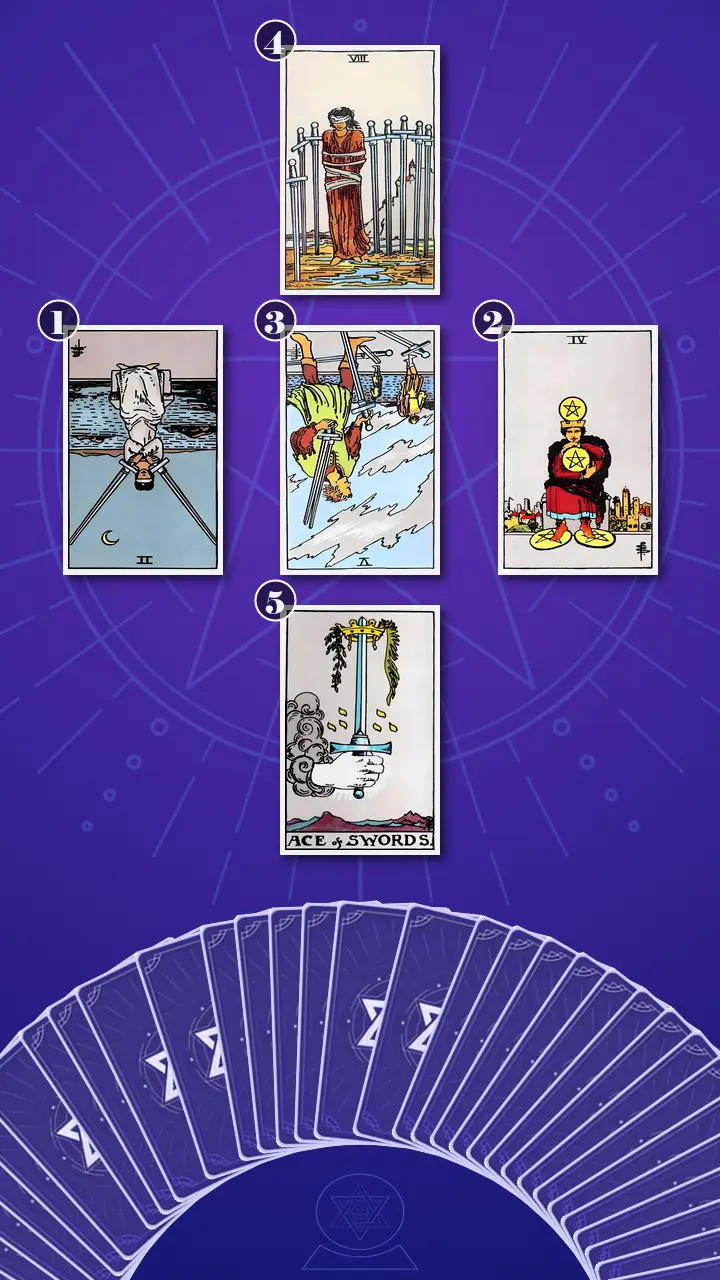
I chose the Relationship Spread · Context Edition, a contextualized five-card Relationship tarot spread for roommate conflict. For readers who ask me how tarot works in a situation like this, I use it as a structured reflection tool. The issue lives inside a relationship pattern, so the spread examines Jordan’s stance, the roommate’s stance as Jordan currently experiences it, the dynamic between them, the fear maintaining that dynamic, and the constructive action Jordan controls. A larger spread would have added noise to a focused household problem.
I arranged the cards as a cross. Jordan’s current stance sat on the left, the roommate’s perceived position on the right, and the household cold war occupied the center. Above it, one card would expose what the conversation seemed to threaten. Below it, the final card would point toward a grounded next step. On my table, the shape looked like a shared apartment floor plan with two people standing on opposite sides of the kitchen and one open route leading out of the stalemate.
Reading the Air in the Apartment
Position 1: The Message That Never Leaves Drafts
Now turning over was the card for Jordan’s current stance, revealing how procrastination appeared when they noticed the imbalance and began tracking resentment. It was the Two of Swords, reversed.
I pointed to the blindfolded figure and the crossed swords held over the chest. At 8:47 p.m., Jordan opens the roommate thread beside a sink full of bowls, types a careful first line, rereads it until it feels too intense, and closes the app. Then they wash the dishes while listening for the roommate to notice. Temporary quiet is chosen over a direct request, but the quiet keeps the resentment alive.
Reversed, the card showed blocked decision-making and an excess of Air trapped inside the mind. Jordan did not lack words. They had too many versions of the words, each edited against an imagined reaction. The energy needed for discernment was being spent on rehearsal, while direct communication received almost none. The conversation had been made to carry the full weight of belonging, so postponement felt considerate even as it maintained the problem.
“When you see the same chore unfinished, what sentence do you start drafting, and what makes you delete it?” I asked.
Jordan’s breath stopped first. Their thumb hovered above the dark phone screen; then their gaze drifted toward the bowls as if several deleted drafts were replaying there. A short laugh escaped, dry at the edges. “That’s too accurate. It’s almost cruel. I think, Maybe after dinner. Then, No, that sounds intense. Then I just handle it this time.” Their shoulders lowered half an inch, recognition arriving with a trace of bitterness.
“The card isn’t accusing you of cowardice,” I said. “It’s showing the cost of a strategy that once helped you avoid immediate friction. Silence can keep a room quiet while making it impossible to relax in.”
Position 2: The Territory Nobody Defined
Now turning over was the card for the other side as Jordan experienced it, examining what they believed the roommate was protecting and which household expectations remained unspoken. It was the Four of Pentacles, upright.
The figure gripped one pentacle against the chest and pinned two beneath their feet. Jordan experienced the roommate as holding tightly to their own schedule, energy, and definition of clean, while Jordan quietly spent their own time resetting the common space. I stressed that this was not an objective verdict about the roommate’s care or intentions. It was a prompt to distinguish visible routines from the motives Jordan had been filling in from silence.
This was Earth in excess: fixed ground, guarded resources, and too little exchange. Jordan had a standard for when the kitchen was finished; the roommate might have had another. Neither standard had become an explicit household agreement. Watching polished TikTok Sunday reset videos had only sharpened the gap between the aesthetic system on-screen and the undefined system in their real apartment.
“What has your roommate actually said about the dishes?” I asked. “And what part have you had to guess?”
Jordan pressed their palm flat against the counter. “They’ve said they’ll do things when they notice them. I’ve turned that into They don’t care because they know I’ll do it.” Their fingers curled, then released. “I still think the impact is unfair. But I guess I don’t actually know what they think finished means.”
“Checking an assumption does not erase the impact,” I said. “It gives you something real to negotiate instead of asking your interpretation to do all the work.”
Position 3: When Every Plate Becomes Evidence
Now turning over was the card for the cold-war pattern, showing how postponed conversation, silent compensation, and internal scorekeeping interacted to keep the household direction stagnant. It was the Five of Swords, reversed.
I read the scene through the figures walking away in different directions while another gathered the swords. After another pile of dishes, Jordan says, “Fine, I’ll do it,” in a clipped voice, or leaves the task untouched so it will be seen. The roommate may register tension without understanding the full issue. Later, Jordan replays the exchange in bed and adds it to an internal ledger. Someone may make a point, but nobody receives a usable plan for the next night.
The reversed energy was blocked conflict rather than peace. Unspoken arguments circulated through sighs, selective cleaning, withdrawn warmth, and the full recycling bag left by the door. Air had become residue. Repair and direction were deficient because neither person was discussing the current task in a form that could produce an agreement.
I described the loop as an algorithm trained on every previous chore slight. Each new plate was automatically recommended as further proof that nobody cared. The algorithm might contain valid evidence of imbalance, but it could not design tomorrow’s routine. A chore becomes a scorecard when the agreement stays imaginary.
Jordan’s jaw tightened; their eyes went unfocused; then their chest released a long breath. “Last Thursday I loaded only my mug and left everything else. When they asked if I was okay, I said I was tired. In my head it started as, I shouldn’t have to explain this. By bedtime it was, Now I have to explain all of it.”
I let the silence sit without assigning a villain. “You may be right that the labor is uneven,” I said. “But being right about the imbalance and having no shared plan for tomorrow can coexist. This card asks whether you want the next conversation to establish a workable arrangement or prosecute the entire history. Those are different goals.”
Position 4: The Fear Hanging Over the Kitchen
Now turning over was the card for the challenge and hidden fear, identifying what Jordan believed the chore talk could threaten and how that belief narrowed the available choices. It was the Eight of Swords, upright.
The figure was blindfolded and loosely bound, encircled by blades, yet a muddy route remained visible toward the distance. In bed after the apartment went quiet, Jordan rehearsed five ways to bring up the kitchen. Each version sounded accusatory in their head, so postponing felt like the only safe option. One uncomfortable request had expanded into a referendum on whether they could still belong and decompress in their own home.
Here, mental restriction was in excess, while tested evidence was in short supply. Fear kept zooming in like a phone map until every route disappeared from the screen. The card did not claim the conversation would be easy, and I did not use it to dismiss real constraints. It asked Jordan to separate a possible awkward response from the untested conclusion that awkwardness would permanently make the apartment hostile.
“If your roommate responded defensively, what would you fear that proved about you?” I asked.
Jordan folded their arms, then noticed the movement and slowly uncrossed them. “That I’m difficult to live with. That I can’t keep a home calm unless I make myself easy.”
“That is much heavier than a saucepan,” I said. “No wonder your body braces before you type. But the loose bindings matter. You do not need a perfect tone to name a practical problem. You only need to make the first choice smaller than the catastrophe your mind has attached to it.”
When the Ace of Swords Put One Sentence on the Table
Position 5: The Clear-Kitchen Opener
The refrigerator compressor clicked off in Jordan’s kitchen just as I reached the final card, and the sudden quiet made the room feel wider. Now turning over was the card for the constructive next step, translating clarity into a small, self-directed request without asking the cards to decide for either person. It was the Ace of Swords, upright.
I showed Jordan the single blade held openly, crowned and framed by laurel and palm. Unlike the two crossed swords at the beginning, this blade did not hide behind a blindfold. Its Air was balanced: thought becoming discernment, discernment becoming language, and language creating a beginning.
In practical terms, Jordan chooses a neutral moment and says, “The dishes have been left overnight a few times this week, and I need us to decide who handles them after dinner. Could we make a simple plan?” The goal is not to force agreement with every past frustration. It is to replace mind-reading and silent compensation with an opening the household can actually respond to.
I returned Jordan to the Tuesday-night scene: the commute finished, the faucet running, yesterday’s dishes catching the overhead light, and a deleted text glowing on the phone. Their jaw was already locked while they were still insisting that the problem was not worth making awkward.
I told them, A clear request is not a verdict on the relationship; it is a way of giving a shared home something real to respond to.
Stop treating silence as the safest way to avoid conflict; make one clear request and let the Ace of Swords turn a hidden household scorecard into an honest conversation.
When I stopped speaking, Jordan froze. Their lips parted, but no sound came; their fingertips stayed pressed to the counter as if the laminate were the only fixed surface in the room. Then their gaze slipped past me on the screen. I watched recognition move across their face in stages: the unreadable stillness, a faint widening around the eyes, and the sudden crease between their brows as old kitchen scenes appeared to replay. “But doesn’t that mean I handled all of this wrong?” they asked, sharper than before. The anger lasted only a beat before their voice thinned. “I did all that work, and now I’m supposed to make it sound small?” Their eyes reddened. One fist closed, opened, and rested flat. Then came a breath that trembled on the way out, followed by a quieter admission: “Maybe small is the only size I can actually say.” Their shoulders dropped, yet they looked briefly unsteady, as if clarity had removed a wall they had been leaning against. I waited, then asked, “Now, using this new perspective, think back to last week. Was there a moment when this insight could have made you feel different?”
“Thursday, before I took the recycling out,” Jordan said. “I could have said one true thing before turning the bag into a test. I can say one true thing without proving the whole history.”
The Ace brought me back to a habit I learned on Wall Street: when a strategy keeps consuming resources without producing the intended result, I stop calling it patience and audit the allocation. I call this Time-Asset Valuation. Jordan and I listed the hidden sunk costs of the current routine: revising a message, washing while angry, listening for recognition, replaying the evening in bed, and losing the recovery time home was supposed to provide. The return was temporary quiet, followed by the same unresolved task.
A bounded fifteen-minute conversation still carried risk, but it had a possible return: new information, a shared definition of done, or at minimum the knowledge that Jordan had communicated clearly. The point was not to reduce care to a spreadsheet. It was to expose how much time and nervous-system bandwidth the supposedly safer option was already charging them.
I asked Jordan to open Notes while we were still together. Within ten minutes, they wrote three lines: “The dishes have been left overnight twice this week. I’m finding it hard to use and relax in the kitchen. Can we decide who handles them after dinner?” I told them they did not have to send it during the session. If their chest tightened again, they could stop after writing, breathe, and return later. The target was one usable sentence, not a perfect case file.
This was the spread’s real turning point: from resentment-driven silence and fear of household conflict toward grounded confidence in direct requests and shared practical agreements. The cards did not promise a particular response. They showed Jordan the difference between waiting for safety to arrive and taking one proportionate action that could create clearer information.
From a Private Tally to a Shared Plan
Read together, the spread told a coherent story. The reversed Two of Swords showed Jordan holding the decision inside. The Four of Pentacles revealed fixed assumptions around time, effort, and standards. The reversed Five of Swords showed the result: a silent contest in which chores carried messages that nobody had agreed to read. The Eight of Swords exposed the fear protecting the loop, while the Ace of Swords redirected all that trapped mental energy into one observable fact, one practical impact, and one specific request for a shared responsibility agreement.
The cognitive blind spot was not that Jordan cared too much about dishes. It was the belief that a request needed perfect wording and a guaranteed good reception before it was legitimate. Jordan had also treated silence as neutral, even though silence was allowing resentment to set the household agenda. The direction was clear: stop waiting for the roommate to pass a private test of care, name one pattern early, and let fairness become a plan both people can examine.
- Write the Fact-Impact-Request Line In Notes, spend no more than ten minutes on one recurring task. Write one motive-free observation, one practical impact, and one request for the next occurrence: “The dishes were left overnight twice this week. I can’t use the kitchen easily in the morning. Can we decide who handles them after dinner?” Keep it to three lines. This is an opener, not a courtroom brief, and you choose when to use it.
- Hold a 15-Minute One-Task Agreement Ask your roommate for a short window tonight or tomorrow and discuss only dishes, bins, or one other category. Ask, “What does finished mean to you?” State your own concrete standard, choose an owner or rotation, and test that definition of done for seven days. Put only the future task, owner, and timing in a shared note. Review the experiment after a week instead of treating it as permanent.
- Use Energy Portfolio Restructuring For the next 48 hours, subtract one high-friction habit: repeated drafting, deleting, and mentally rehearsing the same message. Once the three-line request exists, stop editing it for the day and reinvest twenty minutes in a high-yield recovery block such as a walk, shower, quiet meal, or phone-free rest. The challenge is subtraction, not avoidance. Protect recovery after creating the usable request so fake resting does not consume the evening.
I also made the boundary explicit. Jordan did not have to continue a conversation that became unsafe or unmanageable. They could pause, name a specific time to return, or choose a more supported setting. Directness restores agency only when the person making the request retains control over pace, timing, and limits.

A Week Later, One Clear Sentence at the Table
Six days later, I received Jordan’s message. The first two minutes had been awkward. Their roommate thought dishes could wait until morning; Jordan needed the counter clear before bed. They agreed to alternate after-dinner duty for one week and review it Sunday.
Jordan slept through the night, then woke with the thought, “What if I made it weird?” Pale Toronto light lay across the usable counter. They laughed softly and wrote, “At least now we know what we’re testing.”
I did not read that message as proof that tarot had fixed their apartment. Jordan had done the consequential part: they had spoken before resentment forced the issue, stayed with one concrete task, and allowed two different assumptions to become visible. Their Journey to Clarity was not a leap from uncertainty to certainty. It was movement from a private tally to a shared plan, with enough grounded confidence to revise that plan later.
Fairness works better as a shared plan than a private test. When you keep washing the same dishes with your jaw clenched, it is not only the mess that hurts; it is the fear that one honest sentence could make the place you live feel less like home. Noticing that fear already loosens its claim to write the whole script.
If one clear sentence did not have to carry the entire history or win the silent scoreboard, what small household truth might you be ready to let exist out loud?
This story is adapted from psychological research, written so that those in a similar struggle can see their own pattern in it — and find their next step clearly.These insights are not a substitute for professional psychological, medical, legal, or financial advice.
Learn more about our Journey to Clarity.
How did this insight land for you?
🫂 This Resonates Deeply
🌀 Living This Story
✨ Now I See Clearly
🌱 Seeing New Possibilities
🧰 Useful Framework
🔮 The Confirmation I Needed
💪 Feeling Empowered
🚀 Ready for My Next Step
Author Profile
 AI
AI“I spent years in the intense, high-stakes world of Wall Street. I know exactly how isolating and heavy the weight of uncertainty can feel in the dead of night. I use strategic, commercial logic not to be cold, but to protect you from unnecessary friction. Think of me as a fellow traveler who has walked the same rocky path—offering sharp but deeply supportive wisdom to help you clear the fog and confidently win your narrative back.”
In this Lifestyle Tarot Reading :
Core Expertise
- Time-Asset Valuation: Auditing the hidden sunk costs and true ROI of your current daily routines from a strategic perspective.
- Bandwidth Bankruptcy Prediction: Deconstructing structural imbalances in work, sleep, and health to locate the root of 'fake resting'.
Service Features
- Energy Portfolio Restructuring: A 48-hour subtraction challenge to cut one high-friction habit and reinvest the time exclusively into a high-yield recovery block.
Also specializes in :
Explore Related Patterns:
Conflict AvoidanceJordan opens the roommate thread beside the sink, types a careful message, deletes it, and washes the dishes instead. The cleaning resolves the visible task while moving the conflict out of conversation and into silent labor, bodily tension, and private resentment. Immediate quiet functions as protection, but it leaves the underlying disagreement untouched. When you rely on silence to keep a shared space calm, the short-term relief can make the strategy feel considerate even as each repetition raises its emotional cost. Conflict Avoidance becomes visible here as a self-reinforcing defense in which preventing one awkward moment allows tension to govern the home indirectly. Naming the pattern separates a reasonable wish for safety from a strategy that is no longer creating it.
Mind ReadingJordan hears that the roommate handles chores when they notice them and privately translates that statement into the belief that they do not care because they know Jordan will do the work. Jordan then listens for recognition or leaves a task visible as a test. Missing information about standards and motives is filled with an interpretation that feels increasingly factual each time the test fails. When you expect another person to infer an unstated need, their failure to do so can appear to confirm the motive you already fear. Mind Reading turns silence into evidence while denying the relationship a chance to produce clearer data. Asking what finished means does not erase the unfair impact; it separates the observable imbalance from the assumptions that have been carrying the conversation in its absence.
People-Pleasing Resentment CycleJordan washes everything while angry, says it would be easier if the roommate simply noticed, and believes the home stays calm only when Jordan remains easy to live with. Taking on the work prevents immediate friction, but it also hides the need whose repeated neglect is generating resentment. The accommodation and the anger are therefore parts of the same cycle. When you preserve harmony by absorbing both the practical burden and responsibility for everyone else's comfort, your apparent agreement can conceal an unstated limit. The People-Pleasing Resentment Cycle describes how self-silencing earns short-term calm while resentment records the accumulating cost. Recognizing the cycle allows a request to function as information about your boundary rather than proof that you have failed to be accommodating.
Perfectionism-Driven AvoidanceJordan rereads the opening line until it feels too intense, closes the app, and starts over later. The problem is no longer simply how to mention dishes. Communication has become permissible only if the tone is flawless, the roommate responds well, and the safety of the apartment remains guaranteed. When you make a request's legitimacy depend on perfect delivery and a controlled reception, preparation becomes a defense against exposure. Perfectionism-Driven Avoidance lets you keep refining the message while postponing the uncontrollable part in which another person gets to respond. A proportionate request interrupts the pattern by allowing clarity to be sufficient even when certainty is unavailable.
Relational ScorekeepingJordan adds each unfinished chore to an internal ledger, treats every new plate as evidence, and turns the recycling bag into a test the roommate does not know they are taking. The tally preserves valid information about unequal impact, but it also makes each current task carry the weight of the entire unresolved history. Household objects become messages without an agreed way to read them. When you track fairness privately, the score can feel more reliable than a conversation because it cannot contradict your interpretation. Relational Scorekeeping keeps attention fixed on cumulative proof while producing no shared rule for the next occurrence. Moving one item from the private ledger into a concrete agreement does not cancel the history; it gives fairness a form that both people can examine and revise.
Analysis ParalysisJordan rehearses five versions of the chore conversation in bed, edits each one against an imagined reaction, and concludes that every route sounds accusatory. The expanding analysis creates a sense of active preparation, but no version can supply the certainty that only an actual conversation could provide. Thought therefore keeps consuming the energy required for action. When you search for wording that eliminates every possibility of discomfort, discernment can turn into a closed loop. Analysis Paralysis is not a lack of ideas in this case; it is an excess of untested scenarios competing for control. Reducing the task to one observable fact, one impact, and one request restores analysis to its useful role without requiring you to predict the entire exchange.
CatastrophizingJordan imagines that one awkward chore conversation could make the whole apartment permanently tense and that a defensive response would prove they are difficult to live with. A bounded request about dishes expands into a threat to belonging, calm, and the ability to recover at home. The anticipated consequence becomes far larger than the action being considered. When your mind treats possible discomfort as the beginning of lasting hostility, postponement can feel like a proportionate safety measure. Catastrophizing narrows the available choices by presenting the most threatening interpretation as if it were already established. Separating temporary awkwardness from permanent relational damage gives you room to take a smaller action without pretending the conversation is risk-free.
Boundary DiscernmentJordan states the need for a clear counter before bed while the roommate states that morning feels acceptable, and neither preference is treated as proof of the other's character. Jordan also retains the option to pause an unmanageable conversation, set a return time, or choose a more supported setting. The practical disagreement is separated from control over pace and personal limits. When you can distinguish your need from a verdict about another person, a boundary becomes usable information rather than an accusation. Boundary Discernment allows you to remain connected without requiring identical standards or abandoning your own. The resulting agreement is negotiable because both positions stay visible, and your right to adjust the conversation's timing does not depend on suppressing the issue.
Assertive CommunicationJordan writes three lines that identify the overnight dishes, their practical impact, and a request for a shared plan, then raises the issue before resentment forces it. The message does not prosecute every previous incident or assign a motive to the roommate. It turns a private grievance into information another person can answer. When you state one observable fact, one need, and one proportionate request, directness becomes compatible with relational care. Assertive Communication does not guarantee agreement or remove awkwardness; it keeps your position visible without erasing the other person's agency. The one-week rotation shows how clear language can create a workable experiment instead of demanding a permanent verdict.
Reality TestingJordan distinguishes the roommate's actual statement about noticing chores from the inferred conclusion that they do not care, then learns that the two roommates have different definitions of when dishes are finished. The one-week rotation creates observable information that neither silence nor rehearsal could provide. Interpretation is brought back into contact with what has been said and tested. When you compare your prediction with direct evidence, you do not have to dismiss the impact of an imbalance to question the story attached to it. Reality Testing makes room for both facts at once: the current arrangement can be unfair, and the other person's motives can still be uncertain. That distinction gives you clearer material for negotiation without requiring false optimism.
Explore Related Struggles:
Tone-Truth FusionYou draft a careful first line, reread it until it sounds too intense, and delete it. Several usable versions exist, but each is measured against an imagined reaction until none of them feels safe enough to leave the screen. When the truth of a need is fused with perfect delivery, wording receives an impossible assignment: it must communicate the problem, prevent defensiveness, preserve the atmosphere, and guarantee that you will still be seen as reasonable. The more completely the sentence must control its reception, the less likely it is to be spoken. One observable fact, one practical impact, and one specific request let the truth remain proportionate. Your voice no longer has to prosecute the entire history or produce a perfect outcome before it is allowed to begin.
Voice-Safety FusionYou type a roommate message beside the same bowls, reread it, delete it, and turn on the tap. The request is not blocked by a lack of words; it has been made responsible for whether the apartment stays calm and whether you remain safe inside the relationship. When using your voice and preserving the safety of home become fused, silence can look like protection even while resentment takes control of the atmosphere. Recognizing that fusion gives you room to let one bounded request communicate a practical need without requiring it to guarantee belonging or prevent every awkward response.
Pre-Resentment LockYou handle the chore one more time, leave only your own mug another night, and say you are tired when your roommate notices the tension. By bedtime, the sentence you did not say about one task has expanded into a conversation that seems responsible for explaining every previous slight. Each skipped early request adds another entry to the private tally. The larger the tally becomes, the less adequate a small conversation appears, so postponement keeps increasing the amount of history the next attempt seems required to carry. The lock loosens when one current truth is allowed to exist without proving the whole case. Speaking before resentment determines the timing preserves your ability to choose the size, scope, and purpose of the conversation.
Unspoken Expectation LoadYou need the counter clear before bed, while your roommate thinks the dishes can wait until morning. Before the conversation, neither definition of finished had been made explicit, so you kept waiting for the other person to notice the same threshold and assigning meaning when they did not. A private expectation can register a real impact without giving the household anything concrete to negotiate. As each plate becomes a test of care, you carry both the physical labor and the burden of interpreting what the unfinished chore says about the relationship. Naming the standard does not erase the unequal impact. It moves fairness out of an invisible test and into a shared plan whose timing, ownership, and results can be examined by both people.
Low-Maintenance Worth LockYou imagine that a defensive response would prove you are difficult to live with, and you describe keeping the home calm by making yourself easy. A practical need about dishes is therefore forced to carry a much larger judgment about whether you are an acceptable person to share space with. Absorbing the work helps preserve a low-friction role, but the role becomes increasingly expensive when your time, kitchen access, and recovery remain negotiable while your ease is treated as mandatory. The lock sits between staying acceptable and taking up enough relational space to name an impact; making one proportionate request allows those two questions to be separated.
Explore Related Emotions:
Conditional Belonging FearWhen you imagine the roommate responding defensively, the feared conclusion is not merely that the conversation will be awkward. You hear it as possible proof that you are difficult to live with and that the apartment can remain peaceful only while you make yourself easy. Conditional Belonging Fear grows when acceptance appears dependent on having minimal needs. Your body braces because the chore request has become a referendum on whether you are still welcome in your own home. Recognizing that added meaning lets you distinguish a practical disagreement from your right to occupy space, name an impact, and remain part of the household.
Hidden ResentmentAt the sink, you delete the roommate text, wash the bowls, and listen for the other person to notice. The task gets completed, but the need remains unspoken, so each act of silent compensation enters an internal ledger rather than becoming usable information. That ledger gives Hidden Resentment its shape. You are holding both a valid sense of unequal impact and the expectation that care should be proved without a request, leaving heat contained until chores begin carrying messages that no one has agreed to read. Naming the feeling separates it from the dishes and returns the next move to you.
Low-Maintenance ShameWhen asked what a defensive response might prove, you answer that you would be difficult to live with and unable to keep the home peaceful unless you made yourself easy. Even before the conversation begins, your jaw, shoulders, and stopped breath treat having a need as exposure. Low-Maintenance Shame turns an ordinary preference into a judgment about your acceptability. You can coordinate competing needs at work, yet at home your own request feels like evidence that you have failed at being effortless. Identifying that shame allows the chore issue to return to proportion. A request can create temporary friction without making your needs excessive or your presence burdensome.
Message DreadAt 8:47 p.m., you type a careful opening line beside the sink, reread it until it feels too intense, delete it, and turn on the tap. The words are available, but every version is edited against a reaction that has not happened. Message Dread appears because the draft has been made responsible for protecting the entire atmosphere of home. You are no longer sending three practical lines about dishes; internally, you are trying to guarantee that nobody becomes defensive and nothing feels different afterward. Seeing that impossible assignment helps reduce the message to what you can control, which is one observable fact, one impact, and one clear request.
Grounded ConfidenceWithin ten minutes, you write three lines that name what happened, how it affects the kitchen, and what agreement you want. Six days later, you stay with one task long enough to hear that your roommate has a different standard and to establish a one-week rotation. Grounded Confidence comes from discovering that directness does not require a flawless tone, a complete case file, or a guaranteed reception. You remain able to pause, protect your limits, and revise the plan after receiving new information. The confidence is grounded because it rests on an action you actually took and a conversation you can evaluate, not on certainty about how every future exchange will go.
Cautious ReliefSix days later, you wake after sleeping through the night and see pale Toronto light across a usable counter. The thought that you may have made things weird still appears, but you can laugh softly and recognize that both roommates now know what they are testing. Cautious Relief lives in that combination of release and continued watchfulness. The apartment is not declared permanently fixed, and the conversation is not treated as proof that every future request will be easy. You have a temporary agreement, a review date, and clearer information. Those limited certainties create enough room to exhale without asking you to pretend that all relational risk has disappeared.
Resentful ExhaustionAfter coordinating five people at work, you come home, see the same bowls, clean them with your jaw clenched, and replay the evening after getting into bed. The supposedly easier option keeps charging you through physical work, monitoring for recognition, and hours of mental review. Resentful Exhaustion is the drained aftermath of spending energy without creating a shared arrangement. You are not only tired from completing the chore; you are tired from carrying the request, the imagined conversation, and the private record of every previous imbalance. Auditing that full cost makes the depletion visible before it is mistaken for patience or rest.
Unseen Effort GriefYou wash everything and then listen for the roommate to notice what you handled. When recognition does not arrive, the clean counter records the work physically while the relationship appears not to register it at all. Unseen Effort Grief names the ache beneath the scorekeeping. The labor matters, but so does the wish that someone would perceive its cost without requiring you to explain it. That wish is understandable, yet keeping it private leaves your contribution visible only to you. Naming the grief clarifies that the unmet need involves acknowledgment and mutuality as well as dishes.
Contained OverwhelmYour shoulders rise before a word is spoken, your breath stops over the phone, and the pressure gathers behind your ribs like steam under a lid. Outwardly, you are only standing beside the sink, but internally you are holding multiple drafts, old chore slights, imagined reactions, and tonight's unfinished work at once. Contained Overwhelm describes that crowded inner weather. The intensity stays compressed because washing, deleting, and postponing prevent any part of it from moving through a real exchange. Separating the accumulated history from the next observable task gives the pressure smaller containers, so one sentence no longer has to release everything at once.
Explore Related Contexts:
Unspoken Table Rule PressureJordan has heard the roommate say they will do things when they notice them, while Jordan needs the counter clear before bed. Neither statement has become an owner, deadline, or shared definition of finished, so the phone draft keeps being edited against a response that has not happened. When a request is made to carry the whole question of whether you belong at home, a practical negotiation gets inflated into a test of the relationship. You can separate the unequal impact from the assumptions about motive, then ask for one concrete rule that both people can examine.
Invisible Domestic LaborJordan coordinates five people at work, then comes home and washes everything when the same bowls remain by the sink. The labor is visible in the clean counter but absent from any agreed household record, so the person who restores the common space becomes the default carrier of a shared task. That arrangement spends your evening and recovery time for only temporary quiet while the roommate's standard and timing remain untested. You are dealing with an external allocation problem in which domestic work is being absorbed privately instead of distributed through a visible agreement.