Assigned to the Outside?
A grounded look at Outsider Identity Lock, related tarot cards, and tarot reading insights shaped by the edge of belonging.

Outsider Identity Lock
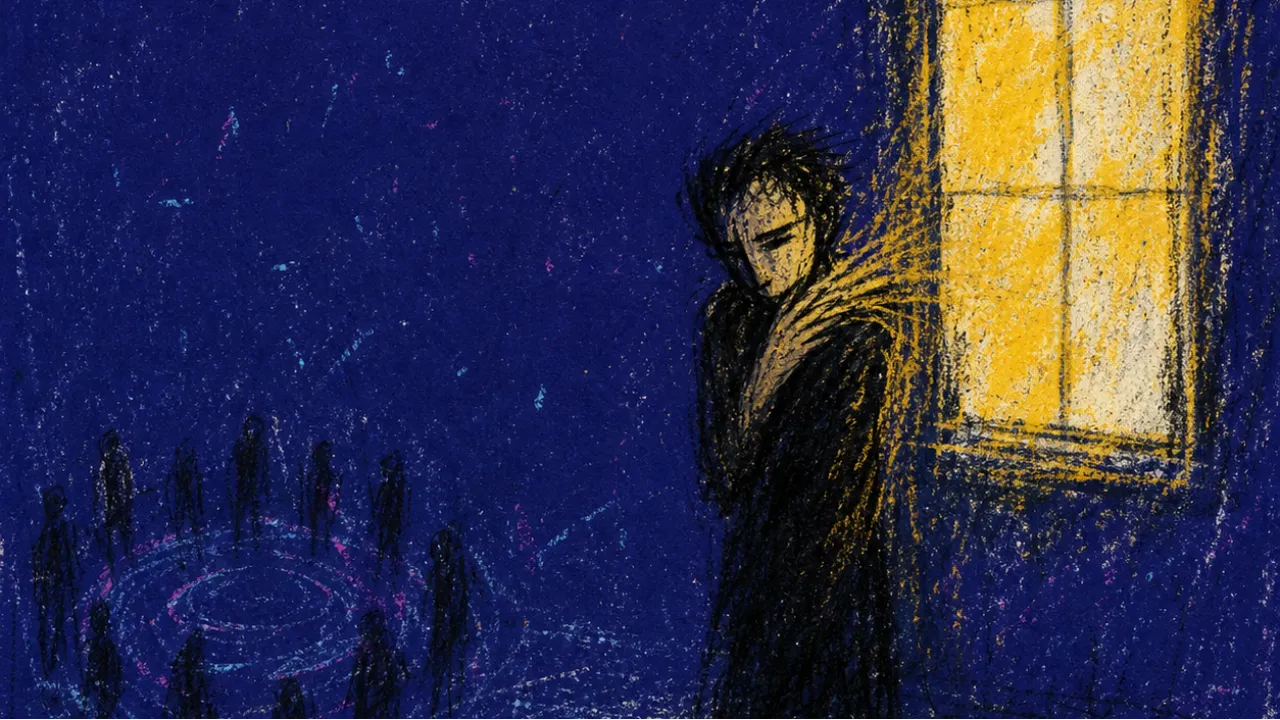
What does this feel like?
Outsider Identity Lock is the feeling of standing close enough to belonging to see its warmth, but still moving through life as if the outside has already been assigned to you. You notice it in small, ordinary moments: arriving at a friend's apartment and seeing everyone already settled on the couch, opening a group chat and realizing the plan formed before your name came up, walking into a room where nobody has rejected you and still feeling your body brace as if the verdict has been delivered. Your shoulders get tight before anyone says anything. Your eyes start mapping clusters, exits, inside jokes, who turns toward whom, who leaves space beside them, who looks surprised to see you there. You can be funny, capable, observant, even liked, but some part of you stays pressed against the glass, watching for the tiny sign that proves you were never quite one of them. The painful part is how reasonable it can feel: if you have been placed at the edge enough times, the edge starts to feel less like a position and more like your shape. You become skilled at being adjacent: helpful but not held, known but not claimed, present but not relaxed. You tell yourself you prefer it this way, that distance keeps you clear, that needing less makes you safer, and sometimes that is partly honest. But underneath the clean self-control is a quieter cost: every room gets pre-read through the geometry of exclusion, and even an open circle can start to look like a closed door. Eventually the question is not just whether they will let you in, but whether you still know how to step toward warmth without first proving you can survive the cold, much like the Five of Pentacles, where the lit window and the freezing street share the same frame, but no visible doorway tells the figures how to cross from one world into the other.
What's pulling at you?
You're not stuck because you are bad at belonging; you're stuck because distance has been repeated often enough that your body now treats it as advance information. One part of you wants the warmth of being included, while another part relies on staying outside because that is where you can read the room, protect your dignity, and avoid being surprised again.
How It Shows Up?
- You arrive at a party, a lecture hall, or a friend's birthday dinner and pause at the edge of the room just long enough for your body to decide the layout before your mind catches up. People are laughing in small circles, coats are thrown over chairs, someone waves you over, and still your feet stay planted like there is an invisible line on the floor. Your mouth feels dry, your shoulders lift slightly, and you start scanning for proof that the invitation was only polite. You can let your body take one slow breath before you decide what the room means.
- You see a group chat light up with plans you were not part of, and the familiar math starts before you even open the message. Your thumb hovers, your chest tightens, and you tell yourself it makes sense, you were never really in the inner circle anyway. Then someone mentions it casually later, as if your absence was obvious but not hostile, and the old cold-street feeling rises anyway, warm windows visible from the outside. It is allowed to notice the sting without turning it into a permanent verdict.
- At work or school, someone praises you for being independent, sharp, low-maintenance, easy to trust with things on your own, and the compliment lands in a strange place. You smile, nod, maybe make a quick joke, but your stomach pulls inward because you can hear the hidden shape of it: useful at the edge, not needed in the room. Your neck gets stiff, your jaw sets, and you keep performing competence from the ridge while everyone else seems to move through shared warmth below. You do not have to accept every role just because you can carry it well.
- You are alone on a weekend afternoon with no urgent plans, and the quiet does not feel peaceful so much as confirming. You make coffee, leave it half-drunk, open three apps, close them, and feel the room widen around you like a desert with landmarks too far away to help. Your ribs feel hollow, your hands keep looking for something to hold, and the thought appears with an almost rehearsed calm: this is where I belong, apart. A quiet day can be quiet without becoming evidence against you.
- In a conversation with someone you genuinely like, you catch yourself stepping back inside your own head the second the mood turns warm. They ask what you think, and instead of answering from the middle of the moment, you observe the timing, the tone, the group dynamic, the small shifts of power, like the Queen of Swords sitting above the weather. Your forehead tightens, your breath becomes shallow, and you feel safer being accurate than being reachable. It is okay to stay discerning without making distance the only place you trust.
Outsider Identity Lock in Tarot Cards
Outsider Identity Lock lives in the moment when being near the circle starts feeling less like a situation and more like a fixed address. You can feel it in the dry mouth, lifted shoulders, and shallow breath that arrive before a room has fully spoken. From an existential perspective, the structural framework is about how repeated distance can start organizing the way you read every new social field. The Tarot Cards below make that outside-position visible without turning it into a final identity.
Outsider Identity Lock in Tarot Card Reading Insights
When Outsider Identity Lock is active, people often bring the same question into readings: am I being left out now, or am I reading this room through an older map? The shift from cards to readings shows how this edge-position appears in different social moments. Tarot Reading Insights from sessions touching this pattern.

Calling the Group Story Fake; One Honest Message Tested a Bond
Topic:Social Tarot Reading
Struggle:Belonging-Authenticity Split
Context:Direct Communication Trial

Inside Jokes at Dinner and the One Honest Way Back into the Room
Topic:Social Tarot Reading
Struggle:Observer-Self Split
Context:Community Integration Trial

Friend Group FOMO After a Story, Learning to Separate Hurt From Proof
Topic:Social Tarot Reading
Struggle:Outsider Identity Lock
Context:Soft Exclusion
Typing "No Worries :)" and Going Quiet—Until the Facts Cut In
Topic:Study Tarot Reading
Struggle:Clarity-Exposure Split
Context:Direct Communication Trial

The 9:14 a.m. Slack Compliment—And the Practice That Let It Count
Topic:Introspection Tarot Reading
Struggle:Recognition-Containment Split
Context:Always On Availability

From Door-Slamming to a Two-Line Boundary: The 60-Second Pause
Topic:Introspection Tarot Reading
Struggle:Boundary Rigidity
Context:Direct Communication Trial

From Discord Exclusion Spirals to Self-Respect: Verify, Don’t Investigate
Topic:Friendship Tarot Reading
Struggle:All-or-Nothing Belonging
Context:Direct Communication Trial

From Camera-Off Shame to Time-Boxed Presence in Zoom Meetings
Topic:Introspection Tarot Reading
Struggle:Observer-Self Split
Context:Unspoken Social Rules

From First-Week Impostor Syndrome to Learning Out Loud at Work
Topic:Career Tarot Reading
Struggle:Feedback Disconnection
Context:Hidden Curriculum Gap

From Shame-Freeze to Speaking Up: A Group Chat Inclusion Journey
Topic:Friendship Tarot Reading
Struggle:All-or-Nothing Belonging
Context:Social Gatekeeping Circle