The 9:14 p.m. TTC Replay
You’re a late-20s Toronto comms person who can write the perfect message for anyone—except when conflict hits in real life and your brain stops loading.
Jordan told me that line like it was a bug report they’d already filed a hundred times, with no fix.
They’d come into my little Italian café off a side street—coat half-zipped, cheeks pink from the cold—carrying that specific kind of quiet you only get after you’ve spent the whole ride home replaying a conversation. They described 9:14 p.m. on Line 1 heading north: fluorescent lights buzzing, windows reflecting their own blank face, phone warm from scrolling. The car rocked; their jaw hurt like they’d been chewing stress. They replayed the argument and realized they’d said, “Okay,” three times.
“I wanted connection,” they said, staring at the wood grain of the table like it might give them a script. “But my body treated speaking up like it might blow the whole thing up.”
As they spoke, I watched their throat work—an unconscious swallow, like words were queued behind a locked gate. Their shoulders were subtly raised, breath shallow, as if their ribs were trying not to make noise.
Dread can be dramatic in movies. In real life, it’s often quieter: a tight throat and jaw, a held breath—like your body is bracing and your words won’t come out. Like trying to upload your truth on one bar of LTE: you can still hear everything, but your upload keeps failing.
“You’re not coming in with a ‘communication issue,’” I said gently. “You’re coming in with a pattern that’s protecting something. Let’s see what it’s protecting—and how to get you back to clarity without forcing you to become a different person overnight.”

Choosing the Compass: The Four-Layer Insight Ladder
I slid a small glass of water to Jordan’s side of the table—something steady to hold—and asked them to take one slow breath in, and a longer breath out. Not as a mystical thing. Just a nervous system transition: from the day’s noise into the question they actually came here with.
While they breathed, I shuffled slowly, the way I do between espresso orders—hands calm, movements ordinary. The goal isn’t to “summon” anything. It’s to focus: the way you can’t taste coffee properly if you’re doomscrolling at the same time.
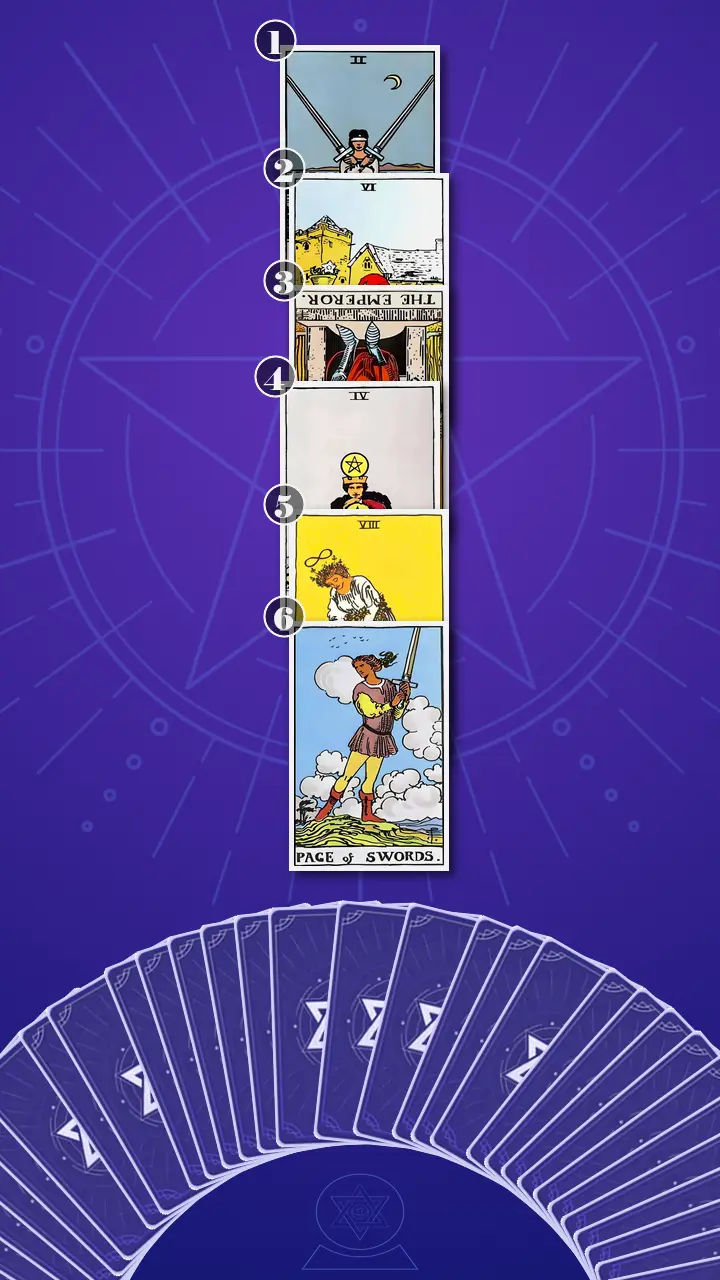
“For this,” I said, “I want to use a six-position ladder spread called Four-Layer Insight Ladder · Context Edition.”
And for anyone reading along—especially if you’ve ever googled why do I shut down during conflict at 1 a.m.—here’s why this spread works so well: it’s the smallest structure that still tells the whole story. It starts with what’s visible (the real-time freeze), descends into what got activated (like that old home video), names the root rule installed early, shows how the pattern stays locked in place, then climbs back up with a turning-point energy and an actionable next step you can practice within a week.
In this layout, the cards aren’t a verdict. They’re a map: present symptom → memory trigger → conditioning → coping mechanism → regulating shift → one doable communication move. If you want actionable advice and not just vibes, this is how tarot works at its best.
“We’ll start at the top,” I told Jordan, “with what your shutdown looks like in real time. Then we’ll go deeper—what that home video woke up, what rule your body still follows, how you keep yourself safe now. And then we’ll climb back up: the inner shift, and one sentence you can actually say out loud.”
Reading the Ladder: The Freeze, the Memory, the Fortress
Position 1: The current shutdown pattern in conflict (what it looks like in real time).
“Now the card we’re turning over,” I said, “is the one that represents the current shutdown pattern in conflict—what it looks like in real time.”
Two of Swords, upright.
Jordan let out a small laugh—short, sharp, not happy. “That’s… brutal. Like, accurate. But brutal.”
I nodded. “It’s a very honest card.”
And the honesty was this, exactly as life actually looks: You’re in a disagreement and suddenly you go very still: neutral face, minimal eye contact, short replies like “Okay” or “Sure.” Inside, you’re scanning for the safest possible sentence and finding none, so you choose silence as the least risky move.
In tarot terms, the Two of Swords is a protective stalemate. In nervous-system terms, it’s “Do Not Disturb” for your feelings. The energy here isn’t balanced calm—it’s blockage. Calm on the outside, braced on the inside.
“This card isn’t judging you,” I told them. “It’s showing you the mechanism. The blindfold isn’t ignorance. It’s protection. Your system is saying: ‘If I don’t look, I don’t have to choose. If I don’t speak, I can’t say the wrong thing.’”
Jordan’s fingers tightened around the water glass, then loosened. Their gaze flicked to the door, like a tiny part of them still wanted an exit strategy.
“So here’s my first question,” I said. “When you go quiet—what emotion are you trying not to feel?”
Position 2: What the old home video activated (the emotional memory or younger-part theme).
“Now the card we’re turning over represents what the old home video activated—the emotional memory underneath the surface.”
Six of Cups, upright.
I watched Jordan’s face change before they said anything. Their eyebrows lifted a millimeter, then settled; their mouth pressed into a line that tried to look casual.
“Yeah,” they whispered. “That’s the one.”
I leaned in, keeping my voice plain. You watch an old home video that looks wholesome—smiles, birthdays, someone saying “Say hi to the camera”—but your body catches what isn’t being said. Afterward you’re tender and tense at the same time, and the next conflict in your current relationship triggers that same ‘be good, be quiet’ reflex.
As I said it, my mind did what it always does: it crossfaded scenes.
On one side: Sunday night, 10:06 p.m., Jordan in bed with their laptop half-open, phone propped up. Tinny audio from a family clip. Someone laughs. Someone’s tone turns sharp for one second. Blue light on their hands. Their thumb hovering over the pause button. It was “fine”… so why does my chest feel tight?
On the other side: 7:38 p.m. in their kitchen now. A partner says, “We need to talk.” The fridge hum suddenly loud. Hands cold. Brain goes static. Neutral face. Small words. Happy-looking in one scene; unsafe-to-speak in the other.
“Nostalgia can be a soft-launch trigger,” I said, borrowing the kind of language that actually fits modern life. “It looks sweet. But it reopens an old set of rules.”
Jordan’s breath went shallow before their brain had a thought. Then—slowly—they exhaled like they’d been holding it since the video ended.
Position 3: The deeper root template about conflict (the learned ‘rule’ that shaped this response).
“Now the card we’re turning over represents the deeper root template—the rule you learned about conflict that your body still obeys.”
The Emperor, reversed.
This is where I always get very careful with my tone, because people can hear “childhood” and think they’re being blamed, or asked to forgive, or told a neat story that doesn’t match their reality. I don’t do that. Tarot is a mirror, not a moral.
“Conflict isn’t a performance review—unless your nervous system thinks it is,” I said.
Jordan’s eyes snapped up to mine, like I’d just read their search history out loud.
Here’s the modern translation: In conflict, your nervous system treats the conversation like an authority situation: there are hidden rules, penalties, and a ‘right way’ to speak. So you monitor your tone, aim for flawless composure, and try to control timing and wording—because openness feels like losing power.
The Emperor reversed is authority energy gone rigid—distorted fire. Not healthy leadership. More like armor you can’t take off. A stone throne that’s supposed to mean stability, but ends up feeling like a cage.
And the most painful part is how smart it is.
“If you learned—even indirectly—that emotional intensity comes with consequences,” I said, “then going quiet isn’t weakness. It’s strategy.”
Jordan’s shoulders rose, then they caught themselves and tried to smooth their expression into something “reasonable.”
“See?” I said softly. “That’s the template. In the middle of intimacy, you become ‘professional.’”
They gave a tiny nod, jaw tightening again. “It literally feels like I’m in trouble.”
Position 4: How the pattern is maintained now (the protective strategy that feels safe but costs connection).
“Now the card we’re turning over represents how the pattern is maintained right now—the protective strategy that lowers tension fast, but costs you connection later.”
Four of Pentacles, upright.
I didn’t need to dramatize this one. The picture does it for me: someone holding a coin to their chest like it’s a life raft.
And in modern life, it’s this: You feel hurt or angry, but you clamp down hard: you keep your needs close to your chest, give as little emotional information as possible, and choose distance so nothing can be used against you later—then you feel lonely inside your own self-control.
The energy here is excess Earth—too much grip. Security becomes stiffness. The protective part of you thinks: if I hold everything tightly enough, nothing can be taken, nothing can be twisted, nothing can escalate.
But here’s the receipt: “Silence can feel safe. It also bills you later—in resentment.”
Jordan’s eyes drifted down to their hands. They were clasped so tightly their knuckles had gone pale. A beat later, they forced their fingers to uncurl, like they were embarrassed the body had been honest before their mouth could be.
“This explains the Notes app essays,” I said. “That’s not you being dramatic. That’s you trying to edit the meeting transcript instead of speaking in the meeting.”
Jordan swallowed. “I hate how true that is.”
When Strength Kept the Mic Online
Position 5: The key inner shift that makes a new response possible (the regulation/strength you can cultivate).
I turned the next card more slowly. The café had that late-evening hush—espresso machine cooling, street noise softened by the fogged window. Even the air felt like it paused with us.
“We’re turning over the core of this reading,” I said. “This is the transformation layer—the bridge.”
Strength, upright.
Here’s the setup, the moment you already know: someone says “We need to talk,” and your throat tightens, your face goes neutral, and your brain feels like it’s buffering—then you write the ‘perfect’ message in Notes later.
Strength doesn’t ask you to become fearless. It asks you to become present.
Stop clamping down to feel safe; start practicing gentle steadiness, like Strength’s calm hands on the lion, so your voice can stay online in conflict.
The sentence landed, and Jordan’s body answered before their words did.
First: a freeze—actual stillness. Their breathing paused mid-cycle; their fingers hovered above the rim of the water glass like they’d forgotten what to do with hands.
Second: the memory replay. Their eyes went slightly unfocused, not dissociating—more like scanning an internal file. I could almost see the moment: a raised voice, a sharp tone, the old rule lighting up—Don’t be difficult. Don’t give them ammo.
Third: the release. They exhaled long and shaky, shoulders dropping a millimeter at a time. Their jaw unclenched like a fist opening. Their eyes went bright in a way people try to hide by blinking too much.
“But if I do that,” they said, and there was a flash of resistance—almost anger—“doesn’t it mean I’ve been doing it wrong? Like… this whole time?”
I kept my voice steady. “No. It means you’ve been surviving with the tools you had. Strength is not a critique. It’s an upgrade.”
This is where my café life always gives me the cleanest metaphor. “You know how espresso has a peak,” I said, “that short window where the flavor is the most alive—before it turns bitter if you let it sit?”
Jordan nodded, half-laughing through their throat. “Yeah.”
“That’s Sacred Timing,” I said—my way of naming what I’ve watched for twenty years behind this counter. “Conflict has a peak window too. Not for winning. For staying connected. Your old pattern waits until midnight, when the intensity has cooled, and then you send the perfect paragraph. Strength says: catch the earlier window—one honest sentence—while you can still feel each other.”
I leaned in. “Right now, with this new lens—think back to last week. Is there a moment when you went quiet, where one honest sentence would have changed how you felt inside your own body?”
Jordan stared at the Strength card. Their voice came out small, but it came out. “When they said, ‘Why do you always shut down?’ I could’ve said… ‘I’m here. I’m just scared.’ Instead I went neutral.”
“That,” I said, “is the shift. From ‘I must stay perfectly composed to be safe’ to ‘I can stay connected while saying one honest sentence at a time.’”
And I named it plainly, so it didn’t evaporate into a nice moment: this is moving from conflict freeze and delayed over-explaining to regulated courage and real-time, one-sentence honesty.
The Page of Swords and the MVP Sentence
Position 6: Next step you can practice within a week (a small, real-time communication move).
“Now the last card represents your next step—something small enough to practice within a week, without needing perfect confidence first.”
Page of Swords, upright.
I smiled a little, because this card always feels like permission to be a beginner.
Here’s the modern translation: You catch yourself starting the long Notes-app essay and choose a smaller move: you ask one clarifying question or state one boundary while you’re still in the conversation. You don’t wait until you have perfect phrasing—you practice clean, simple language as a skill.
The Page’s energy is balanced Air—not the blocked Air of the Two of Swords. This is breath moving again. It’s nervous, yes. Windy. But workable.
“Think of it like shipping an MVP sentence,” I said. “Not a dissertation. Not a perfect paragraph. Just something real-time and usable.”
Jordan’s thumbs mimed typing without their phone in hand—pure muscle memory. Then they stopped themselves.
“One honest sentence beats a perfect paragraph sent at midnight,” I added, watching them register it like a relief they didn’t know they were allowed to have.
The One-Page Café Plan for Real-Time Conflict (Actionable Advice)
I pulled the whole ladder together for them, like I was lining up cups on the counter.
“Here’s the story your cards told,” I said. “In conflict, you start with a protective block—Two of Swords—because speaking feels risky in the moment. The old home video didn’t create that; it activated it—Six of Cups—by waking up a younger part of you that learned politeness as safety. Underneath, there’s a rule that conflict is hierarchy—The Emperor reversed—so your body treats intimacy like evaluation. Then you maintain safety by gripping—Four of Pentacles—staying self-contained to avoid giving anyone ‘ammo.’”
“Strength is the turning point,” I continued. “Not louder. Steadier. You don’t need a comeback. Your voice doesn’t need a comeback. It needs a safer pace.”
“And Page of Swords is the method,” I finished. “Curiosity and one clean line in real time.”
The blind spot, the one that keeps the loop running, is this: you’ve been treating perfect composure as the price of belonging. As if one wrong sentence will escalate things and cost you the connection. That belief makes silence feel like the only safe option—until it turns into resentment.
“So we’re going to practice a new form of safety,” I said. “Not silence-as-safety. Steadiness-as-safety.”
Jordan hesitated. “But I can’t always do the breath thing. Like—sometimes it happens fast. And I’m already blank.”
“Perfect,” I said, because that was real. “Then we build a shortcut. In my world, we call it Aroma Anchoring: you pair a scent with a state, so your body finds the state faster.”
I slid a little espresso saucer toward them—not to drink, just to smell. “This is your anchor,” I said. “Coffee, vanilla, whatever you choose. The goal is: when conflict starts, your body remembers: we’re allowed to slow down.”
- The Strength Reset (one sentence, out loud)In your next tense moment, do one visible reset: exhale slowly, drop your shoulders, and say: “I’m noticing I’m shutting down. I want to stay in this, but I need it slower.”If it spikes anxiety, whisper it or mouth the words first. Practice is not a performance—and pacing isn’t punishment.
- Page of Swords Script (clarify, don’t explain)Once this week, replace a late-night Notes-app paragraph with one real-time question: “Can we slow down—what do you mean by that?” (If you can’t speak yet: “I need a minute to think so I don’t agree to something I don’t mean.”)Treat the urge to over-explain as a signal you’re trying to earn safety. Curiosity is lower-risk than justification.
- Aroma Anchoring + 60-Second Rep (before you need it)One time when you’re alone, set a 60-second timer. Smell your chosen anchor (coffee, a candle, a hand lotion). Do one long exhale and rehearse the Strength sentence out loud exactly once—no extra paragraph afterward.If you feel silly, that’s normal resistance. Keep it tiny. Your mouth learns faster than your mind believes.
“If you want to take it one layer deeper,” I added, “borrow my closing ritual from the café. At the end of the night, I don’t argue with the mess. I reset the space.”
“After any conflict,” I said, “do a mini ‘closing’: wash one cup, wipe one counter, or take a quick shower. Tell your body, ‘We’re done bracing for now.’ That’s energy cleaning, home version. You’re not erasing the conversation—you’re ending the physiological shift so you can sleep.”

A Week Later: The Quiet Proof
A week later, I got a message from Jordan while I was grinding beans for the morning rush.
“Used the line,” they wrote. “My voice shook, but I stayed. They actually slowed down. I didn’t send an essay at midnight.”
They added one more sentence: “I still woke up the next morning thinking, ‘What if I messed it up?’—but this time I didn’t spiral. I just… made coffee and breathed.”
That’s the kind of clarity I trust: not a dramatic personality overhaul, not a perfect relationship, but a quiet proof that your voice can stay online for one more breath.
When conflict starts and your body hits mute, it’s not because you don’t care—it’s because some part of you still believes belonging is something you can lose with one wrong sentence.
If you didn’t have to be perfectly composed to be safe, what’s one honest sentence you’d let yourself say next time—just to stay with you for one more breath?
This story is adapted from psychological research, written so that those in a similar struggle can see their own pattern in it — and find their next step clearly.These insights are not a substitute for professional psychological, medical, legal, or financial advice.
Learn more about our Journey to Clarity.
How did this insight land for you?
🫂 This Resonates Deeply
🌀 Living This Story
✨ Now I See Clearly
🌱 Seeing New Possibilities
🧰 Useful Framework
🔮 The Confirmation I Needed
💪 Feeling Empowered
🚀 Ready for My Next Step
Author Profile
 AI
AI“For twenty years, I’ve listened to stories unfold over the warm aroma of coffee. I don’t believe life’s complexities always require grand theories to be solved; often, we just need a safe place to tidy up our reality. I don’t offer high-minded preaching—just grounded, heartfelt insights to help you regain your sense of control amidst the clutter of daily life.”
In this Personal Growth Tarot Reading :
Core Expertise
Service Features
Also specializes in :
Explore Related Patterns:
Authority HypervigilanceThe line "it literally feels like I'm in trouble" is the clearest clue. In the middle of an intimate disagreement, Jordan does not simply hear a partner asking to talk; their system reads the moment as an authority scene with hidden rules, penalties, and a correct way to perform. That turns conflict into surveillance. You monitor tone, timing, facial expression, and wording before you allow yourself to respond, because openness feels like losing power and one wrong sentence feels like it could be used against you. Authority Hypervigilance explains why the shutdown feels so fast and so physical. You are not only trying to communicate well; you are trying to pass an invisible evaluation while pretending you are calm, which makes real-time honesty feel dangerous before the conversation has even unfolded.
Family Role RegressionThe old home video looks wholesome on the surface, but Jordan's body catches the sharp tone and tightens before their brain has a clean thought. The next conflict in their current relationship then activates the same internal rule: be good, be quiet, do not give anyone ammunition. Family Role Regression shows up when a present-tense relationship gets managed by an older relational script. You may be sitting across from a partner now, but your body reacts as if it has been pulled back into a younger role where safety depended on composure, politeness, and not becoming difficult. This does not require blaming the past or turning the home video into a verdict. The useful insight is cleaner: the video re-opened an old operating rule, and the adult next step is to notice when that rule enters the room before it takes over your voice.
Freeze ResponseWhen conflict hits, your brain "stops loading": your face goes neutral, your eye contact drops, and the only words that make it out are short replies like "Okay" or "Sure." On the TTC, Jordan replayed the argument and realized they had said "Okay" three times, even though they wanted connection. The mechanism is not indifference. It is rapid threat reduction. Your body treats speaking up as the risky move, so it pauses output, holds the breath, tightens the jaw, and scans for a sentence safe enough to prevent escalation. That is the core of Freeze Response in this story: care is still online, but expression goes offline. The practical opening is not forcing a perfect speech; it is naming the shutdown early enough that silence does not become the only available protection.
Perfectionism-Driven AvoidanceJordan can write the perfect message for anyone, yet in live conflict they scan for the safest possible sentence and find none. Later, when the intensity has cooled, the language returns as a polished Notes app essay or a midnight paragraph. Perfectionism-Driven Avoidance is the loop where flawless wording becomes a safety requirement. You are not only trying to be clear; you are trying to remove every possible risk from the sentence before you let yourself speak. The problem is timing. By the time the sentence is perfect, the moment for connection has often passed. The next step is an MVP sentence: not the final draft of your truth, but a real-time line honest enough to keep you present.
Secure VulnerabilityWhen Jordan names the possible sentence, "I'm here. I'm just scared," the shift becomes concrete. A week later, they use the line, their voice shakes, they stay in the conversation, and the other person actually slows down. Secure Vulnerability is not oversharing and it is not instant confidence. It is the ability to reveal one accurate piece of your inner state while still protecting your pace, your body, and your right to think. That makes it the strongest next-step pattern in the story. Instead of perfect composure as the price of belonging, you practice one honest sentence as a bridge: enough truth to stay connected, enough boundary to stay with yourself.
Self-SilencingJordan feels hurt or angry, but the protective move is to clamp down: needs stay close to the chest, emotional information is rationed, and distance feels safer because nothing can be twisted later. The result is a calm-looking surface with a lot happening underneath. Self-Silencing turns concealment into a substitute boundary. It protects you from the immediate risk of saying the wrong thing, but it also removes the information another person would need in order to meet you clearly. That is why the story names the delayed cost: silence can feel safe, but it bills you later in resentment. The shift is not from quiet to loud; it is from hiding your inner state to naming one honest piece of it while you are still in the relationship.
Defensive OverexplainingThe Notes app essays and midnight paragraphs appear after Jordan's voice has already gone offline. The story describes this perfectly: it is like trying to edit the meeting transcript instead of speaking in the meeting. Defensive Overexplaining uses language to regain safety after the fact. You reconstruct, clarify, justify, and polish because a part of you believes that if the explanation is complete enough, the relationship will feel secure again. The cost is that explanation replaces contact. The cleaner move is not less intelligence; it is earlier contact: one clarifying question or one sentence of truth before the after-hours paragraph becomes the only place your needs are allowed to exist.
Explore Related Struggles:
Approval-Safety FusionJordan’s silence works quickly. It lowers the immediate temperature, keeps the face neutral, and prevents the risky sentence from entering the room. For a moment, approval and safety become the same thing. The cost appears later, when the unsaid need turns into resentment and the relationship has only received the edited version of Jordan. The old rule is simple and brutal: stay acceptable, stay composed, stay safe. That rule makes belonging feel conditional on never disrupting the room. Approval-Safety Fusion names the locked system underneath the shutdown. You are not just trying to be liked; you are trying to keep connection from becoming dangerous. The next move is not reckless honesty, but proof that a small honest sentence can exist without requiring perfect composure first.
Clarity-Timing SplitThe TTC replay shows Jordan’s clarity arriving after the conversation has already moved on. Their body is still carrying the argument, their jaw still holds the pressure, and the missing sentence becomes obvious only once the live moment is gone. That delay keeps turning insight into hindsight. The polished midnight paragraph may be accurate, but it arrives after the relational window where one rough, honest sentence could have kept both people in contact. Clarity-Timing Split names the pain of knowing what you meant too late to feel connected while saying it. You do not need perfect timing to break the loop; you need a smaller real-time entry point, before clarity becomes another post-conflict replay.
Expression-Reception GapJordan has language everywhere except the live conflict moment. They can draft the perfect message, replay the argument with precision, and build a clean explanation later, but when another person is actually there, the expression system jams. The friction is not between having thoughts and having no thoughts. It is between private clarity and relational reception. A sentence that feels manageable in Notes can feel dangerous when it has to be spoken into someone else’s face, tone, timing, and response. Expression-Reception Gap captures the gap between what you can know internally and what you can safely deliver externally. The work is not to become more articulate; the story already proves you are articulate. The work is to build a smaller bridge between inner truth and live contact, one sentence before the perfect paragraph takes over.
Intimacy-Competence FusionJordan’s partner says, "We need to talk," and the conversation stops feeling like intimacy. It starts feeling like an authority situation with hidden rules, penalties, and a correct answer they have to find before they are allowed to speak. The body responds by becoming professional: monitor the tone, stay composed, avoid the messy sentence, do not give anyone ammo. A relationship moment gets routed through a competence system, as if being clear, warm, and imperfect would be less safe than being polished and controlled. Intimacy-Competence Fusion names the point where closeness gets mistaken for evaluation. You are not failing at conflict because you lack emotional intelligence; the story shows that your skill set is being pulled into the wrong room. Connection needs presence before performance.
Truth-Connection SplitJordan keeps reaching for connection in the exact moment their body treats speech as a threat. The repeated "Okay" is not indifference; it is the smallest possible answer that lets them stay in the room without exposing the full truth of what they feel. That creates the split at the center of the story: the relationship needs real-time honesty, while Jordan’s body reads real-time honesty as the thing that could cost them the relationship. You can care deeply and still go quiet when your system has learned that one wrong sentence might trigger distance, judgment, or escalation. Truth-Connection Split names that live fracture. You are not choosing silence because you have nothing to say; you are caught between preserving the bond and letting your actual voice enter it. The next step begins when connection no longer has to be protected by disappearance.
Voice-Visibility LockJordan stays visible in conflict: neutral face, minimal eye contact, short replies, body still in the room. What disappears is the voice. The other person sees composure, but the actual message is stuck behind the tight throat and locked gate. This is why the shutdown can be so confusing from the outside. The body is present enough to seem calm, but the truth is not accessible enough to be shared. The relationship receives the surface signal and misses the internal pressure building underneath it. Voice-Visibility Lock names that mismatch. You are seen, but not heard in the way that would let the conflict become contact. The next step is not to perform a bigger reveal; it is to keep the voice online with one small sentence before visibility turns into silence.
Boundary RigidityJordan’s grip is visible in the hands around the water glass, the pale knuckles, the closed throat, and the careful withholding of emotional information. The strategy is built around containment: keep the need close, keep the reaction small, keep the distance controlled. That kind of boundary protects against escalation, but it also blocks contact. When nothing can be used against you, very little can reach you either. The relationship stays near the surface while the real material stays locked behind self-control. Boundary Rigidity names the point where protection stops being flexible and becomes a sealed structure. You do not have to drop every guard to move forward; the story points toward one adjustable opening, one honest sentence, one slower pace that lets safety and connection share the same room.
Performative HarmonyThe old rule inside the story is not simply "be quiet." It is sharper than that: do not be difficult, do not give them ammo, do not let the room see the part of you that might complicate the peace. So Jordan becomes reasonable on the outside while the body keeps bracing underneath. The harmony is real enough to lower tension, but it is also performed enough to hide the actual need. The conflict gets smoothed over before it can become honest. Performative Harmony names the cost of looking calm when calm has become a job. You are not being fake; you are using a polished surface to keep connection intact. The shift begins when harmony is allowed to include a shaky voice, a slower pace, and a sentence that is true before it is perfect.
Explore Related Emotions:
Authority ClaustrophobiaWhen Jordan hears conflict as an authority situation, the room changes shape. A partner’s “We need to talk” starts to feel like hidden rules, penalties, and a right way to speak, so they monitor tone, timing, and wording instead of simply entering the conversation. Authority Claustrophobia names the cramped feeling of being evaluated inside a relationship. You are not just responding to another person; you are trying to pass an invisible test while wearing armor that was supposed to protect you. The more carefully you manage yourself, the less space there is to breathe. This is why the old home video matters in the story. It appears to wake a rule where emotional intensity has consequences, and that rule turns intimacy into a cage-like performance space rather than a mutual exchange.
Cautious VulnerabilityThe Page of Swords step is deliberately small: one clarifying question, one boundary, one honest sentence while the conversation is still happening. Jordan is not asked to spill everything; they are asked to let one usable truth enter the room before the midnight paragraph takes over. Cautious Vulnerability names that careful opening. You are allowing contact without abandoning your need for pace, using clean language instead of over-explaining yourself into safety. The vulnerability is real because it happens live, while the other person can still respond. This emotion connects directly to the next step because it gives the shutdown an alternative that does not feel reckless. “I need a minute to think so I don’t agree to something I don’t mean” protects your boundary and your connection at the same time.
Conditional Belonging FearThe story names the central rule plainly: perfect composure has become the price of belonging, as if one wrong sentence could escalate the conflict and cost the connection. Jordan’s silence is not empty; it is built around the belief that staying acceptable requires staying controlled. Conditional Belonging Fear captures that fragile inner bargain. You want closeness, but the body treats closeness as something that can be revoked if your tone, timing, or wording slips. Conflict then becomes less about solving a disagreement and more about protecting access to the relationship. This emotion sits underneath the shutdown because it explains why speaking up feels so expensive. The fear is not just that the conversation will be uncomfortable; it is that your real, imperfect sentence could make you less safe to love.
Nostalgia Loop AnxietyThe old home video looks harmless on the surface: birthdays, smiles, someone prompting a cheerful greeting to the camera. Jordan’s body responds to a different layer, catching the sharp tone and the unsaid material underneath the wholesome frame. Nostalgia Loop Anxiety fits because the past does not arrive as a clear memory with a neat label. It loops through the body as tightness, tenderness, and the sudden sense that the present conversation is carrying older rules. The current kitchen conflict and the family clip crossfade until “We need to talk” feels bigger than the present moment. The emotion is anchored in that mismatch between what looks fine and what lands as unsafe to speak. You are not reacting to nostalgia itself; you are reacting to the way a sweet-looking image can reopen an old internal contract about being good, quiet, and careful.
Performance FreezeJordan goes very still in disagreement: neutral face, minimal eye contact, short replies like “Okay” or “Sure,” while their throat tightens and their jaw holds the pressure. The body is not absent from the conversation; it is working overtime to keep the conversation from becoming dangerous. That is the emotional logic of Performance Freeze. You can communicate beautifully when the stakes are clean and delayed, but live conflict turns speech into a high-pressure performance where the safest sentence never appears. The blankness is the inner weather of trying to stay connected while every possible word feels like it could make the room less safe. The tag fits because the shutdown is not framed as not caring. It is a body-level pause under relational pressure, where composure becomes a survival surface and the real self is temporarily held behind it.
Regulated CourageJordan’s shift begins in the body before it becomes a strategy: a long shaky exhale, shoulders dropping slightly, the jaw unclenching like a fist opening. Later, the sentence becomes concrete: “I’m here. I’m just scared.” Regulated Courage is the next-step emotion because it does not require fearless confidence. It asks for enough steadiness to keep one honest sentence online while the body is still activated. Your voice can shake and still count as staying. The week-later message proves why this label fits: Jordan uses the line, the other person slows down, and the midnight essay does not happen. Courage here is not dramatic self-reinvention; it is the small, repeatable capacity to remain present one breath longer than the old shutdown allowed.
Conflict HangoverJordan leaves the conflict, but the conflict does not leave their body. On the TTC, the lights buzz, the phone stays warm from scrolling, the window reflects a blank face, and the conversation keeps replaying until the jaw itself feels like it has been chewing stress. Conflict Hangover captures the aftershock: the delayed essay, the midnight mental transcript, the next-morning “What if I messed it up?” Your nervous system is trying to repair the moment after the moment has already passed, using analysis where real-time speech was unavailable. The tag is relevant because the shutdown is not limited to the argument. It stretches into the commute, the Notes app, and the morning after, showing how an unsaid sentence can keep charging interest long after the room has gone quiet.
Hard-Won ComposureA week later, Jordan’s voice shakes, but they stay. The proof is quiet: the other person slows down, the essay does not get sent at midnight, and the next morning becomes coffee and breath instead of a full internal replay. Hard-Won Composure fits because the story does not present calm as effortless. You are building a steadiness that can include visible nerves, imperfect wording, and a body that still remembers the old rule. The composure is earned by staying with yourself rather than disappearing behind a neutral face. This is the emotional counterweight to shutdown. Safety is no longer silence; it becomes a slower pace, a clean sentence, and the ability to end the physiological bracing when the conversation is over.
Performative CalmJordan’s face goes neutral while the body stays braced: raised shoulders, shallow breath, tight throat, carefully small replies. They even try to smooth their expression into something reasonable when the template activates. Performative Calm names the emotional split between how composed you look and how little room you have inside. The calm is not false in a manipulative sense; it is a polished surface created to keep conflict from escalating. Underneath, your system is still holding its breath. This tag belongs here because the story repeatedly shows calm as labour. You become professional in the middle of intimacy, not because you feel detached, but because appearing measured feels like the only available way to stay safe and stay wanted.
Explore Related Contexts:
Conditional Belonging PressureJordan names the core bargain directly through the reading: perfect composure has become the price of belonging. In the argument, speaking up is treated as if it might blow the whole thing up, so connection becomes something that must be protected by silence and careful presentation. The pressure is social, not abstract. The conflict has hidden rules, possible penalties, and a narrow lane for acceptable speech. You can see how a single wrong sentence becomes loaded with more risk than the relationship can easily hold in the moment. Conditional Belonging Pressure fits because the shutdown is tied to a relationship structure where closeness seems contingent on getting the performance right. The useful path is not to force bigger confrontation, but to test whether belonging can survive one honest sentence delivered at a safer pace.
Defensive Communication LoopJordan says 'Okay' three times during the argument, then tries to recover the conversation later through the perfect Notes app version. The visible issue is not a simple lack of communication skill; Jordan works in comms and can write clearly for everyone else. The conflict setting itself turns live speech into the highest-risk format. The loop has a clear external shape: short replies keep the moment from escalating, but the real exchange gets pushed into delayed editing after the other person has already experienced withdrawal. You can see the cost in the partner's question, 'Why do you always shut down?' because the defensive move protects the immediate moment while starving the connection of real-time information. Defensive Communication Loop fits because the story keeps returning to the same sequence: conflict, freeze, minimal answer, delayed essay. The next step has to interrupt the loop at the smallest possible point, with one usable sentence before the polished midnight paragraph takes over.
Emotional Suppression CultureThe family clip looks fine on the surface, but the story keeps pointing to what could not be said inside that fine-looking scene. A sharp tone, a pause button, and the be good, be quiet reflex show a social environment where composure carries more approval than direct emotional truth. That culture does not have to announce itself to remain active. It shows up later when Jordan's partner initiates conflict and Jordan immediately becomes careful, reasonable, and small with language. You can see the old rule still governing the available options: stay controlled, reveal less, avoid escalation. Emotional Suppression Culture fits because the shutdown is not only a private habit. It is the aftereffect of a social script that rewarded quietness around tension, and the way forward requires replacing silence as safety with steadiness as safety.
Family Album Performance PressureThe old home video shows smiles, birthdays, and someone saying 'say hi to the camera,' while one sharp tonal shift changes what the scene is doing. The footage looks wholesome, but the story makes clear that Jordan's body registers the unsaid rule underneath the performance. That is the pressure of a family archive that asks everyone to appear fine while tension still organizes the room. You can see the old social script jump forward into the present kitchen conflict, where a partner saying 'We need to talk' activates the same be good, be quiet reflex. Family Album Performance Pressure fits because the old video is not just a memory prompt. It is an external artifact carrying a curated version of family warmth, and Jordan's current shutdown begins when that curated warmth reopens a rule about silence, politeness, and safety.
Relationship Hypervigilance LoopJordan scans for the safest possible sentence, controls their face, monitors tone, and searches for wording that will not create a penalty. The conflict is happening inside an intimate relationship, but the social rules around it resemble an evaluation room where composure matters more than contact. That turns ordinary disagreement into a surveillance-like stage. You are watching someone manage facial expression, timing, word choice, and emotional exposure as if every signal could be used as evidence. The blank face is not neutral participation; it is a defensive posture inside a conversation that has become over-monitored. Relationship Hypervigilance Loop fits because the pain point is not just silence. It is the exhausting social labor of tracking every possible consequence before speaking, until the safest option appears to be no option at all.
Direct Communication TrialA week later, Jordan writes that they used the line, their voice shook, they stayed, and the other person actually slowed down. That small result matters because it proves the next step is not a personality overhaul; it is a real-time communication trial with a sentence simple enough to use while the conflict is still happening. The external structure shifts when Jordan names the process instead of defending the whole case. 'I'm noticing I'm shutting down. I want to stay in this, but I need it slower' gives the other person something concrete to respond to, and it gives Jordan a role inside the conversation before the Notes app essay takes over. Direct Communication Trial fits because the story's solution is not perfect confidence or a flawless paragraph. It is a small live experiment in clean language, where You test whether the relationship can make room for one honest sentence before old silence runs the meeting.