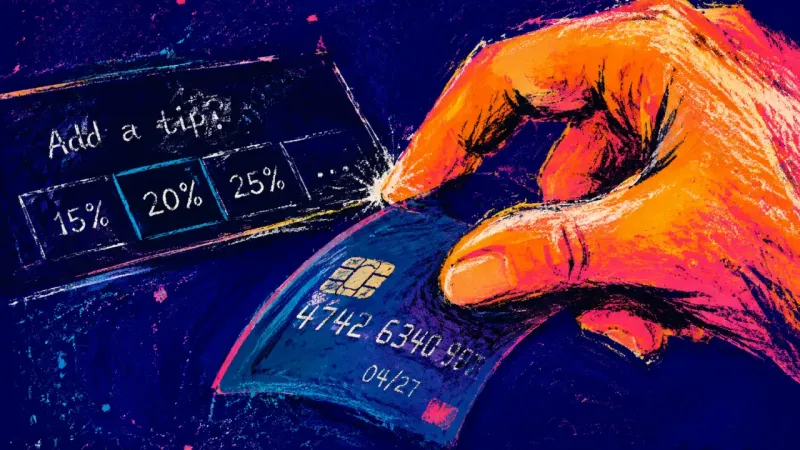
The Tip-Screen Guilt Spiral on a Rainy Streetcar
If you’ve ever tapped a higher tip just to escape the awkwardness, then opened your banking app on the sidewalk to “make sure you didn’t mess up,” you already know the shape of the loop I’m about to describe.
Taylor met me over a video call from Toronto—hair still damp at the temples, as if she’d just run in from weather that couldn’t decide what it wanted. Behind her, a condo hallway light bled under a door. She kept a coffee cup close to her chest like it was doing a job.
“It’s so stupid,” she said, but the word landed like a stone in her throat. “I can handle a spreadsheet. I can plan my month. But the second the café iPad flips around with those 20% presets and there’s a line behind me… my body acts like I’m in trouble.”
She described the moment with the precision of someone who’s replayed it too many times: the terminal glow on her face, the hiss of the milk steamer, her thumb hovering over 18% / 22% / 25% while her breath locks up. Then the quick tap—usually higher than she meant—followed by a two-second relief that evaporated as soon as she stepped outside and refreshed her banking app.
“I hate that this tiny screen can ruin my whole mood,” she said. “Why does tipping feel like a personality test? I’m not trying to be cheap, I’m trying to be okay.”
I watched her jaw clench as she spoke, the way her shoulders rose like she was bracing against wind. The guilt she named wasn’t abstract. It had weight—like carrying a wet coat you can’t take off, even after you’re indoors.
“You’re not alone,” I told her, keeping my voice steady and ordinary on purpose. “We’re going to treat this like a pattern you can understand—so you can get your agency back. Let’s make a map through the fog and find some clarity.”

Choosing the Compass: The Transformation Path Grid (6) · Context Edition
I asked Taylor to take one slow inhale and one slow exhale—not as a spell, just as a nervous-system reset. While she breathed, I shuffled my well-worn Rider–Waite–Smith deck, letting the cards make that soft papery whisper that always reminds me of wind in dry grass.
“Today I’m going to use a spread called the Transformation Path Grid (6) · Context Edition,” I said. “It’s a tarot spread for money shame and guilt patterns—especially those anxiety loops where something small becomes loaded.”
For anyone reading along: this issue isn’t about predicting whether you should tip, or what percentage makes you a “good person.” It’s about unpacking a repeatable internal loop—people-pleasing, fear of judgment, and a deeper scarcity sting that gets activated in public money moments. A big spread like the Celtic Cross would be more than we need, and a simple three-card pull can’t reliably separate the present trigger from the mental trap and the deeper root.
This six-card grid does exactly what Taylor was asking for: it moves from observable checkout behavior → the cognitive blockage → the underlying money-and-belonging wound → the reframe that breaks the loop → one practical next step → and finally, what balanced giving looks like when it’s embodied.
“We’ll look at the first card as the exact moment your body spikes at the terminal,” I told her. “The second will name what snaps shut in your mind. The fourth—our turning point—will show the reframe that restores choice.”
Reading the Map: How Tarot Works in Real Life (Not in Comment-Section Theory)
Position 1: The Present Trigger at Checkout
“Now we’re turning over the card that captures the specific, observable checkout behavior—the start of the guilt–money–anxiety loop,” I said.
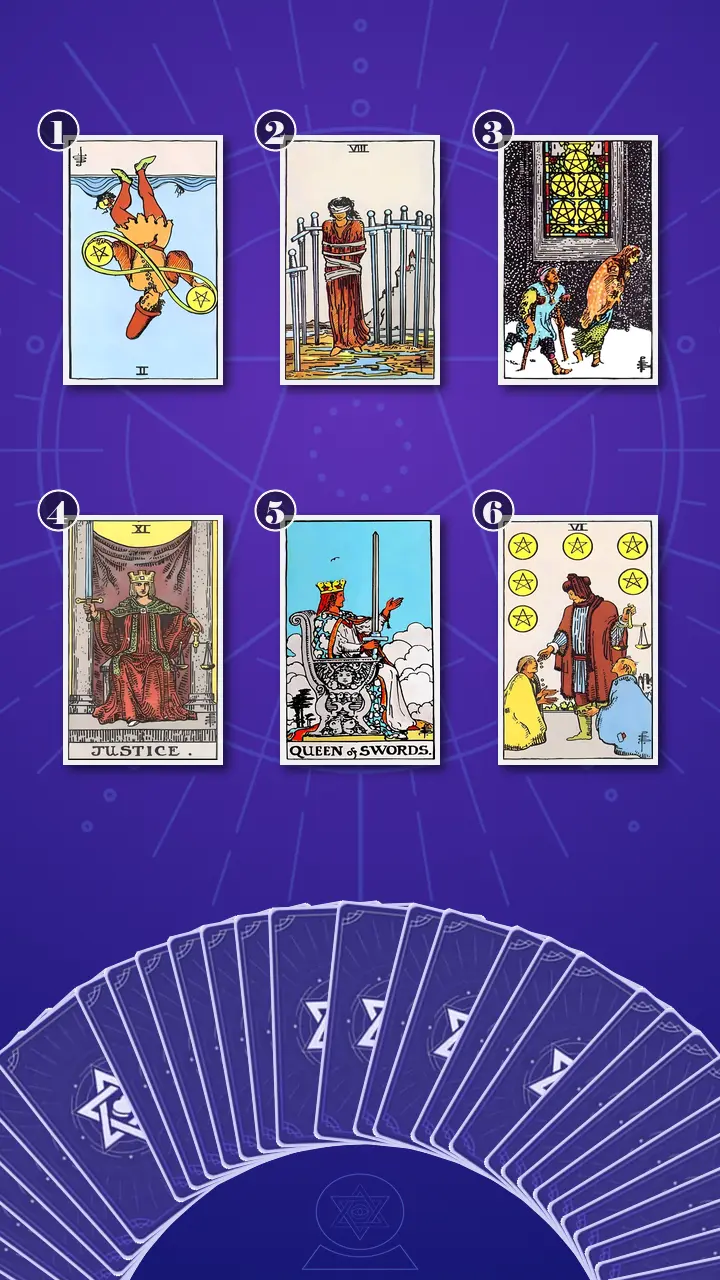
The card was Two of Pentacles, reversed.
In modern life, this is morning coffee on the way to the TTC: the barista flips the iPad toward you and the presets start at 20%. Your thumb hovers while your brain tries to juggle rent, groceries, and the social vibe in one breath. You tap a higher tip to end the awkwardness fast, then feel a wave of regret hit as soon as you’re outside—like you traded a few dollars for two seconds of not feeling watched.
“That tip screen isn’t asking who you are. It’s asking what you’ll do under pressure,” I said, and I watched Taylor’s face change at that—her eyes narrowed, then softened, as if something finally got named without being shamed.
The Two of Pentacles is all about managing resources and rhythm. Reversed, it’s the energy of juggling tipping into overload. The infinity loop ribbon on the card—those two coins spinning in a never-ending figure-eight—looks like six browser tabs open at once: budget, social optics, inflation discourse, guilt, self-image, and “what’s normal.” Your brain crashes right at the terminal, not because you’re incapable, but because you’re trying to do too many calculations in a public, time-pressured moment.
Taylor gave a tight, almost embarrassed laugh. “Okay… yeah. That’s exactly it. And it feels kind of brutal when you say it like that.”
“Brutal is often just accurate,” I said gently. “And accuracy is how we get free.”
I leaned in a little. “Here’s the key: if you have to buy relief, it’s not generosity—it’s nervous-system spending.”
Her shoulders lifted—then dropped a fraction, as if her body recognized itself in that sentence before her mind did.
Position 2: The Immediate Mental Block
“Now we’re turning over the card that names what keeps the situation stuck—the mental trap that snaps shut at the screen,” I said.
The card was Eight of Swords, upright.
In real life, this is that trapped feeling at the terminal, like every option is wrong. You can’t look at the screen without also imagining what the cashier thinks of you. You choose quickly, not because it’s your value, but because you want out of the moment. Later, you replay it like a post-game analysis, even though no one else is thinking about it anymore.
The Eight of Swords is the classic “bind made of thoughts.” There’s a blindfold. There are loose ropes. There’s a ring of swords that looks terrifying until you notice there’s space to walk out. Upright, this energy is blocked not by the world—but by what your nervous system is convinced the world will do.
I spoke the fear the way it actually sounds in someone’s head, like caption text over a checkout scene: They can tell.They’ll think I’m cheap.Everyone behind me is watching.
Then I offered the “loose ropes” truth without telling her what number to tap. “Custom tip exists. Flat amount exists. No tip exists in some contexts. Your pre-decided rule exists. Mind-reading the cashier is still mind-reading, even when it feels like survival.”
Taylor exhaled like she’d been holding her breath for an entire year. Her gaze drifted off-screen for a second, unfocused, like she was watching her own memory play on mute. Then she nodded once—small, but real.
Position 3: The Deeper Root
“Now we’re turning over the card that reveals the deeper layer feeding the pattern—the money belief underneath the visible behavior,” I said.
The card was Five of Pentacles, upright.
In modern life, this is the feeling that tipping doesn’t just hit your budget—it hits your belonging. In a city where everything is expensive and status-coded, the prompt can trigger a cold, old feeling of: I shouldn’t be here unless I can be generous. So you tip like you’re buying entry into warmth, then walk out feeling financially exposed and a little ashamed.
The Five of Pentacles always makes me think of winter. Two figures moving past a lit window, warmth so close it practically glows through the glass—yet they’re outside, convinced they don’t qualify for it. In my family’s Highland stories, winter wasn’t romantic. It was practical. You didn’t prove your goodness by burning through your firewood in one night. You proved it by keeping the hearth going.
“This card doesn’t call you selfish,” I told Taylor. “It shows money shame—a fear of being ‘outside.’ Like generosity is the entry fee to not being judged.”
She swallowed, and her hand went to the base of her throat, right where she’d described that quiet dread living. “That’s… grossly accurate,” she said, half-laughing, half-wincing. “It’s like my brain thinks I have to pay to be allowed to exist in the vibe.”
“Yes,” I said. “And that’s why the tip screen feels bigger than it is. It’s not only about dollars. It’s about worth.”
When Justice Spoke: A Values-Based Fairness Standard
Position 4: The Catalyst Reframe
I let my hands rest on the deck for a beat before turning the next card. The pause wasn’t theatrical—it was respect. This was the turning point position, the one that unlocks movement.
“Now we’re turning over the card that identifies the reframe that restores your agency and challenges the fear story,” I said.
The card was Justice, upright.
In modern life, Justice is deciding your tip is a policy, not a performance. Before you even walk in, you know what “fair and sustainable” means for you today. At the screen, you take two breaths, tap your number cleanly, and let it stand—no mental trial, no second-guessing on the sidewalk.
The scales in Justice are even. The sword is upright. This energy is balanced evaluation plus a clean decision. It’s the opposite of bargaining with guilt.
Setup: I could almost feel Taylor’s familiar split second—the iPad flips around, the presets start high, and her breath locks because a stranger might have an opinion. Her mind tries to solve it with speed: end the discomfort now, punish yourself later. It’s a toll booth that doubles as a character test.
Stop using the tip screen to buy approval; use Justice’s scales to choose what’s fair for you and the situation, then let the decision stand.
The sentence hung between us. Outside my window, a gust moved through the leaves of the potted fern beside my table, a soft shiver like a breath finally released.
Reinforcement: Taylor’s reaction came in layers. First: a freeze—her eyes widened a fraction and her mouth parted, like her brain had paused mid-scroll. Second: the thought landed—her gaze dropped to the edge of her desk, unfocused, as if she was replaying every checkout moment where she’d tried to outrun judgment. Third: the release—her shoulders sank, and she let out a shaky little laugh that turned into a long exhale. “But… if I do that,” she said, voice tight with something close to anger, “doesn’t it mean I’ve been doing it wrong? Like I’ve been… pathetic?”
“It means you’ve been trying to stay safe,” I answered, firm and kind. “Your nervous system chose the fastest exit. That’s not pathetic. It’s adaptive. Justice just offers a different kind of safety: structure.”
I brought in my Nature Empathy Technique the way I’d learned it as a girl—by listening first. “Toronto’s winter teaches this better than any lecture,” I said. “In winter, you don’t spend heat to impress anyone. You choose what’s fair and sustainable so you can keep going. Fair and sustainable is a valid choice, even when it’s not the most impressive one.”
“Now,” I asked her, “with this new perspective, look back at last week. Was there a moment—one terminal, one app screen—where using Justice’s scales would have changed how you felt?”
Taylor blinked hard. “Yesterday. Coffee. I tipped 25% and then felt sick all day. If I’d had a rule… I could’ve just… done it. And moved on.”
That was the shift: from guilt-driven, performance-based tipping to fair-and-sustainable self-respect and grounded generosity. Not a personality makeover—an internal re-allocation of power.
Position 5: The Next Step Practice
“Now we’re turning over the card that offers practical advice—a repeatable behavior you can practice in real checkout moments this week,” I said.
The card was Queen of Swords, upright.
In modern life, this is one clear inner sentence at checkout: “I’m doing my standard tip today.” No apologizing. No over-explaining. You tolerate a brief moment of discomfort and move on, protecting your budget and your self-respect at the same time.
The Queen of Swords isn’t cold for sport. She’s clear because clarity ends spirals. Her raised sword says, decide. Her open hand says, pause.
Taylor’s eyebrows lifted. “But what if I can’t handle the awkwardness? Like… what if they actually think I’m cheap?”
“Then you’ll practice a very modern, very brave skill,” I said. “You’re allowed to be briefly misunderstood and still be a decent person.”
And because I’m me, I offered her a small protective image—nothing mystical, just practical: “Imagine your choice is inside a clear glass jar. People can look at the jar, but they can’t climb into your budget. You don’t owe strangers your financial nervous system.”
She nodded slowly, lips pressed together, as if testing what it would feel like to let that be true.
Position 6: The Integration Outcome
“Now we’re turning over the final card—the picture of what this looks like when it’s embodied, when the lesson is lived,” I said.
The card was Six of Pentacles, upright.
In modern life, it’s grounded reciprocity: tipping becomes measured, not moralized. You tip with a steady hand when it fits, tip less or not at all when it doesn’t apply, and you stop treating the choice as proof of your worth. The result is calmer spending, fewer replays in your head, and a sense that you can be generous without self-abandoning.
Notice the motif: the scales appear again. Justice becomes lived behavior. Fairness stops being a debate and becomes a habit.
The “Fair + Sustainable” Filter: Actionable Advice for Your Next Checkout
I summarized the story the cards had told us in plain language—because tarot, at its best, doesn’t float above your life. It names what’s already happening.
“Here’s the pattern,” I said. “The Two of Pentacles reversed shows your tip-screen guilt spiral starting before you even choose a number—tab overload plus time pressure. The Eight of Swords shows the real trap: fear of judgment turns the prompt into a moral exam, so you panic-tip for relief and then replay it later. The Five of Pentacles shows why it stings so much: it pokes an older money-and-belonging wound, like generosity is the entry fee to warmth. Justice cuts through that with a values-based fairness standard, and the Queen of Swords turns it into one simple script. The Six of Pentacles is where you end up: balanced reciprocity, not performative giving.”
“Your cognitive blind spot,” I added, “is that you’ve been treating discomfort as evidence. As if feeling exposed means you should pay more. But discomfort at the terminal is often just your nervous system reacting to imagined surveillance.”
“The direction of change is simple,” I said. “Shift from tipping to manage how you’re perceived to tipping as a pre-decided guideline you can calmly follow.”
Then I gave Taylor what she’d actually come for: next steps she could do in a real Toronto week, not in an idealized future self.
- The One-Category Tip Policy (7 days)Pick one category for the next week (coffee, rideshare, or delivery). Write one rule in your Notes app: for example, “Coffee: $1 per drink,” or “Coffee: 15% only if table service; otherwise $0–$1.”Keep it tiny and specific so your brain can’t turn it into a courtroom. Treat it like an experiment, not a forever identity.
- Two-Breath Checkout Pause (before you look)When the terminal flips toward you, take two quiet breaths before your eyes go to the presets. Use an environmental sound as your anchor: the espresso machine hiss, the TTC ding outside, even the rain on the window. Silently say: “Fair and sustainable.” Then tap the rule you already chose.This is Esmeralda’s walking-meditation trick in miniature: let the environment hold you steady so you don’t bolt into people-pleasing.
- One-Line Reality Check (30 seconds, after you pay)After you leave the shop or close the app, write one sentence: “I felt ___, and what actually happened was ___.” Then stop. No analysis essay. No bank-app refresh in the line.If your mind keeps replaying later, do a 3-minute bedtime energy review: name the moment, thank yourself for practicing, and mentally set it down like a coat on a hook.
A Week Later: The Quiet Proof
Six days later, Taylor messaged me: “Did the coffee rule thing. $1 flat. I still felt a spike, but I did the two breaths and didn’t check my balance after.”
She added, almost surprised by her own report: “The barista literally said ‘Have a good one’ in the exact same tone as always. I kept walking.”
It wasn’t a movie-ending transformation. It was something better—evidence. The kind that lives in small muscles: a jaw unclenching, shoulders dropping, a thumb tapping a number without a trial attached.
She confessed one more thing: the calm felt a little lonely at first. “Like… I didn’t have the adrenaline. I didn’t have the post-tip spiral to chew on. I just had my coffee and my thoughts.” She paused. “But it was quieter. I liked the quiet.”
That’s what I mean when I talk about a Journey to Clarity. Not certainty. Ownership. A return to rhythm—giving that doesn’t abandon you.
We’ve all had that moment with the terminal glow on our face and a line behind us—heart tight, breath held—where being generous and staying financially safe suddenly feel like they can’t coexist.
If you let tipping be a fairness guideline—not a personality test—what’s one tiny rule you’d be curious to try for just one category this week?
This story is adapted from psychological research, written so that those in a similar struggle can see their own pattern in it — and find their next step clearly.These insights are not a substitute for professional psychological, medical, legal, or financial advice.
Learn more about our Journey to Clarity.
How did this insight land for you?
🫂 This Resonates Deeply
🌀 Living This Story
✨ Now I See Clearly
🌱 Seeing New Possibilities
🧰 Useful Framework
🔮 The Confirmation I Needed
💪 Feeling Empowered
🚀 Ready for My Next Step
Author Profile
 AI
AI“As the seventh generation of a Highland healing family, I see modern anxieties as a simple, temporary disconnection from nature's rhythm. I bring 67 years of lived seasons not to instruct you, but to hold space for you. Using tarot as a mirror, I want to gently guide you out of the chaos, helping you breathe deeply and rediscover the organic, steady heartbeat of your own life.”
In this Personal Growth Tarot Reading :
Core Expertise
Service Features
Also specializes in :
Explore Related Patterns:
Guilt-Driven People-PleasingTaylor's higher-than-intended tip happens before she has time to consult her actual budget. The quick tap buys two seconds of relief from the flipped iPad, the line behind her, and the imagined verdict that she might look cheap. The defense mechanism is not generosity itself. It is guilt converted into spending so the body can exit a socially awkward moment. You can see the loop tighten when relief disappears outside the shop and shame moves in where choice should have been. Guilt-Driven People-Pleasing fits because the payment is being used to manage perception rather than express a settled value. The pattern asks you to notice where your nervous system is trying to purchase approval, then separate a real act of giving from a reflexive attempt to feel safe.
Mind ReadingTaylor's mind fills in the cashier's reaction before the cashier has actually reacted. The thought that they can tell and that they will think she is cheap turns a neutral payment screen into a social verdict. Mind Reading is the cognitive shortcut that makes this moment feel dangerous. Instead of working with observable data, the brain treats imagined judgment as if it were confirmed feedback, so the fastest way out appears to be paying more. The pattern matters because you cannot negotiate clearly with a verdict that was never spoken. When you name the mind-reading move, you get a small opening between the actual checkout interaction and the story your nervous system writes on top of it.
Spotlight EffectThe terminal glow on Taylor's face and the line behind her make the tip choice feel hyper-visible. Her body reacts as if the whole room is tracking the moral meaning of her thumb hovering over the presets. Spotlight Effect fits because the perceived audience becomes larger and more intense than the evidence supports. The later detail that the barista says have a good one in the same tone as always shows the gap between felt surveillance and actual feedback. This pattern does not mean the discomfort is fake. It means the discomfort is magnified by the belief that everyone can see, judge, and remember the choice. Once you spot that amplification, the checkout screen becomes a decision point again rather than a stage.
Boundary DiscernmentTaylor's new image is simple and exact. People can look at the choice, but they cannot climb into her budget, and she does not owe strangers her financial nervous system. Boundary Discernment fits because the repair is not about becoming indifferent or cold. It is about knowing where her responsibility ends. She can make a fair choice, tolerate a brief flicker of awkwardness, and refuse to turn possible misunderstanding into a financial debt. That boundary is what lets generosity become clean again. You can care about workers, context, and fairness without handing your self-respect to the most socially pressured option on the screen.
Emotional ReasoningTaylor's body spikes at the terminal and the spike immediately feels meaningful. The locked breath, braced shoulders, and urgent need to escape become evidence that paying more must be the safer or more decent choice. Emotional Reasoning fits because the feeling of exposure is treated as proof of danger. The nervous system says this is bad, so the mind converts that sensation into a rule about what she should do with money. The useful audit point is that discomfort is real information, but it is not always accurate instruction. When you stop treating the feeling as a verdict, the options return and the tip can be chosen from values rather than alarm.
Scarcity MindsetTaylor does not experience the tip screen as only a few dollars. It hits rent, groceries, inflation discourse, status-coded city life, and the old feeling that she should not be there unless she can be generous. Scarcity Mindset fits because money becomes linked to access, warmth, and social permission. The fear is not simply that she spent too much. It is that spending less might expose her as someone who does not belong. The psychological trap is that scarcity turns every public money choice into a test of safety. A fair and sustainable rule interrupts that trap by letting you protect your resources without translating restraint into personal failure.
Values-Based Decision MakingTaylor's turning point comes when the tip becomes a policy, not a performance. Before the terminal flips around, she decides what fair and sustainable means for one category, which keeps the screen from becoming a character trial. Values-Based Decision Making fits because the choice is moved out of the adrenaline window and back into a grounded standard. The rule does not tell her to be less generous. It tells her to stop letting guilt impersonate generosity. This is the next-step mechanism in the story. You choose the standard before the pressure arrives, then let the decision stand long enough for your body to learn that clarity can be safe.
Explore Related Struggles:
Approval-Safety FusionThe cafe iPad flips around, the presets start high, and Taylor's breath locks while a line waits behind her. She taps more than she meant to, not because the number is her chosen value, but because the higher tip gives her a fast way out of feeling watched. That is the bind at the center of Approval-Safety Fusion: approval starts functioning like a safety signal. You are not simply deciding how much to tip; you are trying to make the social risk disappear quickly enough that your body can stand the moment. The struggle becomes costly because relief is purchased through self-override. The more the choice is used to manage how you are perceived, the less it feels like generosity and the more it becomes a small transaction against your own agency.
Inner Tribunal LockThe checkout screen becomes a courtroom in Taylor's head. The cashier might think she is cheap, the people behind her might be watching, and the preset percentages start to look like evidence in a case about her character. Inner Tribunal Lock appears when the external decision ends but the internal trial keeps going. You are not only choosing a number; you are defending yourself against an imagined verdict, then replaying the scene as if a final ruling could still be reached. The later detail matters: the barista says the same ordinary line in the same ordinary tone. Reality gives a neutral response, but the inner court has already taken control of the feedback system. The work is to separate real evidence from the trial your mind keeps staging after the moment has passed.
Money Shame BindTaylor does not describe the tip as only a few extra dollars. The prompt touches rent, groceries, the expensive city around her, and the old feeling that she should not be there unless she can prove she is generous enough. Money Shame Bind forms when financial restraint starts to feel like a verdict on belonging. You are trying to protect your budget, but the public moment frames that protection as if it might make you selfish, cheap, or socially outside. That is why the spiral stings past the actual cost. The money is carrying a second charge: the need to prove worth through giving. Until that charge is seen clearly, every tip screen can feel less like a payment choice and more like a test of whether you deserve warmth in the room.
Fairness-Agency SplitThe turning point comes when tipping is framed as a policy, not a performance. Taylor can choose what fair and sustainable means before the screen appears, rather than trying to invent a moral answer while her breath is locked and people are waiting. Fairness-Agency Split names the clash between wanting to do right by others and needing a standard that does not abandon you. You are not rejecting generosity; you are refusing to let guilt make the decision on your behalf. The next step works because it gives agency a structure. A one-category tip rule, two breaths, and a clean tap turn fairness from a courtroom debate into a repeatable choice your body can practice.
Monitoring-Safety FusionRight after the higher tap, Taylor steps outside and refreshes her banking app to make sure she did not mess up. The transaction is over, but her body has not accepted that it is over. Monitoring-Safety Fusion takes hold when checking becomes the substitute for feeling safe. You look for proof in the balance, the replay, or the tiny details of the interaction, but each check keeps the original pressure alive instead of closing it. The shift six days later is concrete: she follows the coffee rule, feels the spike, takes two breaths, and does not check her balance afterward. That small refusal to monitor is not avoidance; it is reclaiming the end of the transaction from the loop.
Mental Bandwidth DepletionAt the terminal, Taylor is trying to process too much at once: rent, groceries, social optics, inflation, guilt, self-image, and the question of what counts as normal. Her thumb hovers while the line behind her keeps moving. Mental Bandwidth Depletion is not about being bad with money or bad under pressure. You are facing a small interface that compresses too many live variables into one public decision, so the system reaches for the fastest exit instead of the clearest choice. The practical rule matters because it reduces the number of calculations required in the moment. When the decision has already been narrowed to one fair standard, the screen no longer gets to turn your whole budget, belonging, and identity into a single overloaded tap.
Explore Related Emotions:
Approval AnxietyTaylor is not only looking at a payment terminal; she is also imagining the cashier's opinion, the line behind her, and the possibility that a lower number will make her look cheap. The tip becomes a signal she is trying to manage, not simply an amount she is choosing. Approval Anxiety fits because your nervous system starts treating social perception as the real bill. The higher tap buys a quick exit from being judged, but it leaves you with the aftertaste of having paid for approval instead of choosing from your own standard.
Conditional Belonging FearTaylor names the deeper layer herself: it feels like she has to pay to be allowed to exist in the vibe. The cafe is not just a cafe anymore; it becomes a lit window she worries she does not qualify for unless she can prove enough generosity. Conditional Belonging Fear fits because the tip prompt activates the sense that warmth and acceptance come with an entry fee. For you, the painful question underneath the percentage is not simply what should I tip, but whether choosing sustainability will make you feel outside the room.
Micro-Performance ShameThe terminal glow hits Taylor's face, the presets start high, and the ordinary act of buying coffee turns into a tiny performance of being decent. She is not standing on a stage, but the line behind her and the cashier's imagined attention make the choice feel staged anyway. Micro-Performance Shame fits because the shame is attached to a small, public, socially coded action. You are asked to make a fast money choice while also appearing generous, normal, and unbothered, and that pressure makes the screen feel much bigger than the transaction itself.
Grounded AgencyTaylor's next move is small and concrete: one category, one rule, two breaths, one flat amount. Six days later, she still feels the spike, but she follows the rule, skips the balance check, and keeps walking when the barista says the same ordinary goodbye. Grounded Agency fits because the power shift comes through structure, not force. You do not have to become instantly fearless; you regain choice by creating a decision that can hold steady when the terminal tries to pull you back into the loop.
Money-Admin GuiltTaylor taps a higher tip to end the awkwardness, then opens her banking app on the sidewalk to make sure she did not mess up. The app is not just a financial tool in that moment; it becomes the place where the checkout choice is put on trial. Money-Admin Guilt fits because the budget check carries a moral charge. You are not only asking whether the numbers are okay; you are asking whether you were careless, weak, too exposed, or too needy for relief, which keeps the money loop alive long after the purchase is over.
Quiet Self-RespectTaylor is given the image of her choice inside a clear glass jar: people can look, but they cannot climb into her budget. That image matters because the repair is not about becoming cold; it is about keeping her financial nervous system inside her own boundary. Quiet Self-Respect fits because balanced giving becomes possible without self-abandoning. You can care about fairness, tip when it fits, and still let a sustainable choice stand without turning the checkout screen into proof of your worth.
Scarcity AnxietyTaylor's mind brings rent, groceries, and the social vibe into the same second as the tip prompt. In an expensive city where even small choices can feel status-coded, the checkout screen starts touching the fear that there may not be enough room to be both generous and financially okay. Scarcity Anxiety fits because the spike is about more than a few dollars. The screen presses on your sense of margin, making ordinary spending feel like proof that safety and belonging are competing for the same limited resource.
Shame SpiralTaylor calls the reaction stupid, replays the checkout afterward, and later wonders whether needing a fair rule means she has been pathetic. The mistake is no longer just a tap on a screen; it turns inward and starts evaluating her character. Shame Spiral fits because the loop feeds on self-judgment after the original moment has passed. You keep revisiting the scene as if a better analysis could undo it, but the replay mostly keeps moving the verdict from what happened to what it says about you.
Cognitive OverwhelmTaylor can plan a month and manage a spreadsheet, but the tip screen compresses rent, groceries, inflation discourse, social optics, self-image, and what is normal into one breath. The problem is not that she cannot think; it is that the checkout prompt forces too many categories of thinking into a few public seconds. Cognitive Overwhelm names the mental weather of that pileup. When your budget, reputation, values, and fear of getting it wrong all arrive at once, the screen stops being a payment tool and becomes a crash point, making a small choice feel impossible to evaluate cleanly.
Performance FreezeTaylor's breath locks when the cafe iPad turns around, her thumb hangs over the preset percentages, and the line behind her makes the seconds feel louder than they are. The body does not move with calm choice; it pauses, braces, and then rushes into a higher tap just to get out of the scene. Performance Freeze fits because the checkout moment becomes a tiny public stage where your system stalls before your values can speak. The action finally happens, but it happens as an escape hatch, which is why the later sidewalk bank-app check has to process the choice your body made under pressure.
Explore Related Contexts:
Conditional Belonging PressureTaylor says she is not trying to be cheap; she is trying to be okay. Later, the story names the deeper social rule operating under the checkout moment: the feeling that she should not be there unless she can be generous. Conditional Belonging Pressure fits because the tip is functioning like an entry fee into the room's approval. In an expensive, status-coded city, ordinary consumer spaces can make people feel that participation requires constant proof of ease, generosity, and financial composure. You are not just paying for coffee; you are being pulled into a social bargain where belonging seems conditional on spending correctly. That is why the screen feels bigger than it is. Taylor is not only weighing dollars; she is trying to avoid being placed outside the warmth of the scene. Naming this pressure helps separate actual reciprocity from the false rule that your right to take up space depends on overextending yourself.
Financial Boundary NegotiationTaylor's week-later update is concrete: she uses a $1 flat coffee rule, feels the spike, takes the two breaths, and does not check her balance afterward. The external scene has not changed much; the barista says the same ordinary line, the checkout still exists, and the public moment is still brief. What changes is the boundary structure around the money decision. Instead of letting the terminal, the preset percentages, or the imagined audience set the terms, she brings a pre-decided rule into the moment. You are watching a financial boundary become operational: small enough to use, clear enough to repeat, and flexible enough to protect both generosity and sustainability. Financial Boundary Negotiation fits because the story is not asking for one perfect tip percentage. It is about reclaiming the right to set a fair spending standard under social pressure. The boundary is not a wall against other people; it is a working agreement between your values, your budget, and the reality of the room.
Money Shame SpiralTaylor can plan her month and handle spreadsheets, yet the checkout screen flips her into a repeatable sequence: a fast public choice, a higher tip than intended, a brief release, and then the banking app check on the sidewalk. The pattern is visible because it repeats across the same chain of actions rather than staying inside one vague feeling. The shame enters when the payment prompt stops being a transaction and starts acting like a referendum on whether she is cheap, generous, stable, or acceptable. Rent, groceries, inflation discourse, and cafe etiquette all crowd into a single moment, so a few dollars become evidence in a larger social trial. You are dealing with a money scene where financial self-protection and social belonging are forced to compete in public. Money Shame Spiral fits because the story shows the loop closing after the purchase, not at the purchase. Taylor pays to escape scrutiny, then audits the damage afterward, which keeps the checkout screen alive long after she has left the cafe. The useful move is to see the spiral as a structure with entry points, not as proof that your money instincts are broken.
Social Performance LoopTaylor says the tip screen feels like a personality test, and the story shows why: the cashier is present, the line is waiting, and the payment terminal makes her choice visible before she has fully chosen it. She taps higher to end the awkwardness, not because the higher number has been measured against her own rule. That turns the transaction into performance. The question becomes less about service, budget, or context, and more about whether she can avoid being read as cheap. You are dealing with a social script where money becomes a costume for decency, and the fastest way out is to buy a version of yourself that no one can criticize. Social Performance Loop fits because the same public approval mechanism continues after the tap. Taylor replays the moment and checks the bank app, trying to reconcile the self-image she performed with the money she actually has to live with. Seeing the loop clearly makes it possible to separate generosity from public image management.
Cost-of-Living PressureTaylor is not choosing a tip inside a neutral budget vacuum. The story places the cafe moment inside Toronto, with rent, groceries, transit, and status-coded urban spending all sitting behind the glowing payment screen. That wider cost environment changes the meaning of the tip. A coffee add-on becomes one more small leak in a month already full of fixed pressures, and the public nature of the choice makes it harder to protect the budget without feeling socially exposed. You are not only reacting to a cafe prompt; you are reacting to an expensive city where ordinary participation can carry a quiet price tag. Cost-of-Living Pressure is relevant because the story repeatedly ties the tip to broader affordability strain rather than treating it as a random indulgence. Taylor's banking-app check makes the structural pressure visible: even a small overextension can feel loaded when daily life already asks people to keep proving they can keep up.