Moralized Money Anxiety: From a $38 Cart to One Measured Choice

The $38 Checkout That Became a Trial
If you are the early-career city worker who can calculate the markup on a coworker's delivery lunch in ten seconds but needs twenty minutes to approve your own $30 purchase, moralized money anxiety may already be running the checkout.
At 10:42 on a wet Tuesday night, Jordan joined my video table from a small Toronto condo kitchenette. The refrigerator's hum leaked through the microphone, rain silvered the window, and wet tires hissed on the street below. Their laptop fan warmed their wrists. On the screen beside our call sat a $38 home item, two comparison pages, and a banking app they had already checked twice.
“I can tell when someone else is being careless with money,” Jordan said, moving the item out of the cart and then restoring it. “But when it's my choice, there's always one more thing to check. I want to make my own decisions. I just don't trust myself to stop one bad decision from becoming a pattern.”
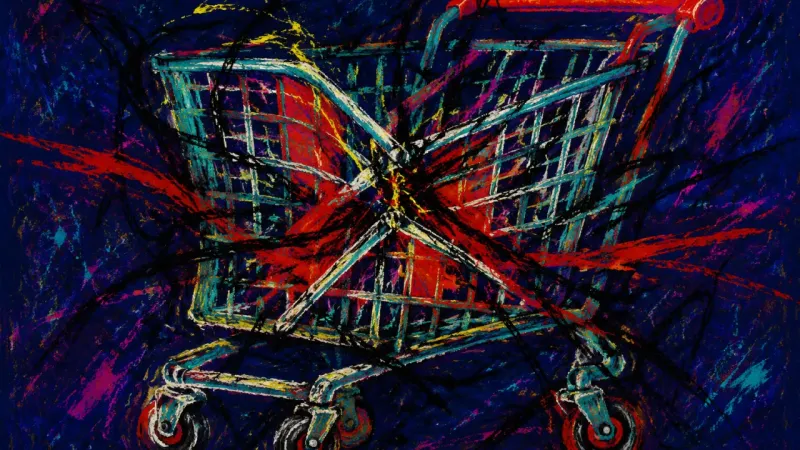
I watched their thumb hover above checkout while their jaw locked. The anxiety looked less like ordinary caution and more like an overactive bank fraud filter: every harmless signal was flagged as suspicious, and the growing number of alerts was being treated as proof that danger must be everywhere.
Jordan admitted that a friend's restaurant Story or weekend trip could trigger an instant calculation, followed by the thought, “That seems irresponsible.” The judgment gave them a few seconds of control. Resentment, guilt, and the old uncertainty arrived later, after the brief verdict had failed to make their own choices any easier.
“I don't think you're here because you need a card to approve or reject a purchase,” I told them. “You're here because you want to understand why fear has acquired veto power over choices that are meant to be yours. We can sit with that without shaming the part of you that learned to be careful. Let us draw a map through the fog and see which rules still protect you, and which ones have become ruins.”
Choosing a Map for the Inner Court
I asked Jordan to place both feet on the floor, close the shopping and banking tabs, and hold the question in one plain sentence: “Why do I judge other people's spending while fear controls my choices?” I shuffled slowly. The pause was not a mystical performance; it gave their attention somewhere to land before we examined a charged pattern.
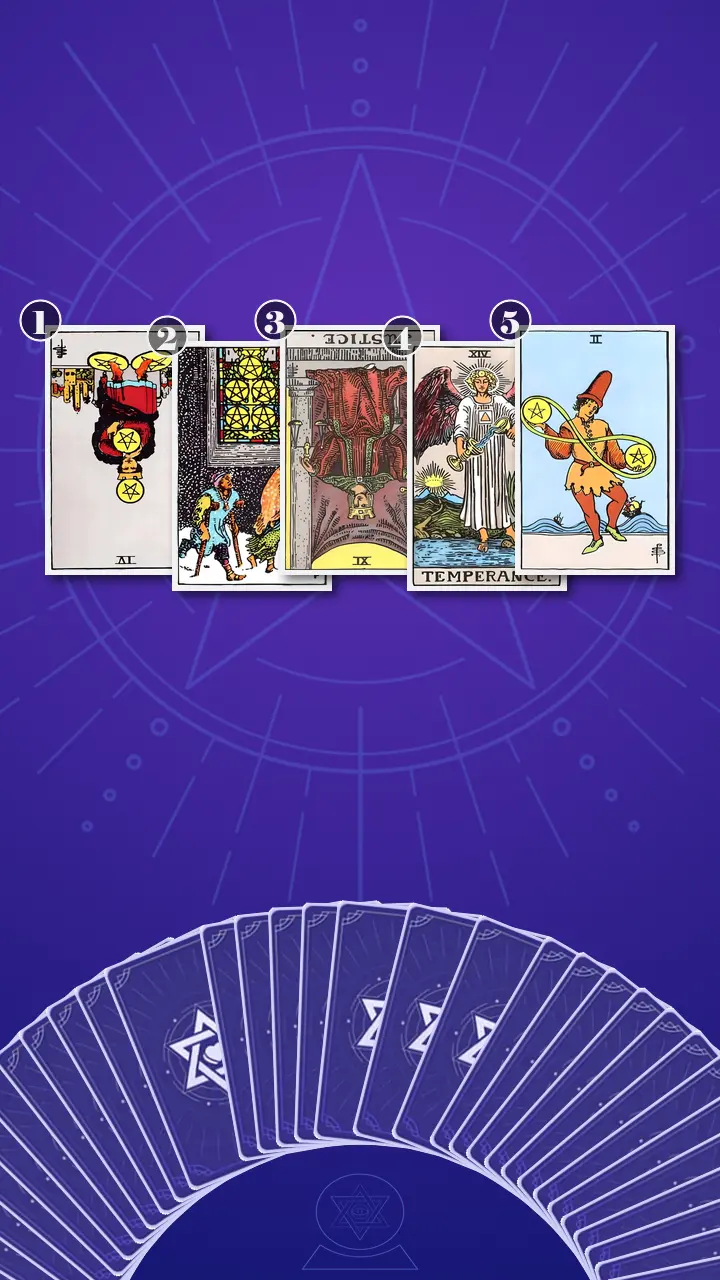
I chose The Shadow Spread · Context Edition, a five-card shadow-work tarot spread designed to trace a visible habit back to its hidden driver, expose what gets projected onto other people, identify an integrating resource, and finish with a grounded practice. For anyone wondering how tarot works in a consultation like this, I use the cards as structured prompts and symbolic mirrors. They do not reveal another person's finances, authorize a purchase, or predict Jordan's future.
This spread suited the question because the real issue was not whether the $38 item was objectively worth buying. A decision spread would have overemphasized the external options. A larger spread could have encouraged speculation. These five positions kept us with the inner sequence: the visible checking ritual, the scarcity fear beneath it, the private rule projected onto other people's receipts, the resource that could restore proportion, and the next step that could be tested in ordinary life.
I laid the cards in a narrow horizontal line. The first two positions formed the locked room of control and fear. The third occupied the exact centre, where judgment would become visible. The last two opened onto integration and movement. I told Jordan that card meanings in context matter more than isolated keywords; the cards would become useful only when Jordan tested their symbolism against lived evidence.
What the Grip Was Protecting
Position One: Holding Every Variable at Once
I began with the card representing the visible shadow pattern: the concrete habit of judging other people's spending while repeatedly checking, delaying, or prosecuting Jordan's own choices. I turned over the Four of Pentacles, in the reversed position.
In the Rider-Waite-Smith image, the seated figure tries to secure every pentacle at once: one is pressed against the chest, two are pinned beneath the feet, and another dominates the head. Reversed, that earth energy showed a blockage. Control was no longer providing stable confidence; it had become a rigid prerequisite that prevented movement.
I pointed to the warm phone in Jordan's hand. At 10:42 p.m., the $38 item already fitted the month's discretionary amount. Yet they had checked the balance again, read six more reviews, removed the item, restored it, and closed checkout once before our session began. The price, account balance, reviews, imagined regret, and moral meaning of the purchase were all being held at the same time, just as the figure clutched every pentacle.
“The inner script sounds like this,” I said. “One more check, and then I'll know. But the contradiction underneath it is: I want to make a responsible choice, so I am demanding impossible certainty before I permit myself to choose.”
Jordan gave a short, bitter laugh. Their fingers tightened around the phone and then released it. “That's so accurate it's almost cruel. I call this research.”
“I hear the sting,” I replied. “The card isn't calling you foolish or careless. Checking once can be useful. The question is whether a new check adds a new fact or merely delivers the same fear in different wording. If repeated checking produced real certainty, the fifth balance check would feel more final than the first. It doesn't, does it?”
Jordan looked down at the darkened phone. Their jaw remained tight, but the defensive smile faded. They shook their head.
“Fear can use a spreadsheet and still be fear,” I said. “That does not make the spreadsheet bad. It means we need to distinguish the tool from the purpose fear has assigned to it.”
I also warned against reading the reversal as permission to rebel through impulsive spending. Throwing away every limit to prove that money no longer controlled them would preserve the same all-or-nothing system. The useful invitation was smaller: allow one low-stakes choice to pass through a proportionate review instead of executive approval.
Position Two: Outside the Lit Window
I next turned over the card representing the underlying fear: what Jordan imagined an imperfect choice might prove about their safety, independence, belonging, and ability to recover. It was the Five of Pentacles, upright.
The card showed two figures moving through snow beneath an illuminated stained-glass window. I made the boundary clear at once: this was not a prediction of financial hardship. Its upright energy concentrated Jordan's experienced sense of deficiency, the feeling that support and ease existed somewhere inside while they had to remain outside, vigilant and cold.
I asked Jordan to return to a recent Line 1 ride home. They had watched a friend's Montreal weekend recap while fluorescent lights buzzed above damp coats and the brakes squealed into Bloor-Yonge. Before liking the post, Jordan had estimated the train fare, hotel, meals, and drinks. “Careless” arrived before the more vulnerable question: “What if they can recover from a choice like that and I can't?”
“The social feed is the lit window,” I said. “You can see the bright hotel room and the restaurant table. You cannot see income, debt, gifts, family support, packed lunches, tradeoffs, private anxiety, or any of the other context outside the frame. Your mind fills the missing space with a painful story: They get to live inside ease; I have to stay alert outside it.”
Jordan's breathing paused. Their eyes moved away from the card and seemed to replay the train carriage. Then their mouth softened, and a long breath left their chest.
“I thought I was annoyed because they didn't care,” they said quietly. “Maybe I'm annoyed because I want to believe I could be okay after an imperfect decision too.”
I nodded. On archaeological digs, I learned never to treat the visible surface as the entire site. A hard wall at the top might rest on an older layer built for a different climate, danger, or social order. Jordan's judgment was the visible wall. Beneath it lay fear of exclusion and fear of being unable to recover. Naming that layer did not diagnose its origin or make it destiny. It simply stopped the surface from pretending to be the whole truth.
When the Scales Tilted
Position Three: The Receipt-Sized Case File
I turned over the card representing projected judgment and the central blind spot: the place where Jordan's scarcity fear became a private fairness rule imposed on other people's spending and then returned as an even harsher rule for their own choices. The card was Justice, in the reversed position.
The scales and upright sword normally speak to evidence, accountability, and balanced consequences. Reversed, their air energy was distorted. Analysis had not disappeared; it had become overconfident about missing information. The scale tilted toward condemnation, while the sword cut context-heavy choices into the categories of responsible and careless.
I brought Jordan back to the office kitchen. A coworker had opened a $24 delivery bowl while sesame and chilli filled the room and a courier notification chimed from the counter. Before Jordan's leftovers had finished turning in the microwave, their mind had calculated the markup, delivery fee, tip, and groceries that the same amount could have bought.
“That price became evidence,” I said. “Your spreadsheet became the scale, and irresponsible became the sentence. But you had no evidence about the coworker's income, available time, health, caregiving load, debt, priorities, or what that lunch supported. Later, a purchase of the same amount went through a longer trial because your own court uses an even harsher standard.”
The pattern reminded me of The Good Place and its impossible moral points system: an ordinary, context-heavy choice receives a clean score even though no one can calculate every consequence. Jordan's mental algorithm had been trained on receipts and then asked to score character. Its output sounded objective because it was fast, not because the data was complete.
“Discernment asks, 'Does this fit my life?' Judgment asks, 'What does this prove about a person?'” I said. “A budget is a boundary, not a character reference.”
Jordan leaned back. Their brows drew together. “But sometimes people really are irresponsible with money. Am I supposed to pretend every choice is fine?”
“No,” I said. “Giving up condemnation does not require giving up discernment. You can decide that a purchase does not fit your life. You can protect your limits. You can even notice a pattern when someone asks you to carry its consequences. What you cannot honestly do from one lunch receipt is claim full knowledge of a person's character or use their choice as evidence that your own fear is correct.”
I replayed the lunch scene in three slower beats: “I saw what they bought. I noticed the story my mind supplied. I admitted what I could not know.” Then I offered two neutral questions: “What need might this purchase serve? What evidence do I actually have about the other person's situation?”
Jordan looked again at Justice. Their shoulders lowered a fraction. “So context before verdict,” they said.
“Exactly. Justice reversed is the blockage, but it is also the catalyst. Once the tilted rule is visible, you no longer have to confuse it with objective truth. You can observe the judgment before it becomes a ruling.”
When Temperance Poured Between Two Cups
Position Four: The Integrating Resource
The refrigerator compressor on Jordan's side clicked off, and the sudden quiet made the rain sound more precise. I turned over the card representing the integrating resource: the capacity to hold practical limits, emotional needs, facts, and personal values without forcing one to defeat the others. It was Temperance, upright, the key card and antidote in the spread.
The angel poured liquid between two cups, with one foot on land and one in water. I read its upright energy as balance in motion: practical reality joined with emotional permission, caution joined with participation, and patience joined with action. Temperance did not endorse every purchase. It offered a proportionate process in place of a flawless verdict.
I asked Jordan to picture the familiar sequence: a friend's weekend photos, the instant estimate, then the return to their own $38 cart and the second balance check. Their jaw tightened because even wanting the item had begun to feel like evidence in a case.
You do not need to make fear the gatekeeper of every purchase; let Temperance's two cups combine practical evidence with the need the choice is meant to serve.
I let the sentence sit in the quiet before I added the sharper distinction:
Responsibility is not the ability to produce a flawless verdict. It is the ability to make a proportionate choice without turning the receipt into evidence about your worth.
Jordan went completely still. First, their breath stopped and two fingers remained suspended above the phone, as if the body had frozen between clicking and retreating. Then their focus slipped beyond the card; their pupils widened and their mouth opened slightly while old checkout scenes seemed to replay behind their eyes. The first emotion to break through was not relief but anger.
“But doesn't that mean I got it wrong?” they asked, their voice suddenly louder. “All those judgments, all that time checking, and I was just making myself feel safe?”
“It means the strategy had a function,” I said. “It gave you brief control. It also reached the end of its useful era. Recognizing that cost is not the same as condemning the person who relied on it.”
The anger flickered into grief. Jordan blinked hard; their eyes reddened at the rims. Their raised shoulders descended, one after the other, and the hand that had curled into a fist opened on the counter. A trembling exhale became a small, almost embarrassed “Oh.” Relief arrived, but so did the dizziness of responsibility: if fear was no longer the unquestioned gatekeeper, Jordan would have to choose without its false guarantee.
“Now, with this new perspective, think back: was there a moment last week when this insight could have made you feel different?” I asked.
Jordan remembered an Ossington bar where the Splitwise total had climbed after another round. They had agreed without naming a limit, resented friends who seemed relaxed, and later inspected every line of the bill. “I could have said what worked for me before I got resentful,” they said. “Their ease didn't have to decide my boundary.”
This was the moment I used what I call Cognitive Paradigm Excavation. I treated Jordan's bottleneck as the necessary collapse of an obsolete intellectual era. The old governing law had been: “Responsible people avoid regrettable choices, and enough analysis can eliminate regret.” It had produced vigilance, but it could not produce the certainty it promised.
Temperance did not ask Jordan to clear the entire site and start again. Through Core Philosophy Stratigraphy, I helped them separate what remained structurally sound from what needed to stay in the past. Care for essential expenses, accountability, planning, and thoughtful limits were durable foundations. Moral surveillance, universal rules for unknown lives, and the demand for perfection were later additions that no longer deserved to govern the site.
“Self-trust is not certainty before the choice; it is a proportionate process you can live with after it,” I said. “Wanting something is not the whole decision, but fear is not the whole decision either.”
I drew two cups in Jordan's phone note. Under one, I wrote, “What does this support?” Under the other, “What limit fits my actual situation?” A third line held the bridge: “What facts do I actually have?” The insight marked the first crossing from moral comparison, repeated checking, and fear-driven control to proportionate money choices grounded in personal values, practical limits, and measured self-trust.
I stressed that no purchase was required. The note could be used for a hypothetical or past choice. If essential expenses, debt commitments, housing, medication, or immediate safety were involved, “not now” remained a valid answer, and the exercise could remain observational. Temperance was restoring Jordan's authorship, not granting spending permission.
Position Five: Balance That Keeps Moving
I turned over the final card, representing the grounded next step: a small one-week practice through which Jordan could test the new relationship to choice without repeated checking. It was the Two of Pentacles, upright.
The figure juggled two pentacles inside a looping band while ships rose and fell on the waves behind him. I read its earth energy as dynamic balance, not frozen control. Rent, groceries, social plans, subscriptions, and small pleasures would continue moving. Stability could be an active adjustment skill rather than a perfectly still financial landscape.
I translated the loop into one repeatable decision note containing the date, need, chosen limit, available facts, and choice. Jordan would review it once at the end of the week instead of reopening the case after every card notification. The ships carried an equally important message: changing conditions do not automatically make the earlier choice a moral failure.
“The month can move without making every earlier choice wrong,” Jordan said, testing the sentence aloud.
I saw their hand settle flat on the counter. The method felt manageable because it did not promise permanent certainty. It asked for flexible stewardship: one review, one choice, and an adjustment only when genuinely new information appeared.
The Governing Laws Jordan Chose to Keep
I drew the five cards together as one coherent history. The Four of Pentacles reversed showed control being used as proof of responsibility. The Five of Pentacles revealed the fear beneath the grip: one mistake might mean exclusion, dependence, or an inability to recover. Justice reversed showed that fear hardening into an internal courtroom, where other people's incomplete stories became moral evidence and Jordan's own choices received the harshest sentence. Temperance restored circulation between values, needs, facts, and limits. The Two of Pentacles turned that integration into a repeatable practice for conditions that would never stop changing.
The cognitive blind spot was not caution itself. It was the assumption that hesitation proved responsibility, and that a personally useful limit could become a fair rule for someone else's life. Jordan had been spending more effort grading choices than identifying what each choice was meant to support.
The transformation direction was precise: separate values-based discernment from moral judgment by naming the need, setting a personal limit before the emotional spiral began, checking relevant facts once, and allowing a low-stakes decision to remain closed unless something materially changed.
The Paradigm Shift Manifesto
I asked Jordan to write a short Paradigm Shift Manifesto, my preferred intervention when an old rule has lost authority but a new one still needs explicit structure. I gave them five fields: “Old law,” “What it tried to protect,” “What it now costs,” “New governing law,” and “First field test.” Their new law became: “My limits govern my choices; they do not grade my worth or govern lives whose context I cannot see.”
We turned that manifesto into two concrete, low-pressure actions:
- Run the seven-minute Need-Limit-Facts check. Before one low-stakes decision this week, open a phone note and write one sentence for each line: “Need this serves,” “Limit I choose,” and “Facts I actually have.” Check the relevant facts once, then mark “fits,” “does not fit,” or “not enough information yet.” Close the note when the timer ends and record the choice once in a one-week log. Use a past or hypothetical $20 choice if no purchase is appropriate. For essential expenses, debt, housing, medication, or immediate safety, keep this observational and choose “not now” whenever needed. Stop if the exercise increases distress.
- Put context before verdict. When a friend's purchase triggers a label this week, take one minute in Notes and write: “What I observed,” “What context I do not have,” and “What value or fear this activated in me.” Replace one character label with a camera-level fact, such as “They ordered delivery today.” No confrontation or disclosure is required. If a social account repeatedly activates comparison, mute it for 48 hours and treat the pause as information, not punishment.
I added a one-review boundary. After the seven-minute check, Jordan would close the cart and banking tabs for ten minutes, then ask whether an actual new fact had appeared. A price change, fraud alert, changed essential expense, or material new information could reopen the case. The same fear asking for another hearing could not.
“This isn't a command to spend more,” I said. “It is a way to stop making fear, desire, and somebody else's receipt compete for sole control. You remain the person who decides what fits your life.”

A Week Later, One Closed Tab
A week later, Jordan messaged me: they had used the note, bought the $38 item after one review, and closed every tab. The next morning, “What if I got it wrong?” appeared on schedule. They smiled, made coffee, and did not reopen the case.
I did not take the purchase as proof that the reading had “worked.” Buying was not the achievement, and declining would not have been a failure. The quiet proof was that Jordan had used a process they chose, tolerated the remaining uncertainty, and allowed the decision to become part of life instead of evidence in a trial.
That was Jordan's Journey to Clarity: not a magical release from every money fear, but the first observable move from an Inner Judge toward an adaptive Steward. The cards supplied a map. Jordan supplied the boundary, the decision, and the courage to leave the tab closed.
When every checkout button makes your chest tighten, I know it can feel safer to put someone else's receipt on trial than to face the possibility that your own imperfect choice might mean you cannot trust yourself. But noticing that trial is already a change in jurisdiction: fear may testify, yet it no longer has to serve as judge.
If a small choice could be information rather than a verdict, what would you pour into Temperance's two cups: which need, and which limit, would you want beside you while you decide?