Finding Clarity in the 9:58 p.m. Venmo Scroll
You open Venmo to split a normal bill in NYC, and somehow you leave the app with a full-body money shame spiral.
Jordan sat across from me with their phone face-down on my little table, like it was a hot pan they didn’t trust themselves not to touch. They were 27, a product designer at an early-stage company, the kind of job where your calendar is stacked and your pay is “fine” until the city reminds you what rent costs.
They described a scene so specific it practically had a soundtrack: Sunday Scaries in a Brooklyn walk-up, takeout containers on the coffee table, the radiator clicking like a metronome. They’d opened Venmo to pay their half of a group dinner. The screen glow felt too bright, their phone warm in their hand—then the feed loaded and “rent 💸” appeared like a lit sign. Their stomach dropped. Their throat tightened, as if their body tried to fold itself smaller.
“I open Venmo to do one thing,” they said, voice low and annoyed with themself, “and somehow I leave feeling like a worse person.”
I could hear the core contradiction underneath their words: wanting to feel financially and socially okay, while fearing that what others can see proves they’re falling behind. Shame wasn’t an abstract emotion in Jordan’s story—it was a physical contraction, like trying to swallow with a knot in your throat while your brain runs a silent audit of your worth.
“We can work with this,” I told them, gentle but direct. “Not by pretending the trigger isn’t real, and not by scolding you for being human in a very visible city. Let’s make a map. This is a Journey to Clarity—so Venmo can go back to being a tool, not a mirror that decides your value.”

Choosing the Compass: A Celtic Cross for Money Shame and Social Comparison
I asked Jordan to take one slow breath—not as a ritual for the universe, but as a handoff from autopilot to choice. While they held their question in mind—Why does the Venmo feed trigger shame—what pattern am I in?—I shuffled. The sound of cards sliding against each other is quiet, but it’s clarifying; it’s one of my favorite “threshold” moments, like stepping out of a noisy subway car into a calmer street.
“Today we’ll use a Celtic Cross · Context Edition,” I said.
For readers who wonder how tarot works in a practical way: this version is perfect when the problem is a tiny modern moment (a feed, a scroll, an emoji) that’s actually powered by layers—subconscious beliefs, social environment, and a repeating internal stance. It’s ethical and action-oriented here because we’re not treating card ten as a fixed fate; we’re treating it as an integration practice. And we’re reframing the “near future” card as a next experiment, something you can actually try in the next week.
I pointed to the center of the spread. “The first card shows what happens in you in the first three seconds—before you even scroll. The crossing card shows the mechanism that hooks you. And near the end, we’ll look at the integration practice: the healthiest synthesis, the way you build self-trust without turning money visibility into a verdict.”
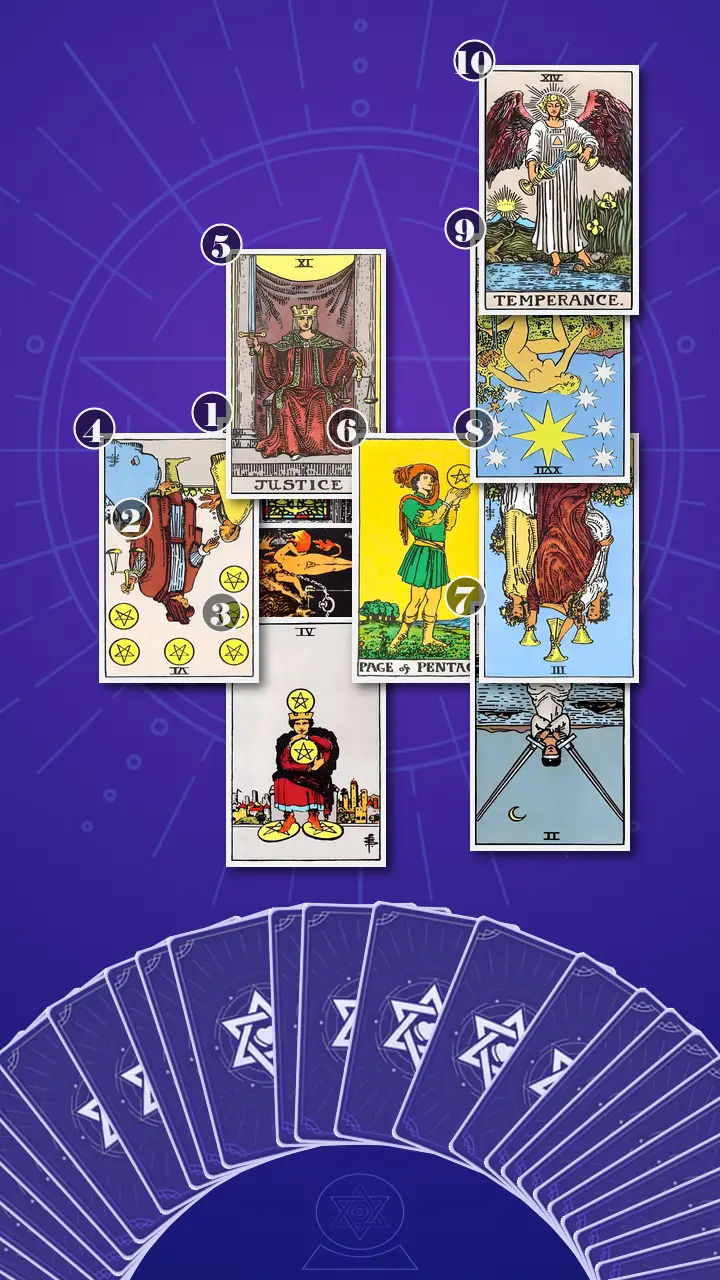
Reading the Map: Card Meanings in Context
Position 1: The Immediate Shame Trigger
“Now we’re turning over the card that represents the immediate shame trigger: what’s happening in you the moment the Venmo feed hits.”
Five of Pentacles, upright.
In the classic image, two figures move through cold weather past a warm, lit window. In Jordan’s life, it’s painfully modern: this is like seeing a stream of ‘rent,’ ‘weekend trip,’ or group dinner splits and instantly interpreting it as proof that everyone else is inside a warm, stable life while you’re barely holding it together.
The energy here is contraction—not “you’re bad with money,” but “I’m outside, and I’m not allowed in.” Five of Pentacles doesn’t just describe scarcity; it describes the shame story that attaches to scarcity. The moment the feed loads, the nervous system doesn’t think, Oh, an app. It thinks, Judgment. Exposure. Ranking.
Jordan gave a tense, bitter little laugh—one sharp exhale that was half recognition, half protest. “That’s… yeah. That’s too accurate. Like, kind of rude.”
“I know,” I said softly. “But accuracy is how we stop blaming you and start naming the pattern.”
Position 2: What Crosses You (The Hook)
“Now we’re turning over the card that represents what crosses you: the mechanism that hooks you into comparison and self-judgment.”
The Devil, reversed.
This is the comparison-and-control loop becoming visible. Not destiny—mechanics. The symbolism is blunt: chains, a pedestal, the sense that something else has the remote control. In Jordan’s modern translation: you don’t even want to check the feed, but your thumb still moves there automatically, as if the app is holding the remote control for your self-esteem.
The Devil reversed is an energy of blockage loosening: you can see the chain. But you’re still wearing it, and your body still reacts like it isn’t optional.
I leaned in and described it exactly as it happens—the phone-autopilot micro-scene. “You open Venmo to request $32.50. You tell yourself, ‘I’m not going to look—just one second.’ And somehow your thumb is already scrolling before your brain votes yes. Your inner monologue goes, ‘Why am I already here?’ That’s not a character flaw. That’s a nervous system seeking control.”
Jordan’s shoulders lifted a fraction. Their mouth twitched like they wanted to laugh again, but it didn’t quite land. It was that uncomfortable clarity: oh… I do that.
“Freedom versus control,” I said. “The hook offers you control. But it costs you freedom.”
Then, because I’m a Jungian psychologist, I named the shadow without shaming it: “There’s a part of you—an exiled, scared part—that believes, ‘If I gather enough public evidence, I can’t be caught off guard.’ The shadow isn’t evil. It’s protective. But it’s using a brutal strategy.”
Position 3: Root Cause (The Grip That Feels Like Safety)
“Now we’re turning over the card that represents the root cause: the underlying belief about money, safety, and worth that keeps the pattern alive.”
Four of Pentacles, upright.
This card is the body posture Jordan described: the tight throat, the shrinking, the grip. The modern translation is almost a New York coping manual: trying to feel safe by controlling the story—what you spend, what you reveal, how you look—while living in a city where everyone’s lifestyle is constantly on display.
The energy dynamic here is excess control. It’s not budgeting; it’s bracing. It’s the belief that “being seen” means “losing control,” so the system locks down: spend less, say less, need less, ask for less—then check the feed like it’s the only way to know where you stand.
I watched Jordan’s hand unconsciously curl around their coffee cup. Their fingers tightened, then loosened. Body first, mind second. Always.
“If you learned somewhere that safety equals tightness,” I said, “then an app built on visibility will feel like danger.”
Position 4: Past Conditioning (The Reciprocity Script)
“Now we’re turning over the card that represents past conditioning: earlier reciprocity scripts—owing, earning belonging, strings attached—that the feed reactivates.”
Six of Pentacles, reversed.
Reversed, this card points to imbalance in giving and receiving—where fairness turns into performance, or where asking feels like risk. Jordan’s modern translation: unconsciously translating friendship into a hierarchy—who pays, who receives, who has to ask—and feeling ashamed of landing on the ‘receiving’ side.
The energy is a blockage in clean exchange. Not because Jordan is selfish—because the nervous system thinks receiving equals exposure. So the feed doesn’t just show transactions; it replays an old lesson: don’t owe, don’t need, don’t be the burden.
Jordan’s gaze drifted away from the cards, toward the window, like they were remembering group chats where someone drops a restaurant link and “down?” and nobody names the cost. Their jaw set for a second.
“Yeah,” they said quietly. “I’ll go silent instead of just… saying what I can do.”
Position 5: Conscious Mindset (The Inner Courtroom)
“Now we’re turning over the card that represents your conscious mindset: how you’re trying to make sense of this, and where self-judgment masquerades as ‘being realistic’.”
Justice, upright.
Justice is the desire for truth and fairness. Jordan isn’t asking for a mystical answer—they’re asking for a clear explanation, like a designer debugging a system: what pattern am I in?
But Justice has a knife edge. The energy can be balance—discernment, reality, clean accountability. Or it can become excess—a harsh inner judge using “truth” as a weapon. The modern metaphor here is perfect: Justice is a spreadsheet that can be used for clarity—or used like a weapon if every cell is “evidence” against you.
I offered Jordan a line I’ve repeated to travelers on ships crossing the Atlantic, staring at endless water and trying to “figure themselves out” with more data: “Information won’t soothe a nervous system that thinks it’s being watched.”
Jordan nodded once, small and tight, like the statement hit a place beneath language.
Position 6: Next Experiment (The Beginner-Builder)
“Now we’re turning over the card that represents the next experiment: the most practical small change you can try this week to interrupt the loop.”
Page of Pentacles, upright.
This is my favorite kind of antidote: not dramatic, not performative—just real. The modern translation is clear: replacing scrolling with one private, steady practice—tracking one category, setting one boundary, learning one money skill—so confidence comes from experience, not from other people’s transactions.
The Page’s energy is balanced Earth: practical learning, steady attention, competence built through repetition. It’s the opposite of doomscrolling. It’s one sticky note instead of ten open tabs.
I watched Jordan’s shoulders drop a little, like their body heard the words “small” and “week” and decided it could stay in the room. “One category,” I said. “One week. One rule you can keep. That’s practicing competence instead of performing it.”
Position 7: Your Role in the Cycle (Gridlock Breaking into Overwhelm)
“Now we’re turning over the card that represents your role in the cycle: the internal stance that keeps you stuck—or can help you shift.”
Two of Swords, reversed.
This is the slipping blindfold—the moment you realize you’ve been trying not to see. In Jordan’s modern translation: keeping the feed in your life because it feels easier than choosing a boundary—and the boundary would require facing the discomfort of not knowing what others are doing.
The energy is blockage turning into spillover: decision paralysis breaking into overwhelm. And this is where the spread’s major blockage clicks into place: The Devil reversed + Two of Swords reversed is awareness of the hook without a decision. That combination creates a loop that feels “fated” even though it isn’t.
I mirrored it back with the exact inner monologue structure: “You scroll until you feel bad. You tell yourself you should stop. You keep scrolling anyway because stopping would mean admitting you care—and deciding what to do.”
Jordan let out another sharp exhale—then looked down at their hands, as if caught doing something in public. Not shame at the reading—shame at being understood. I kept my voice steady. “You’re not broken,” I said. “You’re stuck between two protections: ‘If I don’t look, I’m naive’ and ‘If I look, I’m punished.’ We’re going to build a third option.”
Position 8: External Context (When Belonging Becomes a Feed)
“Now we’re turning over the card that represents external context: how social culture and public money visibility amplify the trigger.”
Three of Cups, reversed.
Upright, it’s celebration and closeness. Reversed, it’s performative togetherness—party energy turned sideways. In Jordan’s modern translation: interpreting Venmo captions as proof of closeness and ease—then feeling ashamed when your own social life doesn’t look equally effortless on a public timeline.
The energy is distortion: community becomes a highlight reel; friendship becomes a ledger. This isn’t Jordan “being dramatic.” This is the environment doing what environments do: shaping what your nervous system believes is required to belong.
“In NYC,” I said, “a lot of social plans are basically a link and ‘down?’ That vagueness leaves room for your brain to fill in the worst.”
Position 9: Hopes and Fears (The Hall of Mirrors)
“Now we’re turning over the card that represents hopes and fears: what you’re secretly trying to secure by checking and comparing.”
The Star, reversed.
This is the mirror wound. Star reversed is a guiding light dimmed—not because there’s no hope, but because you’re looking for it in a place that distorts. Jordan’s modern translation: wanting one clear sign you’re doing life ‘right,’ but the feed turning into a hall of mirrors that makes your own path feel less legitimate.
The energy is deficiency of inner reassurance. You go to the feed for a sign you’re okay. You leave with less faith in yourself. The inner monologue is so familiar it could be a voiceover in an NYC-night montage: “I’m looking for a sign I’m okay… and somehow I only find proof I’m not.”
Jordan nodded slowly, eyes a little glossy but steady. “That’s exactly it,” they said. “I’m not even looking at the money sometimes. I’m looking at… whether I’m doing life right.”
“And that’s why this isn’t about deleting an app,” I replied. “It’s about reclaiming your compass.”
Position 10: Integration Practice (The Temperance Move)
“Now we’re turning over the card that represents the integration practice: the healthiest synthesis to build a steadier relationship with money visibility and self-worth.”
Before I flipped it, the room went a touch quieter—the way it does on a ship deck at night when the engine hum becomes the only sound and you can finally hear your own thoughts.
Temperance, upright.
Temperance is the Integrator: one foot on land, one in water, pouring steadily between two cups. In Jordan’s modern translation: learning to separate facts (a bill, a split, a budget) from stories (I’m behind, I’m unlovable) and responding with a steady ritual that protects your attention.
Setup (the stuck moment): Jordan opens Venmo to split a totally normal bill, and within seconds their throat tightens—because the feed makes it feel like everyone else is living warmer, easier, more “adult” lives than they are. They’re trapped between “I should be chill” and “I need to check,” using visibility as a shortcut to self-worth.
Delivery (the sentence that changes the frame):
Stop using the feed as a verdict and start mixing facts with compassion—like Temperance pouring steadily between two cups.
I let the words sit for a beat, like a bell you can feel in your ribs.
Reinforcement (what happened in Jordan’s body): First, there was a tiny freeze—Jordan’s breath paused mid-chest, and their fingers hovered above the phone as if the habit had been called into the room. Then their eyes went slightly unfocused, like they were replaying the last “rent 💸” moment in slow motion, seeing not the numbers but the instant self-verdict. Then the exhale came—quiet, shaky, real. Their shoulders lowered by an inch. The tightness in their throat softened enough for them to swallow without effort. And in that softening, something else showed up: a flicker of anger.
“But if I stop using it as a verdict,” they said, voice sharper for a second, “doesn’t that mean I’ve been… doing this to myself?”
I nodded. “It can feel like that. But I want to be precise: you didn’t invent the pressure. The feed is designed like a public timeline, and NYC culture already makes spending feel like belonging. What you’re noticing is agency—not blame. Devil reversed is you seeing the chain. Temperance is you learning a new way to hold the cup.”
This is where I used my Energy State Diagnosis—my three-dimensional check for energy leaks through environment, relationships, and self. “Environment: the public feed turns logistics into a stage. Relationships: group culture + inside-joke captions can feel like membership badges. Self: Four of Pentacles grip—your body clamps down and your mind collects evidence. Temperance doesn’t demand you ‘stop caring.’ It regulates the flow, like we do in Venice when canal currents get chaotic: not by draining the water, but by guiding it into a steadier channel.”
I leaned forward, warm and practical. “Now—using this new frame—think back to last week. Was there a moment when you opened the app and the shame hit? If you had treated that moment as facts plus feelings, not a verdict, what would you have done differently in the next 20 seconds?”
Jordan blinked, then looked down. “I would’ve… closed it,” they said. “Like, immediately. Without making it mean I’m failing.”
“Exactly,” I replied. “This is the emotional shift we’re aiming for: from shame contraction to noticing the comparison hook in real time, choosing one grounded action instead of scrolling, and building cautious self-trust. Visibility isn’t a verdict.”
The One-Week “Tool, Not Mirror” Protocol (Actionable Next Steps)
I gathered the story the spread had told us: the Five of Pentacles shows the instant drop—public visibility translating into “I don’t belong.” The Devil reversed reveals the mechanism—compulsive checking that pretends to be “being realistic.” Four of Pentacles shows the root grip—control as safety. Six of Pentacles reversed shows an old reciprocity script—fear of owing, fear of receiving, fear of being the burden. Justice is the conscious mind trying to fix it with fairness, but risking cruelty. The Page of Pentacles offers the pivot: small, trackable practice. Two of Swords reversed names the stall: awareness without a boundary decision. Three of Cups reversed shows the social amplifier: performative closeness. Star reversed reveals the hope wound: seeking reassurance and leaving with less hope. And Temperance is the bridge—facts plus care, mixed steadily, so money can be logistics without becoming a moral score.
The cognitive blind spot was simple and common in a career crossroads / high-visibility city life way: Jordan’s brain treated public comparison as a shortcut to self-worth. It felt efficient—like “checking the vibe”—but it quietly made every payment into a performance review. The transformation direction was clear: private values + small, trackable money choices as the source of self-trust.
I offered Jordan a plan that matched their nervous system: small, doable, measurable—no drama, no perfection.
- Pay/Request-Only Boundary (7 days)Create a shortcut that opens Venmo directly to Pay/Request (or use the search bar immediately). After each transaction, close the app right away—no feed, no caption editing, no “just one second.” Track one thing in Notes: how many times the urge to peek shows up.Expect your brain to say, “This is dramatic.” Treat that thought as part of the loop. Start with 24 hours if a full week feels like too much.
- Make Your Transactions Private (One-time setup)Set Venmo’s privacy to Private for future transactions and change your default audience if available. Do one tiny test payment to confirm it sticks—then you’ll know your logistics aren’t also public content.Private choices build louder confidence than public captions. You don’t owe anyone access to your attention or your spending.
- The Temperance “Fact + Feeling” Line (60 seconds)Right after you close the app, write one line: “Fact: ____. Feeling: ____.” Example: “Fact: I spent $48 at dinner. Feeling: anxious.” No analysis afterward—just the pour between two cups.If the breath feels activating, skip it. Do a tactile cue instead: one hand on chest, feel the fabric, then write the line. Neutral is the goal—not euphoric.
To make this even more doable, I taught Jordan one of my Instant Adjustment Techniques—a coffee-break-sized “soft exit.” “If you catch yourself mid-scroll,” I said, “close the app without a lecture. Then do one grounding action: drink water, wash your hands, or stand at a window for 20 seconds. The move is: interrupt the loop, not punish the person.”

A Week Later: Ownership, Not Certainty
A week later, Jordan messaged me a screenshot: their Venmo default set to Private, and a Notes app list that simply read, “Logistics done.” Beneath it: seven little tally marks for “urge to scroll.” No essay. No shame confession. Just data that was actually kind.
“It’s weird,” they wrote. “I still get the throat thing sometimes. But now I can tell it’s my body reacting to being seen, not proof I’m behind. Closing the app feels like… choosing myself.”
I thought of Temperance’s path leading to a rising sun—quiet, not cinematic. Jordan hadn’t “solved money.” They’d built the first rung of self-trust.
On one morning they described, they slept through the night for the first time in weeks—then woke up with the old thought, What if I’m wrong? They paused, put a hand on their chest, and said, “Purpose: pay/request.” The fear was still there. The verdict wasn’t.
That’s the Journey to Clarity I care about: not becoming a different person, but becoming less governable by a public scoreboard.
When a simple payment turns into a stomach-drop moment, it’s not that you’re “bad with money”—it’s that being seen feels like it could expose you as behind, so your brain starts building a case before you can even breathe.
If you let your money choices be private evidence of self-trust for one week—what’s the smallest boundary or ritual you’d actually be willing to try first?
This story is adapted from psychological research, written so that those in a similar struggle can see their own pattern in it — and find their next step clearly.These insights are not a substitute for professional psychological, medical, legal, or financial advice.
Learn more about our Journey to Clarity.
How did this insight land for you?
🫂 This Resonates Deeply
🌀 Living This Story
✨ Now I See Clearly
🌱 Seeing New Possibilities
🧰 Useful Framework
🔮 The Confirmation I Needed
💪 Feeling Empowered
🚀 Ready for My Next Step
Author Profile
 AI
AI“Having traveled across cultures... I've learned that what we often lack isn't a simple answer, but a moment of being truly understood. I use a Jungian psychological lens to help you deconstruct your subconscious patterns—not to prove anything, but to be the gentle companion who helps you unravel your knots, free of judgment, so you can reconnect with your inner wisdom.”
In this Personal Growth Tarot Reading :
Core Expertise
- Limiting Belief Deconstruction: Auditing the subconscious self-sabotage mechanisms that trigger when you are on the verge of leveling up.
- Imposter Syndrome Decoding: Separating your authentic potential from the fear of being 'found out' or unworthy of your success.
Service Features
- The Cognitive Reframing Protocol: A structured psychological journaling exercise to translate a vague fear of failure into actionable, logical risk-management data.
Also specializes in :
Explore Related Patterns:
Comparison TrapJordan sees rent payments, weekend trips, group dinner splits, and inside-joke captions, then the mind starts treating those fragments as a full social map. The feed appears to show who is stable, who is included, who is relaxed about money, and who has already figured life out. The psychological mechanism is selective attention under threat. You are not comparing complete lives with complete lives; you are comparing your private uncertainty with other people's public transaction fragments. That mismatch creates a distorted audit where ordinary payments start looking like proof of hierarchy. Comparison Trap fits because the trigger is not only money. It is the moment public visibility becomes a ranking system for adulthood and belonging. The shame spiral begins when the feed stops being data and starts being interpreted as evidence that you are outside the life everyone else seems to be living.
Shame BindingJordan's body tightens when the feed makes money visible, and the same contraction shows up around group plans when saying what they can afford feels harder than going quiet. The visible transaction is not processed as neutral logistics; it lands as exposure. Shame Binding fits because the shame attaches to ordinary money movements and turns them into statements about character. Paying, requesting, receiving, owing, or setting a limit all start carrying the same hidden fear: that being financially visible will reveal you as behind, needy, or less legitimate. This pattern keeps you locked because it makes relief dependent on staying unseen. Silence feels safer than a clean boundary, and checking feels safer than not knowing. The deeper shift begins when the transaction can become a fact again instead of a verdict about your worth.
Visibility Shame LoopJordan opens Venmo for a normal split, but the feed immediately turns the moment into exposure. Rent payments, captions, and group transactions become a mirror that seems to decide whether they are stable, included, adult, and on track. Visibility Shame Loop fits because the story shows a full cycle: public money visibility triggers shame, shame looks for control through checking, and checking creates more visible material to judge. The loop is self-reinforcing because the same place that activates the wound also pretends to offer the answer. You can see the pattern most clearly in the shift from tool to mirror. Venmo starts as logistics, then becomes a public scoreboard, then becomes an inner verdict. Naming the loop restores agency because the issue is not that you are bad with money; it is that visibility has been wired to self-worth.
Compulsive CheckingJordan opens Venmo to request or pay a normal amount, but the action does not stay contained. Their thumb moves toward the feed almost automatically, and the app shifts from a payment tool into a scanning device for social and financial evidence. The checking promises control: if you look closely enough, maybe you will know where you stand, who is ahead, who belongs, and whether you are falling behind. But the nervous system pays for that promise with freedom, because every scroll supplies new material for comparison and self-judgment. Compulsive Checking fits because the visible behavior is not simple curiosity. It is a repeated attempt to reduce uncertainty that immediately increases shame. The pattern becomes clear when you notice that the feed does not answer the fear; it keeps the fear active by making one more check feel necessary.
Control CopingJordan's response to the Venmo feed is a tightening: spend less, reveal less, need less, ask less, and monitor more. The body contracts first, then the mind tries to regain safety by controlling the story around money and visibility. Control Coping fits because the strategy is not budgeting in the clean, practical sense. It is bracing. The nervous system treats being seen as a loss of control, so it reaches for restriction, surveillance, and self-monitoring as ways to feel less exposed. This pattern can look responsible from the outside, which is why it is so easy to miss. But in Jordan's story, control does not create calm; it keeps the threat alive. The healthier move is not abandoning structure, but using structure to protect attention instead of using it to prosecute the self.
Boundary DiscernmentJordan's one-week experiment is concrete: use Venmo for pay or request, close the app immediately, and make transactions private. The boundary is not dramatic; it simply separates the transaction from the feed that turns money visibility into self-judgment. Boundary Discernment fits because the goal is not to avoid money or pretend the app has no pull. The goal is to distinguish what belongs in the moment from what does not: the bill belongs, the public scoreboard does not; the fact belongs, the shame verdict does not. This pattern gives you a clean behavioral handle on the deeper loop. When privacy becomes an act of self-trust rather than proof that you are hiding, the nervous system gets a new option: complete the task, protect attention, and leave before the mirror starts talking.
Explore Related Struggles:
Comparison EntrapmentThe feed shows rent, trips, dinners, emojis, and inside jokes, and Jordan reads the stream as proof that other people are moving through a warmer, easier life. Nothing in the feed says that directly, but its public format turns scattered transactions into a ranking system. Comparison becomes entrapping when each visible detail asks you to run another silent audit. You do not just compare once and leave; you keep trying to complete the picture, and every new data point creates another gap where your mind can decide you are outside, late, or less legitimate.
Identity Verdict LockJordan opens Venmo to split a normal bill, then rent labels, dinner splits, and social captions start behaving like evidence. The app stops being a tool and becomes a public scoreboard where each transaction seems to answer whether they are behind, adult enough, or acceptable. The lock forms when visibility is treated as identity proof. You are not only reacting to a bill; you are reacting to the way a small money fact gets turned into a verdict on your value before you have time to separate what happened from what it allegedly proves about you.
Status-Belonging FusionJordan sees captions, group payments, and casual plans that seem to carry more than money. A dinner split or inside-joke emoji starts to look like evidence of who is close, who is included, and who can move through the city without naming the cost. The struggle tightens when belonging becomes measured through visible spending and social ease. You are no longer only asking, "Can I afford this?"; you are asking whether your ability to participate, pay, receive, and appear relaxed decides whether you are truly inside the group.
Monitoring-Safety FusionJordan does not open Venmo because they want to spiral; they open it to complete a task, then the thumb moves toward the feed as if more public evidence could make them safer. The scroll offers the feeling of being prepared, but it also hands control of their steadiness to whatever appears next. This is the pattern where monitoring starts impersonating self-protection. You keep checking so you will not be caught off guard, yet the checking becomes the source of the impact; the need to know and the need to be free from knowing pull against each other until the app feels less like a tool and more like a guardrail you cannot step away from.
Scarcity Compass LockThe moment "rent" appears in the feed, Jordan's body drops before any real financial calculation has happened. The city, the salary, the dinner split, and the public timeline collapse into one signal: maybe everyone else is stable and you are barely holding it together. Scarcity becomes a compass when lack is not just a fact to manage but the main instrument for locating yourself. You start using the tightest, most exposed money cue to decide whether you are safe, enough, or behind, which makes every ordinary payment feel like it can redirect your whole sense of standing.
Insight-Integration GapJordan can name the loop in real time: open the app, tell themself not to look, scroll anyway, feel worse, then judge the fact that it happened. The chain is visible, but the next movement has not yet fully changed. That gap is where insight has not become integration. You may understand the pattern with painful accuracy while still lacking the small embodied boundary that interrupts it; clarity increases pressure until it is converted into one concrete move, like pay/request only, close the app, and let the fact stay a fact.
Explore Related Emotions:
Belonging ShameJordan says they will go silent instead of simply naming what they can do when a group plan appears. That silence is the relational hinge of the story: the cost is not just financial, because speaking up risks feeling like the person who breaks the vibe. Belonging Shame appears when needing a limit feels like evidence that you are less included, less easy, or more burdensome than everyone else. Paying, receiving, asking, and owing stop being ordinary parts of friendship and start forming a ledger of who gets to belong without explanation. The Venmo feed intensifies this because it makes closeness look public and effortless. Captions become membership badges; group payments become proof of who was there, who could say yes, and who seemed relaxed about it. Underneath the scroll is a quieter fear: if your needs are visible, your place might become conditional.
Comparison FatigueYou open the app for one thing, tell yourself not to look, and somehow the thumb is already scrolling. The loop is tiring because it keeps offering the same false bargain: check one more piece of public evidence and maybe you will finally know where you stand. Comparison Fatigue captures the drained quality of that bargain. Every rent caption, dinner split, or trip payment gives the mind another data point, but the data never settles the deeper question. It only creates more material to process, more ways to measure, and more reasons to leave the app feeling smaller. The exhaustion comes from using a public feed for a private reassurance task it cannot perform. You are asking the scroll to tell you that you are okay, but the scroll is built to keep moving. The fatigue is a signal that the source of reassurance needs to move back into private values, direct boundaries, and small actions you can actually keep.
Exposure DreadJordan puts the phone face-down like something too hot to hold, which says a lot before any explanation arrives. The object is not dangerous by itself; the danger comes from what the feed might make visible and what that visibility might seem to prove. Exposure Dread names the feeling of being financially and socially seen before you feel internally ready to be seen. A normal payment moment becomes crowded with other people's rent, trips, dinners, captions, and the city's constant price tag, until there is almost no private space left around your own choices. The trigger lands because visibility starts to feel like ranking. You are not simply afraid someone will see a transaction; you are bracing for the sensation that being seen will collapse your complexity into one public score. A private boundary matters here because it restores the distance between being visible and being evaluated.
Shame SpiralYou open Venmo to split a normal bill, and the feed turns a tiny logistical task into a stomach-drop moment. The phone is warm, the screen is too bright, the throat tightens, and the body tries to make itself smaller before there is even time to think. That physical contraction is the emotional signature of Shame Spiral: one visible transaction becomes a doorway into a whole private audit of worth. You are not just seeing rent captions or dinner splits; your mind is using them as evidence in a case about whether you are behind, exposed, or failing at adulthood. The spiral keeps its power because it moves fast. A payment app becomes a mirror, and the mirror stops reflecting facts and starts reflecting a harsh story about who you are. Naming it gives you a point of interruption: the moment the body contracts is not proof that the verdict is true; it is the first signal that the feed has taken over the frame.
Status AnxietyThe feed shows rent, weekend trips, and group dinner splits, and your mind starts reading them like signs from a life tier you are supposed to have reached. Other people's public ease begins to look warmer, more stable, and more adult than your own private reality. Status Anxiety is the inner weather that forms when social visibility and financial visibility merge. The question stops being whether you can pay one bill and becomes whether your life is measuring up against the ambient scoreboard of the city. That is why the trigger can feel so disproportionate. You are not reacting only to money; you are reacting to the fear that status, belonging, competence, and maturity are all being displayed in real time, and that your own path is somehow less legitimate because it looks less effortless.
Verdict DreadThe feed loads, and ordinary payment facts start behaving like a ruling. Rent, dinner, trips, and inside-joke captions stop being separate pieces of information and become one blunt question: are you doing life right? Verdict Dread fits because the pain is not only comparison; it is the fear that the comparison has already decided something about you. Your mind turns public transactions into a courtroom, then asks your body to sit there while every caption becomes evidence. The pattern is especially sticky because it disguises itself as realism. You think you are checking the facts, but the deeper movement is a search for a final answer about your worth. The way out begins when facts are allowed to remain facts, instead of being promoted into a sentence against the self.
Self-Audit AnxietyJordan opens Venmo to request or pay a specific amount, then the mind starts scanning for where they stand. The task is simple, but the internal process becomes a review board: what did everyone else spend, who looks comfortable, who seems more secure, what does this say about me? Self-Audit Anxiety names the strain of turning your own life into a constant internal report. The feed supplies raw material, but the painful part is the private conversion of that material into a judgment about competence, adulthood, desirability, and social standing. The pattern can feel productive because auditing resembles clarity. But clarity helps you see facts; self-audit keeps asking facts to confirm whether you are enough. The shift begins when the app returns to its actual job and your worth is no longer treated as something that can be reconciled against other people's transactions.
Cautious Self-TrustA week later, Jordan has a private default set, a short Notes list, and seven tally marks for the urge to scroll. Nothing about that is dramatic, which is exactly why it matters: the new evidence is quiet, private, and kind enough to be usable. Cautious Self-Trust shows up when you stop demanding total certainty from yourself and start building reliability through small kept promises. Closing the app after Pay/Request, writing one fact and one feeling, and tracking the urge without a lecture all give the body a different kind of proof. The trust is cautious because the old throat-tightening still appears sometimes. But the meaning has changed. The body can react without the reaction becoming a verdict, and one grounded action can become a vote for your own agency.
Scarcity AnxietyThe word rent appears on the feed, and the body reacts before the mind can organize the facts. In a city where a fine salary can still feel thin against rent, food, plans, and social expectations, the payment screen becomes a sudden reminder of how narrow the margin can feel. Scarcity Anxiety is not the same as a budget problem. It is the body-level sense that there may not be enough room, enough money, enough permission, or enough stability to relax into the life you are trying to build. The feed sharpens this because it makes other people's spending look smooth while your own choices feel exposed and precarious. The anxiety is asking for containment, not punishment: facts separated from stories, money choices separated from social rank, and private limits treated as signs of care rather than failure.
Explore Related Contexts:
Adulting Performance PressureJordan says they are not always looking at the money itself; they are looking for proof that they are doing life right. In the story, rent payments, dinner splits, and weekend plans become markers of competence, maturity, and social arrival. The pressure works because adulthood is being performed through visible logistics. Paying, splitting, living in the city, keeping up with friends, and appearing calm about it all become part of the same public test. You are not only trying to manage money; you are trying to look like the kind of adult who has money fully handled. Adulting Performance Pressure names the stage behind the shame spiral. It shows why a small feed can feel so large: the app is carrying a bigger social question about whether you are on track, legitimate, and keeping pace with the version of adulthood your environment keeps displaying.
Algorithmic Comparison LoopJordan opens Venmo to pay a normal bill, but the feed immediately supplies a stream of public cues: rent, trips, dinners, captions, and social signals compressed into one scrollable timeline. A tool meant for logistics becomes a comparison engine before there is any deliberate choice to participate. The loop is structural because the app makes other people's money movements visible in a format built for scanning. You enter with a task, the feed offers social evidence, and attention gets redirected from payment to ranking: who is included, who is stable, who seems ahead, who seems effortless. Algorithmic Comparison Loop names the external mechanism behind the trigger. The issue is not that you are unusually weak around an app; the environment is designed to keep public signals available, repeatable, and easy to interpret as proof about your own position.
Attention Economy TrapJordan opens Venmo to request $32.50, but the story describes their thumb moving toward the feed before the decision feels fully conscious. The app captures attention at the exact moment when the original task is simple: pay, request, close. The trap is not just screen time. It is a feed architecture attached to money, friendship, and urban status cues, so a practical action becomes an invitation to gather evidence about where you stand. You go in for logistics and leave with a social audit. Attention Economy Trap explains why the pattern feels sticky even when you understand it. The environment keeps offering a quick hit of information that promises control, while the cost is your attention, your privacy, and your ability to treat a payment as just a payment.
Friend Group Money PressureJordan's trigger begins with a group dinner split, and later the story names the social script directly: someone drops a restaurant link, asks who is down, and nobody names the cost. The money pressure is embedded in friendship logistics, not isolated from them. That structure makes participation feel conditional. Paying, receiving, asking, and opting out all become socially loaded, especially when the record of those exchanges is visible. You may want connection, but the format turns affordability into something that has to be managed quietly. Friend Group Money Pressure captures the external social bind: belonging is routed through shared spending, while clear money boundaries feel risky. The pattern is not only inside your head; it is reinforced by group norms that make cost hard to discuss until the bill is already part of the social record.
Social Performance LoopJordan reads Venmo captions as proof of closeness and ease, then measures their own social life against that public timeline. A payment note becomes more than a payment note; it starts acting like a tiny performance of who is included, who is invited, and who belongs. The loop is social because the feed rewards interpretation. Inside jokes, group dinners, trips, and rent notes all become visible props in a public version of everyday life. You are placed in the audience and the cast at the same time, expected to participate while also absorbing everyone else's signals. Social Performance Loop fits this story because the external stage keeps converting normal logistics into visible identity work. The useful move is not to pretend the stage has no influence, but to notice when it is asking you to perform confidence instead of make a clean practical choice.
Status Anxiety CircleJordan sees payments for rent, weekend trips, and group dinners, then reads those fragments as evidence that everyone else is inside a warmer, more stable life. The feed does not simply show transactions; it turns visible spending into a status map. That map is unreliable, but it is socially powerful. In a high-visibility city, public traces of money can start to look like proof of adulthood, ease, popularity, or belonging. You are left comparing your private uncertainty against other people's edited financial signals. Status Anxiety Circle fits because the trigger keeps rotating through the same external setup: a public cue appears, social ranking gets inferred, and your own position feels newly under review. Naming the circle helps separate real social pressure from the distorted scoreboard it creates.
Cost-of-Living PressureJordan has a product design job and a stacked calendar, yet the story makes clear that a salary that looks fine on paper changes shape once NYC rent and ordinary social costs enter the room. The pressure is not created by one extravagant purchase; it comes from trying to maintain a normal life in a city where basic participation is expensive. The Venmo feed sharpens that pressure because every rent note, dinner split, and weekend payment becomes a reminder that financial adequacy is being measured against an environment with unusually high costs. You are not just reacting to numbers on a screen; you are navigating a city where housing, friendship, and adulthood all carry a visible price tag. This context matters because the shame trigger is anchored in a real material backdrop. Naming Cost-of-Living Pressure separates the external constraint from the private self-verdict, giving you room to ask what the city is demanding before deciding what your spending says about you.