The Yellow Heart Behind the Happy-Family Image
I have learned to recognize the moment when a family group chat asks, “How is everyone?” and a yellow heart feels safer than an honest answer. At 8:47 on a Tuesday evening, Alex, a 28-year-old marketing coordinator in Toronto, showed me exactly what that moment looked like.
Our video session had been open for less than a minute when their phone lit up. The blue-white notification reflected across their glasses while the radiator clicked beside the apartment window. Alex read the message, typed three candid lines about the last family call, and then held the phone still. I watched their thumb hover over the screen. Delete, delete, delete. A yellow heart went into the chat instead.
“There,” they said, shifting the warm phone from one palm to the other. Their jaw tightened even as their voice became lighter. “That is what I do. Keep it easy. Do not be the person who ruins the mood.”
The reflex made painful sense in the context of Alex's work. Every day, they turned scattered information into polished campaigns: one clear message, one emotionally accessible story, no awkward material left floating outside the frame. That professional skill had quietly become a personal algorithm. Before Alex could ask what they felt, their mind was already optimizing the family story for reassurance, heart reactions, and the lowest possible chance of a difficult follow-up.
“I keep saying we're close and easy,” Alex told me. “Some of that is real. I love them. But I am hiding how hurt and separate I can feel. I do not know whether I am protecting my privacy or protecting a performance.”
I saw the central conflict clearly: Alex was maintaining the happy-family image to protect belonging while privately longing to let one unedited part of their experience be seen. The shame was not an abstract cloud. Alex described it as an ink stain spreading beneath a clean white shirt: invisible at first, then suddenly all they could feel, accompanied by a heavy sternum, shallow breath, and the fear that one wrong movement would make it visible to everyone.
“I am not going to tell you that disclosure is automatically brave, or that privacy is a problem,” I said. “You remain in charge of what anyone gets to know. I would like us to examine when privacy is your decision and when fear has already made the decision for you. We can draw a map of the fog without forcing you to walk anywhere before you are ready.”
I added one distinction before reaching for the deck: “A family photo can be real without being the whole truth.”

The Shadow Spread Beneath the Portrait
I asked Alex to put both feet on the floor, let their phone rest face down, and take one unforced breath. I shuffled slowly while they held the question in mind: “What am I hiding to keep up the happy-family image?” I use this small ritual as a transition in attention, not as a supernatural test. It gives the nervous system a moment to stop composing the acceptable answer.
I chose The Shadow Spread, a five-card F5 Inner Excavation tarot method. I use it when a question is less about predicting what other people will do and more about examining the internal structure beneath a repeated pattern. A ten-card Celtic Cross would have broadened this reading into external circumstances and possible futures. Alex's question required a tighter instrument: five positions moving from visible performance to concealed feeling, sustaining belief, disowned resource, and grounded expression.
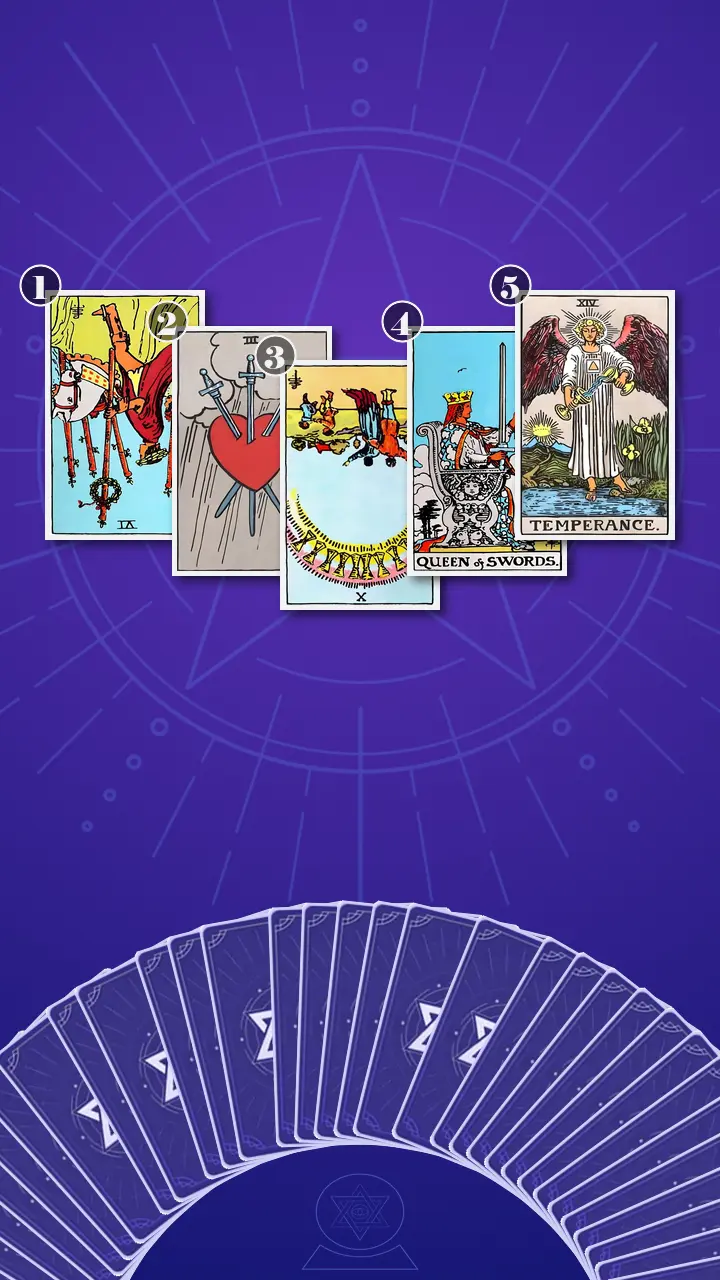
I arranged the cards in a shallow arc. The first card sat at the left as the behaviour everyone could see. The second moved closer to the concealed emotion. The third rested slightly lower, where I would look for the belief making concealment feel necessary. The fourth rose as the bridge: the truth or capacity Alex had not fully claimed. The fifth settled at the right as a practical form of integration.
This is how tarot works in my practice. I do not treat the cards as verdicts about a family or guarantees about an outcome. I use their symbols as an objective set of prompts. Each image helps me separate behaviour, feeling, belief, resource, and choice so they do not remain fused into one overwhelming thought. Alex would decide what fit, what did not, and what to do with the information.
Reading the Applause and the Ache
Position One: The Approval Dashboard
I turned the card representing the visible performance: the concrete habit of saying “We're fine,” curating family evidence, and managing other people's impressions. It was the Six of Wands, reversed.
Upright, the rider carries a laurel wreath through a watching crowd. Reversed, I saw the public recognition system turning inward and becoming unstable. The imagined audience remained present even when nobody was actively judging Alex. The card described selecting the most affectionate family photo, writing a caption such as “so grateful for these people,” sending a cheerful group-chat reply, and checking the reactions more closely than the body that sent it.
I read the reversed Fire as a blockage supported by excess display and a deficiency of inner recognition. Alex had plenty of energy for making closeness visible, but very little permission to ask whether the visible story included their experience. The performance reduced immediate tension, which was why it had survived. It also left resentment and sadness without a legitimate place to land.
“Who is this version for?” I asked. “And what would you admit privately if nobody needed to applaud the answer?”
Alex gave one short laugh, but there was no amusement in it. Their mouth lifted while their eyes stayed fixed on the card. “That is so accurate it is almost rude,” they said. “I am not just sharing the photo. I am checking whether the story passed.”
I did not shame the performer in the card. “That part of you learned that cheerfulness could lower the temperature and preserve contact,” I said. “We can respect why it developed without letting it run every conversation. Protection strategies are not character flaws. They are simply expensive when they become automatic.”
Position Two: What Remains After the Screen Goes Dark
I turned the card representing the concealed feeling: the shame, sadness, resentment, fear, or longing kept outside the happy-family image. It was the Three of Swords, upright.
I made one point immediately. “This is not a forecast of betrayal or permanent heartbreak. I am reading the image in context: the heart is already visible. The card is asking us to acknowledge an emotional experience that the polished story has excluded.”
When I asked what happened after the yellow heart, Alex described another evening. At 10:18, they had closed a shared family album on their phone. The screen went black. The apartment was quiet except for the refrigerator's hum. Without the smiling faces in front of them, sadness remained in the room, followed by a flash of anger. Alex had opened Slack instead and told themselves that other people had more legitimate reasons to be upset.
The upright Air of the Three of Swords brought a painful form of balance: the capacity to name what was present accurately. The blocked element was not truth itself but Alex's permission to experience it without turning it into an accusation, a diagnosis, or a verdict on the entire family. A feeling could be information before it became an explanation.
“This feeling is here before you explain it,” I said. “It does not need to become a family verdict to be real. What single word belongs to that moment after the album closes?”
Alex's fingers stopped rubbing the phone case. Their gaze drifted past the card as though the black screen had appeared again. After a long breath, their shoulders moved down by a fraction.
“Sad,” they said. Then, more quietly, “Actually, lonely.”
I let the second word stand. That was already a movement: not a confrontation, not a disclosure, simply the end of arguing a private feeling out of existence.
The Rainbow That Became a Rule
Position Three: The Reversed Ten of Cups
I turned the card representing the sustaining belief: the rule that made emotional concealment feel necessary and turned visible complexity into a possible threat to belonging. It was the Ten of Cups, reversed.
The familiar image showed a rainbow of cups above a family, raised arms, children, a home, and a green landscape. Reversed, the ideal had not become worthless. It had become compulsory. Family harmony was no longer something Alex could value; it was a standard every private feeling had to pass.
I asked Alex about a birthday brunch. They remembered someone lifting a phone and saying, “Everyone look happy.” Coffee and warm toast filled the kitchen. Alex raised their glass and smiled while pressing their fingers into their palm below the frame. The gathering held genuine affection, but it also contained an unfinished conversation and anger they did not feel permitted to name.
“The photograph is a real memory and an incomplete picture,” I said. “The blockage appears when the picture becomes evidence against anything it cannot show.”
I read the reversed Cups energy as emotional overcorrection. The desire for harmony had expanded into a rule: if the family looked joyful, sadness must mean Alex was ungrateful; if Alex acknowledged hurt, they must be the person damaging connection. That rule encouraged quick reconciliation, forced positivity, over-agreement, and the reflexive phrase “Let's keep things positive” before anybody had named what happened.
“When you see the smiling photo and conclude that your pain makes you the problem, what law about belonging are you obeying?” I asked.
Alex's breathing stopped for a beat. Their eyes narrowed, then lost focus. Their hand tightened around the edge of the table before slowly releasing it.
“If I admit that something hurt me, I become the difficult one,” they said. “I thought my sadness meant I was the disloyal one.”
“That is the hidden law,” I replied. “It confuses connection with emotional simplicity. It also creates a false binary between silence and telling everyone everything. Privacy is a choice about access; concealment is when fear chooses for you.”
I could see both recognition and resistance in Alex's expression. The family image still mattered to them, and I had no interest in asking them to destroy it. The work was subtler: to stop requiring one image to carry every truth about belonging.
When the Queen of Swords Drew a Boundary
Position Four: The Sentence That Changed the Structure
The radiator stopped clicking as I reached for the fourth card. In the sudden quiet, the narrow reflection of Alex's lamp stood upright in the dark window like a line drawn through the room. I turned the card representing the disowned truth and resource: the awareness capable of moving Alex from total concealment toward one honest, bounded statement. It was the Queen of Swords, upright.
Her sword was vertical, her gaze direct, and her other hand open. I read her Air energy as balance: discernment without cruelty, honesty without uncontrolled exposure, and a boundary without a closing argument. She did not ask Alex to explain the entire family history. She offered one accurate sentence and the authority to decide what remained private.
I gave the card a modern voice: “I care about my family, and I am not ready to pretend this feels simple for me.” The sword made the statement precise. The open hand determined access. The throne represented Alex's right to say, “I am still sorting it out, so I do not want to unpack it tonight.”
Years spent studying old intellectual systems and working around archaeological remains have taught me to treat collapse carefully. A fallen wall is not automatically proof that its builders failed. Sometimes it reveals that a structure could no longer support the life developing around it. I used what I call Cognitive Paradigm Excavation here: I treated Alex's bottleneck as the visible fracture of an obsolete governing idea, not as evidence that Alex was broken.
The old paradigm read: “I belong only when I am easy to reassure, and I must manage everyone else's reaction to remain connected.” The Queen's paradigm read: “I can say this is true for me without making it true for everyone.”
I then used Core Philosophy Stratigraphy to separate what deserved to survive from what needed to remain in the past. Care for family, discretion, warmth, and respect belonged in the next layer of Alex's life. Emotional self-erasure, compulsory cheerfulness, and responsibility for every adult's response did not.
I brought us back to 8:47 PM: the candid reply drafted, the warm phone shifting between Alex's palms, the yellow heart sent, and the radiator clicking after the screen went quiet. I named the bind: the feeling was real, but belonging had started to look conditional on deleting it.
The happy-family performance cannot create real closeness by itself; like the Queen of Swords, let clear language and a deliberate boundary replace automatic silence as your way of staying connected.
I left the sentence alone for several seconds. Then I made its practical meaning explicit: “You do not have to prove family belonging by maintaining a flawless story. You can name one true feeling, choose one boundary, and leave everyone else's reaction in their own hands.”
I watched Alex's breath stop. Their fingertips remained suspended above the face-down phone, and their pupils widened before their gaze slipped away from me, as if several deleted messages were replaying at once. Then recognition arrived with an edge of anger. “But doesn't that mean I have been doing it wrong this whole time?” they asked, their voice suddenly sharper. I did not rush to turn the anger into relief. “No,” I said. “It means a strategy that protected you became too small for what you now need. You are allowed to revise it without prosecuting your former self.” Their eyes reddened. The hand beside the phone opened first; then their shoulders dropped and a trembling breath left their chest. Relief followed, but it was not clean or triumphant. I saw a brief, almost dizzy blankness cross their face: if the old rule was optional, Alex now had the vulnerable responsibility of choosing a new one.
“Now, with this new perspective, think back to last week,” I said. “Was there a moment when this insight might have made you feel different?”
Alex remembered a friend's voice note asking how the family situation was going. They had recorded “Honestly, we're good” three times, then sent the polished version. “I could have said, ‘I care about them, but it has been heavy lately. I do not need you to fix it,’” they said. “I would not have needed to explain every detail.”
I gave them ten minutes to write two private lines: “What is true for me is...” and “What I am willing to share right now is...” Sending either line was optional. I reminded Alex that if their body became overwhelmed or a conversation felt unsafe, they could close the note, end the call, or choose privacy. This was an experiment under their control, not a test of courage they had to pass.
I named the change I had witnessed. This was a first movement from protecting belonging through total emotional concealment toward deliberate, bounded truth-telling with privacy, self-respect, and care intact. One honest sentence was not the same thing as telling everyone everything.
Two Cups Without a Forced Confession
Position Five: Temperance and the Grounded Expression
I turned the final card representing the grounded expression: a proportionate next step through which privacy and honesty could coexist without a dramatic reveal. It was Temperance, upright.
The angel moved liquid between two cups, with one foot on land and one in water. I read the energy as integration rather than compromise. Alex did not need to choose between “I care about my family” and “this hurts me sometimes.” Temperance made room for both statements in the same frame.
In daily life, this looked small. Alex could tell one trusted friend, “I love my family, but I do not want to describe this as simple,” and stop there. They could keep names, events, and private details undisclosed by choice. The two cups held care and pain. The two surfaces held public discretion and private experience. The path toward the mountains suggested gradual practice, not one announcement designed to fix everything.
I described it as a Notion board with two columns that were not competing for approval. One column read, “What I care about.” The other read, “What this costs me.” Alex's old algorithm had kept trying to delete the second column so the first would look more convincing. Temperance allowed the full dataset to exist before Alex decided what anyone else needed to see.
The balance in this card also prevented the Queen of Swords from becoming another extreme. Clear language did not have to mean constant disclosure. A boundary did not have to become punishment. Privacy could remain intact because it was intentional rather than automatically selected by fear.
“It is more like changing TTC lines one stop at a time than making one huge announcement,” Alex said, finally smiling without softening their voice.
“Exactly,” I replied. “Care for your family and honesty about your experience can occupy the same frame. The cards do not decide the amount of access. You do.”
The Paradigm Shift Manifesto for Honest Belonging
I placed the five cards back into their arc and read the sequence as one coherent history. The reversed Six of Wands showed a protective skill organized around approval: Alex had learned to make closeness visible before checking whether they felt close. The Three of Swords revealed the private hurt left behind by that editing. The reversed Ten of Cups exposed the deeper law that made the pattern feel necessary: a complicated feeling seemed capable of cancelling belonging. The Queen of Swords restored precise language and chosen access. Temperance turned that language into a sustainable practice rather than another performance.
The image I returned to was the polished family portrait held in front of a window. The portrait did not have to be false to block the view. Alex's cognitive blind spot was the belief that lowering it even slightly would destroy what it showed. The spread offered a different direction: keep what is meaningful in the picture, let the window reveal one bounded piece of reality, and stop taking responsibility for controlling how every observer reacts.
To make that shift practical, I introduced my Paradigm Shift Manifesto. I use it when an inherited rule has lost legitimacy but still governs daily behaviour. I asked Alex to write four lines: the old law, the value worth carrying forward, the rule being retired, and one observable action that would place the new law into effect. The point was not to create a motivational slogan. It was to define the governing terms of the next chapter clearly enough to test them in ordinary life.
Alex's draft read: “Old law: I must make the family story easy to keep my place in it. What survives: care, discretion, and respect. What ends: treating my mixed feelings as disloyal evidence. New law: I choose what I share, but I do not have to lie to myself first.”
When Alex asked what to do if even a small truth felt impossible in the moment, I kept the plan proportionate. “Then the truth stays in your private note,” I said. “Recognition comes first. Disclosure remains optional.”
- The Five-Minute Private-Feeling Check Before the next family group-chat reply, open Notes and write one sentence beginning, “What I actually feel is...” Add one precise word such as sad, angry, ashamed, afraid, relieved, or lonely. Set a five-minute timer and decide nothing about sending it. Start with an observable body cue if the feeling is hard to name: “My jaw tightened when the photo was praised.” Stop when the timer ends.
- The Four-Line Paradigm Shift Manifesto During one ten-minute session this week, write the old law, the value you are keeping, the rule you are retiring, and the new law you want to test. Place the final line where you draft family messages so it appears before the automatic cheerful edit. Keep the new law behavioural: “I check what is true before I decide what is shareable” is easier to test than “I will always be authentic.”
- The Two-Minute Queen of Swords Test Choose one trusted friend and say or text, “I want to give you the unpolished version for two minutes; I am not asking you to fix it.” Share one first-person sentence, then add a boundary such as, “I do not want to discuss private details tonight.” Keep the truth under 20 words. If you start adding a joke or saying “but everything is fine,” pause instead. You can end the conversation or keep the entire exercise private.
I told Alex that these were not assignments from the cards. They were controlled experiments Alex could adapt, postpone, or refuse. The measure of success was not whether the family became more comfortable. It was whether Alex could distinguish a private choice from fear-driven self-editing and retain ownership of both the truth and its audience.

A Week Later: Ownership, Not Certainty
Six days later, I received a message from Alex: “Did the five-minute thing. The word was lonely. I did not send it to the family chat. I told Sam the unpolished version for two minutes and did not apologize for making it serious.”
Before the next family call, Alex had also written, “I care about everyone, and I have had a heavier week than I expected.” When a relative asked what was wrong, Alex said, “I am still sorting it out, so I am not unpacking it tonight.” The conversation did not produce a cinematic reconciliation. Nobody suddenly understood the entire hidden history. The call moved on to weekend plans, and Alex still noticed their shoulders tightening.
But they did not add a joke. They did not retract the sentence. They did not reassure everyone that nothing was wrong.
They slept through the night. In the morning, their first thought was, “What if I made it worse?” They told me they smiled, made coffee, and let the question wait until after breakfast.
I consider that the quiet proof of our Journey to Clarity. The tarot did not repair Alex's family or hand them certainty. It helped us separate the layers of a pattern so Alex could see where their own choice began. The change belonged to Alex: one feeling noticed, one boundary selected, and one sentence allowed to stand.
I want to leave you with the same recognition I offered beside those five cards. When you smile for the family photo while your jaw is tight and your chest feels heavy, you may be trying to preserve belonging by making your complicated feelings disappear. Noticing that effort does not make you disloyal, and it does not require you to reveal anything before you choose. A family photo can be real without being the whole truth.
So I will place one final question beside Temperance's two cups: if you could let one small, private truth exist tonight without turning it into a verdict on your family, what feeling would you allow into the second cup?
This story is adapted from psychological research, written so that those in a similar struggle can see their own pattern in it — and find their next step clearly.These insights are not a substitute for professional psychological, medical, legal, or financial advice.
Learn more about our Journey to Clarity.
How did this insight land for you?
🫂 This Resonates Deeply
🌀 Living This Story
✨ Now I See Clearly
🌱 Seeing New Possibilities
🧰 Useful Framework
🔮 The Confirmation I Needed
💪 Feeling Empowered
🚀 Ready for My Next Step
Author Profile
 AI
AI“Having spent a lifetime at Cambridge and on archaeological digs, I’ve witnessed the rise and fall of countless civilizations. Please know that your current struggles are not a permanent fate, but merely a necessary fracture before rebuilding. I won't lecture you; instead, I invite you to sit with me in the ruins, using a patient, historical perspective to gently dust off the true, enduring value hidden beneath your temporary doubts.”
In this Personal Growth Tarot Reading :
Core Expertise
- Cognitive Paradigm Excavation: Treating your current growth bottleneck as the necessary collapse of an obsolete intellectual era.
- Core Philosophy Stratigraphy: Identifying which foundational beliefs must be carried forward to your next life stage and which must be left in the past.
Service Features
- The Paradigm Shift Manifesto: A rigorous intellectual exercise to definitively articulate the new governing laws and core values of your next life chapter.
Also specializes in :
Explore Related Patterns:
Approval SeekingAlex selects the most affectionate family image, adds a grateful caption, and watches the reactions more closely than the tension in their own body. The imagined audience remains active even when no one is explicitly criticizing them, so approval becomes a rapid signal that the family narrative is still socially acceptable. When you use that signal to confirm that you have not disrupted belonging, external feedback can temporarily feel more trustworthy than private emotional information. This strategy is functional in the short term because heart reactions and easy replies reduce uncertainty and preserve a sense of contact. The problem is not enjoying approval; it is allowing anticipated approval to make the first decision about what can be acknowledged. Approval Seeking describes the repeated attempt to stabilize belonging through reassuring audience feedback before Alex checks whether the approved version includes their actual experience.
Boundary DiscernmentAlex tells a trusted friend that the family situation feels heavy while making clear that they do not need it fixed, then tells a relative they are still sorting things out and will not unpack the issue that night. Each statement distinguishes emotional truth from unlimited access. When you decide what is true before deciding what is shareable, privacy can become an expression of agency rather than the automatic result of fear. The boundary does not punish the listener, erase affection, or require Alex to disclose the entire family history. It identifies where Alex's experience ends and another adult's interpretation begins, preserving both connection and self-definition. Boundary Discernment names this emerging capacity to choose the audience, depth, timing, and limits of disclosure without first lying to oneself.
Emotional Hyper-ResponsibilityAlex optimizes family messages for reassurance and the lowest possible chance of a difficult follow-up, then monitors whether the resulting story has been accepted. Their old rule says they must manage every adult's reaction to remain connected, even though the narrative does not show anyone explicitly assigning Alex that responsibility. When you assume ownership of other people's comfort before they have even responded, self-erasure can begin to look like ordinary relational care. This over-responsibility explains why one honest sentence feels larger than it is. Alex is not only considering what to share; they are mentally carrying every possible interpretation, mood shift, and follow-up as though those outcomes are theirs to control. Emotional Hyper-Responsibility names this boundary distortion, while the later decision to leave other adults' responses in their own hands shows where Alex's actual responsibility ends.
Emotional Self-CensorshipAlex drafts an honest family-chat response, deletes it line by line, and substitutes a yellow heart. The same sequence appears when they record "Honestly, we're good" three times for a friend and when they smile for a photograph while pressing their fingers into their palm below the frame. When you repeatedly detect a feeling and remove it before anyone can encounter it, privacy is no longer operating solely as a deliberate boundary. The editing protects Alex from an immediate difficult follow-up, but it also teaches them to treat sadness, anger, and loneliness as material that should not survive the drafting process. Their body continues carrying what the message excludes, so the apparent calm depends on ongoing internal effort. Emotional Self-Censorship captures this fear-driven filtering of emotional information before Alex has decided whether it deserves acknowledgment, expression, or chosen privacy.
Relationship PerformanceAlex deletes three candid lines, sends a yellow heart instead, curates affectionate family photos, and checks whether the resulting story has "passed." These actions turn belonging into an audience-tested presentation in which visible closeness receives more attention than the experience of the person producing it. When you repeatedly organize family contact around how convincing it looks, an incomplete image can begin governing what you permit yourself to notice. The presentation reduces immediate tension and helps Alex preserve contact, which explains why it became automatic. Its cost appears after the screen goes dark, when sadness, anger, loneliness, and resentment remain without a recognized place in the relationship. Relationship Performance names this repeated use of polished connection as a defensive substitute for letting a more complicated experience exist, even privately.
Toxic PositivityAlex lightens their voice, sends a cheerful symbol, and follows an internal instruction to "keep it easy" rather than become the person who ruins the mood. The same rule appears in quick reconciliation, over-agreement, and "Let's keep things positive" before anyone has named what happened. When positivity is deployed before emotional information is allowed to exist, it stops being simple warmth and starts functioning as a bypass around relational complexity. The positive presentation preserves an immediately reassuring atmosphere, but sadness, anger, resentment, and loneliness remain active after the interaction ends. Alex is then left with the added burden of treating those feelings as evidence of ingratitude. Toxic Positivity names this compulsory use of brightness to invalidate difficult but compatible truths, not the genuine affection Alex continues to feel for their family.
Black-and-White ThinkingThe smiling birthday photograph becomes evidence against everything outside its frame, and Alex concludes that feeling hurt must make them ungrateful or disloyal. They also experience privacy and honesty as opposing choices, as though acknowledging one feeling must lead either to total silence or a complete family reckoning. When you force compatible realities into opposing camps, a complicated but manageable decision begins to feel like a threat to the entire relationship. That cognitive split makes concealment appear necessary because love and pain are not permitted to coexist in the same account. It also hides the middle ground Alex later practices by naming one feeling while withholding private details. Black-and-White Thinking describes the rigid either-or rule that turns emotional complexity into false choices between loyalty and honesty, harmony and hurt, or privacy and unrestricted disclosure.
Self-GaslightingAfter the family album closes, Alex notices sadness and anger, opens Slack, and tells themselves that other people have more legitimate reasons to be upset. They also use smiling photographs as evidence against feelings those photographs could never display. When you repeatedly disqualify direct emotional information through comparison, image management, or moral judgment, you weaken your ability to treat your own experience as credible data. Alex does not merely keep a feeling private; they first argue that the feeling should not count. Hurt becomes supposed proof of being difficult, and loneliness is treated as a challenge to the reality of family affection. Self-Gaslighting names this internal invalidation loop in which Alex replaces observed experience with a more acceptable explanation and then doubts the legitimacy of what remains.
Shame BindingAlex describes shame as an ink stain spreading beneath a clean white shirt while their jaw tightens, chest grows heavy, and breathing becomes shallow. The feared exposure is not only that other people might notice sadness; it is that sadness might reveal Alex as ungrateful, difficult, or disloyal. When you bind a feeling to a verdict about your character, hiding the feeling starts to feel necessary for protecting belonging. The shame therefore operates as more than an unpleasant emotion. It converts ordinary hurt into apparent evidence of personal wrongdoing and makes the polished family image feel like moral cover. Shame Binding names this fusion between emotional experience and negative identity judgment, allowing Alex to separate "I feel hurt" from "my hurt makes me a bad family member."
Secure VulnerabilityAlex gives a trusted friend a two-minute unpolished account, says they do not need it fixed, and later offers one accurate sentence during a family call. They keep names and private details undisclosed, and they do not retract the family statement, add a joke, or reassure everyone that nothing is wrong. When you combine limited openness with a clear stopping point, vulnerability becomes a chosen relational act rather than an uncontrolled exposure. This practice allows care, pain, privacy, and honesty to remain in the same frame. Alex is neither performing total ease nor turning disclosure into a test of courage, and the amount of access stays under their control. Secure Vulnerability describes this proportionate form of truth-telling in which being seen does not require surrendering boundaries or taking responsibility for the listener's reaction.
Explore Related Struggles:
All-or-Nothing BelongingAlex looks at a smiling family photograph and concludes that their pain would make them ungrateful, then names the rule beneath that conclusion: admitting hurt would make them the difficult or disloyal one. A single feeling is therefore made to carry an impossible consequence, as though acknowledging one painful part would invalidate every affectionate part of the relationship. You are left with only two apparent positions: stay silent and belong, or speak and become the person who damages the family. That binary hides the ordinary middle ground where love, disappointment, privacy, anger, and loyalty can coexist. The deeper thing being concealed is your right to remain connected without presenting an emotionally simplified self.
Belonging-Authenticity SplitAlex types three candid lines, deletes them, and sends a yellow heart while their jaw tightens. The message keeps the family exchange warm, but it also removes the hurt, separation, anger, and loneliness that would make Alex visible as a more complicated participant in that relationship. You are looking at a conflict in which belonging and personal truth both matter, yet speaking from one side appears to endanger the other. What is being hidden is not a secret verdict that the family is false; it is the part of your experience that does not fit the easy version of closeness, along with the wish to be known without having to disown either your love or your pain.
Performative HarmonyAt the birthday brunch, Alex smiles for the photograph while pressing their fingers into their palm below the frame. The affection in the image is real, but the unfinished conversation and anger are denied equal standing once the photograph is treated as proof that the family must be uncomplicated. You become trapped when harmony stops being one valued part of connection and becomes the admission requirement for every feeling. The cheerful caption, yellow heart, quick reconciliation, and polished answer then do more than present a positive moment: they keep the entire relationship organized around what can be displayed without friction. The hidden material is whatever would interrupt that presentation, including hurt that can coexist with care.
Privacy-Belonging SplitAlex cannot initially tell whether deleting the candid reply protects legitimate privacy or protects the family performance. The uncertainty matters because both choices look identical on the screen, even though one preserves Alex's agency and the other lets anticipated reactions determine what can be acknowledged. You can keep details private and still allow a true sentence to exist. The struggle begins when belonging seems to require surrendering that distinction, leaving you caught between total concealment and more disclosure than you want. Alex's later boundary, “I am still sorting it out, so I am not unpacking it tonight,” shows the missing structure: truth and controlled access can occupy the same conversation.
Self-Editing ExhaustionAlex deletes the candid message, records the reassuring voice note three times, and opens Slack when sadness and anger remain after the family album goes dark. Each edit successfully lowers the temperature of the immediate interaction, yet none of them gives the excluded experience anywhere to go. You end up doing the same emotional production work at every new contact point: detect the complicated material, remove it, deliver reassurance, and carry what remains. The exhaustion comes from maintaining two versions of the same life, not merely from writing careful messages. Your body continues registering the cost while the polished version requires another round of maintenance whenever the family story reappears.
Explore Related Emotions:
Belonging ShameAt the birthday brunch, you raised your glass and smiled while pressing your fingers into your palm because the unfinished conversation and anger did not feel permitted inside the frame. Later, you gave the rule a direct sentence. If something hurt you, you became the difficult one; if you admitted it, you became disloyal. Belonging Shame is the inward turn of that rule. It makes an ordinary emotional fact feel like evidence against your character, so the family photograph seems to accuse you simply for containing more than it shows. Your sadness does not need to become a verdict on the family, and it does not need to become a verdict on you.
Conditional Belonging FearWhen you deleted three candid lines about the last family call and replaced them with a yellow heart, the message was doing more than keeping the conversation pleasant. It was protecting the possibility that your place in the family depends on staying easy to reassure and uncomplicated to receive. Conditional Belonging Fear names the felt threat underneath that edit. You are not hiding a lack of care; you are hiding the belief that hurt could make you the difficult or disloyal one. Separating affection from that rule lets you keep what is real without requiring your pain to disappear first.
Relational Distance AcheYou said that you love your family and still feel hurt and separate from them, a combination the happy-family image cannot fully display. After the shared album closed, the quiet apartment made that distance easier to notice because the smiling faces were no longer occupying the foreground. Relational Distance Ache gives language to the gap between public closeness and private experience. It does not cancel the affection in the photograph, and it does not prove that the relationship is empty. It marks the part of you that wants to be known without having to make the entire family story either perfect or broken.
Self-Betrayal AcheYou wrote the honest version of the family reply, deleted it line by line, and later recorded the same polished reassurance three times before sending it. Each edit kept the relationship looking manageable, but it also required you to collaborate in removing your own account before anyone could respond to it. Self-Betrayal Ache describes the pain of that split without treating it as a character flaw. The strategy once reduced immediate friction, yet it became costly when it required you to deny what you already knew. A private note or one bounded sentence gives your experience a place to exist before you decide who, if anyone, receives it.
Approval AnxietyAt 8:47, your thumb hovered over the candid reply while the phone moved from one palm to the other, and the final question became whether the family story had passed. The same checking appeared in the affectionate photo, the grateful caption, and the polished voice note, where other people's reactions received more attention than the body sending them. Approval Anxiety captures the tightening created by that monitoring. The surface looks warm, but part of you is waiting for confirmation that no one has noticed the missing material. Naming it makes the approval check visible as a feeling rather than allowing it to quietly decide what you are permitted to say.
Hidden ResentmentAt 10:18, the family album closed and the screen went black, but the room did not become emotionally empty. Sadness stayed, followed by a flash of anger, while you opened Slack and reminded yourself that other people had more legitimate reasons to be upset. Hidden Resentment names the pressure left by repeatedly making room for everyone else's acceptable feelings while giving your own no legitimate landing place. It does not require an accusation or a dramatic confrontation. It asks you to recognize that care can coexist with a clear record of what has been costing you.
Cautious VulnerabilityYou told Sam the unpolished version for two minutes and made clear that you did not need fixing. Later, you told a relative that the week had been heavier than expected and that you were still sorting it out, while keeping the rest of the situation private. Cautious Vulnerability is the feeling of allowing limited visibility without surrendering control of the whole story. It answers the hidden conflict by showing that honesty does not require total exposure. One sentence can be real, bounded, and yours even when the wider family image remains intact.
Grounded AgencyAfter the family call moved on, you did not add a joke, retract the sentence, or reassure everyone that nothing was wrong. When the thought appeared that you might have made things worse, you let it wait until after breakfast instead of immediately handing the decision back to the family's comfort. Grounded Agency names that quiet ownership. It does not require certainty or a public reveal. It is the capacity to choose the amount of access, protect private details, and let a true sentence remain true without taking responsibility for controlling every response.
Privacy AnxietyYou already understand that privacy can be legitimate, yet you cannot always tell whether the yellow heart reflects a deliberate boundary or a decision made before you have checked what is true for you. The uncertainty appears again when you draft an honest voice note and replace it with a version that is easier for everyone else to receive. Privacy Anxiety is the unsettled feeling around access and exposure, not a demand to reveal more. Your agency becomes clearer when you can keep the details private because you chose to, rather than because the anticipated reaction made the choice feel unavailable.
Explore Related Contexts:
Conditional Family BelongingAlex says that admitting something hurt would make them the difficult or disloyal family member. At the birthday brunch, they smile for the camera while an unfinished conversation remains unnamed, and in the group chat they replace a candid response with the symbol most likely to preserve easy contact. Belonging is therefore operating through an informal condition. Alex can remain visibly close as long as their contribution does not complicate the shared account of harmony, while mixed or unresolved experience appears capable of changing their status inside the group. For you, Conditional Family Belonging names the external terms under which connection seems available. Seeing those terms clearly creates room to distinguish genuine care from a participation rule that requires emotional simplicity before your place in the relationship feels secure.
Designated Peacekeeper RoleAlex describes their family function in direct terms: keep it easy and do not become the person who ruins the mood. That function reappears when they delete a candid message, soften a voice note, smile beneath the camera, and anticipate how every adult might react before deciding what can be said. The family system gains continuity from this work because one person absorbs the complexity and returns a manageable version to the group. Alex is not simply choosing kind language; they are carrying responsibility for the interaction's emotional temperature, the speed of reconciliation, and the continued appearance of unity. When you occupy a Designated Peacekeeper Role, what remains hidden is often whatever would interrupt your assigned function. Naming the role allows you to examine which parts of maintaining contact are genuinely yours and which parts belong in the hands of the other adults involved.
Family Privacy NegotiationAlex tells a relative that the week has been heavier than expected, then says they are still sorting it out and will not unpack it that night. The relative asks one question, the limit remains in place, and the call continues to weekend plans without Alex adding a joke or retracting the update. That exchange creates a live negotiation over access rather than a choice between total concealment and total disclosure. Alex contributes accurate information, decides which details remain private, and stays connected without taking responsibility for eliminating every possible reaction. When you enter a Family Privacy Negotiation, privacy becomes an active boundary instead of an automatic edit. The unresolved task is to keep clarifying what is true, what is shareable, and what remains yours while the relationship adapts to a less polished form of contact.
Happy Family PerformanceAlex drafts three candid lines in the family chat, deletes them, and sends a yellow heart. The same editing process appears in the affectionate photo selection, the grateful caption, the staged birthday smile, and the close monitoring of reactions to see whether the story has passed. These repeated acts turn family connection into a presentation that must be made coherent for an audience. The affection in the photographs can be genuine while the demand for a consistently uncomplicated image keeps unresolved parts of family life outside the frame. When you recognize a Happy Family Performance, the central issue is not whether every warm image is false. It is whether maintaining that image has become a condition of participation, leaving you responsible for protecting the family brand at the expense of an accurate account of your own experience.