The 11:47 p.m. Text That Made Every Red Flag Negotiable
I met Jordan as the late-twenties Toronto professional who could de-escalate a difficult client call before lunch, then spend midnight rewriting a simple dating boundary because one warm text had restarted the situationship anxiety loop.
At 11:47 p.m., Jordan joined my video call from a bedroom near Little Italy. Blue phone light washed over the rumpled duvet, the radiator clicked behind them, and a half-written boundary message waited in their Notes app. An affectionate notification arrived after several distant days. I watched their shoulders drop before they had even finished reading it.
The message said the week had been chaotic, that the other person had been thinking about them. It did not address the latest cancelled plan. Jordan's thumb hovered over the draft they had written, then erased it line by line.
“Why does one good message make me question everything I already know?” they asked. “I can see the red flags, but I can also see who they could become. What if leaving now means I quit right before it got better?”
They showed me the pattern: delayed replies, convincing warmth, plans made, plans cancelled without repair, then another perfectly timed message. Their Notes app held an ending draft, a softer draft, and no sent version. They had shown friends the screenshots, listened to the concern, then scrolled rapidly toward the sweetest messages as if the best moment might overrule the full timeline.
The feeling in their body was not vague. It was like standing with one hand on a closing door while a seat belt tightened across their chest: stopping meant losing the possibility, but holding the door open was already hurting. Their restless fingers kept returning to the phone, and every new contact delivered a few seconds of physical release before the knot under their ribs returned.
“I don't think your problem is that you cannot see what is happening,” I said. “I think what you see is being forced to defend itself against what you hope. I am not here to tell you to leave, stay, block, forgive, or give another chance. I am also not going to guess what the other person means. I want to help you understand why potential keeps receiving more authority than repeated behavior.”
I asked Jordan to place the phone face down. “Let's make a map of the fog,” I said. “The cards will not choose your future. We will use them to organize the information, the fear, and the inner resource you already have. You remain the person with the vote.”

Choosing a Map for the Mixed-Signal Loop
I invited Jordan to put both feet on the floor and take one ordinary breath, without trying to make the breath profound. I shuffled slowly while they held one question in mind: Why do I keep choosing hope when the red flags say stop? The brief ritual was a transition for attention, not a performance of mystery.
I chose the Shadow Spread, a five-position tarot self-inquiry method. It was the right tool because Jordan was not asking me to predict an outcome or reveal another person's hidden motives. They wanted to understand a recurring relationship pattern: visible behavior, the defense sustaining it, the fear underneath it, the resource hidden inside it, and the next response that could restore agency.
This is how tarot works in my practice. A spread gives separate seats to information that has become emotionally tangled. Card meanings in context provide images and language for comparing those parts. The result is not a supernatural verdict. It is a structured conversation in which intuition can meet receipts.
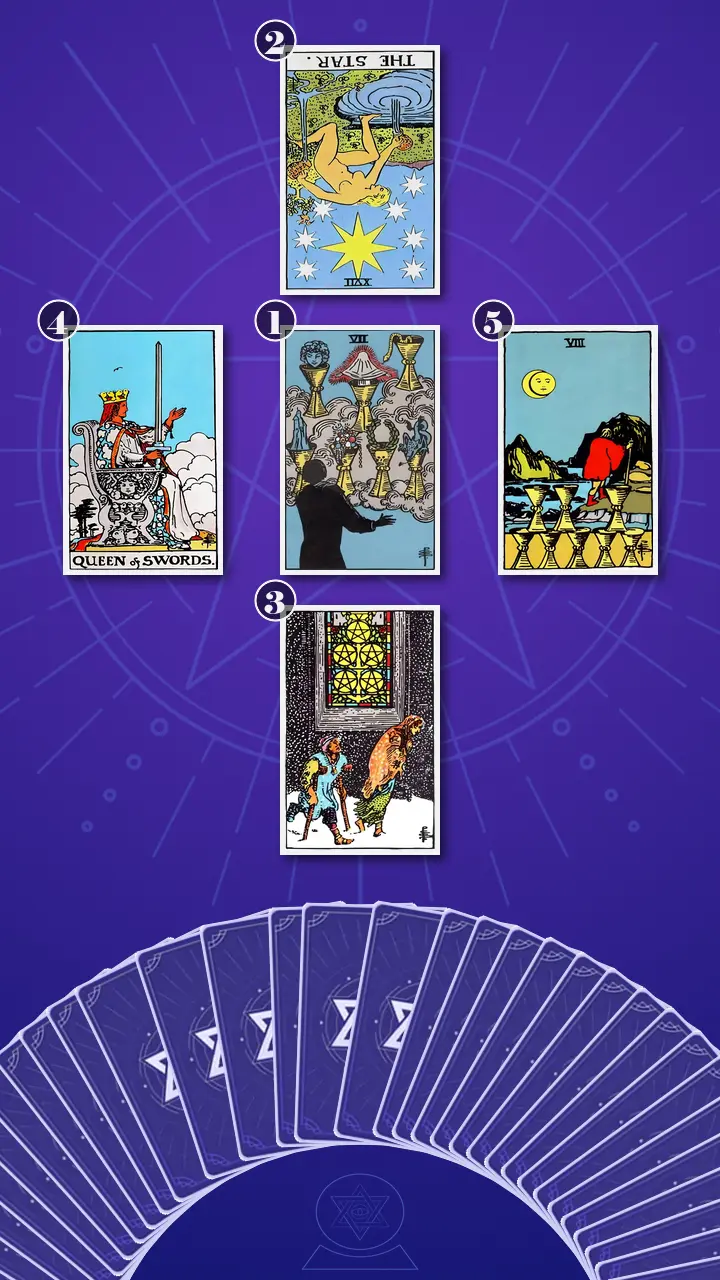
I laid the first card at the center for the observable red-flag override. The second went above it for the protective use of hope, and the third below for the fear of exclusion beneath that strategy. The fourth rested to the left as Jordan's hidden capacity for discernment. The fifth waited to the right, where clarity would have to become behavior. The cross looked like a lantern above roots, with a path extending across the middle.
“We will begin with what happens on the screen,” I told them. “Then we will look beneath the screen. After that, we will ask what you already know how to do, and what one self-chosen next step could look like.”
Seven Futures in One Notification
Position One: The Pattern That Keeps Opening New Tabs
I turned over the card representing the observable red-flag override: Jordan's habit of generating hopeful possibilities and re-engaging despite a repeated mismatch. It was the Seven of Cups, upright.
A silhouetted figure faced seven cups suspended in a cloud. Each cup contained a different vision, some attractive, some unsettling, none yet tested on solid ground. I asked Jordan to imagine every cup as a browser tab opened by the affectionate message that had just arrived.
Jordan named the tabs without much prompting: “Maybe they really were overwhelmed. Maybe the timing has finally changed. Maybe they understand what I need now. Maybe this is the turning point.”
At 11:47 p.m., one affectionate cue had generated several possible relationship futures. The actual sequence of missed plans remained visible in the message history, but the imagined outcomes felt brighter and more urgent than the record. It was like minimizing the only tab containing the full timeline while keeping seven speculative tabs running in the foreground.
Energetically, I read this as Excess: an overflow of imaginative Water. Imagination itself was not the enemy. It allowed Jordan to see nuance and resist simplistic villain stories. The problem was unequal weighting. Every warm cue received the authority of a pattern, while every repeated inconsistency was tried as an isolated case.
“One warm message is data,” I said. “It is not a pattern rewrite.”
Jordan gave a short laugh, but there was no amusement in it. Their jaw tightened, then their eyes dropped to the phone lying face down. “That's so accurate it feels a bit brutal,” they said. “I know what happened, but I always find a way to add, ‘Maybe it means this instead.’”
“The card is not accusing you of being unrealistic,” I said. “It is showing us the instant when possibility begins outranking evidence. When that last message arrived, which future did you start imagining, and what had the previous three relevant interactions actually shown?”
Jordan answered slowly. The future was consistency beginning now. The previous interactions showed two cancellations, one vague apology, and no clear reschedule. Once spoken aloud, the difference between the forecast and the record became difficult to blur.
Position Two: Hope on Low Battery
I turned over the card representing the protective strategy that maintained the pattern: Jordan's use of hope and generous explanations to postpone the loss implied by stopping. It was The Star, reversed.
In the upright image, water moves from two pitchers into land and pool. It circulates. It restores. Reversed, I saw that current becoming a Blockage. Jordan was still pouring, but the act of maintaining hope had stopped replenishing them.
I brought them back to a familiar evening. After an hour spent composing explanations for another mismatch, they would notice that optimism no longer felt spacious. It felt like work required to prevent grief from arriving. One warm message produced a brief lift, but the exhaustion returned because no repeated behavior had changed.
“One stream goes into explaining their behavior,” I said, touching the first pitcher on the card. “The second goes into suppressing your own unease so you can remain the patient, fair person. You are spending energy twice.”
Jordan's chest rose and held. Their right hand made a small movement toward the phone, then stopped. On the exhale, they lowered both hands into their lap.
“I keep thinking that if I stop hoping, I'm being unfair,” they said. “Or cynical. Like I'm punishing someone for having a difficult week.”
“There is restorative hope, and there is compulsory hope,” I replied. “Restorative hope can look at current evidence and remain open. Compulsory hope requires you to keep producing explanations so that loss never becomes final. Hope stops being kind when it requires you to cross-examine your own memory.”
I asked what observed behavior had to be minimized whenever the thought maybe I should give this more time appeared. Jordan said it was not the delayed reply by itself. It was the repeated failure to repair a cancelled plan. Their voice became quieter as they named it, but steadier too.
Position Three: The Lit Window Behind the Sunday Scroll
I turned over the card representing the fear beneath the defense: Jordan's fear that ending this possibility would confirm exclusion from secure belonging. It was the Five of Pentacles, upright.
Two figures crossed falling snow beneath an illuminated stained-glass window. I did not read the image as a prediction of abandonment. I read it as the bodily story scarcity tells when one uncertain connection starts to feel like the only available shelter.
Jordan had already described the real-life version. At 7:18 on a snowy Sunday, they had reheated takeaway while scrolling past an Instagram engagement carousel. Wet tires hissed below the condo window; garlic and cold air hung in the room. Ending the situationship began to feel less like closing one unsuitable door and more like falling another place behind everyone who appeared securely chosen.
Energetically, the Five showed Deficiency, not necessarily a deficiency of actual support, but a narrowed perception of belonging. When romantic uncertainty became the loudest measure of being wanted, the active group chat, familiar routines, friendships, and wider community receded behind the glow of one message thread.
I asked, “If this thread ended tonight, what conclusion would your mind try to draw about you?”
Jordan's breathing paused. Their fingers stayed curled around the cuff of their sweatshirt. Then their gaze lost focus, as though the Sunday feed were replaying behind their eyes. When the words finally arrived, they came with a low, uneven exhale: “That everyone else gets chosen, and I keep getting close without getting there. That maybe this was my closest chance.”
I let the silence remain long enough to be respectful, but not long enough to become a threat. Snow moved past the dark window behind my desk, and for a moment the illuminated pentacles on the card resembled apartment windows seen from the street.
“That fear makes sense,” I said. “It also expands one dating disappointment into a verdict about your place in love. The connection can matter, and losing its imagined future can hurt, without proving that you are outside belonging. Your grief would describe an attachment and a possibility. It would not certify a life sentence.”
Jordan looked toward their own window, then back at the card. The expression on their face held recognition and sadness together. They did not look relieved yet. I considered that honest progress. The defense had loosened enough for the protected grief to become visible.
When the Queen's Sword Split the Screen
Position Four: The Judgment Jordan Already Trusted at Work
The room seemed to become quieter before I touched the next card. Even the radiator on Jordan's side of the call stopped clicking. I turned over the card representing the capacity already hidden inside the struggle: accurate perception, independent judgment, and the ability to communicate a humane boundary. It was the Queen of Swords, upright, the catalyst and antidote of the reading.
The Queen held one sword vertically while extending her other hand. I saw Balance in that posture. The sword classified and separated; the open hand remained receptive. Discernment did not require cruelty, and compassion did not require negotiability.
I reminded Jordan of their work in customer success. In a ticket history, they could identify that three recurring support incidents revealed one product problem rather than three unrelated exceptions. Yet in dating, three similar cancellations each received a fresh trial, a new context, and another appeal.
“If you read the relevant message history once and were not allowed to guess anyone's motive,” I asked, “what could you state in one camera-verifiable sentence?”
Jordan looked down and said, “Plans were cancelled three times without a clear reschedule.” Their voice accelerated at the end, ready to add context. I raised one hand gently.
“Let the sentence stand,” I said. “You can understand their context without making your evidence disappear. Potential is a possibility; pattern is evidence. A humane boundary can still be a firm one.”
Seeing the Queen's upright sword, I flashed back to the years I spent on Wall Street, where a decision could become dangerously distorted by the need to justify yesterday's investment. Relationships are not trades, and people are not positions. Still, the cognitive trap is recognizable: time, money, or emotion already spent begins demanding further investment simply because walking away would make the past feel wasted.
I call my way of interrupting that trap Sunk Cost Neutralization. I told Jordan that the affection, time, and hope they had invested remained meaningful history. None of it needed to be mocked or erased. But past investment did not get automatic voting rights over tomorrow's opportunity cost. The relevant question was not, Have I put in too much to stop? It was, Given what repeatedly happens now, what does another unbounded round cost my sleep, attention, and trust in my own judgment?
I returned us to 11:47 p.m.: the boundary draft open, the warm notification landing, Jordan's chest loosening, and last week's cancellations suddenly seeming less real than tonight's possibility. They were still trying to make the newest feeling settle the oldest evidence.
“Potential can be real without being reliable,” I said. “Seeing what this connection could become does not require you to overrule what it repeatedly is.”
You do not need to become cynical to stop bargaining with evidence; choose a clear boundary, and let the Queen's upright sword separate observed behavior from imagined potential.
For one beat, Jordan did not breathe. Their fingers remained suspended above the edge of the duvet, and their pupils widened slightly. Then their gaze moved past the screen as if several weeks of messages were replaying in a faster, less flattering order. Their mouth tightened. “But doesn't that mean I've been wrong this whole time?” they asked, with a flash of anger that sounded sharper than anything they had said before.
I did not rush to turn that anger into relief. “No,” I said. “It means hope protected you from grief for a while, and the cost of that protection has increased. Updating your method is not a confession that your feelings were foolish.” Their eyes became glassy. One clenched hand slowly opened; their shoulders lowered, and a trembling breath left their chest. Relief appeared, followed by a brief blankness, the light dizziness of realizing that clearer evidence also returned responsibility to them.
“Now, with this new perspective, think back to last week,” I said. “Was there a moment when this insight could have made you feel different?”
Jordan remembered Tuesday on the northbound Line 1 train. A warm check-in had arrived after three quiet days, and relief had reached their body before they read the entire message. “I could have called it one kind message,” they said, “without calling it a new pattern. I could have waited until I got home.”
To give the insight a physical form, I asked them to open a private note and set a seven-minute timer. They made two headings: Observed and Possible. Under Observed, they entered the three cancellations without repair. Under Possible, they wrote the future the newest affectionate cue made them imagine. Then they completed one line: If the observed behavior repeats, the limit I can choose is ___.
I reminded them that the note was private. They did not have to send anything, end anything, or finish the exercise if it became too intense. One fact and one possibility would be enough. The point was classification, not coercion.
This was the first real movement from anxious hope that postponed loss toward compassionate discernment and evidence-based self-trust. Jordan had not stopped caring. They had simply allowed their own record to occupy the same room as their longing.
The Cups Left Standing
Position Five: Distance Without a Guilty Verdict
I turned over the card representing conscious integration: allowing repeated behavior and a stated boundary to guide a self-chosen adjustment in emotional investment. It was the Eight of Cups, upright.
The cups in the image remained upright. They acknowledged that real feeling and meaningful moments existed. Yet a visible gap remained in their arrangement, and a red-cloaked figure walked toward difficult ground beneath the moon.
Energetically, I saw Balance returning to Water through direction. Emotion was not being denied, but it was no longer required to circle the same incomplete arrangement. The card did not predict that Jordan would end the relationship. It showed that movement could begin before hatred, certainty, or a final verdict arrived.
I translated it into the next hope-triggering message. Jordan could set a twenty-four-hour reminder, mute only that thread, and spend the evening away from the conversation before deciding whether to reply. The pause would not declare the other person bad. It would let Jordan notice what became clearer when intermittent attention no longer controlled the evening.
Jordan frowned. “Muting it feels manipulative,” they said. “Like I'm playing a game to make them notice.”
“It would be manipulative if the goal were to provoke a response,” I said. “That is not the exercise. This is private regulation, chosen before the next ping. You are not controlling their access to punish them; you are protecting a short period in which your nervous system can settle before you interpret new information. You can choose twenty-four hours, one evening, or ten minutes. You can also choose not to use it.”
Their forehead softened, although uncertainty remained around their mouth. “One evening sounds possible,” they said.
“Good. You do not need a guilty verdict to choose distance. It mattered, and you do not need to use the next message to settle every uncertainty.”
The elemental story had completed its turn. Diffuse Water had opened seven imagined futures. The Star's blocked streams showed hope becoming depleted. The Five of Pentacles brought the fear onto cold ground. The Queen introduced Air as language, classification, and boundary. Then the Eight returned to Water, but now the feeling could move.
The Third Path Between Staying and Ending
I drew the cards together into one clear account. Repeated inconsistency had trained Jordan to search for exceptions. Hope then protected them from the grief of losing the imagined future, while the fear of being left outside belonging made that future feel unusually scarce. Their hidden resource was not tougher detachment. It was the pattern recognition they already used every day, combined with communication that could remain warm and precise. The final card converted that resource into a bounded pause rather than a dramatic verdict.
The loop worked like a recommendation algorithm learning that generous explanations kept Jordan engaged. Every time a hopeful interpretation postponed loss, the mind served another version of the same content. The update was not to ban hope from the feed. It was to stop treating a polished preview as proof that the feature already worked in production.
I named the cognitive blind spot directly: Jordan had been treating the sadness, guilt, or uncertainty that followed a boundary as evidence that the boundary must be unfair. They also demanded complete certainty before granting their own pattern recognition any authority. That standard sounded balanced, but in practice it made endless ambiguity the default.
The key shift was simpler and more demanding: stop asking only whether the connection could improve. State one boundary, record whether repeated behavior meets it, and let that record guide the next self-chosen step. Grief could come along. Hope could come along. Neither had to falsify the evidence.
I also used a restrained version of my Asymmetric Risk-Benefit Analysis. I was not assigning commercial value to a person. I was comparing the structure of Jordan's available choices. Open-ended re-engagement offered an upside that depended on someone else's unproven future consistency, while its downside kept compounding in lost sleep and weaker self-trust. A bounded pause carried a predictable short-term cost, discomfort and delayed relief, but offered a meaningful upside: cleaner information, protected attention, and a decision made from Jordan's own standard.
Jordan had arrived believing there were only two options: reply warmly and keep hope alive, or send the ending message immediately and destroy the possibility. I introduced my 3rd-Option Leverage Test, a seventy-two-hour exercise designed to reveal a path that a pressured A-or-B frame hides. The third option was not indecision. It was a temporary evidence window in which no new notification could automatically rewrite the operating standard.
The Seventy-Two-Hour Clarity Test
- The Seven-Minute Observed vs. Possible Split On Wednesday evening at home, open a private note, set a seven-minute timer, and sort three statements about the connection under Observed or Possible. Keep Observed camera-verifiable: what happened, how often, and whether it was repaired.Tip: The Possible column is allowed to exist; it simply receives an accurate label. If seven minutes feels heavy, write one line in each column and stop.
- The One-Sentence Pattern and If-Then Boundary Before the next relevant reply, read only the last three interactions and write one neutral sentence about the recurring behavior. Then complete privately: ‘When ___ happens repeatedly, I will ___ because I need ___.’ Read it aloud once and edit for clarity, not for total emotional comfort.Tip: Use a behavior such as plans being cancelled without repair, not a character judgment. A boundary describes what you will choose; it is not a tool for controlling the response you receive.
- The Third-Option Hope Pause During the next seventy-two hours, if a hope-triggering message arrives, choose a reply pause before opening the full thread. Set a reminder for twenty-four hours or a shorter interval, mute only that chat if useful, and spend twenty minutes with an existing source of belonging. At the end, reread the one-sentence pattern and record whether it meets the boundary before reopening the conversation.Tip: The pause is an experiment, not a punishment or a universal rule. Do not delay urgent logistics or safety-related communication, and shorten or abandon the exercise whenever that is the better choice for you.
There were no Wands in the spread, and I found that instructive. Jordan did not need a burst of dramatic courage. They needed enough structure for one small act to survive the next emotional ping. Actionable advice, in this case, meant reducing friction around a choice they were already capable of making.
“The goal is not to become someone who never hopes,” I told them. “The goal is evidence-aware hope. You can acknowledge potential, attachment, and another person's context while still giving repeated behavior, reciprocity, and your own limits decisive weight.”

A Week Later, the Thread No Longer Set the Evening
One week later, Jordan messaged me: “I muted the thread, called a friend, and slept.” They wrote that their first thought the next morning was still, “What if I'm wrong?” They had smiled at it. The fear remained, but it no longer held the phone.
Jordan had not solved the relationship or reached permanent certainty. They had given their record one honest vote. They had also learned that the discomfort following a boundary experiment could be grief for the imagined future, not proof that their judgment was defective.
I did not credit the cards with making the change. The Shadow Spread had separated the visible loop, depleted hope, belonging fear, hidden discernment, and possible action. Jordan supplied the honesty. Jordan chose the pause. Jordan remained the author of what happened next.
For me, that was the real Journey to Clarity: not moving from uncertainty to perfect confidence, but from anxious hope that postponed loss to compassionate discernment, evidence-aware hope, and steadier self-trust. Clarity arrived as a small change in authority. The newest message was no longer the only voice in the room.
When one warm message makes your chest loosen, trusting the red flags can feel as though it would not merely end a thread, but confirm that you are the one left outside the kind of connection everyone else seems to find. If that is where you are tonight, noticing how possibility bargains with your evidence already means you are no longer standing at the beginning.
If your own record received one honest vote tonight, what small amount of distance would you be curious to imagine: seven minutes beneath the Queen's two headings, one face-down phone, or one evening in which the newest ping does not get to rewrite the whole story?
This story is adapted from psychological research, written so that those in a similar struggle can see their own pattern in it — and find their next step clearly.These insights are not a substitute for professional psychological, medical, legal, or financial advice.
Learn more about our Journey to Clarity.
How did this insight land for you?
🫂 This Resonates Deeply
🌀 Living This Story
✨ Now I See Clearly
🌱 Seeing New Possibilities
🧰 Useful Framework
🔮 The Confirmation I Needed
💪 Feeling Empowered
🚀 Ready for My Next Step
Author Profile
 AI
AI“I spent years in the intense, high-stakes world of Wall Street. I know exactly how isolating and heavy the weight of uncertainty can feel in the dead of night. I use strategic, commercial logic not to be cold, but to protect you from unnecessary friction. Think of me as a fellow traveler who has walked the same rocky path—offering sharp but deeply supportive wisdom to help you clear the fog and confidently win your narrative back.”
In this Choice Tarot Reading :
Core Expertise
- Sunk Cost Neutralization: Objectively decoupling past investments (time, money, emotion) from future opportunity costs in your decision matrix.
- Asymmetric Risk-Benefit Analysis: Evaluating high-stakes choices for structural advantages and long-term scalability.
Service Features
- The 3rd-Option Leverage Test: A rigorous 72-hour strategic exercise to map out a hidden 'third path' when Option A and Option B both appear to be zero-sum dead ends.
Also specializes in :
Explore Related Patterns:
Certainty SeekingJordan's Notes app contains an ending draft, a softer draft, and no sent version, while every affectionate cue reopens a decision the accumulated record had already prompted. Even after a successful pause, the first thought the next morning remains, "What if I'm wrong?" When Certainty Seeking becomes the condition for a boundary, ambiguity receives automatic permission to continue. You may wait for a level of confidence that relationships rarely provide, while repeated behavior keeps accumulating below that impossible threshold. A self-chosen limit does not require a perfect forecast; it requires enough evidence to decide what uncertainty you are and are not willing to keep carrying.
Emotional ReasoningJordan experiences immediate relief when the warm notification arrives, then interprets the discomfort of muting the thread as a sign that the pause might be manipulative. The emotional state produced by each option begins functioning as evidence about whether the relationship has improved or whether the boundary is fair. When Emotional Reasoning takes over, feeling hopeful can make a new pattern seem real, while feeling guilty can make a reasonable limit seem wrong. You are not inventing those emotions; they are meaningful responses to attachment, uncertainty, and anticipated loss. The audit is to distinguish what the feeling reveals about your internal experience from what repeated behavior demonstrates about the relationship.
Intermittent ReinforcementJordan's shoulders drop before the affectionate message is fully read, following a repeated sequence of distance, convincing warmth, plans, cancellation without repair, and renewed contact. Each return delivers a few seconds of physical release, but the knot beneath the ribs comes back because the underlying pattern remains unchanged. When Intermittent Reinforcement shapes a relationship loop, unpredictable warmth can become more attention-grabbing than reliable availability would be. You may experience the relief of renewed contact as proof that the connection is especially meaningful, when part of its intensity is being produced by uncertainty itself. The pattern persists because each rewarding exception refreshes engagement before the accumulated evidence can guide a boundary.
Loss AversionJordan describes holding a closing door open even as the pressure across their chest already hurts, then asks whether leaving would mean quitting immediately before things got better. The anticipated loss of the imagined future becomes more psychologically urgent than the recurring costs of keeping that future available. When Loss Aversion drives hope, you may keep paying a familiar cost to avoid making one feared loss feel final. This can make continued ambiguity appear safer than distance, even when ambiguity is already consuming sleep, attention, and self-trust. Recognizing the mechanism does not erase attachment; it lets you compare the pain of relinquishing a possibility with the ongoing price of protecting it from reality.
Potential ProjectionThe 11:47 p.m. message does not address the cancelled plan, yet it immediately opens several futures in Jordan's mind: perhaps the timing has changed, perhaps the other person finally understands, or perhaps consistency begins now. The actual record remains visible, but an improved future version of the connection becomes more emotionally vivid than what has repeatedly happened. When Potential Projection is active, you are responding partly to the person in front of you and partly to the development arc your imagination has supplied. This does not make your hope foolish; imagination can preserve nuance and openness. The distortion begins when possibility receives the authority of evidence, allowing who someone could become to overrule what the relationship currently and repeatedly requires from you.
Self-GaslightingJordan shows friends the message history, hears their concern, and then scrolls rapidly toward the sweetest messages before erasing the boundary draft line by line. The positive cue does not add repair to the record, but it triggers another internal trial in which Jordan's own memory and judgment must defend themselves against a more comforting interpretation. When Self-Gaslighting operates this way, you may repeatedly treat clear perception as suspicious while granting imagined alternatives generous credibility. The issue is not an inability to see red flags; it is the habit of cross-examining what you see until your boundary loses authority. Reclaiming self-trust means letting observable repetition count without requiring your discomfort, hope, or another person's possible motives to invalidate it first.
Sunk Cost FallacyJordan asks whether stopping now would mean quitting right before improvement and then reacts to clearer evidence with, "Doesn't that mean I've been wrong this whole time?" Affection, time, and interpretive effort already invested in the connection begin demanding another round, as though a new decision must justify the past. When the Sunk Cost Fallacy enters a relationship decision, you may continue investing to protect previous investment from feeling wasted. The past can remain meaningful without acquiring automatic voting rights over your next choice. The clearer question is what another unbounded round is likely to cost now, given the behavior that has actually repeated, rather than what stopping would appear to say about everything you previously felt.
Boundary DiscernmentJordan moves from erasing a half-written boundary to completing the private sentence, "If the observed behavior repeats, the limit I can choose is ___." The limit is anchored to cancellations without repair and describes Jordan's own response, so it does not require a character judgment, hidden-motive claim, or guilty verdict against the other person. When you practice Boundary Discernment, compassion and self-protection no longer have to compete for the same seat. You can acknowledge another person's context while deciding what repeated behavior means for your availability. The boundary restores agency because it defines what you will choose, not what someone else must do to prove your perception valid.
Scarcity MindsetOn a snowy Sunday, Jordan scrolls past an engagement carousel and begins experiencing the situationship as the closest available chance to be securely chosen. Existing friendships, routines, community, and an active group chat recede while one uncertain thread starts to feel like the only illuminated shelter. When a Scarcity Mindset narrows belonging, ending one unsuitable possibility can feel like accepting a verdict about your entire future. You may protect a limited connection because the mind has temporarily collapsed "this option" into "my last option." Restoring the wider field does not trivialize romantic grief; it prevents one person's inconsistent availability from becoming the sole measure of whether connection is available to you.
Confirmation BiasAfter friends review the screenshots and express concern, Jordan scrolls toward the sweetest messages as though the best moment might overrule the full sequence. Warmth is treated as proof of a turning point, while each cancellation without repair receives a fresh explanation and remains classified as an isolated event. When Confirmation Bias supports hope, your attention does not fabricate evidence; it changes the weight assigned to the evidence already present. Information that preserves the desired future becomes vivid and memorable, while contradictory repetition is fragmented into exceptions. The corrective is not forced pessimism, but applying the same evidentiary standard to affectionate cues and disappointing behavior.
Reality TestingJordan states, "Plans were cancelled three times without a clear reschedule," and is asked to let that camera-verifiable sentence stand without adding a theory about motive. Sorting the interaction into Observed and Possible gives the behavioral record a different cognitive status from the future activated by the affectionate message. When you use Reality Testing in this way, you do not have to suppress hope or turn another person into a villain. You give interpretations a fair but limited role, then allow repeated, observable behavior to inform your next decision. The resulting clarity comes from comparing predictions with receipts rather than demanding that either longing or fear settle the question alone.
Reflective DistanceJordan places the phone face down, sorts the record into Observed and Possible, and later mutes the thread long enough to call a friend and sleep. These concrete pauses interrupt the moment when a notification changes the body first and recruits interpretation second. When you create Reflective Distance, you are not withholding contact to provoke a reaction or pretending not to care. You are creating enough psychological space for arousal to settle before assigning meaning or making a relational choice. The pause returns authority to your wider record, your support system, and your own timing instead of leaving the newest ping in charge of the evening.
Explore Related Struggles:
Guilt-Evidence FusionJordan worries that stopping hope would be unfair and that muting the thread would be manipulative, even when the pause is private and designed to protect one evening. The discomfort surrounding a limit is repeatedly admitted as evidence against the limit, while the cancellations that prompted it are forced to defend themselves again. You can care about being humane so deeply that guilt begins functioning like a fact-checker. A boundary then has to feel completely comfortable before it is allowed to stand, even though limits often bring grief, uncertainty, or concern about how they will be received. Guilt-Evidence Fusion captures the point where emotional cost is treated as proof of factual error. Reclaiming your judgment means allowing discomfort to describe what the choice costs without letting it decide whether the underlying record is true.
Potential OveridentificationAt 11:47 p.m., Jordan erases a boundary draft after receiving a warm text that never addresses the latest canceled plan. The documented sequence remains on the screen, but several brighter futures suddenly compete with it: perhaps the timing has changed, perhaps consistency begins now, perhaps this message is the turning point. You can see potential without inventing it and still give that potential more authority than it has earned. The friction appears when every affectionate cue is treated as evidence of a new relationship while every repeated inconsistency is retried as an isolated exception. Potential Overidentification names the point where attachment to what a connection could become starts governing your response to what it repeatedly is. Restoring clarity does not require banning hope; it means letting possibility remain possible while observed behavior retains its own vote.
Relief-Progress FusionJordan's shoulders drop before the affectionate message has even been fully read. The body receives a few seconds of release, although the text contains no repair, no reschedule, and no evidence that the recurring pattern has changed. That release is real, but it answers a different question from the one Jordan is trying to decide. You may feel the pressure of uncertainty ease and then treat the easing itself as proof that the relationship is moving forward. When the knot returns, the next message gains even more power to provide another temporary reset. Relief-Progress Fusion names the locked feedback system in which short-term regulation is mistaken for relational development. Separating those signals lets you appreciate a kind message without requiring your body's immediate relief to certify a new pattern.
Affection-Workability SplitThe affectionate messages are real, and so are the repeated cancellations without repair. Jordan is not choosing between a wholly caring person and an obviously empty connection; they are receiving enough warmth to feel closeness without receiving the follow-through that would make that closeness dependable. You can value a tender interaction while also noticing that tenderness and workability answer different questions. Affection says that a moment matters. Workability depends on whether plans, repair, reciprocity, and stated needs can survive beyond that moment. Affection-Workability Split captures the strain of holding both records at once. The task is not to dismiss the meaningful moments, but to stop asking those moments to prove that the relationship can provide what repeated behavior has not yet established.
Closure-Belonging SplitOn a snowy Sunday, Jordan scrolls past engagement posts and experiences ending the situationship as something larger than closing one unreliable connection. The imagined ending begins to carry a second meaning: everyone else gets chosen, while Jordan remains outside the lit window of secure belonging. When one door is made to represent your entire access to love, closing it can feel like closing every future door at once. You are then asked to protect the possibility not only because the connection matters, but because its loss appears to confirm a wider verdict about where you stand. Closure-Belonging Split names that double burden. A relationship can matter and its imagined future can be difficult to release without becoming evidence that belonging itself is unavailable to you.
Scarcity Compass LockAt 7:18 on a snowy Sunday, an engagement carousel makes the possible end of one situationship feel like further evidence that everyone else is being chosen. Jordan's active group chat, friendships, routines, and wider community remain present, but they recede behind the glow of one uncertain message thread. Scarcity changes the scale of the decision. You are no longer evaluating whether one connection meets your needs; you are guarding what feels like your closest or only route into secure belonging. Under that narrowed frame, preserving access can appear more urgent than examining its actual quality. Scarcity Compass Lock describes how one possibility becomes the reference point for the whole future. Widening the frame does not make the attachment meaningless. It prevents this single thread from defining the total amount of belonging available to you.
Systemic DepletionAfter another mismatch, Jordan can spend an hour composing explanations, rewriting a boundary, reviewing screenshots, and scrolling back toward the sweetest messages. The work does not create repair or stable information; it keeps the connection emotionally operational until the next cue arrives. You spend energy once to make sense of the other person's behavior and again to quiet your own unease so the generous explanation can hold. The output is only a brief lift, while sleep, attention, and trust in your judgment continue absorbing the cost. Systemic Depletion describes hope after it has stopped replenishing the person maintaining it. Seeing the full resource flow makes room for a different question: not whether you can produce one more explanation, but whether the current structure returns enough clarity and reciprocity to sustain your participation.
Explore Related Emotions:
Anticipatory GriefJordan keeps an ending draft beside a softer draft, but one affectionate notification leaves both unsent. The pause protects more than the current conversation; it protects the future you can still picture as long as no ending becomes final. Anticipatory Grief is the sadness already gathering around a possibility that may never become real. You can keep choosing hope because fully acknowledging the pattern would also require feeling the loss of who the other person could have become, what the relationship might have offered, and how close that imagined future seemed.
Boundary GuiltJordan calls a private mute manipulative even though it is designed only to create one quiet evening before replying. When a limit produces discomfort, you may interpret that discomfort as evidence that you are punishing someone, being unfair, or failing to account for their circumstances. Boundary Guilt makes your own space feel morally questionable before anyone else has even challenged it. The feeling can push you to erase a clear message or reopen access simply to prove that you remain patient and kind. Recognizing the guilt as an internal response, rather than a verdict on the boundary, returns the choice to your stated needs.
Conditional Belonging FearJordan reheats takeaway on a snowy Sunday while scrolling past engagement photos, and ending one uncertain connection suddenly feels like falling another place behind. When a single thread becomes the brightest available sign of romantic possibility, you may experience its loss as a verdict on whether secure belonging is available to you at all. Conditional Belonging Fear sits beneath the urge to keep the door open. The relationship does not merely represent one person; it temporarily carries your wish to be chosen, included, and on time with everyone else. Seeing that expansion lets you distinguish the pain of losing this imagined future from a broader conclusion about your place in love.
Conditional Hope AnxietyJordan deletes the boundary draft line by line after an affectionate message that does not repair the cancelled plan. When warmth arrives, you can feel possibility taking authority from repeated behavior, while continued openness starts to seem like the only fair or generous response. The conflict is not an inability to see the red flags. Conditional Hope Anxiety describes the pressure you feel when releasing a possibility seems morally harsher than repeatedly negotiating against your own evidence. Naming that pressure separates genuine openness from the fear that choosing a limit would make you cynical or unkind.
Hope FatigueJordan spends an hour composing explanations after another mismatch, then receives only a brief lift when a warm message appears. If you must continually generate context for someone else while suppressing what their repeated behavior costs you, optimism begins to require more energy than it returns. Hope Fatigue names the depleted feeling underneath that effort. You are not tired because caring was foolish; you are tired because the possibility has to be repeatedly rebuilt in the absence of repair, leaving you responsible for sustaining an emotional future that current behavior does not yet support.
Self-Betrayal AcheJordan shows friends the screenshots, hears their concern, and then scrolls toward the sweetest messages as if the best moment might overrule the complete record. When you repeatedly recognize a pattern but watch your own recognition lose authority, the deepest pain can shift from the other person's inconsistency to your relationship with your own judgment. Self-Betrayal Ache describes that inward sting. It is the feeling of knowing that your memory, limits, and observations are present but not being sure they will still matter when the next warm cue arrives. Giving your record one honest vote begins repairing that inner relationship without requiring you to deny that the connection mattered.
Unburdened HopeJordan places the imagined future under Possible instead of deleting it, while the cancelled plans remain under Observed. That classification does not ban hope; it releases hope from the job of disproving every uncomfortable fact. Unburdened Hope lets you remain open without making possibility responsible for preserving the entire connection. You can acknowledge affection, context, and potential while allowing reciprocity and repeated behavior to guide your investment. Hope becomes a feeling you are free to have, rather than an obligation that decides for you.
Cautious Self-TrustJordan writes the cancellations under Observed, places the imagined turning point under Possible, and later notices that "What if I am wrong?" is still present. The difference is that the question no longer holds the phone or dictates the evening. Cautious Self-Trust does not require perfect confidence or certainty about another person's motives. It is the steadier feeling that you can act from what you have repeatedly observed while remaining open to new information. Doubt may accompany the decision, but it no longer receives the only vote.
Relational WhiplashJordan's shoulders drop before they finish reading the affectionate message, yet the knot under their ribs returns within seconds. When distant days, cancelled plans, and sudden warmth keep alternating, you can experience each new contact as a bodily reset even though the relationship record remains unchanged. Relational Whiplash is the inner swing between immediate soothing and renewed constriction. The feeling becomes powerful because your body responds to the newest cue faster than your wider memory can reassemble the timeline, allowing one tender moment to feel larger than several unrepaired disappointments.
Bittersweet ReleaseJordan's clenched hand opens and a trembling breath leaves their chest after hearing that revising a choice does not make their feelings foolish. A week later, they mute the thread, call a friend, and sleep without first solving the entire relationship. Bittersweet Release holds two valid experiences at once. You can feel pressure loosening while still caring about what happened and mourning what might not happen. The release comes from no longer requiring attachment to erase the record, not from pretending that distance carries no sadness.
Grounded BelongingJordan mutes the thread, calls a friend, and sleeps while familiar routines and a wider community remain intact around them. The uncertain romantic connection still matters, but it is no longer the only illuminated window in the emotional landscape. Grounded Belonging is the felt recognition that being connected does not depend entirely on one person's next message. When you return attention to relationships and routines that are already reciprocal, the situationship carries less authority to decide whether you are chosen. That broader base gives you room to evaluate the connection without treating distance as total exclusion.
Clarity ShockJordan states, "Plans were cancelled three times without a clear reschedule," and their voice immediately tries to accelerate toward another explanation. When the factual sentence is finally allowed to stand, their jaw tightens, anger flashes, and a brief blankness follows. Clarity Shock is the jolt that arrives when information you already possessed becomes difficult to negotiate away. You are not only seeing the pattern more cleanly; you are also feeling choice return to your hands. That can be destabilizing because clearer evidence removes some of the protection that ambiguity previously supplied.
Explore Related Contexts:
Mixed Signal LimboThe affectionate message arrived after several distant days and did not address the latest cancelled plan. Plans were made, cancelled without repair, and followed by convincing warmth, leaving you with a new signal but no stable update to the relationship record. That exchange gives the newest message disproportionate authority. You are asked to interpret possibility while the observable pattern stays unresolved, so the connection remains suspended between access and accountability. Naming this as a mixed signal limbo keeps the focus on the external arrangement rather than guessing motive, because the relationship offers contact without dependable repair or a clear next stage.
Relationship Repair BreakdownJordan's message history contains plans made, plans cancelled, a vague apology, and no clear reschedule. When a new affectionate message arrives without addressing the missed plan, the relationship receives renewed attention without repairing the event that interrupted it. That leaves you carrying the work of reconciling warmth with the record. A connection can contain genuine affection and still lack a repair process that restores reliability. Seeing the gap as a relationship repair breakdown lets you judge the structure by whether cancelled commitments are acknowledged and repaired, rather than by how persuasive the next explanation feels.
Sunk Cost Exit DilemmaJordan explicitly weighed leaving against quitting before the connection got better, while the time, affection, and hope already invested made another round feel increasingly necessary. Each warm notification reopened the imagined future and made the previous cancellations easier to treat as exceptions. Past investment then becomes a vote over future access, even though the possible improvement depends on behavior that has not yet become consistent. You can honor what the connection meant without allowing its history to set the price of another unbounded round. The relevant evidence is what repeats now and what continued openness costs your attention and trust in your own judgment.