At 8:43 P.M., Two Missed Study Blocks Became One Honest Test

The 8:43 P.M. Calendar Loop
I recognized the pattern immediately: for a twenty-something Toronto professional studying for a qualification after a full workday, career-pivot anxiety can look less like quitting than moving the same missed study block into next week for the fourth time.
Riley (name changed for privacy) told me that at 8:43 p.m. on Tuesday, she opened Google Calendar to begin Module 4, saw two red overdue blocks, and started dragging them into next week. The laptop fan hummed beside her, the tea at the shared desk had gone cold, and the blue screen made her tight jaw look sharper than it felt.
'Why do I keep revising a failed study plan instead of restarting?' she asked. She wanted a clean beginning, but closing the old calendar felt like admitting that the time already spent had been wasted, or worse, that it proved something about her ability to follow through.
Her frustration moved through her like a browser with forty tabs open and none of them willing to load: heavy shoulders, restless fingers, and pressure behind the eyes whenever an overdue task appeared. Beneath it sat private shame, apprehension, and a quiet resentment toward the evenings the commute and full workday had already taken.
I did not hear a lack of discipline in her story. I heard sunk-cost productivity paralysis: the need to make a broken study plan redeemable before permitting a true restart. I told her, 'We can look at the pattern without turning it into a verdict. Let us make a map of the fog, then let you decide where to walk.'

Choosing the Four-Layer Insight Ladder
I asked Riley to put both feet on the floor, take one slow breath, and hold the question without trying to solve it. I shuffled slowly, using the movement as a transition from the workday and the planner's red badges into focused observation, not as a supernatural test.
For this reading, I used the Four-Layer Insight Ladder - Context Edition. I chose it because the problem was a self-reinforcing loop rather than a prediction about an external outcome: a missed session triggered a belief about discipline, calendar revision brought brief relief, less studying created a larger backlog, and the backlog demanded still more revision.
This compact systemic deconstruction spread holds exactly what the question needs. The first position shows the concrete behavior currently visible. The second reveals the pressure beneath it. The third identifies the release that changes the pattern, and the fourth turns that insight into one grounded next step. A Celtic Cross would add broad past, external, and outcome positions that could distract from the actual study-plan revision loop. This is how tarot works here: card meanings in context become a structured way to notice what the planner has been hiding.
I told Riley that the first card would show the presenting pattern, the second would ask what the old schedule was protecting, the third would mark a necessary transition, and the final card would offer practical integration rather than a promise about her qualification.
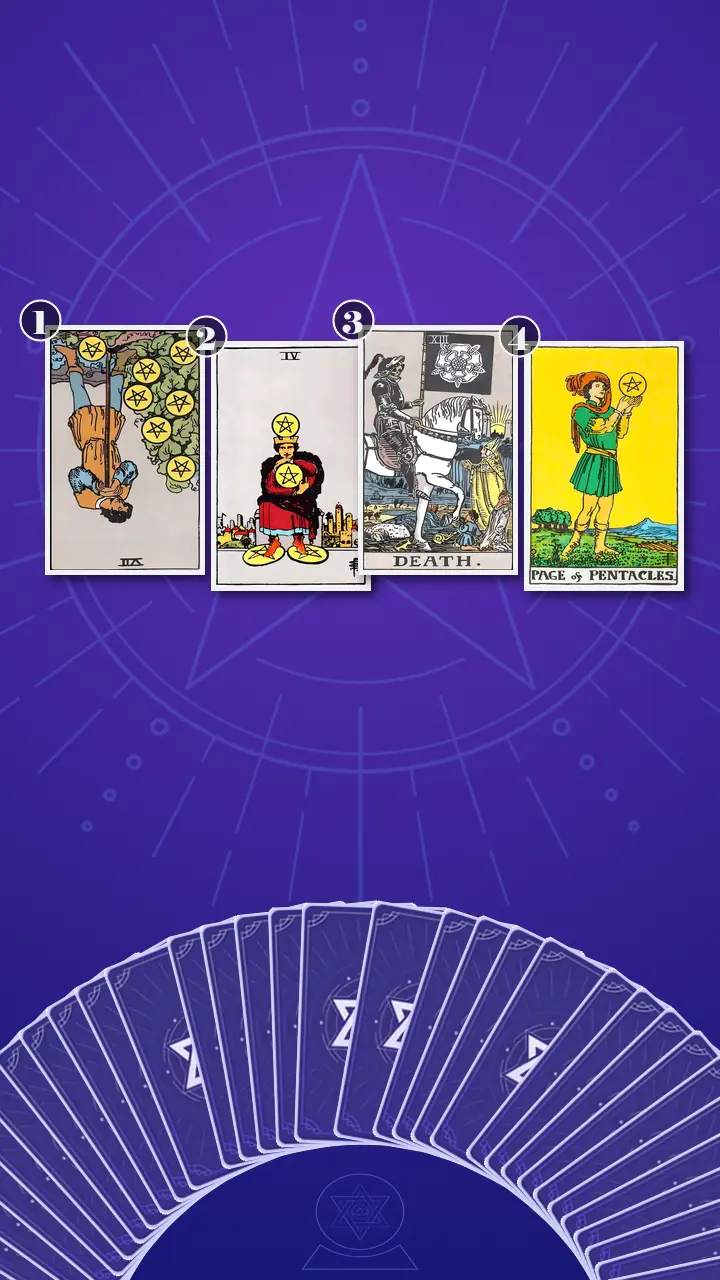
Reading the Map of the Revision-Relief Loop
Position 1: The Study Harvest That Never Becomes Practice
Now I turned over the card representing the presenting pattern: the concrete behavior of revising missed study blocks and the stagnant frustration described in the diagnosis.
It was the Seven of Pentacles, reversed. In the Rider-Waite-Smith image, a figure leans on a hoe and studies a plant bearing pentacles, pausing to inspect the return on their labor. Reversed, the card carries an excess of evaluation and a deficiency of usable practice. It shows frustration with delayed results becoming so repetitive that the review itself replaces the work being reviewed.
At position one, I saw Riley opening the planner intending to study, then becoming absorbed in the week that had not produced the expected work. She moved missed blocks, recalculated available hours, changed labels, and compared the revised layout with the ideal one. The activity looked responsible for a few minutes, but no practice question was attempted. The planner was giving her relief; the practice task was the part that could give her data.
I said, 'This sounds like the sentence, I am not avoiding the work; I am fixing the system so the work will finally count. But the block moved, and the learning did not. You are measuring the appearance of the week before you have measured what you can recall.'
Riley gave a short, bitter laugh instead of nodding. 'That is painfully accurate,' she said. 'It is almost rude.'
I smiled gently. 'I am not asking you to mock the part of you that wants structure. It is trying to create safety. I am asking whether structure is still serving learning when it lets you end the evening without touching the material.'
Her finger stopped above the trackpad. She glanced from the red overdue badge to the unopened chapter, then folded her hands together as if she had finally caught the exact moment when planning shifted into postponement.
Position 2: The Hours Held Against the Chest
Now I turned over the card representing the root pressure: the fear that restarting will make the invested time feel wasted and may prove a lack of discipline or self-worth.
The card was the Four of Pentacles, upright. Its figure holds one pentacle against the chest, stands on two more, and keeps another on the crown. The energy is concentrated, fixed, and protective. In this position, the card shows Riley holding the hours already spent, standing inside the old timetable, and allowing the schedule to become evidence of who she is.
At position two, the old plan was no longer just a tool. Every overdue block carried the setup time, the original intention, the colour coding, and the hope that the qualification would widen her career options. Archiving it felt less like changing a method and more like losing the story that she was a disciplined person who could make the plan work if she edited it carefully enough.
I asked, 'When you hover over delete or archive, which thought feels most threatening: I wasted the time, I cannot follow through, or I will have no proof that I am disciplined?'
Riley reread the question. Her chest lifted, her jaw tightened, and her hand curled around the edge of the chair before slowly opening again. 'If I let this version end,' she said, 'what does that say about all the effort I put in? And what does it say about me?'
Here I used my signature lens, Draft Paralysis Deconstruction. I explained that perfectionism can function as a subconscious defence against academic criticism: if the plan remains under revision, Riley never has to test her knowledge in a way that could produce an uncomfortable result. The calendar becomes a protected draft. It looks active, but it cannot be evaluated.
'Sunk cost often sounds like one more revision when self-worth is on the line,' I told her. 'Your mind is trying to preserve control, but control is not the same as learning. The question is not whether the old plan deserves loyalty. The question is what evidence it has already given you about your real evenings, commute, energy, and attention.'
Riley looked down at the four cards. The muscles around her mouth softened, though her eyes stayed wary. She was not suddenly comfortable with closure. She was beginning to see why another Sunday reset could feel safer than one imperfect question.
When Death's White Rose Made Space
Position 3: The Necessary End of the Active Calendar
The room grew quiet when I reached for the card at the visual centre-right of the line. I turned over the card representing the transformative release: the old behaviour and interpretation that need to end so Riley can move from repairing the schedule to testing a smaller study method.
It was Death, upright. I said the name plainly and immediately clarified that this is the Rider-Waite-Smith symbol of necessary transition, not literal death, danger, or a prediction. The skeleton rider carries a black banner marked by a white rose. A fallen king lies beneath the horse, while the sun rises between distant towers. The image does not erase what came before; it changes who is allowed to govern what comes next.
In Riley's life, Death looked like taking a screenshot of the current calendar, labelling it 'Old Plan v1, ended because it exceeded weekday energy,' and stopping the automatic migration of overdue blocks. The hours were not deleted from history. The method was simply no longer allowed to make demands on the present.
This is where I used my second signature lens, Performance Anxiety Decoupling. I separated three things that Riley had fused together: the performance of the study plan, the result of a future exam or practice question, and her core self-worth. A plan can be badly matched to a commute and a full-time job without the person using it being bad at follow-through. An uncertain answer can identify a learning need without becoming a character reference.
The Sentence That Separates a Method from a Person
At 8:43 on a Tuesday, Riley had opened the planner to study, spotted two overdue blocks, and begun dragging them into next week. The tea cooled beside her. Her jaw tightened, but the untouched chapter stayed safely outside the frame. She was trapped between repairing the route and admitting the route had ended.
You do not need to keep reviving a failed plan to prove that you are disciplined; let Death's white rose mark the end of that version and use the cleared space to test a simpler one.
Riley's breath stopped first. Her finger froze above the trackpad, and her eyes widened slightly as if the sentence had interrupted a familiar reflex. Then her gaze lost focus; I could almost see her replaying the Sunday resets, the productivity videos at 1.5x speed, and the moments when she had chosen another calendar edit over a practice question. Finally, her clenched hands loosened. Her shoulders dropped a fraction, her eyes grew bright, and a shaky breath left her chest with a quiet, surprised 'Oh.' The room had not changed, but the crowded screen seemed less authoritative. I invited her to open a note titled 'Restart test, not new master plan,' screenshot the current schedule, label it 'Old Plan: closed, not erased,' and choose one exam topic for eight minutes of closed-book recall. No complete replacement system was required.
I asked, 'Now, using this new angle, can you think back to a moment last week when this insight might have made you feel differently?'
She looked at the white rose on the black banner. 'Thursday,' she said. 'I was hovering over Delete recurring series. I thought I needed a better replacement before I was allowed to close the old one. Maybe I only needed to stop asking the old one to keep proving itself.'
That was the bridge. The first movement was not from failure to perfect confidence. It was from frustrated schedule maintenance to dignified closure, then from closure toward beginner curiosity. Death did not make the decision for Riley. It made the distinction visible enough for her to make it herself.
The Page and the One-Question Restart
Position 4: A Beginner-Sized Piece of Evidence
Now I turned over the card representing the grounded integration: the observable learning action that can generate evidence without requiring a perfect new plan.
The card was the Page of Pentacles, upright. In the Rider-Waite-Smith image, the Page studies one pentacle with concentrated attention. A cultivated green field stretches around the figure, and distant mountains remain visible without demanding to be climbed today. The energy is grounded but flexible: practical effort returned in an apprentice-sized form.
At position four, the Page became Riley closing the weekly planner, choosing one exam objective, and setting a fifteen-minute timer for a single closed-book retrieval question. She could record what she remembered, where the answer became unclear, and how much energy the task required. The block did not have to prove that she could complete the qualification, maintain a flawless routine, or become the person in a StudyTok video. It only had to show her what she knew next.
I said, 'This block does not have to prove I can finish the qualification; it only has to show me what I know next. One completed question can teach you more than another perfectly arranged week.'
Riley kept the planner closed for a moment longer. Her hand moved toward the textbook rather than the calendar, then paused. She was still apprehensive, but the pause no longer looked like paralysis. It looked like a choice with a smaller cost of entry.
From Schedule Maintenance to Learning Evidence
When I placed the four cards together, I could see a clean causal story. The reversed Seven of Pentacles showed Riley inspecting a disappointing harvest until review became the evening's main activity. The Four of Pentacles explained the grip: the old schedule held her invested hours, professional hope, and sense of discipline so tightly that changing it felt like losing herself. Death created the needed gap, allowing the method to end without erasing the effort or turning the ending into shame. The Page of Pentacles filled that gap with one useful object: a question she could actually answer.
The blind spot was not that Riley needed more productivity advice. It was the belief that the plan had to be made redeemable before learning could begin. She had been measuring loyalty to the calendar instead of evidence of learning. A failed method was being treated as a failed person, while the real information - limited weekday energy, a long commute, shared space, and a need for shorter practice - stayed buried beneath colour labels and revised deadlines.
The transformation direction was practical: move from repairing the schedule until it feels worthy of trust to running one small restart experiment that measures what is useful now. The old plan is data, not debt. Discipline is not loyalty to a broken calendar. It is the willingness to notice what the evidence says and adjust without humiliating yourself.
I gave Riley three small next steps. Each one was deliberately reversible, because a restart should gather information rather than demand a new identity.
- Close the old experimentOn one weekday evening at the shared desk, screenshot or export the current study calendar, place it in a folder called 'Old Plan v1,' add an end date, and do not move any overdue blocks forward. In a phone note, write three lines: 'Stop: automatic rollover of missed blocks. Keep: the topic priority that still matters. Test: one shorter practice block after work.'If archiving feels like making failure permanent, archive rather than delete. The screenshot keeps the history available, and the minimum version is only renaming the calendar 'Old Plan v1, ended.'
- Use the Inner-Critic Mute ProtocolWhen an overdue block appears, capture its title in a temporary note and complete one ten-minute practice attempt before opening the calendar editor. Before starting, write the critic's sentence - such as 'This has to prove I can follow through' - then answer, 'Noted, not in charge. This is a learning test, not a verdict.' Set the timer and keep the weekly planner closed.After the timer, record only minutes attempted, what you could recall, and the first point that became unclear. Keep a twenty-four-hour no-edit window after a missed session unless a real deadline, accessibility need, illness, or work limit requires an immediate change.
- Run the One-Object Learning TestChoose one exam objective, one tool, and one fifteen-minute block. Answer a single closed-book retrieval question using paper, a blank document, or existing flashcards. Use the unclear point to choose the next single practice task, but do not design the rest of the week during the same session.If fifteen minutes feels unrealistic after work, use five minutes and one question. The result evaluates today's task and method, not your intelligence, discipline, or future qualification.
I watched Riley read the list twice. The old reflex would have asked her to turn these actions into a seven-day master plan. This time she wrote only one line beside the second action: 'Practice before schedule.' That was enough for the evening.

A Week Later, One Question Was Enough
Six days later, Riley sent me a message: 'Old Plan v1 is archived. I did the ten-minute question before touching the calendar. I did not know the answer, but now I know exactly what to review.'
That night, she slept a full night after the shorter block, but her first thought the next morning was still, 'What if I am wrong?' This time she smiled, wrote the question into her evidence log, and opened the chapter for ten minutes before deciding what came next. The doubt remained, but it no longer held the trackpad.
I call that a real beginning. The cards did not restart Riley's study plan, and they did not guarantee an academic result. They helped her separate the end of a method from the value of the person who tried it. She supplied the courage, the question, and the next small piece of evidence.
If a study plan has started to feel like proof of who you are, even hovering over 'Delete recurring series' can tighten your jaw. You may want the relief of a clean restart while fearing that the blank space will confirm you were the problem; noticing that conflict already means the old story is no longer invisible.
If the old plan did not need defending tonight, what is one tiny piece of learning you might feel curious enough to test for yourself - one question, one topic, one honest ten minutes?