Why Going Home Feels Like a Performance Review
When Taylor came to my table, I recognized the pattern at once: if you work a contract role, live in a city that keeps reminding you how expensive adulthood is, and one casual 'So what’s next for you?' text can trigger instant career-pivot anxiety before you have even packed a bag, you are in very familiar territory with me.
She told me about 11:42 p.m. on a Wednesday in her shared apartment kitchen in Toronto’s west end: her overnight bag open on a chair, VIA Rail prices on one tab, LinkedIn on another, and an Apple Notes page titled 'If they ask' glowing in her hand. The fridge hummed, leftover garlic hung in the air, and the phone felt almost hot in her palm. She wanted the softness of being home. Instead, she was treating a weekend visit like she needed a passable quarterly update before she earned it.
'I just need a clearer answer before I go home,' she said. Then, after a beat: 'I know they care, but every question sounds like a performance review.' What sat underneath was the true contradiction: she wanted to go home, and she was afraid to go home before the next move was figured out. The feeling lived in her body like a carry-on strapped too tightly across the chest—portable, private, and hard to breathe around.
I nodded. 'Sometimes I hear "I need a plan" and what it really means is "I don’t want to feel exposed." Home gets heavy when belonging starts acting like a report card. Let’s draw a map through that fog and look for the kind of clarity that lets you arrive as a person, not a performance.'

Choosing the Bridge: a Situation-Obstacle-Advice-Outcome Spread
I asked Taylor to put both feet on the floor and take one breath slower than the city usually allows. Then I shuffled while she held the exact question in mind: why does going home make me want my next move figured out first? For me, that small ritual is not theatre. It is simply a way to stop the mind from sprinting ahead long enough to notice what is already true.
I chose a Situation-Obstacle-Advice-Outcome spread, a four-card tarot spread for family pressure and next-step anxiety, because the real issue here was not which job to take. It was why the idea of home had become tangled up with performance, self-surveillance, and the need to sound settled. When people ask me how tarot works in a moment like this, this is what I mean: the cards give structure to a pattern the nervous system is already living.
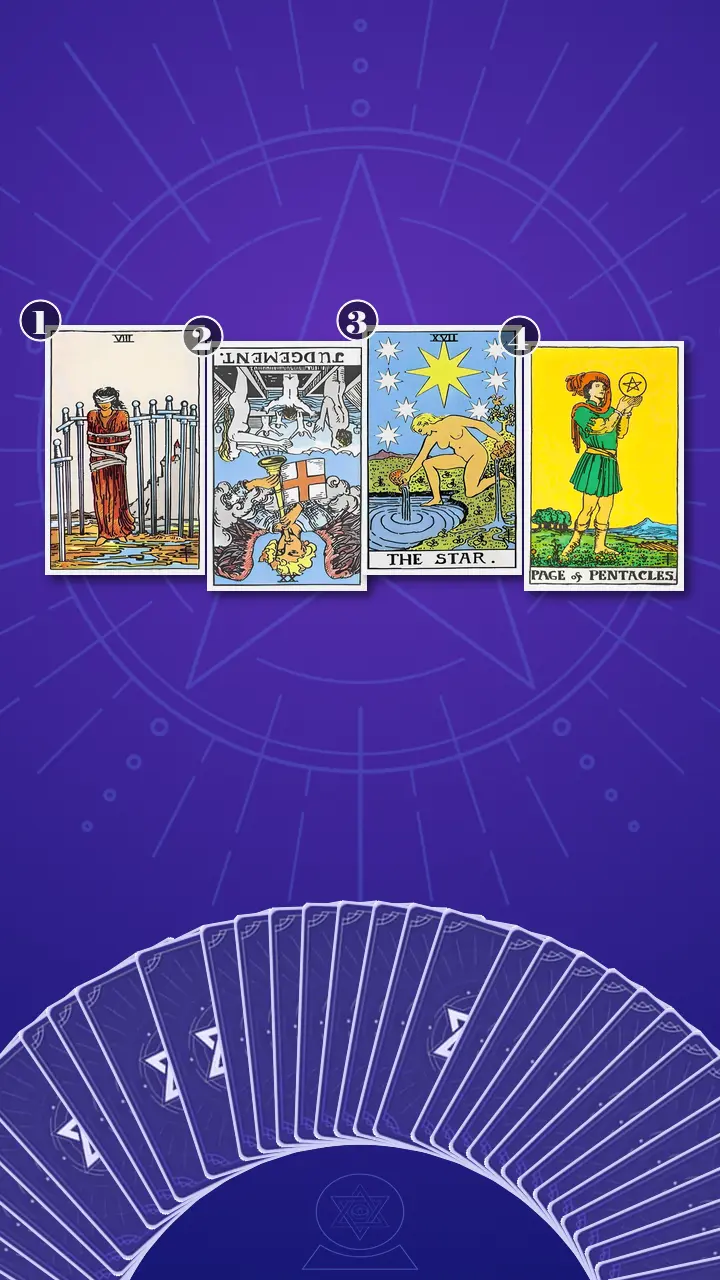
In this spread, the first card would show the visible pattern: the freezing, overplanning, or postponing. The second would reveal the deeper blockage underneath it. The third, our key card, would name the medicine—the shift from performed certainty to honest self-trust. The fourth would show how that truth could become one grounded next step instead of another five-year manifesto.
Reading the Pressure Cluster
Position 1: The Tabs That Call Themselves Preparation
Now I turned the card representing the concrete homecoming trigger pattern from the diagnosis: how the querent freezes, overplans, or postpones going home until there is a presentable answer about the next move. It was the Eight of Swords, upright.
I told her this was the exact image of a family visit turning into a mental hazard course. The night before going home, she had a half-packed bag and too many tabs open—train prices, job boards, LinkedIn, rent math, maybe even a grad program page she did not truly want. Instead of confirming the trip, she kept polishing possible explanations for her life because arriving without a clean narrative felt more dangerous than staying exhausted and undecided. It was like keeping seventeen tabs open and still not pressing confirm booking.
Energetically, the card showed blockage: air multiplying into overthought, not movement. The blindfold mattered to me. Some pressure around family was real, yes, but not all of it. A meaningful portion had been self-tightened. 'Is the real pain that you do not know yet,' I asked her, 'or that you hate being seen before you know?'
She let out a small laugh that carried more ache than humor. 'That’s so accurate it feels rude,' she said. Her fingers tightened around her mug and then loosened. 'Not rude,' I told her softly. 'Just visible.' I could feel the first layer of recognition settle; she was no longer lost in the loop, only looking at it.
Position 2: The Invisible Panel Under the Text Message
Then I turned the card representing the psychological mechanism beneath the symptom: the core fear that arriving home without a plan will expose a lack of worth, plus the inner critic activated by family context. It was Judgement, reversed.
This card took me underneath the tabs and into the private rule running them. I told her I could see the office-bathroom version of the story clearly: a normal text from home landing on the screen, and her body reacting as if an invisible panel had convened. She drafts and deletes an answer in Apple Notes until it sounds adult enough to pass. The actual question might be about train times or work, but inside her, it arrives with Severance-style performance-review energy.
Energetically, this was fire turned inward—conviction collapsed into self-criticism. Judgement reversed often shows me a person listening harder for imagined verdicts than for their own inner call. Here was the blind spot: she was reacting more to the comments section in her head than to the actual people in front of her. In my practice, I call one part of this Social Clock Decoupling. Toronto rent, LinkedIn promotions, late-20s milestone culture, the whole artificial timeline—none of that is a sacred clock, but under pressure it can start wearing your own voice.
When I said that, she went very still. First her breath paused. Then her eyes unfocused, as if she were replaying a dozen tiny moments by an office sink or on Line 2 with a family text open and a spreadsheet called 'next 6 months' waiting beside it. Then she swallowed and said quietly, 'My family isn’t even that harsh.'
'I know,' I said. 'That is why this matters. The loudest judge here may not be sitting at the dinner table at all.'
When The Star Poured Water Over the Script
Position 3: The Card That Lowered the Guard
When I turned the card representing the key transformation needed in this case—moving from performed certainty to honest self-trust and allowing belonging without having everything resolved—the room changed. The card was The Star, upright. A stripe of pale afternoon light caught the blue on the card just as the kettle clicked off behind us, and the quiet that followed felt clean.
I told Taylor that this was the antidote. Not a polished monologue. Not a better defense. The Star was the image of answering with one real direction and one real unknown: 'I’m leaning toward this, and I’m still figuring out that.' It was the difference between personal-brand mode and an honest voice note. A truthful direction can regulate you more than a polished script.
This was also where my own Seasonal Energy Diagnostics became useful. I told her I did not see laziness or drift in these cards. I saw a young woman trying to force a spring harvest during a winter dormancy phase. No wonder she was exhausted. She had been asking herself to arrive at home with fruit in her hands when the season was really asking for root growth, water, and a quieter kind of truth. Seeing that, I had one of those clear inner flashes I trust: not myth this time, but the hard Highland winters of my own childhood, when nothing above ground looked impressive and life was still gathering itself below.
At 11:42 p.m., her bag still half-packed and her Notes app full of draft answers, one weekend train ride home had somehow become a referendum on whether her adult life sounded coherent enough yet. She was trapped inside the old equation: finished plan equals safety; uncertainty equals exposure.
You do not need the old polished script to earn your place; let The Star's clear water replace performance with honesty, and clarity will grow from what is real.
She did not melt immediately. First, her breath caught halfway in her chest and stayed there. Then her gaze slid past me, unfixed, as if she were back in that shared kitchen looking at the note titled 'If they ask,' hearing all the lines she had deleted because they sounded too unfinished. Then came the resistance, sharp and almost angry: 'But if I say it that simply, won’t I sound like I have nothing?'
I shook my head. 'No. It means you sound like someone telling the truth before the pitch deck is done. Protection is not the same thing as dishonesty, but protection can outlive the weather that created it.' I watched the sentence land. Her mouth tightened, then trembled into the faintest, most disbelieving smile. One shoulder dropped. Then the other. She let out a long breath that sounded like it had been waiting days. There was relief in it, yes, but also that strange slight dizziness that comes when a burden lifts and leaves you suddenly responsible for your own simpler answer. I asked her, 'With this lens, can you think of a moment last week when this would have changed how you felt?'
She nodded slowly. 'My dad texted, "When are you coming up?"' she said. 'And I heard, "Explain yourself first." But I could have just said, "I’m leaning toward applying for permanent comms roles, and I’m still figuring out what kind of team I want."'
That was the hinge. Not from confusion to perfect certainty, but from anticipatory shame and self-surveillance toward honest belonging and steadier self-trust. The blindfolded figure of the Eight of Swords had hidden. The naked figure of The Star simply stood there, visible and alive. That was the kind of clarity we were after.
Position 4: One Pentacle, Not Ten
Finally, I turned the card representing the actionable next step: replacing the demand for a full life plan with one grounded move and a more realistic way of speaking about what comes next. It was the Page of Pentacles, upright.
I smiled when I saw it. After all that trapped air and inward fire, here was earth. The Page of Pentacles does not ask for a life verdict. It asks for one real thing you can hold with both hands: one application, one recruiter email, one budget check, one call, one course outline. It is the card of changing your Notion dashboard from 'my whole life' to one checked box.
Energetically, this was stabilizing balance. The future did not need to be defended; it needed to be touched. 'You do not need a five-year answer to name one real next step,' I told her. 'One pentacle week is enough.' For the first time that session, she leaned forward instead of bracing back. 'That,' she said, almost surprised, 'I can actually do.'
Belonging Before Certainty
When I laid the four cards together, the story was clean. First, home triggered the Eight of Swords pattern: thoughts multiplying until a simple train booking felt like a referendum. Then Judgement reversed showed the hidden engine underneath it: achievement-based belonging, the private rule that said she had to sound settled in order to feel safe and worthy. The Star changed the whole climate by replacing performance with honest visibility. And the Page of Pentacles turned that emotional truth into behavior: one grounded experiment instead of rehearsing an entire future.
The blind spot was not that Taylor lacked options. It was that she kept mistaking overplanning for safety, and she was obeying an imagined verdict more faithfully than the actual question in front of her. The transformation direction was what I call Belonging Before Certainty: letting self-worth exist before the plan is finished, naming a truthful direction, and allowing home to be a place you enter while still in process.
- Write the Direction, Not Defence ScriptBefore the visit, open Notes and write only two lines: 'The direction I’m leaning is...' and 'What I’m still exploring is...' Read it out loud once, then stop editing. If family asks what’s next, use those two lines and let there be two breaths of silence.Short on purpose is still respectful. If speaking live feels too exposed, send the unpolished version as a voice note to one trusted friend first.
- Choose One Pentacle for This WeekPut one measurable task in your calendar for 25 minutes: one application, one recruiter email, one budget pass, or one call. When you talk about your future, name that one step instead of defending the next five years.When your mind tries to turn one task into a life reset, ask, 'What counts as one pentacle, not ten?' Stop when the timer ends.
- Try the Winter Dormancy RitualBook the trip or reply to the family text before the plan feels finished, and then take seven days off from late-night future-scripting about this blocked goal. If a message lands hard, make two quick notes on your phone: 'Actual question' and 'Imagined verdict.'Minimum version: one night, not seven. Put the phone face down for 60 seconds and wait for even a slight softening in your chest before you answer.
When I offered the Winter Dormancy Ritual, she gave me a look that made me smile. 'A whole week of not trying to figure it out sounds impossible,' she said.
'Then begin with one evening,' I told her. 'Winter is not failure. It is restoration. The point is not to perform calm. It is to stop yanking at the roots long enough to let organic energy return.'
I reminded her of one more thing: she could answer the question without handing over her whole interior.

A Week Later, the Quiet Proof
A few days later, Taylor sent me a message. She had booked her VIA Rail ticket before editing LinkedIn. She had sent a voice note to a friend with the simple version: 'I’m leaning toward permanent comms roles, and I’m still figuring out what kind of environment suits me.' Later, when family asked what was next, she said nearly the same thing. No dramatic applause, no collapse, no tribunal. Just a conversation.
The change was small and real, which is the only sort I trust. She told me she slept through the night after booking the trip, though the next morning her first thought was still, What if I sound behind? This time, she laughed softly, made tea, and did not reopen LinkedIn.
That is what this Situation-Obstacle-Advice-Outcome tarot spread for understanding why going home triggers pressure to have the future figured out gave her: not a destiny, not a script, but a cleaner relationship to her own timing. I did not watch her become finished. I watched her become more honest, and therefore more steady.
A lot of us know the strange ache of wanting home and bracing against it at the same time: bag half-packed, chest tight, because love got tangled up with having a convincing answer ready.
If you let yourself arrive as someone still in process, what is one honest sentence about your direction that would feel light enough to carry home?
This story is adapted from psychological research, written so that those in a similar struggle can see their own pattern in it — and find their next step clearly.These insights are not a substitute for professional psychological, medical, legal, or financial advice.
Learn more about our Journey to Clarity.
How did this insight land for you?
🫂 This Resonates Deeply
🌀 Living This Story
✨ Now I See Clearly
🌱 Seeing New Possibilities
🧰 Useful Framework
🔮 The Confirmation I Needed
💪 Feeling Empowered
🚀 Ready for My Next Step
Author Profile
 AI
AI“As the seventh generation of a Highland healing family, I see modern anxieties as a simple, temporary disconnection from nature's rhythm. I bring 67 years of lived seasons not to instruct you, but to hold space for you. Using tarot as a mirror, I want to gently guide you out of the chaos, helping you breathe deeply and rediscover the organic, steady heartbeat of your own life.”
In this Timing Tarot Reading :
Core Expertise
- Seasonal Energy Diagnostics: Diagnosing your deep exhaustion as a misalignment with natural seasons—trying to force a spring harvest during a winter dormancy phase.
- Social Clock Decoupling: Detaching your core self-worth from artificial timelines like peer pressure or societal milestones.
Service Features
- The Winter Dormancy Ritual: A grounded challenge to consciously do 'nothing' regarding a blocked goal for one week, eradicating guilt and rebuilding organic energy.
Also specializes in :
Explore Related Patterns:
Certainty SeekingTaylor's half-packed bag, open train tab, LinkedIn tab, and Notes page titled 'If they ask' show planning taking on an emotional function beyond preparation. She is not only organizing a trip; she is trying to reduce the vulnerability of being seen before her next chapter feels explainable. The defensive logic is clear: if the answer is polished enough, the visit may feel safer. Certainty becomes a shield against the discomfort of being unfinished, especially in a family context where casual questions are experienced as evaluation. Certainty Seeking fits because the pressure is not solved by more information. Each extra tab promises relief but keeps You locked inside the same loop: one more draft, one more career search, one more version of the story before You are allowed to arrive.
Competence TheaterTaylor's Notes page titled 'If they ask' captures the performance layer of the story. She is not just preparing to answer a question; she is editing herself until the answer sounds adult enough to pass an imagined review. The defense is presentation management. Instead of using language to share what is true, she uses language to prove competence, reduce exposure, and make her unfinished life sound more complete than it feels. Competence Theater fits because the story shows You staging coherence as protection. The relief comes when Taylor no longer has to deliver a quarterly update on her life and can offer one real direction with one real unknown.
Conditional Self-WorthTaylor's weekend visit becomes psychologically loaded because home is no longer just a place to return to; it starts functioning like a report card. The clearest evidence is her belief that she needs a cleaner career answer before she can arrive, as though belonging has to be earned through a coherent update. That rule turns uncertainty into exposure. A normal question from family is filtered through an internal evaluation system, so the issue is not simply that You do not know the next move yet; it is that not knowing gets translated into not being worthy enough, adult enough, or settled enough to be seen. Conditional Self-Worth fits because the story shows worth being tied to performance outcomes. The pattern becomes visible when Taylor moves from 'I need a plan before I go home' toward the possibility that she can be loved, included, and spoken to while still in process.
Mind ReadingTaylor's dad texts, 'When are you coming up?' and her nervous system hears, 'Explain yourself first.' That gap between the actual sentence and the internal translation is the central evidence: the threat is being amplified by interpretation before the conversation has even happened. The cognitive mechanism is anticipatory projection. Because home has become linked with evaluation, neutral questions are read as hidden verdicts, and the imagined panel in her head starts to feel more authoritative than the people actually texting her. Mind Reading fits because the story shows You responding to assumed judgment as if it has already been spoken. The shift begins when Taylor separates the actual question from the imagined verdict and discovers that the conversation can be simpler than the internal courtroom predicted.
Analysis ParalysisTaylor's preparation multiplies until it blocks the action it was supposed to support. The open tabs, the half-packed bag, and the repeated script polishing create the image of a mind trying to think its way into safety while the actual next step stays suspended. The mechanism is a cognitive overload loop. More analysis temporarily feels responsible, but it also raises the threshold for action: the train ticket cannot simply be booked, the text cannot simply be answered, and the visit cannot simply be a visit until every possible question has been mentally rehearsed. Analysis Paralysis fits because the story shows thought replacing movement. You can see the trap in the way preparation keeps calling itself progress while quietly postponing the one grounded step that would reduce the pressure.
Productivity as SafetyTaylor's late-night planning has the texture of emotional regulation. LinkedIn, rent math, job boards, and future scripts become tools for calming the exposed feeling that comes with going home unfinished. The defense is productive control. Career planning is real and useful in the right dose, but here it becomes a safety behavior: if enough work is done on the future, the present moment might stop feeling vulnerable. Productivity as Safety fits because the story shows You trying to earn nervous-system relief through output. The turning point is not abandoning practical steps; it is shrinking the demand from a whole defended life plan to one grounded action that does not have to prove your worth.
Social Clock ComplianceTaylor's pressure is fed by a wider timeline: Toronto rent, LinkedIn promotions, late-20s milestone culture, and the feeling that adulthood should already sound coherent. Those signals do not stay outside her; they start speaking in the voice she uses to judge herself. The cognitive distortion is timeline fusion. External benchmarks become internal deadlines, so going home while still uncertain feels like showing up late to a life stage everyone else has supposedly passed. Social Clock Compliance fits because the story is not only about family pressure. It is about You measuring your timing against an artificial adulthood schedule and then treating deviation from that schedule as evidence that You must defend your life before being seen.
Assertive CommunicationTaylor's eventual answer is short, honest, and bounded: she names the direction she is leaning and what she is still figuring out. That matters because earlier in the story, a simple family question had been treated as an invitation to defend her entire life. The mechanism is boundary-based communication. Instead of collapsing into overexplaining or hiding behind a polished script, she gives enough truth to be real without handing over her whole interior for evaluation. Assertive Communication fits because the change is behavioral and relational at the same time. You can answer clearly without turning the answer into a performance, and You can stay connected without surrendering your private uncertainty to the room.
Reality TestingTaylor's key move is learning to separate the text she received from the verdict she imagined. Her dad's 'When are you coming up?' becomes less threatening once she can see that 'Explain yourself first' was an internal translation, not the actual message. The cognitive mechanism is evidence checking. By writing down 'Actual question' and 'Imagined verdict,' she creates a small reality-testing pause between stimulus and interpretation, which interrupts the automatic slide from contact into self-judgment. Reality Testing fits because the story shows You reclaiming the difference between what happened and what your nervous system predicted. That distinction does not erase pressure, but it gives You enough clarity to respond to the real conversation rather than the one already happening in your head.
Explore Related Struggles:
Belonging-Authenticity SplitTaylor wants the softness of being home, but she prepares for it like a presentation. The note titled 'If they ask' holds the polished version, while the honest version is simpler: she is leaning toward permanent comms roles and still figuring out what kind of environment fits. Belonging-Authenticity Split lives in that gap between being welcomed and being real. You can be near people who care and still feel pressure to arrive as a more finished version of yourself. The shift comes when she books the ticket before editing LinkedIn and lets one honest sentence be enough. The belonging does not arrive because she has completed the plan; it becomes available because she stops replacing herself with the script.
Certainty-Safety FusionTaylor has the VIA Rail tab open, the overnight bag half-packed, and LinkedIn waiting beside a note called 'If they ask.' The trip itself is simple, but her body treats the booking as unsafe until the future has a cleaner shape. That is the precise lock inside Certainty-Safety Fusion: certainty is no longer useful information; it becomes the condition that makes belonging feel survivable. You can want home and still hold yourself outside it because unfinished plans feel like exposure. The struggle is not that she lacks any next step. It is that the need for a finished answer starts standing guard at the door, turning a weekend visit into something she must qualify for before she can receive it.
Clarity-Exposure SplitTaylor says she needs a clearer answer before she goes home, but the story keeps showing that the missing answer is only one layer of the pressure. She is polishing explanations because being seen before she knows what comes next feels more dangerous than the uncertainty itself. Clarity becomes a shield against visibility. You can hear it in the way a simple question about timing turns into a need to sound settled, adult, and coherent enough to pass. Clarity-Exposure Split names that friction: the mind asks for a plan, while the body is really asking not to be caught unfinished. The work is not to fake certainty faster, but to tell the truth in a shape small enough to carry.
Inner Tribunal LockA normal text from home lands on Taylor's screen, and her body reacts as if a panel has already convened. The actual message may be about train times, but inside the pressure chamber it becomes 'Explain yourself first.' Inner Tribunal Lock is the state where the imagined verdict becomes more authoritative than the real conversation. You start answering the comments section in your head instead of the person in front of you. The story loosens when she separates the actual question from the imagined verdict. That distinction gives her back a piece of agency: she can respond to the text, not to the whole invisible court.
Performance-Worth FusionTaylor does not describe her family as cruel, yet every question starts sounding like a performance review. She drafts and deletes until her answer feels adult enough, as if the right phrasing could prove she deserves to be unguarded at home. Performance-Worth Fusion appears when a life update stops being communication and starts becoming a worth test. You are not just preparing to answer; you are trying to make your unfinished life sound acceptable before anyone gets a chance to see it. That fusion makes ordinary care hard to receive. Belonging cannot feel soft while part of you is still trying to submit a quarterly report on your own becoming.
Social Clock EntrapmentTaylor's kitchen is crowded with more than a train ticket. Toronto rent, LinkedIn promotions, contract-work instability, and late-20s milestone culture all press into the same small screen. Social Clock Entrapment shows up when an artificial timeline starts sounding like your own inner voice. You are not only wondering what comes next; you are measuring whether your pace is defensible against everyone else's public progress. That pressure explains why home can feel loaded even when the family question is gentle. The visit becomes a place where the city, the platform, and the invisible timeline all seem to ask whether you are behind.
Explore Related Emotions:
Anticipatory ShameTaylor has not even arrived home, yet she is already preparing for the feeling of being exposed. The visit becomes emotionally loaded before it happens: the bag is open, the answers are being drafted, and the imagined moment of sounding unfinished has already started shaping her breathing. Anticipatory Shame names that early arrival of self-consciousness. It is the feeling of being embarrassed in advance, not because anyone has actually rejected you, but because your mind has already staged the scene where your life sounds behind, messy, or not impressive enough. In this story, the shame attaches to timing. The question “what’s next?” becomes less about logistics and more about whether you can prove that your adulthood is coherent. That is why going home makes you want the next move figured out first: the unfinished part of your life feels like it might be seen before you feel ready to hold it in public.
Cautious Self-TrustTaylor’s steadier answer is deliberately modest: she is leaning toward permanent comms roles, and she is still figuring out what kind of environment suits her. Nothing about that sentence pretends the whole future is solved, yet it gives her enough ground to stand on. Cautious Self-Trust is the feeling of letting a truthful partial answer count. You are not forcing confidence to arrive on command; you are allowing one real direction to be valid even while part of the map remains open. This matters because the story’s relief does not come from becoming finished. It comes from trusting that an honest sentence can hold more integrity than a polished defense. The self-trust is cautious, but it is real enough to book the ticket, answer the text, and stop reopening LinkedIn for proof.
Certainty HungerTaylor says she needs a clearer answer before she goes home, and the sentence sounds practical until the rest of the scene reveals its emotional charge. The plan is being asked to do more than guide the next step; it is being asked to make exposure feel survivable. Certainty Hunger is the craving for a finished answer when unfinishedness feels too visible. It is not the healthy wish for direction. It is the urge to hold a complete narrative in both hands so no one can see the open edge of your life. In this story, certainty becomes a kind of emotional armor. The five-year answer is wanted because one honest next step feels too small to protect you, even though the actual relief begins when Taylor lets one direction and one unknown be enough.
Conditional Belonging FearTaylor wants the softness of home, but the visit has started to behave like a report card. The painful contradiction is clear: you want to be close, yet you feel as if closeness has an entry requirement, and the requirement is sounding settled enough. Conditional Belonging Fear names the feeling that your place with people might depend on how well you can account for yourself. The issue is not simply that the next career move is unclear; it is that the unclear part feels like it could threaten your right to arrive as you are. That fear turns a weekend trip into a referendum on worth. You are not just packing clothes. You are packing proof, editing your uncertainty into something that sounds acceptable, and hoping the version of you who walks through the door will be easy enough to approve.
Grounded BelongingA few days later, Taylor books the train before editing LinkedIn, sends the simple version to a friend, and says nearly the same thing when family asks. The feared tribunal does not appear. There is just a conversation, which is precisely why the shift lands quietly rather than dramatically. Grounded Belonging is the sense that you can return while still in process. It does not require total openness or total certainty; it asks for enough honesty to be present and enough boundary to stay intact. In the emotional weather of this story, belonging becomes grounded when it stops depending on a finished plan. You can bring one real sentence home, let the rest remain unfinished, and still feel that your place is not something you have to earn with a perfect update.
Performance FreezeThe half-packed overnight bag, open train tab, LinkedIn window, and Notes page titled “If they ask” show a body caught between leaving and defending itself. You are not watching someone casually prepare for a trip; you are watching movement stall because the visit has started to feel like a test that requires a passable answer before the ticket can be booked. That is the emotional logic of Performance Freeze. The pressure to sound sorted locks the next action in place, so preparation stops being useful and becomes a holding pattern. The more you try to make the answer presentable, the harder it becomes to do the simple thing you wanted to do: go home. The freeze is especially strong because home is not just a location in this story. It is a place where you want softness, but your system expects evaluation. That makes the chest-tight, tab-heavy, not-quite-packed state feel like protection, even while it keeps you stuck outside the belonging you are trying to reach.
Self-Audit AnxietyThe Notes page titled “If they ask” is the emotional center of this pattern. Taylor is not only thinking through her options; she is reviewing the way her life might sound, editing it until the answer feels adult enough to survive being heard. Self-Audit Anxiety is the inner pressure to keep inspecting your own words, choices, and timeline before anyone else gets near them. It turns ordinary preparation into a private evaluation cycle, where every possible sentence has to prove that you are reasonable, focused, and not falling behind. This is why clarity feels urgent in the story. The clearer answer is not only wanted for practical direction; it is wanted as evidence. You are trying to reduce the risk of being misunderstood by auditing yourself first, but the audit keeps you in the very pressure you are trying to escape.
Verdict DreadA normal message from home lands like an invisible panel has convened. The actual people in the story are not described as brutal or unforgiving, but the question still arrives with review-room energy, as if every answer could be weighed and scored. Verdict Dread captures the fear of being internally sentenced before the conversation has even begun. You are not only preparing for what they might ask; you are bracing for what your own mind might decide their question means about you. That dread makes home feel less like a place to return to and more like a room where your unfinished choices might be read aloud. The emotional charge comes from the gap between the actual text and the imagined judgment attached to it, and that gap is where the pressure multiplies.
Identity PR FatigueThe story keeps returning to presentation work: LinkedIn, polished explanations, adult-sounding phrasing, and the pressure to turn a still-forming life into a clean update. Taylor is not just deciding what to do next; she is trying to manage how her identity will be received. Identity PR Fatigue names the exhaustion of having to make yourself sound coherent before you feel coherent. It is the tiredness that comes from translating your private uncertainty into a public-facing version that will not raise questions, disappoint anyone, or make you look behind. The fatigue matters because it shows why home feels so heavy. You are not resisting the people themselves as much as the performance layer that has grown around being seen by them. The more polished the script becomes, the further away your actual voice feels.
Truth ReliefWhen Taylor imagines saying the simple version, her body reacts before the rest of her life changes. A shoulder drops, then another, and the breath that comes out sounds like it has been waiting days. Truth Relief is the release that comes when the honest sentence is finally allowed to be shorter than the defense script. The relief is not about having a perfect answer. It is about no longer needing to turn every unknown into a polished explanation. That is why the voice note matters. The simple sentence gives her nervous system something clean to hold: a direction, an open question, and no extra performance. The truth is small, but it reduces the pressure because it no longer asks her to impersonate certainty.
Explore Related Contexts:
Adulting Performance PressureTaylor has an overnight bag open, train prices on one tab, LinkedIn on another, and a Notes page titled 'If they ask' glowing in her hand. A weekend visit is being managed like a quarterly update, where the right answer about work and timing seems to determine whether she can arrive as a person or has to arrive as a presentation. The pressure is external because it is attached to a recognizable social stage: young adulthood being measured through career clarity, financial self-management, and a clean explanation of the next move. The family question may be ordinary, but it lands inside a culture where adulthood is treated as something that should be reportable, optimized, and visibly progressing. That is why Adulting Performance Pressure fits the story so tightly. You are watching home become a review room, not because every person in it is hostile, but because the visit has been loaded with proof-of-adulthood expectations before it even begins. The useful clarity here is not a perfect plan; it is seeing that the demand to sound fully formed is part of the pressure field, not a requirement for belonging.
Conditional Family BelongingTaylor wants the softness of being home, but she feels she needs a clearer answer before she goes. The contradiction is visible in the half-packed bag and the edited Notes page: belonging is desired, yet access to that belonging appears to require a presentable update. Conditional Family Belonging is the right outer context when home feels available only after proof of progress has been prepared. The story does not require the family to be openly cruel for the condition to operate; the condition can live in repeated questions, old scripts, and the way adult status gets measured around the dinner table. For You, the important distinction is that care and conditionality can coexist in the same environment. Family may care, and the visit can still activate a rule that says unfinishedness must be defended. Naming that rule makes it possible to enter with a truthful sentence rather than trying to earn entry through a polished performance.
Five-Year Plan PressureTaylor is not only booking a train ticket; she is trying to assemble an answer that can survive the question of what comes next. The tabs around her tell the story clearly: LinkedIn, rent math, possible job options, and a private script all open at once while the actual trip remains emotionally harder to confirm. Five-Year Plan Pressure appears when one unfinished decision starts demanding the authority of a whole life strategy. In Taylor's case, a single weekend home gets pulled into a larger expectation that career direction, financial logic, and adult identity should already line up in a polished sequence. The friction is that she does have a direction, but not a finished blueprint. You can see how the pressure turns a reasonable next step into a defensive life plan, making it harder to speak honestly about what is still forming. The path back to agency begins by separating one real next move from the impossible demand to defend the next five years.
Social Clock PressureTaylor's dad texts, 'When are you coming up?' and she hears, 'Explain yourself first.' That shift does not come from the words alone; it comes from the surrounding scoreboard of Toronto rent, LinkedIn promotions, contract work, and late-20s milestone culture pressing on the same moment. Social Clock Pressure is the outer timeline that makes an unfinished chapter feel late. It turns ordinary contact with home into evidence gathering: whether the job is stable enough, whether the next move sounds adult enough, whether the pace of life can be defended against an imagined benchmark. The story keeps showing that the clock is social rather than natural. Taylor is not without motion; she is trying to move while measuring herself against a schedule that keeps changing shape. Naming the clock gives You room to ask a sharper question: which part of the timeline is materially useful, and which part is only borrowed pressure wearing your voice?
Performance Defense ModeTaylor keeps polishing possible explanations for her life instead of simply confirming the trip. The Notes page titled 'If they ask' captures the defensive shape of the moment: she is preparing for contact as if ordinary questions require a controlled public statement. Performance Defense Mode names the external situation where a social setting pushes You to manage your image before You can participate. It is not just an internal habit; the defense is organized around a real audience, a real visit, and a real expectation that your choices should sound coherent on demand. The story shows how quickly this mode can take over practical action. Train booking, career reflection, and family contact collapse into one rehearsal loop. Once the mode is identified, the work becomes more concrete: reduce the performance surface, choose one honest line, and let the conversation be a conversation rather than a hearing.