The Archived Chat on Line 1: Finding Clarity After Friendship Fallout
I recognized Jordan as soon as she described the pattern: she was twenty-seven, early in a communications career in Toronto, and one tagged photo on the subway could turn an ordinary ride home into a full Betrayal-Closure Loop before she reached her stop.
At 6:18 PM on a packed Line 1 train between St George and Bloor-Yonge, Jordan had opened the archived WhatsApp chat and scrolled from the final exchange to an older affectionate message. She told me the carriage smelled of wet coats, the fluorescent lights buzzed overhead, and her phone felt warm against her palm while her thumb hovered above the search bar. She locked the screen without sending anything, but the conversation continued in her head.
When she sat across from me, she said, What am I refusing to release after this friendship fallout? Then she added, I do not want them back, but I still want the story corrected. I can release the friendship only when the betrayal has been properly acknowledged.
I heard the grief beneath the resentment and the vigilance beneath the questions. It was like keeping an old browser tab pinned because closing it might make the information stop being true, even though the tab had administrator access to every quiet evening. I said, I believe that the hurt happened. We do not have to make you forgive, forget, or accept someone else's version. Let us draw a map of what the checking protects, what it costs, and where your own authority can begin.
Choosing a Map for an Unfinished Ending
I invited Jordan to put both feet on the floor, take one slow breath, and name the question without trying to solve it first. I shuffled slowly, using the movement as a transition from the subway loop into a focused conversation, not as a test of fate.
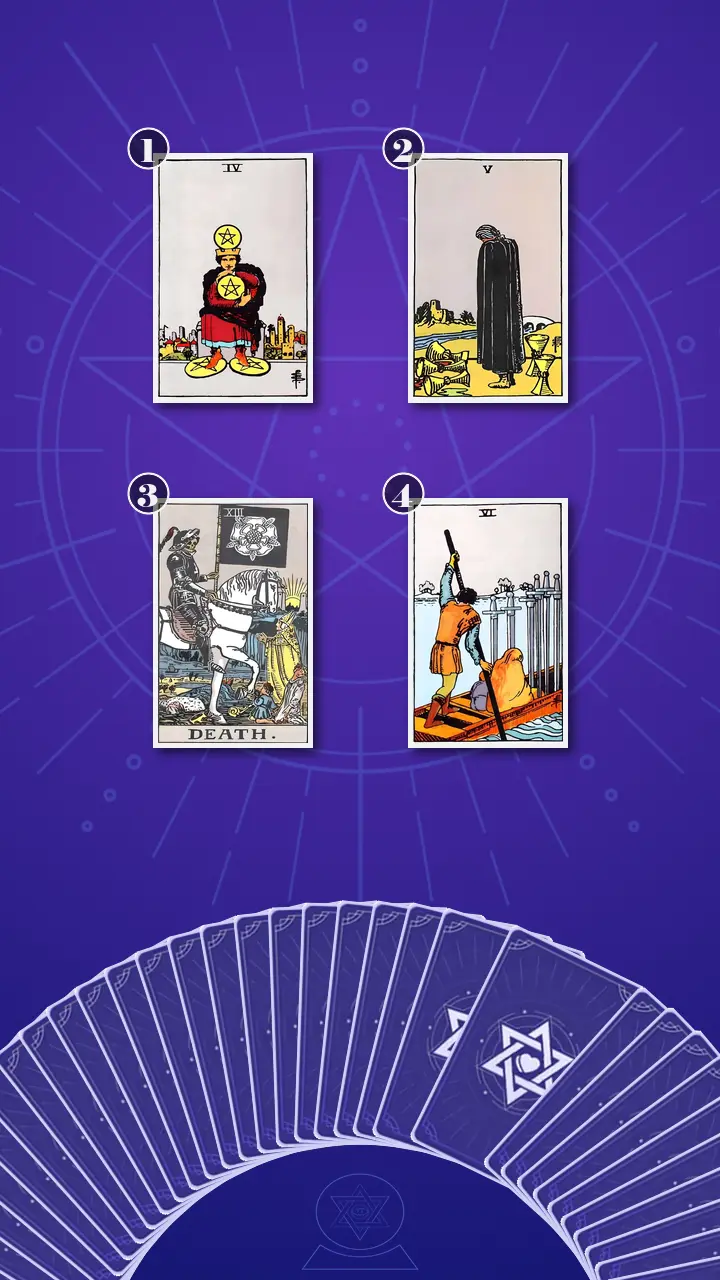
I chose The Shadow Spread · Context Edition, a four-card friendship fallout tarot spread designed for one inward question. I explained to anyone reading along that this is one practical way to understand how tarot works: the images give the mind a structured language for patterns that may otherwise remain vague. The first position would show the visible shadow pattern, the second the hidden wound feeding it, the third the exact release point, and the fourth an integrated boundary that Jordan could choose for herself.
The 2x2 layout kept the reading narrow. The upper row would show the closed loop of grip and grief; the lower row would open toward transformation and movement. A Celtic Cross could have introduced broad past, external, and future material, but for this question I wanted clarity rather than outcome prediction.
The Phone Held Close
I began with the upper-left position, the one I call the visible shadow pattern: the concrete behaviors keeping the friendship's case open. I turned over the Four of Pentacles, upright.
The card showed a guarded figure securing pentacles against the chest, beneath the feet, and above the head. Jordan's modern version was precise: at 11:36 PM in her Parkdale apartment, she moved between the archived WhatsApp thread, a screenshot folder called Receipts, and the former friend's muted Instagram profile. None of it was new, but keeping the record within immediate reach felt like retaining custody of what the friendship meant.
I read the Earth energy as an understandable protection that had become excessive and contracted. The archive against her body, the screenshots restricting where her attention could move, and the story occupying the space above every new interaction all gave her a temporary sense of agency. The blind spot was that access had begun to impersonate control. The more she checked, the more the old friendship could interrupt the present.
Jordan did not nod. Her breath paused, her fingers tightened around her mug, and her eyes fixed on the card as if an old message had just appeared there. Then she gave a short, bitter laugh. That is too accurate. Almost cruel.
It is not a character judgment, I said. It is a strategy that once helped you feel less exposed. What does keeping the record protect, and what does it prevent you from noticing now? She looked down at her phone and answered, If I stop holding this, their version becomes true. I lose the evidence. I asked her to notice the distinction between protecting the truth and giving the truth repeated access to her attention.
The Three Spilled Cups
I moved to the upper-right position, the root shadow: the Betrayal-Closure Lock beneath the possessive attachment, including the fear that moving on before acknowledgment would surrender control of the story. The card was the Five of Cups, upright.
In Jordan's daily life, a mutual friend's casual update in the King West office kitchen could consume an entire lunch break. She would hear one name beside the hissing espresso machine, keep her voice neutral, and then return to the final exchange while current group chats waited unanswered at the edge of her screen. The card's cloaked figure staring at three overturned cups translated the same narrowing of focus. The rupture became sharp; the rest of life blurred.
Water was not deficient here. It was pooling around the loss, with grief and resentment becoming so concentrated that looking away felt morally wrong. The two upright cups and the bridge remained in the image, but I did not use them to tell Jordan to replace the friendship or rush toward gratitude. They showed that the emotional field was larger than the injury, not that the injury was small.
Her chest tightened first. Her gaze drifted past the card, replaying a memory, and then she released a long breath through her nose. If I look away, I am saying it did not matter, she said. I answered, Grief can testify that the bond mattered without being appointed gatekeeper of every hour that follows.
When Death Changed the Sentence
The room became quieter when I reached the lower-left position. I named its role before turning the card: the release point, where the attachment, defense, or old identity that must transform can be distinguished from the facts of the hurt. Then I revealed Death, upright.
Death is not a literal forecast. In this reading, it described the ending of the friendship's former shape and the role Jordan had been carrying as permanent casekeeper. The modern-life scene was a rainy Sunday at an Annex cafe. She had written, The friendship in which I keep waiting for them to correct the ending is over. The boundary I carry forward is that I do not need agreement to step back after trust is broken. She had not deleted the history or declared the betrayal acceptable.
I pointed to the black banner and its white rose. Finality and value were held together in one image. The rising sun between the towers suggested that meaning could evolve after the old channel closed. The friendship can have mattered deeply and still be over, I said. Closure is not a document that needs both signatures.
At that moment I used my signature lens, Savior Complex Auditing. I asked whether Jordan had quietly assigned herself a job no one had hired her for: to fix the former friend's understanding, produce the perfect explanation, and repair the moral shape of the ending before she was allowed to leave. I was not diagnosing her or asking her to save anyone. I was checking whether her boundary had become another unpaid repair project.
I could see the impossible equation forming in her face. If she released the loop, the harm might become negotiable; if she kept investigating, the bond stayed present as a wound. She was no longer looking for a new fact. She was asking whether her own boundary could count without a witness.
You do not honor the hurt by keeping the old friendship on trial; like the Death card's white rose on a black banner, allow the former bond to end while carrying its lesson into a self-chosen boundary.
Jordan's breath stopped first. Her eyes held on the white rose, then lost focus as if they were replaying the last train ride and the unsent message at once. Her right hand tightened around the mug and released. A line appeared between her brows, and her mouth opened as though an argument was ready. But if I end the trial, what if their version wins? she asked, with a flash of anger that I welcomed as honesty rather than resistance. I held the silence instead of persuading her. Her shoulders lowered by a fraction. She rubbed her jaw, blinked hard, and let out a trembling breath. Relief arrived, followed by a small, dizzying emptiness, as if clarity had removed a railing she had been leaning against. I told her that self-authored closure would not certify the other person's account; it would return authorship to her.
I asked, Now, use this new perspective to recall whether there was a moment last week when this insight might have made you feel different. I set a ten-minute timer and placed a private note between us. I invited her to complete only two unfinished prompts: What I no longer need this friendship to provide is... and The boundary I can carry forward is... One phrase under each was enough. If the writing became another prosecution brief, she could stop.
For me, this was the first visible movement from grief-fueled message checking and external-closure anxiety toward self-authored closure and present-focused boundaries. Nothing had been erased. The mental trial had simply stopped being the only place where the meaning of the friendship could live.
The Boat That Carries the Swords
I turned to the lower-right position, the integrated path: the small boundary and attention shift that restores agency while carrying the lesson forward. The card was the Six of Swords, upright.
The image translated release into a manageable passage. Jordan could choose a seven-day pause from opening the archived conversation or checking the former friend's profile, then use one freed ten-minute block for a present relationship or grounding routine. The swords stayed in the boat. She did not have to throw away the lessons in order to leave the rough water.
This was balanced Air: perspective, movement, and a deliberate change of attention. The absence of Wands mattered too. The reading did not ask for a dramatic confrontation or a public performance of closure. It asked for a small route change. On the subway, Jordan could notice the urge, write I am allowed to carry what I learned without travelling back through the argument tonight, and answer one current friend's message before her stop.
Her phone remained face down, but her hand no longer hovered over it. She asked whether seven days would be too much. Then make it one commute, I said. A boundary is still yours when it is small enough to practice.
Putting the Case File Down Without Deleting the History
When I read the four cards as one story, I saw a clear sequence. The Four of Pentacles began with Earth clenched around the record. The Five of Cups revealed the Water of grief beneath that grip, making further checking feel like proof of love and moral seriousness. Death interrupted the loop by ending the friendship's old form and the job of waiting for the other person to issue a verdict. The Six of Swords carried the knowledge into a quieter, self-directed practice.
Jordan's cognitive blind spot was not that she cared too much. It was the assumption that evidence would eventually create control, and that control would eventually create closure. The transformation direction was more precise: move from external acknowledgment as the condition for release to an internal boundary that can hold three truths at once. The betrayal can be real. The friendship can have mattered. The mental trial can still end.
I called the path The Self-Authored Closure Boundary. It did not require deleting messages, contacting the former friend, forgiving on command, or deciding what mutual friends should believe. It required changing the relationship between history and attention. I gave Jordan three low-pressure next steps.
- Write the ending, not another case file.On one private evening this week, open the Notes app and write exactly two sentences: What ended was... and What I am carrying forward is... Close the note after the second sentence.The minimum version is one phrase under each heading. Stop if the exercise starts turning into another argument draft.
- Try the Seven-Day Attention Crossing.Use Screen Time or an app limit to pause access to the archived chat and former friend's profile for seven days. When the urge appears on the subway, note three fields: What happened, what I hope checking will give me, and what is within my control for the next ten minutes.One commute or one evening counts. Keep the history if needed; change its access to attention rather than forcing permanent deletion.
- Use the Compassionate Detachment Protocol with mutual friends.When someone brings an update or invites another post-mortem, validate their curiosity without absorbing the emotional spillover: I get why you are curious, and I am keeping that situation private. I am not taking updates or discussing the fallout tonight.Send the script by text if speaking feels difficult. It protects Jordan's boundary without controlling what anyone else says or believes.
I reminded her that the experiment was hers to continue, revise, reduce, or end. Tarot had not made the decision. The cards had helped us see the decision that had already been waiting beneath the checking loop.

A Week Later, The Quiet Proof
A week later, Jordan texted me from a cafe. She had moved the archived chat out of Favorites, slept through the night, and woke with the thought, What if I am wrong? She stared at it for a moment, smiled without forcing certainty, and answered a current friend's invitation.
That was the proof I trusted: not a perfect ending, not an apology, and not a sudden lack of grief. Just ten minutes returned to the present. Jordan had carried the lesson instead of the live investigation, and the friendship's meaning had survived the change in access.
My Journey to Clarity with Jordan did not end with the cards deciding what she should feel. It ended with her naming what could end and what she would carry forward. Self-authored closure is not forgetting; it is the quiet authority to stop asking the past for permission to live now.
When a thumb hovers over an archived chat and a jaw tightens, closing it can feel less like peace than letting the other person's version become the official one. I want to name that feeling without asking anyone to forgive, forget, or rush. The history and the investigation are not the same thing.
If the hurt could stay true without staying on trial, where might you let ten minutes of your attention go next, before the train reaches your stop?
This story is adapted from psychological research, written so that those in a similar struggle can see their own pattern in it — and find their next step clearly.These insights are not a substitute for professional psychological, medical, legal, or financial advice.
Learn more about our Journey to Clarity.
How did this insight land for you?
🫂 This Resonates Deeply
🌀 Living This Story
✨ Now I See Clearly
🌱 Seeing New Possibilities
🧰 Useful Framework
🔮 The Confirmation I Needed
💪 Feeling Empowered
🚀 Ready for My Next Step
Author Profile
 AI
AI“Having traveled across cultures... I've learned that what we often lack isn't a simple answer, but a moment of being truly understood. I use a Jungian psychological lens to help you deconstruct your subconscious patterns—not to prove anything, but to be the gentle companion who helps you unravel your knots, free of judgment, so you can reconnect with your inner wisdom.”
In this Friendship Tarot Reading :
Core Expertise
- Guilt-Trip Deconstruction: Uncovering the subconscious codependency that forces you to act as an unpaid 'emotional dumping ground' for friends.
- Savior Complex Auditing: Identifying whether your inability to set boundaries stems from a deeply ingrained psychological need to 'fix' others.
Service Features
- The Compassionate Detachment Protocol: A psychological boundary script to validate a friend's emotions while firmly refusing to absorb their psychological toxic waste.
Also specializes in :
Explore Related Patterns:
Closure ChasingSaying that you can release the friendship only after the betrayal is properly acknowledged turns the former friend's response into a gate you must pass through before leaving. Reopening the final exchange, retaining the Receipts folder, and mentally refining the case keep that gate active even when you do not want the friendship back. Closure Chasing operates by outsourcing the endpoint of your experience to someone who may never confirm it in the required form. What you are refusing to release is not simply the person or the history, but the condition that the ending must be jointly corrected before your own boundary can count. Recognizing that condition allows the hurt to remain true without making another person's agreement the administrator of your future attention.
Compulsive CheckingOpening the archived chat on Line 1, moving between the thread, the Receipts folder, and the muted Instagram profile at night, and returning after a mutual friend's update form a visible checking cycle. Each check offers a brief sense that you are monitoring the truth and staying prepared, but the material contains no new information. Compulsive Checking persists because the immediate reduction in uncertainty rewards the action, while the emotional cost arrives later as another commute, lunch break, or quiet evening becomes occupied by the fallout. The pattern does not prove that the hurt is unresolved because you have failed to think hard enough. It shows that repeated access has become a self-reinforcing protection strategy, and changing access can interrupt the cycle without deleting the history.
Illusion of ControlKeeping the archive, screenshots, and muted profile immediately accessible gives you control over where the evidence is stored and when it can be reviewed. That concrete control feels especially powerful after an ending in which you could not control the other person's interpretation, acknowledgment, or willingness to repair. The Illusion of Control appears when authority over the record is expected to produce authority over the meaning of the fallout. More evidence can preserve your memory, but it cannot compel a shared verdict or reverse the ending, so the strategy remains active without completing its task. Separating control of access from control of truth lets you protect your account while withdrawing attention from an unwinnable trial.
Information HoardingMoving between the archived WhatsApp thread, the Receipts folder, and the muted profile keeps multiple forms of evidence within immediate reach. When you fear that releasing the material could let someone else's version replace your own, storing information becomes a defense against memory being invalidated or the relationship being rewritten. Information Hoarding is serving a psychological function here rather than a practical research need. The archive protects continuity and confirms that your experience existed, but its permanent availability also gives the old friendship repeated access to your attention. The useful distinction is between keeping a record and keeping it open, which allows you to preserve history without making constant retrieval the price of believing yourself.
Post-Event RuminationLocking the screen without sending anything does not end the exchange because the conversation continues internally. When one name in the office kitchen consumes a lunch break and brings you back to the final messages, the event is no longer being reviewed for new facts. It is being mentally replayed in pursuit of a verdict that the replay itself cannot supply. Post-Event Rumination keeps the fallout cognitively present by treating more analysis as a possible route to certainty, correction, or emotional completion. The mind remains busy, but the process is circular because it works with the same evidence and the same unanswered relationship. Seeing the replay as a mechanism rather than a duty gives you permission to stop a thought sequence without declaring the underlying hurt unimportant.
Moral PerfectionismTreating looking away as proof that the friendship did not matter makes attention carry a moral burden it cannot resolve. When ending the internal trial feels like allowing the former friend's version to win, you are no longer choosing only whether to revisit a message. You are deciding whether disengagement would make you disloyal to your own truth. Moral Perfectionism operates here through an impossible standard in which the ending must be fully acknowledged, correctly understood, and ethically repaired before you may leave it. Because another person controls part of that outcome, the standard keeps your boundary permanently provisional. You can retain a clear judgment about what happened without requiring every future hour to serve as evidence of your moral seriousness.
Boundary DiscernmentWriting that you do not need agreement to step back after trust is broken separates your boundary from the former friend's verdict. Pausing the archive for one commute, declining updates from mutual friends, and later moving the chat out of Favorites translate that distinction into observable choices under your control. Boundary Discernment allows you to decide what access the history receives without controlling what anyone else says, believes, or remembers. The boundary can be small, revisable, and still valid because its purpose is to govern your participation rather than force a shared narrative. You carry the lesson forward while ending the automatic pathway through which the former friendship enters each present moment.
Internal ValidationWriting that the friendship is over and asking whether your own boundary can count without a witness shifts the source of permission. The facts of the hurt are not erased, but the former friend's acknowledgment is no longer treated as the only authority capable of validating your decision. Internal Validation becomes visible a week later when the thought that you might be wrong appears and you do not force yourself to eliminate it before answering a current friend's invitation. You are allowing your boundary to operate without perfect certainty or external certification. This does not make your interpretation infallible; it means uncertainty no longer automatically cancels your right to choose where your attention and participation go.
Explore Related Struggles:
Betrayal-Closure LockJordan does not want the friendship restored, yet she says she can release it only after the betrayal is properly acknowledged. Every return to the final exchange keeps two actions tied together: leaving the bond and securing a verdict from the person involved. When your permission to move on depends on that verdict, the ending remains structurally unfinished even after contact has stopped. The grip is not on reunion; it is on the condition that the harm must be confirmed before your life is allowed to move, and clarity begins when that condition becomes visible.
False Responsibility LoopJordan has quietly taken on the job of correcting the former friend's understanding, producing the perfect explanation, and repairing the moral shape of the ending before she may leave. No new fact is being sought, yet the unpaid assignment keeps generating more checking and more argument drafts. When closure is tied to completing a task that requires another person's cooperation, responsibility expands beyond your actual authority. You can put down the repair job without withdrawing your standards, because your boundary does not need to finish someone else's understanding.
Inner Tribunal LockJordan keeps reopening the case through messages, screenshots, profile checks, and arguments that continue after the screen is locked. By the time she becomes the permanent casekeeper, the friendship's meaning has been confined to an internal hearing that never reaches a verdict. You are left serving as investigator, witness, and judge for an absent counterpart, so every attempt to settle the case produces another reason to review it. The structure loosens when your account can remain valid without an endlessly renewed trial.
Memory-Loyalty BindJordan says that looking away would mean saying the friendship did not matter, and keeping the record feels like retaining custody of its meaning. The messages therefore carry more than evidence; they are made responsible for proving that the bond and the injury were real. When memory becomes the price of loyalty, releasing constant access can feel like betraying your own past. You can honor what mattered without requiring repeated contact with the archive to certify its value.
Monitoring-Safety FusionThe archived WhatsApp thread, Receipts folder, and muted Instagram profile stay within immediate reach even though none contains new information. Checking is asked to protect the facts and restore control, but each check gives the fallout another route into the commute, lunch break, or quiet evening. You are caught where access feels like protection while access itself keeps the threat active. Seeing that distinction lets you preserve the record without allowing the record to govern when the past can enter your attention.
Internal Authority CollapseJordan asks whether her boundary can count without a witness and fears that ending the trial would let the other person's version win. The absent friend's acknowledgment has become the credential that her own decision must obtain before it can take effect. You remain unable to act on what you know because authorship has been transferred to someone who is no longer participating in the relationship. Reclaiming authority means allowing your boundary to be valid as a decision, even while the competing account remains uncorrected.
Wound-Compass FusionA mutual friend's casual update sends Jordan back to the final exchange while current conversations wait unanswered, and she says looking away would feel morally wrong. The injury is not only remembered; it starts deciding what deserves attention and what counts as seriousness. When the wound becomes the compass, movement toward the present can register as disloyalty to the truth. You recover choice by separating the reality of the hurt from the rule that every available hour must continue pointing toward it.
Explore Related Emotions:
Authorship AnxietyJordan says, "I do not want them back, but I still want the story corrected." The sentence places her ability to leave inside a process she cannot complete alone: the former friend must acknowledge the betrayal before Jordan's ending is permitted to feel valid. You can experience Authorship Anxiety when another person's disagreement seems capable of overruling your own boundary. The deepest uncertainty is no longer about the facts; it is about whether you are allowed to close a chapter that someone else may continue describing differently.
Betrayal AcheJordan scrolls from the final exchange to an older affectionate message, then holds the phone while her body tightens around what those two moments reveal. The archive places the friendship's former closeness and its rupture in the same palm, keeping the injury physically near even without renewed contact. You can experience Betrayal Ache when the bond still matters but its meaning has been altered by a breach of trust. The ache does not require you to want the person back; it registers that something valuable was injured and that your account of that injury still deserves recognition.
Closure DreadClosing the mental trial makes Jordan ask whether the former friend's version will win. The ending is therefore not experienced as a neutral stopping point; it appears to carry a verdict about whether the betrayal was real and whether the friendship mattered. You can feel Closure Dread when finality seems to threaten the legitimacy of your pain. Keeping the case open then feels safer than stepping into an ending without mutual acknowledgment, even as the ongoing trial gives the past repeated access to your present.
Evidence AnxietyAt 11:36 PM, Jordan moves between the archived thread, a folder named Receipts, and the former friend's muted profile, even though none of the material is new. Immediate access gives her a brief sense of custody over the truth, but every check also returns the disputed ending to the center of her attention. You can feel Evidence Anxiety when saved proof seems responsible for keeping your reality intact. The record stops functioning as passive history and becomes something you must repeatedly monitor, because loosening access feels dangerously close to losing the right to name what happened.
Friendship Rupture GriefA mutual friend's casual update consumes Jordan's lunch break, while the old affectionate message continues to sit beside the final exchange. She does not ask to restore the friendship; she keeps returning to the place where a meaningful bond became something she could no longer safely inhabit. You can grieve the friendship's lost shape, the recognition that never arrived, and the version of the bond you thought would survive conflict. Friendship Rupture Grief allows the relationship to have mattered without turning that significance into an obligation to reopen it.
Protective AngerJordan's fingers tighten around the mug, a bitter laugh escapes, and the question arrives sharply: if she ends the trial, what if their version wins? Her anger appears at the exact point where release seems to demand that she soften, minimize, or surrender her account of the betrayal. You can feel Protective Anger as the heat that keeps an injured boundary visible. Its presence does not make you hostile or unreasonable; it shows that part of you is still guarding the distinction between moving forward and agreeing that the harm was acceptable.
Resentful WaitingJordan keeps her voice neutral when a mutual friend mentions the fallout, then spends the rest of lunch back inside the final exchange. She is not waiting for reconciliation; she is waiting for the acknowledgment that would confirm she was right to step away. You can experience Resentful Waiting as a prolonged emotional stance toward a response that may never come. The resentment protects the truth of the injury, while the waiting keeps the former friendship active as an unfinished demand on your attention.
Bittersweet ReleaseRelief arrives for Jordan alongside a small, dizzying emptiness, as though the mental trial had been a railing she no longer needed but had grown used to leaning against. A week later, the uncertainty is still present, yet she leaves the archive where it is and answers a current friend's invitation. You can experience Bittersweet Release when freedom and loss occupy the same moment. Attention returns to the present, but the bond's importance does not disappear; you are learning that carrying the lesson and carrying the live investigation are different acts.
Cautious Self-TrustA week after the reading, Jordan wakes with the thought, "What if I am wrong?" She does not force certainty or reopen the case; she lets the question remain and answers a current friend's invitation instead. You build Cautious Self-Trust when your boundary begins to count even before every doubt has disappeared. The small scale matters: one commute, one unopened archive, or one present-tense reply lets you test your own authority without demanding a flawless performance of closure.
Cognitive OverwhelmOne tagged photo turns Jordan's subway ride into a full review of the fallout, one name consumes a lunch break, and the archived record continues into quiet evenings after the screen is locked. The issue does not stay contained inside a single memory; it repeatedly recruits the same limited field of attention across work, transit, home, and current relationships. You can experience Cognitive Overwhelm when every cue opens several competing layers at once: remembered messages, imagined rebuttals, saved proof, and questions about whose account will prevail. The crowded inner weather helps explain why release feels difficult even after you have decided that the relationship itself is over.
Explore Related Contexts:
Friendship Closure LimboJordan says she does not want the former friend back, yet she keeps the archived WhatsApp thread, the screenshots, and the muted Instagram profile within reach because release seems to require the betrayal to be acknowledged. The old friendship has ended as a relationship, but its social meaning remains open for adjudication. The missing acknowledgment makes her next step dependent on another person's account of the ending. You can see the cost in the Line 1 checking, the lunch break consumed by a mutual friend's update, and current group chats left unanswered while the former exchange remains active. Your boundary can become valid without a second signature. The history can remain true while the trial ends, allowing you to carry what the friendship taught you without keeping the former bond in charge of the present.
Access as Proof PressureThe archived thread, a screenshot folder called Receipts, and a muted Instagram profile all stay one tap away, from the Line 1 commute to the Parkdale apartment. None of the material is new, but its availability is being used as a safeguard for the truth of the fallout. Because Jordan equates stopping access with allowing the other person's version to win, the phone becomes a portable proof station rather than a neutral record. A mutual friend's update can pull an entire lunch back to the final exchange while current group chats wait at the edge of the screen. You do not have to destroy the history to change its authority. A smaller access boundary lets the evidence exist without giving it repeated control over your present attention.