The Saturday Kept Empty by a Friend's Future Promises
I met Maya through a video call at 11:40 on a Sunday night. She sat cross-legged on her bed in a Toronto apartment, her laptop casting a blue rectangle across the duvet while Google Calendar waited in the next tab. Her phone looked warm from being held too long. Through her microphone, I could hear the radiator click and the soft, tinny beginning of the same iMessage voice note she had already played twice.
“You're a Toronto junior product designer with a flexible hybrid schedule,” I said, reflecting the pattern back to her, “and you're keeping Saturday blank for a friend who has only said soon. You declined a real dinner invitation so the possibility could stay alive.”
Maya pressed pause. “I know their track record, but the next plan always sounds different. This time they talked about doing weekly calls and finally booking that trip. Their words make me feel close again before anything has actually changed.”
Her chest had tightened while she waited for the message, she told me, then briefly loosened when the warm promise arrived. Underneath that relief was longing that felt like keeping a phone battery at one percent for a call that might come, while treating every other person and plan as an interruption. When the promised check-in passed without follow-through, her stomach dropped. Before she let herself register the hurt, she began searching for an explanation generous enough to make the next promise believable.
“Why do I cling to a friend's promises after repeated letdowns?” she asked. “I don't even need another apology. I need them to finally mean it. If I stop hoping, I feel like the friendship ends without ever making sense.”
I told her I would not use tarot to diagnose her friend, predict an ending, or tell her whether to stay or leave. After a decade of reading cycles, I have learned that a difficult phase is not automatically a personal failure, but neither does compassion require anyone to ignore repeated evidence. “We can respect what this friendship has meant without asking you to keep your present on hold,” I said. “Let's make a map of the hope-disappointment loop and look for the part of it that is actually in your hands.”

Choosing the Six-Card Bridge
I invited Maya to put both feet on the floor, take three slower breaths, and hold one question in mind: what changes when trust is based on completed behavior rather than the emotional force of the next promise? I shuffled slowly. The preparation was not a supernatural performance; I used it as a transition from replaying the message to observing the pattern.
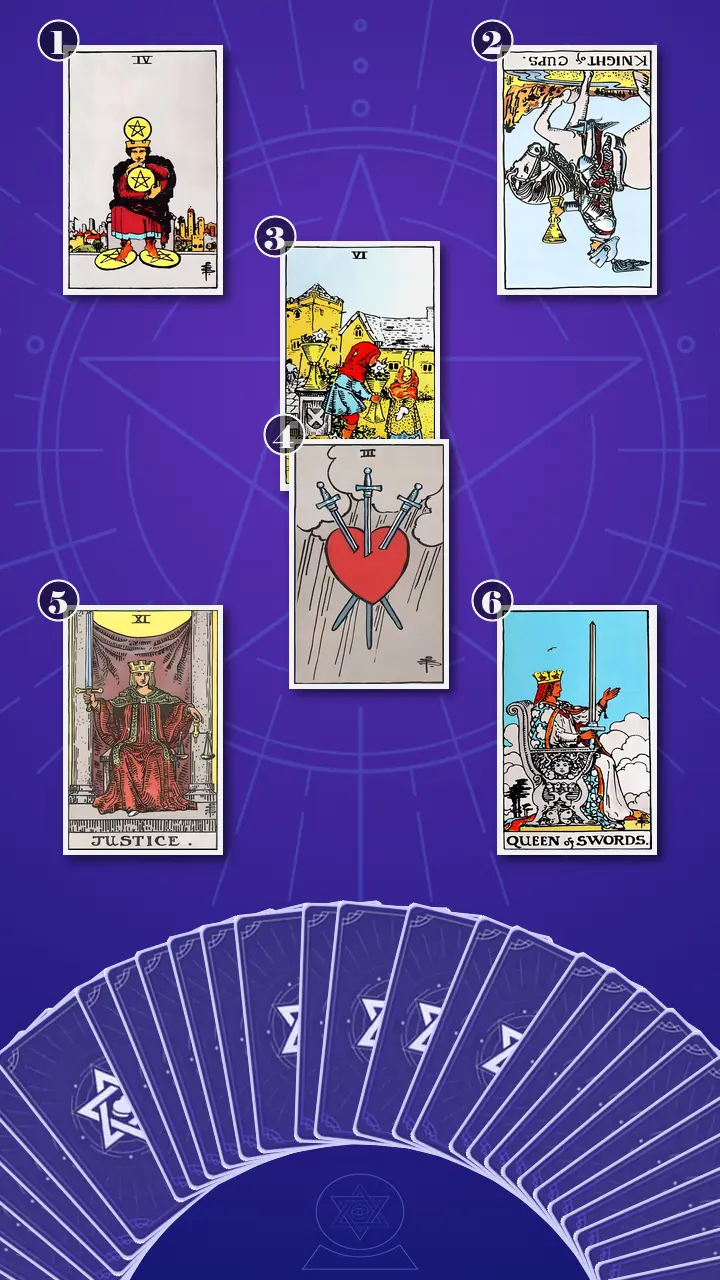
I chose the Relationship Spread · Context Edition, a six-card relationship tarot spread for friendship trust, repeated promises, closure, and boundaries. I arranged the cards as a bridge: three across the upper half to show how the attachment remained active, one beneath them to reveal the rupture, and two lower supports to turn recognition into a self-directed response.
For anyone wondering how tarot works in a situation like this, I use the cards as a structured cognitive tool. Each position limits the question so that emotion, memory, evidence, and choice do not collapse into one another. A ten-card spread would have widened the inquiry unnecessarily. Six positions were enough to examine Maya's current grip, her friend's observable promises and follow-through, the history supporting the bond, the accumulated impact, the awareness needed for clarity, and one boundary Maya could enact herself.
I also narrowed the second position deliberately. I would assess only what the friend had said and completed, not claim access to motives or private feelings. The final position would not predict whether the friendship survived. It would identify a constructive experiment under Maya's control. That ethical frame mattered because the goal was not certainty about someone else; it was a more reliable relationship with her own perception.
Reading the Hope-Disappointment Loop
Position 1: The Grip Around an Empty Calendar Slot
I began with the card representing Maya's present attachment stance, especially the ways she held calendar space, emotional access, and hope after another letdown. I turned over the Four of Pentacles, upright.
I pointed to the seated figure pressing one pentacle against his chest while pinning two beneath immobile feet. The city stood at a distance behind him. I saw the same shape in Maya's Sunday night: the phone held close, the following Saturday blocked in Google Calendar, and a coworker's dinner declined because the empty slot had begun to feel like proof of loyalty. The reserved time was no longer neutral. It had become a way to preserve the promised future of the friendship before any plan was confirmed.
I read the card's energy as Excess: protection tightening into control. Maya was trying to secure belonging by limiting her own movement. The strategy offered short-term relief because keeping Saturday available meant the friendship still might become what had been promised. Its longer cost was that suspense, rather than connection, began organizing her life.
“What are you protecting with the grip?” I asked. “The relationship as it is, or the chance that one future plan will explain the relationship as it has been?”
Maya gave a brief laugh, but there was no amusement in it. Her fingers pressed harder around the edge of her phone. “That's so accurate it's almost cruel.”
I let the discomfort remain without amplifying it. “The card is not accusing you of being possessive or foolish,” I said. “It is showing me a protection strategy. Holding the possibility close has helped you avoid a sudden sense of loss. We are only checking whether that strategy still protects you, or whether it now preserves the waiting.”
Position 2: The Offer That Has Not Landed
I next turned over the card representing the friend's observable promises, communication, and follow-through, without making claims about hidden intent. It was the Knight of Cups, in reversed position.
I drew Maya's attention to the cup presented ahead of the rider's actual arrival. In the card, the emotional offer is visible before the destination has been reached. In Maya's life, it looked like a warm voice note about taking a trip, starting weekly calls, or finally being more present. The message felt so vivid that she updated her expectations and asked when they could plan it, even though no day, booking, or completed action existed.
I asked her to remember the last time this happened on the TTC. She described standing on a Line 1 platform under fluorescent lights, wet-coat and coffee smells trapped in the evening air. Train brakes shrieked as she replayed an affectionate voice note after a missed check-in. “I remember thinking, I know this pattern, but this wording feels more specific, so maybe I can stop protecting myself now.”
The reversal showed Blockage: feeling had not crossed into embodiment. I compared it to a product roadmap full of exciting features marked coming soon while the bug disrupting the user experience remained unfixed. The roadmap might express genuine aspiration, but aspiration is not deployment. In the same way, I did not need to decide whether the friend meant the promise sincerely. I only needed to separate what the message made Maya feel from what it gave her to verify.
“A promise can reopen hope without repairing the thing it promised,” I said. “What was the specific action, and was it completed by the agreed time?”
Maya's hand moved to the center of her chest. She looked away from me and toward the calendar tab. The silence told me the distinction had landed: the message had produced immediate closeness while leaving the original missed commitment untouched.
Position 3: The Past Lending Credit to the Present
I then opened the card representing the shared history and emotional memory that made renewed promises feel credible. The card was the Six of Cups, upright.
I showed Maya the child offering a flower-filled cup inside a protected courtyard. I did not read this memory as false sentimentality. Maya had old iMessages, photographs, inside jokes, and specific memories of a period when the friend had shown up consistently. At 9:03 after a hybrid workday, she could scroll back to that earlier thread, stop on a familiar photo, and feel the old friendship return for a moment. The latest affectionate message then seemed like restoration rather than a new claim requiring current evidence.
The Six of Cups carried Balance when it allowed Maya to honor genuine care from the past. It became Excess when that history functioned like unlimited emotional credit for present promises. Memory explained why the bond mattered, but it could not complete today's missed call or confirm next Saturday's plan.
“You can care about the history without lending it unlimited credit,” I told her. “Which earlier version of this friendship are you hoping the newest promise will bring back, and what present behavior shows that return is happening now?”
Maya rubbed her thumb over the phone case, tightened her grip, then released it. “They were there during a horrible year,” she said. “Part of me keeps treating that version of them as the most real version.”
“That version was real,” I replied. “The question is not whether the past mattered. The question is whether the past should decide today's level of access without new evidence.”
Position 4: When the Rain Was Allowed to Count
I moved to the card representing the central rupture: the repeated words-actions gap and the hurt Maya kept trying to resolve through another future promise. I turned over the Three of Swords, upright.
Rain had begun tapping against Maya's window as I showed her the exposed heart beneath the card's grey sky. The room seemed to join the image. I asked her to open Notes and write the last three commitments in plain language: the promised check-in, the dinner that never received a confirmed time, and the plan to book a trip. Beside each one, I asked her to record only what happened.
The modern meaning was painfully simple. A Notes table felt sharper than another reassuring message because it gave accumulated impact somewhere to exist. Maya wanted to add the friend's work stress, family situation, and affectionate explanation after every line. I asked her to place those in a separate column. Intent could remain uncertain while impact became visible.
I read the Three of Swords as Balance returning through acknowledgment. Its air interrupted the emotional blockage created by successive promises. It did not predict a friendship breakup, and it did not demand that Maya turn pain into a verdict. It asked her to stop covering one unfinished commitment with the next proposed future.
“I do not need to decide what they intended before I admit what this did to me,” Maya read from the sentence I had invited her to type.
Her breathing paused. Her eyes moved down the three rows as if replaying each evening in order. Then a long exhale lowered her shoulders. I could see both grief and steadiness in the change. The hurt had not increased because she wrote it down; it had simply stopped being translated into another investigation.
When Justice Returned the Scales to Her Hands
Position 5: The Fair Witness at the Center of the Reading
The room became noticeably quieter when I reached the card representing the awareness needed to loosen Maya's dependence on an explanation. This was the key card of the reading: Justice, upright.
I pointed to the evenly held scales and the vertical sword. In Maya's world, they became a two-column Google Sheet or Notes table: promised action on one side, completed action on the other. Justice did not ask her to prosecute her friend or strip affection from the evidence. It asked what level of trust the evidence could fairly support.
Seeing those scales, I flashed back to the first time I plotted two planetary paths on transparent paper. The bodies appeared close from one angle, yet their actual directions were different. The diagram did not blame either orbit; it clarified the movement. That memory is part of a lens I call Orbital Drift Recognition.
I used that lens carefully with Maya. Her standards had evolved: affectionate intent still mattered, but reliability now mattered too. If the friendship remained organized around evocative promises while Maya was moving toward completed commitments and clearer time boundaries, the resulting mismatch did not mean she had become cold, demanding, or disloyal. It meant the current frequency of the bond needed to be assessed as it was. Two people can remain meaningful in each other's sky without being given identical proximity, access, or gravitational pull.
At 11:40 that Sunday night, Maya was still caught between relief and dread: her phone was warm in her hand, Saturday remained blank, and the promise of weekly calls had already changed her calendar before one call had been completed.
I asked her, “If you removed the warmth of the latest message, what evidence would still be here?” Then I gave her the sentence at the center of the reading.
You do not have to keep the bond on trial until your friend supplies the perfect explanation; let completed actions carry more weight than promises, and use Justice's scales to return judgment to your own hands.
I left a pause after it.
I watched Maya's breathing stop halfway in. Her right thumb hovered above the voice-note waveform, perfectly still. Then her eyes unfocused from the card and moved toward the blank Saturday square, as if replaying the coworker's declined invitation and every version of soon that had occupied it. Her jaw tightened. “But doesn't that mean I've been wrong this whole time?” she asked, sharper than before.
I did not rush to turn the anger into gratitude. “It means you used hope to protect something meaningful,” I said. “That strategy gave you relief, and now it is costing you self-trust. Recognizing the cost is not a verdict on the person you were.”
Her fingers curled once around the phone, then slowly opened. The skin around her eyes reddened; her shoulders dropped, but the release left her looking briefly unsteady, like someone stepping off a moving walkway onto still ground. A breath came from deep in her chest. “Oh,” she said, almost whispering. “I can decide what the pattern means for my access, even if I never learn exactly why.” The radiator clicked once and went quiet. I saw relief arrive with a new vulnerability: if the scales were hers, so was the next choice.
I asked, “Now, using this new perspective, think back to last week. Was there a moment when this insight could have made you feel different?”
Maya looked at the calendar and answered slowly. “Friday. I turned down dinner because they might confirm. If I had called the plan tentative instead of treating the voice note as confirmation, I could have gone to dinner without making it mean I was abandoning them.”
I named the crossing we had just reached: this was a first movement from protective longing and closure-dependent waiting toward evidence-based self-trust and proportionate connection. It was not certainty, emotional detachment, or a final judgment on the friendship. It was the ability to let care remain while the calendar, access, and next level of trust responded to what had actually happened.
I kept the first test deliberately small. I asked Maya to spend ten minutes with the newest promise and write two lines: the specific action promised, and whether it had been completed by the agreed time. She did not have to change the whole friendship that night. She only needed to make one alternate plan and keep trust proportional to evidence. I told her to stop or reduce the exercise to a single sentence if it increased rumination.
Position 6: The Open Hand with a Clear Edge
I turned over the final card, representing a Maya-controlled boundary experiment that could support self-trust without predicting whether the friendship would continue or end. It was the Queen of Swords, upright.
I contrasted the queen's vertical sword with her open left hand. She did not grasp, chase, or close herself completely. I saw a model of selective openness: connection remained possible, but access had a clear shape.
In Maya's daily life, the card sounded like one concise message: “I am happy to make plans, but I will only hold the time once we have a confirmed day and time.” If confirmation did not arrive by a cutoff she had chosen, she could fill the slot with another invitation, a gym class, coffee, or an evening that belonged to her. She would not send repeated reminders or argue about intent. The friend's follow-through would remain the friend's responsibility.
I read the Queen's energy as Balance: perception paired with communication, warmth paired with standards, and openness paired with self-governance. She was not emotional coldness in card form. She was the capacity to let lived experience inform access.
“An open hand can still have a boundary,” I said.
Maya turned her palm upward on the duvet, mirroring the card without seeming to notice. “So I don't have to cut them off to stop holding every Saturday hostage.”
“Exactly,” I replied. “You are not required to choose between unlimited availability and a permanent ending. You can let one completed action, not beautiful wording, determine the next level of trust.”
From Promise to Proof, One Saturday at a Time
I gathered the six cards into one coherent story. The Six of Cups showed why the bond still carried weight: Maya was protecting a history that had once felt mutual and safe. The Four of Pentacles showed how that protection had contracted into reserved time and emotional suspense. The reversed Knight of Cups kept the cycle moving by delivering the feeling of repair before repair had entered behavior. The Three of Swords allowed the accumulated impact to count. Justice turned that impact into fair criteria, and the Queen of Swords translated those criteria into one calm boundary.
I compared the loop to holding a reservation for a train that kept being cancelled because each new platform announcement sounded convincing. Maya's core conflict was not simply hope versus cynicism. She wanted to preserve the friendship's promised future, while fearing that releasing it would expose an untrustworthy bond and leave the betrayal unexplained. Her blind spot was treating emotional vividness as evidence and assuming that shared history should keep underwriting current access.
The spread's movement from Pentacles to Cups to Swords mattered to me. Contracted earth had immobilized her calendar. Water circulated through future promises and past memories. Air finally separated intent, impact, words, and outcomes. No Wands appeared, so I did not recommend a dramatic confrontation. The missing fire could be introduced through one modest action that returned the present to Maya.
I framed the next steps through my Constellation Release Protocol. The purpose was not to erase the friendship from the sky. It was to honor what had been real, identify the orbit supported by current behavior, and release Maya's calendar from a gravitational pull that the friend had not yet matched with action. Closure could begin as peaceful reorientation, even if no perfect explanation arrived.
- Run a seven-day Promise-to-Proof Pause. For the next week, spend no more than ten minutes in Notes when a new promise is made. Use four fields: Promised action, Agreed time, Completed by, and Impact on me. Record one observable commitment only, leave motives out, and wait for completion before increasing availability or emotional access. Keep the log private and review it only when a promise is made or its deadline passes. If it increases rumination, reduce it to two lines or stop; this is a short experiment, not a permanent surveillance system.
- Use the Constellation Release Protocol on one unconfirmed plan. Write one sentence honoring what the friendship has meant, then set a specific confirmation cutoff in Google Calendar, such as Thursday at 6 p.m. If no day and time are confirmed, send one warm boundary message and place a real, low-stakes plan in the slot: a 30-minute coffee, a workout, or a quiet evening you chose. Release the calendar reservation without erasing the friend's place in your history. Send the boundary once: “I am happy to make plans, but I will only hold the time once we have a confirmed day and time.” Do not add a long case history or another reminder. The boundary describes what you will do; it does not require agreement.
I reminded Maya that these were options, not commands. She could adapt the cutoff, pause the exercise, or decide that a different level of contact fit her life. Tarot had made the pattern visible, but the standard of evidence, the pace of change, and the boundary all remained hers.

A Week Later, the Quiet Proof
Six days later, I received Maya's message: she had let Thursday's cutoff pass, booked coffee with a coworker, and slept through the night. On Saturday morning, her first thought was, What if my friend finally texts? She smiled, silenced the phone, and left.
I did not read that small change as the cards making Maya brave or deciding the friendship for her. The reading had offered an objective structure; Maya had supplied the discernment and the action. Her Journey to Clarity was not a leap from hurt to perfect certainty. It was the quieter shift from waiting for closure to practicing self-trust while some grief and unanswered questions remained.
I want to leave you with what I learned beside Maya's spread. When a new promise makes your chest loosen before your calendar has received one confirmed detail, I know how easily you can feel split between protecting a friendship's imagined future and protecting yourself from discovering that its past no longer guarantees present belonging. Noticing that split does not make you disloyal. It means Justice's scales are already returning to your hands.
If one small completed action, rather than the next beautiful promise, were allowed to move the next marker on those scales and guide your calendar this week, what might feel quietly different inside you?
This story is adapted from psychological research, written so that those in a similar struggle can see their own pattern in it — and find their next step clearly.These insights are not a substitute for professional psychological, medical, legal, or financial advice.
Learn more about our Journey to Clarity.
How did this insight land for you?
🫂 This Resonates Deeply
🌀 Living This Story
✨ Now I See Clearly
🌱 Seeing New Possibilities
🧰 Useful Framework
🔮 The Confirmation I Needed
💪 Feeling Empowered
🚀 Ready for My Next Step
Author Profile
 AI
AI“After a decade of guiding people through the stars, I’ve come to see life much like the orbits of planets: everything has its inevitable cycles. When you feel lost, please don't blame yourself; you might just be in a natural low tide. I’m here to sit under the night sky with you, offering a gentle cosmic perspective to distinguish temporary pain from the beautiful breakthroughs just around the corner.”
In this Friendship Tarot Reading :
Core Expertise
- Orbital Drift Recognition: Objectively mapping how personal cognitive upgrades naturally lead to mismatched frequencies with old friends, removing the guilt of outgrowing them.
- Gravity De-linking Analysis: Identifying the painful friction that occurs when two friends try to force an alignment despite moving into completely different life phases.
Service Features
- The Constellation Release Protocol: A psychological closure technique to peacefully accept the natural fading of a friendship, leaving them in their orbit while you transition to your next.
Also specializes in :
Explore Related Patterns:
Closure ChasingMaya says she does not need another apology; she needs her friend to finally mean the promise. She also fears that stopping hope would make the friendship end without ever becoming coherent, so the anticipated follow-through carries the burden of explaining everything that came before it. That burden turns waiting into a search for closure. Each future promise offers a temporary route around the unfinished hurt, allowing you to believe that one completed plan could repair both the present disappointment and the confusing history behind it. Closure chasing keeps your peace dependent on another person's eventual explanation or action. Once the pattern is visible, closure can begin with your own recognition of the words-actions gap, even while some questions remain unanswered and the relationship's future remains undecided.
Emotional ReasoningOn the TTC, Maya replays an affectionate voice note after a missed check-in and decides that the more specific wording may justify lowering her guard. The message produces warmth and closeness immediately, even though it contains no completed call, confirmed date, or booked trip. Emotional reasoning occurs when the strength of that internal shift is treated as information about external reliability. If a promise makes you feel safer, the relief can seem to prove that something has changed, although the feeling only confirms that the message affected you. Separating emotional truth from behavioral evidence does not require dismissing the message as fake. You can acknowledge that it felt intimate and hopeful while asking a different question about trust: what observable action was agreed, and was it completed by the agreed time?
Intermittent ReinforcementThe warm voice note loosens Maya's chest before any weekly call or trip is booked, and the next missed check-in sends her back into hurt. That alternating sequence makes relief arrive unpredictably, so each renewed promise becomes unusually attention-grabbing even when the longer track record remains unchanged. When closeness arrives in uncertain bursts, your attention can learn to stay on standby because it cannot predict which message might finally be followed by action. The cycle is sustained by the variable emotional reward of the promise, not by reliable evidence that the relationship has changed. Recognizing intermittent reinforcement lets you audit the sequence without diagnosing the other person. You can allow the warmth of a message to be real while waiting for completed behavior before changing your calendar, availability, or level of trust.
Loss AversionMaya leaves Saturday empty and declines a real dinner invitation so the possibility of her friend's plan can stay alive. Releasing the slot does not feel like a neutral calendar decision to her; it feels emotionally similar to giving up the friendship itself. Loss aversion makes the feared cost of releasing hope loom larger than the visible cost of continued waiting. You may therefore protect a possible future even when doing so requires sacrificing confirmed opportunities in the present, because the definite choice seems to carry a more painful symbolic ending. The useful distinction is between losing a friendship and releasing an unconfirmed reservation. You can preserve care, history, and openness while allowing your calendar to respond only to plans that have crossed from possibility into completed coordination.
Motivated ReasoningBefore Maya lets the hurt of a missed commitment fully register, she searches for an explanation generous enough to make the next promise believable. Even while recording observable outcomes, she wants to place her friend's work stress, family situation, and affectionate explanation beside every missed action. Motivated reasoning directs attention toward information that protects a preferred conclusion. When you deeply want the friendship to return to its earlier form, ambiguous details such as warmer wording or greater specificity can receive extra weight, while the repeated words-actions gap is repeatedly contextualized away. This is not evidence that your compassion is defective. The audit is to let context explain behavior without allowing it to erase impact, and to notice when understanding another person's circumstances has quietly become a requirement for overriding your own observations.
Nostalgia BiasMaya scrolls through old iMessages, photographs, and inside jokes from a period when her friend showed up consistently. When a new affectionate message arrives, those memories make it feel less like an untested promise and more like the return of a relationship she already knows. Nostalgia bias does not mean the earlier care was imaginary. It means your memory of genuine past reliability can become the dominant filter for present evidence, allowing an earlier version of the relationship to receive more authority than its current pattern of action. You do not have to devalue the history in order to recalibrate access. The past can explain why the bond matters, while present follow-through determines how much time, proximity, and trust the relationship can reliably hold now.
Self-AbandonmentMaya declines a confirmed dinner invitation, keeps Saturday empty, and experiences other people and plans as interruptions to a call that may never be confirmed. The friendship's possible future is protected by reducing her own present choices. Self-abandonment appears here as a relational coping strategy rather than a judgment about caring too much. When you preserve connection by repeatedly overriding your schedule, preferences, and available relationships, loyalty becomes organized around leaving yourself on standby. Reversing that pattern does not require emotional cutoff. You can remain open to the friendship while allowing your own plans to exist without waiting for permission from someone else's follow-through.
Boundary DiscernmentMaya replaces the vague promise of soon with one concrete condition: she will hold time only after a day and time are confirmed. When the Thursday cutoff passes, she books coffee with a coworker instead of sending repeated reminders or keeping Saturday suspended. Boundary discernment separates openness from unlimited access. You are not controlling whether another person follows through; you are deciding what their current level of follow-through can reasonably reserve in your calendar and emotional life. This creates an alternative to the false choice between permanent cutoff and endless availability. Care can remain, the friendship can remain undecided, and your next level of trust can still be proportionate to completed behavior.
Reality TestingMaya writes the last three commitments in plain language and records what actually happened beside each one. She then places possible intent in a separate column, allowing the friend's circumstances to remain uncertain without making her own impact disappear. Reality testing restores distinctions that the promise cycle had blurred. You can separate what was said from what was completed, what you felt from what was verified, and what the other person may have intended from the effect their behavior had on you. The point is not to turn a friendship into permanent surveillance. It is to use a brief, proportionate cognitive audit when a vivid message begins changing your expectations before any action has occurred, then return your attention to the choices available in the present.
Explore Related Struggles:
Betrayal-Closure LockAfter a promised check-in passes, Maya searches for an explanation generous enough to make the next promise believable. She says she does not need another apology; she needs her friend to finally mean it, because giving up hope would make the friendship end without ever making sense. Betrayal-Closure Lock forms when the action that would supposedly resolve the rupture must come from the same relationship that keeps reopening it. You can remain suspended between acknowledging repeated impact and waiting for one future act to redeem the whole pattern. Closure begins returning to your control when you allow the evidence to shape access even while the unanswered why remains unanswered.
Endurance-Evidence SplitMaya knows her friend's track record and can write down three commitments that were not completed, yet each new promise still receives reserved time and renewed access. Her endurance continues operating even after the available evidence has stopped supporting the same level of trust. Endurance-Evidence Split describes the locked state in which what you can clearly observe and what you continue to carry no longer move together. The bind is not a lack of intelligence or care; the bond has remained meaningful enough that endurance feels connected to loyalty. Letting evidence set the next level of access allows you to preserve care without repeatedly asking your time and attention to absorb the same unresolved gap.
Hope-Agency SplitMaya keeps Saturday empty and declines a real dinner invitation because her friend's unconfirmed plan might still materialize. Preserving that possibility keeps the friendship's promised future within reach, but it also prevents her present life from moving until someone else acts. When hope begins scheduling your time before a commitment becomes real, care and personal agency start pulling in different directions. Hope-Agency Split names the point where protecting a meaningful possibility costs you access to your own choices; you can keep the care while allowing completed behavior to determine what your calendar holds.
Ambiguity-Promise FusionA warm voice note about weekly calls and a future trip changes Maya's expectations before a day has been chosen, a booking has been made, or one call has been completed. The wording is emotionally specific enough to produce immediate closeness, so the practical uncertainty becomes harder to see. Ambiguity-Promise Fusion takes hold when the force of a promise begins functioning like proof that the promised future is already underway. You may organize your availability around what the message evokes rather than what the other person has completed. Separating affectionate intention from confirmed action lets you receive the warmth without requiring your calendar or trust to treat it as delivery.
Memory-Loyalty BindMaya returns to old messages, photographs, inside jokes, and memories of a year when her friend showed up consistently. Because that history was real and meaningful, each affectionate new promise can feel like the reappearance of the friendship she remembers, rather than a current claim that still needs current evidence. Memory-Loyalty Bind develops when honoring what someone once gave you becomes entangled with maintaining the same trust and access in the present. You do not have to rewrite the past as false to assess the relationship as it functions now; gratitude for an earlier bond and proportionate present-day trust can occupy different places.
Explore Related Emotions:
Borrowed Warmth AcheThe affectionate voice note makes Maya feel close again before a single weekly call, trip booking, or confirmed plan exists. You may genuinely feel the warmth carried by someone's words while also noticing that the relationship has not yet produced a stable place for that warmth to live. The ache develops because the message lends you a momentary experience of connection that current behavior does not continue. Recognizing Borrowed Warmth Ache does not require dismissing the words as false; it allows you to receive their emotional effect without automatically treating that effect as evidence of restored reliability.
Closure DreadMaya says that stopping hope would make the friendship end without ever making sense, and that another apology is less important than finally seeing the friend mean the promise. You can become attached to a future explanation when it seems like the only thing capable of preserving both the relationship's meaning and your understanding of what happened. Closure Dread is the inner weather surrounding the possibility that no perfectly coherent answer will arrive. It keeps the bond open for further evidence even after repeated impact, because choosing without complete explanation can feel like accepting an ending you did not author. Naming that dread returns attention to the meaning and level of access you can determine for yourself.
Guarded LongingMaya holds the phone against her palm, keeps Saturday blank, and treats other invitations as interruptions because the newest promise appears to preserve the friendship's future. You can feel how the calendar slot becomes a protective container for the earlier version of the bond, keeping the possibility of mutual closeness within reach. The longing is guarded because allowing it to meet current evidence could expose a painful mismatch between what the friendship was and what it presently offers. Naming that protection lets you respect the bond's meaning without requiring an unconfirmed future to carry all of it.
Nostalgia Loop AnxietyAt 9:03 after work, Maya can scroll to an old photograph or familiar message and feel the earlier friendship return for a moment. When the newest promise arrives, you can experience it through that remembered period of reliability, so a present claim feels like restoration before present behavior has established a return. Nostalgia Loop Anxiety forms when the past repeatedly supplies credibility that the present has not yet earned. The history remains real and worth honoring, but seeing the loop allows you to ask what is happening now without stripping earlier care of its meaning.
Reassurance CrashMaya's chest tightens before the message, loosens when the affectionate promise arrives, and drops again when the check-in passes without follow-through. Your body can receive the emotional force of a promise as if repair has already happened, even while no day, booking, or completed action exists. That brief closeness resets expectation and makes the next letdown feel like a sudden loss of something you had just regained. Reassurance Crash names the collapse between felt repair and observable repair, giving you a clearer place to distinguish what a message evokes from what the relationship currently sustains.
Agency ReliefMaya's fingers open when she realizes she can decide what the pattern means for access even if she never learns exactly why her friend keeps making promises. You gain breathing room when your next choice no longer depends on another person producing the perfect explanation, apology, or confirmation. Agency Relief comes from locating a decision that is genuinely yours. The friendship can remain meaningful and uncertain while your calendar responds to completed behavior, giving you a workable form of influence without pretending you control the relationship's outcome.
Betrayal AcheMaya writes down the missed check-in, the dinner that never received a confirmed time, and the trip that was never booked. Each promise invites renewed trust, yet each unfinished action leaves another mark that she has been trying to soften with context and generous explanations. Betrayal Ache names the felt impact of trust being repeatedly reopened and left unsupported. You do not need certainty about another person's private intent before allowing that impact to count, and acknowledging it can end the pressure to translate every letdown into another investigation.
Bittersweet ReleaseSix days later, Maya lets the confirmation cutoff pass, books coffee with a coworker, and leaves even after wondering whether her friend might finally text. You release the reservation while still carrying the history, care, and unanswered questions that made it difficult to release. Bittersweet Release does not require emotional detachment or a final judgment. It is the experience of returning one part of the present to yourself while accepting that something once reliable may not occupy the same place now. The gain in space and the ache of that recognition are allowed to coexist.
Cautious Self-TrustMaya writes down the promised action, waits for the agreed time, and allows completion to determine whether she reserves further access. You begin trusting yourself through this limited sequence because it gives your observation practical weight without asking you to reach a permanent verdict on the friendship. Cautious Self-Trust is visible in the modest scale of the change. One cutoff, one alternate plan, and one honest record are enough to test a different relationship with your perception while care and uncertainty remain present.
Self-Betrayal AcheOn Friday, Maya turns down a confirmed dinner because her friend might still make the promised plan real. You feel the cost internally when another person's wording repeatedly overrides what you have already observed and redirects time you could have chosen for yourself. Self-Betrayal Ache does not accuse you of causing the original letdowns. It describes the pain of noticing that a strategy built to protect a meaningful bond has begun to distance you from your own perception, preferences, and present opportunities. Seeing that cost creates room to restore trust in yourself one decision at a time.
Standby Mode AnxietyMaya declines a real dinner invitation, leaves Saturday blank, and keeps replaying a message that contains no confirmed time. You are placed in a suspended relationship with your own life when an unconfirmed possibility receives the practical authority of a completed plan. Standby Mode Anxiety is the inner pressure of remaining available while nothing definite is happening. The empty calendar stops functioning as open space and becomes a waiting room, making it harder to move toward present connection without feeling that you are abandoning the promised one.
Clarity ShockThe three rows in Maya's Notes app separate what was promised from what actually happened, and her first response is to ask whether she has been wrong the whole time. Your body may register a clear pattern as destabilizing when that pattern changes the meaning of choices that once felt protective and loyal. Clarity Shock holds the sharpness of seeing without turning the insight into self-condemnation. The evidence does not prove that your former self was foolish; it shows what the strategy provided and what it now costs, allowing a more current standard to emerge.
Explore Related Contexts:
Charm Without Follow-ThroughMaya receives warm voice notes about weekly calls, greater presence, and a future trip, yet no confirmed day, booking, or completed action follows. The wording is concrete enough to change her expectations and calendar, so the friend receives the practical benefits of renewed closeness before the proposed connection has materialized. When you encounter charm without follow-through, the relevant evidence is not whether the speaker sounded sincere but whether the offer crossed into observable behavior. Separating the emotional force of the message from its delivery record lets you recognize an external words-actions gap without claiming access to the other person's private intent.
Friendship WhiplashA missed check-in is followed by an affectionate voice note, the voice note restores a sense of closeness, and the next commitment again passes without completion. This repeated movement gives Maya moments of apparent reconnection without producing a stable relationship position she can plan around. When you are living through friendship whiplash, each new high point can appear to cancel the preceding letdown even though the external pattern remains unchanged. Naming the oscillation helps you assess the whole sequence instead of allowing the latest message to become the only evidence in view.
Measured Reciprocity TrialMaya records the last three commitments in plain language, separates explanations from outcomes, and begins a seven-day test in which one completed action carries more weight than another vivid promise. The Notes table and calendar cutoff convert an ambiguous relational pattern into observable exchanges she can assess over time. A measured reciprocity trial gives you a limited way to test what the friendship can presently sustain without forcing an immediate stay-or-leave decision. Trust, time, and access can move in response to delivered behavior, allowing connection to remain possible while your present life stops being collateral for an unverified future.
Friendship Reciprocity GapMaya keeps Saturday empty, declines a coworker's real dinner invitation, and continues monitoring an unconfirmed possibility while her friend supplies no completed plan. Her time, flexibility, and planning attention are therefore entering the friendship more reliably than the promised check-ins and shared activities are coming back. A friendship reciprocity gap becomes visible through what each person is materially contributing, not through a verdict about who cares more. When you compare reserved time, completed plans, and actual availability on both sides, you can adjust access to the exchange that currently exists rather than the one repeatedly described.