The 11:40 p.m. Loop: Staying Because of History
When Maya sat across from me, I met someone who could defend a product decision with evidence at work, then spend Sunday night wondering whether asking for evidence of relationship repair was somehow too clinical for love.
She took me back to 11:40 p.m. on a Tuesday in her dim Toronto apartment. She had opened a phone note titled "What needs to change." The radiator clicked, her phone warmed her palm, and blue light caught the rim of an untouched mug. After two sentences, she closed the note and opened a holiday album instead.
"What keeps me staying for our history when we're clearly stuck?" she asked. I heard two truths pulling across her ribs like opposite ends of a tightened seat belt: the history was real, and the stalemate was real. Each time she used the first truth to overrule the second, the difficult conversation moved another week away.
"I am not here to tell you whether to stay or leave," I said. "Let's give both truths somewhere to sit, then make a map through the clutter. The purpose is clarity, not a verdict."
Choosing the Compass: A Five-Card Cross
I invited Maya to place both feet on the floor, take one slow breath, and hold the question without trying to solve it. I shuffled while the smell of fresh coffee settled between us. I have never treated this preparation as a mystical performance; it is a practical transition from mental noise to focused observation.
I chose a Five-Card Cross tarot spread for relationship guidance. For anyone wondering how tarot works in a situation like this, I use the cards as structured prompts that make a pattern visible. I was not trying to speculate about her partner's private thoughts or predict a predetermined outcome.
The Five-Card Cross was the smallest map that could separate five things Maya had been blending together: the history influencing her judgement, the present pattern of postponement, the hidden need for security, the corrective perspective available now, and the boundary-setting capacity she could consciously develop. A three-card reading would have compressed nostalgia and security into one issue; a larger Celtic Cross would have added predictive and environmental layers we did not need.
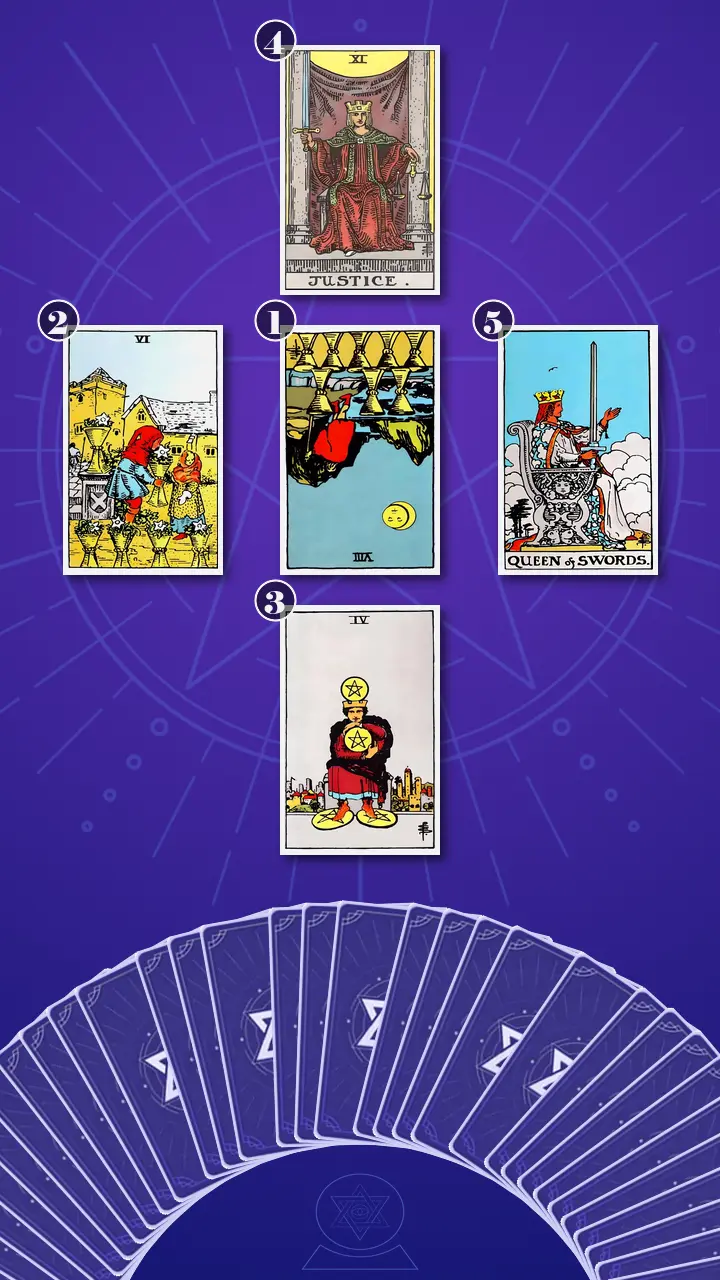
I arranged the cards like a compass crossing a timeline. I would begin on the left with the past influence, move to the centre of the current situation, descend to the hidden root, rise to the guidance above it, and finish on the right with an integrated response. The horizontal line would show movement from history to choice; the vertical line would recalibrate what guided that movement.
The Curated Archive and the Path Left Waiting
Position Two: The Six of Cups and the Past Still Voting
I first turned over the card representing how shared memories and the meaning assigned to the relationship's history continued to influence Maya's present judgement. It was the Six of Cups, upright.
I pointed to the flower-filled cup offered between the two figures. Upright, the Six of Cups carries a balanced capacity for tenderness, remembrance, and gratitude. In Maya's decision-making, however, that energy had acquired excessive authority. A memory was no longer simply allowed to feel warm; it was being asked to testify about the condition of the relationship now.
"This is the Google Photos moment," I said. "An old winter photo appears, or a shared Spotify playlist brings back the version of you who first built this life together. Tenderness reaches your throat before interpretation begins. Then the thought follows: If this was real, maybe I have to keep trying."
I told her the flowers resembled a curated digital archive: genuine, beautiful, carefully preserved, and unable to report what happened after the most recent request for change. I knew the comparison would land with a product designer, so I made it more concrete. "You would not use a product's best launch-day reviews as current retention data. The praise can be completely real and still belong to a different question."
Maya gave one short laugh, but there was no amusement in it. Her fingers tightened around her coffee cup before loosening again. "That is too accurate," she said. "A little brutal, honestly."
"Then let's make it less brutal and more precise," I replied. "Nothing here says the memories are false. A relationship can have been real without remaining right in its current form. A warm memory can prove that love existed; it cannot prove that repair is happening now."
I asked what conclusion she had drawn the last time an old photograph appeared. She looked toward the rain stippling the window and said, "I thought, We cannot be done if we once looked that happy." I heard her catch the unsupported leap as she spoke it: real then had quietly become working now.
Position One: The Eight of Cups Reversed at the Unfinished Note
I moved to the centre and turned over the card representing the presenting problem: repeatedly remaining in the relationship and postponing a decision despite recognising the lack of movement. The Eight of Cups appeared in reversed position.
I showed Maya the visible gap in the stacked cups and the cloaked figure oriented toward a moonlit path. In reversal, the emotional energy was blocked. She could see what was missing and could even prepare to approach it, but complete certainty had become the imagined entry requirement. Every approach to honest reassessment ended in an emotional U-turn.
"At 11:40 p.m., you open the draft, feel the drop in your stomach, and type what is not working," I said. "Then you return to old messages until the need for a direct conversation feels less urgent. That brings relief for the night, but it also prevents you from receiving the response and behavioural evidence that might actually create clarity."
I thought of all the cold cups of coffee I had watched accumulate beside conversations people intended to have "when the timing was better." After twenty years of listening, I have learned that postponement can look passive while quietly shaping the outcome. Waiting for certainty can become a way of avoiding the evidence that only a clear conversation could provide.
"Think about the last time you prepared to raise the recurring issue," I said. "What did you do in the next ten minutes, and what did you believe waiting would protect?"
Maya's eyes lowered to the card. Her thumbnail traced the cup's edge, paused, and pressed against the table. "I found photos from Lisbon," she said. "I told myself I should not start a serious conversation while I was emotional. Really, I wanted my chest to stop feeling like something heavy was sitting on it."
I nodded. "That delay protected you from one difficult night. It did not tell you whether the relationship could repair. Those are different functions, and separating them matters."
Position Three: The Four of Pentacles and the Cost of Holding Still
I descended to the card representing the hidden foundation beneath the visible problem: the fear that letting go could mean losing security, belonging, or proof that the past mattered. I turned over the Four of Pentacles, upright.
The figure clutched one pentacle against the chest, balanced another on the crown, and pinned two beneath the feet. Here, upright Earth had become excessive preservation. The relationship was not only a bond with another person; it contained mutual friends, familiar grocery runs, neighbourhood routes, shared shows, private jokes, and several versions of Maya's adult identity. Holding the structure in place brought short-term safety while immobilising the person trying to protect it.
I asked Maya to recall the last time the fear had become physical. She described searching "staying in a relationship because of history" on a crowded King Street streetcar, then locking her phone when the results felt too personal. Wet coats had filled the aisle, the brakes had ground against the rails, and her stomach had dropped as she thought, If I let this change, what else do I lose with it?
"This card is not accusing you of being unable to let go," I said. "It is showing me a whole-body attempt to preserve belonging. Familiar disappointment may feel easier to organise around than grief whose shape you cannot predict."
I used one of my most practical lenses, Emotional Clutter Sorting. I asked us to separate possible incompatibility from the static created by chores, fatigue, deadlines, housing pressure, and bad timing. An argument beside a droning dishwasher at 10 p.m. does not, by itself, define a relationship. But if the same need is raised when both people are rested, in a scheduled conversation, and still produces vague reassurance without shared follow-through, that repeated mechanism becomes meaningful evidence.
"So I do not have to turn every bad week into proof that we are wrong for each other," Maya said.
"Exactly. And you do not have to turn every affectionate weekend into proof that repair is underway," I replied. "We are sorting the clutter so neither exhaustion nor nostalgia gets to impersonate the whole truth."
Her breath paused. Her gaze moved away from the card as if replaying several kitchen conversations, then her shoulders dropped by a fraction. "I think I have been protecting an entire life," she said quietly, "not just the relationship."
When Justice Put the Present Back on the Scales
Position Four: Justice and the Evidence That Exists Now
The room grew quieter as I reached the card representing the available guidance: assessing the relationship through present evidence, reciprocity, accountability, and personal values. I turned over Justice, upright.
The scales were level in one hand; the double-edged sword stood vertical in the other. This was balanced Air, the energy the earlier cards had been missing. Justice did not ask Maya to become colder, dismiss the past, or make an immediate decision. It asked her to conduct a fair present-tense relationship assessment in which history remained valid context without receiving the deciding vote.
I placed three headings on a blank page: reciprocity, repair, and room to grow. I defined reciprocity as both people participating rather than one person repeatedly initiating, interpreting, and carrying the emotional work. I defined repair as an observable change that continues after the temporary calm, not only an apology or affectionate reset. I defined room to grow as the ability to name a need without shrinking it to protect the relationship from discomfort.
Then I brought in Daily Friction Deconstruction, my way of stripping away dramatic accusations until I can see the ordinary mechanics underneath. Instead of asking, "Do we love each other enough?" I asked: What was requested? What response followed? Who initiated the next conversation? What changed a month later? Who was responsible for keeping the repair alive?
This did not reduce love to a spreadsheet. It prevented large, painful claims such as "we always fail" or "we have survived everything" from hiding the daily pattern. Justice's scales could hold tenderness on one side while also admitting missed follow-ups, mutual effort, changed behaviour, and the cost of continued delay onto the other.
Until then, Maya had been treating each warm photograph as sentimental credit against each unresolved month. She was not truly weighing the relationship; she was trying to make old evidence pay the current bill while waiting for total certainty before collecting anything new.
Shared history is not a debt you must repay; weigh the relationship by what is reciprocal now, as Justice's scales measure present evidence rather than sentimental credit.
I let the sentence remain between us without softening it.
Maya's breath stopped first. Her index finger hovered above the blank page, and her pupils widened as though the light had changed. Then her brow pulled tight and her jaw shifted forward. "But doesn't that mean I've been wrong all this time?" she asked, the words suddenly sharper than anything she had said before. I did not rush past the protest. "No," I said. "It means postponement protected something important until you were ready to examine its cost. Protection is not a moral failure. It is simply no longer the only tool available to you." Her gaze lost focus for several seconds while, I suspected, she replayed the last unfinished conversation. Then air left her chest in a long, uneven stream. Her hand opened flat on the table; her shoulders lowered; her eyes shone without spilling over. The release brought a brief, almost dizzy blankness, the look that can appear when a familiar burden lifts and leaves responsibility in its place. "Oh," she said. "Then I have to look at what is actually happening."
"Now, using this new perspective, think back to last week," I said. "Was there a moment when this insight could have changed how the situation felt?"
She remembered asking to revisit an unresolved disagreement. Her partner had said, "Later this week," and Maya had organised an anniversary dinner instead of asking when "later" meant. "I still would have felt sad," she said, "but I might not have treated the dinner as the answer."
I heard the reading's central movement in that distinction. Maya was moving from nostalgic ambivalence and repeated postponement toward present-focused discernment, grounded clarity, and self-trust. She did not yet have certainty, but she had stopped confusing certainty with permission to observe.
Position Five: The Queen of Swords Opens Her Hand
I turned over the final card, representing the capacity Maya could integrate through conscious choice: expressing a clear boundary or decision without denying the relationship's emotional significance. It was the Queen of Swords, upright.
I showed Maya the Queen's upright sword and her open left hand. The sword represented precise language and standards; the open hand represented willingness to receive an honest response. In balance, this Air energy was neither harsh nor detached. It allowed Maya to speak plainly, listen without auto-correcting the answer in her head, and decide what that answer meant for her.
"This is you entering one direct conversation with written criteria," I said. "You name one recurring pattern, ask what concrete participation your partner can offer, and listen without converting vagueness into a future promise. Openness does not require self-abandonment. Directness is not cruelty."
I asked her for one sentence she could actually say. She looked at the Queen's open hand, swallowed, and tried: "The pattern I am noticing is that we agree to return to this, but I initiate every follow-up. I need us to choose one concrete change and share responsibility for it. If that does not happen, I will take space to decide what I want."
Her voice trembled on the final line, but she did not retract it. A small crease returned between her brows while the rest of her face softened. "That sounds terrifying," she said. "But it also sounds like me."
"That is the Queen of Swords in context," I said. "You can hear the answer without rewriting it for them. Clarity does not require you to erase tenderness; it asks you to stop making tenderness answer every question."
I also noted what the Five-Card Cross did not contain: there was no Fire card pushing Maya toward a dramatic exit or instant transformation. The spread moved from obstructed Water, through fixed Earth, into clarifying Air. Her next step was not a cinematic decision. It was one deliberate act that could produce honest information.
The Present-Tense Relationship Audit
I gathered the cards into one coherent story. The Six of Cups showed why the past felt so persuasive. The reversed Eight of Cups showed how Maya approached the path, then circled back before new evidence could emerge. The Four of Pentacles revealed why: preserving the relationship's shape also preserved belonging, identity, and immediate protection from grief. Justice replaced gripping with weighing, and the Queen of Swords turned that fair assessment into language Maya could use.
The central image was simple: Maya had been steering through the rear-view mirror. The mirror contained real places and real love, but it could not show whether the road beneath her was still moving. Her cognitive blind spot was not nostalgia alone. It was treating delay as neutral. Each postponement prevented her from gathering present evidence, then added more time to the investment she already felt obliged to justify.
The shift was not from love to detachment, or from staying to leaving. It was from using shared history as evidence that she must stay to evaluating the relationship against reciprocity, repair, and room to grow. She would remain the person deciding what those findings meant. The cards could organise the question; they could not live the answer for her.
I gave her two actionable next steps, deliberately small enough to begin without forcing an outcome.
- The Seven-Minute Justice ReviewOn one evening this week, Maya would open a private phone note and write three headings: reciprocity, repair, and room to grow. She would set a seven-minute timer and place one observable example from the last 30 days beneath each heading, including positive present-day evidence where it existed. She would record behaviour, not explain or defend it, and she would make no relationship decision during the exercise.If seven minutes felt too heavy, she could write one sentence beneath one heading and stop. The note could remain private; completing it did not obligate her to take any further action.
- The 24-Hour Micro-Boundary ResetWithin the next 24 hours, Maya would establish one time boundary she controlled: no processing the recurring issue in bed or after 10 p.m. Instead, she would send a request for one 20-minute, device-free conversation in a neutral place that week. Before it, she would prepare three lines: "The pattern I am noticing is... What I need to see is... What I will do if the pattern continues is..." The final line would name only an action she could take herself.The minimum version was sending the scheduling request, not resolving the relationship. She could read directly from the note, pause the conversation, or leave if the exchange became coercive, contemptuous, or unsafe.
I explained why the micro-boundary mattered. By removing late-night fatigue, a buzzing phone, and the pressure to solve everything at once, Maya could deconstruct the daily friction around the conversation. Whatever remained would be cleaner information about participation, accountability, and repair.
A Week Later: The Question Lost Its Authority
A week later, Maya messaged me: she had completed the note and scheduled the conversation. She slept through the night. Her first thought at sunrise was still, "What if I'm wrong?" She smiled, then got up. It was a question now, not a command.
I did not read that message as proof that everything had been solved. I read it as the first grounded evidence of her Journey to Clarity: she had respected the history, looked at the present, and taken one action without demanding that uncertainty disappear first.
I never considered the power in that room to belong to Justice, the Queen of Swords, or me. The cards gave Maya an objective surface on which to sort memory from evidence. She supplied the honesty, the boundary, and the next step. Whatever she ultimately chose would be hers.
When your chest tightens at the thought of changing course, I hope you remember Maya's scales. You may be protecting both a relationship that shaped you and the hope that holding on a little longer can still secure lasting belonging. Noticing both does not erase the love; it simply returns your hands to the wheel.
If your history could remain meaningful without taking the deciding vote, what present-tense truth would you place on Justice's other scale next?
This story is adapted from psychological research, written so that those in a similar struggle can see their own pattern in it — and find their next step clearly.These insights are not a substitute for professional psychological, medical, legal, or financial advice.
Learn more about our Journey to Clarity.
How did this insight land for you?
🫂 This Resonates Deeply
🌀 Living This Story
✨ Now I See Clearly
🌱 Seeing New Possibilities
🧰 Useful Framework
🔮 The Confirmation I Needed
💪 Feeling Empowered
🚀 Ready for My Next Step
Author Profile
 AI
AI“For twenty years, I’ve listened to stories unfold over the warm aroma of coffee. I don’t believe life’s complexities always require grand theories to be solved; often, we just need a safe place to tidy up our reality. I don’t offer high-minded preaching—just grounded, heartfelt insights to help you regain your sense of control amidst the clutter of daily life.”
In this Love Tarot Reading :
Core Expertise
- Daily Friction Deconstruction: Stripping away dramatic accusations to locate the mundane, mechanical breakdowns in your shared daily routine.
- Emotional Clutter Sorting: Separating actual relationship incompatibility from the stress of household chores, fatigue, or external life pressure.
Service Features
- The 24-Hour Micro-Boundary Reset: A highly pragmatic exercise to establish one non-negotiable physical or time boundary in your shared space to instantly reduce friction.
Also specializes in :
Explore Related Patterns:
Conflict AvoidanceMaya begins writing what needs to change, feels the drop in her body, and retreats into old messages. When her partner offers the vague timing of “later this week,” she organises an anniversary dinner instead of asking when the postponed conversation will actually happen. These substitutions protect you from the immediate discomfort of conflict, but they also block the information the conflict could produce. The defence backfires because temporary calm is mistaken for resolution, while the need, the unanswered question, and the responsibility for restarting the conversation all remain in place.
Nostalgia LoopAt 11:40 p.m., Maya closes her unfinished note and opens a holiday album; before another difficult conversation, she reaches for photos from Lisbon. Each return to the archive converts present discomfort into remembered tenderness, making the need for a direct conversation feel less urgent for the night. When you repeatedly use warm memories to regulate distress about what is happening now, nostalgia becomes more than remembrance. It forms a self-reinforcing loop in which the past provides relief, relief enables postponement, and postponement leaves the present unresolved enough to trigger another return to the past.
Certainty SeekingEach time Maya approaches honest reassessment, complete certainty appears as the imagined entry requirement. Her question, “What if I’m wrong?” functions as a command to stop until she completes the note and schedules the conversation; only then does it become a question she can carry without obeying. Certainty seeking traps you in a closed evidence loop. You wait to feel sure before asking for clarity, but the clarity depends on observing how the other person responds to a direct request. The pattern loses authority when uncertainty is allowed to remain present while you take one measured action that can generate new information.
Loss AversionOn a crowded King Street streetcar, Maya asks herself what else she would lose if the relationship changed. The possible loss extends beyond her partner to mutual friends, familiar routes, shared routines, private jokes, and versions of her adult identity built inside the relationship. When you compare a familiar disappointment with a change whose consequences cannot yet be mapped, potential losses can carry more psychological weight than possible gains. Staying then protects continuity and belonging in the short term, even when the current structure is no longer supplying clear evidence of reciprocity or repair.
Sunk Cost FallacyEach postponed conversation adds another week to the history Maya already feels responsible for honouring. She then treats the growing investment as further evidence that she should keep trying, while old photographs become sentimental credit against unresolved months. This is how sunk cost reasoning can keep you attached to a stalemate. Time and love already invested remain meaningful, but they cannot be recovered by investing more, and they cannot establish whether repair is happening now. The pattern loosens when past value is treated as context rather than as a debt that present choices must repay.
Boundary DiscernmentMaya names the recurring lack of follow-up, asks for one concrete change with shared responsibility, and states that she will take space if the pattern continues. Her boundary describes what she will do rather than prescribing or rewriting her partner’s response. Boundary discernment allows you to preserve the meaning of a shared history without turning that meaning into compulsory access to your future. You can remain open to an honest response while keeping responsibility for your standards, time, and next action on your side of the relationship.
Reality TestingMaya’s seven-minute review separates reciprocity, repair, and room to grow, then asks for observable examples from the previous 30 days. She also examines what was requested, what response followed, who restarted the conversation, and whether anything remained different a month later. This process helps you test an emotionally compelling interpretation against current behaviour without dismissing either tenderness or disappointment. Reality testing restores proportion: memories can verify that love existed, while repeated follow-through, shared effort, and changed behaviour provide the evidence needed to assess how the relationship functions now.
Explore Related Struggles:
Certainty-Safety FusionMaya can identify what is missing, draft the conversation, and move close to asking for change, yet she treats complete certainty as the admission price for proceeding. Returning to old messages protects her from the immediate impact of one difficult night, but it also keeps the information she needs beyond reach. When you require certainty before you act, certainty starts functioning as a form of safety rather than a realistic outcome of observation. You remain caught because the conversation feels too consequential to enter without guarantees, while the guarantees you want cannot emerge until you allow present behavior to answer the question.
Evidence DisconnectionAt 11:40 p.m., Maya moves from a draft about what is not working to photographs that make the issue feel less urgent. Later, an anniversary dinner occupies the space where a scheduled follow-up could have been, allowing affection to register as an answer before participation or changed behavior has been observed. You can want evidence and still become separated from the process that produces it. The loop disconnects you from present feedback because every retreat prevents a clear request, an accountable response, and enough time to see whether repair continues after the temporary calm; without those inputs, memory becomes the most available data even though it cannot evaluate the relationship now.
Memory-Loyalty BindMaya closes a note titled "What needs to change" and opens a holiday album instead. The memories are genuine, but each photograph is asked to do more than preserve what mattered; it is made to justify another round of staying, as though ending or changing the relationship would retroactively invalidate the love that existed. You can honor a shared history without turning it into a loyalty test. The bind forms when recognizing present stagnation feels equivalent to betraying the past, leaving you caught between respecting what shaped you and responding honestly to what the relationship is offering now.
Security-Identity FusionMaya lists mutual friends, neighborhood routes, grocery runs, shared shows, private jokes, and several versions of her adult self when she considers what the relationship contains. Her recognition that she has been protecting "an entire life" shows why the decision cannot be experienced as a simple judgment about compatibility. When a relationship becomes the container for your security and identity at the same time, changing it can seem to threaten the continuity of who you are. You are then weighing more than whether the bond is working; you are facing the possibility of rebuilding belonging, routine, and self-definition without using the relationship's current shape as their only anchor.
Sunk Cost ParalysisEach time Maya postpones the conversation, another week is added to the history she already feels compelled to defend. Warm photographs become sentimental credit against unresolved months, and the time accumulated through waiting starts to argue for still more waiting. You become immobilized when past investment is treated as a debt that only continued commitment can repay. The relationship's duration then influences the decision twice, first as proof of what mattered and again as pressure not to let that investment end, even though the only evidence capable of guiding your next choice has to come from the present.
Reciprocity DeficitMaya asks to revisit an unresolved disagreement, receives "later this week," and then organizes an anniversary dinner instead of securing a time. Across the broader pattern, she is the person who initiates, interprets, follows up, and keeps the possibility of repair in motion while shared follow-through remains unclear. You can receive affection and still lack mutual participation in repair. The struggle deepens when warmth keeps the connection emotionally meaningful while responsibility for changing its recurring mechanics stays largely with you, forcing you to choose between carrying the process alone and discovering what remains when you stop compensating for the missing half.
Explore Related Emotions:
Anticipatory GriefOn the crowded streetcar, Maya locks her phone after asking what else she would lose if the relationship changed. Her mind moves immediately from the bond itself to mutual friends, neighbourhood routes, daily rituals, belonging, and versions of herself that developed inside the relationship. The possible future therefore reaches her as a collection of absences before any decision has been made. Anticipatory Grief is the sorrow of emotionally approaching those losses in advance, when you cannot yet know their final shape but already feel how much of your familiar life may need to be reorganised.
Belonging AmbivalenceThe relationship contains Maya's mutual friends, grocery runs, neighbourhood routes, shared shows, private jokes, and several versions of her adult identity. Examining the bond therefore feels larger than evaluating one recurring disagreement; it places an entire familiar world beside the present stalemate. You may feel pulled toward preserving that world while also wanting room to recognise what is no longer moving. Belonging Ambivalence holds both attachments without forcing either one to become the whole answer, allowing history to remain meaningful while your present needs regain a place in the decision.
Certainty HungerMaya repeatedly prepares to reassess the relationship, then waits for a level of certainty that would make the conversation feel fully justified. Because the conversation is also the source of the evidence she needs, waiting leaves her with neither certainty nor new information. You can begin to experience uncertainty as a prohibition rather than an ordinary part of choosing. Certainty Hunger is the urgent wish for proof before exposure, permission before observation, and a guaranteed conclusion before action. Its grip becomes visible when waiting for certainty repeatedly prevents you from gathering the facts that could support clearer judgement.
Evidence AnxietyMaya can defend a product decision with evidence, yet on Sunday night she wonders whether asking for evidence of relationship repair is too clinical for love. The unfinished note shows how quickly observation becomes emotionally loaded when the findings could challenge the relationship's meaning. Facts are not frightening because you lack the ability to understand them; they are frightening because they may alter what you can continue believing. Evidence Anxiety describes that tightening around present-tense information, when you soften requests, translate vagueness into hope, or delay follow-up to avoid the emotional consequences of seeing the pattern more clearly.
Guarded LongingMaya writes what needs to change because she still wants reciprocity and repair, then turns to old messages before asking whether her partner can participate. Her longing remains active, but direct evidence could either support that hope or establish its limits. You may protect what you want by keeping it slightly untested, preserving possibility at the cost of present knowledge. Guarded Longing captures the wish for closeness and shared effort held behind postponement, where the heart remains invested while the part of you seeking protection keeps the decisive conversation at a distance.
Investment AmbivalenceMaya describes two truths pulling across her ribs: the history is real, and the stalemate is real. The relationship also contains years of routines, friendships, places, and adult selves, so reassessing it seems to place far more than the current partnership under review. You may feel unable to move cleanly in either direction because both staying and changing appear to threaten something valuable. Investment Ambivalence is the divided inner weather of caring about what has been built while recognising that accumulated meaning cannot, by itself, demonstrate present reciprocity or repair.
Nostalgia AcheMaya closes the note about what needs to change and opens a holiday album instead. An old winter photograph or shared playlist reaches her throat before analysis begins, preserving direct contact with a version of the relationship that felt warm and coherent. When your body responds to a memory this quickly, the past can remain emotionally present even when it cannot describe the relationship now. Nostalgia Ache names the tenderness of knowing that something was real alongside the pain of discovering that its reality cannot provide current evidence of repair.
Nostalgia Loop AnxietyAt 11:40 p.m., Maya writes two sentences about what needs to change, closes the note, and opens a holiday album. When another difficult conversation approaches, Lisbon photographs or old messages offer enough warmth to lower the pressure for that night. The archive then becomes part of a repeating emotional circuit. You feel briefly steadied by evidence that love existed, but the current question remains unanswered and returns with greater urgency. Nostalgia Loop Anxiety names the restless suspension created when memories repeatedly soften the immediate discomfort while preventing new information from entering the relationship.
Shocked ClarityMaya's pupils widen and her hand goes still when she recognises that postponement has not been neutral. The realisation reorganises familiar events: the anniversary dinner was affectionate, but it did not answer the unresolved request to talk. Seeing that difference can momentarily leave you without the explanation that once kept everything organised. Shocked Clarity is the abrupt internal reset that follows, when past love, current behaviour, and hoped-for repair become separate pieces of information and you recover the ability to examine each one on its own terms.
Sunk Cost GriefMaya treats each warm photograph as sentimental credit against another unresolved month. Every postponed conversation then adds more time to the history she already feels responsible for defending, making the accumulated years seem like an obligation to continue. You can mourn the possibility that a meaningful investment may not produce the present relationship you hoped it would. Sunk Cost Grief names the pain beneath that accounting: not a belief that the past was worthless, but the recognition that its value cannot guarantee repair now or require you to keep adding time simply to validate what has already been given.
White-Knuckle SecurityMaya's fingers tighten around her cup, her thumbnail presses against the table, and changing the relationship feels like a heavy weight on her chest. She is holding mutual friends, familiar routes, private jokes, and a stable picture of her adult life alongside the bond itself. When so many forms of continuity appear attached to one relationship, gripping its existing shape can feel like the only way to keep the rest of life organised. White-Knuckle Security names the strained steadiness of holding on for protection even as your body registers how much force that protection now requires.
Bittersweet ReleaseAfter Maya hears that shared history is not a debt, air leaves her chest in a long, uneven stream. Her hand opens on the table and her shoulders lower, but the space created by that release immediately contains a new responsibility: she has to look at what is actually happening. You can feel lighter without feeling finished. Bittersweet Release captures the moment when an old obligation loosens while choice becomes more visible, leaving tenderness for what mattered alongside the sober recognition that the present still requires your attention.
Cautious Self-TrustMaya's voice trembles as she names the recurring pattern, asks for shared responsibility, and states what she will do if nothing changes. She does not retract the final line, and the words feel recognisably like her even while they remain frightening. A week later, the thought that she might be wrong still appears, but it no longer dictates her behaviour. Cautious Self-Trust describes that emerging inner footing: you do not need uncertainty to disappear before you can respect your observations, speak in your own voice, and take one action that remains yours to choose.
Explore Related Contexts:
Accountability Evasion CycleMaya asks to revisit an unresolved disagreement and receives "later this week," but no time is set and she remains responsible for reopening the subject. The relationship repeatedly produces verbal agreement without assigning ownership, a deadline, or a concrete change that can be observed afterward. You cannot evaluate repair accurately when reassurance substitutes for participation and every missed follow-up can be moved into another undefined future. Accountability Evasion Cycle identifies that recurring external mechanism, helping you distinguish a partner's willingness to calm the immediate moment from their willingness to share responsibility for what happens next.
Relationship StagnationMaya repeatedly drafts what needs to change, but the conversation moves another week away; when her partner says "later this week," she remains the person responsible for initiating the follow-up. The issue is therefore larger than one badly timed discussion: repair has no shared deadline, owner, or observable continuation. You can remain highly active inside this arrangement while the relationship itself stays stationary, because planning, remembering, and arranging affectionate moments create movement around the unresolved issue rather than through it. Naming Relationship Stagnation separates the continued existence of the bond from evidence that its central pattern is actually changing.
Sunk Cost Exit DilemmaMaya is not evaluating only a partner; the relationship contains mutual friends, grocery routines, neighbourhood routes, shared entertainment, private jokes, and several versions of her adult identity. Every postponed conversation adds more time to a structure she already feels pressure to justify, making change appear to threaten an entire established life. You may therefore be weighing current compatibility against the perceived cost of invalidating years of investment and reorganising your social world. The Sunk Cost Exit Dilemma becomes visible when preserving what the relationship has contained starts carrying more authority than examining what the relationship currently provides; recognising that structure lets history remain meaningful without making further investment automatic.
Nostalgia Timing TrapMaya closes her note about what needs to change after two sentences and immediately opens a holiday album; before another difficult conversation, she searches for photographs from Lisbon. Old images, playlists, and anniversary rituals become most persuasive at the exact point when present behaviour is about to be examined. You are encountering more than ordinary remembrance when preserved moments repeatedly interrupt the collection of current evidence. The Nostalgia Timing Trap allows proof that the relationship mattered then to answer whether repair is happening now; separating those questions protects the value of the memories while returning the present relationship to observable standards.
Measured Reciprocity TrialMaya places recent examples under reciprocity, repair, and room to grow, then schedules a focused conversation rather than making an immediate stay-or-leave decision. Those criteria move the assessment away from broad declarations of love and toward who initiates, what changes, and whether the change continues. You are entering a Measured Reciprocity Trial when you create a fair opportunity for both people to participate and allow their actual contributions to become visible. The trial does not predetermine an outcome; it gives you a bounded way to learn whether repair can become shared work instead of remaining a promise that you maintain alone.
Emotional Labor ImbalanceMaya says that she initiates every follow-up, and after her partner postpones the disagreement she organises an anniversary dinner instead of requiring a definite return time. She is identifying the problem, scheduling its reconsideration, interpreting vague replies, preserving connection, and keeping the possibility of repair alive. You can mistake that volume of relational work for evidence that two people are still building together, even when the labour itself is unevenly distributed. Emotional Labor Imbalance names the external arrangement in which one partner becomes the repair manager; seeing the workload clearly allows you to ask whether responsibility becomes shared when you stop supplying the missing structure.