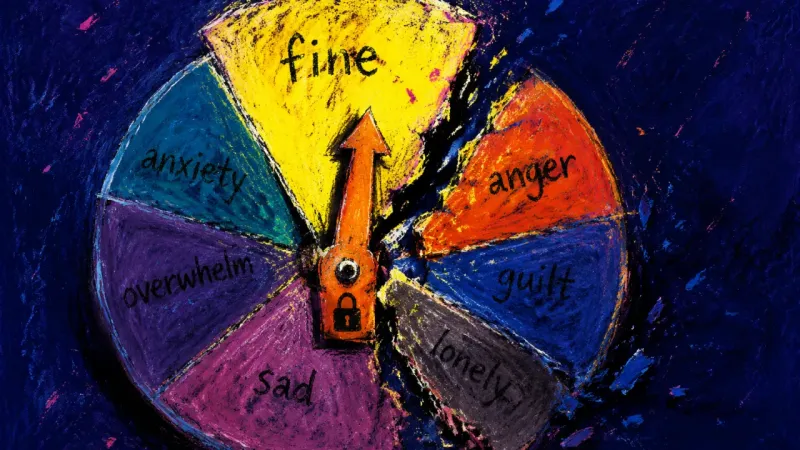
The 9:07 A.M. “I’m Fine” Reflex
At twenty-seven, Casey worked in communications for a Toronto wellness organization and could write a flawless caption about emotional honesty. But when a coworker noticed their sudden silence, their jaw locked before they could produce the emotionally intelligent answer their job seemed to require.
Casey described the moment to me during our video consultation. It had happened at 9:07 on a Monday morning, inside a glass meeting room downtown. They were presenting a campaign about authentic living when the deck froze. The projector fan hummed over the silence, burnt coffee lingered in the room, and the edge of the laptop felt cold beneath their fingers.
“You okay?” a coworker asked.
Casey smiled. “Totally. Just a tech moment.”
The slide had stopped moving, but Casey knew their silence had begun before the screen froze. Their breath remained high in their chest while an unspoken sentence pressed against the polished reply: I’m bored, disappointed, and scared that admitting it would make me a fraud.
That night, at 10:38, they opened a meditation app in their apartment near Bloor. Then a saved Substack about finding purpose. Then a Notion gratitude template. The radiator clicked, tyres hissed over wet pavement below, and the blue light from the phone stung their eyes. They closed each tab without beginning.
“I keep doing the work,” Casey told me. “So why do I still feel nothing?”
I watched one of their hands rise toward their jaw and stop there. The longing beneath the question felt like a person standing behind a locked glass door, visible enough to be noticed but unable to make their voice carry through.
“I can explain why this is happening,” they added, “but I can’t tell you what I actually feel. I keep calling it a season of pause because saying I feel stuck sounds too honest.”
I told Casey that I was not interested in tearing away a coping strategy that had once helped them function. Nor would I use tarot to declare what they secretly felt. Our purpose was more practical: to observe the sequence between the mask slipping and the polished answer arriving, then see whether the cards could help them name what their own body already knew.
“A slipping mask is not a failed self,” I said. “It is an edited feeling asking for one unfiltered line. Let’s make a map of the space between ‘I’m fine’ and what you have not yet had permission to say.”

Choosing a Map for the Quiet Room
I invited Casey to place both feet on the floor and take one unforced breath while holding the question, What am I hiding behind “I’m fine” when my mask slips? I shuffled slowly, using the repetition as a transition from explaining the problem to observing it.
This was not a mystical test and Casey did not need to empty their mind. The pause simply gave us a shared point of focus.
I chose The Shadow Spread · Context Edition, a four-card Shadow Spread arranged in a two-by-two grid. For readers wondering how tarot works in a consultation like this, I treat a spread as a structured set of questions rather than a machine that reveals an unquestionable truth. Card meanings in context can illuminate patterns, but the querent decides what fits, what does not, and what action follows.
This spread suited Casey’s question because it moved through four distinct layers: the visible “I’m fine” performance, the feeling hidden behind it, the defense that kept the feeling out of awareness, and an integrating response. It was compact enough to keep us with the specific problem of spiritual bypassing instead of turning the reading into a sweeping judgment about Casey’s identity or future.
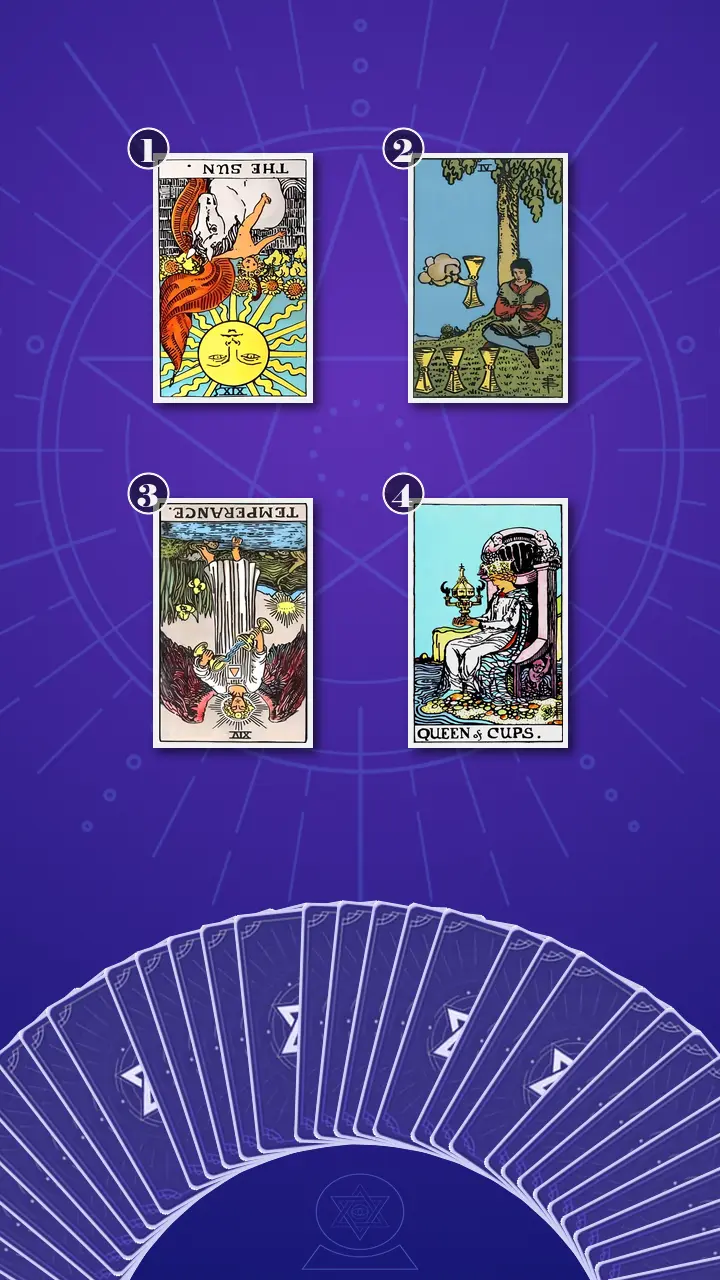
I showed Casey the empty grid. The upper-left position would reveal the public mask and where its strain had become visible. The upper-right would hold the hidden longing or dissatisfaction. The lower-left would show the positive-reframing habit that interrupted the message. The final position would offer a bridge into contained emotional honesty, not a prediction of what Casey had to do next.
Visually, the spread resembled a window: bright public light across the top, a quieter room beneath it, and one opening through which feeling might finally move into an ordinary choice.
Reading the Distance Between Brightness and Joy
Position One: The Radiance That Became a Role
“The card now opening,” I told Casey, “is the one that represents the visible ‘I’m fine’ performance and the point where the strain in that performance can be observed.”
I turned over The Sun, in reversed position.
The familiar image was still bright: a child on a white horse, an oversized sun, a red banner lifted into open air. Yet reversed, the brightness did not disappear. It became harder to inhabit. I read this as a deficiency of privately felt vitality paired with an excess of visible radiance. Casey had not become inauthentic; they had become highly skilled at presenting a state their inner life could no longer consistently supply.
I brought us back to the glass meeting room. Casey had presented a wellness campaign, sounded composed, and reassured a coworker automatically after their expression went flat. Later, the upbeat copy felt like a description of wellbeing they could perform but could not currently feel. The raised banner looked to me like the polished post announcing resolution more loudly than the private experience could support.
“It’s like turning up the brightness on a phone whose battery is nearly empty,” I said. “The display still looks vivid. The underlying capacity keeps dropping.”
I asked Casey what exact phrase appeared in their mind before they could answer honestly.
“Usually something about trusting the timing,” they said. “Or being grateful for the lesson. I know how this should sound, but I don’t know how to say what’s true.”
Casey gave a short laugh, but bitterness caught in it. Their fingers froze against the mug beside their laptop; their eyes moved away from the card as though replaying the meeting; then their shoulders lowered by a fraction.
“That is painfully accurate,” they said. “Almost a little brutal.”
“Then let’s be precise about what is brutal,” I replied. “The card is not accusing you of being fake. It is showing the cost of having your competence mistaken for endless emotional capacity. Your smile has been doing two jobs: communicating with other people and concealing information from you.”
Position Two: The Cup No Routine Could Reach
“The card now opening is the one that represents the feeling, longing, or dissatisfaction hidden behind ‘I’m fine,’” I said. “This is the emotional truth that has not yet entered your conscious description of the problem.”
I turned over the Four of Cups, upright.
The figure sat with crossed arms and a lowered gaze. Three cups stood within reach, while a fourth was offered from a cloud and remained unacknowledged. The card carried the stillness of emotional blockage: not an absence of resources, but a failure of familiar resources to meet a need that had not been named.
I described what I saw in Casey’s life. They had supportive contacts, a meditation subscription, a gratitude template, and enough saved prompts to build a second curriculum. Yet at 10:38 p.m., none of those familiar cups touched the hollow place behind their sternum. The hidden truth was not a dramatic secret. It was the quieter admission that their current work, routines, and public language might no longer fit what they wanted.
“Gratitude can be true, and the unmet need can still be true,” I said.
Casey’s lips pressed together. Their hand tightened around the mug, then loosened. I waited until they looked back at the fourth cup.
“I have support,” they said. “My job is stable. I know Toronto is expensive, so ‘just change your life’ isn’t exactly useful. But I don’t want to spend every day making emotional language more marketable. I think I want fewer public-facing responsibilities. Maybe I want work where I don’t have to be the calm person all the time.”
I heard both relief and grief in the admission. Naming a desire did not solve the cost of living, create a new job, or oblige Casey to resign. It simply transformed the flatness from evidence of failure into information about fit.
“The fourth cup does not demand that you take it,” I said. “It asks you to look at it. What do you actually want that the existing tools cannot provide?”
Casey looked down for several seconds. “Room to be undecided without turning the uncertainty into content,” they said.
Position Three: When “Growth” Became Emotional Autocorrect
“The card now opening is the one that represents the specific defense keeping the hidden feeling out of reach,” I said. “In your case, it is the moment when difficult emotion becomes a positive lesson before its practical message can be heard.”
I turned over Temperance, in reversed position.
Upright, Temperance blends water between two cups with patience and proportion. Reversed, the flow was interrupted. One foot remained in water and one on land, but emotional information was not reaching an ordinary request or action. The card showed imbalance in the order of operations: interpretation arrived too early, while feeling and need remained blocked.
I asked Casey about a recent walk along Queen Street West after a friend told them, “You seem checked out lately.” Streetcar brakes had screeched beside them, cold air had caught in their throat, and their shoulders had risen toward their ears. Before replying, they had opened Notion and typed three gratitude statements.
“What I posted was, ‘This is teaching me to release expectations,’” Casey said.
“And what did you need to say before that lesson?” I asked.
Their answer came more quietly. “That hurt, and I need them to check in without making me feel observed.”
Temperance reversed looked like an autocorrect setting that replaced angry, lonely, and disappointed with grateful for the lesson before the message could be sent. The adjustment brought brief relief because it restored Casey’s familiar self-image. It also removed the boundary from the conversation.
“When every feeling becomes a lesson too quickly, the need never gets a speaking part,” I said.
This was where I named spiritual bypassing carefully. Meditation, gratitude, and spiritual meaning were not the problem. The blockage came from using them before the original emotional information had been read. Emotional regulation made room for a feeling; emotional avoidance made the feeling disappear from the record.
Casey’s chest rose and held. Their gaze became unfocused, then settled on the two cups. A slow breath left them.
“I thought I was integrating,” they said. “But I’ve been interrupting.”
The distinction reminded me of archaeological layers disturbed by a later construction trench. On a dig, a beautiful upper layer can still obscure the earlier structure if it is treated as the whole site. Meaning may be valuable, but it cannot tell us what lies beneath when it is poured over the evidence before we document it.
“Notice the order,” I said. “The cards are not asking you to give up hope. They are asking hope to wait until the feeling has finished one sentence.”
When the Queen Faced the Closed Cup
Position Four: A Private Draft, Not a Public Confession
The room seemed to become quieter before I turned the final card. Even through the call, I could hear the radiator click in Casey’s apartment. The sound echoed the late-night scene they had described, but this time the meditation app was closed.
“The card now opening is the one that represents a compassionate, concrete way to acknowledge what the mask conceals,” I said. “It shows how you might explore fulfillment through honest self-expression rather than performance.”
I turned over the Queen of Cups, upright.
The Queen sat at the water’s edge, studying an ornate closed cup with complete attention. Her emotional energy was in balance: receptive without becoming engulfed, honest without becoming performative, and private without becoming avoidant. The closed cup mattered. It suggested that a feeling could be witnessed carefully while the choice of audience, timing, and depth remained Casey’s.
I connected the image to a specific modern scene. Before revising another polished post, Casey could open a private note and write, “I feel disappointed, and I need room to reconsider my work.” They could read the sentence without improving its tone. Later, if they chose, they might tell one trusted person, “I’m not looking for advice. I just want to be honest that work has felt empty.”
“Honesty does not owe the internet a live broadcast,” I said. “This feeling can be accurate without becoming your identity, your content, or everyone’s emergency.”
Here I used a method I call Cognitive Stratigraphy. I treat a sudden emotional trigger as a surface artifact and excavate downward without assuming that the first interpretation is the foundation. Casey’s coworker noticing their silence was the surface artifact. Beneath it lay the automatic reassurance. Beneath that was shame about feeling dissatisfied. At the deepest visible layer was an older rule: If I need something, people may discover that my calmness was the only reason I deserved their trust.
I asked whether that foundation fit. Casey nodded once.
“Being useful has always felt safer than being uncertain,” they said.
The Queen of Cups did not destroy that old structure. She gave Casey a steadier place from which to examine it. In Ruins Restoration Thinking, I do not treat a fractured identity as proof that nothing valuable remains. I identify which walls still carry weight, which additions no longer serve the building, and what can be rebuilt without pretending the fracture never happened. Casey’s spirituality could remain. Their compassion could remain. The requirement to appear resolved could be removed.
Casey was still caught between two fears: that honest dissatisfaction would become a public crisis, and that silence would preserve a life they no longer fully inhabited. The Queen introduced a third possibility—a small, bounded truth that neither denied the feeling nor surrendered control of it.
Stop treating a slipping mask as proof that you have failed at being well; let the Queen of Cups hold the unedited feeling without judgment, then name one need before choosing a grounded response.
I let the sentence remain between us. Then I gave its order in the simplest language I could.
You do not have to make pain meaningful before it is allowed to be true: feel first, name the need, and choose the meaning later.
Casey’s breath stopped. Their fingers hovered above the keyboard as if the familiar impulse to record, edit, or improve the line had been interrupted. Their pupils widened; then their gaze slipped away from the screen, replaying some private sequence I did not need to enter without invitation. Colour rose into their face. Their jaw tightened once before releasing, and their shoulders descended as though a strap had been cut from a heavy bag.
For a moment, the relief did not look comfortable. Their eyes shone, but their forehead creased. One hand opened slowly from a fist.
“But doesn’t that mean I’ve been doing all of this wrong?” they asked. Anger sharpened the first words, then gave way to a small tremor. “All the gratitude. All the work. What if I’ve just been hiding?”
“No,” I said. “It means a strategy that once protected your sense of worth has become too narrow for your present life. We can respect why you built it without requiring you to live inside it forever.”
Casey exhaled from somewhere deep in the chest. Their expression softened, then briefly emptied—the slight dizziness that can follow when clarity returns responsibility to the person asking the question. They no longer had to prove they were fine, but they would have to decide what one honest response might be.
“Now, using this new perspective,” I asked, “was there a moment last week when this insight might have changed how you felt?”
Casey returned to the message from their friend: “No polished answer. Are you actually okay?” They had typed and deleted four explanations on a crowded Line 1 train before sending a heart reaction.
“I could have waited until I got home,” they said. “Then I could have written, ‘I’m not ready for a full conversation, but I’m disappointed about work and I don’t want to pretend I’m not.’”
That was the breakthrough: not certainty, disclosure, or a dramatic decision, but the first movement from performed wellness and private emotional disconnection toward compassionate self-listening and contained emotional honesty. The Queen of Cups did not hand Casey an answer. She returned the unedited evidence to the person who could choose what to do with it.
I offered one immediate version of the practice. Casey could set a ten-minute maximum and open a private note with four headings: “What happened,” “I feel,” “My body is doing,” and “I might need.” One short line under each would be enough. During the timer, they would not post, send, solve, or spiritualize the experience. If it felt exposing, they could stop after one body cue and one feeling word. Sharing would remain entirely optional.
Restoring the Order of Operations
I gathered the four cards into one story. The Sun reversed showed the visible strain of being trusted as the radiant, composed person. The Four of Cups revealed that the private flatness was not proof of ingratitude; it carried information about work, support, and desire. Temperance reversed showed why that information remained static: a spiritual interpretation repeatedly arrived before the feeling could become a need. The Queen of Cups supplied the missing movement—private attention first, a proportionate truth second, and meaning only after the evidence had been heard.
The cognitive blind spot was the belief that acknowledging a need would automatically require a dramatic confession, a resignation, or a new public identity. It did not. Naming a need was data collection, not a verdict. Casey could remain spiritually engaged while changing the sequence in which feeling, need, meaning, and response were processed.
The transformation was therefore modest but consequential: from asking, “How do I make this feeling sound wiser?” to asking, “What is this feeling accurately reporting, and what small response is mine to choose?”
“Feel first. Name the need. Choose the meaning later,” I repeated. “These are experiments, not commandments. You remain in charge of the audience, timing, depth, and next steps.”
- The Three-Minute “Before the Lesson” Note On one quiet evening at home, open a private phone note titled “Before the lesson.” Set a three-minute timer and complete only two lines: “I feel…” and “I need…” Do not add gratitude, analysis, or a takeaway until the timer ends. If the urge to polish arrives, leave the plain sentence first and put the reassuring version in a separate paragraph. The minimum version is one feeling word in a locked note.
- The Trigger Excavation Exercise After the next difficult interaction, wait ten minutes before opening a meditation app or gratitude tracker. In a pinned note, record five brief items: event, feeling, body cue, need, and possible request. This separates the present trigger from the older rule that needing something makes you unworthy or burdensome. Start with only the event and one body cue if capacity is low. A need is information, not a demand, and no message has to be sent.
- One Boundary-Sized Truth Choose one trusted friend and, from home or during a quiet walk, send: “I’m not looking for advice, but I want to say one accurate thing: I’ve been feeling disappointed about work.” Add a boundary such as, “I only have capacity for a short check-in tonight.” Draft it without sending if disclosure does not feel safe or useful. Honesty remains valid even when the only audience is you.
None of these actions required Casey to abandon meditation, expose themselves online, confront a coworker, or make an immediate career decision. Their purpose was to restore the missing order of operations and let an unmet need become visible enough to inform a reversible choice.

Six Days Later, One Unedited Sentence
Six days later, Casey wrote the two-line note and sent one measured message to their friend. They slept through the night, then woke thinking, What if I’m wrong? The doubt remained, but this time they smiled before reaching for their phone.
Their friend had replied, “Thank you for telling me. No advice. I’m here.” Casey did not resign, solve their career, or become permanently clear. They did spend fifteen minutes reading one job description and noticed that fewer public-facing duties brought a quiet sense of interest rather than panic.
I regarded that as the real proof of our Journey to Clarity. Tarot had not rescued Casey or predicted a better life. It had helped them see the difference between a feeling, the old rule wrapped around it, and the response they were free to choose.
When being known as the calm, grateful one makes your jaw tighten and your breath stop at the first honest question, a crack in the mask can feel like proof that your worth depended on never needing anything. But a slipping mask may simply be an edited feeling asking for one unfiltered line; noticing that line means you are already standing somewhere new.
If you let one feeling remain in the Queen’s closed cup—unedited and safely private—for ten quiet minutes, what small need might become visible before you decide what the feeling means?
This story is adapted from psychological research, written so that those in a similar struggle can see their own pattern in it — and find their next step clearly.These insights are not a substitute for professional psychological, medical, legal, or financial advice.
Learn more about our Journey to Clarity.
How did this insight land for you?
🫂 This Resonates Deeply
🌀 Living This Story
✨ Now I See Clearly
🌱 Seeing New Possibilities
🧰 Useful Framework
🔮 The Confirmation I Needed
💪 Feeling Empowered
🚀 Ready for My Next Step
Author Profile
 AI
AI“Having spent a lifetime at Cambridge and on archaeological digs, I’ve witnessed the rise and fall of countless civilizations. Please know that your current struggles are not a permanent fate, but merely a necessary fracture before rebuilding. I won't lecture you; instead, I invite you to sit with me in the ruins, using a patient, historical perspective to gently dust off the true, enduring value hidden beneath your temporary doubts.”
In this Introspection Tarot Reading :
Core Expertise
- Cognitive Stratigraphy: Treating sudden emotional triggers as 'surface artifacts', systematically digging down to locate their foundational trauma or obsolete belief system.
- Ruins Restoration Thinking: Reframing fragmented identities and chronic mental exhaustion as a necessary phase of profound internal transition.
Service Features
- The Trigger Excavation Exercise: A logical framework to trace a current, disproportionate emotional reaction back to its original 'epoch', separating the past from the present.
Also specializes in :
Explore Related Patterns:
Emotional Self-CensorshipCasey's jaw locks before the meeting-room reassurance appears, and later four possible explanations are deleted before a heart reaction is sent to a friend's direct question. In both scenes, an accurate emotional signal reaches the edge of communication and is then edited into something that asks less of the other person and reveals less of Casey. Self-censorship offers immediate protection from exposure, conflict, and the possibility of being misunderstood. When it becomes automatic, you may preserve the appearance of composure while deleting the very information that could clarify your limits or needs; "I'm fine" then functions less as a lie than as a reflexive gate that closes before you have decided what you actually want to share.
Usefulness-Based Self-WorthCasey's statement that "being useful has always felt safer than being uncertain" connects the polished workplace response to a deeper rule about deserving trust. Remaining calm, articulate, and helpful is not merely a professional skill in the story; it has become evidence Casey uses to establish personal worth and relational safety. When usefulness is carrying that much psychological weight, saying "I need," "I don't know," or "this no longer fits" can feel as though you are withdrawing the very service that makes you acceptable. The mask protects a valued identity while concealing the fear beneath it: that other people may trust your capacity more readily than they can tolerate your uncertainty.
Wellness PerfectionismCasey's presentation about authentic living freezes at the same moment their own expression goes flat, yet the visible response is a smile and the polished reassurance, "Totally. Just a tech moment." The behavior preserves professional continuity by restoring the bright, emotionally capable persona before boredom, disappointment, or fear can become publicly legible. When wellness becomes a standard you must visibly embody, emotional honesty can turn into another performance requirement. You may know the right language for authenticity while treating ordinary uncertainty as evidence that you are failing the identity attached to that language; the slipping mask then reveals not dishonesty, but the strain of trying to appear resolved beyond your current emotional capacity.
Spiritual BypassingAfter a friend says Casey seems checked out, Casey writes three gratitude statements and posts that the experience is teaching them to release expectations before admitting that the comment hurt. The positive interpretation restores a familiar sense of coherence, but it arrives early enough to remove the original feeling and its boundary from the record. Spiritual language becomes a bypass when meaning is used to get around emotional information rather than help metabolize it. You may genuinely value gratitude, meditation, or growth while still using them as an emotional autocorrect; the issue is not the practice itself, but whether it repeatedly replaces disappointment, anger, loneliness, or need before those signals can inform a grounded response.
Secure VulnerabilityCasey's eventual message names disappointment while also stating the limits of the interaction, and the friend responds without advice or pressure. The disclosure is neither a polished performance nor an uncontrolled release; it is one accurate sentence shared with a selected person under conditions Casey can tolerate. Secure vulnerability means you can let yourself be known without surrendering control of the audience, timing, depth, or next step. The story shows that honesty can be bounded and proportionate: your feeling does not need to become content, identity, or crisis before another person is allowed to witness it.
Black-and-White ThinkingCasey moves from "I feel bored and disappointed" to "that would make me a fraud," and from naming one need to imagining resignation, public confession, or an entirely new identity. After the pattern is exposed, the same cognitive jump appears again in the question of whether all previous gratitude and inner work must therefore have been wrong. Black-and-white thinking compresses a spectrum of proportionate options into mutually exclusive verdicts. You can then feel forced to choose between being grateful or dissatisfied, stable or fraudulent, silent or dramatically exposed; because neither extreme feels workable, the smaller truth remains unspoken even though it does not logically require either outcome.
Emotional RegulationCasey's four-part private note records the event, feeling, body cue, and possible need before any post, solution, gratitude statement, or spiritual interpretation is added. The pause changes the order of operations: bodily activation and emotion are first treated as information, and only afterward does Casey decide whether meaning or communication would be useful. Regulation here does not require you to suppress a feeling or disclose it immediately. It gives you enough internal space to notice what is happening, put proportionate language around it, and retain control over the response; the emotion can remain real without becoming either a public emergency or a command for instant action.
Cognitive FlexibilityCasey's shift begins when gratitude and dissatisfaction are allowed to coexist, and when naming a need is separated from resigning, confessing publicly, or adopting a new identity. Six days later, the doubt "What if I'm wrong?" remains present, but it no longer prevents Casey from reading one job description and noticing a quiet sense of interest. This is the capacity to hold competing information without forcing immediate closure. You can respect what a job, routine, or coping strategy has provided while also registering that it may no longer fit; uncertainty then becomes something you can investigate through reversible choices rather than a threat that must be polished away.
Explore Related Struggles:
Masked Self-DivisionWhen the deck freezes at 9:07, your silence has already begun, yet 'Totally. Just a tech moment' arrives before the truth about boredom, disappointment, and fear of looking fraudulent. The same split appears when you can write about emotional honesty but cannot say what you actually feel, or when 'season of pause' replaces 'stuck.' You are not hiding one dramatic secret so much as separating the competent public self from the private self that knows work feels empty and wants room to be undecided. The mask keeps the room socially manageable, but it also conceals useful information from you. Seeing the split gives you a way to hold one plain sentence privately before deciding who gets to hear it.
Insight-Integration GapAfter your friend says you seem checked out, you type gratitude statements before answering, and at work you reach for 'trusting the timing' or 'a lesson' before 'I feel stuck.' You can explain the framework around the experience, but the bodily pause, disappointment, and need do not get to complete their route into a request. Behind 'I'm fine' is the interruption between knowing what an emotion should mean and registering what it is reporting now. Meaning can remain part of your life, but it arrives before the evidence is heard, so reflection feels productive while the original signal stays outside the decision. Letting the feeling finish one sentence restores the order without requiring you to abandon hope or make an immediate choice.
Joy Performance FatigueAt the wellness meeting, the campaign about authentic living and your reassuring smile still look bright while your breath stays high and your jaw locks. Later, the meditation app, purpose Substack, and gratitude template glow on your phone, but you close them without beginning and ask why doing the work still feels like nothing. You are hiding how far visible wellness has moved from privately felt vitality, including the possibility that the work's version of brightness no longer gives you joy. The issue is not that your compassion or spirituality is false; it is the cost of being read as radiant when your capacity to feel radiant is not available on demand. A quieter account of what has gone flat can carry more information than another polished signal that you are okay.
Role-Purpose SplitAt 10:38, your stable job and carefully built routines are still in place, yet you say you do not want to spend every day making emotional language marketable and may want fewer public-facing responsibilities. The job is workable as a structure while the role it asks you to perform no longer fully matches the way you want to contribute. You are hiding a change in fit, not proof that you are ungrateful or incapable. The desire is specific enough to name but not yet a resignation plan: less public calmness, more room to be undecided, and work that does not require your emotional presentation to be the product. Treating that desire as information lets you investigate it without turning one honest sentence into a life verdict.
Tone-Truth FusionWhen you are asked whether you are okay, the emotionally intelligent answer is ready before the plain one. You know how the sentence should sound, then type and delete several explanations until a heart reaction can stand in for what you actually want to say. Behind 'I'm fine' is a fusion between sounding emotionally capable and being allowed to report the truth. The polished tone protects your professional identity and keeps the exchange easy, but it also edits out the disappointment that could clarify what you need. Writing the unedited sentence first, even in a private note, separates accuracy from presentation without requiring you to become publicly exposed.
Performance-Worth FusionAfter the coworker notices your silence, you protect the interaction by sounding fine; later you describe usefulness as safer than uncertainty and recognize the rule that needing something might make people question your trustworthiness. Your calmness is doing more than communicating competence; it is carrying the burden of proving you deserve connection. Behind the mask is the fear that an ordinary need will expose the conditions under which you have been accepted. That makes dissatisfaction costly to admit, because it seems to threaten both the role and the relationship around it. A bounded statement such as being disappointed about work, without asking anyone to fix it, tests whether trust can include your uncertainty rather than only your usefulness.
Clarity-Exposure SplitWhen the slide freezes and when your friend asks whether you are actually okay, you reach for a polished explanation, then imagine that a direct answer could make you look fraudulent or turn dissatisfaction into a public crisis. You want the clarity of saying what is true, while the imagined exposure makes silence feel like the safer form of control. Behind 'I'm fine' is the belief that honesty comes with an all-or-nothing price tag, as though naming disappointment would require a confession, a new public identity, or an immediate career decision. The closed cup offers a narrower channel: one accurate private sentence, followed by a deliberate choice about audience, timing, and depth. That preserves agency while allowing the truth to become visible.
Explore Related Emotions:
Identity PR FatigueCasey spends their working day making emotional language marketable, then reaches for the same polished language when their own expression goes flat. Even private uncertainty is quickly edited into a lesson, a gratitude statement, or a reassuring explanation that preserves the recognizable brand of the calm person. Identity PR Fatigue is the exhaustion of continuously managing how your inner life will be interpreted. You are not necessarily tired of compassion, reflection, or emotional language; you are tired of having to package every difficult experience into a coherent public-facing version before you are allowed to know what it says.
Need Exposure DreadWhen a coworker asks whether Casey is okay, their jaw locks before they answer, "Totally. Just a tech moment." On the train, they later type and delete four explanations to a trusted friend, as though one accurate sentence could expose far more than they intended to share. The need itself is modest: room to reconsider work, to remain undecided, and to be checked on without feeling observed. Need Exposure Dread arises because your mind treats that bounded need as evidence that your competence, credibility, or entire public identity may be at risk.
Polished AlienationCasey can write flawless copy about emotional honesty, yet their jaw locks when a coworker notices their silence. The skill that makes them publicly articulate has become separated from the private voice that would say their work feels empty and their current role no longer fits. You can sound emotionally fluent while feeling estranged from the person producing the language. Polished Alienation captures that distance: other people can see a coherent, insightful version of you, while the unedited experience remains behind glass, visible but unable to make itself heard.
Suppressed RageCasey's jaw locks when they are noticed, their hand tightens around the mug, and anger sharpens the question they ask after the protective strategy becomes visible. They also identify the missing word directly: angry is being replaced with grateful for the lesson before the message can be sent. Suppressed Rage names the protest that remains in the body after its language has been edited away. When you convert anger into growth too quickly, the feeling cannot report that a boundary was crossed, that observation felt intrusive, or that the demand to remain calm has become intolerable.
Usefulness-Based Belonging FearCasey says, "Being useful has always felt safer than being uncertain," and recognizes a rule beneath the automatic smile: needing something might reveal that calmness was the only reason other people trusted them. Their usefulness has therefore carried more than professional value; it has functioned as evidence that they are safe to keep close. When your place with others seems tied to being composed, capable, and low-maintenance, an ordinary need can feel like a threat to belonging. Usefulness-Based Belonging Fear names the apprehension that people may withdraw trust once you stop providing the stable version of yourself they rely on.
Emotional NumbnessCasey opens a meditation app, a purpose essay, and a gratitude template, then closes every tab without beginning. They can still work, present, and explain the problem, but the routines designed to create inner contact no longer reach the place they are trying to access. When you remain outwardly functional while repeatedly asking why you feel nothing, the blankness is not evidence that you lack depth or effort. Emotional Numbness names the inner weather created when feelings are continually intercepted before they can register as needs, preferences, or usable information.
Identity GriefCasey admits that their work, routines, and public language may no longer fit what they want, then worries that this admission invalidates everything they have built. The possible loss is not limited to a job; it includes the familiar self who earned trust by being calm, useful, and apparently resolved. Identity Grief emerges when you begin to outgrow a version of yourself that was both restrictive and protective. Mourning that identity does not require rejecting the compassion or reflective practices it carried; it allows you to acknowledge the cost of leaving a once-safe role before deciding what should remain.
Restless DissatisfactionAt 10:38 p.m., Casey moves from meditation to a purpose essay to a gratitude template, but none of the tabs can hold their attention. The repeated searching shows that something is pressing for change, while the repeated closing shows that the desired change has not yet become clear enough to pursue. Restless Dissatisfaction is the feeling of continuing to scan for an answer because the current arrangement no longer feels livable from the inside. You may not be ready to name a new direction, but the inability to settle back into familiar routines is already reporting that the existing fit has worn thin.
Cautious VulnerabilitySix days later, Casey writes the private note and sends one measured message to a trusted friend. They name disappointment without offering a full explanation, requesting advice, announcing a career decision, or turning the disclosure into public content. Cautious Vulnerability allows you to be accurately known while retaining control over audience, timing, and depth. The openness remains bounded and reversible, so honesty can create contact without requiring you to surrender privacy or make the feeling responsible for an immediate life change.
Truth ReliefWhen Casey hears that pain does not need to become meaningful before it can be true, their jaw releases, their shoulders descend, and one hand opens from a fist. The body responds before any career problem is solved because the immediate burden was the requirement to edit the feeling out of existence. Truth Relief is the easing that follows when you permit one accurate sentence to remain plain. The sentence does not become a verdict about your identity or future; it returns usable information to you, making a bounded conversation or reversible next step possible.
Explore Related Contexts:
Office Emotional LaborCasey is presenting a campaign about authentic living when the deck freezes and their silence becomes noticeable. Their communications job requires polished emotional-honesty copy, public-facing delivery, and an emotionally intelligent answer at the exact moment their own dissatisfaction interrupts the presentation. That arrangement makes composure part of the labor being supplied, not merely a private preference. Office Emotional Labor becomes especially visible when your professional credibility depends on packaging emotional language while your ordinary uncertainty has no recognized place in the workflow. Naming the role demand separates proven communications competence from the assumption that you must provide calmness without interruption or limit.
Public Mask MaintenanceCasey smiles and calls the frozen presentation a tech moment after a coworker notices their silence. Later, they delete four explanations to a friend and send only a heart reaction. Across both settings, the polished response restores the calm, grateful version of Casey that other people already know. Public Mask Maintenance names the social work required to keep that recognizable version intact after contradictory information becomes visible. When you are repeatedly trusted as the composed person, a candid sentence can appear to threaten more than one interaction; it can disrupt the role through which work, credibility, and connection have been organized. Seeing the maintenance cost clearly gives you room to decide where a smaller, more accurate response can replace the automatic performance.
Toxic Positivity CultureCasey reaches for phrases about trusting the timing, gratitude, and releasing expectations before saying that the work feels empty. The same vocabulary circulates through their wellness job, gratitude template, saved purpose content, and public post, making positive interpretation readily available while the practical message about work remains unstated. Toxic Positivity Culture describes an environment in which difficult information becomes socially acceptable only after it has been translated into growth. When you work and socialize inside that language system, an unresolved need can be edited into an uplifting takeaway before it has influenced a boundary or decision. Recognizing the cultural rule lets you retain useful practices while refusing the demand to make every accurate dissatisfaction sound resolved.
Career Mismatch CycleCasey keeps doing the communications work, yet says they no longer want to spend each day making emotional language more marketable. They can identify one concrete preference, fewer public-facing responsibilities, while the current role continues to require polished visibility and composure. Career Mismatch Cycle captures the recurring external arrangement in which functional performance keeps a person inside work that no longer matches the duties they want to carry. When you remain capable, the organization receives little visible signal that the fit has changed, so competence can prolong the mismatch. Treating the dissatisfaction as evidence about role design allows you to test alternatives without confusing a possible direction with an immediate resignation order.
Direct Communication TrialCasey first deletes four explanations on a crowded train and substitutes a heart reaction. Six days later, they send one measured statement to a trusted friend, specify that they are not seeking advice, and receive a reply that respects those terms. Direct Communication Trial names the live relational test taking place between automatic reassurance and unlimited disclosure. You can state one accurate fact, define the available capacity, and observe whether the other person honors the boundary without turning the exchange into a public crisis or a demand for certainty. The friend's response provides external evidence that honesty and control can coexist in at least one relationship.
Strategic Privacy WindowCasey moves the first accurate sentence out of the glass meeting room and into a private note at home. The consultation also makes audience, timing, depth, and sharing optional, while the later message to a trusted friend remains deliberately limited. A Strategic Privacy Window provides an external container between recognizing information and turning it into content, workplace action, or broad disclosure. When your public role rewards polished resolution, protected time lets you inspect an undecided position without exposing it to immediate feedback or performance demands. Privacy becomes a temporary decision resource, preserving your agency until the information is clear enough to support a proportionate next step.
Career Stability Lock-InCasey explicitly places a stable job beside Toronto's high cost of living and rejects the simplicity of advice to just change their life. Even after naming a preference for different duties, they do not resign; the first career experiment remains a fifteen-minute review of one job description. Career Stability Lock-In appears when a role supplies enough material continuity to make dissatisfaction manageable but also raises the cost of testing a different structure. If your current position is both a resource and a constraint, staying does not prove that the role fits, and questioning it does not erase the value of stability. Mapping both sides supports reversible exploration that respects real economic limits without allowing those limits to settle the entire career question.
Wellness Optimization TrapAt 10:38 p.m., Casey moves from a meditation app to a purpose-focused Substack and then to a gratitude template, closing every tab without beginning. The available wellness stack is extensive, but none of its familiar prompts reaches the specific conflict between stable work and unwanted public-facing duties. The Wellness Optimization Trap forms when every difficult signal encounters another tool for regulation, gratitude, purpose, or improvement before it becomes usable information. When you already have abundant guidance, adding another framework can extend the distance between the event and the practical need it reports. Auditing which resource produces a concrete request or experiment helps distinguish genuine support from an optimization loop that keeps the underlying situation unchanged.