Moving Home, Feeling Seventeen: Finding an Adult Voice in One Sentence

The 10:45 p.m. Hallway Where Adulthood Went Quiet
When Jordan, a 28-year-old hybrid marketing coordinator in Toronto, told me why she had booked the reading, I recognized the split at once: you can lead a client call at 3:00 p.m. and still hear yourself ask, “Is it okay if I come back after midnight?” at 10:45 p.m. This is what feeling like a teenager at home can look like, even when moving back was a rational response to Toronto rent and a fixed-term contract.
I asked her to take me into the most recent moment. She described standing in the hallway on a Friday night with her coat already zipped. The dryer hummed behind the wall, her zipper sounded absurdly loud in the quiet house, and the metal door handle felt cold against her palm. A family member asked when she would be back. Jordan named the friends she was meeting, explained the TTC route, promised not to wake anyone, and finally asked whether midnight was all right.
“No one had actually said I couldn’t go,” she told me. “But I was already preparing my defence.”
I watched her frustration move through her like a winter coat two sizes too small. Her shoulders folded inward, her jaw set, and her voice lost volume as she spoke. Outside the house, she made campaign decisions, handled client feedback, and sent concise Slack recaps. Inside it, she treated ordinary plans as applications awaiting approval.
“I pay toward the house,” she said. “I help with everything. But I still hear myself asking if I can go out. I don’t know how to set a boundary without sounding ungrateful.”
I did not tell her to “just set boundaries,” and I did not treat every family question as an attempt to control her. Shared homes require communication. Toronto housing costs are real. So are the risks of making a temporary living arrangement feel unstable. The contradiction was more precise: Jordan wanted the financial and emotional support of moving home while retaining adult autonomy, but the family home automatically restored the child role before anyone had consciously chosen it.
“Your address changed; your adulthood did not,” I told her. “We are not here to predict whether your family will approve of every boundary. We are here to identify the old script, find the moment where you still have leverage, and turn vague household assumptions into workable adult-to-adult terms. Let us draw a map through this fog.”

Choosing a Ladder for the Old Family House
I invited Jordan to take one slow breath and hold a single question in mind: “What makes my adult voice disappear here, and where can I bring it back?” I shuffled slowly, using the movement as a transition from replaying individual arguments to examining the system beneath them. Nothing about this required mystical theatre. The pause simply gave us a cleaner frame.
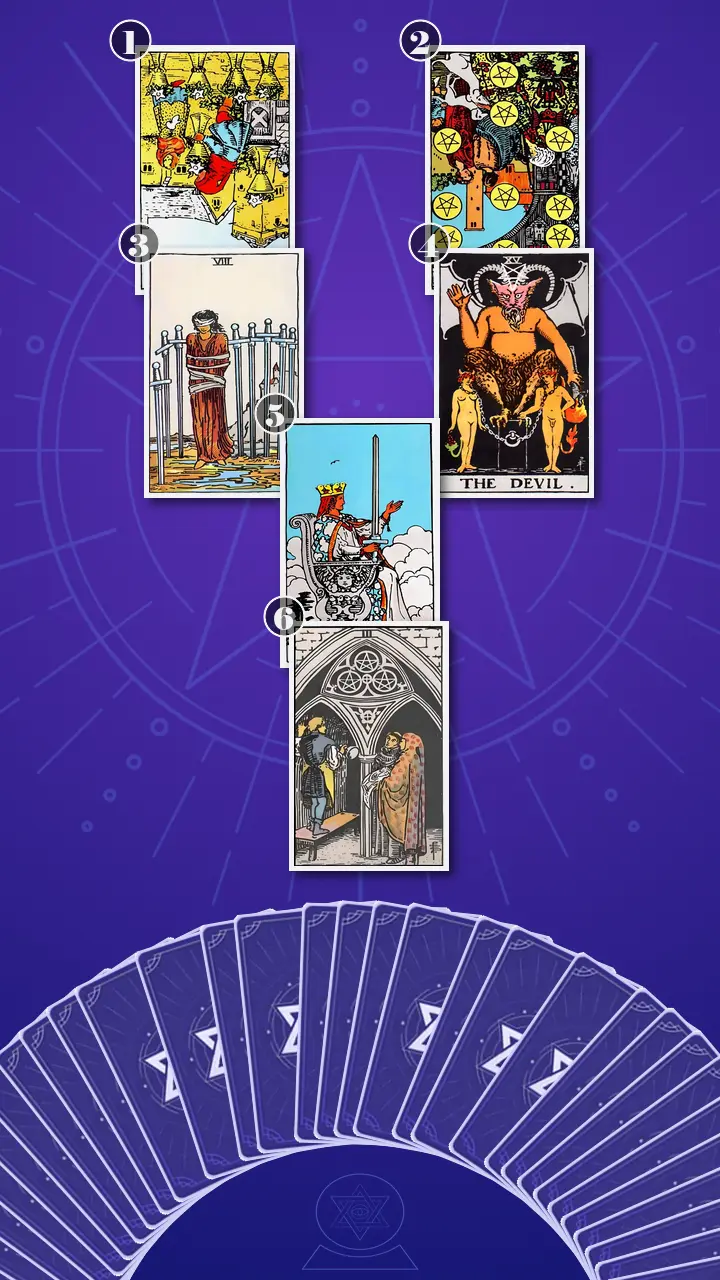
I chose the Four-Layer Insight Ladder · Context Edition, a six-card systemic tarot spread designed to separate a recurring pattern into its working parts. A broad future-oriented spread would have been less useful because Jordan did not need a verdict about whether moving home was right or wrong. She needed to understand why one familiar question could trigger permission-seeking, overexplaining, temporary relief, and delayed resentment.
I arranged the first two cards across the top to show the visible behaviour and the household conditions around it. Beneath them, two cards would reveal the root belief and the feedback loop that kept proving that belief. The fifth card would identify the leverage point, and the sixth would translate that leverage into a sustainable living arrangement.
From where I sat, the layout resembled two floors of an old house narrowing into a newly designed doorway. I have spent enough time around excavated walls to know that architecture is never merely background. A building carries evidence of how people once moved through it, but an inherited route is not the only route its present occupants can take.
This is how tarot works at its most grounded: the cards externalize a pattern so that card meanings in context can be examined without turning every emotion into evidence. They do not issue commands or guarantee outcomes. They help me ask better questions, and they help the person opposite me see where choice has been hidden inside habit.
Reading the Rooms That Remembered Her
Position 1: The Childhood Setting That Reconnected Automatically
I turned over the card in the position that shows the observable role-regression behaviour: asking permission, overexplaining, and becoming quieter after moving home. It was the Six of Cups, in reversed position.
I pointed to the larger child offering a flower-filled cup to the smaller child inside an enclosed courtyard. Upright, the image can hold affection, memory, care, and the safety of what is familiar. Reversed here, its Water energy was blocked and flowing backward. Care had become entangled with an earlier role, and the emotional memory of being looked after was arriving with outdated permission settings.
“This is the moment you unpack in your childhood bedroom,” I said, “and, within hours, ‘I’ll be back around midnight’ turns into ‘Is it okay if I come back that late?’ No one needs to announce that you are the child. The room, the tone of voice, and the familiar question restore the old setting automatically.”
I compared it to joining familiar Wi-Fi. The connection happens before anyone checks whether the device should still be using the old configuration. Jordan’s adult competence had not vanished. Her nervous system was reconnecting to a family script with a lower permission level.
She gave a short, bitter laugh. “That is so accurate it’s almost rude.” Her fingers tightened around her mug, then loosened. “I walk through the door as an adult and start talking like I need permission before anyone has even set a rule.”
I asked where the line changed in her last hallway conversation. What practical information did the household need, and at what sentence did she begin securing approval? Jordan thought for a moment and answered, “They needed to know I might make noise after midnight. They did not need everyone’s names, my route, or my full defence of why I deserved to go.”
That distinction mattered. I was not inviting her to reject reasonable communication or become sharp whenever someone asked a practical question. That would merely be an overcorrection. The Six of Cups reversed asked her to separate present-day consideration from a childhood request for permission.
Position 2: The Contract Nobody Had Actually Written
I turned over the card representing the external household conditions that reactivated the child role, especially the implicit expectations around money, chores, privacy, guests, and schedules. It was the Ten of Pentacles, in reversed position.
I showed Jordan the multigenerational household beneath the stone arch, with pentacles spread across the domestic scene. In reversal, Earth was unstable. The family structure looked established from the outside, but its current terms had not been made solid enough to support the adults actually living inside it.
Jordan sent an Interac e-Transfer, bought groceries, emptied the dishwasher, and took on whatever task was visible. Yet there had been no single conversation confirming what her contribution covered, what privacy meant during client calls, whether guests were welcome, how late schedules should be communicated, how long the arrangement might last, or when everyone would review it.
“It is like a fixed-term job whose pay, scope, hours, and review process were negotiated across six separate Slack messages,” I said. “Each fragment may be understandable, but nobody can see the complete agreement.”
Jordan looked down at the card. “I keep doing more because I think the next chore will prove I’m not taking advantage.”
I noticed her jaw tighten again. I told her that overcontributing could look responsible while quietly becoming another way to purchase legitimacy. Paying more than she could sustain or handling nearly every chore would not automatically produce adult status. It could create financial strain and resentment while leaving the original expectations just as vague.
“An unstated expectation can shape your behaviour,” I said, “but it is not the same as an agreed rule.”
I asked which topic would reveal the largest mismatch if everyone sat at the kitchen table that evening. Jordan answered immediately: privacy during work hours. The speed of her answer told me that clarity was already present in one layer. What had been missing was permission to treat that clarity as usable information.
Position 3: The Message Deleted Before Anyone Replied
I turned over the card revealing the restrictive belief beneath the pattern: the assumption that living at home removed Jordan’s authority to state adult needs without permission. It was the Eight of Swords, upright.
I drew her attention to the blindfold, the bound figure, and the incomplete ring of swords. The feeling of restriction in this card is real, but the enclosure is not absolute. Here, Air energy had moved into excess and then blockage. Jordan was using intelligence to simulate every possible negative reaction until an untested prediction became the final decision.
She told me about a Sunday night in her childhood bedroom. The radiator had clicked beside old shelves while blue laptop light covered the room. She had drafted, “Could we agree that people knock before entering during client calls?” Then she imagined being called difficult, ungrateful, and overly formal. Her palms became damp. She deleted the note before anyone responded.
“The practical constraints of shared housing are real,” I told her. “But the Eight of Swords shows anticipated reactions occupying the space where an explicit answer could have been. It is like a navigation app announcing that there is no route because several roads might be busy, even though none has been confirmed closed.”
I asked for the exact prediction beneath the deletion. Jordan stared briefly past the screen, as though reading the missing draft from memory. “If I ask for privacy, they’ll think I’m acting like the house belongs to me.”
I did not challenge the fear by promising a positive response. Her family might disagree with a request, and some constraints might be genuine. Instead, I separated three categories: what had been explicitly agreed, what shared living practically required, and what Jordan’s mind had concluded in advance. That separation created a gap in the swords without pretending the whole field was open.
Position 4: The Quiet Minutes That Charged Interest
I turned over the card representing the reinforcing mechanism: the exchange in which compliance reduced tension briefly, left the terms unspoken, and encouraged the old role to continue. It was The Devil, upright.
I told Jordan immediately that I did not read this card as evil, punishment, or a warning of inevitable harm. I read it as attachment in excess: a habit strengthened by a reward. The chained figures on the Rider-Waite-Smith card wear collars loose enough to remove, yet neither is removing one. That detail allowed me to name participation without turning it into blame.
I mapped the sequence aloud. A family member asked one neutral question. Jordan’s body heard monitoring. She gave a four-minute explanation, offered to return earlier, and changed part of the plan. The room became calmer. Her nervous system recorded the relief as success. Later, resentment arrived on the Line 1 train while she scrolled through Instagram Stories of friends cooking in their own apartments.
“Overexplaining buys a few quiet minutes and charges interest in resentment,” I said.
Jordan’s lips pressed together. I watched her shoulders contract as she remembered the relief. “That calm feels so good in the moment,” she said. “I think, okay, I haven’t ruined anything. Then I’m angry at myself for the rest of the night.”
I used my Generational Trauma Excavation lens carefully here, as a question rather than a diagnosis. I asked whether anyone in the family had learned that being exceptionally easy, helpful, or obedient was the safest way to preserve peace. Jordan did not know, and I refused to invent a family history to fill the gap. Not knowing was still useful. It loosened the idea that this reflex proved a personal defect while keeping our attention on the observable bargain happening now.
On archaeological digs, I have seen later walls built directly over earlier foundations. The newer occupants may not know why a passage narrows where it does; they simply keep walking through the opening they inherited. The Devil suggested something similar. Jordan did not create the whole architecture, but she could notice the precise moment when immediate relief persuaded her to use the old passage again.
I wrote four words on paper: cue, response, relief, cost. The cue was a question about timing. The response was a defence. The relief was reduced tension. The cost was resentment, vagueness, and another repetition of the parent-child role.
Jordan leaned closer to the screen and read the sequence twice. Her breathing slowed. “So the chain isn’t fake,” she said, “but it isn’t locked either.”
“Exactly,” I replied. “This reaction is familiar, but familiar is not the same as required.”
When the Queen Opened a Door Through the Wall
Position 5: One Upright Sword and One Open Hand
The rain against my study window thinned as I reached the transformation position, and a pale strip of sky appeared beyond the glass. I turned over the card that would show where a different response could enter the loop: the Queen of Swords, upright.
I placed the Queen’s vertical sword beside her extended hand. Her Air energy was neither crowded nor blocked. It was balanced and directed. The sword defined what was clear; the open hand kept communication relational. Together, they challenged Jordan’s assumption that she had to choose between adult boundaries and continued family connection.
In practical terms, I saw Jordan arriving at a 25-minute household check-in with three lines rather than a courtroom defence: “I need uninterrupted privacy during client calls. I will put my meeting times on the kitchen calendar. I’d like us to review whether that works in two weeks.” Then I saw the most important part: she paused instead of apologizing for having a need.
“A boundary can sound like information, not a courtroom defence,” I told her. “Another person can respond, disagree, or propose a change. Your adulthood does not depend on securing approval before the conversation begins.”
I then brought in my Inherited Belief Stratigraphy method. In archaeology, an older layer is not automatically a truer layer. It only tells me what existed earlier. I drew three horizontal bands on my notepad and labelled them Current Fact, Inherited Rule, and Chosen Value.
In the first band, I wrote: “Co-residents need relevant information when plans affect noise, safety, transport, or shared space.” In the second: “Inside this address, Jordan must ask permission and prove gratitude before naming a need.” In the third: “Jordan values consideration, reciprocal contribution, privacy, and honest communication.”
The exercise separated a reasonable present-day responsibility from an older, fear-based rule. Jordan did not need to excavate every generation before acting. She only needed to stop treating the oldest layer as the current operating system. The Queen’s single sword was the sentence chosen from her actual values rather than inherited automatically from the layer beneath them.
I brought Jordan back to the 10:45 p.m. hallway. Her coat was on, the handle was cold, and one practical question had already triggered a full defence. Her jaw tightened because the adult who handled clients all day had gone quiet before she had tested whether clear information might be enough.
You are not a child asking permission; you are an adult making a clear proposal, like the Queen of Swords holding her blade upright while extending an open hand.
I let the sentence stand. Jordan’s inhale stopped halfway; her fingers froze around the cuff of her sweater, and her eyes widened before shifting away from the screen. The silence was not relief. I watched memory move across her face as if she were replaying every hallway explanation at once. Then her mouth tightened. “But doesn’t that mean I’ve been doing this to myself?” she asked, sharper than before. “Does that mean I got it wrong all this time?” I told her no. A learned protection is not a moral failure, and noticing her part in a loop did not erase family pressure, housing economics, or old conditioning. Her fist loosened one finger at a time. Her eyes came back to the Queen; moisture gathered without falling. Then came a long, unsteady exhale, followed by a small laugh that sounded both relieved and exposed. “Okay,” she said quietly. “So I have a place to enter the pattern, but that means I have to use it.” Her shoulders dropped, and for a second she looked almost dizzy with the responsibility of having a choice.
I asked, “Now, with this new perspective, think back to last week. Was there a moment when this insight could have made you feel different?”
Jordan described finishing a confident client call and then abandoning dinner plans when a family member asked whether she would be home. “I could have said, ‘I’m going out, so don’t include me for dinner,’” she said. “That would have answered the actual question. I didn’t need to turn it into a referendum on whether I’m grateful.”
I gave her the practical form of the insight: Needing a place to land does not cancel your adulthood; the shift begins when you offer clear information and shared terms before approval becomes the price of belonging.
This was the central emotional crossing in the reading: from contracted frustration, shame, and permission-seeking toward adult discernment, cautious relief, and belonging without self-erasure. It did not require Jordan to feel fearless. It required one deliberate sentence before the old role made the decision for her.
The Blueprint Under the Final Arch
Position 6: Turning Insight into a Shared Living Plan
I turned over the final card, representing the action-and-integration layer through which adult agency could become a repeatable household practice. It was the Three of Pentacles, upright.
I showed Jordan the craftsperson standing on a bench and the two collaborators consulting a plan beneath an arch. Earth energy had returned in a balanced form. Unlike the reversed Ten of Pentacles, where a large inherited structure rested on fragmented assumptions, this card showed a smaller structure being built through visible skill, consultation, and agreed plans.
I translated the scene into three people looking at one shared Google Doc instead of arguing from separate private expectations. The headings were practical: contributions, chores, privacy and work hours, guests, schedule communication, expected duration, and a review date. Not every preference had to be settled in one conversation. The point was to make assumptions visible and revisable.
“The document is not evidence for a trial,” I said. “It is a working plan. You are not deciding whether you deserve to belong. You are deciding how this household will function.”
Jordan nodded cautiously. I saw relief arrive, but it did not erase the strain around her eyes. “My family might think a Google Doc is ridiculous,” she said.
“They might,” I replied. “So call it a temporary living-arrangement check-in, cap the first conversation at 25 minutes, and start with the three topics causing the most friction. The card does not promise agreement. It shows the quality you can bring: competence, reciprocity, and a process for review.”
I reminded her that belonging through participation is different from belonging through compliance. The Three of Pentacles did not ask her to prove adulthood by doing everything alone. It invited her to make her adult contribution visible inside a jointly designed structure.
The Lineage Artifact Review: What to Keep, Renegotiate, and Bury
I gathered the six cards into one story. The reversed Six of Cups showed the childhood setting restoring an earlier identity. The reversed Ten of Pentacles showed why that identity found traction: the practical terms of the household had never been assembled into one current agreement. The Eight of Swords revealed the internal conclusion that adult speech was unavailable, while The Devil exposed the short-term relief that rewarded silence and overexplanation. The Queen of Swords introduced one clear adult sentence, and the Three of Pentacles gave that sentence somewhere solid to live.
The repeated architecture mattered. We had moved from the enclosed childhood courtyard, through the inherited family arch, into a mental enclosure and a loose chain. The Queen opened a new doorway, and the Three of Pentacles placed plans beneath the final arch. I did not see a command to leave the house immediately or reject the family connection. I saw an invitation to change how the living structure was defined and inhabited.
I named Jordan’s cognitive blind spot directly: she had been treating gratitude as a qualification she needed to earn before her needs became legitimate. That made support and autonomy look mutually exclusive. It also made every moment of disagreement feel like evidence that her place in the home was at risk.
The transformation direction was not defiance. It was explicit adult-to-adult household terms. Jordan could communicate relevant information without requesting permission, pair needs with responsibilities, and negotiate contributions, chores, privacy, guests, schedules, duration, and review dates as a resident who was both connected and adult.
To make that distinction concrete, I adapted my Lineage Artifact Review. I asked Jordan to examine each household custom as I would examine an object from an old layer: preserve what still carries genuine value, renegotiate what belongs to a different stage of life, and bury what now produces harm without serving a present need.
Her first draft was precise. She wanted to preserve the courtesy of messaging when a late return might affect sleep or shared plans. She wanted to renegotiate how privacy worked during client calls and how chores were divided. She wanted to bury the assumption that gratitude required her to seek approval for an ordinary adult evening.
I gave her three next steps. I kept them small because confidence often arrives after a usable action, not before it.
- The Eight-Minute Information-Not-Permission Rewrite Before one low-stakes outing this week, Jordan would set an eight-minute timer in her Notes app and change “Can I go out tonight?” into “I’m meeting friends tonight and expect to be back around midnight. I’ll message if that changes.” Afterward, she would record only three facts: what was asked, what she actually said, and what actually happened. Tip: Keep the statement to one or two sentences and include only information that affects the shared household. If saying it aloud feels too activating, practise privately or send a brief text. Predictions about what others secretly thought do not belong in the factual record.
- The Need-and-Responsibility Pair Before Wednesday, Jordan would spend five minutes drafting one sentence for a real household issue: “I need uninterrupted privacy during client calls, and I will put my meeting times on the kitchen calendar.” She would practise it once while standing in her normal work voice. In the next relevant conversation, she would make the point once and allow five seconds of silence before adding an explanation. Tip: Another person is allowed to disagree, and Jordan is allowed to keep the original point available for negotiation. The minimum version is writing the sentence without delivering it. A pause is not proof that the boundary was rude.
- The 25-Minute Lineage Artifact Review Jordan would send a calendar invitation titled “Living arrangement check-in” and bring a one-page Google Doc to the kitchen table. For the first meeting, she would choose only three urgent headings, classify inherited customs as Preserve, Renegotiate, or Bury, and finish by recording agreements, unresolved questions, and a review date four to six weeks later. Tip: Frame the document as a temporary working draft, not a permanent contract. Nobody has to accept terms on the spot. If direct discussion could create a genuine housing or personal-safety risk, Jordan would keep the draft private and seek outside support before testing a boundary.
I told Jordan that the cards could not conduct the household conversation for her, control anyone’s response, or guarantee that each request would be accepted. What they had done was make the mechanism observable. The decisions, pacing, safety judgments, and next words remained hers.

Six Days Later: One Sentence at Normal Volume
Six days later, I received a message from Jordan. Before meeting friends, she had said, “I’m heading out and expect to be back around midnight. I’ll message if that changes.” Her family member had asked whether she had her key. Jordan answered yes. The exchange ended there.
Her first thought in bed was still, “What if I sounded rude?” This time, she let the thought pass without sending a follow-up apology. The private “House stuff” document was still unsent, but it now had three headings and a proposed review date.
I did not mistake that for a solved family system. I saw it as the right kind of proof: one ordinary plan communicated at normal volume, one old prediction left unconfirmed, and one practical document moving from endless rehearsal toward possible use.
That was Jordan’s Journey to Clarity. The Four-Layer Insight Ladder · Context Edition had not revealed a fixed fate. It had shown her the old architecture, the bargain that kept it standing, and the doorway where she could begin rebuilding. She supplied the sentence and chose to say it.
I know that when a voice shrinks in the hallway and a normal adult plan turns into a defence, the hardest part is rarely the practical question itself. It is the fear that taking up adult space could cost a place in the home. Noticing that fear does not settle every household term, but it does mean the old script is no longer playing entirely outside awareness.
If support and adulthood could sit at the same kitchen table, which one line would you place in the shared document first: the contribution you can offer, the privacy you need, or the expectation you are ready to bring into daylight?