Thesis Procrastination: Let the Draft Guide Your Next Search
The 8:47 P.M. Google Scholar Spiral: Thesis Procrastination Disguised as Productive Research
If you are a Toronto graduate student who opens your thesis during a protected writing block, spots one unsupported phrase, and immediately follows a Google Scholar citation trail, I know the scene. I have seen how quickly responsible research can become thesis procrastination disguised as productive research, especially when a deadline or supervisor check-in turns one paragraph into a referendum on competence.
Alex sat across from me with a laptop under one arm, a phone in her hand, and several printed articles arranged in a careful stack. To explain the problem, she took me back to Tuesday at 8:47 P.M., at the small desk beside her Toronto kitchen. She had opened the thesis document, noticed one phrase that might need a stronger citation, and switched to Google Scholar. The fluorescent light buzzed above her, the laptop fan warmed the air, and the blue phone screen spilled over the paper. One useful article became twelve browser tabs through the Cited by link while the cursor kept blinking beside the same heading.
She had reserved two hours for writing after her research assistant shift. Instead, her hands moved between search terms, Zotero collections, renamed PDFs, and an outline she had already revised three times. She told me, 'I am not procrastinating because I am doing research.' Then she added, 'There is always one more source that could change the argument. I can write it once I know what I really think.'
I heard the contradiction clearly: she wanted the research to feel complete before writing, yet she was afraid that writing before the research felt complete would expose whether she truly understood the subject. Her shoulders stayed lifted, her fingers kept searching for another tab, and her chest looked heavy each time she glanced at the blank paragraph. Apprehension seemed to sit inside her like an elevator stalled between floors, neither descending into the work nor arriving at a place where she could safely begin.
I did not hear laziness or a lack of seriousness. I heard a capable person using information to create a few minutes of relief from the vulnerable act of making a claim. I said, 'More research can lower the panic without moving the argument. We can respect the research and still look at what it is protecting you from. Let us draw a map of that loop together. That is our Journey to Clarity today.'

Choosing a Map for the Researching-Instead-of-Writing Loop
I invited Alex to place both feet on the floor, take one slower breath, and name the question she wanted the cards to examine. I shuffled gradually, not as a performance of mystery, but as a small transition from reacting to the problem to observing it. The cards would give us an external structure for thoughts and habits that were otherwise circling inside her.
For this consultation, I chose a four-card reading called The Shadow Spread. When people ask how tarot works in a psychological reading, I explain that I use the cards as an objective cognitive mirror, not as a verdict about grades, deadlines, or academic success. My Jungian lens treats an image as a way to bring a pattern into view so we can question it, test it against lived reality, and choose what to do next.
The Shadow Spread suited this question because it is compact and precise. A broad Celtic Cross would have surveyed many areas of life when the issue was one self-reinforcing loop. This four-card spread follows the visible behavior, the hidden driver beneath it, the resource Alex has disowned, and the practical way to integrate that resource. Its card meanings in context would show why research had become a protective substitute for writing, then point toward a repeatable writing practice without asking her to abandon necessary research.
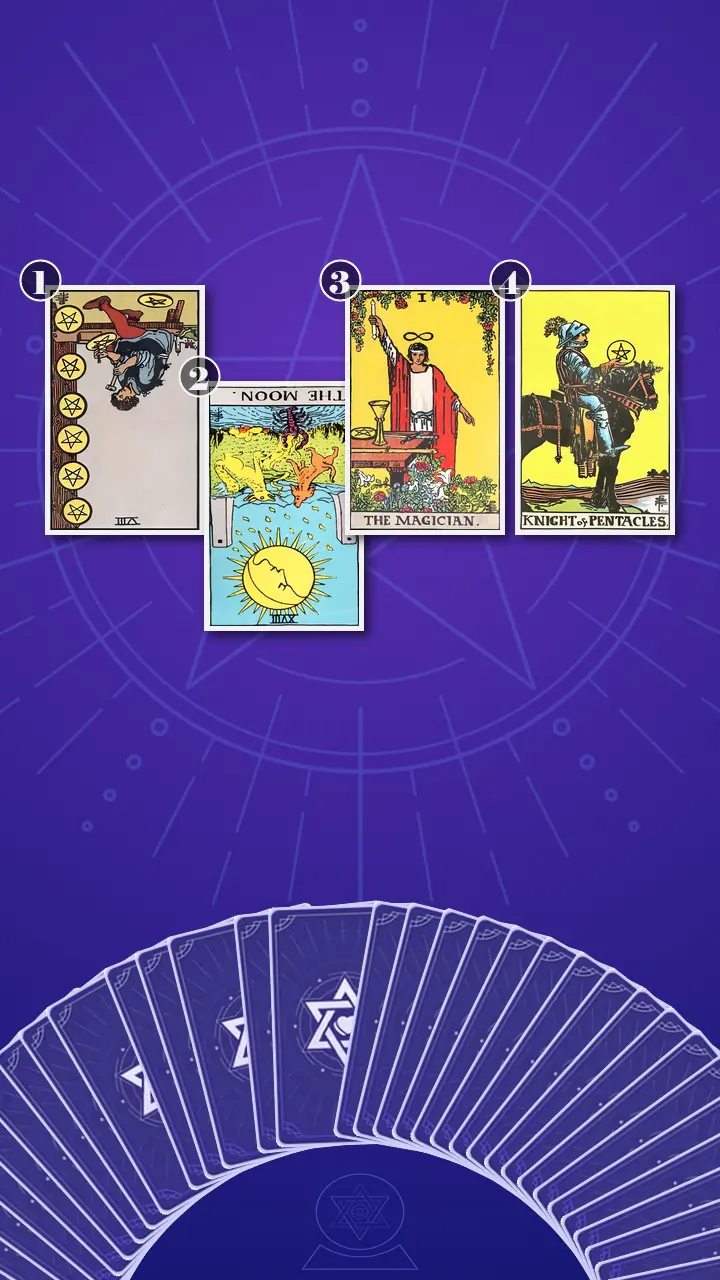
I told Alex that the first position would show the observable research-to-writing substitution. The second would reveal the uncertainty and control-based fear maintaining it. The third, the central Bridge, would identify the agency she had been treating as unavailable. The fourth would turn that insight into small, practical next steps that could work around commuting, part-time work, and an already fragmented schedule.
Reading the Map: Where the Work Keeps Disappearing
The Eight of Pentacles: When Preparation Looks Like Progress
Now I turn over the card for Position 1, the position showing the observable research-to-writing substitution: what Alex does when writing becomes difficult and how the resulting stagnation appears in daily life. The card is Eight of Pentacles, in reversed position.
The image shows a craftsperson bent over one pentacle while more pentacles line the wall behind them. I asked Alex to picture that repeated concentration beside her own desk. During the two-hour thesis block she had reserved, she spent the first hour formatting citations, renaming PDFs, and expanding a Zotero collection. The work resembled careful craftsmanship, but no paragraph appeared. The archive became increasingly organised while the argument remained untouched.
Reversed Earth energy here is not a bad omen. It is effort with its direction blocked. The diligence is real, but it has become repetitive preparation that produces the sensation of labour without the visible trace of thesis craft. The difficult sentence triggers the thought that the argument is not ready. A new search then lowers the immediate pressure, but the absence of prose leaves the deadline more threatening, which makes the next search feel even more necessary.
This is where I used my signature lens, Draft Paralysis Deconstruction. I look for perfectionism as a subconscious defense mechanism designed to protect someone from possible academic criticism. In Alex's loop, a sentence that might be questioned by a supervisor becomes a new research question. The research question becomes a safer task than choosing language. The defense is intelligent and temporarily soothing, but it keeps the thesis in a private preparation stage where no sentence can be tested.
Alex gave a short, bitter laugh. 'That is too accurate. I am not procrastinating because I am doing research.'
I answered, 'You are doing real research. The question is what function it is serving at that particular moment. The card is not asking you to dismiss the work. It is asking whether the work is still producing what you opened the document to produce.'
Her fingers froze above the trackpad. Then her gaze dropped to the same empty paragraph, as if she were watching a recent session replay itself. Finally, she released a breath through her nose and rubbed the tight place between her eyebrows. Recognition arrived with a little shame, but I could also see the first separation between her identity and the pattern. She was not the loop. She was the person who could observe it.
The Moon Reversed: When a Blank Space Becomes a Cliff
Now I turn over the card for Position 2, the position revealing the hidden influence beneath the surface pattern: the uncertainty and control-based fear that make more research feel safer than drafting a provisional argument. The card is The Moon, in reversed position.
I returned to the scene she had described from 2:18 P.M. in a university library carrel. Two credible studies sat open side by side. The air conditioner clicked on and off, paper edges rasped beneath her wrist, and her eyes had gone dry from rereading the same paragraph. She changed her search terms four times and reopened notes she had already considered settled because the studies did not line up.
The Moon's winding path became her citation trail. The two towers became competing interpretations. The dog and wolf represented two ways of meeting the same uncertainty: ordinary curiosity or alarm. The crayfish rising from the pool became the half-formed question she kept trying to push back into research before letting it appear in the draft.
Reversed Water energy brings the confusion into view. The blockage is not simply a shortage of information. It is the meaning assigned to every gap. The inner sequence sounded like this: The studies disagree, therefore I must not write, and if I search longer, I can regain control. A manageable evidence gap had started to look like a cliff. The Moon did not tell Alex that the thesis was doomed. It showed me how normal ambiguity was being emotionally amplified into a stop sign.
I asked, 'When two studies conflict, what do you fear the disagreement proves about your thesis or your competence?'
She looked at the laptop instead of the card. 'That I have misunderstood the whole subject. Or that I do not have the right to make a position sound confident.'
Her breath paused halfway in. Her eyes lost focus while she remembered reopening a settled folder before the last supervisor check-in. Then her jaw loosened, and a long exhale moved through her chest. I said, 'A draft is not a verdict on your competence; it is where uncertainty becomes specific.' The sentence did not erase the uncertainty. It made the uncertainty small enough to name. We could now ask which question was essential, which was useful, and which could be parked without treating the parked question as an emergency.
When The Magician Put the Archive on the Table
The Magician: The Bridge from Collection to Authorship
The room grew quiet before I turned the central card. I could hear the soft hum of the heater and the faint traffic beyond the window. Now I turn over the card for Position 3, the position identifying the shadow truth and the disowned agency Alex can reclaim, translating the shift from exhaustive certainty to iterative expression. The card is The Magician, in upright position.
The Magician stands over a table holding a cup, sword, wand, and pentacle. I asked Alex to see her own workspace in that image. The cup was her willingness to tolerate exposure. The sword was her ability to make a clear distinction. The wand was language becoming a visible act. The pentacle was the evidence she had already gathered. The table was not waiting for another tool. It was waiting for a deliberate arrangement.
Upright energy here is focused agency, resourceful synthesis, clear expression, and the conscious use of what is already available. The research, notes, language, and analytical skill were not raw materials waiting for perfect conditions. They became useful when Alex combined one research question, one relevant source, and one provisional claim on the same page. The Magician's raised hand and grounded hand suggested a movement from receiving information to making something with it.
At this point, I used my other diagnostic lens, Performance Anxiety Decoupling. I asked Alex to separate her core self-worth from exam results, peer comparisons, and mentor evaluations. A supervisor's comment can tell her where a draft needs clarification. A peer's polished thesis announcement can show what a finished stage looks like. Neither one can measure whether she is intelligent, deserving, or in control of her entire subject. This is not a slogan designed to make criticism disappear. It is a logical distinction that gives criticism a smaller and more useful job.
At 8:47 P.M., the cursor blinked while Alex's hand opened another Google Scholar tab. Her shoulders tightened because a weak sentence felt more exposing than another article, even though the article would not create the paragraph. She was trying to make writing safe by postponing writing.
Do not wait for complete mastery before you begin; place the research, language, and analytical tools already on the Magician's table into one provisional claim, then let the draft show you what to refine.
Alex's breath stopped. Her fingers hovered over the trackpad, as if the next click could restore the old safety. Her eyes widened, then moved from the card to the laptop and lost focus while she replayed the library scene and the weeks of reopened notes. Her jaw tightened. 'But doesn't that mean I've been doing it wrong for months?' The question carried a flash of anger followed by a quieter hurt. I told her no: the research had been a resourceful protection, not a character flaw; it had simply outlived its usefulness. Her grip loosened one finger at a time. Her shoulders dropped, and a shaky breath left her chest. For a moment she looked relieved, then briefly blank, as if the cleared path required a new choice. I asked, 'Now, use this new perspective to remember last week: was there a moment when this insight could have made you feel differently?'
This was the first movement from anxious certainty-seeking and research-driven avoidance toward cautious authorship, visible progress, and steadier self-trust through revision. Writing was no longer the final examination that came after understanding. It became the method by which understanding could be tested. I said, 'Your thesis does not need every source. It needs a claim your current evidence can test.'
The Quiet Road Back to the Same Draft
The Knight of Pentacles: A Reliable Stop on the Route
Now I turn over the card for Position 4, the position turning the transformation into a small, practical writing practice that can create visible progress without requiring perfect certainty first. The card is Knight of Pentacles, in upright position.
The Knight sits on a still horse and holds one pentacle carefully over a cultivated field. I connected the image to a Thursday at 8:30 A.M., before Alex's commute to her research assistant shift. She opened the same thesis file, wrote 150 imperfect words from existing notes, circled one source gap for later, and recorded the paragraph count. The work was not thrilling. It was dependable. The page now contained something that could be revised.
Upright Earth energy restores balance through patience, reliability, and methodical effort. The Knight does not demand one heroic writing sprint or a permanent ban on research. He asks for a defined return to the same draft before optional searching. One paragraph becomes like a small Git commit: evidence that the work changed, even when the final version is many revisions away. In a fragmented Toronto schedule, the recurring writing appointment is also like a reliable TTC stop. It may not feel dramatic, but returning to the same direction gets the work somewhere.
Alex looked at her calendar and moved two writing blocks beside the desk next to the kitchen. Her shoulders were still not completely relaxed, but her hands were no longer searching for a new folder. She asked, 'Would it count if the paragraph still had a [source needed] note in it?'
'Especially then,' I said. 'The note makes the gap specific. Progress can be visible before the argument feels finished. Let the paragraph show you what research is actually missing.'
The Source-to-Sentence Gate
When I placed the four cards together, their story became clear. The reversed Eight of Pentacles showed a diligent craftsperson bent over an archive, mistaking repeated preparation for movement. The reversed Moon showed why: every contradiction made the path feel less like a route through partial visibility and more like a warning to stop. The Magician brought the cups, sword, wand, and pentacle onto one working table and returned authorship to Alex. The Knight then carried one selected pentacle into a field of furrows, where progress could accumulate through repetition.
The cognitive blind spot was not that Alex needed no more information. It was that she treated complete certainty as a prerequisite for writing, while treating writing as a final performance of knowledge. The key shift was to let writing test, organise, and strengthen the research already gathered. That meant moving from private preparation to provisional authorship, from fear-driven searching to steadier revision, and from a growing source archive with very little prose to visible evidence of change.
I also made the boundary explicit. Research still belonged in the thesis. The change was the order and the stopping rule: prose first, then focused research guided by a real gap. I called the first exercise my Inner-Critic Mute Protocol. It would not silence every uncomfortable thought. It would briefly remove the inner critic's authority to turn one weak sentence into a judgment about Alex's whole identity.
Three Small Experiments for Finding Clarity
I offered Alex these as reversible experiments rather than rules. She could adjust the timing, keep the work private, or stop if a session became unmanageable. The purpose was not to force certainty or productivity. It was to create a small place where her own inner wisdom could meet the evidence on the page.
- The Inner-Critic Mute ProtocolOn Tuesday and Thursday at the desk beside the kitchen, write the critic's prediction before opening Google Scholar: 'If this paragraph is weak, it will prove I do not belong here.' Under it, write one observable task: 'Write from one existing source for 20 minutes and mark [source needed].' Open the current thesis file, draft before the database or Zotero, then record the paragraph count and one sentence beginning 'This paragraph is trying to say...'Set a phone timer and keep a separate research-later note so new ideas are captured without controlling the session. If 20 minutes feels too demanding, use 5 minutes or 3 sentences. After the prose exists, spend no more than 10 focused minutes checking only the marked gaps.
- The Essential, Useful, Parked SortOn Wednesday, spend 8 minutes listing the open thesis questions pulling you toward another search. Label each one essential, useful, or parked. Choose one essential question and write a provisional paragraph with the evidence already collected, including one clearly marked limitation if needed. Then limit the next search to three deliberate queries connected to that paragraph.Do not colour-code, redesign the list, or follow every citation trail. Treat a question as essential only when the paragraph cannot make a meaningful claim without answering it. If two studies conflict, write the disagreement as a defined limitation instead of trying to erase it immediately.
- One Question, One Source, One ClaimOn Friday, create a three-column note titled Question, Evidence, Provisional claim. Fill in one row using one research question and one source already in your notes. Write 150 words connecting the source to the claim, underline the sentence that most clearly sounds like your position, and send only that excerpt to a trusted supervisor, writing partner, or peer with the question, 'Where does this claim need clarification?'Set a feedback boundary before sharing: ask about one claim, not a verdict on your competence or the whole thesis. If sharing is not appropriate, read the excerpt aloud privately or leave it in a dated draft. A 50-word version is still a valid minimum, and you control what is shared, with whom, and when.
I reminded Alex that the cards had not instructed her to abandon scholarship. They had helped distinguish a genuine evidence gap from the emotional impression that every gap was an emergency. The actionable advice was simple: make the first contact with the draft, let the draft identify the next question, and allow revision to do the work of making the argument stronger.
The Quiet Proof: A Paragraph on the Page
Four days later, I received a message from Alex. She had written 143 words before opening Google Scholar, placed [source needed] beside one sentence, and spent ten minutes checking only that gap. The paragraph showed her that a missing definition, not an entirely new literature review, was blocking the section. She had not solved the thesis. She had made the uncertainty specific enough to work with.
Later that week, she sent a 150-word excerpt to a trusted colleague and asked where the claim needed clarification. The colleague found one vague phrase and one strong connection. Alex revised the phrase, kept the connection, and left the rest of the thesis for another session.
The clear-but-fragile version was this: she slept through the night, then woke with the thought, 'What if I am wrong?' She smiled, opened the same file, and wrote three sentences before answering the question.
That was her first small proof of the emotional transformation. Cautious authorship did not feel like perfect confidence. It looked like returning to a living draft, tolerating an unfinished claim, and letting revision build trust one visible change at a time.
I do not present the cards as the force that completed anything for Alex. I used them as a structured cognitive tool, a way to connect an image with a behaviour, a fear, a resource, and a practical experiment. The Shadow Spread did not choose her thesis or guarantee an academic outcome. Alex made the choices. The querent remained the author of what happened next, and the cards simply helped her hear the part of her own intelligence that had been buried beneath one more search.
When the cursor keeps blinking and your shoulders are tight from one more database tab, it can feel safer to keep collecting evidence than to risk a paragraph that might expose whether you really understood the subject all along. Yet noticing that protective loop is already a small act of clarity: you are seeing the pattern, and seeing it gives you room to choose.
If writing were allowed to be the way you find out what you think, what is the smallest provisional claim you might let onto the page today?