The “Ten-Minute” Edit That Eats Your Evening
If your “quick edit” turns into a two-hour Figma spiral and you resurface with a tight jaw and zero applications sent, yeah—this is that pattern.
Taylor showed up on my screen from a Zone 2 flatshare in London, framed by a tiny desk and a window that looked out onto a wet, ordinary streetlight glow. She kept one hand wrapped around a mug like it was a heat source, not a drink. Somewhere off-camera, a radiator clicked. Her laptop fan had that thin, stressed whine you only notice when the room goes quiet.
“It’s basically done,” she said, and the words landed with the tired precision of someone who’s said them every night for weeks. “I just need to polish it. If I send it like this, they’ll see the weak parts immediately.”
I watched her shoulders rise a fraction as she spoke—like her body was bracing for impact that hadn’t happened yet.
Perfectionism doesn’t feel like laziness in moments like this. It feels like standing in front of a door you want to open while your hand keeps wiping fingerprints off the doorknob, over and over, until your skin is raw. A restless urge to fix tiny things—spacing, wording, order—followed by that heavy drop when you realise hours passed and the world didn’t change.
“You’re not broken,” I told her. “You’re caught in a loop that’s trying to protect you. Let’s see if we can map it—so you can get out of edit mode and into forward motion. This is a Journey to Clarity, not a trial.”

Choosing the Compass: A Celtic Cross for Feeling Stuck
I had Taylor take one slow breath—not as a ritual for luck, but as a hard reset for the nervous system. Then I shuffled while she held the question in mind: My portfolio’s “almost ready” again—how do I work with perfectionism?
“I’m going to use a Celtic Cross · Context Edition,” I said. “Because this isn’t one single decision—it’s a repeating perfectionism loop. The Celtic Cross is great for showing the chain: what’s happening now, what’s blocking you, what’s driving it under the surface, and how to build an integration that actually holds in real life.”
For anyone reading who’s ever googled how tarot works in a career crossroads moment: this is what I love about it. Tarot doesn’t hand you a fate. It gives you a structured way to see your own pattern—your inputs, your pressure points, and your next steps—so you can make different choices on purpose.
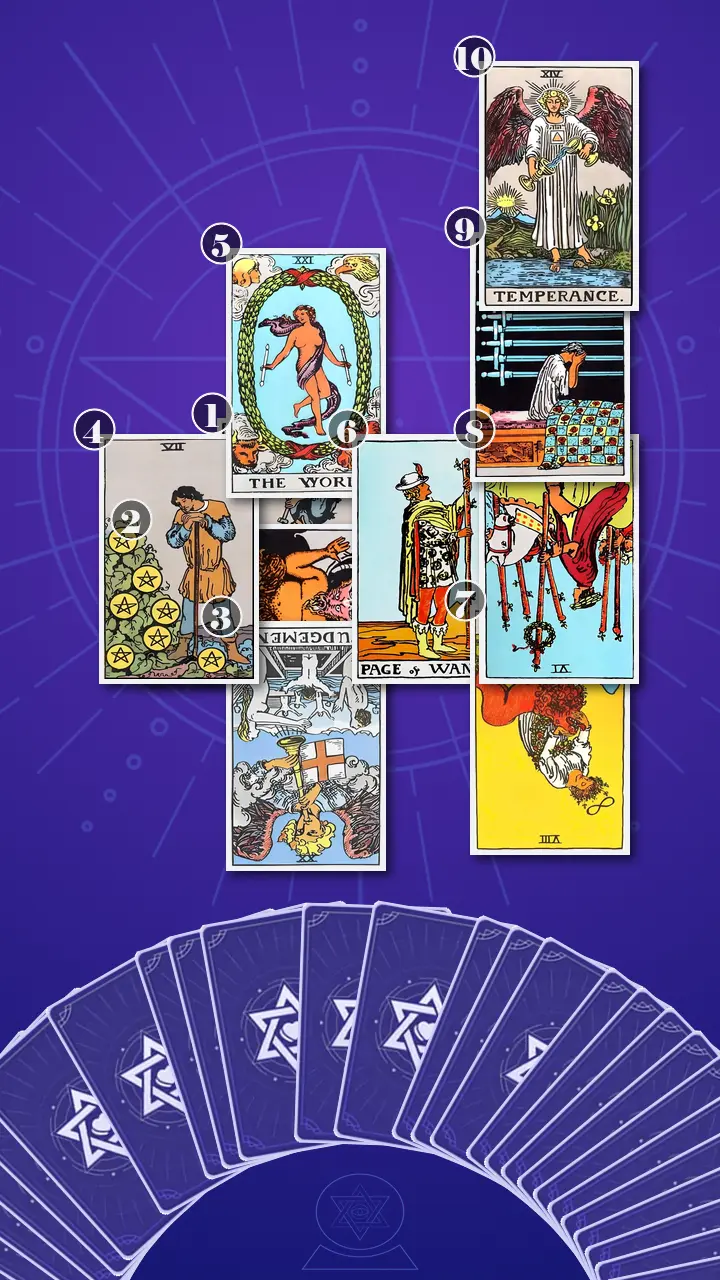
“We’ll start with the center,” I explained, tapping the space where Cards 1 and 2 form the cross. “That’s the current loop and the main friction. Then we’ll drop to the root, climb through the goal and the near-future direction, and finish with integration—what makes progress sustainable.”
Reading the Map: Card Meanings in Context
Position 1: The current loop — Eight of Pentacles (reversed)
“Now we’re turning over the card representing the current loop: how perfectionism shows up in your portfolio behavior right now.”
Eight of Pentacles, reversed.
“This is 9:30 PM you,” I said, keeping my voice simple. “You open your portfolio site ‘just to tidy up.’ You adjust spacing, rewrite headings, tweak the same case-study intro again—tiny improvements that look like work, while the actual publish/send step stays untouched.”
In terms of energy, Eight of Pentacles is craft. Reversed, it’s blocked craft—skill trapped in repetition. The same way Google Docs version history can show 47 edits to the same paragraph… but no one outside the doc has ever read it.
“Editing can be craft, or it can be avoidance wearing craft’s outfit,” I added. “The card isn’t calling you lazy. It’s showing you where the finish line keeps moving.”
Taylor let out a short laugh—sharp, almost embarrassed. “That’s… brutal,” she said, rubbing her jaw. “Like, you even got the 2px thing.”
Position 2: The main friction — The Devil (upright)
“Now we’re turning over the card representing the main friction: what blocks completion and keeps ‘almost ready’ repeating.”
The Devil, upright.
“Your portfolio becomes a contract you didn’t mean to sign,” I said. “I can only apply when it’s flawless. So you scroll job listings and other designers’ portfolios until the pressure spikes—LinkedIn ‘Open to work’ posts, polished carousel case studies—and then you compulsively edit to feel safer.”
The Devil’s energy is excess attachment: approval tied to worth, control used as coping. And the symbol that matters most here? The chains are loose. They’re not welded. They’re not HR. They’re not a recruiter standing over you. They’re a rule that feels external… but lives inside your head.
I heard my own New York art-school brain flash a cinematic reference, the way it always does when something feels like a power dynamic: in Wall Street, Gordon Gekko doesn’t just want money—he wants the feeling of being untouchable. That’s what perfectionism is selling you: not a better portfolio, but the illusion of being unjudgeable.
I leaned in. “Can we do a quick ‘imagined audience’ monologue? Just for ten seconds.”
I lowered my voice, like a recruiter living in the walls of her flatshare kitchen. “Strong portfolio required. Hmm. Is she senior enough? Why is this project framed like that? Does she even know what she’s doing?”
Taylor’s eyes flicked away from the screen. Her shoulders crept up toward her ears. And then—very quietly—she nodded, like she’d been caught listening to a familiar, unwanted podcast.
Position 3: The hidden driver — Judgement (reversed)
“Now we’re turning over the card representing the hidden driver: the deeper fear or belief underneath the perfectionism.”
Judgement, reversed.
“This is the hover,” I said. “You draft an application email. Cursor on Send. And suddenly your brain runs a full simulation of being judged—recruiters noticing gaps, silent rejection, you being ‘found out’ as not senior enough. So you close the tab and go back to editing, because editing lets you delay being seen.”
Judgement is a call. Reversed, the energy is blocked response—like the notification sound in your head is an alarm, not a normal career step.
“You’re treating sharing like a trial,” I told her, “not like a conversation.”
She exhaled, and it wasn’t relief yet. It was recognition. Like the moment you finally name a background hum and realise it’s been there the whole time.
Position 4: Recent shaping — Seven of Pentacles (upright)
“Now we’re turning over the card representing what has been shaping this pattern recently: your recent history with effort, patience, and feedback.”
Seven of Pentacles, upright.
“You’ve genuinely put in work,” I said. “And lately you’ve been stuck in assessment mode: Should I add another project? Is this narrative cohesive enough? You keep reviewing the garden instead of choosing a harvest date.”
This is balanced effort sliding into over-evaluation. Notion ‘Portfolio v2’ pages multiplying like gremlins. Are.na rabbit holes that start as “inspo” and end as comparison fatigue. The pause replaces the publish.
Taylor’s mouth tightened—an irritated little line. “I keep telling myself I’m being responsible.”
“You are,” I said. “And also: responsibility without a deadline becomes a hiding place.”
Position 5: What you think you need — The World (upright)
“Now we’re turning over the card representing what you think you need: the ideal outcome you’re aiming for with the portfolio.”
The World, upright.
“You want a finished chapter,” I said. “A clean, cohesive reveal. The kind of portfolio that feels like it proves you belong at the next level.”
The World is integration—and it’s beautiful. But paired with Judgement reversed, it becomes a trap: completion starts to mean perfection, like this version has to be your permanent identity.
“The wreath is a boundary,” I told her. “It can say: this version is complete. Not: my life is complete.”
Position 6: The next workable direction — Page of Wands (upright)
“Now we’re turning over the card representing the next workable direction: what happens when you move from polishing to publishing and iterating.”
Page of Wands, upright.
“This is prototype energy,” I said, letting the tone lighten on purpose. “One application sent. One case study shared. One message to a recruiter. Done with curiosity rather than a need to be unbreakable.”
Page of Wands is healthy Fire—not the panic-flare of visibility pressure, but the pilot-light of experimentation. It’s the opposite of decision fatigue. It’s: Let’s run a tiny test.
“Think ‘tiny pilot,’” I said. “Prove vs learn. This card is firmly on the learn side.”
Taylor’s face softened—barely—but it was the first sign her nervous system believed movement might be possible without a personality transplant.
Position 7: Your inner stance — Strength (reversed)
“Now we’re turning over the card representing your inner stance: self-talk, confidence, and how you hold pressure while creating.”
Strength, reversed.
“Under pressure, your self-trust wobbles,” I said. “So you try to ‘be tougher’—late-night grind sessions, harsher self-talk, more proof. But the more force you use, the more frozen you feel at the moment of sharing.”
Strength reversed is deficiency of gentle leadership. The lion isn’t your talent. The lion is the fear that says, if they judge the work, they’ll judge me. And your current strategy is to wrestle it at midnight under blue light.
“Strength isn’t force,” I reminded her. “It’s steadiness.”
Position 8: External pressure — Six of Wands (reversed)
“Now we’re turning over the card representing external pressure: visibility, comparison, and what your environment reinforces.”
Six of Wands, reversed.
“Your environment is a spotlight machine,” I said. “Polished posts. Announcements. Visible wins. And you start believing that if you share and don’t get a strong reaction, it means the work isn’t good.”
Six of Wands reversed is distorted feedback loops. It’s the crowd becoming louder than any actual hiring manager you could DM. It’s the design Twitter-to-Threads migration vibe where everyone has a hot take on what’s ‘senior,’ and your portfolio starts trying to win an argument instead of tell a story.
“This card is basically saying: stop auditioning for the internet,” I said. “Start talking to real humans.”
Position 9: Hopes and fears — Nine of Swords (upright)
“Now we’re turning over the card representing hopes and fears: what you secretly want sharing to give you, and what you fear it will cost.”
Nine of Swords, upright.
“At night, your mind turns into a courtroom,” I said. “You replay wording, imagine critique, forecast worst-case outcomes until your body feels wired and heavy at the same time.”
Nine of Swords is excess Air—thoughts multiplying faster than reality. The hope is relief. The fear is that one public moment could ‘prove’ you’re not enough.
“If it’s not data, it’s drama,” I said gently. “And this card is pure drama—your brain trying to protect you with rehearsals.”
Taylor pressed her fingertips to her temple, like she could physically hold the thoughts in place. “I literally do that,” she admitted. “I re-read my own case study copy like I’m marking it.”
Position 10: Integration — Temperance (upright)
“And now,” I said, and even I felt the room go still on my side of the screen, “we’re turning over the card representing integration: the most empowering way to stabilize progress and keep perfectionism workable.”
Temperance, upright.
“Temperance is the alchemist,” I began. “Pouring between two cups. One foot on land, one in water. It’s measured integration: publish one coherent version, collect a small amount of real feedback, make targeted updates—without reopening your entire portfolio universe.”
Setup: Taylor was right back in that familiar moment: late, alone, opening the portfolio ‘for ten minutes,’ then two hours deep in tiny fixes—because editing feels safer than being seen. Her brain had been treating ‘publish’ like a single irreversible launch.
Stop treating your portfolio as a final verdict on you, and start treating it as an alchemist’s blend—Temperance asks for steady mixing, not endless polishing.
The sentence landed, and Taylor’s reaction came in layers.
First, her breath stopped—just a tiny freeze, like someone hit pause on her chest. Her eyes went slightly unfocused, as if she was replaying a week of nights in fast-forward: the radiator clicks, the laptop fan, the cold tea, the tab with the application sitting untouched behind the portfolio editor.
Then her jaw unclenched. I watched it happen. Her shoulders dropped a few millimeters, like she’d been carrying a bag she forgot she could set down. She swallowed, and when she spoke her voice had a small tremor—not sadness exactly, more like the vulnerable edge of relief.
“But if I stop polishing,” she said, and the resistance flared, quick and honest, “doesn’t that mean I’ve been… doing it wrong? Like I wasted so much time?”
I shook my head. “It means you’ve been surviving with the tools you had. Temperance doesn’t shame the craft. It gives it a container.”
This is where my own work as an artist always comes back to me: in jazz, you don’t ‘perfect’ a solo in private until it can’t be judged. You learn the structure—then you improvise in public, responding to what’s actually happening in the room. Temperance is that kind of musicianship. Craft plus responsiveness, not craft as hiding.
“Now,” I asked her, “use this new lens and look back at last week. Was there a moment—maybe that Tuesday night—when you could’ve stopped at ‘clear enough’ and sent one small message instead?”
Her eyes watered, but she didn’t cry. She just nodded once, like she’d found the exact hinge where her week could have swung differently.
“Yeah,” she whispered. “On Sunday. I had the link ready. I just… couldn’t press send.”
“That’s the shift,” I said. “Not from doubt to total confidence overnight—but from self-doubt running the schedule to a process that can hold you. From ‘publish as judgement’ to ‘publish as a conversation starter.’”
From Insight to Action: A Version 1.0 That You Can Actually Ship
Here’s the story the spread told, cleanly: your craft is real (Seven and Eight of Pentacles), but it’s gotten stuck in a loop where polishing gives short-term relief and long-term stagnation. The Devil and Judgement reversed show the hidden contract—be flawless before you’re allowed to be seen—and that turns visibility into a courtroom (Nine of Swords) under the harsh spotlight of modern design culture (Six of Wands reversed). The World shows you’re aiming for coherence, not chaos. And Temperance offers the way through: a repeatable rhythm where you ship a cohesive version and iterate with real data.
The cognitive blind spot is subtle but common: you’ve been treating your portfolio as if it must prove you’re exceptional, instead of letting it simply introduce you. That’s why every detail feels high-stakes. The transformation direction is to move from “final verdict” to “living document,” from fear-driven micro-edits to bounded iteration and real conversations.
When I feel someone drowning in infinite options, I use what I call my Mondrian Grid Method. Like a Mondrian painting, your portfolio needs strong boundaries more than more paint: clear rectangles, clean lines, a limited palette. Not because you’re limiting yourself—but because structure creates freedom.
- The 60-Minute Final PassThis week, set a timer for 60 minutes. You’re only allowed to fix three pre-defined items (example: one typo, one alignment issue, one unclear sentence). When the timer ends, you stop—even if it itches.A timer is a boundary you can actually keep. If 60 minutes feels impossible, do a 20-minute version and fix only one item—then still do the send.
- Write Your “Version 1.0” DefinitionOpen your to-do list and write one sentence at the top defining what “publishable” means today. Example: “3 case studies + about + contact + working links.” That’s your wreath boundary.If you feel yourself negotiating with it, that’s The Devil trying to reopen the contract. Put a sticky note on your laptop: “Stopping is part of the process.”
- Schedule One Small Send (Within 24 Hours)Put one calendar block within 24 hours of the final pass: “Send portfolio to one person.” It can be a recruiter, a mentor, a trusted designer friend. Direct sharing counts—no public post required.If you start spiralling, close the editing tab and do the send from your phone with a simple message. Anxiety isn’t a veto.
- Use an Oscars-Style 2-Minute PitchDraft a two-minute, three-sentence note to attach to your link: who you are, what kind of roles you’re targeting, and one specific thing you’re proud of in Project X. Then reuse it—don’t rewrite it every time.This is my “Oscars Speech Training”: you don’t win by improvising a new identity at the mic each time. You win by showing up with a clean message.
Taylor blinked at the list and gave me the most honest pushback: “But I genuinely don’t have time. Work is chaos. Flatshare noise. I barely get five minutes.”
“Then we go full Page of Wands,” I said. “Embarrassingly small.”
“Tonight,” I suggested, “write the Version 1.0 sentence. That’s one minute. Tomorrow, draft the message. Don’t send it yet if that’s too much—saving the draft still counts as building the pathway.”

A Week Later: The Quiet Proof
Eight days later, I got a message from Taylor with a screenshot of her calendar. One block, highlighted: Wednesday 12:30 PM — Send portfolio link. Under it, a short line: “Did the 60-minute pass. Stopped. Jaw clenched, hated it. Sent anyway.”
Then a second message: “I asked one narrow question like you said. They replied in six lines. No verdict. Just helpful.”
She didn’t tell me she was suddenly fearless. She told me she slept a full night, then woke up with the same first thought—what if it’s not enough?—and for the first time, she laughed a little, like she’d caught her brain trying to run the old script.
That’s the real Journey to Clarity: not erasing fear, but shifting your relationship to it. From tightening and hiding to mixing and moving—steady, measured, human.
When you’re alone at night nudging tiny details with a tight jaw, it’s rarely about the pixels—it’s that split-second fear that if the work gets judged, you will too.
If your portfolio only had to be a snapshot that opens one conversation this week—not a final verdict—what’s the smallest ‘send’ you’d feel willing to try?
This story is adapted from psychological research, written so that those in a similar struggle can see their own pattern in it — and find their next step clearly.These insights are not a substitute for professional psychological, medical, legal, or financial advice.
Learn more about our Journey to Clarity.
How did this insight land for you?
🫂 This Resonates Deeply
🌀 Living This Story
✨ Now I See Clearly
🌱 Seeing New Possibilities
🧰 Useful Framework
🔮 The Confirmation I Needed
💪 Feeling Empowered
🚀 Ready for My Next Step
Author Profile
 AI
AI“I’ve always felt our lives are films currently in production. As an artist, I know that when you feel stuck, it’s often because you’ve bravely stayed in a painful scene for just a little too long. I’m not here to coldly analyze you. I want to sit closely with you, look at those difficult moments with profound empathy, and gently hand you the pen so you have the courage to write your next beautiful act.”
In this Career Tarot Reading :
Core Expertise
- Workplace Typecasting Analysis: Identifying how your office ecosystem has boxed you into a marginalized or undervalued 'supporting role'.
- Leadership Narrative Construction: Rewriting the script of your professional identity to command authority and visibility.
Service Features
- The Protagonist Reframe Directive: A micro-behavioral script for your next cross-departmental meeting to instantly disrupt your established subordinate persona.
Also specializes in :
Explore Related Patterns:
Imposter SyndromeTaylor's imagined recruiter voice asks whether she is senior enough and whether she even knows what she is doing. That imagined audience matters because it shows the portfolio is not being treated as a sample of work; it is being treated as evidence for or against her legitimacy. The cognitive mechanism is a competence threat. Any gap in the portfolio becomes over-personalized into proof that she does not belong, so sending the link feels like risking exposure rather than starting a professional conversation. The fear is not only that the work could be critiqued; it is that critique could reveal something supposedly false about her. Imposter Syndrome fits because the story links visibility with being found out. You can see it in the way Taylor's standards escalate around seniority, proof, and belonging: the portfolio has to defend her identity before she feels allowed to submit it.
Visibility AvoidanceTaylor's most revealing moment is not the editing itself, but the cursor hovering over Send while her mind simulates recruiters judging the gaps, the framing, and her level of seniority. She does not lack a portfolio link; she lacks a felt sense that being seen can be survivable. The defense is retreat from visibility into a private zone where she can keep control. As soon as the work might become relational, meaning another human could respond, evaluate, or ignore it, the nervous system treats sharing like a trial. Editing becomes the exit ramp away from exposure. Visibility Avoidance fits because the story keeps returning to the same threshold: Taylor can build, revise, and assess, but she freezes at the point where the work leaves her screen. You are seeing a pattern where being observed feels fused with being judged, so hiding in refinement becomes the safer move.
PerfectionismTaylor's nightly pattern starts with a portfolio that is already close to usable, then narrows into spacing, wording, order, and tiny case-study edits while the application stays unsent. The behavior looks like diligence from the outside, but the repeated delay shows that the standard is not simply quality; it is emotional safety through flawlessness. The mechanism is a control-based defense against evaluation. By making the portfolio prove she belongs before anyone sees it, Taylor turns normal creative revision into a cognitive trap where every weak part feels like a threat to her competence. That is why the finish line keeps moving: the goal is no longer a clear portfolio, but the impossible feeling of being unjudgeable. Perfectionism fits because the story repeatedly shows high standards converting into avoidance, self-surveillance, and stalled visibility. You are not looking at laziness or lack of care here; you are looking at care becoming so fused with self-protection that shipping begins to feel unsafe.
Productive ProcrastinationThe ten-minute edit that eats Taylor's evening is the clearest behavioral anchor: she is active, focused, and technically working, yet the action that would move her career forward still does not happen. The portfolio receives more labor, but the application receives none. This is productive delay rather than ordinary procrastination. The mind picks a task that feels legitimate enough to reduce guilt, then uses that task to avoid a more vulnerable action. Editing gives Taylor a controlled hit of progress while protecting her from the uncertainty of recruiters, rejection, or real feedback. Productive Procrastination fits because the story shows motion being mistaken for movement. You can see the trap in the gap between effort and exposure: more polishing creates the feeling of responsibility, while the send button stays untouched.
Strategic VisibilityTaylor's next workable move is deliberately small: one application, one case study shared, or one message to a recruiter. The scale matters because the story is not asking her to perform fearlessness; it is asking her to make visibility specific, bounded, and testable. The mechanism is exposure with structure. When Taylor sends the portfolio to one real person with one narrow question, feedback becomes data instead of a verdict. This interrupts the imagined audience loop and gives her mind an actual relational experience to work with. Strategic Visibility fits because the path forward is not more private certainty. It is a controlled step into being seen, where the purpose is learning rather than proving that she is beyond criticism.
Boundary DiscernmentTaylor's integration begins when the portfolio gets a container: a 60-minute final pass, three pre-defined fixes, and a Version 1.0 definition of what publishable means today. Those limits matter because they separate genuine craft from the endless reopening of the same fear loop. The mechanism is boundary-setting applied to the creative process. Instead of asking the portfolio to become permanently beyond critique, Taylor gives it a current scope and a next action. The boundary does not lower her standards; it prevents standards from mutating into avoidance. Boundary Discernment fits because the story's solution is not to stop caring about quality. It is to learn where enough is enough for this version, this week, and this next conversation.
CatastrophizingTaylor's mind forecasts recruiters spotting gaps, silently rejecting her, and treating one portfolio version as proof that she is not enough. The body follows the simulation before anything has happened: shoulders rise, jaw tightens, and the send button starts to feel dangerous. The mechanism is a threat forecast that outruns the available data. Instead of letting feedback arrive from the outside world, the mind manufactures a courtroom internally and then responds to that imagined verdict as if it were real. This creates a loop where fear of judgment produces more editing, and more editing keeps the fear untested. Catastrophizing fits because the story shows a future negative outcome being rehearsed with so much intensity that it controls present behavior. You are seeing the brain trying to protect Taylor through prediction, but the prediction becomes the cage.
Comparison TrapTaylor's pressure spikes after scrolling polished portfolios, public career updates, carousel case studies, and visible wins. Those inputs become the measuring stick for her own readiness, even though they are curated outputs rather than the actual hiring conversation in front of her. The cognitive mechanism is external benchmarking under social pressure. Instead of asking whether the portfolio can introduce her clearly to one real person, Taylor starts trying to satisfy an imagined crowd. The feed becomes louder than the facts, and the portfolio starts defending itself against comparison rather than communicating her work. Comparison Trap fits because the story shows readiness being outsourced to a distorted environment. You can see how the internet spotlight turns normal iteration into an endless audition, making clear enough feel unacceptable.
Control CopingTaylor keeps returning to the parts of the portfolio she can control: spacing, wording, order, and the exact framing of each case study. These details are real, but in the story they become emotionally loaded because they offer a sense of safety before she faces uncertain feedback. The defense is control as regulation. When the outcome cannot be guaranteed, the mind tightens around what can be adjusted. This makes the portfolio editor feel safer than the recruiter inbox, because the editor responds to her commands while the outside world remains unpredictable. Control Coping fits because Taylor's precision is not just an aesthetic preference; it is a nervous-system strategy. You are seeing control used to lower threat in the short term, even as it keeps the larger action delayed.
Explore Related Struggles:
Perfect Readiness TrapTaylor opens the portfolio for a ten-minute edit and loses the evening to spacing, wording, and order. The work is not neglected; it is over-tended at exactly the point where it needs to leave the private workspace and meet a real reader. That is the pressure point of Perfect Readiness Trap. You are not waiting because nothing is ready. You are waiting because readiness has been quietly redefined as flawlessness, and every small imperfection becomes a reason to postpone exposure. The loop keeps moving the finish line just far enough away to feel responsible. Seeing the structure gives you a way to separate craft from permission, so a complete-enough version can become a doorway rather than a final verdict.
Performance-Worth FusionTaylor is not only trying to make the portfolio cleaner. She is asking it to prove that she belongs at the next level, that she is senior enough, and that a stranger's reaction will not expose a weak part of her identity. Performance-Worth Fusion forms when the artifact stops being a communication tool and starts carrying the weight of personal proof. You can feel how every 2px adjustment becomes high-stakes when the portfolio is treated as evidence of whether you are enough. The pressure softens when the work is allowed to introduce you instead of certify you. A portfolio can be coherent, serious, and useful without becoming a referendum on your entire capacity.
Visibility-Execution SplitTaylor has the link ready, the cursor near Send, and the application route open, but the moment of visibility turns into another edit pass. The portfolio can keep moving inside the editor while the action that would create a conversation stays frozen. Visibility-Execution Split names that exact break. You can work intensely and still remain blocked if the work never crosses the threshold into being seen. The friction is not about effort; it is about the body bracing when execution becomes exposure. Once that split is visible, the goal changes from forcing total confidence to creating a smaller crossing. One message, one recruiter, one narrow question turns publishing from a courtroom into a contact point where real information can finally enter the system.
Inner Tribunal LockBefore any recruiter responds, Taylor is already hearing the verdict. The imagined audience lives inside the room with her, questioning whether she is senior enough and turning a normal career step into a private cross-examination. Inner Tribunal Lock is the structure underneath that pre-judgment. You are not receiving feedback and then responding to it; you are rehearsing a verdict in advance and letting that rehearsal decide whether the work is allowed to leave the tab. The lock loosens when imagined critique is separated from actual evidence. Real feedback can be narrow, practical, and human, while the inner courtroom tries to make every sentence stand trial.
Explore Related Emotions:
Approval AnxietyThe polished posts, visible wins, and public takes on what counts as senior keep pressing into Taylor's quiet flatshare room. You are not just preparing a portfolio for a recruiter; you are trying to satisfy a crowd that keeps changing its standards. Approval Anxiety fits because the need for validation starts running the creative process. When a strong reaction becomes proof that the work is good, every small choice begins to carry the weight of being liked, accepted, and allowed forward.
Exposure DreadThe cursor reaches Send, then the tab closes and the portfolio editor opens again. You are not simply delaying a task; you are standing at the edge of being seen, where a normal career step starts to feel like stepping into a room full of invisible reviewers. Exposure Dread names the charged moment when private craft has to become public evidence. In Taylor's story, visibility feels less like connection and more like impact, so the nervous system chooses another round of polishing because the edit screen feels safer than the audience.
Imposter Exposure FearThe imagined recruiter voice asks whether she is senior enough, why the project is framed that way, and whether she even knows what she is doing. You can hear how quickly the question moves from the work to the self. Imposter Exposure Fear names the fear that a visible flaw will expose something supposedly flawed in you. The portfolio becomes dangerous because it is no longer just a body of work; it starts feeling like a test of whether you deserve to be considered at all.
Cautious MomentumEight days later, Taylor sends the link after a 60-minute pass: jaw clenched, hating it, but sent anyway. You do not become fearless first; you move with the discomfort still present and let the action stay small enough to be real. Cautious Momentum fits because progress arrives as a narrow, tolerable motion rather than a total personality shift. One message, one question, one real reply gives the nervous system a new rhythm: not perfect confidence, but movement that can keep going.
Completion AnxietyTaylor keeps saying the portfolio is basically done, but every ending opens another detail to fix. Completion has stopped meaning 'ready enough for one conversation' and started meaning 'permanent proof of who I am as a designer.' Completion Anxiety fits because the finish line carries too much identity weight. When the portfolio has to represent your whole competence, stopping becomes harder than working, and 'almost ready' becomes a shelter from the pressure of calling anything complete.
Grounded AgencyThe Version 1.0 definition gives Taylor a boundary: three case studies, about, contact, working links, and then the send. You stop asking the portfolio to prove your entire future and give it a smaller job it can actually do today. Grounded Agency fits because the power returns through structure, not through force. A timer, a narrow feedback question, and a real conversation separate your worth from the workflow, letting you act on purpose without reopening the whole portfolio universe.
Optimization FatigueThe quick edit keeps becoming a two-hour Figma spiral: spacing, wording, case-study intros, and tiny order changes absorb the evening while zero applications go out. Your body is still working, but the work is trapped inside refinements that produce effort without release. Optimization Fatigue fits because the exhaustion comes from endless improvement with no clean stopping point. The portfolio is not being neglected; it is being over-handled until craft stops feeling like expression and starts feeling like a private treadmill.
Performance FreezeTaylor has the link ready, the email drafted, and the cursor close to Send, yet the action collapses back into another edit. Your body can get right up to the threshold and still treat the final click like an impact it has to brace for. Performance Freeze names that shutdown at the point of visible action. The task is small on paper, but the moment carries so much imagined evaluation that movement stalls and the safest available behavior becomes another private adjustment.
Self-Audit AnxietyAt night, Taylor rereads her own case study copy like she is marking it, replaying wording and forecasting critique before anyone has responded. You become both the designer and the harsh reviewer, trapped in a private review cycle with no external data to end it. Self-Audit Anxiety fits because the mind keeps inspecting itself for evidence of inadequacy. The portfolio becomes a mirror that never stops asking for corrections, and each reread feels less like clarity and more like another internal check you have to survive.
Clarity ReliefTaylor's jaw unclenches after the portfolio is reframed as a living document instead of a final verdict. You can feel the body register that the problem is not a personal defect; it is a loop with a shape, a trigger, and a possible exit. Clarity Relief fits because the release comes from accurate naming. The pressure does not disappear, but it becomes more workable once you can see the difference between craft, hiding, and the small moment where the week could have moved differently.
Explore Related Contexts:
Job Search LimboTaylor's 'quick edit' turns into a two-hour Figma spiral, and she resurfaces with zero applications sent. The portfolio is not missing effort; the effort keeps getting routed into private edits while the market-facing step stays untouched. That creates a limbo state where your work is close enough to enter the job search, but the search itself remains suspended in tabs, drafts, and almost-sent emails. Recruiters, mentors, and hiring teams cannot respond to a version that never leaves the laptop. The useful audit is not whether every pixel is ready. It is where the handoff breaks: from portfolio as private craft to portfolio as a tool for contact. Once that threshold is named, you can design smaller exits from the loop instead of trying to win certainty before moving.
Performance Criteria Black BoxThe imagined recruiter voice in Taylor's flatshare asks whether she is senior enough, why the project is framed that way, and whether the weak parts will be seen immediately. The standard she is trying to meet is not a clean rubric; it is a blur of job listings, seniority hot takes, polished case studies, and guessed objections. A black box like that makes micro-editing look rational because there is no stable finish line. If the criteria keep shifting, every heading, spacing choice, and case-study intro can become the thing that might expose a gap. The external pressure to satisfy undefined professional standards is what gives the perfectionism its grip. You regain leverage by replacing the invisible audience with a narrow real recipient and a specific feedback question, so the portfolio is tested against data rather than imagined scrutiny.
Personal Brand PerformanceTaylor wants a clean, cohesive reveal that proves she belongs at the next level. The portfolio stops being a set of case studies and starts carrying the weight of a whole professional identity. That is the pressure point of personal brand performance: the work is forced to represent skill, status, taste, maturity, and future potential all at once. Under that load, publishing feels less like sharing a link and more like stepping onto a stage. The audit here is to separate representation from identity. You can let the portfolio introduce a credible current version of your work without asking it to settle every question about who you are becoming.
Portfolio Career LaunchTaylor already has the raw launch materials: a portfolio link, case-study copy, application drafts, and a clear enough Version 1.0 boundary. The next move is not another abstract self-improvement cycle; it is one application, one case study share, or one recruiter message. A portfolio career launch asks the work to function in the market rather than remain perfect in private. It does not need to settle your whole professional identity. It needs to introduce your current body of work clearly enough for a real person to respond. For you, the launch becomes workable when it is treated as a staged entry rather than a single permanent reveal. A bounded final pass, a reusable pitch, and one small send convert the portfolio from a private artifact into a live career tool.
Safe Visibility TrialTaylor eventually sends one portfolio link and asks one narrow question. The reply comes back in six lines, not as a verdict on her worth, but as usable feedback from a real person. That is the structure of a safe visibility trial. Visibility is kept small, bounded, and specific enough that it can produce information instead of turning into a public performance test. For you, the trial works because it changes the terms of exposure. The goal is not to become unjudgeable before sharing; it is to create a contained exchange where the next edit is guided by reality rather than by the pressure of an imagined crowd.
LinkedIn Performance LoopTaylor scrolls job listings, LinkedIn 'Open to work' posts, polished carousel case studies, and other designers' portfolios before returning to another round of edits. The environment around the work becomes a spotlight machine, constantly presenting visible wins as the standard for being ready. When feeds become the measuring stick, the portfolio starts trying to perform for the platform rather than communicate with an actual hiring person. The crowd's imagined reaction becomes louder than any specific job requirement or real conversation. You move out of that loop by changing the audience. A direct message to one recruiter, mentor, or trusted designer creates a smaller and more useful feedback channel than the platform's public scoreboard.