The 12:06 Deposit That Turns Into a Personality
You’re a late-20s city professional who sees the direct deposit hit and immediately feels like the money has to mean something—and that’s where the Payday Dopamine Loop starts.
Jordan showed up to my little Italian café on a grey Toronto afternoon with that exact look I’ve seen a thousand times from people who are “fine” in public and fried in private. She chose the corner table by the window—the one that catches the cold light and makes your phone screen feel even brighter.
“It’s like… payday happens,” she said, pulling her sleeves down over her hands, “and I become a different person for 24 hours.”
As she talked, I could hear her week like a montage: Friday at 12:06 PM under fluorescent office lights, the microwave beep in the kitchen, her banking app flashing DIRECT DEPOSIT. Relief—so clean it almost feels holy. Then her thumb flipping to Sephora or SSENSE like it’s muscle memory. One-tap checkout. A group chat lighting up. “Down for dinner?” A quick yes so she won’t be the person with an empty night. And then the crash: Thursday-you at 6:42 PM, still hunched over a laptop, Slack pings popping like fireworks, takeout smelling too sweet-salty, jaw tight from clenching your way through the week.
Jordan stared into her Americano like it was going to give her a spreadsheet. “I don’t even buy big things,” she said, voice thin with frustration. “So why does my money disappear. And why do I keep stacking dates and plans like—” she made a little helpless circle with her finger—“like I’m trying to outrun something.”
I watched her mouth as she spoke. The tension wasn’t abstract. It was mechanical: a tight jaw that looked like it had been holding a door shut all week, and that wired-tired buzz that leaves a heavy, sinking feeling the day after you go out—like your body is paying interest on your own choices.
“We’re going to be very practical today,” I told her gently. “No shame. Just clarity. Because what you’re describing is a real contradiction: wanting financial stability and real rest—while also being scared you’ll miss out or end up alone.”
I set my hands on the table between us, palms down, like placing a map flat. “Let’s try to draw the pattern instead of arguing with it. Our journey today is about finding that next step—the one that makes tomorrow morning feel a little more livable.”
Choosing the Compass: How Tarot Works When You Feel Stuck
I don’t treat tarot like a cosmic verdict. I treat it like a well-designed conversation—one that’s good at separating what’s happening on the surface from what’s driving it underneath.
I asked Jordan to take one slow breath while I shuffled. Not as a “ritual” to impress the universe—just a way to transition her mind from spiraling to observing. In my café, that’s how most real changes start: a pause you can actually feel.
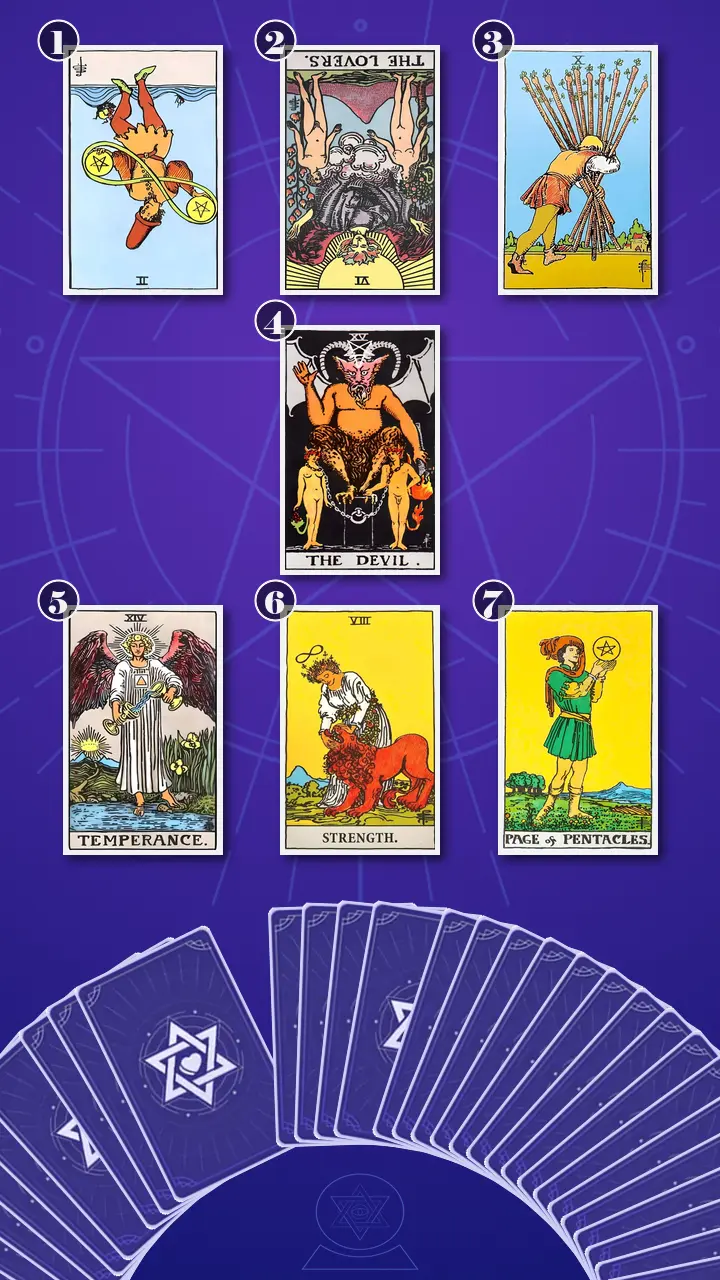
“Today, we’ll use a spread I call the Energy Diagnostic Map (7) · Context Edition,” I said.
If you’ve ever Googled how tarot works and ended up with vague answers, here’s the straightforward version: spreads are structures. This one is built for repeating loops—especially ones that cross domains like money, burnout, and dating. A payday spiral isn’t a single decision; it’s a system with a trigger and a predictable crash. So instead of a timeline, we use a diagnostic.
This spread keeps the reading coherent by separating: (1) your surface pattern, (2) your inner tug-of-war, (3) external pressures, and then it puts (4) the core blockage in the center—the knot that ties everything together. The bottom row translates insight into something useful: (5) resources you already have, (6) the transformation pivot, and (7) a grounded next step you can try within a week. You leave with an experiment, not a prediction.
“We’ll start with what payday looks like on your phone and in your body,” I said, “then we’ll find the knot, and then we’ll design a reset that doesn’t rely on white-knuckling it.”
Reading the Circuit: From Juggling to Chains
Position 1: The Surface Pattern After Payday
“Now we turn over the card that represents your surface pattern after payday: the most observable behavior spiral.”
Two of Pentacles, reversed.
I angled the card toward her. “This one always makes me think of having ten browser tabs open—bank app, shopping cart, group chats, dating app, calendar—and your laptop fan is screaming. The Two of Pentacles reversed is that moment when juggling becomes over-juggling.”
I used the exact modern translation that fit her life: payday afternoon, bouncing between the banking app, a cart, and multiple chats, making fast micro-decisions to keep the high going. Then midweek hits, and the tracking stops—not because you don’t care, but because the system in your body is overloaded.
Energetically, reversed here is a blockage—not a lack of skill. It’s rhythm collapsing. You’re trying to move money, time, and connection all at once, and the pace is too fast to sustain.
Jordan let out a laugh that wasn’t happy. It had a little bite to it. “Okay, wow,” she said, shaking her head. “That’s… too accurate. Like, almost rude.”
“I know,” I said softly. “But here’s the good news: if the pattern has a sequence, it’s not random. And if it’s not random, we can catch it earlier.”
Position 2: The Inner Tug-of-War
“Now we turn over the card that represents your inner tug-of-war: stability and rest versus excitement and connection.”
The Lovers, reversed.
Jordan’s eyes flicked up fast, like she already knew where this was going.
“This isn’t about romance as a fantasy,” I said. “The Lovers is about alignment—what you choose when you’re rested and clear. Reversed, it’s what you choose when you’re tired and urgently trying to feel okay.”
I named the scenario as it shows up now: accepting a date or a night out because being wanted feels safer than being alone, even if it costs your sleep, budget, or standards. The next day, you realize the choice didn’t match what you actually value—calm, consistency, mutual effort.
Reversed here is an energy of deficiency—not enough connection to your own values in the moment of decision. Your “higher self” perspective (the angel on the card) gets drowned out by the serpent’s temptation: reassurance right now.
I kept my voice plain. “A ‘yes’ that costs your tomorrow isn’t a real yes.”
Jordan swallowed, her fingers tightening around the paper cup. “If my calendar is empty,” she admitted, “my brain treats it like an emergency.”
“That’s the inner conflict in one sentence,” I said. “Not ‘Do I want love?’ but ‘Can I sit with one quiet night without turning it into a crisis?’”
Position 3: The External Pressures
“Now we turn over the card that represents external pressures: what in your environment amplifies the cycle.”
Ten of Wands, upright.
“This card is pure overload,” I told her. “It’s carrying your week like a bundle you can barely see around. And when your view is blocked, you don’t make values-based choices—you default to whatever changes your state fastest.”
In modern terms: Slack after-hours pings, the expectation to be responsive, the cost of living that makes every plan a price tag, and the constant background hum of comparison—IG stories, rooftop patios on King West, everyone looking like they’re thriving. This is your decision fatigue engine.
Upright here is an energy of excess. Too many wands. Too much “on.” It turns payday into the only moment you feel allowed to reward yourself, which makes the binge-and-crash more likely.
Jordan nodded slowly. Her shoulders rose toward her ears without her noticing.
“Before we go to the center,” I asked, “when does the pressure hit hardest? Is it right after work? Late night? Midweek?”
“Thursday,” she said immediately. “Thursday is when I start bargaining with myself.”
Position 4: The Core Blockage
“Now we turn over the card at the center—your core blockage: the mechanism that binds budget blowups, burnout, and reactive dating into one loop.”
The Devil, upright.
I didn’t dramatize it. The Devil doesn’t need theatrics. It needs honesty.
“This isn’t a character flaw. It’s a loop with a trigger,” I said, using the phrase the way I use it for customers who think they’re the only ones who do this. “The Devil is what happens when you start using ‘Buy Now’ and ‘Plan confirmed’ as emotional regulation buttons—fast relief with hidden fees later.”
I described it like a phone screen montage, because that’s how it lives now: banking app → shopping cart → group chat → dating app → calendar refresh. And in between each tap, the body cue: jaw tightens, stomach drops, shoulders climb. That’s the moment the chain tightens.
The Devil upright here is bondage through reactivity: stress makes you spend or overbook; spending and overbooking makes you tired; tired makes you crave reassurance; reassurance-seeking leads to more spending and faster yeses. The next morning, the discomfort returns—plus consequences—so your brain drafts a harsher rule set, which then backfires into another rebound.
Jordan went very still. Not blank—more like she was replaying a week in her mind at 2x speed.
“I hate that this is me,” she said quietly.
“I hear that,” I replied. “But naming it is how the exit appears. Notice something important in the card: the chains are loose. The moment you see the mechanism, you’re already not fully inside it.”
When Temperance Poured Between Two Cups
Position 5: Usable Resources
“Now we turn over the card that represents your usable resources: what already exists in you that can stabilize the system.”
Temperance, upright.
The whole feeling at the table changed. Maybe it was the late-afternoon light softening. Maybe it was Jordan’s shoulders lowering half an inch. Either way, Temperance always shifts the sensory palette for me: slower, quieter, like the café after the lunch rush when all you can hear is the espresso machine settling.
“Payday doesn’t have to be a dopamine event. It can be a landing,” I said.
Temperance upright is balance. It’s not “no fun.” It’s fun you can recover from. In her modern-life scenario, it’s a blended week plan: one intentional treat, one intentional social plan, one intentional recovery block—and protecting all three like they matter equally.
“You have this capacity already,” I told her. “You’ve just been treating moderation like deprivation. Temperance is the opposite. It’s integration.”
Jordan exhaled—an actual release. “That sounds… doable,” she admitted. “Not miserable.”
When Strength Put a Calm Hand on the Lion
Position 6: The Key Transformation
“We’re turning over the most important card in this reading,” I said, and I meant it. “This one represents your key transformation: the mindset that breaks the loop without relying on willpower alone.”
Strength, upright.
Right away, I watched Jordan’s eyes go to the lion, then to the woman’s hands. People always expect Strength to look like force. It rarely does.
In modern life, this is that moment right before you check out, say yes to drinks, or start a late-night swipe session: you notice the urge in your body (tight jaw, restless chest), and you choose a slower option without shaming yourself. It’s self-trust built by repetition.
Strength upright here is steady regulation—not suppression. The “lion” isn’t your desire. It’s your urgent need for relief. Strength doesn’t kill the lion. She trains it to stop yanking you down the street.
This is where my café brain always joins my tarot brain. I’ve been opening the doors before sunrise for twenty years. I know what happens when you try to rush extraction: bitter, chaotic, too hot, too fast. So I offered Jordan one of my signature lenses—what I call Sacred Timing. In coffee, there’s a narrow window when the flavor peaks. In your nervous system, there’s a window after an urge hits when you can either react—or let it crest and pass just enough for you to choose.
And then I brought in the other tool I’m known for, Grounds Divination: “When you pour espresso, the grounds leave a pattern,” I said. “Not because they’re magic—because they show you flow. Your payday spiral leaves sediment too: the same taps, the same bargaining phrases, the same jaw tension. Strength is learning to read the sediment early, before you’ve already spent the money or booked the night.”
Stop trying to outsmart the spiral with more rules; start taming it with quiet courage and consistency—like Strength’s calm hand on the lion.
We let the sentence sit between us, like a cup set down gently on a saucer.
Setup (the trapped moment): I could see Jordan’s mind at the exact second after payday hits—relief flipping into urgency, filling carts and calendars like silence is dangerous, telling herself she just needs one more plan or one more “upgrade” to feel okay.
Reinforcement (the body-level shift): Jordan’s reaction came in layers. First, a brief freeze—her breath paused, her fingers hovering above the rim of her cup like she forgot what she was holding. Then her gaze unfocused, not zoning out but turning inward, as if she was replaying a recent moment: her thumb over Apple Pay, the tiny rush, the immediate dread. Finally, her shoulders dropped in a slow wave, and her jaw unclenched so suddenly she pressed her lips together like she was surprised by the sensation. “But…” she started, and there was a flash of anger under the vulnerability, “if I’m not stricter, doesn’t that mean I’ve been doing it wrong? Like I needed rules and I just—failed?”
I kept my voice calm. “It means you’ve been trying to solve a nervous-system problem with a punishment strategy,” I said. “And it’s not working because you’re not lazy—you’re overloaded. Self-trust isn’t built by punishment. It’s built by repeatable gentleness.”
“Now,” I asked her, “use this new lens and look back at last week. Was there a moment—right before a checkout, right before agreeing to a late date, right before a 10:57 PM swipe—where a 20-minute pause would have changed how you felt?”
She nodded, eyes bright. “Wednesday. I said yes too fast. I didn’t even like him like that. I just… didn’t want the night to feel empty.”
“That,” I said quietly, “is you stepping from restlessness and self-judgment toward steadier self-trust. Not perfect. But real.”
Position 7: The Next Grounded Step
“Now we turn over the card that represents your next grounded step: one practical action within a week.”
Page of Pentacles, upright.
“This is apprentice energy,” I told her. “Not ‘be fixed by Monday.’ More like: learn a skill.” The Page is focused attention—one pentacle held with care, instead of a dozen reactive options.
In her world, it looks like one simple system for seven days: a Payday Landing ritual, one recovery night, one dating boundary—tracked with a tiny checklist in Notes. Stability as practice, not a personality trait.
I tapped the card gently. “Pick one small rule you’ll actually keep—even on a tired Thursday.”
The One-Week Reset: Actionable Advice for the Payday Spiral
Here’s the story your spread told, start to finish: after payday, you’re in Two of Pentacles reversed—juggling too many tiny choices too quickly, until you drop tracking altogether. Inside, The Lovers reversed pulls you toward reassurance instead of alignment, so dating and plans become a shortcut to feeling chosen. Outside, the Ten of Wands piles on pressure—work, cost-of-living, social momentum—until you can’t see what matters. In the center, The Devil binds it all into a compulsion loop: you use spending and booking as a lever to change your state fast, then you feel trapped by the consequences. Temperance shows you the stabilizer you already have—pacing, blending, designing a week you can recover from. Strength is the pivot: gentle, consistent self-regulation. And the Page of Pentacles lands it into a small practice you can repeat.
The cognitive blind spot I want you to notice is this: you’ve been treating payday like a test of whether you’re okay. So you try to “prove” you’re okay with a cart, a calendar, or a match. But that turns stillness into risk—so the loop keeps winning.
The transformation direction is clear: shift from using payday as emotional anesthesia to using it as a values-based reset—with one small, grounded commitment in each area (money, rest, connection).
I gave Jordan three small experiments—simple enough to do in a high-cost city, in a real work week, without pretending she’ll suddenly become a monk.
- The 15-Minute Payday LandingOn payday, before you browse or say yes to plans: set a timer for 15 minutes. Move one fixed amount to bills/savings first. Then choose one planned treat (under a cap you decide) and one planned social plan for the week. Write both in your Notes app.If 15 minutes feels impossible, do a 5-minute version and only move the bills/savings amount. You’re building a landing, not performing a full life overhaul.
- The 24-Hour Date + Spend BufferIf a date idea costs both money and sleep (late drinks, Uber, outfit pressure), wait 24 hours before committing. Offer a logistics-only alternative: “That night doesn’t work—want to do Saturday afternoon for a coffee walk?”No explanation required. Boundaries land better when they’re calm and practical.
- One Recovery Night (Protected Like a Meeting)Block one night this week (e.g., Tuesday 7:30–10:30 PM). Phone on the charger across the room. Simple food. The goal is “tomorrow-me comfort,” not productivity. If you live with roommates, tell them: “I’m taking a quiet night.”Use my café-style Energy Cleaning closing ritual at home: wipe one counter, dim the lights, and make one warm drink. You’re teaching your body that the day can end without earning it.
To make it stick, I offered Jordan one more tool from my own strategy kit: Aroma Anchoring. “Pick one scent,” I said, “that becomes the signal for ‘I’m safe to slow down.’ Maybe it’s a specific tea, a cinnamon candle, or even the smell of fresh coffee. Use it only on Recovery Night or during your Strength pause. Your brain learns faster with cues.”

A Week Later: The Quiet Proof
Five days later, Jordan messaged me a photo—not a dramatic transformation, just a Notes app screenshot with four tiny checkboxes and one line at the top: Experiment Log (not a verdict).
Under it: “Bills moved ✅ / Treat chosen ✅ / Recovery night protected ✅ / ‘Saturday afternoon coffee walk?’ sent ✅.”
She added: “I still wanted to swipe at 11, and I still felt that itchy FOMO. But I did the 20-minute pause, made tea, and my jaw unclenched. I went to bed. I woke up and didn’t hate myself.”
That’s what I love about this kind of tarot reading. It doesn’t promise a perfect life. It offers a map out of decision fatigue and into something steadier—a rhythm where money, recovery, and dating choices support each other instead of fighting for dominance.
When the deposit hits and you suddenly feel both excited and terrified—like you have to buy, book, or be chosen right now—it’s not because you’re broken; it’s because stillness has started to feel like risk.
If payday didn’t have to be a rush to prove you’re okay, what’s one tiny choice you’d want to try—just once—that would make tomorrow morning feel a little more like home in your own body?
This story is adapted from psychological research, written so that those in a similar struggle can see their own pattern in it — and find their next step clearly.These insights are not a substitute for professional psychological, medical, legal, or financial advice.
Learn more about our Journey to Clarity.
How did this insight land for you?
🫂 This Resonates Deeply
🌀 Living This Story
✨ Now I See Clearly
🌱 Seeing New Possibilities
🧰 Useful Framework
🔮 The Confirmation I Needed
💪 Feeling Empowered
🚀 Ready for My Next Step
Author Profile
 AI
AI“For twenty years, I’ve listened to stories unfold over the warm aroma of coffee. I don’t believe life’s complexities always require grand theories to be solved; often, we just need a safe place to tidy up our reality. I don’t offer high-minded preaching—just grounded, heartfelt insights to help you regain your sense of control amidst the clutter of daily life.”
In this Personal Growth Tarot Reading :
Core Expertise
Service Features
Also specializes in :
Explore Related Patterns:
Reassurance SeekingJordan names the emotional logic directly when she admits that an empty calendar feels like an emergency. In that moment, a date, a match, or a confirmed plan stops being just a choice and starts functioning as evidence that she is okay. Reassurance Seeking shows up because the story keeps linking being wanted with feeling safe. The nervous system asks for proof right now, and the fastest proof available is external: someone says yes, a group chat includes her, a dating app gives a signal, the night is no longer empty. The trap is that reassurance reduces anxiety briefly without answering the deeper question. You may feel calmer when the plan is confirmed, but if the decision costs sleep, budget, or standards, the next morning brings a new wave of self-doubt. The useful audit question becomes not whether you want connection, but whether the connection is aligned or simply being used to quiet the fear of being alone.
Social OverextensionJordan's quick yes to dinner, dates, and late plans shows a social pattern that starts before the actual event. The trigger is the empty night: when the calendar opens up, her brain reads the space as an emergency, so saying yes becomes a way to shut down the alarm. Social Overextension fits because the problem is not that she likes people or wants connection. The pattern is that connection gets used as a regulation tool when stillness feels unsafe. A plan can be fun, but in this loop it also becomes proof that she is wanted, included, and not alone. The cost appears the next day, when the choice no longer matches her values around rest, budget, standards, or mutual effort. You can see the mechanism most clearly in the moment she says yes to someone she does not even like that much because she does not want the night to feel empty. That is not a failed social life; it is an overloaded nervous system outsourcing safety to a full calendar.
Avoidance CopingJordan's spending, booking, and swiping all cluster around the same uncomfortable state: overload mixed with the fear of stillness. When the body is tired and the calendar is quiet, changing the state quickly starts to feel more important than choosing well. Avoidance Coping fits because the behavior is not random distraction; it is a strategy for escaping a feeling. Shopping avoids the drop after burnout, plans avoid the fear of an empty night, and stricter rules avoid the vulnerability of asking what she actually needs. The problem is that avoidance works just long enough to become convincing. It postpones loneliness, fatigue, or uncertainty, then returns them with interest. The next step is not more punishment; it is learning to stay with the uncomfortable signal long enough to choose a response that does not create a bigger crash.
Compulsive ConsumptionJordan's direct deposit does not simply land as money; it lands as a pressure valve. The banking app, shopping cart, group chat, dating app, and calendar refresh become a chain of fast state changes, where each tap gives a small hit of relief before the hidden cost shows up later in the week. That is the mechanism behind Compulsive Consumption here: buying is not framed as greed or lack of discipline, but as emotional regulation under overload. The Sephora or SSENSE checkout is trying to convert burnout, comparison pressure, and loneliness into something immediately controllable. The pattern becomes costly because the relief is short-term while the consequences are delayed. You get the rush of feeling resourced, attractive, included, or upgraded, then Thursday arrives with a tighter budget, a tired body, and a harsher inner rulebook. Seeing that sequence clearly gives you a cleaner next step than shame: interrupt the state-change chain before the checkout becomes your nervous system's shortcut.
Emotional RegulationJordan's turning point happens in the seconds before checkout, drinks, or late-night swiping, when she notices the tight jaw and restless urgency instead of obeying them. The story does not ask her to erase the urge; it asks her to build a different response to it. Emotional Regulation is the upright pattern because the new behavior creates a workable gap between body cue and action. The 20-minute pause, the 24-hour date and spend buffer, the recovery night, and the scent anchor all teach the nervous system that relief does not have to arrive through immediate purchase or immediate validation. This is regulation rather than suppression. You still want to swipe at 11, and you may still feel itchy FOMO, but the practice gives you a way to let the urge crest without turning it into another cost. The pattern becomes stronger through repetition: one slower choice that makes tomorrow morning more livable.
Urgency BiasJordan's payday sequence is fast: direct deposit, shopping cart, group chat, dating app, calendar. The speed matters because the decisions are not being made from a settled values system; they are being made inside a narrow window where relief feels urgent. Urgency Bias fits the moment when reassurance right now outranks tomorrow morning. The checkout, the dinner, the late swipe, or the date confirmation all promise immediate state change, while the delayed cost to sleep, budget, and self-respect becomes easier to ignore. This pattern is not about being careless. It is about the nervous system treating delay as danger. The 20-minute pause works because it creates a small space between urge and identity: you can notice the tight jaw, the restless chest, or the fear of an empty night before the fastest option becomes the automatic one.
Values-Based Decision MakingJordan already knows the values that keep getting overridden: financial stability, real rest, calm, consistency, and mutual effort. The reset works because it does not remove pleasure or connection; it gives those choices a structure that can survive the week. Values-Based Decision Making is the upright pattern in the one-treat, one-social-plan, one-recovery-block design. Instead of letting payday decide for her through dopamine and urgency, she gives money, rest, and connection equal status before the spiral starts. This matters because the old loop treats moderation like deprivation. The new pattern reframes moderation as integration: fun you can recover from, dating that does not erase tomorrow, and spending that does not become emotional anesthesia. You are not trying to become a different person after payday; you are choosing from the person you are when you are clear.
Self-Judgment LoopJordan's crash does not end the loop; it creates the next version of it. After the spending, overbooking, and fatigue catch up, her mind drafts a stricter rule set and reads the relapse as personal failure. Self-Judgment Loop fits because shame becomes part of the regulation strategy. Instead of asking what the payday trigger is doing to her body and attention, the mind turns the whole pattern into a verdict: if she were stricter, better, or more disciplined, this would not happen. That judgment increases pressure, and pressure is already one of the engines of the spiral. You can see the pivot when she asks whether gentleness means she has been doing it wrong. The more useful frame is that punishment has been trying to solve a nervous-system problem, and the evidence in the story shows it is not the tool that breaks the cycle.
FOMOJordan's environment keeps feeding her comparison cues: IG stories, rooftop patios, group chats, and the sense that everyone else is thriving. Those signals make a quiet night feel less like recovery and more like evidence that she is missing something. FOMO fits because the pressure is not only internal. Social momentum turns every plan into a status signal, while cost-of-living pressure makes each yes carry a price tag. The nervous system gets caught between wanting rest and fearing exclusion. The pattern is clearest when an empty calendar becomes a crisis. You are not just deciding whether to go out; you are defending against the feeling that stillness means being left behind. Naming FOMO helps separate the actual invitation from the imagined emergency around it.
Explore Related Struggles:
False Recovery LoopThe direct deposit lands at 12:06 PM, and the week starts moving through the same sequence: bank app, shopping cart, group chat, dating app, calendar refresh. Each tap offers a fast shift away from work pressure and private burnout, but by Thursday the same choices return as a tight jaw, lost tracking, takeout, Slack pings, and another exhausted night over a laptop. The friction is that the recovery tools are doing the opposite job. A checkout, a dinner, or a confirmed date imitates relief for a few hours, then creates a tomorrow that needs more recovery than before. You are not just spending money or making plans; you are trying to borrow calm from the future, and the future keeps charging interest. The exit begins at the smallest visible link in the chain. Before checkout, before a fast yes, before the late-night swipe, you can ask whether the choice actually restores you or only changes your state until the next crash.
Security-Connection SplitThe contradiction is stated plainly at the table: Jordan wants financial stability and real rest, while also being scared she will miss out or end up alone. A dinner, a date, or a group chat yes becomes a way to feel connected, but the cost shows up in sleep, budget, standards, and the next day's crash. You are caught between two forms of safety. One safety says a steadier week will protect you; the other says being wanted tonight will protect you. Because both needs are real, the split cannot be solved by shaming the part of you that wants connection. The next step is to make connection stop requiring a self-abandoning price. A quieter plan, a cheaper plan, a daytime coffee walk, or one protected recovery night lets belonging remain available without making your whole week pay for it.
Urgency-Compass FusionJordan can name what she values when she is seated in the café: calm, consistency, mutual effort, a week she can recover from. At the decision point, though, the phone is bright, the body is wired-tired, and reassurance right now starts speaking louder than the values she actually trusts. The struggle forms when urgency stops acting like a signal and starts acting like a compass. You are not choosing from the full map; you are choosing from the narrow lane created by stress, FOMO, social comparison, and the fear of an empty night. That is why the choice can feel necessary in the moment and misaligned the next morning. A pause matters because it gives your real compass time to come back online. The goal is not to erase desire, spending, or dating; it is to stop letting the fastest feeling become the final authority.
Rest-Permission SplitJordan says yes so she will not be the person with an empty night. Later, she admits that when her calendar is empty, her brain treats it like an emergency, and the story shows that emergency feeling pulling her toward late swiping, fast dates, and plans she does not actually want. Rest becomes a choice that has to defend itself. A quiet night should be recovery space, but in this loop it starts to feel like exposure: no plan, no match, no proof that you are wanted, no immediate signal that everything is okay. So the body reaches for motion even when it needs stillness. The recovery night is not a productivity hack; it is a boundary around your right to stop. Protecting one evening teaches the system that silence does not have to be filled before it becomes safe.
Mental Bandwidth DepletionPayday does not arrive as one decision. It arrives as ten tabs at once: banking app, shopping cart, group chats, dating app, calendar, Slack residue, cost-of-living math, and the social comparison running in the background. By midweek, tracking stops because the system has too many inputs moving at once. The struggle is a collapse of decision capacity, not a lack of care. You still care about money, rest, and dating standards, but the mental space needed to hold them together has been crowded out by constant micro-decisions. When the bandwidth drops, the fastest option starts to look like the clearest option. This is why the story's practical reset works as a smaller container. One treat, one plan, one recovery block, and one checklist reduce the number of open loops so your choices can become visible again.
Resource Integration StrainThe same paycheck is being asked to do too many jobs at once. It has to cover bills, prove relief, fund a treat, keep social life alive, make dating feel possible, and somehow leave enough room for recovery after a workweek that has already drained the system. The strain comes from routing different needs through the same payday surge. Money needs pacing, rest needs protected space, and connection needs enough discernment that a yes still belongs to you. When all three move at the speed of one-tap urgency, they start competing instead of supporting each other. A better week is not built by cutting out every desire. It is built by giving each resource its own lane: one fixed money move, one intentional social plan, one recovery block, and one dating boundary that keeps connection from overruling recovery.
Explore Related Emotions:
Inner ClaustrophobiaJordan’s quiet nights do not feel neutral. When the calendar is empty, her mind treats the space as a threat, and the urge to swipe, spend, or book something starts pressing in before she can settle. Inner Claustrophobia captures the strange compression inside that stillness. You technically have space, but it does not feel breathable yet; it feels like being trapped with the possibility that no one is choosing you and nothing exciting is coming. That is why the 20-minute pause matters so much later in the story. It gives the empty night a new shape, turning it from a closed room into a small recovery space where your body can unclench before the next choice is made.
Profound LonelinessWhen Jordan remembers saying yes too fast, the detail that lands hardest is that she did not even like him that much. She wanted the night not to feel empty, and the possibility of being alone with that emptiness moved faster than her standards. Profound Loneliness is the ache underneath the dating spiral. You are not just seeking entertainment; you are trying to avoid the moment when silence starts sounding like abandonment or invisibility. This emotion sits close to the center of the story because it turns rest into risk. A recovery night can only become restorative once the empty space stops feeling like evidence that you have been left alone with yourself.
Relational UrgencyJordan says yes to dinner, dates, and late-night swiping not because every plan genuinely fits, but because an empty calendar starts to feel like an emergency. The story keeps returning to the same relational pressure point: being wanted feels safer in the moment than sitting with a quiet night. Relational Urgency names the emotional charge inside those quick yeses. You reach toward connection at speed because the alternative feels too exposed, too silent, or too easy to interpret as being left out. The cost shows up the next morning, when the choice no longer matches your need for calm, consistency, or mutual effort. The urgency is not proof that you want the plan more than rest; it is the feeling of needing reassurance before you have enough space to ask whether the connection is actually good for you.
Cautious MomentumFive days later, Jordan still feels the late-night urge to swipe and still notices the itchy pull of missing out. The difference is that she uses the pause, makes tea, goes to bed, and wakes up without turning the night into another self-attack. Cautious Momentum captures that small but real movement. You are not fixed, transformed, or suddenly immune to the old loop; you are proving that the sequence can bend before it becomes a crash. The checkboxes matter because they give progress a grounded shape. Bills moved, treat chosen, recovery protected, and a calmer date alternative sent become evidence that steadiness can be practiced in a real week, not just imagined when life is quiet.
Cautious Self-TrustJordan does not leave with a promise that the urge will disappear. She leaves with an experiment log, a pause, and one way to choose differently before checkout, drinks, or a late-night swipe session. Cautious Self-Trust names the careful confidence that starts forming when gentleness becomes repeatable. You are not required to believe in yourself all at once; you collect evidence through small moments where you notice the urge and do not hand it the whole night. The phrase not a verdict matters because it protects the practice from becoming another punishment system. Trust grows because the next choice is allowed to be human, trackable, and repairable.
Directionless UrgencyAfter payday, Jordan moves quickly, but the movement does not have a stable destination. Banking, carts, group chats, dating apps, and calendar refreshes create the feeling of action while the deeper need remains unnamed. Directionless Urgency captures that restless forward motion. You feel pushed to buy, book, answer, or be chosen right now, yet the speed is not the same as clarity. The story keeps asking for a next step because the urgency has been spending your energy without giving you direction. What changes the pattern is not a bigger rule, but a smaller, more deliberate choice that makes tomorrow morning easier to inhabit.
Grounded AgencyJordan’s shoulders lower when the plan becomes smaller and more concrete: one treat, one social plan, one recovery block, and a buffer before choices that cost both money and sleep. The table’s pace changes because the next step is no longer a demand to become a different person overnight. Grounded Agency fits the moment when choice returns to the body. You are not trying to win against every urge through force; you are building a structure simple enough to use while tired. The emotional shift is quiet but important. Instead of payday controlling the sequence, you begin placing a few decisions on the map first, which gives tomorrow-you a voice before the rush starts speaking for everything.
Guilt-Free RestJordan’s recovery night is built from ordinary sensory details: the phone across the room, simple food, dimmed lights, a warm drink, and the jaw finally unclenching. Rest is no longer what happens after every demand has been satisfied; it becomes a protected part of the week. Guilt-Free Rest fits because the story gives the body permission to stop performing readiness. You do not have to earn the end of the day by spending, dating, replying, or proving that you are socially alive. The emotional texture here is soft but disciplined. The quiet night becomes a place where tomorrow-you is cared for, not a punishment for wanting less stimulation.
Relief HungerThe deposit gives Jordan a clean flash of relief, almost like the week finally opens a window. Then the phone sequence begins: Buy Now, plan confirmed, date accepted, calendar filled, each tap offering a quick change in state before the hidden cost arrives. Relief Hunger is the craving underneath that sequence. You are not chasing objects or plans for their own sake; you are reaching for the feeling of being okay right now, especially after a week that has left your body clenched and overloaded. The heaviness after going out matters because it shows that the relief is real but not sustaining. It arrives fast, fades fast, and asks to be renewed, which leaves your future self carrying the emotional interest on choices made in the rush.
Scattered OverwhelmThe direct deposit lands at 12:06, and within minutes Jordan is moving between her banking app, shopping carts, group chats, dating apps, and calendar decisions. The pace is not one clean choice; it is a swarm of tiny yeses that keeps her stimulated until her tracking drops out and her body takes the impact later in the week. That is why Scattered Overwhelm fits this story. You are not simply stressed about money or dating in isolation. The pressure spreads across budget, rest, social visibility, and being wanted, so every small decision starts borrowing energy from the next one. By Thursday, the tight jaw, Slack pings, sweet-salty takeout, and heavy crash show how the inner system has lost its rhythm. The emotional weather is crowded, fast, and hard to organize, as if the week has too many open tabs and no single place for you to land.
Shame SpiralJordan does not only notice the spending, overbooking, and tiredness. She turns the pattern back onto herself, saying she hates that this is her and wondering whether needing gentleness means she has failed at rules. Shame Spiral fits because the consequence becomes an identity verdict. You make a reactive choice, feel the crash, draft a harsher rule set, then use the next rebound as evidence that something is wrong with you. The story interrupts that spiral by naming the mechanism without making it a character flaw. Once the loop can be seen as a pattern of overload and relief seeking, you get a little room to respond without turning every setback into self-punishment.
Decision FatigueJordan’s spiral is built from dozens of small decisions rather than one dramatic mistake. She is choosing what to buy, whether to go out, which message to answer, whether to swipe, how much sleep to sacrifice, and how to keep up while work and cost-of-living pressure keep running in the background. Decision Fatigue fits because the system gets tired before the values disappear. You still want stability, rest, and real connection, but the number of micro-decisions becomes so relentless that the fastest option starts to feel like the only available option. By midweek, tracking stops because the inner bandwidth is gone. The emotional texture is not laziness; it is the drained feeling of having too many domains competing for the same limited capacity.
Explore Related Contexts:
Always On AvailabilityJordan's Thursday evening is not a clean end to the workday: she is still hunched over a laptop while Slack pings keep popping. The story names after-hours messages and the expectation to be responsive as part of the pressure system around her, not as a one-off inconvenience. Always On Availability makes rest structurally difficult because work remains present after the office should be over. The phone and laptop keep the job within reach, so the body stays on alert while the calendar is also trying to hold dating, errands, spending decisions, and recovery. You are dealing with a work environment that does not fully release attention back to the person living the life. This pressure helps explain why payday becomes such a loaded moment. When the week is saturated with responsiveness, the direct deposit can feel like the only clean permission to reward yourself quickly. The faster the work environment consumes recovery space, the more tempting it becomes to use spending and social plans as shortcuts back to aliveness.
Budget Ownership TrialJordan's one-week reset starts with a concrete money move: before browsing or saying yes to plans, she moves a fixed amount to bills or savings, then chooses one planned treat under a cap. The direct deposit becomes something she allocates before it becomes something the apps and invitations can absorb. Budget Ownership Trial fits because the story is not asking for a perfect financial identity overnight. It gives her a controlled test environment: one payday, one cap, one checklist, one week of evidence. You can see the budget shifting from a source of shame into a small system she can actually operate while tired. This is directly tied to the next step in the question. Jordan does not need a harsher rule set that collapses into rebound spending. She needs a simple ownership structure that lets money, rest, and connection coexist before the week gets noisy.
Cost-of-Living PressureJordan is not spending inside a neutral backdrop. The story places her in Toronto, where dinner plans, takeout, Ubers, outfit pressure, and casual dates all carry a real price tag before they become memories or connection. Even the ordinary act of saying yes can mean paying to participate in city life. Cost-of-living pressure turns small social choices into budget events. A dinner is not just dinner when it competes with savings, recovery, and the next workday; a date is not just a date when it adds late-night transport, sleep loss, and presentation costs. You are seeing a city environment where staying connected can quietly drain the same resources that are supposed to create stability. This is central to the question because the budget spiral is not only about impulse. The story shows external prices attaching themselves to belonging, romance, convenience, and relief. Once every plan has a hidden bill, payday becomes overloaded with the task of funding both survival and proof that life is still happening.
Dating App Performance LoopJordan names a specific dating pattern: she says yes too fast, swipes late, and accepts plans even when she does not really like the person that much. In the story, the dating app sits in the same phone circuit as the banking app, shopping cart, group chat, and calendar refresh. Dating App Performance Loop fits because the external platform environment turns romantic attention into something trackable and immediately available. A match, a message, or a confirmed plan can briefly prove that the night is not empty, but the proof comes with logistics: time, money, sleep, outfit pressure, and the risk of lowering standards for immediacy. The issue is not that dating apps exist. The story shows app-based dating becoming part of the payday circuit, where being chosen starts to compete with being rested and financially steady. You are seeing a social marketplace that makes reassurance easy to access and hard to pace.
Social Overcommitment SpiralJordan says yes to dinner because she does not want to be the person with an empty night, then describes stacking dates and plans as if she is trying to outrun something. The story keeps returning to the same social mechanism: group chats light up, dating options appear, the calendar fills, and the later week absorbs the weight. A Social Overcommitment Spiral forms when connection is routed through speed and availability. The external pressure is not simply that people invite her out; it is that urban social life rewards quick responses, visible participation, and a calendar that looks alive. You can see how the same yes that promises relief on payday becomes a claim on sleep, money, and attention by Thursday. This label fits because the spiral crosses domains. It is not just a busy week, and it is not just dating anxiety or budgeting friction. The story shows social participation becoming a system that keeps asking for more commitments than the body, wallet, and work week can realistically carry.
Strategic Dating BoundaryJordan identifies the moment clearly: she said yes too fast on Wednesday, did not even like him that much, and did not want the night to feel empty. The next step offered in the story is equally concrete: wait 24 hours before committing to a date that costs both money and sleep, then suggest a Saturday afternoon coffee walk instead. A Strategic Dating Boundary changes the structure of the dating exchange. It slows the yes down long enough for cost, sleep, standards, and mutual effort to become visible. You are not withdrawing from connection; you are testing whether the connection can survive a calmer, more practical container. This matters because dating is one of the places where the payday spiral expresses itself. A boundary around date logistics protects more than romance. It protects the budget, the next morning, and the ability to choose from alignment rather than from the pressure of an empty calendar.
Strategic Pause WindowJordan is given a precise intervention point before the usual sequence takes over: a 15-minute payday landing, a 24-hour buffer before date or spend decisions, and one recovery night protected like a meeting. These are not vague self-improvement ideas; they are small external structures placed exactly where the loop usually speeds up. A Strategic Pause Window gives the week a visible hinge. It turns the space between deposit and reaction into a practical checkpoint where bills can move first, one treat can be chosen deliberately, and a costly plan can be slowed down before it claims sleep and money. You can use that window to make the next choice less dependent on urgency. The reason this belongs in the story is that Jordan's pattern has a sequence. Since the spiral is not random, the next step does not have to be a total life overhaul. It can be a short, repeatable pause that protects attention before apps, chats, and city pressure start making decisions for her.
Sleep Debt LoopThe story repeatedly prices Jordan's choices in sleep: late drinks, Ubers, outfit pressure, late-night swiping, Thursday laptop time, and Slack pings that keep the week switched on. Rest is not missing because she forgot it; it is being displaced by work demands and social commitments that arrive with stronger claims on the calendar. A Sleep Debt Loop forms when recovery keeps getting borrowed from tomorrow. Each night out, late swipe session, or after-hours work stretch may feel manageable alone, but the combined rhythm leaves Jordan wired, tired, and bargaining with herself by Thursday. You can see the body paying interest through jaw tension, heaviness, and the need for a protected recovery night. This context matters because burnout in the story is not separate from budget or dating. Sleep is the shared resource underneath all three. When it is repeatedly spent, the next payday decision starts from depletion rather than clarity.
Private Recovery WindowJordan's reset includes one recovery night with the phone charging across the room, simple food, and a quiet block protected like a meeting. The story makes this specific because recovery has been losing to Slack pings, dating plans, takeout convenience, and late-night app loops. Private Recovery Window is the external container that gives rest a place to happen. It does not require disappearing from life or performing a wellness routine; it creates one protected pocket where the body is not being asked to work, buy, respond, swipe, or prove anything socially. You can treat that window as infrastructure, not a reward for already having everything together. This is a supporting but important context for the main question. The budget and dating reset cannot hold if the week has no protected recovery space. By giving rest an actual appointment, Jordan changes the environment that keeps pushing her toward fast relief.