A Risk Spreadsheet Gives Way to One Forty-Five-Minute Career Test

The 10:47 p.m. Career-Change Loop
I recognised the pattern as soon as Maya appeared on my screen: a highly competent project coordinator who could keep a complicated client timeline moving, yet could not finish one small career experiment of her own. Career-change paralysis was not showing up as laziness. It was showing up as excellent organisation pointed in the wrong direction.
It was 10:47 on a Tuesday night in Toronto. Maya sat at her kitchen counter with a job listing open beside a spreadsheet of salaries, commute times, skill gaps, and possible failure points. The laptop fan whirred; the radiator clicked behind her; a mug of tea had gone cold enough to leave a bitter film on her tongue. As I watched through the video call, she added another column, raised both shoulders towards her ears, closed the listing, and reopened tomorrow's task tracker for the role she already believed was wrong.
“I know this job isn't right,” she told me. “But at least I know how it isn't right. Every other path feels like a gamble.”
That was the contradiction sitting between us: leaving a familiar but misaligned role felt more dangerous than remaining in it, because familiar dissatisfaction came with known numbers while the unknown could be filled with unlimited consequences. The feeling moved through her body like a seat belt ratcheting tighter each time she reached an unfamiliar requirement. Her chest shortened around each breath, her jaw hardened, and the energy that had briefly lifted when she found an interesting role drained back into tomorrow's project plan.
“I don't think you're failing to take your career seriously,” I said. “I think you're trying to make uncertainty disappear before you permit yourself to touch it. We won't ask the cards to choose a job for you. Let's use them to draw a map of how your risk calculation is working, then find one part of the fog you can examine without surrendering your income or your agency.”
Choosing a Compass for the Dim Platform
I invited Maya to place both feet on the floor and take one unforced breath. I shuffled slowly while she held the question in mind. I treat this small ritual as a transition of attention, not as theatre: it gives the nervous system a moment to stop answering emails and begin observing the decision itself.
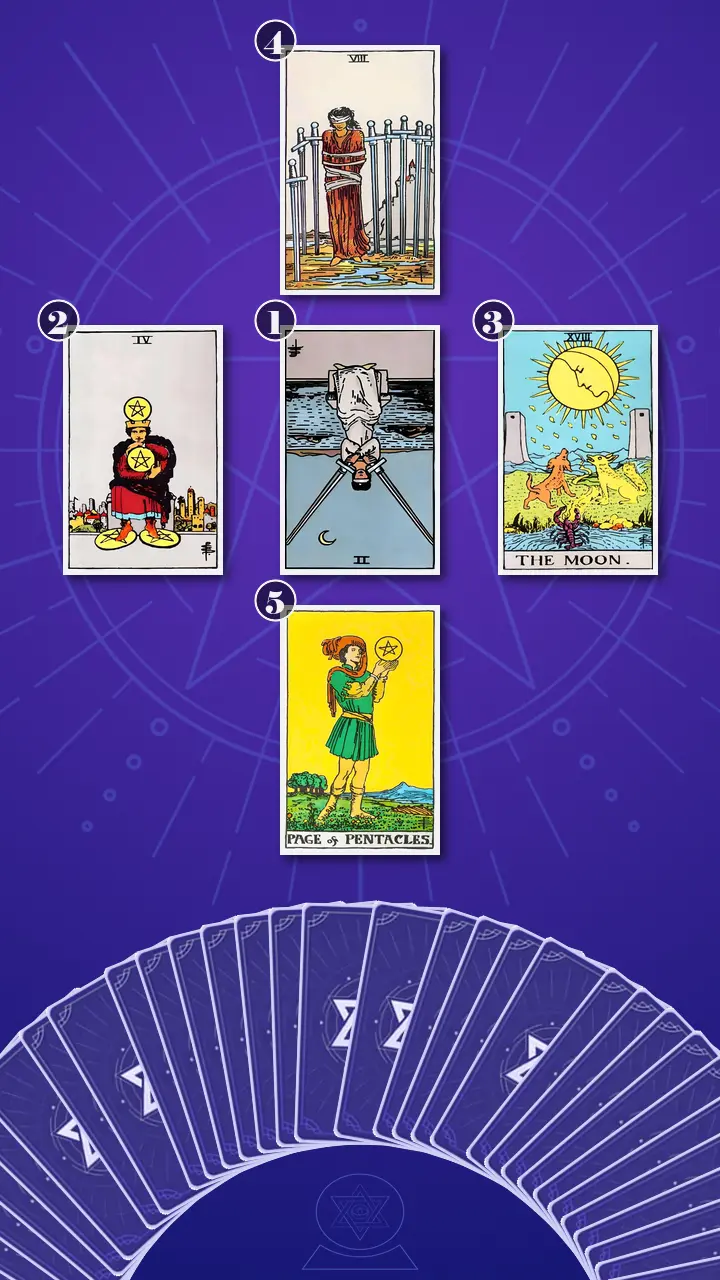
I chose a five-card Decision Cross tarot spread. It is a compact career decision tarot spread designed to compare two options without asking tarot to predict the future. A Celtic Cross would have introduced more background than this question required. The Decision Cross could hold the active stalemate, the familiar role, the unknown path, the hidden belief shaping both, and a practical principle for moving forward.
I placed the first card at the centre. The familiar option would sit to its left and the unknown path to its right. Above the centre, I would look for the unseen frame distorting the comparison. Below it, I would place the grounding card: not an order and not a prophecy, but a criterion Maya could use when choosing her own next step.
This is how tarot works in my practice. The images give us stable symbols to examine, while card meanings in context help turn a vague sensation into a visible pattern. The cards do not remove uncertainty. They let me ask more precise questions about what is fact, what is projection, and where the querent still has room to move.
Reading the Cross Between Staying and Leaving
The Central Knot: Two Screens Held Open
I began with the card representing Maya's observable decision pattern: repeatedly reopening the career question without converting thought into a bounded action. I turned over the Two of Swords, reversed.
In the traditional image, a blindfolded figure holds two crossed swords in a fragile equilibrium. Reversed, that air energy had become congested and unstable. The attempt to preserve balance was no longer protecting Maya; it was consuming her attention. She was trying to maintain two incompatible browser sessions at once: a resignation timeline on one side, tomorrow's current-role task list on the other, with a salary spreadsheet appearing whenever the pressure became too sharp.
I brought her back to 10:47 p.m. She had added another risk column, sent two friends slightly different versions of the same question, and closed everything without booking a conversation or trying a sample task. The inner rule sounded reasonable: “If I compare the options for long enough, perhaps I won't have to choose anything until certainty arrives.” Closing the tab delivered a few minutes of relief, but the next morning she paid for that relief with less energy and no new evidence.
“Research feels responsible until it becomes a substitute for contact,” I said. “You have been asking analysis to produce the certainty that only experience could begin to produce.”
Maya gave a short laugh, but there was no amusement in it. Her fingers tightened around the cold mug before she said, “That is so accurate it feels a little brutal.”
“Accurate doesn't have to mean accusatory,” I replied. “This pattern probably developed because it gave you a temporary sense of control. We can respect why it exists and still notice that it is no longer doing the job you hired it to do.”
I also named the reversal's overcorrection risk. Ending the pressure did not require Maya to resign suddenly or force an all-or-nothing answer. That would only replace prolonged indecision with an unnecessarily expensive decision. The useful invitation was smaller: define one reversible choice that could be completed without solving her whole career.
The Familiar Option: What the Paycheque Really Protects
I next turned the card representing the current role as the familiar option, including the genuine stability it provided and the possibility that those benefits had become reasons to remain completely fixed. It was the Four of Pentacles, upright.
I pointed to the figure clutching one pentacle against the chest while pinning two beneath the feet. The earth energy here was useful conservation beginning to harden into excess control. Maya's salary covered Toronto rent and regular expenses. Her benefits, known routine, and reputation for competence were real resources. I would not call her materialistic or cowardly for protecting them.
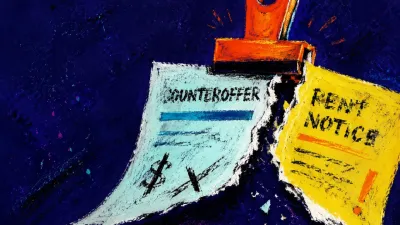
I asked her to recall the rent debit notification she had seen in her condo lobby. In that instant, she told me, the paycheque, benefits, weekly structure, and identity of being “the organised one” had fused into a single package. Her private sentence had been, “I'm not attached to this job. I'm protecting everything it currently pays for.”
“That distinction matters,” I said. “But the card asks a second question: which protections genuinely need to survive, and which have become attached to this exact job simply because the package is familiar? Stability can be a resource you carry into exploration. It does not have to be a structure you are forbidden to question.”
I thought briefly of Severance, not as a dramatic comparison but as a useful shorthand for the split Maya described. She was highly capable inside a professional identity that increasingly felt disconnected from the person living outside it. Accepting another visible project preserved that competent identity, but it also consumed the weekend energy she needed to investigate another one.
Her shoulders lowered by perhaps half an inch. She nodded once and said, “Thank you for not telling me to just quit. Sometimes career advice makes rent sound like a limiting belief.”
“Rent is not a limiting belief,” I said. “It is a number. Our work is to stop that number from being bundled with every untested forecast about what else might be possible.”
The Unknown Path: When One Blank Becomes an Ending
I crossed the centre and turned the card representing the unknown path, showing what was genuinely unclear and what Maya's mind was projecting into the missing information. The card was The Moon, upright.
The Moon carries water energy: instinct, emotion, partial visibility, and the strange enlargement that happens when the road ahead cannot be fully surveyed. I directed Maya's attention to the path disappearing between two towers. The image did not certify that the path was safe, but neither did it announce danger. It showed enough road for another section to exist, while refusing to provide a complete forecast from the starting point.
Maya described a rainy Saturday in a Queen West cafe. She had found a role that genuinely interested her until she reached one unfamiliar tool in the requirements. The espresso grinder shrieked; rain stippled the window; her breathing became shallow. Within seconds, that single gap had expanded into rejection, unemployment, depleted savings, and proof that she could not trust her judgement. The listing had supplied one unknown. Her mind had supplied an entire ending.
“An unanswered question is not the same thing as a confirmed threat,” I said. “Limited visibility tells you where to gather information. It does not tell you what the information will be.”
This was where I used what I call Historical Crossroad Matching. Years at Cambridge and on archaeological digs taught me to be careful with blank spaces in a record. An absence of evidence is not a licence to invent either disaster or triumph. At genuine historical turning points, people rarely possessed a complete map; they reduced uncertainty through scouts, test routes, local knowledge, and bounded commitments. The scale of Maya's career decision was different, but the structure was recognisable. She had been treating an uncharted section like a marked cliff.
“So my fear isn't fake,” Maya said slowly. “But it also isn't a report.”
“Exactly. The feeling is real. The forecast remains unverified.”
Her eyes moved back to the winding path on the card. I watched the defensive speed leave her face and give way to a quieter question. She was no longer arguing that the whole road was safe. She was beginning to wonder what one requirement actually involved.
The Hidden Frame: Every Barrier Marked in Red
I then turned the card representing the limiting belief beneath both options: the assumption that incomplete information meant loss of control, and that the current role was therefore the only viable source of safety. It was the Eight of Swords, upright.
The sword energy had become excessive again, but now it formed a closed interpretive system. The blindfold echoed the central Two of Swords. Loose bindings surrounded the figure, while an uneven ring of blades left open ground nearby. I did not read that open ground as proof that every constraint was imaginary. I read it as a demand for differentiation.
Maya's spreadsheet highlighted skill gaps, salary questions, available time, job titles, and fears about becoming a beginner in the same red. Her current title was treated as the only employable version of her. Weekday fatigue was treated as proof that no experiment could fit anywhere. A missing skill and a catastrophic career outcome received the same visual status.
“Not every barrier is fixed,” I said. “Some are negotiable, learnable, unclear, or imagined. If you label all five categories as impossible, the spreadsheet stops measuring risk and starts manufacturing enclosure.”
Her breath paused. Her thumb remained suspended above the mug handle, and her eyes lost focus as though she were replaying the red rows one by one. Then she exhaled from low in her chest and let her hand fall open on the counter.
“Time is the one that feels absolute,” she said. “But I gave most of Saturday to a project I agreed to because saying yes was easier than being new at something.”
“That doesn't mean time is unlimited,” I replied. “It means the constraint may be partly fixed and partly allocated. Those are different problems, and they deserve different responses.”
I had the familiar archaeological image of a wall emerging from compacted soil. From above, the whole layer can look like one solid obstruction. Careful excavation reveals separate strata, each formed at a different time and carrying different evidence. Maya's barriers needed the same treatment. A salary floor, a learnable software tool, a question for someone in the field, and a feared future were not one wall merely because they occupied the same spreadsheet.
When the Page Lifted One Clear Thing
The Grounding Card: Permission to Be a Practical Beginner
The room seemed to become quieter when I reached the card representing guidance: the decision principle that could replace catastrophic projection with direct evidence. I turned over the Page of Pentacles, upright.
Unlike the two blindfolded figures, the Page's eyes were open and steady. The Page did not scan an invisible horizon for every possible danger. The gaze rested on one pentacle held at eye level. After congested air, rigid earth, uncertain water, and restrictive air, this was earth energy in balance: practical curiosity, patient learning, and one tangible object of study.
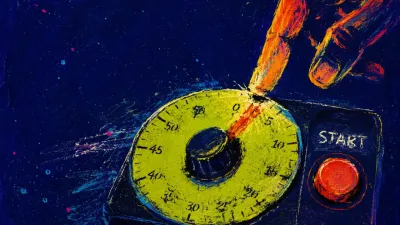
I asked Maya to imagine choosing one possible direction, opening a public sample brief, setting a forty-five-minute timer, and trying the smallest realistic part of the work. No course purchase. No LinkedIn announcement. No application or resignation. When the timer ended, she would record what held her attention, what drained her, what became clearer, and what evidence she needed next. Beginner status would become a learning position rather than a verdict on her competence.
I then asked her to picture 10:47 p.m. once more: the job listing open beside the risk spreadsheet, one unfamiliar requirement turning into three imagined disasters, her shoulders rising, and the tab closing just before tomorrow's familiar task tracker made her chest sink.
This was the moment for my Enduring Value Assessment. I asked which parts of the decision would still matter after the immediate fear had passed. Her need for a financial floor would endure. Her ability to learn from direct contact would endure. Her wish for work that did not make her feel smaller would deserve examination. The midnight demand for a complete guarantee was urgent, but urgency did not make it durable or useful.
On an archaeological dig, I do not excavate an entire city before deciding whether a layer contains evidence. I open a bounded test trench, document what appears, and let contact with the ground revise the map. The Page offered Maya the same logic. A career experiment was not a miniature resignation. It was a test trench.
You do not need certainty before moving; you need one practical experiment that creates evidence, like the Page lifting a single pentacle into clear view.
I let the sentence rest between us, then added, “You do not need a verdict on your whole future. You need one small encounter with the work that gives your fear some actual evidence to answer to.”
For two beats, Maya did not move. Her breath stopped high in her chest, and her fingers hovered over the spreadsheet as though the next click had become unexpectedly consequential. Then her eyes shifted away from the screen and softened, not with instant relief but with the look of someone replaying months of late-night research under a different light. Her jaw loosened. Her shoulders descended. A thin line of red appeared around her eyes before she gave one unsteady exhale. “But doesn't that mean I've wasted all this time trying to solve the wrong problem?” she asked, with a flash of frustration under the sadness. I told her the research was not evidence of failure; it had identified what she cared about and where her fear concentrated. It simply could not complete the next stage of the work. She rubbed both palms over her face, laughed once, and said, “This is a relief, but also weirdly exposing. Now I actually have to try something.” I nodded. “Now, using this new perspective, think back to last week. Was there a moment when this insight might have made the situation feel different?”
She remembered the Wednesday morning when her manager offered another high-visibility project. She had said yes before the elevator doors opened, even though the assignment would occupy the time she had hoped to use for career exploration. “I thought the choice was either accept it or become irresponsible,” she said. “I didn't consider asking about the deadline, sharing part of it, or protecting forty-five minutes before I answered.”
I did not treat that recognition as a command to refuse future work. It was the first crossing from contracted apprehension and catastrophic forecasting towards grounded curiosity, direct evidence, and evidence-based self-trust. The path remained uncertain, and Maya looked briefly weightless in the uncomfortable way clarity can feel when an old excuse falls away. But uncertainty had changed category. It was no longer one vast verdict. It had become a sequence of questions she could test.
Evidence Before Verdict
I drew the Decision Cross together as a single story. Maya's past success at being dependable had made competence a shelter, so she kept accepting work that reinforced the identity she already knew. The reversed Two of Swords showed thought replacing choice. The Four of Pentacles showed what staying genuinely protected. The Moon showed missing information being filled with cinematic worst cases. The Eight of Swords showed those forecasts hardening into apparently fixed barriers. The Page of Pentacles interrupted the sequence with a different verb: test.
The central blind spot was not that Maya valued security too much. It was that she treated the current role as security's only possible provider while comparing its documented benefits with the unknown path's maximum imagined losses. Familiar pain arrived with receipts; unfamiliar possibility arrived with special effects. The wrong train carriage had a confirmed seat, so the dimly lit platform looked more dangerous than another year travelling in the wrong direction.
The key shift was therefore precise: stop comparing the present role with an imagined worst-case future. Protect the practical boundaries that truly mattered, then run one low-cost, time-boxed experiment capable of producing evidence. Tarot had not selected a career for Maya. It had helped us expose an asymmetric risk comparison so she could choose what evidence to gather next.
Two Small Tests for the Next Seven Days
- The Time-Stratigraphy Barrier AuditOn Saturday morning, open one appealing job listing and set a fifteen-minute timer. Mentally stand beside your ten-year future self, then tag each concerning line as fixed, negotiable, learnable, unclear, or an imagined outcome. Convert one item marked unclear into a factual question, such as, “How often does a new hire use this tool during the first three months?” End by naming one protection, such as a minimum income floor, that would still matter from that longer perspective.Keep the audit to one listing. Your future self is there to create distance, not to pretend the answer is obvious. One reclassified barrier is enough.
- The One-Pentacle Career TestOn Tuesday at 7:30 p.m., reserve forty-five minutes, choose one saved career direction, and complete the smallest public sample task you can find or design. Use no confidential employer material and keep the spending cap at zero, or at an amount you can comfortably lose. When the timer ends, write four lines in your notes app: energising, draining, unclear, and next evidence. Save one output in a private folder.The task does not need to prove the career will work. Its only job is to reveal something about interest, friction, or skill. If forty-five minutes feels impossible, do the ten-minute version and stop without penalty.
I asked Maya to place one final sentence above both calendar entries: “No resignation decision is required for this experiment.” That boundary mattered. Small steps only produce useful information when they remain genuinely voluntary, affordable, and reversible.
A Week Later, One File Instead of Thirty Tabs
A week later, I received a short message from Maya. She had completed forty-five minutes of a public sample task and saved the result. She slept through the night, then woke thinking, “What if I'm still wrong?” This time, she smiled, opened the file, and added a second test to her calendar.
Her next message was even simpler: “I don't know whether this is my new career. I do know I want to try the next part.”
That was the quiet proof of the reading. Maya had not solved her life, defeated uncertainty, or received a guaranteed destination from five cards. She had moved from trying to predict herself into safety towards gathering evidence she could trust. The agency belonged to her: she protected her income, chose the experiment, observed her response, and decided what deserved another look.
I have spent enough time among ruins to know that a fracture is not the same thing as a final fate. Sometimes it is simply the point where an old structure stops carrying weight and closer examination becomes possible. Finding clarity did not require Maya to see the whole road. It began when she lifted one small piece of the unknown into view and allowed reality, rather than fear alone, to answer.
If the role you know is wrong still pays your rent, I understand why your chest may tighten at the thought of leaving. The conflict is not ambition versus laziness. It is the longing for a life that fits meeting the fear that one uncertain move could prove you cannot trust your own judgement. Noticing that conflict means you are already looking at the map differently.
If you did not have to decide your whole future, which single pentacle could you lift into clear view this week: one sample task, one factual question, or one barrier finally given its correct name?