A 'Mutual Mistake' Text, Then Leaving the Repair Where It Belongs

Finding Clarity at the 10:30 p.m. Booking
If you are a Toronto account manager who catches client problems before they become visible, I know how easily that same competence can follow you home and turn you into the person answering your partner's group-chat messages when another missed commitment starts to show.
At 10:30 on a Tuesday night, Jordan joined my video reading from the kitchen table of their rented Toronto apartment. An unfinished booking glowed on the laptop beside our call. Their phone, warm from being held too tightly, displayed a draft to friends: "Sorry, we mixed up the dates." Through the microphone, I heard the radiator click against the silence.
Jordan had already completed most of the booking their partner had promised to handle. Their jaw tightened every time they looked at the draft message, and each breath stopped high in their chest, as though their frustration had become a bass note trapped behind their ribs, too low to sing and too constant to ignore.
"I want them to change," Jordan said, rubbing one thumb along the edge of the phone. "But if I leave it alone, I'm the one who has to watch it fall apart. So I fix it, tell everyone it was a mutual mistake, and then get angry that nothing changes. I keep calling it support, but I'm doing the repair before they even have to respond."
The contradiction was painfully clear. Jordan wanted genuine change, so they kept making each problem disappear, and making the problem disappear kept the pattern from becoming visible enough to change.
I told them, "You can be caring and still be tired of being the repair system. I am not going to use tarot to declare what your partner secretly thinks, predict whether they will change, or tell you whether to stay or leave. I want us to build a clear map of the pattern, identify the part you can actually influence, and find a next step that does not require you to carry two adults' responsibilities."
I could see a fraction of the tension leave their mouth, although their shoulders remained braced. That was enough of a beginning. Our Journey to Clarity did not need to produce certainty about the whole relationship. It needed to separate care from rescue and fear from fact.

Choosing the Compass: A Five-Card Relationship Spread
I asked Jordan to place the phone face down, take one unforced breath, and listen to the radiator for a few seconds. I shuffled slowly while they held one question in mind: "Why do I keep covering for my partner when nothing ever changes?" The small ritual was not about summoning an answer from outside them. It was a psychological transition from reacting to observing.
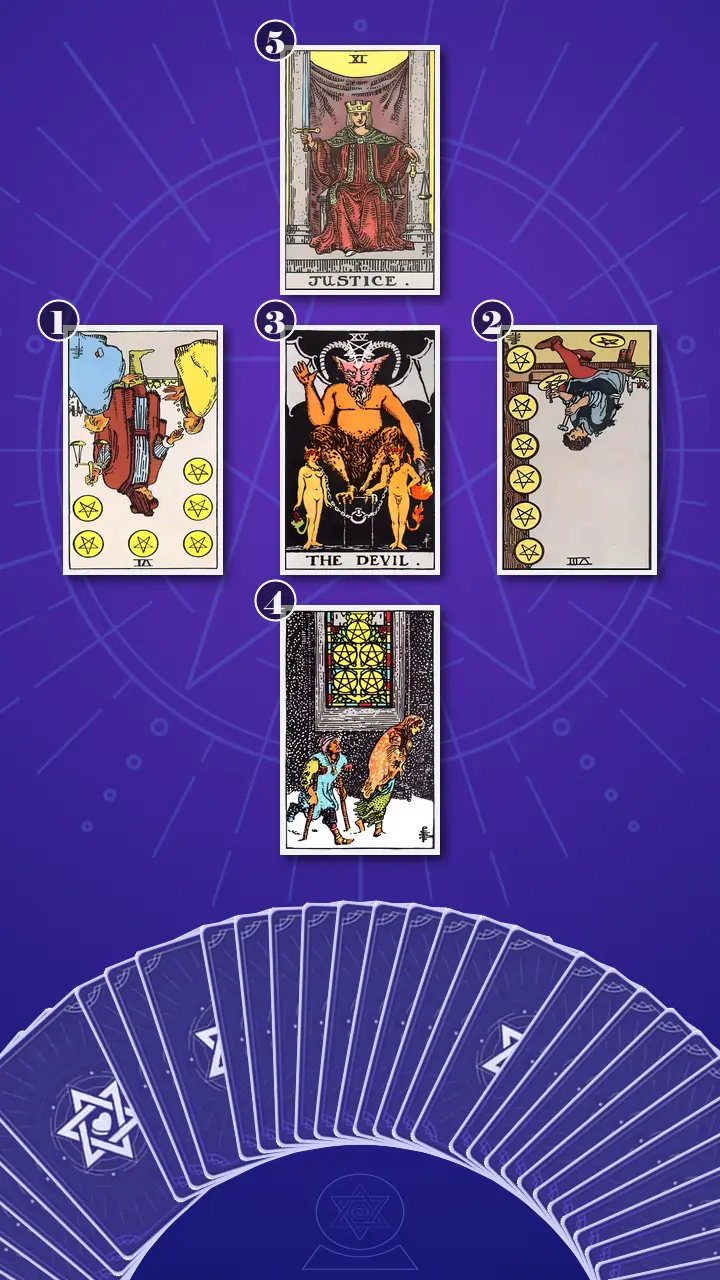
I chose the Relationship Spread · Context Edition, a five-card relationship tarot spread shaped like a cross. I use this layout when blurred responsibility, unequal mental load, conflict avoidance, and repeated follow-through problems need to be examined as separate parts of one system.
For anyone wondering how tarot works in a relationship reading like this, I treat the spread as a structured external map. Card meanings in context can help me distinguish observable behavior from protective interpretation. They cannot read an absent partner's mind, guarantee an outcome, or replace Jordan's judgment.
I placed the first card to the left for Jordan's observable contribution. The second would sit opposite it and examine only the partner's observable follow-through, not private motives. The third would occupy the center and show the shared loop created when those behaviors met. Beneath it, the fourth would reveal the fear anchoring the pattern. Above it, the fifth would identify a self-directed boundary practice and a constructive direction.
Once complete, the cross would resemble a compass: contribution and follow-through feeding the center, fear pulling downward, and conscious accountability pointing upward. That structure made this the right map for finding clarity. It could show Jordan where their leverage existed without pretending that they controlled the whole relationship.
The Scales That Kept Tilting
Position 1: Six of Pentacles Reversed, When Support Becomes Rescue
I turned over the card representing Jordan's observable contribution to the current pattern, specifically the explaining, repairing, and over-functioning that occurred before their partner had to respond. It was the Six of Pentacles, reversed.
I pointed to the scales in the figure's hand and the coins distributed from above. Upright, the image can describe generosity and proportionate exchange. Reversed, those scales asked a sharper question: who kept adding labor to the side already carrying more, and then called the result balanced because the immediate problem had disappeared?
In Jordan's life, the reversed Six of Pentacles looked exactly like the screen beside us. A group chat had been addressed to their partner. Jordan was writing an explanation on the partner's behalf and finishing the missed booking before anyone could ask what had happened. They were spending time, credibility, and practical labor to restore calm, but the rescue prevented responsibility from remaining visible.
I described the energy as an excess of intervention combined with a blockage in reciprocity. Jordan's care was real. The problem was not generosity itself; it was that the generosity repeatedly removed the other person's opportunity and obligation to participate in repair.
"When the next missed responsibility appears," I asked, "what do you do first: answer, explain, remind, or take over? And what are you trying to stop other people from seeing?"
Jordan let out one short laugh, but there was no amusement in it. "That is so accurate it's a little brutal." Their fingers tightened around the phone, their gaze moved from the reversed scales to the booking tab, and then their hand slowly opened on the table.
"The point is not to blame you for someone else's follow-through," I said. "The card is showing the cost of the strategy you learned to use. It probably protected connection and reduced conflict many times. It is also giving you less useful information now. Support does not have to hide who is responsible."
I also cautioned against turning the reversed card into a command to refuse every request. An abrupt withdrawal, offered as a secret test, could replace rescue with punishment and feed Jordan's private scorekeeping. The corrective movement was smaller and more precise: allow one low-stakes responsibility to retain its actual owner.
Position 2: Eight of Pentacles Reversed, When an Apology Never Becomes a Practice
I turned to the position representing the partner's observable pattern of follow-through and repair as Jordan experienced it. I was careful to keep the reading within what Jordan could actually see. The card was the Eight of Pentacles, reversed.
In the upright image, a craftsperson builds skill through repetition, adding one completed pentacle after another. Reversed, the line of work appeared interrupted. This was not a diagnosis of the partner's character, laziness, or private intention. It described a deficiency of consistent practice and a blockage between promise and completed repair.
I connected the image to a recent Thursday. Jordan had opened the booking site two days after their partner said it would be finished. They found an incomplete form and a half-written note, completed the booking themselves, and then received a sincere apology. The apology may have been emotionally genuine, but the observable repair still depended on Jordan's supervision and labor.
"A sincere promise is a beginning; repeated independent repair is the evidence," I said. "Independent repair means the reply is sent, the booking is completed, or the agreed task is finished without your tracker, reminders, supervision, or takeover."
Jordan's gaze slipped away from the card. They pressed their lips together, stared at the cold light on the kitchen wall, and then said quietly, "They always sound sincere. I believe them in the moment. Then I feel horrible for noticing that I'm back here again."
I let that complexity remain intact. "You do not have to decide that the apology was fake in order to notice that the practice is incomplete. Intention and follow-through are different categories of information. We can respect the first without pretending it proves the second."
I also named the tempting overcorrection. Jordan could respond to this card by designing a better system, a detailed Notion board, recurring reminders, and a shared tracker. That would look like accountability while quietly creating another account-management job at home. The useful question was simpler: what repair, if any, happened independently?
The Loop That Bought Peace Tonight
Position 3: The Devil and the Loose Chain Before Send
I turned over the card at the center, the position showing the self-reinforcing relationship loop created when incomplete follow-through met Jordan's repeated covering. The card was The Devil, upright.
I told Jordan immediately that I was not using The Devil as a label for either person. In this position, it represented a binding feedback loop: attachment, compulsion, short-term relief, and the belief that there was no workable alternative. The most important detail was not the looming figure. It was the loose chains around the two human figures, chains that restricted movement without eliminating choice.
I traced the sequence I could see. A responsibility was missed. Jordan saw the group message or unfinished task. Their body predicted conflict before a conflict had occurred. Their fingers typed a harmless explanation. They completed the repair. The tension dropped. Later, resentment returned because the original responsibility had vanished along with the consequence.
It resembled dismissing the same phone alarm every night. The noise stopped, but the reason for the alarm never received attention. It also resembled a low-friction subscription to temporary peace, paid for with Jordan's time, credibility, and growing resentment.
"Every rescued consequence buys peace tonight and less evidence tomorrow," I said.
The Devil's energy showed an excess of relief-seeking and a blockage in the interval where choice could be noticed. Jordan could not control whether their partner developed follow-through. They could examine whether they kept removing the friction that would make the pattern available for an honest conversation and clearer observation.
I used one of my diagnostic tools, Reactive De-escalation Mapping, to identify the emotional high notes in the sequence. The loudest note was not the eventual argument Jordan imagined. It was the internal spike that came first: the message appeared, their chest braced, and their nervous system treated social discomfort as an emergency. Defensive anger arrived later, after the rescue had restored surface calm but left Jordan carrying the cost.
"Try finishing this sentence," I said. "If I do not fix this now, then..."
"Then everyone will see that we're not okay," Jordan answered. Their breathing stopped for a beat. Their eyes stayed fixed on the loose chain as though replaying several group chats at once. Then a low "Oh" left their chest, and their shoulders dropped a fraction. "I don't actually want to do this. I want the discomfort to stop."
That distinction mattered. I asked Jordan to imagine the booking still unfinished and the group message still unanswered, but their own explanation not yet sent. "I can feel the hook before I follow it," they said. The loose chain did not need to mean a dramatic break or a final relationship decision. It could begin as ten quiet minutes in which the phone remained untouched.
Position 4: Five of Pentacles and the Warm Window in the Snow
I turned over the lower card, representing the fear that made covering feel safer than allowing the imbalance to become visible. It was the Five of Pentacles, upright.
I held the card where Jordan could see the two figures moving through snow beneath an illuminated window. The image captured the pressure beneath the logistics: a fear that one honest answer might leave Jordan outside the warmth of connection. Friends might see them as disloyal. Their partner might feel abandoned. A shared life already strained by Toronto rent, schedules, and practical interdependence might become unstable.
The card did not predict rejection. I read its energy as an excess of anticipated scarcity, the mind treating a possible rupture as though it were already happening. Jordan was responding to an imagined notice that their lease on belonging had been cancelled, even when the immediate issue was only a low-stakes booking or unanswered message.
"If you let one small consequence remain visible," I asked, "what do you fear your partner, your friends, or you yourself would conclude?"
Jordan looked past the camera for several seconds. The radiator clicked again, but this time the sound seemed to mark the space between the fear and the facts. "That I'm cold," they said. "Or that the relationship only works because I manage it. And if I stop, I might find out that's true."
I answered carefully. "That fear deserves respect, but it is not established evidence. A boundary can reveal information, and information can feel vulnerable. It is still different from punishment or abandonment. You are allowed to protect safety, housing, finances, and urgent practical needs. We are talking about one proportionate, low-stakes experiment, not watching something dangerous collapse to prove a point."
I noticed how naturally Jordan turned feelings into tasks. The spread was dominated by Pentacles, the suit of practical labor, while Cups and Wands were absent. Guilt, dread, care, and resentment had been converted into calendars, reminders, bookings, and productivity. Jordan had been trying to solve a belonging fear with more project management.
When Justice Changed the Tempo
Position 5: Accurate Ownership Without Punishment
The room seemed to change as I reached for the final card. The radiator, noisy throughout the reading, went quiet. I turned over the card representing a self-directed boundary Jordan could test to restore accurate ownership and gather clearer evidence. It was Justice, upright.
I placed Justice above The Devil and beside the reversed Six of Pentacles. The same symbol appeared twice: scales. In the first card, the scales were inverted inside an unequal giving scene. In Justice, they were level, and an upright sword introduced discernment, factual language, and cause and effect.
Justice carried balanced energy. It did not ask Jordan to become colder, threaten their partner, or announce a verdict on the relationship. It asked them to make responsibility proportionate and visible. In modern life, the card sounded like this: "You agreed to handle this. Please respond directly by 6 p.m. I am leaving the repair with you."
I followed that sentence with silence. No paragraph of context. No apology for having a limit. No second message designed to regulate the other person's response.
At this point, I used my Communication Dissonance Audit. I have spent ten years studying how pressure can pull an internal rhythm out of sync, and I have learned that silence is not necessarily harmony. Two tracks can be quiet and still be fundamentally out of phase.
Jordan's phrase "we forgot" sounded cooperative on the surface, but the emotional tracks did not match. Their partner's responsibility remained unresolved while Jordan moved at emergency tempo, answering, explaining, and repairing. Friends heard a duet called "mutual mix-up," even though only one person was performing the repair. Justice did not turn up the volume. It separated the tracks so each person's part could finally be heard accurately.
Jordan was still trapped in the demand to produce the perfect response: make the booking problem disappear and preserve harmony, or tell the truth and risk becoming the cruel one. I could almost hear their thoughts accelerating several beats ahead of the observable facts.
I said, "Your partner's change is not yours to perform. Your work is to stop hiding the pattern, name what happened, and make responsibility visible enough for real evidence to appear."
Then I gave them the central message of Justice without softening it:
You do not have to keep the peace by carrying both sides; name what is true, assign responsibility clearly, and let Justice's balanced scales replace rescue with accountability.
I let the sentence remain in the quiet. Jordan's breath stopped first. Two fingers hovered above the phone as if the old explanation were still waiting beneath them. Their pupils widened, then their gaze lost focus; I could see them mentally replaying the late booking, the Sunday calendar, and every "we forgot" message that had made responsibility disappear. Their eyes reddened before their shoulders moved. Then both shoulders lowered, their clenched hand opened, and a shaky breath left them.
"But doesn't that mean I was wrong this whole time?" they asked, the first edge of anger cutting through the relief. "Like I helped create the exact thing I kept complaining about?"
"It means your strategy had a function and a cost," I replied. "It reduced immediate danger in your body. It also helped preserve the arrangement. Recognizing your contribution is not accepting responsibility for your partner's choices. It is locating the part of the pattern you can change without waiting for permission."
The relief on Jordan's face was real, but so was the brief, exposed look that followed it. Putting down one side of the bridge meant no longer controlling whether the structure held. Clarity brought responsibility back to Jordan, not responsibility for both people, but responsibility for their own next move.
I asked, "Now, with this new view, can you think of a moment last week when this insight might have made you feel different?"
Jordan looked at the unfinished booking tab. "Sunday. I moved three tasks from our shared Notion board into my own week. I could have corrected the owner field instead of doing the tickets myself."
That was the key crossing in the reading: a movement from braced frustration, guilt, and compulsive rescuing toward cautious self-trust and proportionate relationship boundaries. It was not a promise that the partner would respond well. It was Jordan beginning to trust the difference between an urge, a prediction, and an observable fact.
The Visible Responsibility Reset
I gathered the five cards into one coherent story. The Six of Pentacles reversed showed Jordan holding up both sides of the bridge and calling the strain support. The Eight of Pentacles reversed showed that apologies and beginnings were not consistently becoming independent repair. The Devil revealed the relief-and-resentment loop joining those behaviors. The Five of Pentacles showed why the loop felt compulsory: stopping activated a fear of conflict, exclusion, and insecure belonging. Justice offered the available direction, not control over the partner, but accurate ownership of Jordan's words and actions.
The cognitive blind spot was that giving more had begun to feel automatically fair, caring, and stabilizing. In reality, every extra repair restored the immediate situation while preserving the system that exhausted Jordan. Their task was not to become less caring. It was to shift from explaining away consequences to naming one observable behavior and leaving its repair with the person responsible.
Jordan raised a practical concern. "What if it affects both of us? A missed booking can still ruin my weekend."
"Then proportion matters," I said. "A boundary is not a rigid rule that requires you to harm yourself. Choose a low-stakes task whose delay is tolerable. If safety, housing, finances, work, or another urgent need is involved, respond in the safest proportionate way and seek relevant support. The purpose is clearer evidence and more choice, not manufactured chaos."
I gave Jordan two small next steps. Both were designed to interrupt the automatic rescue without turning the relationship into a test.
- The Syncopation Pause and One-Fact BoundaryWhen the next low-stakes booking, reply, or household errand becomes visible, keep both feet on the floor and listen to one sound in the room for three seconds. I call this the Syncopation Pause: a brief acoustic grounding technique that lowers the emotional BPM before urgency writes the message for you. If the hook remains strong, set a ten-minute timer and write: "What happened? Who owns the next step? What am I about to take over?" Then use one factual sentence, such as, "That was theirs to handle, so they will reply directly."Draft the sentence in your notes app. Do not add a mutual-sounding explanation, complete the task, or send a second message to soften it. Reduce the pause to two minutes or stop the exercise if the situation feels unsafe or overwhelming.
- The Independent Repair TestChoose one specific responsibility your partner explicitly agreed to own this week. State the owner and observable finish line once: "Please reply to them by 6 p.m. and confirm when it is done." During the agreed window, do not create a tracker, send reminders, supervise the task, or complete any part of it. If clarification is requested, answer the question without becoming the task owner.Record only the observable result afterward. One completed or missed repair is information, not a final relationship verdict. Look for repeated independent action over time rather than the intensity of an apology.
"Name the fact, name the owner, and leave the repair where it belongs," I said. "That is actionable advice from Justice, but you remain the person who decides whether, when, and how to use it. Tarot has made the pattern easier to see. It has not taken authorship of your life away from you."

A Week Later: Ownership, Not Certainty
Six days later, I received a message from Jordan. At 8:12 that morning, while they were standing in the hallway before heading for the TTC Line 1 train, a group chat had asked their partner to confirm a shared plan. The kettle clicked off, the apartment smelled faintly of burnt toast, and Jordan's shoulders immediately braced.
They had started typing an explanation about their partner's workload. Then they used the Syncopation Pause. For three seconds, they listened to the kettle settle. They deleted the explanation and wrote, "This is for them to answer directly. I am leaving the booking with them."
Jordan told me their chest stayed tight after they sent it. They checked the chat twice on the train and felt guilty when no reply appeared immediately. Their partner answered later that morning and handled the booking, but Jordan did not turn one completed task into proof that the whole relationship had changed. The first evidence was quieter: Jordan had allowed responsibility to remain visible without making themselves the emergency repair system.
They slept through the night, but their first thought at dawn was still, "What if I was wrong?" This time, they noticed it, smiled once, and did not reopen the group chat.
I thought back to the reversed scales and the level ones. The cards had not repaired the relationship or chosen Jordan's future. Jordan had used them as a recognition tool, heard the dissonance in an old pattern, and made one different decision. That was the real Journey to Clarity: not perfect confidence, but ownership sturdy enough to coexist with uncertainty.
If tonight finds you at 10:30 p.m., phone warm in your hand and chest braced as you repair what someone else promised to carry, I want you to remember this: noticing that you are holding both sides is already the first quiet beat of change.
If you let one low-stakes responsibility remain on its rightful side of Justice's scale this week, what might you hear in the three-second pause: your breathing, your own capacity to choose, or the kind of connection you actually want to protect?