Sending a $35 Budget Limit: From Automatic Yes to Testing Reciprocity

The 11:40 p.m. Draft That Exposed Belonging-Based Self-Silencing
I met Maya, a 27-year-old junior UX designer in Toronto who could defend a user need in a stakeholder meeting, yet struggled to let her own needs slow down a fast-moving group chat. She knew what she felt until everyone else started reacting. Then her different preference became a draft she deleted.
At 11:40 p.m., she sat cross-legged on her bed in the apartment she shared with a roommate. Blue phone light washed over the dark room; the radiator clicked against the silence while her thumb hovered above two lines in WhatsApp: “I feel overlooked,” and, “I need a quieter night.” Her jaw tightened. She held her breath, reread the weekend plan, and deleted both sentences.
In their place, she sent, “Sounds good, I can make anything work,” followed by a laughing reaction. Three hearts appeared. The chat looked settled, but when she put the warm phone face-down, something heavy arrived behind her ribs, like a wet winter coat she could not take off.
“It is easier to be the easy one,” she told me. “I do not want one honest comment to change the whole vibe. But sometimes I agree so quickly that I only notice the resentment later.”
I heard the contradiction clearly. Maya wanted to be emotionally known by people she genuinely valued, but every inconvenient feeling seemed to hook two fingers under her throat and warn that honesty might cost her a place in the circle. She laughed before registering hurt, accepted expensive plans before checking her bank balance, and reassured everyone else before asking what she needed.
I did not tell her to become fearless or to unload years of unsaid feelings into the chat. I told her, “You are not feeling too much; you are editing too early. I am not here to predict whether your friends will approve. I want us to separate what you feel, what you fear will happen, and what actually happens. Let us draw a map through that fog.”

Choosing the Cross: A Relationship Spread for the Unsent Truth
I asked Maya to put both feet on the floor, take one ordinary breath, and hold the question without trying to improve it: “Why do I keep hiding my feelings to match what my circle expects?” I shuffled slowly. The pause was not a mystical performance; it gave her nervous system a clean transition from managing the chat to observing her own pattern.
I chose a five-card Relationship Spread in a cross layout. I use this spread when a question involves a person's private stance, their experience of a social field, the exchange taking place between people, the challenge beneath that exchange, and a constructive direction. That sequence made it precise enough for friendship self-silencing without pretending the cards could reveal anyone else's secret motives.
This is how tarot works best in my practice: as a structured cognitive mirror. Card meanings in context can organize information that apprehension has compressed into one frightening conclusion. They cannot prove what Maya's friends think or guarantee what will happen after an honest message. Position two, in particular, would show how Maya encountered the group's shared mood, not an objective report on what every friend privately expected.
I placed the third card at the center, with the first card to its left and the second to its right. The fourth rested below as the submerged fear; the fifth waited above as a possible bridge. I explained that we would begin with Maya's current emotional stance, move into her experience of the circle, examine the approval exchange holding the pattern together, descend to the fear of exclusion, and then rise toward one self-directed form of honest communication.
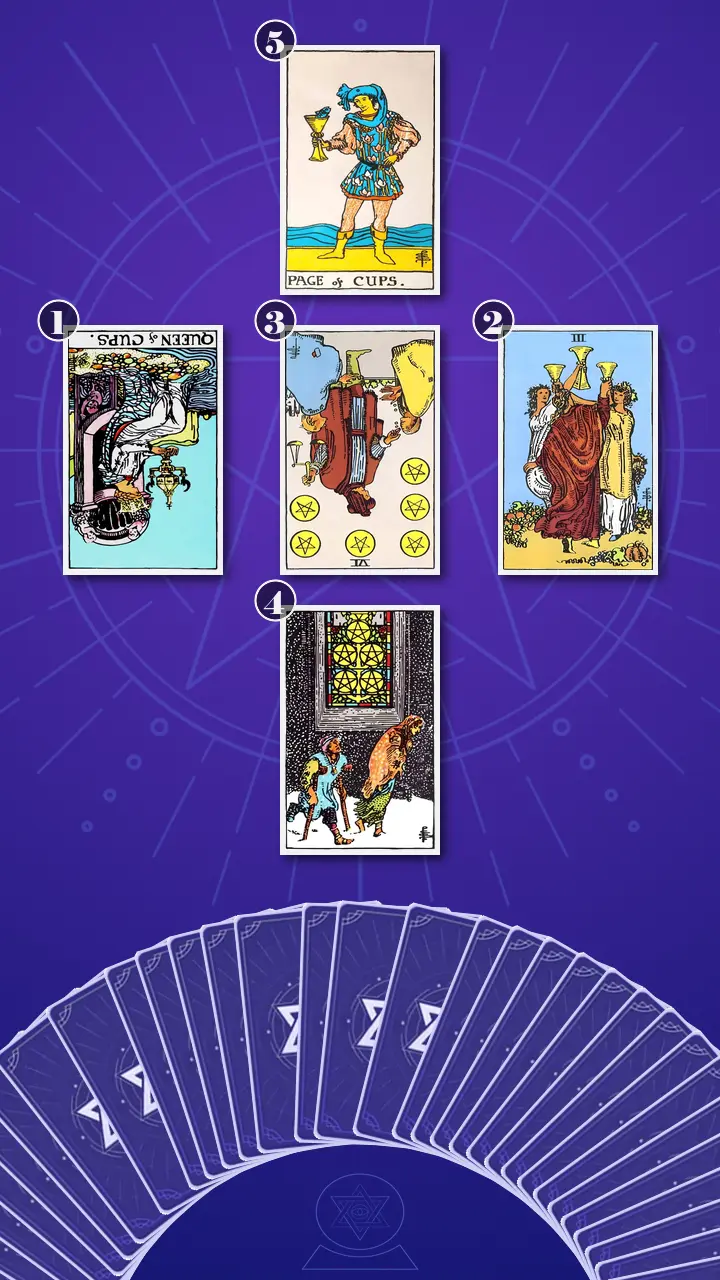
Reading the Map Beneath the Group Chat
Position One: The Feeling Inside the Sealed Cup
Now I turned over the card representing Maya's current emotional stance and the observable self-silencing behavior at the center of her question. It was the Queen of Cups, reversed.
I drew her attention to the Queen's ornate cup, enclosed and held close while the Queen gazed into it alone. In Maya's life, that cup looked remarkably like the phone draft at 11:40 p.m. The emotional content already existed. She knew the loud plan would drain her and knew the speed of the decision had left her feeling overlooked. But she watched the group mood before granting either response permission to become visible.
“The internal script sounds something like this,” I said. “I know I feel hurt and tired, but if I say that, they may read me as difficult, so I will send something light instead.”
I read the reversal as a Blockage of self-trust, not a Deficiency of emotional awareness. Maya had plenty of Water, the suit's receptive and feeling-based energy. The problem was that almost all of it flowed into an Excess of social monitoring. She could detect a change in the chat within seconds, yet needed hours alone before treating her own reaction as valid information.
Her professional habits gave me a useful image. She was presenting the polished Figma prototype of herself while hiding every piece of user feedback that might complicate the stakeholder meeting. Every feeling passed through a brand-safety filter until the message was acceptable but no longer recognizably hers.
Maya gave a small laugh, but no warmth reached it. Her fingers tightened around her mug before loosening again. “That is so accurate it feels a little brutal,” she said. “I am not confused about what I feel. I am deleting it before it gets to count.”
“Exactly,” I said. “And I do not read that as weakness. It is a protective skill that became overworked. You learned to read the room so efficiently that reading yourself began to feel socially dangerous.”
Position Two: Three Raised Cups and an Unwritten Rule
Now I turned over the card representing how Maya experiences the circle's shared mood and apparent expectations, without claiming access to her friends' private motives. It was the Three of Cups, upright.
I showed her the three figures facing one another, their cups raised into a shared focal point. I could see the WhatsApp version immediately: a dinner suggestion, rapid heart reactions, three enthusiastic confirmations, and a joke gathering momentum before a quieter preference has entered the thread.
I read the upright card as genuine Balance in the social field. Maya was not inventing the pleasure of these friendships. The group gave her laughter, history, shared references, spontaneous dinners, and the warm charge of being included. That mattered. The trouble began when the visible celebration became an Excess demand for sameness inside her own interpretation.
“Everyone is having a good time, so my discomfort must be the problem,” I said, giving language to the rule she had never heard anyone state. “But visible harmony is not proof that everyone must feel the same. Lowering your cup for one moment does not automatically break the circle.”
Her shoulders moved down by a fraction. She traced the rim of one illustrated cup with her eyes and said, “I do love being with them. I think that is why even a tiny disagreement feels so high stakes.”
“I agree,” I said. “The reading does not need to turn your friends into villains to validate your fear. The connection can be real, and your strategy for preserving it can still be costing you too much.”
Position Three: The Approval Economy in the Reversed Scales
Now I turned over the card representing the exchange pattern that maintains the problem, especially Maya's trade of flexibility and emotional labor for perceived approval. At the center of the cross sat the Six of Pentacles, reversed.
I pointed to the scales and the unequal positions of the figures beneath them. Reversed, the image became a social ledger whose missing entries mattered as much as its visible ones. Maya contributed quick consent, enthusiasm, reassurance, calendar coordination, and the offer to make the booking. Her budget, energy, disappointment, and hurt stayed off the books.
I asked about the last expensive plan. She described standing under the fluorescent hum of her office lift at 6:18 p.m. while the group chose a $78 set-menu restaurant near Ossington. She had checked her banking app, seen rent approaching, felt her stomach drop, and still typed, “Cute, I am in.” Then she volunteered to reserve the table.
I read the reversal as an Imbalance in Earth energy. Her generosity was not freely balanced against her resources; it had become conditional giving aimed at securing social safety. The immediate reward was a smooth interaction. The delayed cost appeared on the streetcar home, when she calculated what to remove from her grocery budget and felt angry that no one had considered a limit she had never allowed them to see.
“The painful sentence here is: I keep giving them what preserves the vibe, then feel hurt that they did not offer what I never let them see,” I said. “Flexibility stops being generous when it becomes the admission fee for belonging.”
My mind flashed to archaeological context sheets from years on digs after Cambridge. A careful record distinguishes what was found from what was absent from the record. An empty budget field does not prove that the budget never existed. In the same way, Maya's friends could not respond to relational data that had been systematically excluded from every exchange.
Her breathing paused. Her eyes stayed on the reversed scales as if she were rereading a message inside them. Then her jaw unclenched and a long breath left her chest. “Admission fee,” she repeated. “That is what it feels like. I pay in being easy, and then I am furious that nobody knows the cost.”
I let the sting remain without turning it into blame. “That strategy protected your place in the short term. We can respect why it formed while asking whether it still produces the closeness you actually want.”
The Warm Window Beneath the Fear of Rejection
Position Four: The Exclusion Scene That Arrives Before Evidence
Now I turned over the card representing the principal relational challenge and the underlying fear that an honest feeling could lead to exclusion. It was the Five of Pentacles, upright.
The card showed two vulnerable figures moving through snow beneath an illuminated stained-glass window. As I looked at it, flurries crossed the dark Toronto window behind Maya and a passing streetcar cast a brief bar of amber light across her wall. The environment seemed to reproduce the card's central contrast: cold outside, warmth visible but uncertain inside.
In Maya's modern version, she typed, “That joke landed badly for me,” and immediately pictured the chat going silent. She imagined a side thread forming, next Friday's drinks happening without her, and everyone else remaining inside the warm social room. Her throat closed before anyone had responded. The feared result arrived in her body as if it were already verified news.
I read the card as an Excess of anticipated exclusion combined with a Deficiency of present evidence. It did not tell me that rejection was impossible, and I would not minimize a mocking or coercive response if one occurred. It showed that Maya's mind was issuing a verdict before the relationship had produced observable facts.
“A feared reaction is vivid information, not verified evidence,” I told her.
Cognitive Stratigraphy: Excavating the Rule Beneath the Trigger
This was where I used Cognitive Stratigraphy, the method I developed from treating archaeological layers with patience rather than force. I asked Maya to consider the throat closure and the urge to delete as surface artifacts. Instead of arguing with them, I traced the layers beneath them.
The top layer was the current event: the group agreed quickly, or a joke landed badly. Beneath it was the physical artifact: held breath, lifted shoulders, a tense jaw. Below that sat the predicted scene: silence, ridicule, a separate chat, a missing invitation. At the foundation was the obsolete rule organizing everything above it: “If I introduce discomfort, I may lose my place. My seat depends on staying easy.”
Maya frowned and said, “I cannot point to one dramatic first event that created that rule.”
“You do not need to manufacture one,” I replied. “Archaeology becomes unreliable when someone invents a missing layer because the story would feel neater. We can identify the old rule by the pattern it leaves in the present. Then we ask a cleaner question: what evidence belongs to this conversation, and what fear may have travelled here from an older epoch?”
First her breath froze high in her chest. Then her gaze lost focus for several seconds, as though she were replaying old group chats without touching her phone. Finally, she exhaled through parted lips and let her shoulders drop. “No one in this group has actually said I lose my place if I disagree,” she said. “I just behave as if they already did.”
I nodded. “That distinction does not prove that every response will be kind. It gives you back the ability to observe a response before deciding what it means.”
When the Page's Open Cup Answered Back
Position Five: One Honest Sentence as a Bridge
Now I turned over the card representing a constructive, self-directed way for Maya to express one feeling and gather real information about reciprocity. It was the Page of Cups, upright, the key card and bridge of the reading.
The room went quiet enough for me to hear the radiator click and stop. On the card, an unexpected fish rose from an open cup while the Page looked at it with curiosity rather than alarm. I set that image beside the reversed Queen's enclosed vessel. I did not see a demand for Maya to become less sensitive. I saw sensitivity changing from a sealed monitoring system into relational information.
In practical terms, the Page looked like one short message: “I want to see everyone, but I would prefer somewhere quieter,” or, “That joke landed a little badly for me.” Maya did not need to attach a complete history, apologize for her reaction, or issue a final verdict on the friendship. Like shipping a small beta rather than staging a perfect emotional product launch, she could release one usable piece of information and observe what followed.
I read the upright Page as Balance beginning to return to Water. The spread contained no Swords and no Wands, so clear language and decisive action were not yet established energies. I did not prescribe a dramatic confrontation. The Page supplied a beginner's amount of Air and Fire: enough language to name one feeling, and enough action to let it leave the draft.
I also used Ruins Restoration Thinking here. Restoration does not demolish every surviving wall because part of a structure has fractured. It identifies what still carries weight. Maya's emotional perception was enduring architecture, not debris. The work was to preserve that sensitivity while replacing the old admission system that required her to hide its findings.
Before I gave her the center of the card, I returned to 11:40 p.m.: the cursor blinking, her honest draft disappearing, her throat tightening, and the laughing reply landing safely. I could hear the old equation beneath it: perfect agreement equals a secure seat.
Belonging is not proven by how well you edit yourself; it is tested when one real feeling enters the conversation and the response becomes evidence.
Your feelings are not disruptions to hide; name one with the Page's open-cup curiosity and let the response provide real information about the relationship.
I left a few seconds of silence around the words. Maya's breathing stopped first, and her right thumb froze against the side of her mug. Then her pupils widened and her eyes moved away from the card, unfocused, as if every deleted paragraph had begun replaying at once. Color rose along her cheeks. Her grip loosened, but relief did not arrive cleanly.
“But does that mean I have been doing friendship wrong for years?” she asked. The first edge in her voice was anger; beneath it I heard a tremor. Her shoulders dropped, then lifted again, as if putting down the old strategy had left her briefly unsure what would hold her up.
“No,” I said. “It means you used a protective method until its cost became greater than its usefulness. Clarity is not a guilty verdict on your past. It is responsibility returning to your hands in the present.”
I invited her, “Now, with this new perspective, think back to last week. Was there a moment when this insight might have made you feel different?”
She returned to the $78 dinner thread. “I could have treated my budget as information, not as proof that I did not belong,” she said. Her voice was quieter, but steadier. I watched her open Notes and write three lines: “I feel stretched,” “because rent is due,” and, “I would like a cheaper plan.” She reduced them to twelve words: “I want to come, but my budget is around $35 tonight.”
Her throat still tightened when she read it aloud. That mattered. The shift was not from fear to permanent confidence. It was the first movement from apprehensive social editing and performance-based belonging toward curious emotional honesty, with reciprocity assessed through observed responses. She could keep the sentence in Notes, send it to one trusted person, or pause if the experiment felt too exposed. The choice remained hers.
The Open-Cup Field Test: Actionable Next Steps
The five-card Relationship tarot spread had not issued a command or predicted a friendship outcome. It had shown me a coherent maintenance system. Maya's sensitivity became sealed private data; the genuine pleasure of the circle raised the stakes; the central exchange turned flexibility into a fee; and an older scarcity rule made one difference feel like banishment. Her available resource was not a flawless confession. It was the open cup: one bounded feeling, one modest request, and one observable response.
I named the cognitive blind spot directly. Maya had been treating visible group enthusiasm as evidence that disagreement was forbidden, while also hoping for care around needs she kept removing from the conversation. If nobody had been allowed to respond to the honest version of her, acceptance of the edited version could not settle whether the relationship had room for difference.
The transformation direction was therefore specific: move from editing feelings around imagined consensus to stating one low-stakes feeling in first-person language, then evaluate the actual response. Curiosity, negotiation, pressure, dismissal, repair, and silence would all be information. None of them would remove Maya's right to choose her pace, her boundaries, or whether a particular conversation felt reasonably safe.
When I proposed the experiment, Maya raised an immediate obstacle. “I can already see myself adding, 'but honestly anything is fine,'” she said. “I will cancel the preference in the same message.”
I adjusted the practice. “Then you do not need to hold a hard line forever. Delay the compromise by one message. Let the preference exist long enough to be received before you negotiate.”
- The Ten-Minute No-Delete Draft Before replying to one low-stakes social plan this week, open Notes and complete: “I feel... because... and I would like....” Set a ten-minute timer, then reduce the thought to one first-person message of roughly twelve words. Start with a minor question such as noise level, timing, or venue. The minimum version is leaving the honest sentence undeleted for five minutes; sending it is optional if your body says the disclosure is too exposed.
- Preference Before Compromise In one group decision, state a concrete limit before offering reassurance, apology, or an alternative: “My budget is around $35 tonight,” or, “I would prefer the 7 p.m. option.” Wait for one response before adding flexibility. Save the phone template, “I would prefer __. I can also do __ if needed.” Use the first sentence now and the second only when the flexibility is genuine.
- The Trigger Excavation Exercise After one honest message, divide a note into three layers: “Surface artifact,” for the body cue and trigger; “Old epoch,” for the feared scene or rule; and “Present evidence,” for the exact replies, questions, compromises, pressure, or silence that actually occurred. Put the phone across the room for thirty minutes before interpreting a delayed reply. Test with one trusted friend if the full group feels too intense, and pause the exercise if the response becomes mocking, coercive, or unsafe.
I called the whole practice an open-cup field test. Its purpose was not to prove that every friendship would reward honesty. It was to stop imagined rejection from being the only evidence admitted into Maya's decision-making. One honest sentence could be a field test, not a final verdict.

One Week Later: The Quiet Proof
Six days later, I received a message from Maya. The group had started another dinner thread, and she had used the budget sentence before she could polish it into a case brief: “I want to come, but my budget is around $35 tonight.”
The response was not cinematic. One friend suggested noodles. Another still preferred the original restaurant but asked whether Maya wanted to meet afterward. A third admitted that the set menu was also more than she wanted to spend. Maya recorded the exact replies before deciding what they meant.
She wrote, “My chest was tight for the full thirty-minute timer, but nobody removed my seat. I also noticed that I did not need everyone to choose my preference for it to have been worth stating.”
That night she slept through until morning. Her first thought was still, “What if I made it awkward?” She told me she smiled at the thought, opened her evidence note, and got out of bed anyway.
I did not credit the cards with changing her life. They had offered images strong enough to slow down an automatic pattern: the sealed cup, the unequal ledger, the warm window, and the curious fish. Maya created the change when she let one feeling become visible and used the real response, rather than an imagined consensus, to decide what she knew.
I have learned that when someone has spent years keeping the room comfortable, even one honest sentence can tighten the throat as if it might cost them their seat. Staying silent, however, can leave them lonely inside the very circle they are working so hard to preserve. Noticing that tension already means the old admission rule is no longer operating unseen.
If you let one small feeling rise from your open cup before the group-chat algorithm edits it, what might you be curious to notice in the response?