Finding Clarity in the Warm Glow of the Family Group Chat
If you’ve ever typed “Yes!!!” in the family group chat before checking your calendar—then reopened Google Calendar three times a day like you’re renegotiating a contract you didn’t mean to sign—this is for you.
Taylor showed up on my screen from their Toronto condo, shoulders slightly hunched the way people get when they’ve been bracing all week. Behind them, a kitchen light cast that flat, end-of-day glow; you could almost hear the microwave hum through the silence. Their phone kept lighting up on the table—little iMessage reactions, the kind that look harmless (❤️/👍) but somehow raise the stakes instantly.
“I don’t want to disappoint anyone,” they said, voice careful like they were choosing each word with tweezers, “but I also can’t keep doing this to myself. I say yes because it’s easier than explaining a boundary… and then I cancel, and I feel like I have to write an essay to prove I’m not a bad person.”
I watched their hand drift to their jaw without them noticing. A small press, like they were trying to hold their face together. The guilt wasn’t abstract—it sat in their body like a stone in the stomach, then climbed into the chest as pressure, then tightened the jaw into that restless clench that makes you grind through the night.
“Okay,” I said, keeping my voice warm and steady. “Let’s treat this like a pattern—not a personality flaw. We’re going to make a map of the loop, find where it steals your agency, and build a clean next step. A real Journey to Clarity, but in the language of your actual life: group chats, calendars, and the thumb hovering over ‘Send.’”

Choosing the Compass: The Celtic Cross · Context Edition
I asked Taylor to take one slow breath—not as a mystical thing, but as a nervous-system handbrake. Then I shuffled, letting the sound of the cards create a tiny buffer between the ping of obligation and the moment of choice.
“For this,” I told them, “I’m using the Celtic Cross · Context Edition.”
For anyone reading along who’s ever wondered how tarot works in a practical way: this spread is perfect for a repeating behavioral loop. It doesn’t just say ‘do this’—it shows (1) what you’re doing on a normal week, (2) what’s blocking you, (3) the deeper ‘should’ underneath the schedule, and then it climbs toward what to do next. It’s structure, not fortune-telling.
“Card 1,” I said, “will name the loop as it actually plays out in your day-to-day—your RSVP/cancel pattern.”
“Card 2 crosses it,” I continued, “as the immediate block—the thing that makes a clean RSVP feel weirdly impossible.”
“And card 10,” I added, tapping the top of the layout, “is integration: the healthiest communication pattern. Not a fixed outcome—more like the voice you can practice until this stops costing you sleep.”
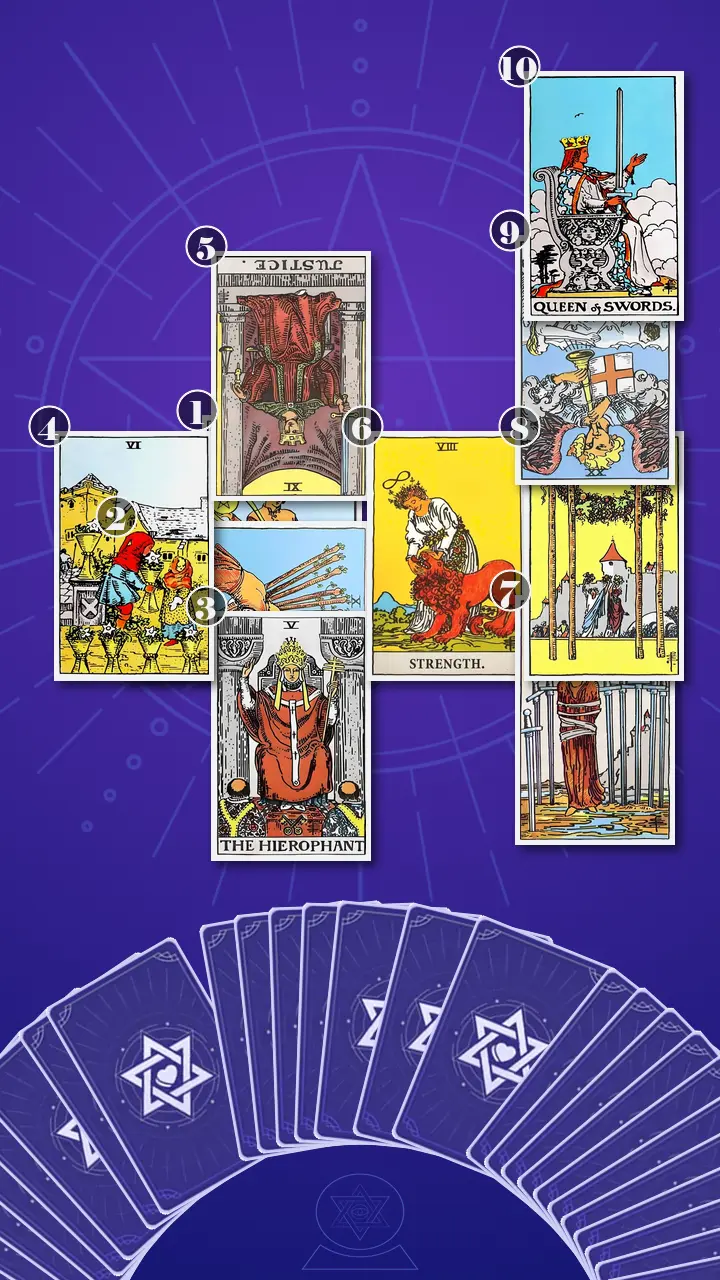
Reading the Map: Card Meanings in Context
Position 1 — The current RSVP/cancel pattern as a concrete, day-to-day behavior loop
“Now turning over,” I said, “is the card that represents the current RSVP/cancel pattern as a concrete, day-to-day behavior loop.”
Two of Pentacles, upright.
The first thing I noticed was the infinity loop ribbon linking the coins—motion without rest. “This is the juggling,” I told Taylor. “Not even dramatic juggling. The quiet kind: keeping everything ‘technically yes’ while constantly recalculating.”
I grounded it in their real life: “This is like when you keep multiple tabs open—calendar, messages, transit times—and you call it ‘being flexible,’ but it’s actually constant background stress.”
Energetically, the Two of Pentacles is balance under movement. In Taylor’s case, it’s balance tipping into excess: too much adjustment, not enough decision. The relief of the instant ‘yes’ lasts five minutes; then the recalculations start.
Taylor let out a small laugh—quick, a little bitter. “That’s… weirdly accurate. Like, it’s almost rude,” they said, but their eyes softened the moment after, like they were relieved someone finally called it what it is.
“Not rude,” I said. “Just honest. And here’s a question this card asks: what would change if ‘I’m not sure yet’ were a valid RSVP instead of a failure?”
Position 2 — The immediate block that makes it hard to give a clean RSVP and follow through
“Now,” I said, “we’re looking at the immediate block that makes it hard to give a clean RSVP and follow through.”
Ten of Wands, upright.
The image is someone carrying too much, their view blocked by the load. “This is over-commitment,” I told them. “The RSVP happens when you’re still imagining the plan as light. Then the week arrives and every responsibility climbs into the same tote bag until you’re mad at the dinner invite like it personally did this to you.”
And then I used the scene-contrast that always lands with people stuck in this pattern: “In the group chat, it’s a light ‘Yes!’—two taps and a heart reaction. Two days later, you’re staring at your calendar like it’s a Tetris game by Thursday, and you’re thinking, ‘I can carry this… I can carry this… why am I suddenly angry at a dinner invite?’”
Energetically, Ten of Wands is excess—carrying obligations past your actual limit. And when a yes is made from duty instead of capacity, it doesn’t stay a yes. It turns into a burden you resent. Resentment makes avoidance more likely. Avoidance makes late cancellation more likely. Late cancellation makes guilt feel “proven.”
I watched Taylor’s throat move as they swallowed. Their head dipped in a tight nod, and when they exhaled it sounded like someone putting down a heavy grocery bag. “Yeah,” they said quietly. “I can literally remember the last text I wrote. It was… so long.”
Position 3 — The hidden driver behind the guilt response (the ‘should’ beneath the schedule)
“This card,” I said, “represents the hidden driver behind the guilt response—the ‘should’ beneath the schedule.”
The Hierophant, upright.
“This is the rulebook energy,” I told Taylor. “Family plans aren’t just plans in your nervous system. They’re moral. They’re tradition. They’re ‘how things are done.’”
In modern terms: “It’s like you hear ‘It’s family’ as a rule that overrides your capacity, so a simple RSVP becomes a test of loyalty instead of a scheduling choice.”
Energetically, the Hierophant is structure. In balance, structure gives belonging. In excess, structure becomes a script you don’t remember agreeing to. That’s when hesitation feels like being ‘difficult,’ and a boundary feels like betrayal.
“When you feel that pressure to say yes,” I asked gently, “what unspoken rule shows up first—‘family comes first,’ ‘don’t make it weird,’ ‘showing up proves love’?”
Taylor’s eyes flicked away from the camera—memory-searching. “It’s… ‘don’t be difficult.’ Like, just be easy. Be the easy one.”
Position 4 — The recent emotional history with family plans that still colors your reactions
“Now we’re looking at the recent emotional history that still colors your reactions,” I said.
Six of Cups, upright.
“This is emotionally old,” I told them. “Not in a dramatic, blame-your-childhood way. In a simple way: you learned early that ‘nice’ keeps things smooth.”
Modern translation: “This is like when you feel a surge of ‘I should be easy to be around’ and you say yes to preserve the familiar good vibe, even if your adult life can’t support it.”
Energetically, Six of Cups is sweetness—but it can become pull. It pulls you toward a younger version of yourself answering the invite: the one who wants approval and peace, not the adult with a calendar and a body.
“When you RSVP,” I asked, “which ‘you’ is texting? The adult with the week ahead—or the younger part that wants everything to stay uncomplicated?”
Taylor didn’t answer right away. Their shoulders lifted, then dropped—like they’d been holding that question in their body for years.
Position 5 — Your conscious story about what being ‘a good family member’ requires
“This card,” I said, “shows your conscious story about what being ‘a good family member’ requires—and how that story shapes guilt.”
Justice, reversed.
Justice reversed is one of the clearest cards for the inner courtroom. “You want to be fair,” I told Taylor. “You want to be accountable. But the scorekeeping has gotten distorted.”
Modern translation: “This is like treating an RSVP like a binding contract and a cancellation like a character flaw—so you try to ‘pay back’ the discomfort with long explanations.”
Energetically, Justice reversed is blockage: fairness gets stuck, then turns inward as self-prosecution. Instead of ‘I changed plans,’ it becomes ‘I did something wrong.’
I layered the earlier scene contrast here, because this is where the loop locks in: “Ten of Wands is the load. Justice reversed is the trial. First you carry too much… then you reread the thread like it’s evidence. You become judge, jury, and defendant in a case called ‘Taylor vs. Being Unreliable.’ And your jaw clench? That’s your internal gavel.”
Taylor’s mouth tightened, then they winced like I’d caught them mid-habit. “I literally edit the cancellation text ten times,” they admitted. “I add context every time. Like I’m… building a defense brief.”
“Exactly,” I said. “And here’s the practical reframe: clarity early is kinder than guilt late.”
Position 6 — The most supportive next step for breaking the loop
“Now we’re turning to the most supportive next step—not a prediction, but a direction for practice,” I said.
Strength, upright.
Strength isn’t loud. It’s not a mic-drop boundary. It’s the steady hand that holds the moment before it turns into a spiral.
Modern translation: “This is like when you reply, ‘I can’t make Saturday, but I can do a short coffee next week,’ and you let that be enough instead of spiraling into apologetic over-functioning.”
Energetically, Strength is balance: firm without being mean, clear without being cold. It’s the opposite of scrambling.
I guided Taylor into the micro-moment: “Picture the group chat ping. Your thumb is hovering over ‘Send.’ You feel your stomach tighten—the first warning sign you usually bulldoze past. Strength says: wait ten minutes. Open Google Calendar. Notice the body cue. Then answer from calm.”
I watched it land the way it often does: a small softening. Taylor’s shoulders dropped a fraction, like their body recognized a door that wasn’t locked. “I could try that,” they said, almost surprised.
“You can,” I agreed. “And here’s the inner script swap: from ‘I need to make this okay’ to ‘I can be firm without being mean.’”
Position 7 — How you are positioning yourself internally (self-talk, perceived options, and confidence)
“This card,” I said, “represents how you position yourself internally—your self-talk and perceived options.”
Eight of Swords, upright.
Eight of Swords is the ‘no safe wording’ story. “You’re blindfolded by imagined consequences,” I told Taylor, “and your bindings are looser than they feel.”
Modern translation: “This is like staring at the keyboard with a drafted message, convinced there’s no safe way to respond, even though a simple, honest sentence would work.”
Energetically, this is blockage—not because you have no options, but because your mind narrows them until you only see two: perform a perfect yes, or later beg forgiveness for a no.
“Which part is real constraint,” I asked, “and which part is a story you’ve repeated so often it feels like fact?”
Taylor blinked slowly. “The ‘they’ll think I’m difficult’ part,” they said. “That’s… a story. It’s loud, but it’s a story.”
Position 8 — The family/group dynamic around plans: the emotional ‘weather’ you’re responding to
“Now,” I said, “we’re looking at the environment—the emotional weather your family plans create.”
Four of Wands, upright.
Four of Wands is the ‘it’s supposed to be happy’ pressure. “Your family plans carry celebration energy,” I told them. “Milestones. Togetherness. The vibe is ‘can’t wait!!!’ which can make negotiation feel like you’re raining on the party.”
Modern translation: “This is like when you know it’s ‘just dinner,’ but the vibe is ‘we’re all together,’ so declining feels like rejecting the family rather than managing a schedule.”
Energetically, it’s fire in balance—warmth, welcome. But when you’re already overloaded, that fire can turn into performance: you feel you must be upbeat and available.
I nodded at Taylor’s phone on the table. “Those heart reactions? That’s Four of Wands energy in an iMessage costume.”
Taylor gave a tiny, reluctant smile. “It’s so true. A heart reaction shouldn’t feel like a contract.”
Position 9 — What you secretly hope will happen and what you fear will happen
“This card,” I said, “shows your hopes and fears—the secret hope for ease and the fear of judgment.”
Judgement, reversed.
Judgement reversed is the fear of the verdict. “This isn’t about the plan,” I told Taylor. “It’s about what you think the plan says about you.”
Modern translation: “This is like refreshing your DMs like you’re waiting for a performance review—checking ‘seen’ receipts and reading silence like a negative Yelp review about your character.”
Energetically, it’s blockage again—because you’re seeking absolution instead of practicing straightforward boundaries.
I went full phone-screen realism, because shame dissolves when we name the mundane details: “You cancel. Then you open the chat. Then you check timestamps. Then you re-open it. Then you imagine what everyone’s saying in their kitchens. And your nervous system starts begging for a verdict: ‘Am I still okay? Are we still okay?’”
Taylor laughed—nervous, a wince inside it. “I do that. I hate that I do that.”
“We don’t shame it,” I said. “We just reframe it: Silence isn’t always a sentence. And also—belonging shouldn’t have an RSVP penalty fee.”
When the Queen of Swords Lifted Her Upright Sword
When I reached for the final card, the room felt quieter—like even the city noise outside Taylor’s cracked window had lowered its volume. “This,” I said, “is the integration card. The voice you grow into.”
Position 10 — Integration: the healthiest communication pattern to adopt so the loop loses its fuel
“Now turning over,” I said, “is the card that represents integration: the healthiest communication pattern to adopt so the loop loses its fuel.”
Queen of Swords, upright.
Her gaze is direct. Her sword is clean. Her open hand says, ‘I’m not here to punish you. I’m here to tell the truth.’
Modern translation: “This is like when you text, ‘I can’t make it. I’m keeping this weekend for rest. I’d love to see you next Saturday for lunch,’ and then you stop rewriting it to manage everyone’s feelings.”
Energetically, the Queen of Swords is balance—clarity with kindness. Not coldness. Not over-explaining. Just respectful, adult information.
Setup. I could see Taylor’s usual moment in my mind as I spoke: the family group chat pinging, everyone reacting fast, their fingers typing “I’m in!” before Google Calendar even opened—because hesitation feels like being the difficult one.
Stop trying to earn forgiveness with apology essays; start offering clean, timely truth with the Queen’s upright sword.
Reinforcement. The sentence hung in the air like a bell. Taylor’s breath stopped for half a beat—physiological freeze. Their eyes unfocused slightly, like their brain was replaying a hundred message drafts at once—cognitive seep. Then their shoulders dropped, slowly, like a tight coat finally sliding off—emotional release.
Their lips parted and they made a sound that wasn’t quite a laugh, not quite a sigh. “But… if I do that,” they said, and there was a flash of heat in their voice, “doesn’t it mean I’ve been doing it wrong? Like I’m the problem?”
There it was: the unexpected reaction that’s actually part of the healing logic. People often meet clarity with grief or anger first, because clarity implies responsibility.
I kept my tone soft but precise. “It doesn’t mean you were bad,” I said. “It means you were buying safety the only way you knew: with extra effort. The Queen isn’t here to shame you. She’s here to stop the interest payments.”
And because I’m Luca—Paris-trained perfumer before I ever read cards—I added the lens that lives in my bones. “I use something I call Family Energy Diagnosis,” I explained. “It’s not woo. It’s sensory psychology. Families have an emotional ‘scent’—a pattern of how closeness is signaled.”
“Think about your family gatherings,” I continued. “Are they ‘sweet’—dessert, nostalgia, jokes, no hard conversations? Or are they ‘bright’—lots of plans, lots of hype? When a family system is built on sweetness, directness can feel like vinegar at first. It doesn’t mean it’s wrong. It means the system is used to comfort notes, not truth notes.”
Taylor’s eyes widened slightly—then they nodded, slower this time. “It’s sweet,” they said. “It’s like… everything is ‘can’t wait!!!’ and if you’re not excited it’s weird.”
“Exactly,” I said. “So your apology essays are you trying to keep the sweetness while changing the plan. The Queen of Swords offers a new kind of belonging: belonging that can hold honesty.”
I leaned in, just a bit. “Now—with this new lens—think back to last week. Was there a moment where a clean, early sentence would’ve changed how you felt in your body?”
Taylor stared at the corner of their screen, replaying. “Wednesday,” they said. “The invite came in and I said yes in like two seconds. My stomach did that tight thing immediately. If I’d paused… I could’ve said ‘not sure yet’ and it wouldn’t have become a whole thing.”
“That,” I said, “is a real step—from self-doubt and apology-spirals to grounded, adult clarity. Not perfect. Just cleaner.”
The Burden-to-Boundary Reset: Next Steps You Can Actually Do
I summarized the story the spread had told us, so Taylor could feel it as one coherent thread instead of ten separate insights.
“Here’s the loop,” I said. “Two of Pentacles is you juggling in real time—answering fast to stay connected. Ten of Wands shows the cost: you’re already carrying more than your week can hold, so the ‘yes’ becomes heavy. The Hierophant and Six of Cups explain why it feels moral and nostalgic—like you’re breaking a rule and a role. Justice reversed and Judgement reversed are the internal courts: you prosecute yourself, then wait for a verdict in the chat. Strength is the hinge: the pause, the self-respect, the early clarity. And Queen of Swords is the integration: fewer words, earlier answers, calm tone. Stop writing apology essays. Start stating plans.”
“The cognitive blind spot,” I added, “is thinking that more explanation creates more safety. But in this system, more explanation usually just keeps you trapped in verdict mode. The transformation direction is simpler: pause before you RSVP, choose a bounded answer, and let your language be clean enough that you can stand behind it without days of repair.”
Then I gave Taylor actions—small, specific, low-drama. Actionable advice, not a personality makeover.
- Build your “RSVP Scripts” Note (2 minutes)Open your Notes app and create a pinned note titled “RSVP Scripts.” Add three copy/paste options: (1) “I can’t make it this time, but I hope you all have a great night.” (2) “I’m not sure yet—can I confirm by Wednesday at 6?” (3) “Yes, but I can only stay until 8:30.” Use it the next time the family group chat pings.Your brain will say two sentences is rude. That’s guilt trying to buy safety with extra labor. Paste it anyway—especially with a ‘safer’ family member first.
- Do the 10-minute “calendar + body check” before you replyBefore you type anything in the chat, open Google Calendar for the day of the plan and the day before. Set a 2-minute timer and ask: “If I say yes, what am I giving up—rest, errands, time with friends, or recovery?” Write ONE cost. If your stomach tightens or your jaw clenches, choose “not sure yet” or a bounded yes.Make it easier: set a personal rule that you don’t send RSVP messages after 10 PM when you’re depleted. If you break it, you’re allowed to revise in the morning without self-punishment.
- Use a scent-anchor to exit the courtroom (30 seconds)Keep one calming scent by your phone—lavender, neroli, or a simple bergamot rollerball. Before you reply or cancel, inhale once and let it mark the shift from “verdict mode” to “plan mode.” Then send the clean script. (This is my “dialogue atmosphere enhancement” strategy, but for your nervous system.)If you start spiraling, step away for 5 minutes and come back. No one needs an immediate essay reply. You can always add context later only if you genuinely want to—not to earn forgiveness.

A Week Later: The Quiet Proof
Eight days later, Taylor sent me a screenshot—cropped tightly, like they didn’t want to make a big deal out of it.
It was a family invite. And below it, their reply: “I’m not sure yet—can I confirm by Wednesday at 6?” No essay. No extra paragraphs. Just a plan.
They added one line: “My stomach did the tight thing, and I used the bergamot. I still felt awkward… but I didn’t spiral. I slept through the night. This morning my first thought was ‘what if they’re annoyed?’ and then I laughed a little because… I stated a plan. That’s allowed.”
That’s what I want people to understand about finding clarity: it’s rarely fireworks. It’s often a small unclenching in the jaw, a calmer thumb over ‘Send,’ a sentence that doesn’t cost you three days.
When a simple family RSVP makes your stomach tighten, your jaw lock, and your brain start drafting a defense—what you’re really carrying isn’t the plan, it’s the fear that belonging has a price tag.
If you didn’t have to earn understanding with an apology essay, what would your clean, early RSVP sound like—just one sentence, in your own voice?
This story is adapted from psychological research, written so that those in a similar struggle can see their own pattern in it — and find their next step clearly.These insights are not a substitute for professional psychological, medical, legal, or financial advice.
Learn more about our Journey to Clarity.
How did this insight land for you?
🫂 This Resonates Deeply
🌀 Living This Story
✨ Now I See Clearly
🌱 Seeing New Possibilities
🧰 Useful Framework
🔮 The Confirmation I Needed
💪 Feeling Empowered
🚀 Ready for My Next Step
Author Profile
 AI
AI“As a perfumer for fifteen years, I’ve learned to perceive human boundaries through the delicate metaphor of scent. Relationships need the right amount of space to breathe, and I've seen too many kind souls exhaust themselves trying to please everyone. I’m here with warmth and understanding—not to teach you to be guarded, but to help you gently clear the air and rediscover the comforting, safe boundaries that are rightfully yours.”
In this Family Tarot Reading :
Core Expertise
- Enmeshment & Permeability Diagnosis: Using scent diffusion as a metaphor to identify suffocating families where personal boundaries are virtually non-existent.
- Atmospheric Toxicity Auditing: Detecting passive-aggressive tension and unstated resentment quietly polluting the family emotional climate.
Service Features
- The Quarantine Zone Protocol: Establishing an impenetrable psychological 'airlock' to prevent family toxicity from bleeding into your independent adult life.
Also specializes in :
Explore Related Patterns:
Boundary DiffusionTaylor saying yes because it is easier than explaining a boundary shows how quickly personal capacity gets absorbed into the family plan. The invite is not treated as one schedule option among many; it becomes a relational signal, so declining starts to feel like rejecting the family rather than managing a weekend. That is the mechanism of Boundary Diffusion: the line between your limit and other people's comfort gets blurry under pressure. You are not refusing care; you are losing the clean separation between what you can genuinely offer and what you feel you must offer to stay accepted. The cancel-guilt loop starts because the boundary arrives too late. By the time your body says no, the group chat has already heard yes, so the boundary has to fight through guilt, explanation, and repair. Naming the diffusion gives you back the first point of agency: the pause before the RSVP becomes a promise your nervous system never agreed to keep.
Defensive OverexplainingTaylor editing the cancellation text ten times and adding context like a defense brief turns a simple update into a trial. The message is no longer just information; it becomes evidence that you are thoughtful enough, sorry enough, and still a good person. Defensive Overexplaining works by trying to buy emotional safety through detail. Your mind tells you that if the paragraph is careful enough, nobody can misunderstand you, judge you, or feel disappointed. But the extra explanation keeps you locked inside the very verdict mode you are trying to escape. The repair is not coldness; it is proportion. A clean sentence gives the other person the plan without handing your nervous system over to the court of imagined reactions. You can be accountable without turning every cancellation into a character defense.
People-PleasingTaylor's instant 'Yes!!!' before opening Google Calendar is not just fast texting; it is a pressure response. The quick agreement gives a short hit of relief because nobody is disappointed yet, but it also skips the part where your actual capacity gets consulted. People-Pleasing shows up here as a defense against relational discomfort. You are using availability, cheerfulness, and extra effort to keep the family atmosphere smooth, even when your body is already signaling that the yes may cost more than you can carry. The pattern turns kindness into self-erasure. You are not trying to manipulate anyone; you are trying to stay safe inside a system where being easy has been linked with being loved. The exit begins when care stops requiring instant compliance and starts allowing honest timing, honest limits, and a calm no.
Reassurance SeekingTaylor refreshing the chat, checking timestamps, and reading silence like a negative review turns the family thread into a verdict machine. After the cancellation, your attention moves away from the plan and toward one question: whether you are still okay in everyone's eyes. Reassurance Seeking appears when the nervous system tries to settle uncertainty by scanning other people's reactions. The apology essay, the seen receipts, and the imagined kitchen conversations all serve the same function: trying to confirm that the relationship survived your boundary. The pattern is understandable, but it cannot give stable safety because every new silence creates another question. The stronger move is to let the clean message stand long enough for your body to learn that a boundary can be sent without immediate emotional proof from everyone else.
Boundary DiscernmentTaylor's later reply - 'I'm not sure yet - can I confirm by Wednesday at 6?' - is small, but it changes the whole architecture of the loop. Instead of choosing between instant yes and guilty cancellation, you create a third option: clear timing, honest uncertainty, and no apology essay. Boundary Discernment is the ability to separate care from over-availability. You are still warm, still connected, and still respectful, but you stop treating every invite as an automatic claim on your time, energy, and recovery. This is the upright pattern that breaks the cancel-guilt cycle. The pause, the calendar check, the body cue, and the bounded sentence give your nervous system a new script: you can be firm without being mean, and you can be honest before the resentment starts.
Family Role RegressionTaylor noticing that a younger part is answering the invite captures why family plans feel bigger than logistics. The adult has a calendar, a body, and a full week, but the older role still knows how to survive: be nice, be easy, keep the vibe uncomplicated. Family Role Regression happens when a familiar family atmosphere pulls you back into an old position before you realize it. You may be grown, independent, and capable in the rest of your life, yet one upbeat group chat can reactivate the version of you who learned that directness disrupts belonging. The work is not to reject the family or shame that younger part. It is to let the adult self answer first. When you pause, check capacity, and send a bounded RSVP, you are updating the role: you can belong without performing endless ease.
Guilt ConditioningTaylor hearing 'It's family' as a rule that overrides capacity turns a dinner invite into something heavier than a plan. The RSVP carries a moral charge: if you hesitate, you are difficult; if you cancel, you are unreliable; if you explain enough, maybe you can be good again. Guilt Conditioning is the learned link between an ordinary limit and a moral alarm. Your nervous system reacts as if belonging depends on compliance, so the schedule problem becomes a self-worth problem before you have time to think clearly. Breaking the loop means separating guilt from guidance. Guilt can tell you that an old rule has been activated, but it does not automatically mean you have done harm. A bounded, timely RSVP is not betrayal; it is adult information delivered before resentment and repair take over.
Decision DeferralTaylor keeping everything 'technically yes' while reopening Google Calendar again and again shows a decision that has been postponed, not resolved. The quick RSVP avoids the awkwardness of uncertainty, but the real choice keeps returning through stress, recalculation, and dread. Decision Deferral is the hidden engine under the cancel-guilt loop. You are not failing to care; you are delaying the moment when your actual capacity has to become visible. The instant yes feels socially smooth, but it pushes the cost into the future, where it becomes resentment and late cancellation. The clean alternative is not a perfect answer; it is a timely provisional one. 'I'm not sure yet - can I confirm by Wednesday?' interrupts the loop because it lets uncertainty be honest instead of pretending certainty exists before your calendar and body have been checked.
Explore Related Struggles:
Agreement-Agency SplitTaylor's fingers type the quick family group chat yes before Google Calendar has even been opened. The agreement lands first, and the actual capacity check arrives later, which is why the calendar starts to feel like a contract negotiation instead of a planning tool. You are not stuck because you cannot make plans. You are stuck because the yes is doing two jobs at once: keeping the family connection smooth and pretending your agency has already consented. Once your body, schedule, and week catch up, the only remaining way to reclaim choice is through recalculation, avoidance, and cancellation. The core bind is that agreement has become faster than self-checking. Breaking the loop starts where the agency was first skipped: before the RSVP becomes a promise your nervous system never truly signed.
Approval-Safety FusionTaylor's apology essays are not random over-explaining; they are attempts to keep the family atmosphere sweet while changing the plan. The extra paragraphs are doing emotional labor that the original RSVP never had the space to do: asking the group to confirm that Taylor is still okay, still loved, still not the problem. You are caught where approval starts functioning like safety. A heart reaction, a quick reply, or the absence of tension becomes proof that the connection is intact. When that proof is missing, your nervous system goes looking for it through longer explanations, reread messages, and careful self-defense. The loop survives because effort temporarily quiets the fear of disapproval. But the cost is high: every RSVP becomes a transaction where you try to purchase belonging with agreeability, context, and repair work.
Autonomy Guilt BindTaylor says the quiet part plainly: they do not want to disappoint anyone, but they also cannot keep doing this to themselves. The family invite is not experienced as a neutral calendar item; it carries the pressure of being the easy one, the available one, the person who does not make the group vibe harder. You are carrying a bind where autonomy feels socially expensive. Rest, uncertainty, or a simple no should be ordinary adult information, but inside this family pattern those choices start to feel like moral disruption. The guilt arrives because your boundary is treated by your nervous system as if it might injure the connection. This is why a clean RSVP can feel heavier than the actual event. The struggle is not a lack of love for your family; it is the learned equation that being loving means staying frictionless even when your capacity is already gone.
Capacity-Identity FusionTaylor's week fills up after the quick yes, and the plan that once sounded light starts to feel like one more thing in an already overloaded tote bag. When the cancellation finally happens, it does not stay in the category of logistics. It becomes evidence in a story about being unreliable. You are not simply misjudging your schedule. Your actual capacity is being fused with your identity, so needing to change a plan starts to feel like becoming the kind of person you fear being. That fusion makes every limit feel like a character flaw waiting to be discovered. The long cancellation text is the visible symptom of that fusion. You keep adding context because you are not only updating the plan; you are trying to separate your bandwidth from your worth in front of an imagined jury.
Inner Tribunal LockTaylor rereads the thread like evidence and edits the cancellation text as if building a defense brief. A family dinner invitation becomes the setting for a private trial where the charge is not changing plans, but being a bad or unreliable person. You are stuck inside an internal courtroom that turns ordinary communication into prosecution. The more you try to prove fairness, the more the court stays open. Every added sentence becomes another exhibit, and every silence in the chat starts to sound like a verdict. This lock keeps the guilt loop alive because it makes closure dependent on being acquitted. A cleaner RSVP breaks the pattern by refusing the premise that your boundary needs a legal defense.
All-or-Nothing BelongingTaylor knows the invite may be just dinner, but the emotional weather says something bigger: we are all together, we are excited, do not be the one who changes the tone. In that field, declining does not feel like managing a schedule; it feels like stepping outside the circle. You are caught in a belonging structure with only two visible doors. One door is the perfect yes, where you show up as expected. The other is the late no, where you ask to be forgiven for needing something different. Neither door gives you a normal amount of room to be human. This is why the family group chat can feel both warm and trapping. The issue is not that belonging is absent; it is that belonging feels conditional on constant availability, enthusiasm, and emotional smoothness.
Clarity-Exposure SplitTaylor can identify the moment when the loop could have changed: the invite came in, the stomach tightened, and a simple 'not sure yet' would have kept the plan clean. The problem is that directness does not feel neutral inside this family atmosphere; it feels sharp against a system built on sweetness. You are facing a split between clarity and exposure. The clearer the sentence, the less room there is to hide inside extra warmth, apology, or explanation. That makes clean communication feel risky even when it is kinder and more accurate. The work is not to become cold. It is to let clarity carry connection without padding every boundary until it becomes an emotional performance.
Explore Related Emotions:
Boundary GuiltTaylor says yes because it is easier than explaining a boundary, then cancels and feels pulled into writing an essay to prove they are not a bad person. The emotional injury is not the family plan itself; it is the moment where a normal limit starts feeling like a moral offense. You can see the guilt attach itself to the boundary before the boundary has even been spoken. The phone lights up, the group chat reacts warmly, and your nervous system treats a clean RSVP as if it could threaten belonging. Boundary Guilt fits because the story keeps returning to the same inner equation: having capacity limits equals disappointing people. The deeper shift begins when Taylor tests a different equation, where a short, honest answer can still be kind without becoming a defense brief.
Clarity ReliefEight days later, Taylor sends a short reply with a clear confirmation time and no extra paragraphs. The awkwardness still appears, but it does not take over the whole night, and the next morning they can recognize the simple truth: they stated a plan. You can feel the relief in how small the evidence is. No fireworks, no perfect confidence, just a cleaner sentence, a less clenched body, and a morning that is not consumed by repairing an imagined mistake. Clarity Relief fits because the story's resolution is not about never feeling guilt again. It is about the nervous system learning that a bounded answer can hold, that silence is not automatically a sentence, and that your belonging does not have to be purchased with an apology essay.
Grounded AgencyTaylor practices the pause: open the calendar, notice the stomach tightening, choose “not sure yet” or a bounded yes before the automatic performance takes over. The body is still activated, but the choice is no longer being made entirely by the fear of disappointing everyone. You begin to recover agency at the exact point where the loop usually steals it. Instead of rushing to preserve the vibe, you check your real capacity and let your answer come from the adult with a week, a body, and limits. Grounded Agency belongs here because the movement is practical and emotional at once. Taylor is not becoming harsh or detached; they are learning that clarity can be warm, brief, and self-respecting without requiring days of repair.
Self-Audit AnxietyTaylor edits the cancellation text ten times, adding more context each time, as if the right wording could prevent anyone from feeling disappointed. The message stops being a message and becomes a self-review, with every sentence checked for evidence of being inconsiderate, unreliable, or too difficult. You are trying to create safety by auditing yourself before anyone else can. Tone, timing, length, apology level, and explanation all become variables to manage, which makes a simple RSVP feel like a performance review conducted inside your own head. Self-Audit Anxiety captures the exhausting vigilance underneath the apology essay. The story shows that more explanation does not actually create more peace; it keeps your attention locked on how you might be judged instead of what you honestly have capacity for.
Verdict DreadTaylor rereads the thread like evidence, edits the cancellation text ten times, and waits inside the silence for some sign that everyone still sees them as okay. The family chat becomes less like a conversation and more like a courtroom that never formally adjourns. You are not just reacting to the plan; you are reacting to the imagined verdict attached to the plan. Seen receipts, timestamps, delayed replies, and heart reactions all become tiny data points in a larger fear that your reliability, warmth, or goodness is being evaluated. Verdict Dread names that suspended state where you are waiting to be cleared, blamed, or quietly demoted in someone's mind. It matters here because the cancel-guilt loop survives on that dread: the longer you wait for absolution, the harder it becomes to trust your own clean sentence.
Obligation DreadTaylor types “Yes!!!” before opening Google Calendar, then spends the next few days reopening the schedule as if renegotiating a contract they never fully meant to sign. The dread enters early, in the tiny gap between the cheerful invite and the body realizing what the yes will cost. You can feel the obligation arrive before the actual plan does. A dinner invite, a heart reaction, or a “can't wait!!!” message lands with more weight than its surface suggests because the emotional rule underneath says availability is the price of being easy to love. Obligation Dread fits because Taylor's fear is not only about being busy. It is the anticipatory pressure of knowing that a light yes may become a heavy burden, and that changing it later may trigger the whole guilt economy again.
Rulebook ShameTaylor names the rule directly: “don't be difficult.” Family plans are not experienced as ordinary logistics; they arrive with an invisible code about being easy, enthusiastic, and available. You are carrying a rulebook that turns hesitation into rudeness and a boundary into a betrayal. When that rulebook is active, even a neutral sentence like “I'm not sure yet” can feel emotionally risky because it breaks the old script of keeping everything smooth. Rulebook Shame fits because the shame is not random. It is organized around a learned standard of being the easy one, and the story's clarity comes from seeing that standard as a script rather than as the truth of who you are.
Explore Related Contexts:
Conditional Family BelongingTaylor does not describe the RSVP as a neutral scheduling choice. They say they agree because explaining a boundary is harder, then cancel with an essay-length defense to prove they are not a bad person. The family invite becomes loaded with a social rule: be easy, show up, keep the warmth intact, and do not make the plan weird. Conditional Family Belonging captures the pressure underneath that loop. In this story, closeness appears to come with an availability test, so a practical no can feel like a relational breach. The group chat hearts and 'can’t wait!!!' energy are warm on the surface, but they also raise the cost of hesitation because belonging seems tied to performing enthusiasm on cue. For you, this label separates the family bond from the compliance script around it. It does not say the family connection is fake or unsafe; it shows how the current setup makes acceptance feel conditional on being agreeable. Once that structure is visible, a boundary can become information about capacity rather than evidence against your love.
Family Boundary NegotiationTaylor is not trying to disappear from the family system. They are practicing messages that preserve connection while changing the terms of availability: 'not sure yet,' 'I can only stay until 8:30,' or 'I can’t make it this time.' Those sentences keep the relationship in view without handing the family full access to the calendar. Family Boundary Negotiation fits because the central task is relational and external. The family context still matters, the warmth still matters, and the invite still carries emotional meaning. What changes is the agreement around how much explanation, availability, and upbeat performance Taylor must provide in order to remain connected. For you, this context frames the next step as negotiation rather than rupture. A boundary is not a punishment or a withdrawal of love; it is a clearer operating agreement for how plans get made. The more specific the boundary becomes, the less the RSVP has to be settled through guilt after the fact.
Family Calendar Boundary CreepTaylor types an enthusiastic yes before checking the calendar, then spends the next few days reopening Google Calendar as if the original RSVP were a contract under renegotiation. The family plan does not stay contained as one dinner invite; it spreads into transit calculations, recovery time, errands, rest, message drafts, and the question of whether a boundary will make them seem difficult. That is why Family Calendar Boundary Creep fits the story so closely. The calendar is not merely full; it is being quietly colonized by a family expectation system where availability is presumed first and capacity is audited later. A clean 'I’m not sure yet' has to be rebuilt as a legitimate answer because the existing structure pushes Taylor toward instant agreement followed by late repair. For you, this context names the external mechanics of the cancel-guilt loop. The problem is not that you need a more elaborate apology; it is that the RSVP system has been letting family plans cross your time boundary before your actual week has been consulted. Clarity starts where the calendar gets to speak before the group chat momentum does.
Family Script PressureTaylor names the rule directly: 'don’t be difficult.' That phrase turns the RSVP from a logistics question into a family role test. The invite asks, on the surface, whether Saturday works; the deeper social script asks whether Taylor will remain the easy one. Family Script Pressure fits because the story keeps showing how tradition, nostalgia, and moral language sit beneath the scheduling issue. 'It’s family' operates like a rule that overrides capacity, and the familiar sweetness of the gathering makes directness feel like vinegar in a room built for comfort. The pressure is cultural and relational, not just personal indecision. For you, this context helps locate the exact place where agency gets narrowed. You are not only deciding whether to attend a plan; you are negotiating with an inherited script about what a good family member is supposed to do. A cleaner RSVP becomes possible when the script is treated as a rule you can revise, not a rule you must silently obey.
Overcommitment SpiralTaylor’s yes happens when the plan still feels light: two taps in a family chat, a heart reaction, a simple dinner invite. Then the week fills in around it, and the invitation has to compete with transit, errands, rest, recovery, and everything else already sitting in the same calendar. Overcommitment Spiral fits because the story shows a repeating load pattern rather than a one-off scheduling mistake. The instant yes creates temporary ease, but it pushes the real cost into the future. By the time the cost becomes visible, cancellation carries more social weight, so Taylor reaches for longer explanations to repair the pressure that earlier clarity could have reduced. For you, this context keeps the focus on capacity instead of character. The loop is driven by a mismatch between the commitment made in the chat and the resources available in the actual week. A bounded RSVP interrupts the spiral by making cost visible before the yes hardens into obligation.
Direct Communication TrialTaylor’s week-later screenshot shows a different kind of RSVP: 'I’m not sure yet—can I confirm by Wednesday at 6?' No essay, no extra defense, and no attempt to manage every possible reaction in advance. The message is brief, time-bound, and still connected. Direct Communication Trial fits because the story is not only about pressure; it also shows Taylor testing a new external communication format inside the same family system. The trial is practical: pause before replying, check the calendar, name a limit or confirmation time, and let the sentence be enough. The structure turns the RSVP back into a plan instead of a moral hearing. For you, this context names the live practice phase. You are not expected to become perfectly detached or instantly confident; you are building evidence that clear information can hold connection. Each clean RSVP gives you a way to participate without paying for the plan with days of repair labor.