The GIF That Lands Like a Sticker on a Crack
You’re a 20-something in Toronto tech who can write perfect Slack messages, but the second your partner sends a meme apology, you freeze and default to “lol it’s fine” even as your jaw clenches.
Jordan said that to me like she was reporting a bug she couldn’t reproduce on command—half a laugh, half a wince. She’d booked a late session after a long hybrid-work day, and when our video call connected, I could see the TTC glow still in her eyes: that slightly overlit, fluorescent residue you get from Line 1.
She described the moment with the kind of precision only a UX designer can manage when she’s trying not to cry about it. “Union Station. One hand on the pole. My phone’s warm from doomscrolling. And then the meme pops up—like, an apology, but… a joke.” She swallowed like her throat had to negotiate permission for the next sentence. “My jaw clamps. I type, ‘Can we actually talk about what happened?’ And then I delete it. I send ‘lol.’”
Frustration, in her, wasn’t an abstract feeling. It was a tight throat like her words were getting stuck on a narrow staircase. It was a clenched jaw that kept clicking shut, as if her body had already decided: we’re not doing earnest tonight.
“You’re not asking me how to win,” I said softly. “You’re asking how to ask for repair without performing chill. That’s a real skill. Let’s make a map for this—something you can use the next time a meme tries to replace accountability.”

Choosing the Compass: The Celtic Cross for a Repair Conversation
I asked Jordan to take one slow breath and hold the question in her mind—After they apologize with memes, how do I ask for repair? Not as a spell. As a focus tool, like closing a few browser tabs so the one you actually need can load.
On my side of the screen, I shuffled while the room settled. My studio always smells faintly of paper and citrus—blotters, bergamot, the clean bite of something honest. I’ve learned, in fifteen years of perfume training, that clarity is often a subtraction. You remove the noise until the true note is undeniable.
Today, I told her, we’d use the Celtic Cross. It’s ideal for moments like this because the goal isn’t prediction—it’s finding clarity: what’s happening in the present dynamic, what blocks real repair, what fear lives underneath, and—most important—what your next practical communication stance should be.
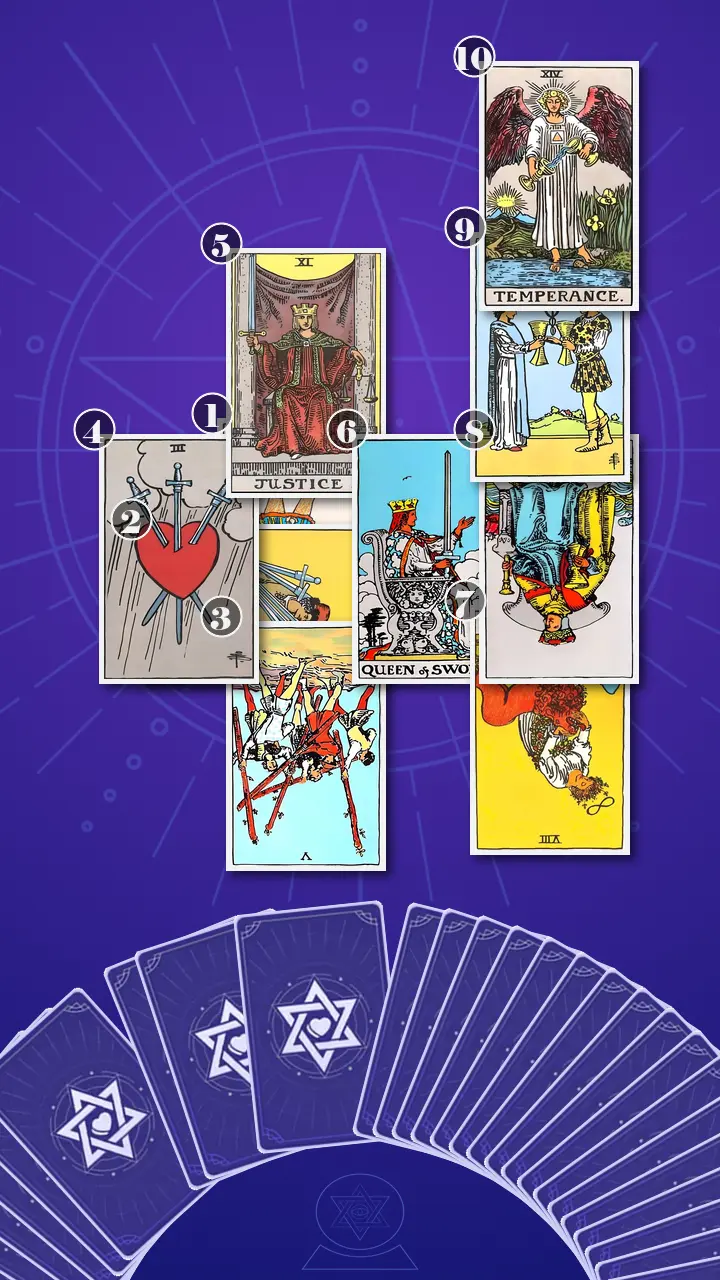
In this spread, the center shows the “right now.” The crossing card shows the obstacle that keeps you stuck in banter mode. And the near-future card—Position 6—often gives the cleanest “what do I do next?” guidance for actionable advice.
Reading the Map: How Tarot Works in Context (and Why You Keep Freezing)
Position 1 — Present dynamic: what happens right now
“Now turning over,” I said, “is the card that represents the present dynamic: what is happening right now when they ‘apologize’ with memes and you try to respond.”
Page of Cups, reversed.
“This,” I told her, “is the sweet, tentative messenger of feelings—except reversed, the message is playful and indirect when what you need is sincerity and follow-through.” I nodded toward her camera. “A meme apology can be a bid for reconnection. But in this position, it also shows how cute communication becomes a way to skip the hard part.”
In modern life terms, it’s exactly what you described: a funny GIF that gestures at feelings, while the real conversation floats offshore with no plan for what changes next.
Energetically, reversed Page of Cups is a blockage: emotional contact is offered, but it’s underdeveloped—more “vibe check” than “repair conversation.”
Jordan gave a small, uncomfortable laugh that sounded like a sip of air through clenched teeth. “That’s… brutal,” she said. Then she paused and added, almost accusing herself, “Because I take it. Every time.”
I kept my voice warm, not indulgent. “A meme can reconnect you. It can’t repair you.”
I watched her eyes flick down to her phone, like her body remembered the thread on its own.
Position 2 — Core challenge: what blocks repair
“Now turning over,” I said, “is the card that represents the core challenge: what blocks a real repair conversation from happening after the meme apology.”
Seven of Swords, upright.
I pointed to the figure sneaking away with the swords. “This is the easiest exit route. Not necessarily malicious—just strategic avoidance. The apology is delivered in a way that makes follow-up questions feel like you’re ‘ruining the vibe.’”
And here, I used her own world: “It’s like a coworker dodging a hard question by changing the meeting agenda mid-call. The conversation moves forward, but the actual issue stays untouched.”
Energetically, this is deflection. The loop becomes: they keep it light, you match the humor, and nobody has to risk a real yes-or-no about accountability.
To mirror what I was seeing, I narrated it like a phone-screen close-up—because that’s where this pattern lives. “The meme lands. Heat rises in your face. Your thumb auto-types ‘lol it’s fine.’ And meanwhile, the unsent draft—‘Can we talk for real?’—sits in the input box like a document you’re too scared to save.”
Then I gave her the inner monologue contrast, clean and non-shaming: “If I keep it playful, we stay connected… but if I keep it playful, nothing changes.”
Jordan nodded once, sharp and small. Like she was admitting the bug was real.
Position 3 — Root cause: the deeper driver underneath “keep it light”
“Now turning over,” I said, “is the card that represents the root cause: the deeper driver that keeps both of you in the pattern instead of direct repair.”
Five of Wands, reversed.
“Underneath the meme-apology dynamic,” I said, “is a deep discomfort with open conflict. Reversed Five of Wands doesn’t mean you can’t handle hard things. It means unstructured emotional conflict feels like chaos, so your nervous system reaches for smoothing and minimizing.”
Jordan’s mouth tightened in recognition. “At work, I can do critiques all day,” she said. “There’s an agenda. A Figma comment thread. In dating, it feels like one wrong sentence and suddenly I’m… the villain.”
Energetically, reversed Five of Wands is a deficiency of structure. And when structure is missing, humor becomes a substitute for containment. That’s why time-boxing matters so much for repair: a 10-minute check-in feels survivable where a vague “we need to talk” feels like falling down a staircase.
Position 4 — Recent past: the moment that still stings
“Now turning over,” I said, “is the card that represents the recent past: the rupture or moment of hurt that still needs to be acknowledged.”
Three of Swords, upright.
“This validates something important,” I told her. “The sting isn’t imaginary. This wasn’t ‘nothing.’ A joke landed like disrespect, and the apology didn’t touch the exact impact.”
Three of Swords is clean pain—direct impact. Like a cracked screen catching the light again days later, even after you put a cute sticker over it.
Jordan’s eyes went a little glassy, not dramatic—just honest. “I can quote the exact sentence,” she admitted. “And I hate that I can.”
“That’s your body keeping the receipt,” I said. “Not your weakness.”
Position 5 — Conscious aim: what you actually want
“Now turning over,” I said, “is the card that represents your conscious aim: what you actually want from an apology and repair.”
Justice, upright.
The room seemed to get quieter—not mystical, just focused. “Justice says you want accountability and clarity,” I said. “Not a reset button. Not a vibe reset.”
I translated the scales and sword into something modern and non-punitive: “This is a terms & conditions moment. Not cold—clear. Not ‘did you mean it?’ but ‘what will be different?’”
And I gave her a one-line definition, the kind you can actually use: “Fair repair is measurable: words, change, and follow-through.”
Jordan let out a visible exhale. Her shoulders dropped a fraction. “Permission to be specific,” she said, like she’d been waiting for someone to say it out loud.
Position 7 — Self position: why your confidence wobbles at send-time
“Now turning over,” I said, “is the card that represents you: your internal state and self-trust when you try to ask for repair.”
Strength, reversed.
“This isn’t a lack of strength,” I said. “It’s doubt about your right to use it calmly.” Strength reversed is that moment your chest tightens and you suddenly feel weirdly small for wanting something basic.
I offered the practical mirror-scene, because her body needed to rehearse the words as survivable. “It’s 11:03 p.m., bathroom light too bright, toothpaste-mint in the air,” I said. “You practice: ‘I’m not mad, I just want repair.’ And then you hear your own fear whisper, ‘Don’t be intense.’ So you add an escape hatch: ‘It’s not a big deal.’”
Jordan’s face softened—an “oh” that wasn’t self-pity, more like recognition without shame. “I do that,” she said quietly. “I literally do that.”
“You don’t need to sound fearless,” I told her. “You need to sound steady.”
Position 8 — Environment/other person: how they tend to handle discomfort
“Now turning over,” I said, “is the card that represents the environment: how the other person is likely to engage with accountability and emotion.”
King of Cups, reversed.
“I’m not going to diagnose them,” I said, because I never do. “But this card describes a pattern: charm without follow-through. They manage discomfort by staying emotionally slippery—pleasant, joking, smooth—without actually holding accountability.”
Energetically, this is avoidant containment: the outside looks calm, but the emotional work doesn’t get held.
“So your best move,” I added, “is structure. Not debating feelings in circles. Asking for one specific repair step.”
Position 9 — Hopes and fears: what you’re longing for underneath the frustration
“Now turning over,” I said, “is the card that represents your hopes and fears: what you want repair to be, and what you fear it might reveal.”
Two of Cups, upright.
Her eyes flicked up at that—like she wanted to believe it.
“You want mutuality,” I said. “Not a power struggle. You’re not asking for groveling. You’re asking for a shared agreement: ‘We handle conflict like adults.’”
And the fear part lived right beside it: “Two of Cups here also asks: if you make a clear request… do they meet you, or do they dodge? Your request becomes a test of reciprocity.”
Position 10 — Integration outcome: what becomes possible with clarity
“Now turning over,” I said, “is the card that represents the integration outcome: what becomes possible when you ask for repair clearly and observe their response over time.”
Temperance, upright.
As a perfumer, Temperance always feels personal. It’s the card of blending—alchemy, calibration, the exact opposite of all-or-nothing.
“This outcome isn’t a dramatic showdown,” I said. “It’s a repeatable repair protocol. You blend honesty with warmth. You keep humor in the relationship, but you stop letting it replace sincerity.”
Temperance is a thermostat, not a light switch. Not “never joke again.” Just “jokes don’t get to be the only tool in the room.”
When the Queen of Swords Cut Through the GIF
Position 6 — Near-future approach: the stance that works next
I let my hand hover for a beat before turning the next card. “This,” I said, “is the near-future approach—the most effective communication stance for asking for repair in the next conversation.”
Queen of Swords, upright.
There’s a particular quiet that happens when someone recognizes a tool they’ve been needing. Jordan’s face went still—like a browser finally stopped loading and showed the page.
“The Queen of Swords is clarity without cruelty,” I said. “A short message. A specific request. And the discipline to not fill the silence with extra justifications.”
Then I brought in my own framework—my Emotional Repair Pathway, the one I use with couples who want intimacy without guessing games. “In repair,” I said, “I look for three phases: Impact (name what happened), Accountability (what changes), and Reconnection (how we come back together). Meme-apologies are often an attempted reconnection without impact and accountability. The Queen says: put the missing phases back in, simply.”
Setup: I could almost see the exact moment in her body: thumb hovering over the chat, jaw tight, rewriting “can we talk for real?” into something cute enough that she wouldn’t get labeled “intense.” She wanted closeness, but she didn’t want to beg for basic accountability.
Stop decoding memes and start naming your needs with the Queen’s raised sword—clear, calm, and unmistakable.
Reinforcement: Jordan’s reaction didn’t arrive all at once. First, she went very still—breath caught, like her lungs were waiting to see if this would be safe. Then her eyes unfocused for a second, as if replaying a dozen threads: the typing bubble anxiety, the timestamps, the way she always backspaced the honest sentence into something softer. Finally, her shoulders lowered on a long, shaky exhale, and her mouth pulled into a tiny smile that was half relief and half grief for all the times she abandoned herself. “But if I do that,” she said, a little sharper than before, “doesn’t it mean I’ve been… letting this happen?”
“It means you’ve been trying to belong,” I said gently. “And now you’re upgrading the system. No shame. Just new information.”
I asked her the question that turns insight into something you can actually use: “Now, with this new lens—can you think of a moment last week when you felt the throat-tightening start, and this two-sentence clarity could have changed how you felt in your body?”
Jordan blinked quickly. “Tuesday,” she said. “Kitchen. Kettle. I did the ‘lmaoo ok’ thing. If I’d sent the clean version… I would’ve at least known.”
That was the shift, right there: from irritated shutdown to vulnerable honesty that feels risky—one step toward calm clarity. Not just about a decision, but about moving from self-doubt to steadier trust in her own needs.
From Insight to Action: The Two-Sentence Repair Ask (Plus a Scent Anchor)
When I looked at the spread as a whole, the story was almost painfully coherent: a tender but underdeveloped bid for connection (Page of Cups reversed) gets protected by an exit route (Seven of Swords), because underneath there’s a fear that serious talk equals chaos (Five of Wands reversed). A real sting still needs naming (Three of Swords). And Jordan’s conscious self is already holding the standard (Justice)—she just needs the near-future stance to carry it (Queen of Swords), even when her confidence wobbles (Strength reversed), especially with someone who prefers smooth vibes to accountability (King of Cups reversed). The hope is mutual repair (Two of Cups), and the likely path is a workable blend over time (Temperance).
The cognitive blind spot I named for her was simple: “You’ve been treating your need like it has to be approved by their tone. But your need doesn’t become valid only when they deliver it in the right packaging.”
The transformation direction was exactly what she came for: shift from decoding their tone and trying to keep it light to making one clear, specific repair request—and letting their response give you real information.
I offered her a set of next steps that were intentionally small—because steadiness beats intensity.
- The Two-Sentence Repair RequestOpen Notes and draft this now (so you’re not improvising in the chat): Sentence 1 = impact. Sentence 2 = one concrete next step + a time container. Example: “When you sent the meme after what happened, I felt brushed off. Can we do a 10-minute call tonight to talk about what repair looks like and what we’ll do differently next time?”If your throat tightens, set a 60-second timer, breathe, and come back. You’re allowed to choose timing; you’re not required to send it immediately.
- The Yes/No Accountability ForkIf they reply with another meme, respond once (only once): “I’m not looking for jokes right now—are you willing to talk and repair this, yes or no?” Then stop talking and let the answer be data.This isn’t you escalating. This is you preventing the Seven-of-Swords exit route from turning into a pattern.
- The 7-Minute Face-Down Rule + a Scent CueAfter you hit send, put your phone face-down for 7 minutes. No rereading, no editing, no “lol jk” follow-up. If you want a body anchor, dab one simple scent you associate with “clean air” (citrus, mint, even your hand soap) before sending—your Queen of Swords cue that this is clarity, not a performance.In perfumery, top notes are loud and fast; base notes are what lasts. Your boundary is a base note—quiet, steady, not begging to be liked.
And because Temperance was waiting at the end of the spread, I gave her an optional reconnection ritual—my “shared blending” strategy, simplified for real life: “After the repair talk, if it goes well, suggest something small and sensory you both enjoy—make tea together, pick a candle, cook one simple meal. It’s not a reward for them. It’s a way to mark: we did accountability, and we came back to warmth.”

A Week Later: Warm, Not Vague
Six days later, Jordan messaged me a screenshot—not of his reply, but of her own Notes app. Two sentences, exactly. Under it she’d typed: “I sent it. I didn’t add ‘lol.’ I put my phone face-down and walked to Tims like a normal person.”
Her follow-up text came a minute after: “He called. He actually apologized without a meme. We kept it to ten minutes. I’m… weirdly shaky, but I feel clearer.”
That’s how a Journey to Clarity usually looks in real life: not fireworks, not perfection—just one clean request, one honest response, and your nervous system slowly learning that you can be warm without being vague.
She didn’t suddenly become fearless. She just stopped negotiating with hints. And that was enough to change the whole shape of the conversation.
When you’re laughing along so they won’t leave, but your throat still tightens because the thing that hurt never got named, it’s not that you’re “too intense”—it’s that you’re trying to belong without asking to be handled with care.
If you let their next response be information—not a verdict on your worth—what’s one small, specific repair request you’d be willing to make this week?
This story is adapted from psychological research, written so that those in a similar struggle can see their own pattern in it — and find their next step clearly.These insights are not a substitute for professional psychological, medical, legal, or financial advice.
Learn more about our Journey to Clarity.
How did this insight land for you?
🫂 This Resonates Deeply
🌀 Living This Story
✨ Now I See Clearly
🌱 Seeing New Possibilities
🧰 Useful Framework
🔮 The Confirmation I Needed
💪 Feeling Empowered
🚀 Ready for My Next Step
Author Profile
 AI
AI“As a perfumer for fifteen years, I’ve learned to perceive human boundaries through the delicate metaphor of scent. Relationships need the right amount of space to breathe, and I've seen too many kind souls exhaust themselves trying to please everyone. I’m here with warmth and understanding—not to teach you to be guarded, but to help you gently clear the air and rediscover the comforting, safe boundaries that are rightfully yours.”
In this Love Tarot Reading :
Core Expertise
- Intimacy Distance Calibration: Using the metaphor of scent diffusion to diagnose whether your relationship suffers from emotional suffocation or detached coldness.
- Boundary Permeability Assessment: Objectively evaluating where your personal identity ends and your partner's begins, identifying unhealthy enmeshment.
Service Features
- The Blank Space Protocol: A behavioral challenge to intentionally create comfortable emotional or physical distance, allowing the 'oxygen' needed to reignite mutual attraction.
Also specializes in :
Explore Related Patterns:
Conflict AvoidanceThe meme apology creates a narrow exit ramp: they keep it light, Jordan matches the humor, and the original hurt never has to be named. Her own description makes the pressure visible: at work she can handle critique with structure, but in dating one wrong sentence can suddenly make her feel like the villain. Conflict Avoidance shows up here as smoothing, minimizing, and staying in banter mode when the conversation needs impact and accountability. The goal is not to deny the hurt forever; it is to keep the emotional field from becoming chaotic, uncontained, or socially punishing. Humor becomes a substitute container because a direct repair conversation feels too open-ended to survive. This pattern matters because the question is not only how to phrase the repair ask. It is how You stop treating conflict as proof that the relationship is unsafe. The two-sentence request gives the conflict a frame, so You can ask for repair without turning the whole moment into a referendum on whether You are too much.
Emotional BypassingThe meme apology offers reconnection before impact has been named. Jordan's 'lol' completes the bypass: the thread gets warm enough to avoid rupture, but not honest enough to repair it. The painful sentence still exists underneath, untouched. Emotional Bypassing is the mechanism where a softer emotional substitute stands in for the harder emotional work. Here, humor is not the problem by itself. The problem is that humor becomes the only tool in the room, replacing the missing phases of repair: what happened, what it did, and what changes next. The practical repair request works because it puts those missing phases back into language. You can keep warmth without letting warmth become a cover for avoidance; You can accept reconnection without accepting a joke as accountability.
Permission SeekingJordan's need for repair becomes conditional the moment the apology arrives in meme form. Instead of treating her hurt as valid because it happened, she scans the other person's tone and adjusts herself downward, as if the joke sets the emotional rules for what she is allowed to ask. Permission Seeking is the cognitive filter underneath that adjustment. It makes You wait for an external cue that your need is reasonable before You state it plainly. In the story, that filter turns 'Can we actually talk about what happened?' into 'lol,' then later turns 'I just want repair' into a sentence padded with 'It's not a big deal.' The repair ask interrupts the pattern by separating validity from approval. You are not asking the meme for permission to matter; You are naming impact, asking for one concrete next step, and letting the response tell You whether reciprocity is available.
Self-SilencingJordan's thumb already knows the honest sentence: 'Can we actually talk about what happened?' Then she deletes it and sends 'lol,' even while her jaw clenches and her body stays tight. The behavior is not random indecision; it is a protective edit, turning a clear need into something less likely to disrupt the vibe. That edit works as a defense against relational risk. If You keep the message playful, You do not have to test whether the other person can handle your disappointment, but the cost is that your own impact gets erased before it can be heard. The clenched jaw, the swallowed sentence, and the escape hatch of 'It's not a big deal' all point to the same internal bargain: stay acceptable first, ask for repair later. Self-Silencing fits because the story is built around an unsent truth. The repair request exists, but it gets muted to preserve connection, leaving You with the temporary relief of not seeming intense and the longer-term frustration of still not being repaired.
Boundary DiscernmentJordan's drafted message names the impact first and then asks for one concrete next step: a 10-minute call to talk about repair and what changes next time. That structure turns a vague emotional ache into a clean boundary around what a real apology needs to include. Boundary Discernment is not coldness or punishment. It is the ability to separate warmth from vagueness, reconnection from accountability, and someone else's tone from your own right to ask for care. You can still be kind while refusing to let a meme become the whole repair process. The yes-or-no accountability fork strengthens this pattern. If another joke arrives, You ask once whether they are willing to talk and repair this. Then You let the answer be data, which keeps the boundary clear without chasing, overexplaining, or negotiating against yourself.
Strategic VulnerabilityJordan's next workable stance is not a dramatic emotional download. It is a short message, a specific request, and the discipline not to fill the silence with extra justifications. She names what happened, asks for a contained repair conversation, and lets the response carry real information. Strategic Vulnerability describes that blend of openness and structure. You are not hiding the hurt, but You are also not throwing the whole relationship into an unbounded argument. The vulnerability is real because You name the impact; the strategy is protective because You ask for one concrete step inside a clear time container. This pattern directly answers the repair question. After a meme apology, You do not need to decode the joke for hidden sincerity. You can offer a precise doorway into accountability and see whether the other person walks through it.
People-PleasingJordan's 'lol' is not just a reply; it is a social performance of being easy, chill, and not too demanding. The story makes the cost explicit: she wants closeness, but she does not want to beg for basic accountability, so she makes the request smaller before the other person even responds. People-Pleasing appears as the attempt to stay lovable by staying low-friction. You soften the ask, absorb the awkwardness, and protect the other person from discomfort while your own discomfort stays in your body. The relationship feels calmer on the surface, but the repair stays incomplete. The two-sentence repair ask changes the role You are playing. Instead of managing how palatable your hurt sounds, You name the impact and ask for one concrete next step. That is not punishment; it is the end of performing chill as the price of being close.
Rejection SensitivityJordan is not only choosing between two texts; she is choosing between two imagined outcomes. If she keeps it playful, the connection stays intact for the moment. If she asks directly, a fear appears: she might be seen as intense, difficult, or suddenly the villain. Rejection Sensitivity fits because the repair request is filtered through anticipated social punishment. The body reaction arrives before the message is sent: throat tight, jaw clenched, chest small, thumb hovering. You are not responding only to the meme; You are responding to the possibility that naming a need could cost You closeness. The shift in the story is to let their response become information rather than a verdict on your worth. That distinction is crucial. A clear repair ask does not prove You are too much; it reveals whether the other person can meet a reasonable bid for accountability.
Emotional ReciprocityJordan's stated aim is not to win, punish, or force a confession. She wants fair repair: words, change, and follow-through. The hope underneath the frustration is mutuality, a shared agreement that conflict can be handled directly without losing warmth. Emotional Reciprocity fits because the repair request tests whether both people can participate in the emotional work. A meme can be a bid for reconnection, but reciprocity asks for more than a bid; it asks whether the other person can acknowledge impact and help build a different next time. The pattern becomes visible when You stop doing both sides of the repair alone. You make one clear request, then observe whether they meet You there or dodge. That response gives You relational data without requiring You to shrink your need to keep the peace.
Explore Related Struggles:
Connection-Repair LoopJordan keeps receiving a form of reconnection that looks warm on the surface: a meme, a joke, a small bid to get the thread moving again. The contact returns, but the rupture itself is still sitting there untouched, because the apology never names the impact or what will change next. You can feel the loop in the moment she types the real sentence and deletes it. If she matches the humor, the connection survives the next few minutes; if she asks for repair, the conversation has to stop being cute and become accountable. That tension makes the chat feel alive and stuck at the same time. Connection-Repair Loop fits because the relationship keeps finding a way back to contact without completing the repair process. The struggle is not whether humor belongs in the relationship; it is whether humor is being used as the only bridge, leaving you connected enough to stay but not clear enough to trust the repair.
False Recovery LoopJordan names the repetition herself: she takes the meme apology every time. The mood resets, the thread keeps moving, and from the outside it can look like the rupture has passed. You can feel the hidden cost of that reset. Each playful apology gives the relationship the sensation of recovery while leaving the actual injury unprocessed, so the next rupture has to carry both the new impact and the old one that never got named. False Recovery Loop fits because the system keeps producing signs of repair without the substance of repair. The struggle is not a single bad apology; it is the way repeated lightness can train you to accept emotional motion as evidence of change, even when no real accountability has been added.
Performative HarmonyJordan's body is not chill when she sends the chill response. Her jaw clamps, her throat tightens, and the sentence she actually wants to send gets replaced by 'lol,' turning a repair request into a performance of being easy to handle. You are watching harmony become something she has to produce on command. The relationship gets a smoother surface, but Jordan pays for that smoothness by swallowing the specific impact and acting less bothered than she is. Performative Harmony fits because the central struggle is not politeness or good communication etiquette. It is the pressure to preserve connection by staging emotional ease, even when the honest need underneath is simple: name what happened, take it seriously, and repair it with follow-through.
Self-Erasure ReliabilityJordan practices a clear sentence and then starts adding exits from her own need: 'I'm not mad,' 'It's not a big deal,' anything that might make the request less likely to be judged as too much. The message becomes safer by becoming smaller. You can see how reliable she has learned to be in the relationship space. She protects the other person from discomfort, protects the vibe from disruption, and protects the connection from pressure, but that reliability is built by shaving down the very repair she needs. Self-Erasure Reliability fits because the story shows a repeated trade: stay easy, stay connected, stay less demanding. The struggle is the slow compression of self-advocacy into something palatable enough to send, even when the original need was already fair.
Truth-Connection SplitJordan can handle direct feedback in a work setting when there is an agenda, a comment thread, and a shared frame for critique. In dating, the same clarity suddenly feels dangerous, as if one honest sentence could flip her from reasonable partner to villain. You can see the split at send-time: the truth is available, but connection feels conditional. She wants to ask, 'Can we actually talk about what happened?' while also trying not to rupture the closeness she still wants. Truth-Connection Split fits because the story keeps placing honesty and belonging on opposite sides of the same button. The repair ask becomes hard not because it is unclear, but because speaking clearly feels like it might cost the warmth she is trying to protect.
Vulnerability Containment StrainJordan does not avoid repair because she lacks the words. The story shows that the words become usable when there is a frame around them: impact, accountability, reconnection, and a 10-minute container instead of a vague drop into emotional chaos. You can feel the difference between a structured check-in and the phrase 'we need to talk.' One gives the vulnerability somewhere to land; the other makes the whole interaction feel like it could spill everywhere. Vulnerability Containment Strain fits because Jordan's need is real, but the container around that need is unstable. The struggle is learning how to make vulnerability specific enough to be held, without turning the repair request into either a shutdown or a dramatic confrontation.
Explore Related Emotions:
Accountability DreadJordan’s jaw clamps at Union Station, and the sentence she actually wants to send disappears before it can become visible. The meme apology gives her a tiny bridge back to connection, but it also sets a playful frame where asking, “Can we actually talk about what happened?” suddenly feels like breaking the social contract. You are watching a need for repair collide with the fear that directness will be treated as too much. The body tightens first because the request is not just about one message; it is about whether accountability can exist without costing closeness. Accountability Dread names that suspended moment before the ask, when the clean sentence feels emotionally risky even though it is reasonable. The dread lives in the gap between wanting a real repair conversation and fearing that the other person will dodge, joke, or make you feel responsible for changing the tone.
Cautious VulnerabilityJordan sends the two sentences and does not add the softening joke afterward. The message is not dramatic; it simply names the impact and asks for a ten-minute conversation about what changes next. You can still feel the shakiness afterward, which matters. The point is not that directness becomes effortless, but that she lets the vulnerable sentence exist without burying it under extra disclaimers. Cautious Vulnerability captures that precise emotional stance: open, but not uncontained; honest, but not flooded; willing to be seen, while still giving the nervous system a small enough step to survive. It is the feeling of choosing clarity before you feel completely ready.
Clarity ReliefJordan’s shift happens when the question stops being “What did the meme really mean?” and becomes “What repair am I actually asking for?” The screenshot of her Notes app matters because the clarity exists before the other person responds. You can feel the relief in the clean sequence: send the two sentences, do not add “lol,” put the phone face-down, let the reply be data. The situation still matters, but it is no longer a maze of tone-reading and self-editing. Clarity Relief names the release that comes from having a usable standard. The relief is not perfection or certainty; it is the body realizing that a specific need can be named without waiting for someone else’s packaging to make it legitimate.
Contained OverwhelmThe ten-minute container changes the shape of the repair ask. Instead of a vague “we need to talk” opening into an endless emotional hallway, Jordan gives the conversation a start, an edge, and a next step. You are seeing intensity become manageable through structure. The feeling is still big enough to make her shaky, but it no longer has to flood the whole exchange or turn into a late-night spiral of overexplaining. Contained Overwhelm fits because the overwhelm is not erased; it is held. The repair request becomes a bounded space where impact, accountability, and reconnection can happen without requiring Jordan to perform total calm.
Grounded AgencyJordan’s repair request is specific enough to stand on its own: what happened, how it landed, and what conversation needs to happen next. She does not have to win the exchange, decode the meme, or prove that her need is reasonable before she names it. You can feel agency return when the message stops negotiating with the other person’s tone. The request gives her real information either way, because willingness to repair becomes observable instead of guessed at. Grounded Agency names the steadiness of acting from a clear standard without turning cold. It is not control over their response; it is ownership of her own ask, her own timing, and her own right to require more than a vibe reset.
Guarded LongingJordan wants the repair talk because she still wants the bond. She is not asking for a dramatic confrontation; she is asking whether the relationship can come close enough to name the hurt without hiding behind another joke. You can feel the guard in the way she edits the sentence into something safer. The wish for closeness is real, but it has to pass through a filter of “don’t be intense,” “don’t ruin the vibe,” and “don’t ask for too much.” Guarded Longing names the ache of wanting mutual repair while protecting yourself from the possibility that the other person will not meet you there. The longing reaches toward connection, but it keeps one hand on the exit because the answer may reveal more than the meme did.
Invalidation AcheThe apology arrives as a joke, and the original sting stays exactly where it was. Jordan can still quote the sentence that hurt, which shows that the impact did not dissolve just because the tone turned cute. You are seeing the difference between reconnection and recognition. A meme can reopen the channel, but it does not necessarily say, “I understand what landed badly, and I know what needs to change.” Invalidation Ache names the soreness left behind when the hurt is treated as lighter than it felt. The ache is not about refusing humor; it is about needing the exact impact to be acknowledged instead of covered with something charming enough to move past it.
Performative CalmThe thread keeps asking Jordan to be funny at the exact moment her body is asking for honesty. Heat rises, the draft gets softened, and “lol it’s fine” becomes a small performance that keeps the conversation smooth while the impact stays untouched. You can see how the performance works because it is socially rewarded. It preserves the vibe, avoids the awkward pause, and lets the other person stay comfortable, but it also teaches the real sentence to stay hidden. Performative Calm fits because the calm on the screen is not the same as calm in the body. Under the easy reply is a clenched, edited, over-managed version of connection that keeps peace by making the need for repair harder to see.
Self-Betrayal AcheJordan knows the clean sentence before she deletes it. That is what makes the moment hurt internally: the issue is not that she has no words, but that she has learned to backspace the words that would protect her. You can hear the cost in the way she asks whether being direct means she has been letting it happen. The story does not frame her as weak; it shows someone trying to belong by making her own need easier to ignore. Self-Betrayal Ache names the soreness that appears after too many softened replies. It is the private sting of realizing you kept the thread comfortable while leaving the part of you that needed care unrepresented.
Reciprocal WarmthAfter the repair talk, warmth does not have to do the job of accountability anymore. The small sensory ritual, the ten-minute call, and the apology without a meme all point to connection that can include both care and specificity. You are seeing a version of closeness that is not built on hinting. Humor can stay in the relationship, but it no longer has to cover the crack or rush everyone past the uncomfortable part. Reciprocal Warmth names the feeling of being met after the truth has been spoken. It is warmth with shape: mutual, observable, and grounded enough that reconnection feels earned rather than vague.
Explore Related Contexts:
Accountability Evasion CycleThe partner's apology arrives as a meme after something hurtful happened, and Jordan's first honest draft, 'Can we actually talk about what happened?', gets deleted in favor of 'lol.' The repair attempt is being routed through humor, which gives the relationship a quick reconnection signal while leaving the actual impact untouched. That is the structure of an accountability evasion cycle: the other person keeps the tone light, Jordan matches the lightness to stay connected, and the conversation moves on before anyone has to name what will change. The problem is not that memes are inherently shallow; it is that, in this exchange, the meme is being asked to carry repair work it cannot carry. You ask for repair by interrupting the loop without turning it into a courtroom. A clear request like 'When you sent the meme after what happened, I felt brushed off. Can we do a 10-minute call tonight to talk about what repair looks like?' shifts the interaction from vibe management into observable follow-through.
Relationship Boundary NegotiationJordan's shift is concrete: she stops treating 'lol it's fine' as the price of staying easy to love, and she practices a two-sentence request that names impact and asks for a 10-minute repair conversation. The boundary is not a wall; it is a clearer rule for what happens after harm. This is relationship boundary negotiation because the conflict is not only about one meme. It is about whether the relationship has enough structure to hold sincerity without turning every direct need into a threat to closeness. The boundary says humor can stay, but it cannot be the only tool allowed in the room. You ask for repair by making the boundary observable: what happened, what it did, and what you are asking for next. That gives the other person a fair chance to meet you while also giving you real information if they keep dodging. The point is not to control their response; it is to stop abandoning your own clarity before the conversation even begins.
Charm Without Follow-ThroughJordan is not describing a partner who explodes or openly refuses contact; she is describing someone who stays smooth, joking, and emotionally pleasant while the repair step stays missing. The apology has social warmth, but it does not yet contain impact, accountability, or a concrete change. That is why the charm matters. A soft tone can make the request for seriousness feel disproportionate, as if asking for follow-through would puncture the mood. The relationship stays warm on the surface, but the part that would actually protect you next time remains undefined. The repair ask needs to be specific enough that charm cannot substitute for an answer. 'Are you willing to talk and repair this, yes or no?' is not an attack; it is a way to separate pleasantness from participation. You are letting their response show whether warmth is paired with accountability or simply used to move past discomfort.
Digital Intimacy Boundary ConfusionThe whole rupture lives inside a phone interface: Union Station, one hand on the pole, a warm phone, a meme popping up as an apology, an honest sentence typed and deleted. The chat box becomes the place where affection, avoidance, embarrassment, and repair all collapse into the same tiny field. That makes this a digital intimacy boundary problem. The meme creates contact, but the format blurs what kind of contact is happening: is it an apology, a joke, a bid for closeness, or a way to avoid the harder conversation? Without a boundary around what repair requires, the digital gesture starts defining the emotional rules for both of you. You do not have to reject playfulness to ask for clarity. The boundary is simply that a GIF can reconnect, but it cannot replace impact, accountability, and a next step. Naming that distinction gives you a cleaner digital container for the repair request instead of letting the medium decide the seriousness of the moment.
Direct Communication TrialJordan already knows the honest sentence; the problem is that it keeps getting edited into something softer before it leaves her phone. The Queen of Swords approach turns that unsent sentence into a short, structured message with impact in the first line and a specific next step in the second. This is a direct communication trial because the relationship is testing a new channel for repair. Instead of decoding tone, matching the joke, or padding the request with extra reassurance, you make one clear ask and then stop filling the silence. The structure protects the message from being diluted at send-time. The trial is not about sounding fearless. It is about giving your words enough shape to survive the moment when your throat tightens and your thumb wants to add 'lol jk.' A direct request lets you see what the other person does with clarity, which is far more useful than guessing what their meme was supposed to mean.