Finding Clarity in the 8:07 a.m. Refresh
If you woke up on your birthday in Toronto and checked notifications before your feet hit the floor—then tried to play it off like you’re “not a birthday person”—this is for you.
Taylor told me that at 8:07 a.m. she stood in her condo kitchen while the kettle clicked off, that tiny mechanical sigh that usually means comfort. Her phone was face-up beside her coffee, screen glare bouncing off the counter like a second light source. She swiped down to refresh before she’d even taken a sip. Nothing new. The silence landed in her body first—throat tightening, stomach dropping—then in her thoughts: It’s still early, like she could negotiate with time itself.
“I hate that I care this much,” she said, the way someone says it when they’re trying to make the feeling smaller by naming it first. “I don’t want a big gesture. I just want to feel considered. And when I have to remind someone… it doesn’t feel real.”
In my experience—ten years guiding people under a planetarium dome—there’s a particular kind of heartbreak that comes from watching a sky you expected to light up… stay dark. It’s not dramatic. It’s quiet. It’s the kind of hurt that makes you move through your day like you’re wrapped in a too-tight scarf you can’t take off at work.
I listened, and I didn’t rush her into “being chill.” I said, “We’re not here to argue you out of wanting warmth. We’re here to figure out what this moment is touching in you—and what your next step is, so you can stop spiraling and start getting real data.”
“Okay,” she exhaled. “Because right now it feels like I’m refreshing my phone like it’s polling an app for my value.”
“That’s exactly the kind of loop tarot is good at mapping,” I told her. “Let’s see what the cards say about the old wound under this—and what ‘next’ actually looks like.”

Choosing the Compass: A Celtic Cross for a Modern Birthday Spiral
I asked Taylor to take one slow breath—not as a ritual for luck, but as a clean transition from rumination into observation. Then I shuffled, the sound of cardstock sliding like soft footsteps on a stage.
“Today we’ll use the Celtic Cross,” I said. “It’s not a yes/no spread. It’s a full map: what’s happening right now, what blocks repair, what old imprint is getting triggered, and the most constructive next step. Then it shows the interaction between your internal stance and the environment—before it offers an integration path.”
For this question—Forgotten birthday again—what old wound is this, and what’s next?—a Celtic Cross works because the problem isn’t just the date. It’s the chain reaction: the sting, the silence-as-a-test, the meaning you assign, and the way it slowly erodes connection. We need structure, not vibes.
“We’ll start with the center: the emotional reality,” I explained. “Then the crossing card: the behavior that keeps the pattern repeating. We’ll go down to the root wound, then left to the recent context, up to your conscious standard, and right to the next step—your pivot.”
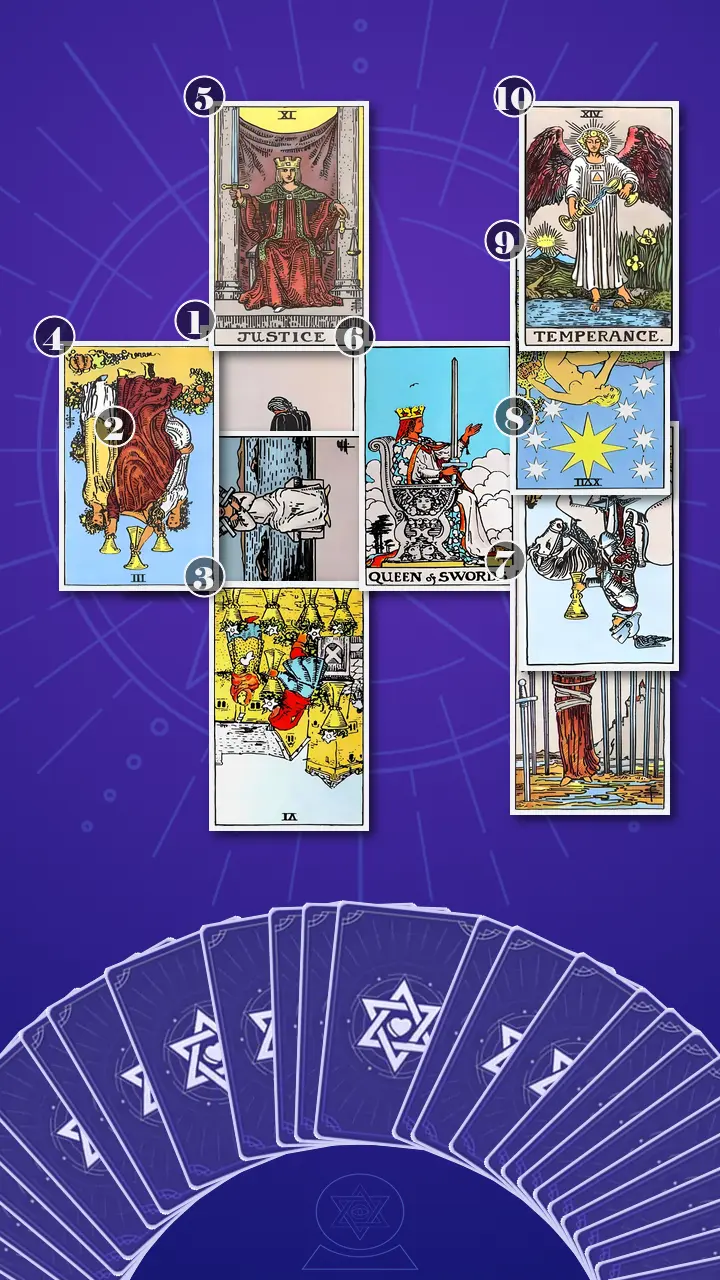
Reading the Map: Spilled Cups, Slipping Blindfolds
Position 1 — The immediate emotional reality of today
“Now flipped open,” I said, “is the card that represents the immediate emotional reality of the forgotten birthday and how it’s being experienced right now.”
Five of Cups, upright.
I tapped the image gently—the cloaked figure staring at what spilled, with two cups still standing behind them. “This is that moment at 4:13 p.m. where the notification screen feels… offensively empty,” I said. “Like the day is moving forward without acknowledging you exist.”
In modern life, the Five of Cups looks like: refreshing messages repeatedly, mentally replaying silence, while ignoring what still exists—one friend who did reach out, the option to make an actual plan, even your own capacity to care for yourself without making it a performance.
“The energy here is contraction,” I told her. “Not ‘you’re dramatic.’ Your attention narrows under hurt. Your nervous system goes, Something important is missing—and it makes the missing thing feel like the whole truth.”
Taylor let out a small laugh that wasn’t amused—more like a flinch wearing a smile. “That’s… too accurate,” she said. “Like, kind of brutal.” Her fingers worried the edge of her mug, then went still.
“It’s not here to judge you,” I said. “It’s here to name the weather.”
Position 2 — The behavior that blocks repair and keeps the pattern repeating
“Now flipped open,” I said, “is the card that represents what blocks repair or clarity in the moment—especially the specific behavior that keeps the pattern repeating.”
Two of Swords, reversed.
“This is the blindfold slipping,” I said, “but instead of using sight, you freeze.”
And immediately I could see it on her face: she recognized the loop. The modern-life version is painfully specific—open the thread → reread the last message → check their online status → draft a text → delete → open Instagram instead. A stalling loop that feels like “being low-maintenance,” but functions like a pressure cooker.
“The reversal is important,” I added. “The energy is blockage breaking down. You can’t maintain the stalemate forever. Silence starts to feel like pressure, not protection.”
She winced. “I literally typed ‘lol it’s my birthday btw’ like a joke and deleted it,” she admitted. “Then I posted a story like ‘aging is fake’ and watched who viewed it. Which is… humiliating to say out loud.”
“A silent test doesn’t protect you from disappointment—it just delays the truth,” I said, keeping my tone steady. “And the longer the test runs, the more your mind fills in the blanks.”
Position 3 — The old wound under the trigger
“Now flipped open,” I said, “is the card that represents the old wound under the trigger: the earlier template this situation is activating.”
Six of Cups, reversed.
In the upright, this card can be sweetness—childhood, innocence, uncomplicated care. Reversed, it’s the past becoming a lens so strong it tints the present.
“This is why today doesn’t just feel like a scheduling mistake,” I told her. “It plugs into an older memory: the version of you who learned that wanting attention was embarrassing, that being remembered had to be earned.”
The energy reads like old emotional gravity—pulling you backward. Not because you’re weak, but because the nervous system remembers patterns.
Taylor’s eyes went unfocused for a second, like she was watching something far away. Then she swallowed—small, controlled. “I don’t even have a big childhood story,” she said quietly. “It’s just… I was always the ‘capable’ one. If I needed something, it felt… inconvenient.”
I nodded. “That’s enough. Wounds don’t need fireworks to be real.”
Position 4 — The recent social context that made “forgotten again” feel predictable
“Now flipped open,” I said, “is the card that represents the recent relational or social context that makes ‘forgotten again’ feel predictable.”
Three of Cups, reversed.
“This is the celebration card—turned inside out,” I explained. “It’s ‘fun and social’ without ‘reliably supportive.’ The group chat moves fast, the hangouts happen… but when it’s your milestone moment, the follow-through evaporates.”
The energy here is misalignment: connection that looks full from the outside and feels thin on the inside. “It also explains why your feed hurts right now,” I added. “Because you’re not just missing a text. You’re watching other people’s ‘birthday weekend’ content like it’s a scoreboard you didn’t agree to, but can’t stop checking.”
She exhaled through her nose, sharp. “Yeah. I feel included until I don’t.”
Position 5 — Your conscious standard: what you want to be true
“Now flipped open,” I said, “is the card that represents what you consciously want to be true about this relationship and your worth within it.”
Justice, upright.
Under the planetarium’s night sky, I teach people that constellations are patterns we agree on—lines we draw to make meaning. Justice is that same impulse, matured: standards that turn vague longing into something you can actually live by.
“You’re not asking for magic,” I said. “You’re asking for consistency. Respect in observable behaviors.”
Justice energy is balance, not punishment. “This card is your internal policy doc,” I told her. “What does respect look like in actions, not intentions? Because if we keep this at the level of ‘maybe they meant well,’ you’ll keep having to mind-read.”
Taylor sat a little straighter. “I want… basic regard,” she said, like she was surprised she could say it without apologizing.
When the Queen Lifted Her Sword
I paused before turning the next card. The room went quieter in that way it does when someone stops performing fine-ness and starts listening for truth—like a theatre right before the spotlight hits.
Position 6 — The most constructive next step: hurt into truth without self-abandonment (Key Card)
“Now flipped open,” I said, “is the card that represents the most constructive next step: how to move from hurt into truth and choice without self-abandonment.”
Queen of Swords, upright.
“This Queen doesn’t do hinting,” I said gently. “She does clarity. She’s the part of you that can say the true thing once—without apology and without a hidden test—and then listen.”
I pointed to her raised sword and open hand. “That open hand matters. This isn’t cruelty. It’s an invitation: Meet me in reality. And if someone can’t, that’s information.”
Because I work with celestial timing, I often use a lens I call Cosmic Redshift Communication: in astronomy, redshift tells you something is moving away even if it looks close in the night sky. In relationships, the earliest signs of distancing aren’t always dramatic—they’re tiny: consistent delays on important moments, apologies with no plan, warmth without follow-through. The Queen of Swords doesn’t panic at the redshift. She measures it. She asks one clear question that reveals whether the distance is temporary… or a pattern.
And this is where Taylor’s mind was stuck: she wanted to be valued and celebrated, but she feared that asking would make her look needy—and confirm she wasn’t worth the effort. So she ran silent tests. And silent tests, by design, produce ambiguous results.
Setup
You know that moment when you’re pretending to work, but your phone is face-up and your eyes keep snapping to it—like the next buzz will decide your entire worth for the day. That’s the crossroads this Queen walks you out of.
Delivery
Not silent hoping, but clear asking—let the Queen’s raised sword draw a clean line where your self-respect begins.
I let the sentence sit between us, the way I let a planetarium audience sit in darkness long enough for their eyes to adjust and actually see the stars.
Reinforcement
Taylor’s reaction came in layers—fast and slow at the same time.
First, a freeze: her breath caught, and her thumb hovered over her phone like she’d been caught mid-refresh. Then, cognitive seep-in: her gaze slid off the card and into the middle distance, like she was replaying every “I’m fine” she’d ever texted. Finally, release: a quiet exhale that sounded almost like a laugh, except it carried relief instead of sarcasm.
“But if I say it,” she blurted, and there it was—an unexpected spike of anger under the hurt—“doesn’t that mean I was wrong for wanting them to just… know?”
I shook my head. “It means you’re done outsourcing your dignity to mind-reading. Wanting to be remembered is normal. The shift is that you stop making your worth depend on whether someone passes an unannounced test.”
I slid her a simple script, the way you’d write a Slack message you’d respect at work—short, direct, emotionally accurate. “Impact plus request: say it clean, once,” I said. “Not a court brief. Not a meme. Not a story view-count audit.”
Then I guided her through a reset I use when people’s throats tighten around honesty: “Open Notes. Set a 10-minute timer. Write one message: ‘Hey—my birthday was [day]. I felt hurt not hearing from you. Can we talk about it this week?’ Read it once out loud. If your body spikes, take three slow breaths. You’re allowed to stop there; saving a draft still counts as choosing clarity over spiraling.”
Her shoulders lowered a fraction, as if she’d been holding them up all day. She nodded—one of those nods that says, Oh… I can say it without making it a whole thing.
“Now,” I asked her, “with this new angle—can you think of a moment last week when a clean sentence would’ve felt different than going quiet?”
She didn’t answer right away. She pressed her lips together, then said, softer: “Sunday night. The ‘busy day, sorry!’ text. I didn’t respond because I wanted them to feel it. But I just… felt alone.”
“That’s the bridge,” I said. “This is you moving from shut-down protection to honest naming of needs—uncomfortable, but clean.”
Up the Staff: The Evidence Board, the Late Apology, the Eclipse
Position 7 — Your internal stance: the trap that feels like fact
“Now flipped open,” I said, “is the card that represents your stance and internal pattern—how you’re positioning yourself in response to the trigger.”
Eight of Swords, upright.
“This is the ‘evidence board’ effect,” I told her. “Tiny cues—typing bubbles, timestamps, read receipts—start acting like courtroom exhibits. Your mind builds a case file.”
The energy here is restriction, but it’s self-generated: “thoughts that feel like facts.” The bindings on this figure are loose enough that one deliberate move changes everything, but the blindfold makes her forget she can move.
I put words to the inner monologue I could practically hear in her: “If I ask, I’m needy. If I don’t ask, I’m invisible. Either way I lose.”
Taylor’s jaw tightened—then she made herself unclench it, like she’d been caught. “That’s literally the script,” she said, low.
Position 8 — The environment: patterns over potential
“Now flipped open,” I said, “is the card that represents the environment: how others’ behavior patterns or the relational dynamic contributes to the repeat experience.”
Knight of Cups, reversed.
“This is charm without consistency,” I said. “The ‘omg I’m the worst, happy birthday!’ voice note that’s emotionally intense for a minute but doesn’t come with an actual plan.”
The energy reads as inconsistency—mood-led effort. “This is where ‘standards over vibes’ matters,” I added. “You can like someone and still require follow-through.”
Under my other lens—what I call a Binary Star System—some relationships become tidally locked: one person’s needs and timing dominate, and the other adapts until adapting becomes identity. The Knight reversed is a classic tidal-lock trap: you keep orbiting their spontaneity, hoping it turns into stability. The Queen of Swords breaks the lock with one clear ask that forces reality to show its hand.
Position 9 — The hope/fear knot: when your North Star dims
“Now flipped open,” I said, “is the card that represents the hope/fear knot—what you most want reassurance about and what you dread confirming.”
The Star, reversed.
“This is comparison fatigue,” I said. “The late-night scroll where other people’s balloons and rooftop bars become a ruler you measure yourself with.”
The energy is deficiency: hope going inward, self-trust harder to access. “It’s the fear that this isn’t a one-off,” I told her, “but proof you’re fundamentally forgettable. And that’s not a fact. That’s a story your hurt writes when it hasn’t been given a clean sentence to stand on.”
“Don’t turn one missed date into a verdict on your worth,” I said, and watched her eyes soften like she’d been bracing for me to say the opposite.
Position 10 — Integration path: mixing truth with tenderness
“Now flipped open,” I said, “is the card that represents the integration path—what ‘next’ looks like when you act from self-respect and emotional balance rather than tests.”
Temperance, upright.
“Temperance is emotional alchemy,” I said. “It’s the middle way: neither swallowing the hurt nor turning it into a personal verdict. It’s one foot on land—standards, reality, boundaries—and one foot in water—tenderness, human messiness, care.”
The energy is balance, and it’s paced. Not a glow-up. A recalibration. “This looks like two moves in one evening,” I told her. “One honest sentence, and one self-led ritual that doesn’t depend on anyone behaving perfectly.”
The One-Page Truth: Turning a Birthday Trigger into Actionable Advice
I leaned back and gave her the through-line—simple, coherent, and kind.
“Here’s the story these cards tell,” I said. “The Five of Cups shows the real grief of being overlooked. The Two of Swords reversed shows the stall: silence-as-a-test that feels safe but costs closeness. The Six of Cups reversed reveals the older imprint—‘needing is inconvenient’—that makes a forgotten date feel like a referendum on belonging. Justice shows you’re craving standards, not theatrics. The Queen of Swords is your bridge: impact + request, clean and direct. The Eight of Swords names the mental trap, the Knight reversed shows inconsistency in the environment, the Star reversed warns against doomscrolling-as-proof, and Temperance gives you a livable integration plan.”
“Your cognitive blind spot,” I added, “is the belief: If I have to remind them, it doesn’t count. That belief keeps you from asking—and then the lack of mind-reading becomes ‘evidence’ you don’t matter. The transformation direction is clear: move from unspoken tests to one clear request and one clear boundary, then let the response give you real data about reciprocity.”
Then I offered her a small, doable plan—something you could start even with a tight throat and a busy calendar.
- The One Sword Sentence Draft (10 minutes)Open Notes and write: “Hey—my birthday was [day]. I felt hurt not hearing from you. Can we talk about it this week?” Read it once out loud. No extra context, no receipts.If your throat tightens or your face gets hot, take 3 slow breaths. You can save it as a draft tonight and decide tomorrow—drafting still counts as choosing clarity.
- Standards-Not-Scoreboards Reset (5 minutes)Make two columns: “Care I can point to” vs “Care I’m imagining.” List only observable facts (who texted, what they said, whether there was follow-through). Choose your next move from column one only.Set a 5-minute timer and stop when it ends. This is data-gathering, not self-punishment.
- Temperance Night: One Truth + One Tender Ritual (12 minutes)After you draft (or send) the message, do a small solo celebration that doesn’t depend on anyone: walk to your favorite café, buy one pastry, and take 10 minutes by a window—phone face-down.Keep it sincere, not performative. If sadness rises, shorten it to 2 minutes. The point is agency, not forced positivity.
To anchor it in time—the way I anchor skywatching plans—I offered her my Social Star Map strategy: “Pick one 48-hour window this week where you’ll do one direct outreach and one self-led care action,” I said. “Not because the planets demand it. Because your nervous system needs a predictable window, like an observation schedule. Otherwise the waiting eats the whole week.”

A Week Later: The Quiet Proof
A week later, Taylor messaged me a screenshot—not of a view count, not of a vague story, not of a thread she’d reread into numbness. It was her draft in Notes, two sentences long, and beneath it: “I sent it. I didn’t over-explain. I feel like I can breathe.”
She told me she still felt a wobble the next morning—clarity can be strangely vulnerable, like stepping off a moving walkway and realizing your legs have to do the work. But she also did the café ritual: pastry, window seat, phone face-down. “It was weirdly lonely,” she admitted, “but also… I didn’t feel like I was waiting for permission anymore.”
That’s what a Journey to Clarity often looks like in real life: not certainty, but ownership. Not a grand gesture, but one clean sentence and one steadying act of care.
When your birthday goes quiet, it can feel like your whole chest tightens around one question—“Do I matter enough to be remembered?”—and the scariest part isn’t the silence, it’s how quickly you start blaming yourself for wanting warmth at all.
If you let yourself trade one silent test for one clean sentence this week, what would you want that sentence to protect—your closeness, or your self-respect?
This story is adapted from psychological research, written so that those in a similar struggle can see their own pattern in it — and find their next step clearly.These insights are not a substitute for professional psychological, medical, legal, or financial advice.
Learn more about our Journey to Clarity.
How did this insight land for you?
🫂 This Resonates Deeply
🌀 Living This Story
✨ Now I See Clearly
🌱 Seeing New Possibilities
🧰 Useful Framework
🔮 The Confirmation I Needed
💪 Feeling Empowered
🚀 Ready for My Next Step
Author Profile
 AI
AI“After a decade of guiding people through the stars, I’ve come to see life much like the orbits of planets: everything has its inevitable cycles. When you feel lost, please don't blame yourself; you might just be in a natural low tide. I’m here to sit under the night sky with you, offering a gentle cosmic perspective to distinguish temporary pain from the beautiful breakthroughs just around the corner.”
In this Friendship Tarot Reading :
Core Expertise
- Orbital Drift Recognition: Objectively mapping how personal cognitive upgrades naturally lead to mismatched frequencies with old friends, removing the guilt of outgrowing them.
- Gravity De-linking Analysis: Identifying the painful friction that occurs when two friends try to force an alignment despite moving into completely different life phases.
Service Features
- The Constellation Release Protocol: A psychological closure technique to peacefully accept the natural fading of a friendship, leaving them in their orbit while you transition to your next.
Also specializes in :
Explore Related Patterns:
Anxious AttachmentTaylor refreshes her phone before coffee, feels the silence hit her body, and then starts bargaining with time as if an incoming notification could settle the question of her value. The forgotten birthday does not stay a scheduling issue; it activates the older template where wanting attention felt embarrassing and being remembered had to be earned. That is why the loop becomes so sticky. You are not just waiting for a message; you are waiting for evidence that closeness is safe and that your need will not make you too much. Anxious Attachment shows up here as the pull between craving direct reassurance and fearing that asking for it will confirm the very wound you are trying to disprove.
Hyper-IndependenceTaylor says she is not really a birthday person, then admits she hates that she cares this much. Later, the older imprint becomes clear when she describes being the capable one, the person whose needs felt inconvenient. Hyper-Independence appears here as the learned reflex to shrink a normal need before anyone else can judge it. You try to protect dignity by needing less, but the defense turns against you when care actually matters. The birthday trigger exposes the cost of always being capable: the people around you may never learn where the real need begins.
Mind ReadingTaylor's line that if she has to remind someone, it does not feel real turns care into an unannounced test. The other person has to know the need without being told, and only that unprompted response counts as emotionally valid. Mind Reading becomes the hidden rule beneath the birthday spiral. You want consideration, but the rule says direct communication contaminates the proof. That makes the relationship depend on inference instead of reality, and it leaves you stuck between wanting to be known and refusing to provide the information that would let someone meet you clearly.
Protest BehaviorTaylor deletes the direct birthday text, posts a casual story, watches who viewed it, and later withholds a reply because she wants the other person to feel the impact. The behavior is indirect, but the emotional message underneath it is not vague at all. Protest Behavior turns hurt into a signal flare that never fully admits what it is asking for. You are trying to get recognition without risking a clean request, which makes sense as self-protection, but it also keeps the outcome ambiguous. The other person may react, miss it, or misread it, and each possibility gives your mind more material to spiral around.
Reassurance SeekingTaylor's loop moves from refreshing notifications to rereading the thread, checking online status, drafting a message, deleting it, and opening Instagram. The phone becomes an evidence machine, as if one buzz or one view could finally answer whether she is valued. Reassurance Seeking is operating as a short-term regulation strategy. Each check offers the hope of relief, but because the data is ambiguous, it sends you back into the loop with even less clarity. The pattern is not about the phone itself; it is about outsourcing emotional safety to signals that were never built to hold that much meaning.
Self-SilencingTaylor types the birthday reminder as a joke, deletes it, posts something casual instead, and later recognizes the familiar script of every 'I'm fine' she has ever texted. The need is present, but it gets compressed into something small enough to avoid feeling exposed. Self-Silencing protects you from the immediate vulnerability of saying, 'That hurt.' The cost is that the relationship never receives clean information, so the silence starts doing work it cannot actually do. In this story, the unsaid sentence becomes the pressure point where closeness stalls and resentment starts gathering evidence.
Boundary DiscernmentTaylor's constructive step is one clean sentence that names impact and makes a request, without turning it into a court brief, a meme, or a view-count audit. The point is not to punish the other person; it is to move the relationship into observable reality. Boundary Discernment is the shift from decoding vibes to testing reciprocity with clear data. You say what hurt, ask for a conversation, and then watch whether the response carries follow-through. That boundary protects both closeness and self-respect because it stops making your worth depend on an unspoken test.
Rejection SensitivityTaylor's throat tightens and her stomach drops before the thought fully forms, and the quiet birthday quickly becomes the question of whether she matters enough to be remembered. The missed message is treated as a social signal with much higher stakes than the date itself. Rejection Sensitivity shows up in that rapid jump from absence to verdict. You are not simply noticing disappointment; you are scanning the silence for proof of an older fear. The pattern makes small cues feel definitive, especially when they touch a history of feeling inconvenient, overlooked, or required to earn care.
Explore Related Struggles:
Read Receipt Worth LockAt 8:07 a.m., Taylor refreshes before coffee; later the thread, online status, view count, timestamps, and read receipts start behaving like an evidence board. The phone stops being a communication tool and becomes the place where her value is being audited in tiny updates. You are caught where digital traces feel more concrete than direct conversation. Each missing notification seems to promise certainty, but it only narrows the frame until the empty screen can feel louder than the people, plans, and choices still available.
Truth-Connection SplitThe Queen of Swords moment centers on one clean sentence: the birthday passed, it hurt not to hear from them, and Taylor wants to talk this week. She can sense that sentence would create clarity, but she also fears it will make her look needy and confirm she was not worth the effort. You are standing in the split between preserving connection through silence and protecting self-respect through truth. The next step is difficult because it asks you to stop outsourcing the relationship's reality to hints, and let one direct sentence show whether closeness can hold honesty.
Unspoken Expectation LoadTaylor types the birthday reminder, deletes it, posts lightly instead, and then watches who views it. The need for consideration is real, but it is placed behind an unannounced test where the other person has to prove care by noticing without being asked. You get trapped between the dignity of wanting spontaneous regard and the cost of withholding the information that would create real data. Silence feels like protection for a while, then becomes a pressure chamber: no clear request, no clear answer, only more room for the mind to fill in what the silence means.
Earned Love BindTaylor does not describe a huge childhood scene; she describes being the capable one, the person whose needs felt inconvenient, and then a forgotten birthday lands on that old template. The missed text becomes more than a calendar failure because it touches the rule she learned early: care feels safest when it arrives unprompted, and asking for it can feel like proof it was not freely given. You are not just reacting to the absence of a message here; you are meeting the bind between wanting to be remembered and believing remembrance must somehow be earned. That bind turns ordinary relational inconsistency into a private verdict, which is why the question becomes not only whether they forgot, but whether you mattered enough to be kept in mind.
Performative IndependenceTaylor tries to shrink the need before anyone else can judge it: not a birthday person, not asking for a big gesture, just joking on a story that aging is fake. The performance looks casual from the outside, but inside it is carrying the weight of wanting to feel considered. You get stuck when independence becomes the costume your need has to wear to stay acceptable. The more convincingly you act low-maintenance, the less visible the actual request becomes, and the harder it is for care to arrive in a form you can trust.
Reciprocity DeficitThe group chat moves, the hangouts happen, and the late apology may arrive with charm, but the milestone follow-through still evaporates. Taylor is not asking for theatre; she is asking whether care can show up in observable behavior when it counts. You are measuring the difference between warmth that feels good in the moment and reciprocity that can actually hold a relationship. The struggle sharpens when inconsistency trains you to orbit someone else's timing, waiting for spontaneity to become steadiness while your own needs keep getting postponed.
Explore Related Emotions:
Fear of Being ForgottenTaylor says the refresh loop feels like polling an app for her value. That line reveals the real scale of the trigger: the phone is no longer just checking for a message; it is being asked to answer whether she occupies a meaningful place in someone's mind. You are not only reacting to a forgotten date. You are facing the fear that being missed on a day designed for remembrance says something about your overall significance, as if one quiet birthday could become a verdict on whether you are easy to overlook. Fear of Being Forgotten fits because the wound is about memory as proof of mattering. The missed birthday becomes a harsh little mirror, and the task ahead is to separate observable care from the story your hurt writes when silence is the only data it has.
Hollow CelebrationAt 8:07 a.m., the phone is face-up beside the coffee, the kettle has clicked off, and the screen gives Taylor nothing back. The room contains all the props of an ordinary birthday morning, but the expected warmth does not arrive, so the day starts to feel like a celebration with the center removed. You are not reacting to the absence of one perfect message; you are tracking the gap between the social meaning of a birthday and the thinness of the response around it. The group chat can still be active, the feed can still be full, and one friend can still reach out, while the inner weather remains hollow because the care you wanted was simple and specific: to be remembered without having to campaign for it. Hollow Celebration fits because the milestone does not disappear; it stays visible enough to hurt. The birthday becomes a bright container with very little felt substance inside, and that emptiness is what makes the silence feel louder than a normal missed notification.
Invalidation AcheTaylor refreshes before taking a sip of coffee, sees nothing new, and feels the silence hit her throat and stomach before she can make sense of it. Her body registers the absence before her mind tries to bargain with the clock by saying it is still early. You are asking for a small sign of consideration, not a performance. That is why the missed birthday lands as more than forgetfulness: it touches the part of you that wants your need to be noticed before you have to turn it into evidence, a reminder, or a request with a receipt attached. Invalidation Ache names the sting of having a real need treated by the environment as if it is too small to count. The ache intensifies because Taylor is already trying to shrink it, saying she hates that she cares this much, even while the body is making clear that the need for regard is not imaginary.
Low-Maintenance ShameTaylor says she is not a birthday person, but her hand keeps returning to the phone before the day has even properly started. Later, she turns the reminder into a joke, deletes it, posts something vague, and watches the view count instead of saying the real sentence. You learned somewhere that needing attention had to be disguised as humor, independence, or casualness. The old wound is not that you want too much; it is that wanting anything at all starts to feel like a social risk, especially if you were used to being the capable one who made other people's lives easier by needing less. Low-Maintenance Shame is the emotional bind where you try to look easy to love while privately hoping someone notices the effort it takes to stay that easy. It makes direct asking feel humiliating, even when the ask is basic, because the hidden fear is that visible need will be treated as proof you are too much.
Mutuality HungerTaylor says she does not want a big gesture; she wants to feel considered. That distinction matters because the need is not for spectacle, but for care that can be seen in ordinary follow-through. You are hungry for reciprocity that does not require constant decoding. The repeated emphasis on observable behavior, consistency, and standards over vibes shows a deeper longing for relationships where warmth is not only intense in the moment but reliable enough to build trust on. Mutuality Hunger names the clean desire underneath the spiral. You want care that moves in both directions, where your needs are allowed to take up space and the other person's response gives you real data instead of another round of guessing.
Resentful WaitingTaylor opens the thread, rereads the last message, checks their online status, drafts a text, deletes it, and moves to Instagram. The action never becomes direct contact, but it never becomes true rest either; it stays suspended in a charged middle space. You are waiting for them to notice, and the waiting is not passive. It carries protest, scorekeeping, and the hope that silence will somehow communicate what you have not said out loud. That is why the phone starts to feel like a pressure point: every empty refresh seems to prove something, while every unsent sentence keeps the real need locked inside. Resentful Waiting captures the emotional weather of holding back as a form of protection while quietly wanting the other person to feel the impact. The cost is that the test keeps you alone with the hurt longer than the truth would have.
Grounded AgencyTaylor moves from refreshing and rereading into a two-sentence draft: 'My birthday was [day]. I felt hurt not hearing from you. Can we talk about it this week?' The action is small, but it changes the power structure of the moment because the need is no longer hidden inside a test. You are not forcing certainty from the other person; you are creating a clean point of contact where reality can answer. The phone-face-down cafe ritual matters for the same reason: it gives your body one space where your worth is not waiting on a buzz. Grounded Agency is the feeling of returning to your own steering wheel without pretending the hurt has vanished. By sending the message without over-explaining and choosing a self-led act of care, Taylor gets breathable evidence that clarity can protect both closeness and self-respect.
Comparison FatigueTaylor watches other people's birthday weekends turn into balloons, rooftop bars, and public proof of being celebrated. Her own quiet phone is painful on its own, but the feed turns that pain into a comparison surface that keeps refreshing itself. You did not agree to make your birthday a scoreboard, yet the platform format makes visible celebration look like measurable worth. The more other people's care becomes public, the harder it is to keep your own need private without feeling like you are losing some invisible contest. Comparison Fatigue names the drain of measuring your inner ache against everyone else's curated evidence of being wanted. It is not jealousy in its simplest form; it is the exhaustion of having your tenderest question answered by a scroll that was never built to hold it.
Explore Related Contexts:
Care Reciprocity TestTaylor wakes up in her Toronto condo, refreshes before coffee, and meets a blank notification screen where a birthday message should have been. She says she does not want a big gesture; she wants to feel considered, and a reminder would make the care feel less real. That turns the missed birthday into a test of reciprocity. Care is being measured through observable follow-through, not through later explanations or affectionate tone after the moment has passed. For You, the pressure point is the gap between ordinary warmth and reliable regard, especially when silence starts functioning like data about whether the relationship can meet you without being chased. The useful move is to stop letting the test stay hidden. One clear impact-plus-request message protects both closeness and self-respect because it asks the other person to respond to a real need instead of an invisible exam.
Charm Without Follow-ThroughThe environment around Taylor is described as charm without consistency: the kind of late, emotionally intense birthday apology that says the right-sounding thing but does not arrive with an actual plan. The issue is not whether someone can be sweet in a moment. It is whether their care holds shape when timing, memory, and follow-through matter. Taylor keeps adapting around mood-led effort. Delays, vague warmth, and last-minute apologies create a relationship rhythm where she has to orbit someone else's spontaneity and hope it turns into stability. For You, that can make even a simple birthday message feel like a referendum on whether affection can become dependable behavior. The next useful signal is not the size of the apology, but the presence of repair. A person who missed the moment can still show accountability through a concrete conversation, a changed plan, or consistent action after the fact.
Relationship Boundary NegotiationTaylor's clearest next step is not another refresh but a short message: her birthday passed, she felt hurt not hearing from them, and she wants to talk this week. That sentence creates a boundary around both closeness and self-respect because it names impact without turning the whole relationship into a trial. The negotiation is not about punishing someone for missing a date. It is about converting vague hope into observable terms: whether respect includes remembering, repairing, planning, and responding when a need is named. For You, this is where agency returns, because the relationship finally has a standard that can be seen instead of guessed. Once the ask is made, the response becomes useful information. Follow-through, avoidance, defensiveness, or repair each tells you something concrete about what this connection can actually hold.
Direct Communication TrialTaylor sends the two-sentence draft a week later and notes that she did not over-explain. Before that, she rehearses the move in Notes, reads it aloud, and uses a timer so the message stays clean instead of expanding into receipts, jokes, or a vague story post. This is a direct communication trial because the relationship is being moved from indirect monitoring into explicit exchange. For You, the trial is not whether you can say everything perfectly. It is whether one honest sentence can replace the exhausting loop of checking, deleting, waiting, and decoding. The value of the message is that it creates real data. If the other person can meet a direct ask, repair becomes possible; if they cannot, the silence stops being a mystery you have to keep refreshing.
Unspoken Expectations GapTaylor types “lol it’s my birthday btw,” deletes it, posts a vague story, and watches who views it. The need is real, but it is being routed through signals, hints, and silence instead of a direct request. The external structure here is an unspoken expectation gap. Taylor wants care to be spontaneous enough to feel real, while the other person is being evaluated against a standard that has not been put into words. For You, that gap can trap the whole relationship in ambiguity because every missed cue becomes evidence, while the other person never has to respond to a clear ask. Clarity changes the data. A clean sentence does not make the need less valid; it gives the relationship a visible standard to meet or fail.
Algorithmic Comparison LoopAfter deleting the direct text, Taylor opens Instagram, watches story views, and later describes other people's birthday weekend posts as a scoreboard she never agreed to. The phone does not create the relational gap, but it keeps presenting new surfaces where the gap can be measured. The algorithmic comparison loop turns a private disappointment into a public-feeling audit. Balloons, rooftop bars, view counts, timestamps, and empty notifications all become social evidence, even when none of them can answer the real question directly. For You, the feed can make the missed message feel larger than the relationship itself because every scroll adds another comparison point. Putting the phone face-down after the message is not avoidance. It is a boundary around the data source, so the next move comes from observable care rather than a platform-shaped scoreboard.