Ghosting After Intimacy: From Reopening the Chat to Setting a Boundary

At 11:40 p.m., the Chat Was Still Open
I heard the pattern before I saw a single card. Maya, a 28-year-old junior product designer in Toronto, moved from Figma reviews to Slack messages all day, yet one unanswered text after intimacy occupied more mental space than her actual sprint. That was the quiet shape of her ghosting closure loop.
Through the screen, I watched her sit on the edge of her rented apartment bed with the chat open in one hand. Blue light sharpened the tired line of her jaw. The phone had gone warm against her palm; behind her, the radiator clicked and a streetcar hummed along the wet road. She typed a carefully detached follow-up, stared at it, deleted it, and reopened the last affectionate exchange.
“I know the silence is information,” she said, “but it still doesn’t feel like an answer. I keep thinking one honest text would let me move on.”
I asked what stopping the checks would seem to mean.
Her thumb went still above the screen. “That I meant nothing. That I was disposable. If I can understand exactly what changed, maybe I can stop feeling foolish.”
I could see how hurt and unresolved longing had become physically tethered to the phone. It was as if a fine hook beneath her sternum tightened every time the screen lit up, pulling her chest forward while the rest of her body tried to leave. One part of her wanted closure after intimacy; another believed closure could begin only when the silent person supplied an explanation.
“I’m not going to tell you that the connection didn’t matter, or that you should be over it,” I said. “I also won’t use tarot to invent their motive. I want us to make a map of the loop: what is known, what the silence activates, and where your authority still lives.”

Choosing a Map That Would Not Chase the Missing Answer
I asked Maya to place her phone face down, set both feet on the floor, and take one ordinary breath. I shuffled slowly. I use that pause as a transition for attention, not as a supernatural performance; it helps the nervous system arrive at the question before the cards give it a visual structure.
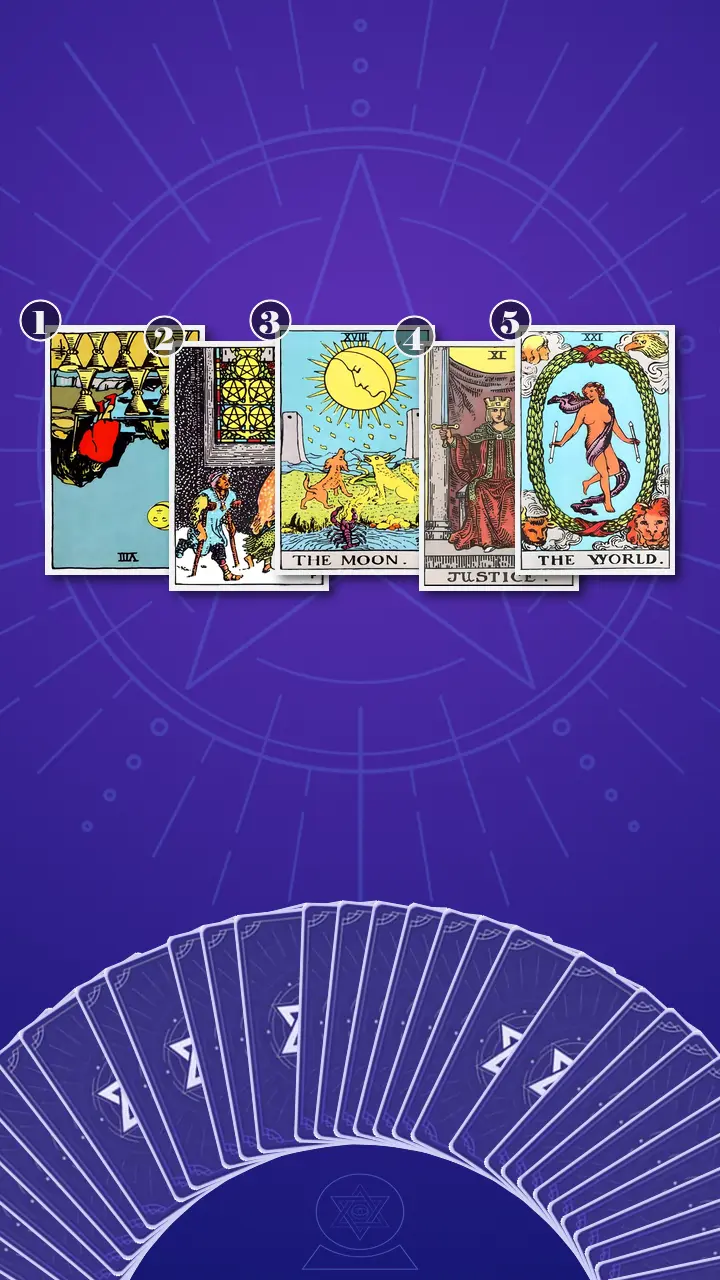
I chose The Shadow Spread · Context Edition, a five-card tarot spread for ghosting and closure. I wanted to make the choice transparent because how tarot works in my practice matters: the cards are not evidence about an absent person’s private feelings. They are an external cognition tool that lets me examine behavior, emotional meaning, unconscious maintenance patterns, available resources, and next steps in context.
I did not choose a conventional relationship spread because Maya’s question was not whether the other person would return. Giving several positions to someone who was not participating would have repeated the very problem we were trying to interrupt. I also did not need the breadth of a ten-card Celtic Cross. This five-position structure was the smallest complete map for tracing the waiting cycle without turning silence into a prediction.
I laid the cards in a line. The first position would show the closure lock in visible behavior: reopening the chat and interrupting an emotional departure. The second would locate the worth and belonging fear beneath it. The third would show how ambiguous silence kept the loop running. After a wider gap, the fourth would reveal the conscious resource capable of interrupting that mechanism, and the fifth would translate insight into an integrated ending.
The layout resembled a narrow corridor opening into a wider room. I told Maya that the first three cards might explain why she felt stuck, but the final two would not command her to block, forgive, send another message, or move on according to anyone else’s timetable. They would help her decide what participation still made sense for her.
The Corridor of Reopened Questions
Position 1: The Departure Interrupted
“Now I’m turning over the card that represents the observable expression of the closure lock,” I said, “the repeated checking, digital monitoring, and difficulty completing an emotional departure.”
I revealed the Eight of Cups, reversed.
I pointed to the cloaked figure whose body was oriented toward leaving. Reversed, the departure felt interrupted. The cups remained arranged behind the figure, but a visible gap suggested the missing piece that kept demanding attention. In Maya’s life, this was the 11:40 p.m. moment when she closed the unanswered chat, reached for her phone again minutes later, and reread the last affectionate exchange. The issue was not whether the connection mattered. Leaving without certainty felt like conceding that she had meant nothing, and the steep path ahead represented the effort of choosing not to reopen the same question.
I read the reversal as blockage. Emotional movement had begun, but it repeatedly circled back toward an unavailable source of reassurance. Closing and reopening the chat worked like refreshing a browser tab that had received no new data. The motion created a brief feeling of activity, but the page still could not produce the missing sentence.
“When the urge appears,” I asked, “what are you hoping the next check will finally tell you?”
Maya gave one short laugh, but no amusement reached her eyes. “That’s so accurate it feels kind of brutal.”
I did not ask her to soften the reaction. “Then we won’t use the card as an indictment. We’ll use it to locate the exact minute when the loop takes over. You are not failing at moving on. You are repeating a protective action that gives you a few seconds of control and then returns you to the same uncertainty.”
Her fingers loosened around the phone. I saw recognition arrive with a trace of bitterness, as though being understood also meant losing one familiar excuse for checking.
Position 2: The Window in the Snow
“Now I’m turning over the card that represents the deeper worth and belonging fear activated by silence after intimacy,” I said. “This does not assume a diagnosis or invent a history. It shows the emotional conclusion giving the current pattern its force.”
I revealed the Five of Pentacles, upright.
I showed Maya the two figures moving through snow beneath an illuminated window. In the modern-life version of this card, the unanswered profile becomes a locked door. The silence starts to feel like proof that she has been placed outside care and recognition. Friends may still be available, but when the phone becomes the only place she looks for confirmation that she mattered, their warmth fades into the background.
I described the energy as a deficiency in felt belonging, not an objective deficiency in Maya’s worth. The card represented the experience of emotional coldness; it did not validate the belief that she was disposable. I reminded her of a Saturday brunch near Roncesvalles, where one friend had suggested the person panicked and another had decided they were never serious. Maya had left with support, but she had also left with three more theories to investigate.
“You were surrounded by people who cared,” I said, “but your attention was pressed against the one window that would not open. What becomes hard to hear when their silence is the loudest sound in the room?”
Maya looked away from the cards. Her jaw tightened first; then she swallowed and rubbed her thumb across the edge of the table. “My friends keep saying it was inconsiderate. I keep turning that into a debate about whether I was worth basic care.”
“Those are different questions,” I said. “The hurt is real. The verdict is not established.”
Position 3: The Moonlit Trail of Timestamps
“Now I’m turning over the card that represents the hidden mechanism maintaining the closure loop,” I said. “This position asks how ambiguous silence becomes a puzzle and how searching for a motive briefly creates control while prolonging your exposure.”
I revealed The Moon, upright.
I traced the winding path between the two towers. The dog and wolf responded differently to the same moonlight, just as one online cue could support several emotional stories. The card’s excess was not imagination itself; imagination is useful in Maya’s design work. The excess appeared when partial information was asked to carry the weight of evidence.
I returned with her to 6:18 p.m. on the TTC Line 1 train. She had seen the person active in an Instagram Story at a rooftop bar while her message remained unanswered. The carriage smelled faintly of wet coats, fluorescent lights buzzed overhead, and the brakes had pulled her shoulder against a pole. Her warm phone moved between the Story, the old chat, and a row of timestamps. One image became fear, indifference, guilt, or another relationship depending on which theory she considered.
I told her that The Moon’s path looked like a browser history full of timestamps, old messages, Reddit threads, relationship-podcast clips, and social posts that seemed connected but did not produce a reliable source document. Underneath the search, I heard the same internal operating system: If I find the right clue, I can stop feeling foolish.
Then I placed the factual counterline beside it: The only confirmed change is that communication stopped.
Maya’s breath paused. Her gaze lost focus for a moment, and I watched her silently replay the train ride. Then she pressed one hand against her unsettled stomach and exhaled from low in her chest.
“I turned the whole commute into detective work,” she said. “By my stop, I had six explanations and no answer.”
“That is The Moon in context,” I said. “It does not tell me which explanation is secretly correct. It shows me that uncertainty and evidence have become fused. The mind keeps searching because every possible motive promises relief, even though each one creates another corridor.”
When Justice Cut the Screen in Two
Position 4: The Boundary Hidden Inside the Facts
A streetcar bell sounded through Maya’s window just as I placed the next card beyond the wider gap in the spread. The single clear note seemed to divide the room’s soft mechanical hum, and I felt the reading cross its threshold.
“Now I’m turning over the card that represents the conscious truth and personal resource available to you,” I said. “This position separates observable behavior from theories about the absent person’s motives.”
I revealed Justice, upright.
I centered the upright sword and evenly balanced scales. Here the energy was balance: discernment without emotional denial, accountability without exaggeration, and judgment proportionate to what could actually be known. Justice did not ask Maya to pretend the intimacy meant nothing. It asked her to evaluate the communication she had received without converting it into a judgment about her inherent value.
I used a product-design analogy familiar to her. A Figma review becomes manageable when the visible issue is separated from speculation about the designer’s private intention. Maya could write that communication had been warm, intimacy had happened, and replies had stopped. She could place theories about fear, guilt, busyness, another person, or waiting for her to text in a separate category. The visible issue did not require access to the other person’s inner file.
Ten years of sound-energy research have trained my attention toward rhythm under pressure. In that moment, I reached for one of my most practical lenses: a Communication Dissonance Audit. I normally use it to examine conflict by listening beneath the words for a mismatch in emotional tempo and frequency. Here, the revealing feature was the absence of words. The connection had carried a warm, reciprocal rhythm; then the other person’s participation dropped into silence while Maya’s internal tempo accelerated. Every profile check and revised message was her system trying to supply the missing beat.
The audit could not tell me why they went quiet, and I made that limit explicit. It could show me the dissonance that mattered: Maya was trying to keep a duet moving through solo effort. She did not need to match silence by becoming cold. She needed to stop increasing her emotional BPM in response to someone else’s nonparticipation.
I drew Justice’s sword as a clean split-screen and gave her three sentence stems: I know… I am imagining… I choose…
“I know communication was warm, intimacy happened, and the replies stopped,” Maya said. “I am imagining that the silence means I was disposable. I choose…” Her voice caught. “I choose not to call sustained silence reciprocal communication.”
I brought her back to 11:40 p.m.: the chat open, the phone warm, and the unanswered message heavier than the room. I could hear the old demand beneath her analysis: she had to reach the correct interpretation before she was allowed to make a fair decision. That was the trap Justice interrupted.
You do not have to solve their motive before responding to the facts. Their silence is observable behavior, not a verdict on your worth, and your boundary does not need their agreement to become real.
Closure is not the reward for solving their silence; it begins when you weigh the facts, cut away imagined explanations, and let Justice's balanced scales guide your boundary.
I let the words remain between us without rushing to make them comforting. Maya’s breathing stopped first, and her fingers stayed suspended above the face-down phone. Her pupils widened as recognition reached her, but her brows pulled together in resistance.
“But doesn’t that mean I spent weeks getting this wrong?” she asked, suddenly sharper. Anger rose into her voice before it thinned into something more fragile. “Like I did all of this to myself?”
“No,” I said. “It means you tried to regulate an abrupt rupture with the tools that gave you a temporary sense of control. The checking makes sense. It also has a cost. Understanding the protection is not the same as blaming yourself for needing it.”
I watched the reaction move through her in three distinct waves. Her shoulders remained fixed near her ears while her eyes went unfocused, as if she were replaying every late-night refresh. Then her fist slowly opened against her knee. A long breath left her with an almost inaudible “Oh.” Her eyes reddened, and relief lowered her shoulders, but it left a moment of exposed stillness behind. I recognized the slight dizziness that can follow clarity: if the boundary was hers to choose, so was the responsibility of living it.
I asked, “Now, using this new perspective, think back to last week. Was there a moment when this insight could have made you feel different?”
Maya remembered a Monday design review. Her phone had been face down beside her laptop, yet her shoulders had risen every time Slack flashed. She had told herself that not sending another message proved she had standards, then spent the break wondering whether silence meant she was too much.
“I could have said, ‘This happened; I don’t know why; this doesn’t work for me,’” she said. “I wouldn’t have felt fine, but I might have been in the meeting instead of arguing with a person who wasn’t there.”
I told her that this was the key movement in the reading: not instant detachment, but a first step from contracted hurt, hypervigilant checking, and motive-seeking toward fact-based self-respect. Silence was information, not a verdict on her worth. Facts could support a boundary even while motives remained unknown.
The World Beyond the Open Tab
Position 5: A Chapter That Can Matter and Still End
“Now I’m turning over the card that represents integration,” I said. “This position asks how insight can become one self-directed closure practice and return your attention to a life larger than the unanswered connection.”
I revealed The World, upright.
I contrasted the laurel wreath with the dancer’s open posture. The wreath gave the experience a defined boundary; the figure inside it remained active, visible, and whole. I read this as balanced integration. Completion did not require Maya to erase the intimacy, secure an apology, or declare herself unaffected. It meant containing the experience so it no longer contained her.
In her modern life, The World looked like writing an unsent closing statement, archiving the conversation, and returning one evening to a friend, rest, or creative work. The unanswered question would not be magically solved. It would be moved out of the active sprint and into the archive: still part of her history, no longer assigned to every evening’s task list.
“So closure is something I practise,” Maya said, looking at the wreath, “not something they hand me?”
“Yes,” I said. “And practice allows grief, anger, and second thoughts. The chapter can matter without remaining open in your phone. The World offers a container, not an order to feel finished on command.”
A Boundary That Needed No Reply
I read the full line of cards as one coherent story. The reversed Eight of Cups showed Maya beginning to leave and then reopening the emotional door. The Five of Pentacles explained why the return carried so much force: silence had become fused with the fear of exclusion and disposability. The Moon showed the maintenance mechanism, where partial digital clues generated theories that briefly felt like control. Justice introduced the reliable thread through that maze: observable facts, proportional judgment, and a communication standard. The World placed the experience inside a wider identity instead of allowing it to organise her attention.
I also pointed out the missing fire in the spread. Cups and The Moon carried emotion, Pentacles grounded the worth wound, and Justice brought the sword’s mental clarity. No Wands card supplied an automatic burst of action. I did not treat that as a warning. It meant action would need to be small and consciously chosen, after discernment rather than as a performance of being over it.
The cognitive blind spot was now visible: Maya had been treating the other person’s motive, the meaning of the intimacy, and her own worth as one question. Because the motive remained unknown, all three seemed unresolved. The shift was to separate them. The connection could have mattered. The motive could remain unknown. The behavior could still fail her standard for reciprocal communication.
“I want closure,” Maya said, “but I keep outsourcing it to someone who isn’t responding.”
“Then our next steps should bring one small part of it back in-house,” I said.
She frowned at her phone. “But my phone is basically my job. Figma, Slack, my calendar, everything. I can’t do a dramatic digital detox every time I get triggered.”
“You don’t need one,” I said. “We’ll make the experiment thread-specific, reversible, and brief. The goal is not to prove that you can resist. It is to create enough space to hear your own standard before the checking loop answers for you.”
- Run the 10-Minute Facts, Stories, Standard Check.After work on one evening this week, open a Notes page titled “Facts, Stories, Standard.” Set a 10-minute timer. Record three observable facts about the change in communication, place every unverified motive in the Stories section, and finish with one sentence such as: “Ongoing silence does not meet my standard for reciprocal communication, so I am no longer keeping this conversation open.” Send nothing during the exercise.If the Facts column feels cold or unfair to the real intimacy, begin with two facts and one story. The exercise is meant to organise the hurt, not minimise it. Stop whenever your body asks for a smaller step.
- Create a 72-Hour Reopening Pause.Archive or mute the unanswered chat for 72 hours and remove the profile from quick access without making a permanent decision. When the urge to check appears, use my Syncopation Pause: place both feet down, listen to one actual sound in the room for three seconds, and let your emotional BPM drop before choosing. Then log the time, one body sensation, and the answer you hoped the check would provide.Keep the phone fully available for work and safety. This is a reversible experiment, not a promise about the future. Ask one trusted friend to offer company with the facts instead of another theory about the motive.
- Give the Chapter an Ending and Reclaim 20 Minutes.On one evening, spend 10 minutes writing an unsent statement that names what mattered, what hurt, and what is ending for you. Archive the conversation afterward, then give 20 minutes to one ordinary part of life: a walk with a friend, a Figma-free dinner, rest, or personal design work. Do it for participation in your life, not to demonstrate recovery.Three plain sentences are enough. Do not send the statement as a disguised final bid for contact. The ritual may remain imperfect and can be changed later; its purpose is to return one piece of waiting time to you.
I told Maya that these actions were not punishments for the other person and not tests of her emotional strength. They were acceptance criteria for her own attention. Her boundary did not need the absent person’s approval because it governed her access, her evenings, and her participation, not their character.

A Week Later, the Quiet Proof
A week later, I received a message from Maya. She had completed the Facts, Stories, Standard note and archived the chat for 72 hours. She had checked the person’s profile once through a browser on the first night, logged the tightness in her chest afterward, and returned to the experiment without turning that lapse into another verdict about herself.
She also sent one friend a direct request: “I need company with the facts, not another theory.” They took a walk after work and discussed anything but the silent person for the final 20 minutes. Maya told me that the ordinary conversation had felt strange at first, then unexpectedly spacious.
On the fourth morning, she had slept through the night. Her first thought was still, What if I’m wrong? She smiled at the thought, left the chat archived, and made coffee while pale Toronto light reached the kitchen window.
I did not see tarot close the chapter for her. I saw the five-card Shadow Spread · Context Edition make the closure loop visible, and I saw Maya choose what to do with that visibility. The cards supplied a map; she supplied the boundary, the pause, and the return to her wider life. That is where the agency belonged.
I know that when intimacy ends in silence, a chest can remain braced over a closed chat, trying to turn one unanswered message into proof that the connection mattered while the part that wants to leave waits for permission from the person who disappeared. I also know that simply noticing that waiting posture means the journey toward clarity has already begun.
If you let Justice’s sword separate one observable fact from one imagined story, what small boundary could support you, and what would you give the next ten minutes to that has nothing to do with checking whether they are online?