Sending a Five-Sentence Reference Request: Rehearsal to Follow-Through

Recommendation Request Procrastination at the Career Crossroads
I met Morgan, a 26-year-old junior communications coordinator in Toronto who could polish client-facing copy before a deadline, yet had let one Gmail request to a former supervisor become Career Pivot Anxiety in tab form.
At 8:47 on a wet Tuesday evening in her apartment near St. Clair, I watched her type Dear Professor, change it to Hi, then search recommendation request email examples for the fourth time. Cold tea sat beside her laptop. Traffic hissed over the pavement, the radiator clicked behind her, and her application portal remained complete except for the red line marked Recommendation: incomplete. A polished LinkedIn milestone post from a former classmate glowed in another tab.
'I want the letter badly enough to keep working on the draft,' Morgan told me, 'but not badly enough to let an answer arrive. I know the next step, so why am I still making the email better?'
The practical contradiction was plain: she needed to ask for a recommendation letter, and she kept postponing the ask. I heard the deeper weight in her voice too. The draft is short; the verdict attached to it is enormous. Apprehension sat in her like a clenched fist beneath the sternum, its thumb pressed against the send button, while shame and self-doubt kept suggesting that one lukewarm response might reveal something permanent about her.
I told her that I would not treat the delay as laziness or a prophecy. We would look at the pattern with enough care to separate facts, predictions, requests, and outcomes. 'We do not need to force certainty tonight,' I said. 'We can give this career crossroads a map, then let you choose the next piece of ground.' That was the beginning of our Journey to Clarity.

Choosing the Compass: The Shadow Spread in Context
I asked Morgan to put both feet on the floor, take three unhurried breaths, and hold the actual question in mind: What keeps me putting off asking for a recommendation letter? I shuffled slowly while she listened to the cards move against one another. The preparation was a focus point and a transition out of the draft spiral, not a supernatural test.
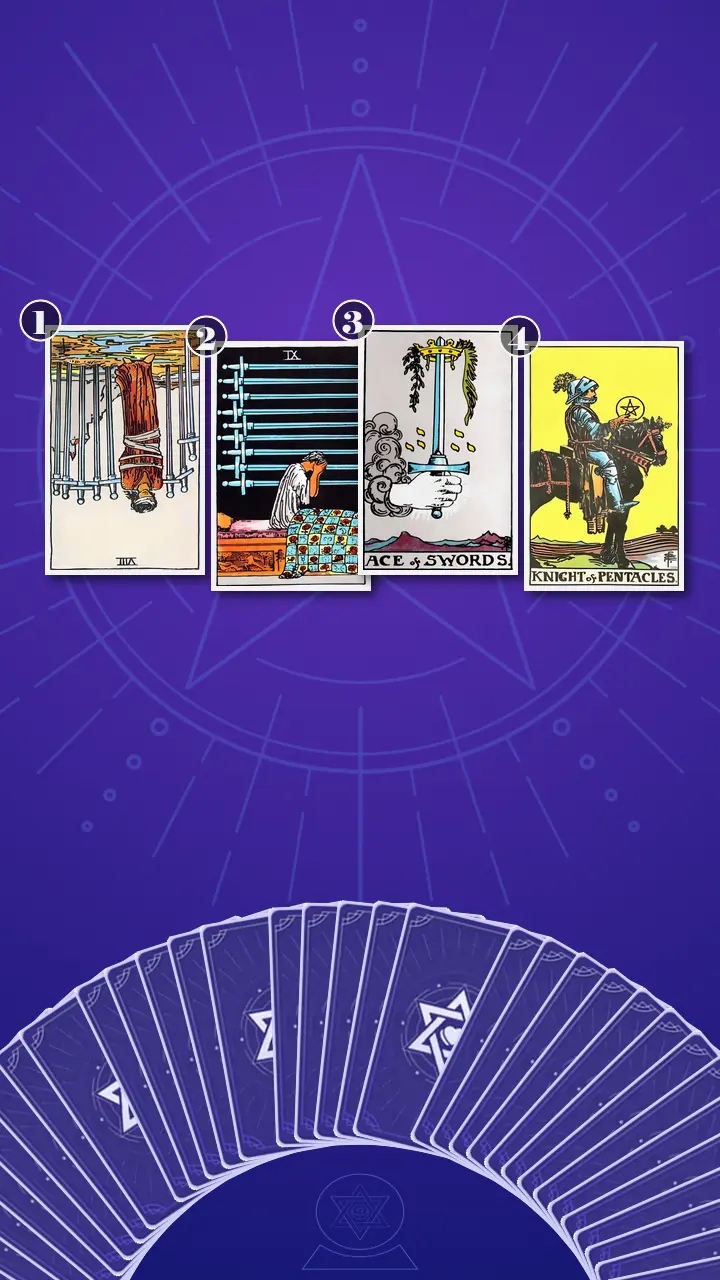
For this reading, I used The Shadow Spread · Context Edition, a four-card tarot spread for recommendation letter anxiety. This spread suited the question because Morgan was not choosing between several real options; she was facing a manifestation gap between a known intention and one vulnerable action. A contextual Shadow Spread lets us examine the visible delay, the hidden fear beneath it, the resource inside the pattern, and a practical experiment that remains hers to choose. That is also how tarot works here: the images offer an objective structure for reflection, while Morgan supplies the lived evidence and makes the decisions.
I explained the route in plain language. The first position would show the observable manifestation gap: the opening, rewriting, and postponing. The second would reveal the unspoken fear that made a possible reply feel like a judgment. The central third position would identify clarity and self-trust as an integrating resource. The final card would translate that shift into a respectful, time-bounded request experiment that Morgan could own without controlling another person's response.
The Draft Box Was an Unlocked Gate
The Observable Manifestation Gap
I turned over the card for position 1, the visible shadow: opening, rewriting, and postponing the recommendation request.
It was the Eight of Swords, in reversed position.
In the RWS image, a blindfolded, bound figure stands inside a narrow enclosure of swords while a distant castle remains visible beyond the water and rocky ground. I read that image as a visual map of Morgan's attention. Her Gmail draft, her etiquette tabs, her application FAQs, and the imagined judgment surrounding the request had become a digital version of those swords. The route was visible. The contact details, opportunity, and workable deadline were already there.
The reversed energy suggested that the restriction was becoming visible and beginning to loosen, but it did not mean Morgan had to fling herself through the gate without consideration. The blockage was a confusion between an actual constraint, such as missing information or insufficient notice, and an imagined constraint, such as needing to sound effortlessly impressive. Rewriting the greeting could solve a factual or tonal problem once. After that, another edit mainly protected her from movement.
I asked her to listen for the sentence that had been running underneath the draft: I technically can send it, but first I need to fix one more thing. I compared the card's narrow enclosure to a Gmail window surrounded by tabs for best subject lines, recommendation etiquette, sample wording, and application deadlines. The real question was not whether she had enough information. It was whether she was using more information to move forward or to keep the answer at a safe distance.
This is where I used my signature lens, Research Bottleneck Analysis. From years of academic work, I know that a research bottleneck is not proof of personal failure; it is a signal that deeper excavation is needed. When research stops changing the facts, I ask what emotional question the research has been recruited to avoid. For Morgan, the buried question was, Can I make their answer safe if I make the email flawless? No wording could provide that control.
Morgan gave a small, bitter laugh and rubbed the heel of her hand against her chest. 'That is painfully accurate,' she said. 'Almost rude.'
I did not ask her to prove the card right by sending the email immediately. I asked, 'Which edit changed a fact, and which edit only tried to make the answer controllable?' Her fingers stopped tapping. For the first time, the delay looked less like missing professional etiquette and more like movement temporarily dressed up as protection.
The Night Shift of the Mind
I moved to position 2, the hidden shadow: the fear, belief, or unacknowledged driver sustaining the visible pattern.
The card was the Nine of Swords, upright.
The RWS figure sits upright with a covered face beneath nine swords displayed across a dark wall. I asked Morgan what happened after the draft followed her home. She described the scene at 1:13 AM: her phone facedown, her laptop closed, and the unsent request still mentally open. She would imagine a former supervisor hesitating, agreeing out of obligation, or writing a lukewarm recommendation. A possible practical response became a private conclusion: If they are not enthusiastic, I must have overestimated myself.
This upright air energy was the major blockage in the spread. The Eight of Swords had shown the enclosure; the Nine of Swords showed how the enclosure stayed powered overnight. An unsent email became a background app draining the battery while no external message had arrived. Her mind had been running an algorithm trained on worst-case searches, recommending a more alarming version of the same hypothetical reply every time she reopened the question. That was why the fear felt immediate even though the evidence was still absent.
I named the feared sequence without making it larger than it was. 'What if they hesitate? What if the letter is lukewarm? What if that means I misread my own potential?' Then I said, 'An imagined response is not a received response.' I asked Morgan to notice which part of her wanted useful information and which part wanted protection from disappointment. Asking for support and fearing evaluation had become tangled together.
First, her breath caught and her jaw tightened against the back of the chair. Next, her eyes lost focus as if she were replaying an old email thread instead of looking at the card. Finally, she let out a low, reluctant 'Ah,' and her shoulders moved a fraction downward. The recognition was not cheerful. It carried shame, grief, and the strange relief of finding the actual room where the fear had been sitting. I told her that seeing the pattern was enough for this moment; she did not have to argue herself into confidence before moving on.
When the Ace of Swords Cut Through the Cloud
The Bridge Was a Clear Sentence
The room became noticeably quieter when I reached for the central card. Even the radiator seemed to pause between clicks, and a pale strip of streetlight rested across the table like a line drawn through fog.
I turned over position 3, the constructive gift within the shadow: the clarity and self-trust that can interrupt procrastination without requiring certainty about another person's response.
It was the Ace of Swords, upright.
The upright sword piercing the RWS clouds gave me the exact counterimage to the first card. The blindfold and surrounding blades had narrowed Morgan's attention; this single vertical sword made one clean line through the cloud of edits. The crown at its tip represented authority over the clarity of the request, not control over the answer. In modern terms, this was the sentence that could remain after every defensive paragraph had been removed: I am applying for this opportunity and would value your recommendation.
I brought in another part of my academic training. I call the lens Academic Stratigraphy: I separate fragmented layers of information and place them into a structure that can endure. On archaeological digs, I learned that a site does not become clearer because every grain of earth is moved at once. The layers have to be identified. For Morgan's email, the bedrock was the opportunity and deadline; the central structure was the direct ask; the supporting layer was why this person had relevant knowledge and what materials she could provide; the open edge was the recommender's genuine freedom to decline.
At 8:47 on a Tuesday, the Gmail draft was still open, the tea had gone cold, and Morgan's hand kept leaving the trackpad. I knew she already knew whom to ask. What felt unbearable was not the wording; it was allowing another person's answer to exist outside her control.
Do not wait for a perfect request to prove that you deserve support; use the Ace of Swords to state the ask plainly, so direct communication can bridge intention and action.
I gave the insight its most compact form: The email is a request, not a referendum: their response can guide your next choice without grading your worth.
For a moment, Morgan did not blink. Her breath paused at the top of her chest, and her eyes widened just enough for me to see that the sentence had reached a place her editing had kept protected. Then her gaze slipped from the card to the draft, unfocused, as if twelve revised openings were replaying in fast succession. Her fingers, curled around the edge of the paper, slowly opened. Finally, a tremor moved through her lower lip and she released a breath that sounded almost like a laugh. Her shoulders sank, but the relief left a clean, unfamiliar space behind it. She looked lighter and briefly unsteady, as though a heavy bag had been lifted before her balance had adjusted. 'So I can ask without knowing what the answer will say about me?' she asked. 'You can ask clearly without assigning the answer that job,' I said. 'Now, use this new view to remember last week: was there a moment when separating the request from the verdict would have let you feel different?'
Morgan looked toward the wet window and named the moment she had dismissed a calendar reminder, then spent twenty minutes formatting a report that was already complete. This was not a prediction that her former supervisor would agree. It was the first believable move from contracted apprehension and perfectionistic mental rehearsal to clear self-trust and grounded follow-through. The Ace of Swords had returned the next choice to the person who would actually make it.
The Still Horse Takes the Next Stop
I turned to position 4, practical integration: the grounded behavior through which the insight could be tested, embodied, and carried into daily life. It would translate the shift into a respectful, time-bounded request experiment that Morgan chose and owned.
The card was the Knight of Pentacles, upright.
The RWS Knight sits on a still brown horse, holding a pentacle steadily before a cultivated field. I read the stillness as reliability rather than hesitation. The field did not ask for a dramatic breakthrough; it asked for one patch of ground tended consistently. In Morgan's life, that meant choosing one suitable recommender, writing a complete five-sentence request, reviewing it once, recording the send date, and setting one reasonable follow-up.
This earth energy grounded the three Swords cards. The spread did not contain Cups or Wands, and I told Morgan that she did not need perfect emotional readiness, inspiration, or a surge of dramatic confidence before beginning. The missing feeling was not a missing prerequisite. She could let apprehension ride alongside a considerate action.
I translated the Knight's symbols into the sentence I wanted her to carry: I do not need to feel fearless; I need to make the request considerate and complete. Morgan opened her calendar and chose a realistic window based on the application timeline rather than on the fantasy of a perfect weekday and hour. I watched the emotional stalemate become a practical follow-through plan: a next stop, not a promise about the entire journey.
The One-Page Map from Insight to Action
I gathered the cards into a short story. The reversed Eight of Swords showed how an ordinary request had become an unlocked gate surrounded by self-imposed rules. The Nine of Swords revealed the older pressure beneath the edits: a possible hesitation had been rehearsed as proof that Morgan was not impressive enough. The Ace of Swords separated the factual request from that imagined verdict. The Knight of Pentacles gave the clarity a body: one suitable person, one complete message, one recorded follow-up, and room for both people to choose.
I named Morgan's cognitive blind spot carefully. She had been treating emotional readiness as if it were missing information, and treating flawless wording as if it could control another person's reaction. The direction of change was therefore modest but exact: move from perfecting the request before asking to sending a concise, respectful request with context and room to decline. The response would become information. It would not become a grade.
The Thesis Stratigraphy Framework for a Five-Sentence Ask
Because Morgan worked with language every day, I gave her my exclusive communication strategy, The Thesis Stratigraphy Framework. I normally use it to rebuild an essay outline so the core argument can pierce through intellectual clutter. Here, I adapted it into a recommendation request: put the central claim where it can be found, then add only the layers that help the reader make an informed choice.
The bedrock sentence was the opportunity. The thesis was the ask. The supporting evidence explained why Morgan was approaching this particular former supervisor. The date and available materials made the request usable. The final layer left an easy, sincere way to decline. I told her that an email did not need to argue that she deserved help; it needed to communicate clearly enough for another person to decide whether they could offer it.
Morgan looked at the seven-minute timer and said, 'I can probably find five minutes. I do not know if I can tolerate the answer.' I told her that the exercise was not a dare and that she could draft the minimum version in Notes, pause, and choose a send time if sending that night felt too activating. A bounded experiment respects her capacity more than an all-or-nothing command does.
This four-card Shadow Spread, Context Edition, had become actionable advice rather than a verdict. I wrote the next steps with her, keeping each one small enough to test and clear enough to finish.
- Run the Information-Not-Verdict CheckBefore opening another template, create a phone note titled Facts, not verdicts and spend three minutes listing the opportunity name, the actual deadline, why the potential recommender knows your work, and any missing context. Put deadlines, missing contact details, or insufficient notice under Actual constraint; put thoughts such as They will realize I am not impressive under Predicted judgment.Give each real constraint one practical response. Label each predicted judgment as possible, not received, then stop searching if the next tab will only postpone exposure to an answer.
- Use the Seven-Minute Five-Sentence AskAt your desk after work, choose one appropriate former instructor, supervisor, or mentor by checking that they know your work and that their perspective fits the opportunity. Set a seven-minute timer and write five sentences: reconnect, name the opportunity, make the request, give the relevant date and context, and offer an easy way to decline. Review once for accuracy and tone, then send from your usual account or schedule one specific send time.If you cannot find the request sentence within five seconds, move it earlier instead of adding another defence. The minimum version is the five factual sentences in Notes; one review is enough.
- Keep a Grounded Follow-Through LogWhen the request goes out, include the opportunity link, the date, and an offer to provide your résumé, statement, or work summary. Record the send date and one reasonable follow-up date in your calendar, then note one alternate recommender without contacting them unless the first person declines, remains unresponsive after a reasonable follow-up, or the timeline requires another route.Use the calendar entry as a next stop, not a demand for a particular result. Self-trust can look like one clear email and one reasonable follow-up while the other person's choice remains theirs.
Ownership, Not Certainty
Four days later, Morgan texted me from the TTC Line 1: 'Sent the five-sentence request. No reply yet.' She had slept a full night, though she still woke with the thought, What if I got it wrong? This time, she smiled at it, checked the calendar follow-up date, and made coffee before opening LinkedIn. The answer was still unknown; her next action was not.
I remembered the table, the cold tea, and the cursor blinking beside a perfectly reasonable ask. The cards had not sent the email, predicted the letter, or granted Morgan permission to move forward. They had helped her excavate the meaning she had attached to asking, rebuild the message around facts, and choose a deliberate act of follow-through. That is the real Journey to Clarity: from contracted apprehension and perfectionistic mental rehearsal toward clear self-trust, grounded in what a person actually does next.
When the cursor blinks beside a perfectly reasonable ask and your chest tightens, the hardest part is often not needing support but fearing that one person's hesitation could confirm everything you already doubt about yourself. Clarity can begin when the fog thins enough for your own outline to appear, even before another person answers.
If the email did not have to prove your worth, what is the smallest clear sentence you might be willing to let it carry, with the Ace of Swords cutting through the cloud of edits?