Self-Help Information Overload: The Pause That Made One Test Possible

The 38-Tab Search for Self-Trust
I recognize the Sunday Scaries that arrive with a queue of saved podcasts, half-finished book summaries, and no clear memory of what anyone actually practised. I see them often in people who call the pattern research because that word feels kinder than avoidance. I have learned to listen for the moment when self-help information overload begins to weaken the very self-trust it promises to build.
At 11:40 p.m. on a Tuesday, Alex, a 26-year-old non-binary junior product designer in Toronto, sat at the kitchen table in their shared apartment. A half-finished weekly review glowed on their laptop while a phone played another video about a better planning system. The phone felt warm in their palm; a cold mug sat beside the trackpad; the laptop fan hummed beneath the creator’s confident voice. I watched Alex pause the review, open a new Notion page, and begin designing another template instead of looking at what had actually happened that week.
Alex looked at me and said, “I have three saved systems for fixing my life and no idea which one I actually believe.” They wanted practical guidance that would create meaningful change, but they had started to fear that their personal judgment could not be trusted without another expert’s framework. After ambiguous work feedback, an ordinary relationship decision, or a difficult evening, their hand reached for another video, podcast, comparison table, or personality quiz before their own first response had time to arrive.
I saw their self-doubt as a browser with thirty-eight useful tabs open, every tab offering one valuable point, and none allowed to become the next step. Their tired eyes, tense jaw, shallow breathing, and restless fingers were not laziness. They were the physical texture of wanting control while fearing that one unverified choice might expose a lack of control. I told Alex, “You are not looking for more ideas because you are careless. You are looking for the framework that would make choosing feel safe. Let’s see whether the cards can help us draw a map without asking them to choose your destination.”

A Grid That Follows the Loop
I asked Alex to place the phone face down, take one slower breath, and name the question exactly as it was: Why do I keep consuming self-help content and trusting myself less? Then I shuffled at an ordinary pace. The preparation was not a supernatural test. It was a clean boundary between reacting to another input and observing the pattern already present.
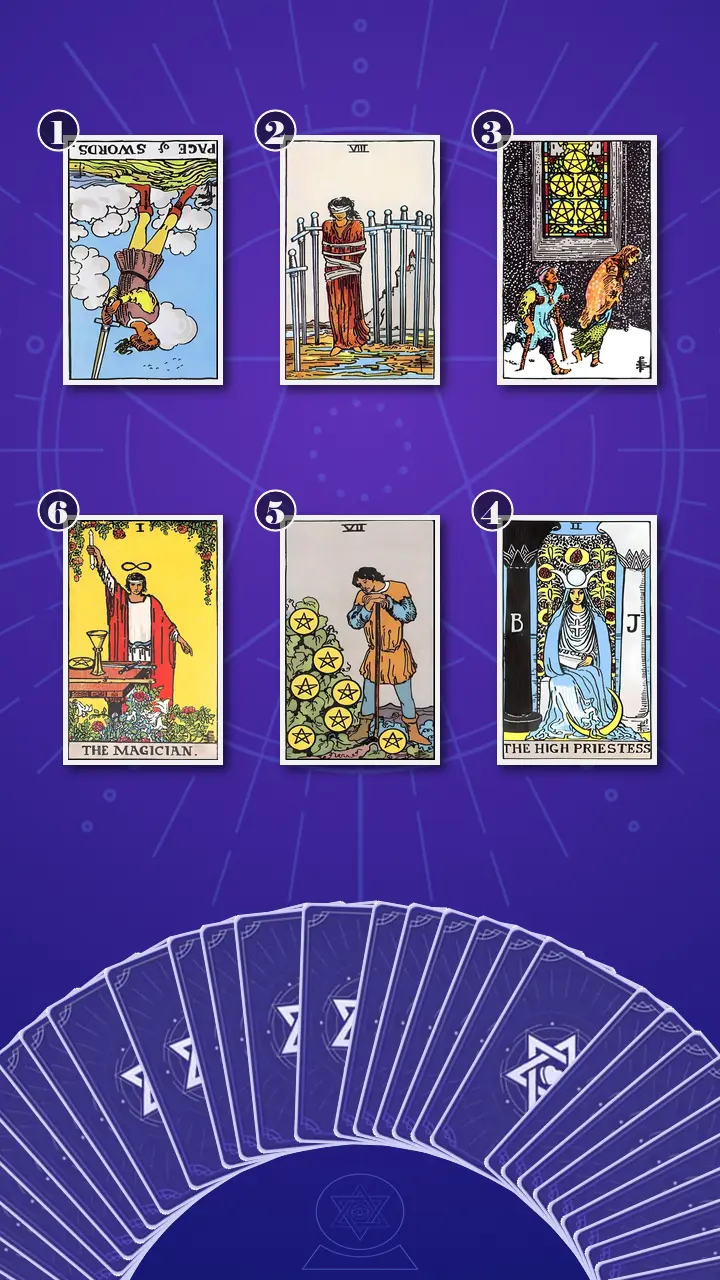
I chose the Transformation Path Grid (6) · Context Edition. For anyone trying to understand how tarot works in a practical reading, this spread treats card meanings in context. It follows the loop from the visible symptom to the immediate blockage, the deeper root, the leverage point, the real-life experiment, and the integrated operating principle.
I had considered a Celtic Cross, but ten positions would have widened the inquiry beyond the layers this question actually required. A classic Shadow Spread could have exposed the hidden belief, yet it would not have cleanly separated the blockage from the trigger, the behavioural test, and the integration. This six-card grid was the smallest structure that could preserve the whole movement from self-help information overload to direct personal evidence.
I arranged the cards in two rows of three. Positions one, two, and three formed the diagnostic group. Position four sat below the root as the interruption point, position five rested in the lower centre as the practice, and position six returned to the lower left as integration. The eye followed a switchback path, like reaching the end of a repetitive corridor, turning around, and coming back with a usable route rather than another map.
I told Alex that the first card would show the surface pattern, the second the belief that kept it in place, and the third the scarcity story beneath it. The High Priestess would identify the pause capable of restoring access to inner judgment. The Seven of Pentacles would turn that pause into a bounded seven-day test, and The Magician would show how outside knowledge could remain useful without taking authorship away.
The Wind-Tossed Sword in the Browser
The Pattern That Calls Itself Learning
I began with the position that presents the observable symptom identified in the diagnosis: repeatedly collecting and switching between self-help systems instead of applying one. The card was the Page of Swords, in reversed position.
I described the scene I had already witnessed. At 11:40 p.m., Alex paused a weekly review to open three recommended videos, copied isolated ideas into separate Notion pages, and built a new planning template. The digital equivalent of this reversed Page was an eager learner stuck in permanent surveillance mode. Every new insight created another question, while no single practice stayed active long enough to become personal evidence.
The Page’s raised sword and wind-tossed clothing gave the card its unstable posture. Reversed Air was not a lack of intelligence. It was an excess of alertness, fragmented attention, and premature comparison. Curiosity had become a security system scanning for the one dangerous mistake Alex might make. More input could feel like progress while quietly replacing the next move.
I asked Alex to notice the difference between a question that genuinely required new information and a question that was using information to postpone contact with experience. Their mouth lifted in a short, bitter laugh rather than a nod. Their fingers stopped over the keyboard, and they said, “That is too accurate. It is almost rude.”
I smiled gently. “The card is naming a behaviour, not issuing a verdict about your character. Your curiosity is still a resource. The problem is that the wind keeps turning the sword before you can use it.” I watched Alex close one of the video tabs. It was a small movement, but the first one that did not require another framework to authorise it.
The Wall Built from Conflicting Advice
The Eight of Swords and the Unfinished Exit
I turned over the card representing the immediate cognitive blockage: treating uncertainty and conflicting advice as proof that personal judgment was unsafe to use. It was the Eight of Swords, in upright position.
I brought the card back to the commute after a vague product critique, when Alex had scrolled from LinkedIn to YouTube to a comparison table before making one design adjustment. Two creators disagreed about prioritisation. One recommended protecting deep work; another recommended responding immediately to feedback. Alex treated the difference as a wall around the decision and kept searching for certainty instead of choosing one reversible design change to test in the next working session.
The Eight of Swords showed Air becoming an enclosure. The blindfold narrowed attention, but the ring of swords was incomplete. The bindings were loose rather than absolute. I read that as a blockage, not a prison. Alex’s belief was, “I cannot move until I know the best method,” even though a small experiment remained available.
I asked what the internal sentence usually became when uncertainty appeared. Alex looked down and answered, “If I choose this and it fails, it means I cannot manage my own life.” I placed the question beside it: “What would still be possible if uncertainty were ordinary?” The contrast mattered. Certainty-seeking demanded a final answer before action. A reversible test only required enough information for the next working session.
Alex’s breath caught first, and their jaw tightened as if the thought had become physical. Then their eyes lost focus for a moment, replaying the last few evenings of advice comparison, while one thumb kept rubbing the edge of the phone. Finally, their hand relaxed and they said, very quietly, “I have been treating uncertainty like proof that I am not allowed to decide yet.”
I answered, “Uncertainty is not a verdict against your judgment. It is a condition in which judgment can still operate.” I did not ask Alex to trust every instinct unconditionally. I asked them to consider that expert disagreement might mean the advice was contextual, not that Alex was unqualified to choose.
The Snow Beneath the Missing Manual
The Five of Pentacles and the Scarcity Story
I turned over the card representing the deeper root, belief, or unmet need beneath the visible blockage. The card was the Five of Pentacles, in upright position.
I connected it to the evening Alex checked their bank app and saw charges for a book-summary subscription, a productivity course, creator newsletters, and several digital templates. They hovered over the cancel buttons but kept everything because one resource might contain the missing lesson. I also thought of the polished career updates and immaculate morning routines Alex saw while waiting for the streetcar. I asked whether those images made it seem as though everyone else had received a private onboarding document for adulthood.
The Five of Pentacles placed an Earth-based scarcity story beneath the airy mental loop. Alex was not only asking, “Which method works?” I heard a more painful question underneath: “What essential quality do other people have that I am still trying to purchase?” The illuminated stained-glass window above the figures in the snow became a precise image for that experience. Guidance and support could be nearby, yet attention remained fixed on personal lack.
Alex said, “I know a lot about changing and very little about what I want.” Their voice held frustration, but also the shame of having been praised for being thoughtful and well informed. I watched their hand move away from the phone. The illuminated window did not promise that a perfect answer was waiting inside another course. It suggested that the story of being under-equipped might be hiding resources Alex already possessed: observation, taste, practical experience, values, and the ability to run a small test.
When the High Priestess Made Room for a First Answer
Between the Black and White Pillars
The room became quieter when I turned over the card representing the leverage point that could interrupt the consumption-to-doubt loop by creating enough silence to hear an initial personal response. It was The High Priestess, in upright position.
I read her as quiet discernment, receptive attention, and knowledge that becomes available through stillness rather than forced explanation. The black and white pillars offered a place between opposing authorities. The partly concealed scroll suggested that not every useful truth needed to be displayed, consumed, or solved immediately. The crescent moon at her feet made the pause feel receptive rather than empty.
I returned to the moment at the kitchen table when Alex could close the recommendation feed, sit for ten minutes, and write an uncensored first response to a work or personal question. The High Priestess did not mean that the first response was infallible. It meant that the response deserved to be recorded before outside commentary edited it out of existence.
This is where I used my Internal Monologue Auditing practice. I listened for the destructive genre of Alex’s inner script. It was not a neutral productivity memo. It was a tense courtroom thriller with a disaster ending: every provisional choice was treated as evidence, every imperfect result as a closing argument, and every expert opinion as a witness more credible than Alex’s own experience.
I also named the Persona Fatigue Diagnosis I could see underneath it. Alex had been maintaining the social character of the endlessly informed designer who should always know the best process. Keeping that character upright required constant research, and the performance was beginning to conflict with the person who wanted to make something, test it, rest, and notice what felt true without staging a presentation for an invisible panel of experts.
At 11:40 p.m. in a Toronto kitchen, a half-finished weekly review sits beside a phone playing another planning video. I could see Alex’s hand open a new template before they named what had failed that week; their jaw tightened, and one more answer briefly felt safer than choosing.
You are not empty without another expert's answer; write your own response first in the High Priestess's quiet space, then let lived experience refine what you know.
I let the sentence settle, then added, “You do not need more input before you can hear your first answer. A choice can be provisional, and lived experience can be the evidence that refines it.”
Alex stopped mid-breath. Their pupils widened, and for a second their face held no expression at all. Their fingers, which had been gripping the phone, hovered above it and then loosened one by one. The laptop fan became audible; the rain against the window seemed to move farther away. I watched their eyes return to the card, not as if it had predicted anything, but as if it had given a familiar experience a new name. Their shoulders lowered, followed by a long breath that trembled at the end. Then a small frown returned. Relief had made room for responsibility. Alex whispered, “But if I choose first and it goes badly, doesn’t that mean I was wrong?”
I asked, “Now, use this new perspective and think back to last week: was there a moment when this insight could have let you feel different?” Alex remembered the feedback meeting and the three hours spent searching for the correct response. We did not turn the memory into proof that they had failed. We treated it as evidence of where a pause might have changed the next move.
This was the first crossing in the emotional journey from urgent self-doubt and externally validated decision-making toward grounded confidence based on direct personal evidence. It was not a dramatic transformation or a demand for absolute self-belief. It was the moment Alex allowed a first answer to exist before asking it to be perfect.
The Week That Became Evidence
The Seven of Pentacles Does Not Plant Another Field
I turned over the card representing the practical action through which this transformation could be tested and evaluated in ordinary life. It was the Seven of Pentacles, in upright position.
I connected the card to one existing practice Alex already owned: a 15-minute weekly review. Instead of replacing it after seeing a cleaner system online, Alex could keep it unchanged for seven days and record only three observations each day: whether they started, how the activity felt, and what it changed in the next hour. The gardener in the card pauses to inspect one crop. They do not order a new field because another person describes a different kind of soil.
The Seven of Pentacles brought grounded Earth back into the reading. Its energy was patient assessment rather than passive waiting. The goal was not to prove that one routine worked forever. It was to create a feedback relationship with lived experience. A missed day would be data, not a verdict on Alex’s discipline. A useful result could be kept; an unhelpful one could be modified or dropped.
Alex wrote the practice on a sticky note and placed it beside the laptop. Their shoulders were still slightly raised, but their hands had stopped redesigning the note. “Seven days feels almost suspiciously small,” they said. I replied, “Small is what lets the evidence belong to you. A life does not need to be rebuilt before you are allowed to notice what one experiment does.”
The Tools Return to the Author
The Magician at the Figma Toolbar
I turned over the card representing cognitive integration: using external knowledge selectively while retaining authorship of decisions and adjustments. It was The Magician, in upright position.
I asked Alex to look at the four suit tools on the table, the raised wand, the grounded hand, and the infinity sign. The Magician was not surrounded by tools as if they were authorities. The tools were arranged for a purpose. In modern life, I translated the image into a product designer using the tools already available on a Figma toolbar instead of downloading another design app before shipping one small interaction.
This card coordinated Air, Water, Fire, and Earth. Alex could think clearly, notice a felt response, care enough to act, and use time and feedback in the material world. The integrated principle was simple: advice could be selected, adapted, tested, and put down. It did not need to become a new identity or a permanent rule.
I said, “Use advice as a tool on the table, not as the person in charge.” Alex looked at the spread, then at the sticky note. I saw the old comparison reflex appear in their expression and pass without taking over. They opened one existing project, chose one idea from a podcast, and wrote a clear start point and review point beside it. That was The Author-Not-Audience Practice beginning in an ordinary room.
A One-Page Route from Input to Evidence
When I placed all six cards together, I could see why the loop had become so persuasive. The reversed Page of Swords showed curiosity scattered across thirty-eight tabs. The Eight of Swords turned that scattered input into a rule that action must wait for certainty. The Five of Pentacles gave the rule its emotional weight: if Alex chose without enough guidance, an imperfect result might seem to prove that they lacked the private manual everyone else received.
The High Priestess interrupted that story with a deliberate pause. The Seven of Pentacles made the pause practical by asking for one week of direct observation. The Magician completed the movement by returning the tools to Alex’s hands. The transformation was not from learning to independence. It was from remaining permanently subordinate to instruction to becoming an active participant in learning.
I named the cognitive blind spot clearly: Alex had been treating comparison as neutral preparation, even when comparison was the decision to postpone ownership. They had also mistaken the absence of certainty for the absence of judgment. The direction of change was therefore specific: choose one small action, test it for seven days, evaluate it against self-defined evidence, and adjust without turning an imperfect outcome into a verdict on personal competence.
I offered three practices. Each one was deliberately small enough to begin during a real Toronto workweek, after a vague Slack message, before a relationship text, or when Sunday evening planning started to slide back into another recommendation feed.
- The First Answer PauseChoose one low-stakes, reversible decision this week, such as which design task to start after ambiguous feedback, whether to reply tonight, or when to practise. Put the phone face down for ten minutes and write three lines: ‘My first response is…’, ‘What I need to protect is…’, and ‘The smallest reversible version is…’ Compare one external suggestion with what you wrote only after the timer ends.If ten minutes feels loaded, begin with two. Keep the boundary specific: no new advice during the pause, while essential factual information remains available when it is genuinely required.
- The Seven-Day Evidence LoopSelect one practice you already own, such as a 15-minute weekly review, a single task list, or a short design session. Keep it unchanged for seven days. Once a day, note whether you started, how it felt, and what it changed in the next hour. At the end, decide whether to keep, modify, or drop it using your criteria.Place new recommendations in one read-later list and mute nonessential creator notifications for the test. A missed day is information; resume or revise without restarting your entire identity project.
- The Director’s Cut of Self-CompassionWhen the punitive internal monologue says, ‘If this fails, I cannot manage my life,’ pause the scene and edit it from the viewpoint of an objective, supportive observer: ‘This is a bounded prototype. I am gathering information about one choice in one week.’ Mark borrowed ideas as ‘use,’ ‘adapt,’ or ‘set aside’ so the framework never gets to define who you are.Use the edit once, in writing, before opening another podcast or comparison table. The aim is not to flatter yourself; it is to replace a courtroom verdict with a fair description of what you are actually testing.
I reminded Alex that the cards were not asking them to reject expertise. They were asking for an order of operations. First, let your own response appear. Then choose the relevant tool. Next, gather direct evidence. Finally, remain free to change your mind because the decision still belongs to you.

A Week Later, the Quiet Proof
Six days later, I received a message from Alex while I was waiting for a streetcar. They had used the ten-minute pause before choosing which piece of product feedback to test, written three uncensored lines, and kept the 15-minute review for a full week. Their message said, “I didn’t find the perfect system. I found out that starting before I compare everything gives me better information.”
That evening, Alex slept a full night after the seven-day review, but woke with the old thought, What if I chose wrong?, still waiting beside the bed. They smiled, opened their notes, and wrote, ‘That is a question, not a verdict.’ The morning was clearer, but not magically certain. That small distinction was the proof.
I do not believe the cards made Alex trust themselves. The cards gave us a structured mirror, and Alex supplied the attention, the experiment, and the evidence. Our Journey to Clarity moved from urgent self-doubt to curiosity, then toward the quieter confidence of someone who can use knowledge without surrendering authorship.
When every small choice sends you back to another expert, your tired eyes and tense jaw are not proof that you lack judgment; they are what it feels like to want control while being afraid that choosing alone will expose you.
If you let your first response exist without asking it to be perfect, what small, reversible experiment would you feel curious enough to notice this week, perhaps holding one choice like a draft in Figma before the comments arrive?