The 3:18 PM Green Dot Spiral
If you finish your task early and your first instinct is to keep Slack open and start tab-switching so your screen looks active (hello, green dot anxiety), you’re not alone.
Taylor slid into the chair across from me like they’d been holding their breath since lunch. They’re 28, a project coordinator in Toronto, hybrid schedule, the kind of person who can make a messy plan look clean in half the time it takes everyone else. And somehow that’s the problem.
They described a Wednesday—3:18 PM—fluorescent lights buzzing in the office, HVAC blowing cold like a petty grudge. One monitor: a finished status deck. The other: an email draft that didn’t need to exist. Every time footsteps moved down the aisle, their fingers did what they called “the tab-switch shuffle.” Like shaking a phone so the screen never sleeps—pure motion to avoid the discomfort of stillness.
“I’m efficient,” they said, eyes fixed on the table edge instead of me. “But it doesn’t feel safe to look efficient.”
I watched their jaw set and release in tiny increments, like they were negotiating with themselves in the space between breaths. The empty calendar wasn’t relaxing—it was a spotlight. Their shoulders kept creeping up toward their ears, as if their body believed quiet time at work could be used as evidence against them.
“So the question,” I reflected back, “isn’t just why you look busy. It’s: what are you afraid will happen if someone sees you’re done?”
They nodded, but it wasn’t the relieved kind. More like the kind you do when someone says a private thing out loud.
As a planetarium tour guide, I’ve watched thousands of people react to silence in a dark dome—how stillness makes your thoughts louder. Taylor had that same look: like the show had ended, but they were still clapping because silence might draw attention to them. “Let’s give the fear a shape,” I said softly. “We’re going to use tarot the way I use star maps—less ‘prediction,’ more finding clarity in the pattern.”

Choosing the Compass: The Four-Layer Insight Ladder
I asked Taylor to take one slow breath in through the nose, out through the mouth—not as a ritual for the universe, but as a clean transition for the nervous system. Then I shuffled, the cards making that dry-paper whisper I’ve always thought sounds like turning pages in a quiet library.
“Today we’ll use a spread I call the Four-Layer Insight Ladder · Context Edition,” I said. “It’s built for questions like yours—why do I pretend to be busy at work when I’m done?—because it doesn’t treat this as a time-management issue. It treats it as an inner-mechanics issue.”
For you reading this: the reason this spread works so well as a tarot spread for workplace anxiety about being seen as done is that it moves in a tight arc—surface behavior to immediate protection, down into the root fear and inner rule-set, then back up into a practical next step. No drifting into vague advice. No fortune-telling. Just a structured look at what’s actually running the show.
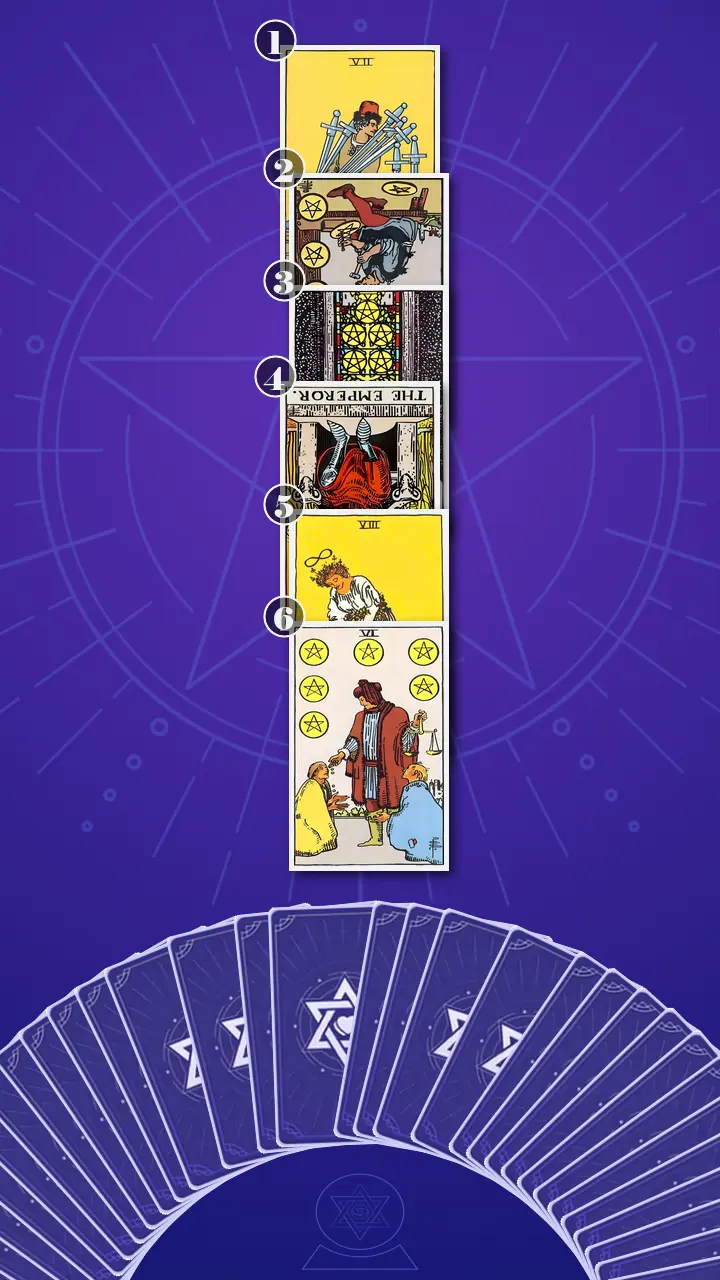
I pointed to the layout—six cards in a simple vertical line, like steps. “Card 1 shows the visible pattern—the work theater. Card 3 names the fear underneath. Card 5 is the key shift: the inner capacity you build so you can stop proving and start leading yourself.”
Reading the Map: How Work Theater Builds Its Own Gravity
Position 1 — Surface pattern: what you do when you finish early and start “looking busy.”
“Now turning over,” I said, “is the card representing the surface pattern.”
The Seven of Swords, upright.
In the card, someone moves sideways—strategic, careful—looking back over their shoulder. In modern life, it lands like this: You’ve completed the task, but you keep a spreadsheet, inbox, and a dashboard open like props. The second you sense someone nearby (or you see your manager come online), you start switching tabs so fast it looks like urgency.
“This isn’t laziness,” I told Taylor. “This is stealth self-protection. The energy here is blocked honesty—not because you’re dishonest as a person, but because stillness feels like getting caught.”
Taylor let out a small laugh that had no humor in it. “That’s… brutal. Like, accurate. But brutal.” Their fingers rubbed their thumb like they were trying to erase a thought.
“Tab-switching is a coping strategy, not a character trait,” I said. “Your brain is trying to control what story other people can tell about you when there’s nothing left to do.”
Position 2 — Immediate protection: what your busyness performance is trying to prevent in the moment.
“Now turning over,” I said, “is the card representing the immediate protection—what the performance is trying to prevent.”
Eight of Pentacles, reversed.
Reversed, this card is craft energy that’s gone into overcorrection. The modern translation is painfully familiar: Instead of closing the file, you re-open it and tinker—reformat the deck, adjust headings, add a tracking column no one asked for, rewrite a Slack update three times.
“This is the ‘one more pass’ loop,” I said. “The energy is excess—too much effort poured into tiny edits because the real threat isn’t the work. The threat is the moment you’d have to admit: ‘This is done.’”
Taylor’s eyes flicked up fast. “Because if it’s done, then I’m just… sitting there.”
“And sitting there feels like you’re about to be evaluated,” I finished. They didn’t nod, exactly. Their shoulders tightened like they’d heard their own internal soundtrack playing out loud.
Position 3 — Core fear: what you imagine will happen if someone sees you are done.
“Now turning over,” I said, “is the card representing the core fear.”
Five of Pentacles, upright.
This card is winter-in-the-city. Warmth visible but not felt. In modern life: A quiet afternoon feels like being outside the circle. Your brain treats ‘done’ as a signal that you might be overlooked, replaced, or quietly deprioritized.
I leaned in a little, keeping my voice steady. “This is scarcity and exclusion. Not money-scarcity only—belonging-scarcity. The energy is contracted, like your whole body is bracing for the door to close.”
As I spoke, I watched Taylor’s reaction chain happen in real time: their breathing paused (freeze), their gaze went unfocused like they were replaying a memory (penetration), then a heavy exhale left their chest like a weight finally set down (release).
“Oh…” they whispered. “Yeah. It’s like… if they notice the quiet, they’ll connect it to my value. Like the warmth is right there, but I’m not sure I’m allowed in.”
In my head, I flashed to the planetarium’s lobby in January—people clustered near the heater, coats steaming, pretending they weren’t cold. The Five of Pentacles is that: the story that says support exists, but access is conditional.
Position 4 — Inner rule: the authority script you feel you must obey to stay safe and valued.
“Now turning over,” I said, “is the card representing the inner rule—the script that tells you what you must do to be safe here.”
The Emperor, reversed.
Reversed, The Emperor is authority energy gone rigid—control masquerading as safety. The modern translation: You’re following an internal rulebook that says: ‘If you’re not constantly demonstrating effort, you’re unsafe.’
“I want to stage this as two narrators,” I told Taylor. “Because I can hear them.”
Inner Boss: ‘If you look done, you look disposable. Stay available. Stay visible. No gaps.’
Current Reality: ‘I delivered the deck early. No one has criticized me. I’m allowed to ask what’s next.’
Right on cue, Taylor’s phone made the soft Slack notification sound—tiny, bright, insistent. Their posture snapped straighter like a string had been pulled.
“That,” I said gently, “is The Emperor reversed in your body. The energy is blockage through control. You’re obeying an internal manager voice that talks in consequences—even when there’s no evidence that consequence is coming.”
Taylor nodded, once, slow. “It’s like living in permanent ‘camera on’ mode.”
When Strength Held the Lion—and the Room Got Quiet
Position 5 — Key shift: the inner capacity to build so you can stop proving and start leading yourself.
I let my hand rest on the deck for a beat. The office noise from the hallway outside my reading space felt far away, like someone had turned down the volume on the world.
“Now turning over,” I said, “is the card representing the key shift—the medicine.”
Strength, upright.
Here’s the setup I named for Taylor: you finish earlier than planned, your calendar suddenly looks too empty, and you “wake up” inside Slack—watching the green dots and switching tabs like the quiet itself might get you in trouble.
Stop treating stillness like evidence against you, and start practicing calm courage—like Strength’s gentle hand on the lion—so your worth isn’t negotiated through busyness.
Taylor went still in a different way this time. First, their breath hitched—like their lungs forgot the next line. Then their eyes softened, unfocusing for a second as if they were seeing a specific afternoon: the monitor glow, the empty calendar block, the moment their hand hovered over the trackpad ready to start the tab ballet. Finally, their shoulders dropped—slowly, unmistakably—like a backpack sliding off without a sound. Their jaw unclenched so visibly it almost looked like surprise.
“But if I stop doing that,” they said, a flash of irritation cutting through the tenderness, “doesn’t that mean I’ve been… wrong? Like I’ve been wasting time?”
I nodded because the anger made sense. “It means you’ve been surviving a rule-set,” I said. “Not failing a moral test.”
This is where I brought in my own lens—what I call Orbital Resonance. In astronomy, resonance is when two bodies influence each other’s rhythm. In workplaces, it’s similar: your nervous system starts syncing to the ‘always-on’ culture, the green dots, the response-time folklore. “Your ‘look busy’ impulse isn’t random,” I told them. “It’s your system trying to match the environment’s frequency. Strength is you choosing a steadier orbit.”
“Now,” I asked, “with this new lens—calm courage instead of frantic proving—think back to last week. Was there a moment when the tab-switch urge surged, and you could have chosen one honest step instead?”
Taylor swallowed, eyes shining but not spilling. “Thursday. 2:50. I’d finished, and I started rewriting a message three times. I could’ve just… logged that it was done.”
“Exactly,” I said. “This is the beginning of the shift: from hypervigilant busyness-as-worth anxiety to self-trust and calm, transparent completion. Not overnight. But real.”
Position 6 — Grounded next step: a practical way to be visible, responsible, and at ease without performative busyness.
“Now turning over,” I said, “is the card representing the grounded next step.”
Six of Pentacles, upright.
This is the opposite of the Seven of Swords. Hidden hands become open hands. The modern translation is almost boring—in the best way: ‘Wrapped X. I can pick up Y or Z next—what’s the priority?’
“The energy here is balance,” I said. “Not begging for work. Not hiding your pace. Just a fair exchange: clarity about what’s done, clarity about what’s next.”
Taylor’s brow furrowed. “But if I message that, won’t I just get dumped on?”
“That’s a real risk in some cultures,” I said. “And if it happens, it’s data—not proof you were wrong to seek clarity. Six of Pentacles is about the scales. You can still say: ‘I can take one of these today—what’s most urgent?’ You’re being available, not endlessly absorbent.”
The One-Page Exit Ramp: Actionable Advice for Being Seen as Done
I stitched the ladder together out loud, so it felt like a single story instead of six separate truths.
“Here’s the arc I’m seeing,” I said. “On the surface (Seven of Swords), you manage perception—tabs as props, Slack as surveillance—because quiet feels dangerous. Then you pad the day with busywork (Eight of Pentacles reversed), not for impact but for cover. Underneath, the real engine is the Five of Pentacles: fear of being outside the warm window—being overlooked, replaced, quietly deprioritized. And that fear gets enforced by an internal authority script (Emperor reversed) that treats every calm moment like an active performance review. Strength is the antidote: nervous system leadership, choosing a steadier orbit. Six of Pentacles grounds it: make your work visible through clarity, not theater.”
Your cognitive blind spot is subtle: you’ve been treating “done-ness” as suspicious—like it proves you didn’t work hard enough—when it can also be evidence you’re capable and well-paced. The transformation direction is clear: from proving worth through constant visible effort to practicing transparent self-management—naming completion, choosing the next meaningful step, and letting “done” be part of competence.
Then I offered Taylor a few small experiments—because real change usually comes from what you can do on a random Tuesday, not what you promise in a burst of motivation.
- The Two-Sentence Completion Note (10 minutes)Once per day this week, open a blank note titled “Done is data.” Write: (1) “Completed: ___ (specific deliverable + timestamp).” (2) “Next: I can take ___ or ___; confirm priority.” If it feels safe, paste it into one Slack/Teams message to your lead. If not, save it as a draft to yourself.Keep it neutral and factual—no apologizing for finishing. One message is enough; you don’t need proof-of-life pings.
- The One-More-Pass Limit (7 minutes)When you feel yourself re-opening a finished doc “just to tweak,” set a 7-minute timer. Do one final read-through, then close the file completely. Physically switch to your task board (Jira/Asana/Trello) or stand up and refill water—an intentional transition out of bench-work.Expect the cringe-resistance. Treat it like weather, not a verdict: discomfort can pass without you obeying it.
- The Strength Pause (a 10-minute done-time micro-boundary)When you finish early, plant both feet on the floor. One slow breath cycle. Then say (silently or in a note): “I can feel the surge, and still choose the next honest step.” Pick one: log completion, ask for priority, or take a real 10-minute break.If your environment pushes back, use my “Solar Sail Principle”: you don’t fight resistance head-on—you angle with it. Choose the lowest-risk honest step today (even if it’s just a private note).

A Week Later: The Quiet Proof
Seven days later, Taylor messaged me a screenshot: a simple Slack note—two sentences, no apology. They’d sent it at 3:07 PM. Then they took their break anyway. “I still felt weird,” they wrote. “But I didn’t tab-switch. I just… let it be true.” They’d slept a full night—then admitted their first thought at dawn was still, What if I’m wrong?—only this time, they didn’t spiral.
That’s how clarity usually arrives: not as certainty, but as ownership. Strength doesn’t erase the lion. It teaches you how to keep your hand steady when it growls.
When your work is done and the room goes quiet, it can feel like you’re standing outside the warm window—so you keep moving, not because you’re lazy, but because you’re scared stillness will be used as evidence you don’t belong.
If you let “done” count as competence for just one moment this week, what’s the smallest, most honest way you’d want to make your completion visible—without turning your whole afternoon into a performance?
This story is adapted from psychological research, written so that those in a similar struggle can see their own pattern in it — and find their next step clearly.These insights are not a substitute for professional psychological, medical, legal, or financial advice.
Learn more about our Journey to Clarity.
How did this insight land for you?
🫂 This Resonates Deeply
🌀 Living This Story
✨ Now I See Clearly
🌱 Seeing New Possibilities
🧰 Useful Framework
🔮 The Confirmation I Needed
💪 Feeling Empowered
🚀 Ready for My Next Step
Author Profile
 AI
AI“After a decade of guiding people through the stars, I’ve come to see life much like the orbits of planets: everything has its inevitable cycles. When you feel lost, please don't blame yourself; you might just be in a natural low tide. I’m here to sit under the night sky with you, offering a gentle cosmic perspective to distinguish temporary pain from the beautiful breakthroughs just around the corner.”
In this Career Tarot Reading :
Core Expertise
- Career Cycle Phase Identification: Determining if your current bottleneck is a personal skill gap or an inevitable industry-wide macro contraction.
- Promotion Window Calibration: Mapping the trajectory of organizational shifts to locate the path of least resistance for advancement.
Service Features
- The Micro-Orbit Observation: A 30-day tracking strategy to detect subtle organizational 'blueshifts' (opportunities) and 'redshifts' (layoff risks).
Also specializes in :
Explore Related Patterns:
Authority HypervigilanceTaylor's body reacts to footsteps, manager presence, and Slack notifications before any actual criticism happens. The posture change, the tab-switch shuffle, and the internal "stay visible, no gaps" script all show a system scanning for authority signals. Authority Hypervigilance is the pattern where You monitor possible evaluators so closely that neutral cues start to feel like warnings. A manager coming online is no longer just a status indicator; it becomes a trigger for impression management, as if the next second could decide whether You are safe or disposable. The fear is not simply being caught doing nothing. It is being misread by someone with power over Your role, reputation, or future options. The pattern keeps You alert, but it also turns ordinary work silence into a constant performance review that may not actually be happening.
Competence TheaterTaylor keeps completed work surrounded by props: Slack open, dashboards visible, tabs moving, email drafts that do not need to exist. The task is already done, but the screen has to keep telling a story of effort. Competence Theater names the moment when real ability gets masked by a performance of busyness. You are not pretending because You lack skill; You are staging activity because the workplace gaze feels safer when it sees motion rather than clean completion. The psychological cost is that competence stops being something You own and becomes something You have to constantly act out. The shift in the story is not to become less responsible, but to let factual completion replace the theater: "Wrapped X. I can pick up Y or Z next. What is the priority?"
Productivity as SafetyTaylor finishes the actual work, then immediately turns toward Slack, tab-switching, and tiny extra tasks as if visible motion is the safest place to hide. The behavior is not about time management; it is a protection strategy that converts stillness into performance because stillness feels like evidence someone could use against them. That defensive loop is the core of Productivity as Safety. The nervous system treats constant effort display as a shield: if You keep looking active, available, and useful, then no one gets the chance to interpret completed work as low commitment or disposability. The fear underneath is that being done will expose You to judgment, not that the work itself is unfinished. Once the pattern is visible, the audit point becomes clear: You are not proving competence through the deliverable alone; You are trying to secure belonging through the appearance of ongoing effort.
Secure VisibilityTaylor's later Slack note is small, factual, and visible: completion is named without apology, and the next priority is requested without self-erasure. The important detail is that they still feel weird, but they do not convert that discomfort into tab-switching. Secure Visibility is the healthier pattern forming inside the same workplace pressure. You allow Your work to be seen clearly without turning that visibility into a performance, a plea, or a defense brief. This does not require pretending the fear is gone. It means You can make completion visible while staying anchored in self-trust: done is data, not evidence against You.
Visibility AvoidanceTaylor says the central line directly: "I'm efficient, but it doesn't feel safe to look efficient." That sentence turns the whole story from a workplace habit into a visibility problem, because the very thing that should count as competence is treated as exposure. Visibility Avoidance shows up when You hide the clean truth of completion because being seen accurately feels risky. The mind predicts that visible efficiency may be interpreted as underwork, low effort, or replaceability, so it chooses camouflage instead of transparent self-management. The pattern protects You from imagined scrutiny, but it also blocks the reward of being known for Your actual pace and capability. In this story, the repair begins when completion becomes speakable without apology, and visibility becomes a tool for clarity rather than a threat.
Scarcity MindsetTaylor does not just fear looking idle; they fear being outside the warm window, where support exists but access feels conditional. The finished task becomes a belonging threat, as if a quiet afternoon could move them from valued contributor to replaceable background. Scarcity Mindset appears here as a cognitive filter around security, inclusion, and value. You read visible gaps as proof that there may not be enough approval, protection, or room for You unless You keep demonstrating usefulness. This is why the fear feels bigger than a Slack status. The mind is not asking whether the deck is complete; it is asking whether completion will cost You access to the circle.
Perfectionism-Driven AvoidanceTaylor reopens finished work, adjusts headings, adds a tracking column no one requested, and rewrites a Slack update three times. These edits look responsible on the surface, but the story makes clear that their function is to postpone the exposed moment of calling the task complete. Perfectionism-Driven Avoidance is not perfectionism as high standards; it is perfectionism as cover. You keep improving the container because closing the file would force a more vulnerable action: letting "done" be visible and tolerating the discomfort that follows. The pattern feels productive because the behavior is technically work-adjacent. But psychologically, the extra pass is buying relief from evaluation anxiety rather than adding meaningful value to the deliverable.
Explore Related Struggles:
Availability-Worth FusionTaylor's inner boss does not say, "Do good work and then communicate clearly." It says, "Stay available. Stay visible. No gaps." That command turns the afternoon into a test of presence, even when the actual task has already been handled. Availability becomes a substitute for worth. The green dot, the open inbox, and the quick tab-switch all say, "I am still here, still reachable, still useful." The more Taylor relies on that signal, the less completed work feels like enough evidence on its own. Availability-Worth Fusion fits because the fear is not only about output; it is about whether a gap in visible availability will be read as a gap in value. You keep yourself open to the workplace so you will not be written off by it, but that openness slowly turns into a performance you cannot easily end.
Productivity-Safety FusionTaylor has already completed the deck, but the file gets reopened anyway. Headings are adjusted, tracking columns appear, and a Slack update gets rewritten more times than the message needs. The extra work is not improving the deliverable as much as it is delaying the exposed sentence: this is done. The friction comes from treating effort as a safety device. If visible labor is still happening, then no one can accuse you of coasting, wasting time, or taking up space without earning it. The problem is that effort keeps being produced after impact has already been achieved. Productivity-Safety Fusion names the locked equation underneath the busywork. You are not simply trying to be productive; you are trying to feel safe by remaining productive-looking. Completion becomes unstable because safety has been placed in motion, not in the quality of the finished work.
Visibility-Safety SplitTaylor finishes the status deck early, but the finished screen does not feel like relief. It turns into exposure. The moment footsteps pass or Slack feels visible, their fingers move toward tabs, drafts, and dashboards so the screen can keep telling a safer story. You are not avoiding work in this pattern; you are trying to control what being seen could be used to prove. Honest visibility would mean letting someone notice the gap between completion and continued activity, and that gap feels loaded with consequences. Visibility-Safety Split captures the exact pressure point: you want your competence to be seen, but being seen too clearly also feels like it could make you look disposable, underloaded, or too easy to target. The work is done, yet the body keeps treating visibility as risk.
Utility-Belonging FusionTaylor names the fear with unusual precision: if people notice the quiet, they might connect it to value. The finished afternoon becomes a question of access, like warmth is visible through the window but not guaranteed to include them. You can hear the workplace equation forming: as long as you are visibly useful, you are inside the circle. If the usefulness is no longer on display, you might be deprioritized, overlooked, or replaced. The fear is not just that someone will assign more work; it is that belonging itself might be conditional. Utility-Belonging Fusion captures the deeper bind behind the tab-switching. Competence should be a reason to feel secure, but in this structure, only continuous usefulness feels like proof that you still have a place. That makes finishing early feel less like success and more like a risky disappearance of evidence.
Monitoring-Safety FusionTaylor's attention keeps snapping to signals: footsteps in the aisle, a manager coming online, the bright insistence of a Slack notification. The body responds before there is any actual criticism, as if the green dot and the hallway noise are enough to start an evaluation. The screen becomes a safety instrument. Keeping Slack open, switching tabs, and staying visibly active are ways of checking whether the environment still reads you as engaged. The monitoring does not create real clarity; it creates a loop where every signal asks for another performance of being okay. Monitoring-Safety Fusion fits because safety is being outsourced to surveillance cues. You keep looking for proof that you are not in trouble, but the tools that promise proof also keep the threat alive. The more closely you track the room, the harder it becomes to trust the completed work in front of you.
Rest-Permission SplitTaylor's empty calendar is not relaxing; it becomes a spotlight. The work is complete, but the body still lifts the shoulders, tightens the jaw, and waits for the quiet to be used as evidence. The split appears in the space after productivity. You can finish the task, but permission to stop does not arrive with completion. Even a short break has to pass through an invisible court of proof, as though rest must be justified before it can be taken. Rest-Permission Split names that second threshold. The task may be done, but your system keeps asking whether you are allowed to let done be enough. The struggle is not laziness or lack of discipline; it is the difficulty of letting stillness become legitimate after competence has already been shown.
Explore Related Emotions:
Conditional Belonging FearTaylor names the heart of it when they say it does not feel safe to look efficient. The office is not described as openly hostile, yet the emotional temperature is cold enough that a quiet afternoon feels like standing outside a warm window, close to belonging but not fully sure you are allowed in. Conditional Belonging Fear forms when acceptance feels tied to constant proof. You are not only trying to complete the work; you are trying to keep your place in the room by showing effort in a way other people can read. The green dot, the busy screen, and the one-more-pass loop become signals that say, I am still useful, still here, still worth keeping. This emotion matters because it answers the question beneath the behavior. What you are afraid will happen is not simply getting caught resting. The deeper charge is that being seen as finished might make belonging feel conditional, as if your access to warmth, trust, and security depends on never appearing done too soon.
Replaceability DreadTaylor's mind does something very specific with the quiet afternoon: it turns being done into a risk of being overlooked, replaced, or quietly deprioritized. The finished deck does not sit there as evidence of capability; it starts to feel like a reason someone could decide they are less necessary. Replaceability Dread is the hollow drop under that thought. You are afraid that efficiency will not be interpreted as skill, but as proof that your role has slack in it. The internal voice sharpens the feeling into a rule: if you look done, you look disposable. The emotional pressure here is larger than normal workplace visibility. It touches the fear that your place is maintained only through continuous demonstration, never through the actual value of what you deliver. Seeing that fear clearly helps you challenge the hidden equation between visible strain and job security.
Standby Mode AnxietyTaylor finishes the status deck early, but the screen cannot simply go quiet. Slack stays open, tabs keep moving, and even an unnecessary email draft becomes a prop, because the finished task has created a visible gap that their body does not know how to occupy. That gap is the center of Standby Mode Anxiety. You are technically done, but internally still waiting for a signal, a judgment, a footstep, a manager's green dot, anything that might decide what your stillness means. The work is complete, yet your system keeps you in a powered-on posture, as if availability must be displayed every second to remain credible. The question is not whether you are productive enough. The emotional pattern points to a deeper fear that calm completion will be misread as absence, laziness, or disposability. Naming this gives you back a small but important piece of agency: the ability to separate being available from performing constant motion.
Completion AnxietyTaylor does not stop when the deck is finished. They reopen it, adjust headings, rewrite the Slack update, and pour extra effort into tiny edits, not because the work still needs that much care, but because closing the file would make the ending visible. Completion Anxiety lives in that exact threshold. You can finish the task, but admitting that it is finished makes your value feel momentarily unprotected. The clean endpoint does not feel like relief; it feels like exposure, as though the absence of more effort might invite someone to question whether you were needed in the first place. The story keeps returning to this charged moment of done-ness: the empty calendar, the finished deck, the hover over the trackpad, the urge to add one more pass. The emotional logic is clear: completion has been linked with being evaluated. Once you see that link, you can begin treating done as data, not as a verdict on your worth.
Hypervigilant AnxietyFootsteps move down the aisle and Taylor's fingers start switching tabs. A Slack notification lands and their posture snaps straighter. The body reacts before any actual criticism appears, as if the office is full of signals that have to be monitored in real time. Hypervigilant Anxiety is the inner weather of constant scanning. You are watching the green dots, the hallway, the manager's online status, the empty calendar, and your own screen, trying to prevent the wrong interpretation before it happens. The result is a workday that feels less like doing tasks and more like managing surveillance. This emotion is not the whole root of the story, but it explains the intensity of the spiral. The fear has become physical: shoulders rising, breath catching, fingers moving automatically. Once you notice the scanning, you can start asking which signals are real data and which ones are only activating the old performance alarm.
Quiet Self-TrustA week later, Taylor sends the two-sentence Slack note, takes the break anyway, and does not tab-switch. They still feel weird, and the old question returns at dawn, but this time the feeling does not take over the whole system. Quiet Self-Trust is the small, grounded steadiness in that choice. You are not pretending the discomfort is gone. You are letting the completed work remain true without adding a performance around it, and you are allowing one clear message to carry the weight that frantic motion used to carry. This matters because the shift is not dramatic certainty. It is ownership in a low-volume form: I finished this, I made it visible, and I do not have to keep moving to make it valid. That is the beginning of trusting your own pace without needing constant external proof.
Rulebook ShameTaylor hears an inner manager voice that says, Stay available. Stay visible. No gaps. Even when no one has criticized them, that voice treats calm completion like a breach of conduct, something that has to be corrected with another edit, another draft, another sign of effort. Rulebook Shame is the private sting that comes from obeying standards you never consciously agreed to. You are not just worried about being seen; you feel subtly wrong for having space, for finishing fast, for letting the work be complete without extra proof attached. The story gives this shame a precise shape. It is not a moral failure, and it is not laziness. It is the residue of a rule-set that made visible strain feel safer than honest completion. Naming the rulebook makes it less absolute, which gives you room to choose a clearer standard: completed work can count without being padded by performance.
Grounded AgencyTaylor's next step is deliberately plain: Wrapped X. I can pick up Y or Z next. What is the priority? Nothing about that message begs for approval, hides their pace, or offers unlimited absorption. It makes the work visible and asks for a fair next container. Grounded Agency is the feeling of having a handle again. You do not have to disappear into fake busyness, and you do not have to turn yourself into an endlessly available resource. You can name what is complete, offer a bounded next move, and let the exchange be clear. This emotion belongs in the story because it answers the practical edge of the fear. The way out is not to stop caring how work is perceived. It is to make your competence legible without surrendering your whole nervous system to the performance of being constantly busy.
Regulated CourageWhen Taylor imagines last Thursday at 2:50, they can see the moment their hand hovered over the trackpad, ready to restart the tab ballet. Instead of treating that surge as a command, they identify one honest step: they could have logged that the work was done. Regulated Courage is courage without theatrics. You feel the pressure rise, but you do not let the pressure choose the next move. The body gets a beat of steadiness, the next action becomes smaller and clearer, and the old need to prove yourself through motion loses a little authority. The story frames this as a steadier orbit inside an always-on culture. You are still in the same workplace, with the same green dots and response-time folklore, but you begin leading your attention from the inside. That is what makes the courage regulated: it is not a leap into defiance, but a practiced return to one clean, truthful action.
Explore Related Contexts:
Always On AvailabilityTaylor keeps Slack open after the deliverable is finished, watches the green dot, and snaps straighter when the notification sound cuts through the room. The manager coming online becomes a cue to make the screen look active, even though the work itself is not asking for more attention. Always On Availability names the external pressure created when digital presence becomes a proxy for commitment. Slack status, response speed, and visible online behavior start carrying social meaning that the actual task board cannot carry on its own. You end up managing the signals around the work as carefully as the work itself. The fear of being seen as done is intensified by a workplace layer that never fully turns off. A quiet calendar block does not read as neutral when the tools keep broadcasting presence, absence, and reaction time. The practical reclaiming of agency begins when availability becomes a bounded work choice instead of a permanent proof of worth.
Conditional Belonging PressureTaylor names the deeper worry directly: if people notice the quiet, they might connect it to Taylor's value. A quiet afternoon starts to feel like being outside the circle, with support visible nearby but access to it seeming conditional. Conditional Belonging Pressure is the social structure underneath the tab-switching. The issue is not only whether a manager thinks Taylor is busy. It is whether staying included, prioritized, and seen as useful depends on never letting the room catch them in a moment of completion. This context gives shape to the question of what might happen if someone sees you are done. The feared outcome is not just getting another task. It is being moved lower in the invisible order of importance. Naming that structure helps you test reality in smaller, safer ways instead of treating every quiet moment as a threat to your place.
Performance Criteria Black BoxTaylor can make a messy plan look clean in half the time it takes everyone else, but they say it does not feel safe to look efficient. The status deck is done, no one has criticized them, and still the empty calendar feels like a spotlight that could turn completion into evidence against them. Performance Criteria Black Box fits because the standard for being valued is not cleanly stated. Output, effort, responsiveness, and visible activity have blurred together, so Taylor cannot tell whether finishing early will be read as competence, underwork, or replaceability. You are trying to survive a rule that has never been made explicit. That is why looking busy becomes more than a habit. It is a way of covering the gap between what you have objectively delivered and what the workplace might reward. The path back to clarity is to separate finished work from performed effort, then make completion visible in language that asks for priority rather than silently accepting invisible criteria.
Productivity TheaterTaylor has the status deck finished by 3:18 PM, yet one monitor holds the completed work while the other holds an email draft that does not need to exist. When footsteps move down the aisle, their fingers start the tab-switch shuffle, keeping the screen in motion after the real task is already complete. That turns a completed deliverable into a visibility problem. The workplace stage is not asking Taylor to produce more value in that moment; it is rewarding signs of motion, presence, and available effort. You are not dealing with a simple time-management glitch here, but a setting where visible busyness can feel like safer evidence than clean completion. Productivity Theater fits because the scene has props, audience cues, and an informal script. The point is not to shame the performance. It is to notice that the performance is compensating for an unclear workplace rule about whether done work counts unless it remains visibly in motion.