At the Kitchen Table, One Sketchbook Interrupted the Self-Help Loop
When Productive Procrastination Wore a Perfect Planner
I have met the twenty-something hybrid worker in an expensive city whose self-help library is beautifully organised while Monday has no personally meaningful priority; their Sunday Scaries look less like panic than one more productivity podcast.
At 11:40 p.m. on a rainy Tuesday, Casey (name changed for privacy) joined my video call from the kitchen table of their small Toronto apartment. A habit-tracking app glowed on the laptop. Three podcast episodes waited in a queue, and a half-finished values exercise sat beside the keyboard, close enough to touch but untouched. The radiator clicked through the microphone. Blue screen light made their cold tea look grey, and their phone was warm in their restless hand.
Casey's shoulders had risen almost to their ears while their legs looked heavy under the table. Their restless dissatisfaction reminded me of a browser with twenty promising tabs consuming all the memory needed to run the one program that might produce an actual result.
“I know a lot about changing my life,” they said. “But I don't feel like I'm living it. Every new framework feels like the answer for about a day. Then I start looking for another one.”
I heard the contradiction clearly. Casey wanted a purposeful, self-directed life, but repeated self-help consumption gave them a quick feeling of progress without making them test any real direction. The polished planning system reduced uncertainty for an evening; the unfinished experiment remained exactly where it was.
“Nothing about this makes you lazy or unserious,” I told them. “Self-help can feel like progress because hope arrives before evidence does. We aren't here to shame the part of you that wants guidance. We're here to see when guidance becomes a substitute for participation. Let's make a map of the fog and find one place where you still have a choice.”
Choosing the Energy Diagnostic Map
I asked Casey to place the phone face down, feel both feet on the floor, and reduce the question to one sentence: “Why do I keep consuming self-help when my life still feels aimless?” I shuffled slowly while they breathed. The pause was not a mystical performance. It was a way of moving their attention from the recommendation feed to the problem actually in the room.
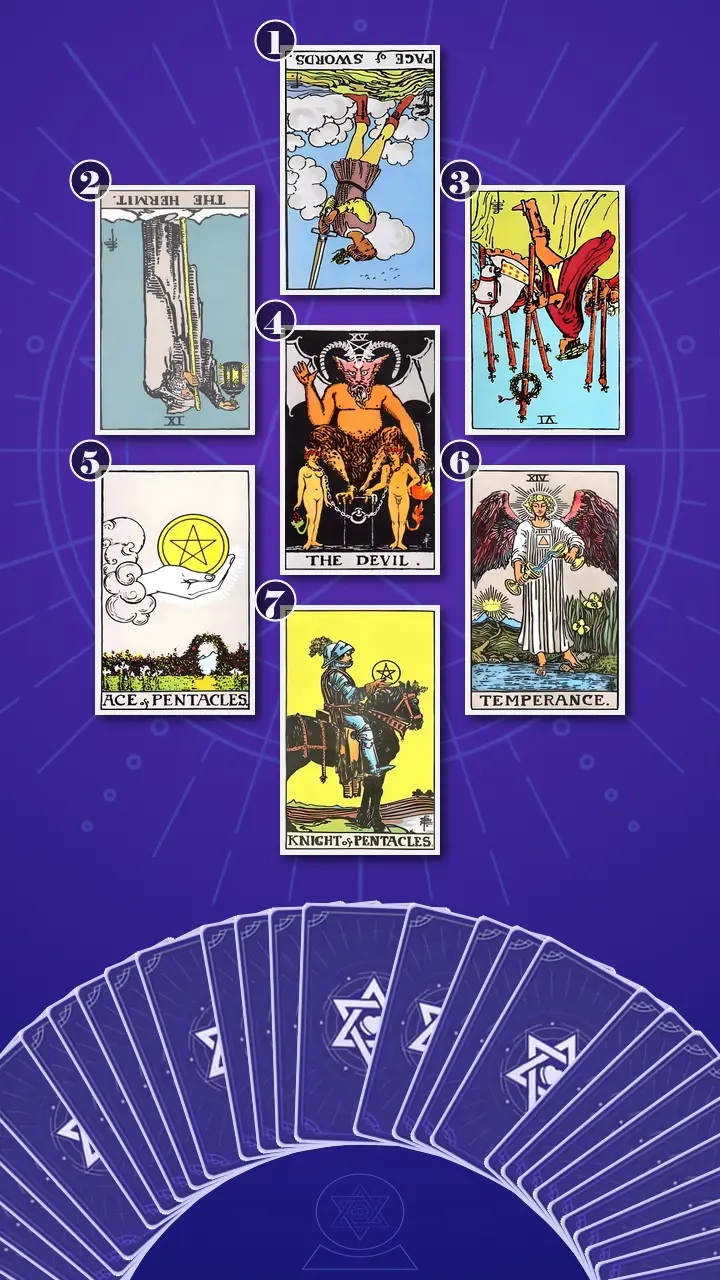
I chose the seven-position Energy Diagnostic Map · Context Edition. A general past-present-future spread would have scattered our attention across too many themes. Casey's problem was a repeating system, so I needed a spread that could separate the visible behaviour, the internal need, the external pressure, the central reward mechanism, and the practical exit.
I placed the first card at the top. Two cards beneath it would show the internal pull and the environmental fuel. Both lines would converge on the central blockage. Three upright positions below that point would identify a resource, the pivotal transformation, and an immediate next step. The layout formed a funnel: scattered signals narrowing into one mechanism, then reopening into a grounded road.
This is how tarot works in my practice. I do not use cards to predict an unavoidable future or hand someone a fixed identity. I use the images as an external cognitive map. Each card holds one part of a complicated pattern still long enough for us to inspect it, question it, and compare it with lived experience. Card meanings in context are useful only when the person across from me can test whether they are true.
The Restless Scout in a Browser Full of Maps
Position 1: The Motion Around the Unfinished Thing
“Now opening,” I told Casey, “is the position that surfaces the observable symptom: saving, switching, and researching self-help material without staying with its application.” I turned over The Page of Swords, reversed.
The Page held a sword high while looking sideways across a windblown landscape. Upright, that alertness can support sharp curiosity. Reversed, the mental energy was in excess and its maturation was blocked. Casey was monitoring every possible answer at once, so no single idea remained in their hands long enough to become tested knowledge.
The modern scene was already visible behind the card. At 11:40 p.m., Casey moved between a habit tracker, three queued podcasts, a productivity-system review, and the half-finished values exercise. Their attention was fast and bright, but it pointed everywhere. I asked them to notice the split screen: polished tracker on one side, fifteen minutes of untouched practice on the other.
“Before you save the next clip,” I said, “the Page asks a blunt question: what observable action will that clip replace tonight?”
Casey gave one short laugh, then pressed their lips together. “That's so accurate it's almost rude.” Their eyes moved toward the phone. “I keep doing so much around the thing. The thing itself somehow stays untouched.”
I let the recognition remain gentle. Curiosity was not the enemy. The problem was curiosity without an object, a duration, or a test. The reversed Page did not ask Casey to become less thoughtful. It asked them to stop confusing mental motion with lived movement.
Position 2: The Lantern That Only Shows the Next Few Feet
“Now opening is the position beneath the symptom,” I said, “the wish for authentic purpose competing with the habit of outsourcing clarity to confident voices.” The card was The Hermit, reversed.
The Hermit's lantern does not illuminate an entire mountain. It reveals only the next few steps. In reversal, Casey's inner guidance was blocked while their demand for a complete, authoritative answer had become excessive. They did not lack reflective capacity. They distrusted any personal evidence that arrived quietly or incompletely.
I described the familiar scene: another online purpose quiz open while a plain journal question remained blank. What felt meaningful or absorbing this week, and what were you physically doing? When no decisive answer appeared in four minutes, Casey looked for a creator who could provide one faster.
“It has a little of The Wizard of Oz in it,” I said. “You keep travelling toward a distant authority who seems to possess the missing declaration. But the useful qualities become visible through what happens on the road. The point isn't that experts have nothing to offer. It's that no expert can install the evidence of your own experience.”
I asked Casey which recent moment had felt absorbing before anyone explained what it was supposed to mean. Their fingers tightened around the cold mug, then loosened. After a pause, they mentioned helping a friend edit a portfolio. They had lost track of time, but dismissed the moment because it had not arrived with a grand feeling of purpose.
“That is exactly the kind of small lantern this card protects,” I said. “Partial does not mean false. Local evidence can be enough for the next step.”
Position 3: When Someone Else's Milestone Became a Deadline
“Now opening is the position of external pressure,” I said, “the feeds, visible milestones, economic realities, and imagined audience that turn ordinary uncertainty into an urgent life reset.” I revealed The Six of Wands, reversed.
The rider, laurel wreath, and watching crowd looked like a social feed organised around display, ranking, and applause. Reversed, recognition energy was overvalued while private confidence was underfed. Someone else's public success could become a verdict on Casey's private pace.
I asked Casey to replay a recent trigger. They described standing on a crowded Line 1 train at 5:52 p.m., seeing a former colleague's promotion announcement on LinkedIn. The brakes squealed, damp winter coats smelled faintly metallic, and their jaw tightened while congratulations filled the screen. Before the next stop, their thumb had moved from the post to a video promising a ninety-day career reinvention.
“The thought was basically, ‘Good for them, so why does their milestone suddenly feel like a deadline for me?’” Casey said.
“A visible milestone is not the same thing as a privately meaningful direction,” I replied. “Their post may contain true information about their life. It contains no evidence about what would make an ordinary Tuesday feel more like yours.”
Casey's breath caught. Their gaze went unfocused for a moment, as if the train scene were replaying behind their eyes, and then they exhaled from low in their chest. “I abandoned the portfolio exercise that night,” they said. “Not because it was going badly. It just looked embarrassingly small after that post.”
The Two-Second Bargain Beneath the Autoplay Button
Position 4: The Loose Chain and the Next Click
“Now opening is the central blockage,” I said, “the instant informational reward that feels like progress and therefore postpones the experiment that could create real evidence.” At the centre of the map was The Devil, upright.
I never treat the Devil as a sentence, a threat, or proof that someone has lost control. Here, its energy showed an excessive attachment to a reliable reward. The next video offered immediate hope, identity, and relief. Beginning a real practice offered uncertain feedback, delayed satisfaction, and the possibility of mixed feelings. The habit narrowed Casey's sense of choice, but the loose chains in the image mattered: a choice point still existed.
I slowed the scene down to two seconds. A self-help clip ends. The apartment becomes quiet. The unfinished portfolio file feels exposed on the laptop. Then a bright thumbnail promises transformation, and the thumb hovers. The hidden bargain sounds like this: I know this will not decide for me, but for the next ten minutes I will not have to feel undecided.
Self-help information overload was not being maintained by information alone. It was being maintained by the emotional return delivered before any real-world result had to arrive.
I used one of my most practical lenses, Daily Clutter Deconstruction, to read the physical scene without judging Casey's tidiness. The warm phone was the immediate relief cue. The three queued podcasts were three open promises of a better self. The unfinished worksheet held delayed feedback. The cold tea and heavy legs showed the body being left behind while the mind continued to collect instructions. The clutter was not a character flaw. It was a traffic map of unresolved invitations competing for the same small reserve of energy.
“What happens inside you in the silence before autoplay?” I asked.
Casey's thumb pressed against the side of the mug. “My stomach drops. Opening the actual document suddenly feels final, even if I'm only opening it for ten minutes. The next video makes every possible future feel available again.”
“Then that two-second drop is the cue,” I said. “We do not need to delete every app or declare advice harmful. A total ban could become another dramatic reset. We only need to make the choice point visible enough for a different response to remain available.”
One Pentacle, One Real Appointment
Position 5: A Foothold That Does Not Claim to Be a Destiny
“Now opening is the available resource,” I said, “your existing capacity to choose one small, concrete experiment before you have resolved every question about purpose.” I turned over The Ace of Pentacles, upright.
A hand offered one pentacle above a garden path. The path passed through an arch, but it did not reveal every turn beyond the distant mountain. This was balanced Earth energy: time, place, materials, and observable participation. It offered potential without pretending potential was a guarantee.
I asked Casey to name one activity they already knew enough to try without buying a course, downloading an app, or announcing a new identity. They looked past the laptop toward a sketchbook wedged beneath two productivity books. Sketching had once held their attention, but they had started treating leisure like another performance metric and gradually stopped.
“Wednesday at 7:30 p.m., at this table, for fifteen minutes,” I said. “The sketchbook can already be open. This does not have to prove who you are. It only has to give you something real to notice.”
Casey's shoulders lowered with a long exhale. The experiment became visible without becoming enormous.
“Do not make one experiment carry the weight of your whole future,” I added. “The Ace is an invitation to enter the garden, not a demand that you promise to live there forever.”
When Temperance Refused a Third Cup
Position 6: The Rhythm That Changes the Whole System
The radiator stopped clicking as I reached for the next card, and a clean silence opened between us. Rain continued down Casey's window in thin, steady lines. “Now opening is the pivotal transformation,” I said, “the shift from binge-and-reset cycles to a measured relationship between input, application, and reflection.” I revealed the key card: Temperance, upright.
The angel moved water continuously between two cups, with one foot in water and one on land. I translated the image into a modern structure. One cup was selected input. The other was lived application. The stream between them was review, carrying information back and forth. Advice did not need to disappear; it needed proportion. Reflection did not need to produce certainty; it needed contact with something Casey had actually done.
I brought Casey back to 11:40 p.m.: the habit tracker open, three podcasts queued, tomorrow's schedule under reconstruction, the unfinished values exercise beside the laptop. The screen looked productive, but their heavy legs already knew that no lived evidence was being made.
An Energy Extraction Audit of One Click
I used my Energy Extraction Audit to examine the loop as a transaction rather than a moral failure. I asked three questions: what energy does the micro-habit take, what does it return immediately, and what useful return does it delay?
The autoplay click extracted another slice of baseline attention and kept Casey's shoulders activated. It returned ten minutes of hope and borrowed certainty. What it delayed was the slower return of practice: evidence about curiosity, boredom, resistance, skill, or fit. That delayed return created more anxiety because Casey kept waiting for direction while repeatedly postponing the process that could produce it.
Temperance did not demand a digital detox. It redistributed the energy budget. Limited input could remain in one cup, but application had to receive the other. Review would connect them before another framework entered the system.
More input is not the missing answer; integrate one idea through measured practice, as Temperance moves water between two cups instead of endlessly filling a third.
I left the sentence in the quiet for a moment. Then I made the shift even plainer.
You do not need a better map right now; you need a rhythm that lets one imperfect choice become evidence.
For one beat, Casey stopped breathing. Their fingers remained suspended above the cold mug, and their pupils widened before their gaze slipped away from the screen. I watched memory move across their face: the saved folders, the abandoned trackers, the Mondays that had been asked to become complete reinventions. Their mouth tightened.
“But doesn't that mean I've been doing this wrong for years?” they said, sharper than before. The anger arrived first, protecting something tender beneath it. Their shoulders stayed rigid, and one hand closed into a fist against the table.
“It means the strategy gave you relief and control when uncertainty felt exposed,” I said. “That is not the same as saying you were foolish. We are identifying the tradeoff now because you can choose whether it still serves you.”
The fist opened finger by finger. Casey's eyes reddened slightly, and they released a shaky breath that sounded more like fatigue leaving than certainty arriving. Their shoulders lowered, but the relief brought a brief, almost dizzy blankness. If no expert was responsible for delivering the right path, Casey would have more freedom. They would also have the vulnerable responsibility of testing one.
“Now, with this new perspective, think back to last week,” I invited. “Was there a moment when this insight might have made you feel different?”
Casey remembered Wednesday night, when they had queued four videos about creativity while the sketchbook remained under the books. “I could have watched one thing, taken one idea, and drawn for two minutes,” they said. “Not because drawing had to be the answer. Just to find out what two minutes felt like.”
That recognition marked the central emotional transformation: from restless self-help consumption and outsourced certainty to grounded self-trust built through lived feedback. It was not total confidence. It was the first willingness to let experience contribute evidence.
I gave Casey eight quiet minutes to open a plain note, not a new template. They wrote one known practice, its smallest observable version, and realistic calendar slots: “Sketch for fifteen minutes at the kitchen table on Monday, Wednesday, and Friday at 7:30 p.m.” They added a two-minute minimum for depleted evenings and a day-fourteen review with three prompts: “What gave me energy? What drained me? What would I adjust?”
“This is a trial, not a contract with your future,” I said. “You may continue, adapt, or stop after the review. If it becomes unsafe, unaffordable, or genuinely disruptive, you stop sooner. Self-trust includes protecting your limits.”
The Knight Who Stayed After the Excitement Left
Position 7: Cultivating Evidence After Day Three
“Now opening is the immediate practical step,” I said, “the repeated commitment that can generate information about interest, values, energy, and fit after the initial excitement fades.” The final card was The Knight of Pentacles, upright.
The Knight sat on a motionless horse, holding one pentacle level before cultivated fields. This was steady Earth energy in balance. It did not dramatise slowness as failure. It treated repetition as stewardship. The Knight was the mature counterpart to the reversed Page: one object of attention, one field, enough time to learn what grows there.
I connected the card to Casey's calendar. The same kitchen table. The same modest practice. Fifteen minutes when available, two minutes on a low-energy day, and one dated line in a private “done and learned” note. No public launch, no elaborate accountability post, and no replacement search before the day-fourteen review.
“What if the excitement disappears after the third session?” Casey asked.
“Then you have reached the part your previous systems kept hiding,” I said. “Loss of novelty is not automatically evidence that a practice is wrong. It is the point where repetition can begin answering questions that excitement cannot. Record boredom if boredom is present. Record relief, irritation, curiosity, or nothing obvious. Revision is data, not proof that you cannot direct your life.”
I made no prediction that sketching would become Casey's purpose. The Knight promised no such thing. It offered a method for discovering preference through contact with reality, which was more useful than another promise of instant clarity.
A Laptop-Sized Corner Where Clarity Could Land
With all seven cards visible, I traced the story from top to bottom. Over time, Casey had learned to treat uncertainty as an information shortage. The reversed Page showed the visible scanning and switching. The reversed Hermit revealed why external certainty felt more credible than their own incomplete observations. The reversed Six showed how promotion posts and transformation feeds converted other people's milestones into private deadlines.
Those three pressures converged in the Devil's reward loop: another click produced hope before evidence, preserving every possible identity while postponing the risk of testing one. The Ace showed that Casey already had a concrete foothold. Temperance supplied the regulating rhythm, and the Knight supplied the repetition required for feedback to become legible.
The core metaphor was simple. Casey had been collecting maps without walking far enough to recognise a landscape. Their cognitive blind spot was the belief that a small experiment had to justify Toronto rent, reveal a permanent purpose, and prove the future was under control. That burden made preparation feel safer than participation.
The transformation direction was not from self-help to no self-help. It was from framework collecting to a one-source, fourteen-day practice trial integrating limited input, real-world application, and private reflection. Direction could become a working hypothesis rather than a verdict delivered by an expert.
Casey looked at the sketchbook and frowned. “But reorganising things is already how I procrastinate. And after an agency day, sometimes I genuinely don't have fifteen minutes in me.”
“Both points matter,” I said. “So the physical reset must serve the action and stop before it becomes a new project. And the two-minute version counts. We are designing for your real energy, not an imaginary perfect week.”
- The 15-Minute Physical Anchor Experiment. Within the next 48 hours, set a timer and radically reset only one laptop-sized corner of the kitchen table. Remove unrelated books, chargers, and cups; place the sketchbook and one pen there; then stop when the timer ends. Do not redesign the apartment or buy storage. The corner exists only to make the scheduled practice physically easier to begin. Tip: End the reset by placing the first fifteen-minute calendar block. If energy is low, opening the sketchbook and drawing for two minutes is the valid minimum.
- The Save-to-Schedule Gate. For fourteen days, whenever a new self-help video, podcast, book, or template appears, write down the single action it suggests. Save the content only if that action receives a specific calendar time. Keep one selected source available and archive related items until the review date. Tip: If no action can be named or scheduled, let the item pass. This is a boundary around input, not a total information ban.
- The One-Source Fourteen-Day Trial. Use the learn-test-review rhythm at the kitchen table on Monday, Wednesday, and Friday at 7:30 p.m.: no more than twenty minutes of selected input, at least two to fifteen minutes of sketching, and one private line recording energy before, energy after, and something noticed. On day fourteen, review the notes and choose to continue, adapt, or stop. Tip: A missed session does not reset the trial. Move it once or use the two-minute minimum. Pause immediately for safety, affordability, consent, or serious practical concerns.
Watching Casey place the sketchbook on top of the productivity books, I thought of the hundreds of coffee cups that had cooled beside twenty years of readings. The turning point was rarely a grand theory. More often, it was the first ordinary action a person was willing to let answer back.

Fourteen Days Without a Verdict
A week later, I received a photo from Casey. The apartment had not undergone a cinematic makeover. One laptop-sized section of the kitchen table was clear. The sketchbook lay open beside a pen, and three repeated calendar entries were visible on the phone.
The message beneath the photo read: “I did all three sessions. Two were fifteen minutes. One was only two because work wrecked me. The third session was boring, which usually sends me straight to YouTube, but I wrote ‘bored, then calmer’ in the note. That feels like information I couldn't have had on day one.”
Casey had slept through the night, but their first morning thought was still, “What if this proves nothing?” This time, they told me, they smiled, put the sketchbook back on the cleared corner, and went to work.
I did not read that update as proof that sketching was their purpose or that the self-help loop had vanished. I read it as quiet evidence of a new relationship with uncertainty. Casey had interrupted one click, kept one appointment after the novelty faded, and discovered that boredom could be recorded rather than treated as an emergency.
The cards had not chosen a life for them. They had made the system visible. Casey chose the experiment, Casey gathered the evidence, and Casey retained the authority to continue, revise, or stop. That was the real Journey to Clarity: not certainty handed down from the table, but enough grounded self-trust to take the next step without demanding that it control the entire future.
I know many of us recognise the flat drop after closing one more “life-changing” tab: heavy limbs, no chosen next step, and the quiet fear that testing one path might reveal how little control we have over where it leads. Simply noticing that the third cup is already overflowing means the old loop is no longer completely invisible.
If one imperfect choice did not have to define your future, which already-known practice would you place in Temperance's second cup and let answer back over the next fourteen days?