Feeling Lost After a Promotion: Five Futures, Then One Small Test

Feeling Lost After the Finish Line
You reached the thing you spent years chasing, and within days you were opening new planning documents, scrolling other people’s milestones, and searching for the next strategically correct move. That was the recognition point I heard before the reading even began: feeling lost after achieving a long-term goal, then feeling ashamed because success was supposed to make everything clearer.
Alex, a 29-year-old senior product designer, joined me from the kitchen table of their Toronto apartment at 11:40 on a Tuesday night. Their promotion announcement was still pinned in a group chat. Four career-development tabs glowed beside a polished Notion board divided into five possible futures, while the refrigerator hummed behind them and the laptop radiated trapped warmth into their palms.
I watched Alex drag “Design leadership” above “Move abroad,” pause, and move it back under “Start a studio.” Their jaw stayed locked while their legs looked too heavy to carry them away from the chair. The confusion had a physical shape: it was like standing in an arrivals hall after every departure board had gone blank, chest braced for an announcement that would not come.
“I know how to chase a target,” Alex told me, rubbing the hinge of their jaw. “I don’t know what to do when I catch it. I should be happier. Instead, I keep trying to plan my way into wanting something.”
I heard the central contradiction clearly. Alex wanted an enduring sense of direction, but every attempt to recover it depended on finding another external goal impressive enough to organize their identity. The next milestone was being asked to provide both a route and proof that the person walking it mattered.
“Nothing about this makes you ungrateful,” I said. “A three-year pursuit gave your days a structure, and that structure ended when you succeeded. We’re not going to force a new life plan into the space tonight. We’re going to make a map of what happens in that space, so you can separate temporary disorientation from the direction that is actually yours.”

Choosing the Compass: The Five-Card Shadow Spread
I asked Alex to close the planning tabs, place both feet on the floor, and take three ordinary breaths while holding one question in mind: “Why do I lose direction every time I reach a long-term goal?” I shuffled slowly, using the pause as a focusing transition rather than presenting it as a mystical performance.
I chose a five-card Shadow Spread. For anyone wondering how tarot works in a situation like this, I use the cards as a structured reflection tool, not a fixed prediction. Card meanings in context can make an invisible pattern visible, but they do not remove choice or announce an unavoidable future.
The Shadow Spread was the smallest complete map for Alex’s question. The first position would show the visible behaviour after success. The central position would reveal the hidden belief driving it. The left side would show what constant planning was protecting Alex from, while the right side would identify an internal resource. The final card would turn insight into a grounded next step.
I laid the cards in a cross that resembled a compass. At its centre sat the belief that needed examination. Above it was the behaviour Alex could already see. To the left was automatic protection; to the right, deliberate transformation. Below was the practical point where reflection would have to meet real life.
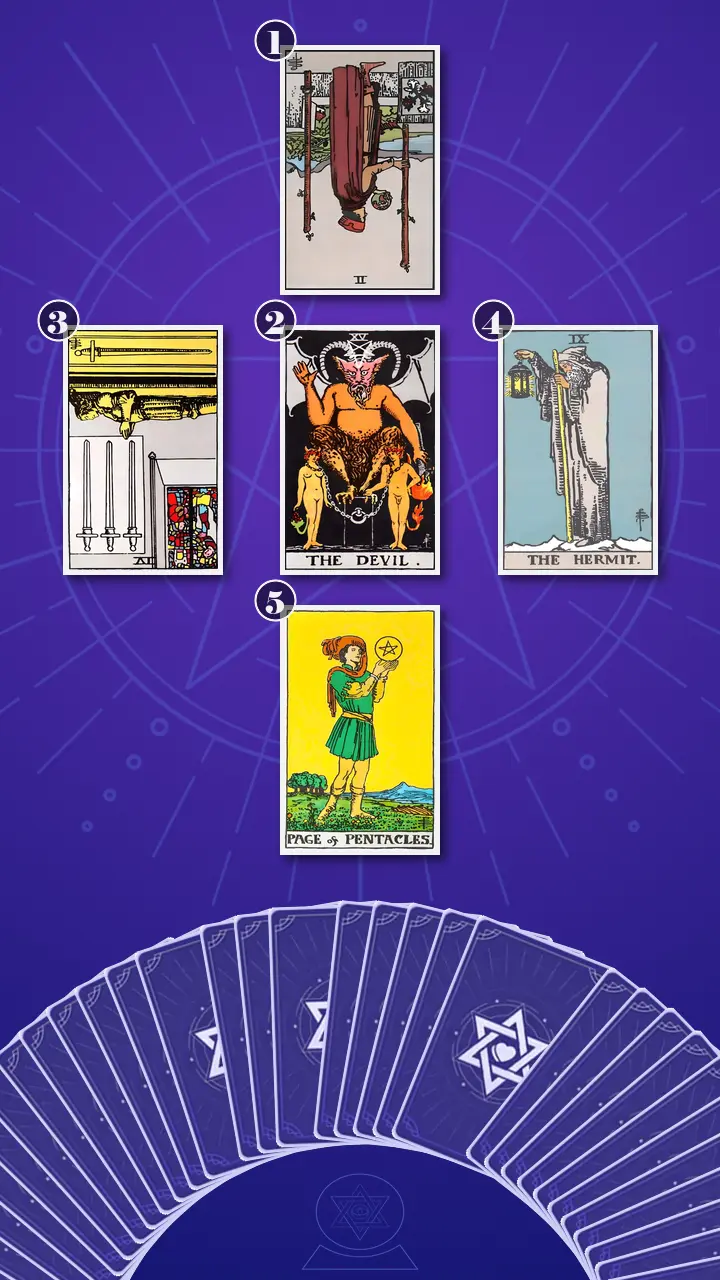
Reading the Map Behind the Milestone
Position 1: The Globe Behind the Wall
Now I turned over the card representing the diagnosis-level behaviour visible after goal completion: multiplying, researching, and ranking future options without committing to a real-world test. It was the Two of Wands, reversed.
I pointed to the figure holding a globe while remaining behind a battlement. Alex had access to an entire world of options, but access was not producing movement. Reversed, the card showed Fire in blockage: initiative existed, yet fear of choosing without a guarantee kept that initiative contained inside planning.
“This is your five-column Notion board,” I said. “Design leadership, a master’s program, consulting, relocation, and a creative side project. You compare salary, timeline, prestige, and risk until midnight, but you don’t email one person, attend one session, or test one ordinary task. You’re demanding a complete map before allowing one step.”
I could almost hear the private algorithm running beneath the board: If I compare enough options, one of them should finally feel inevitable. Yet every additional comparison increased decision fatigue. The system looked sophisticated while functioning like Google Maps with every destination kept open because selecting one route would mean accepting that the others would not be travelled today.
“Planning can look like direction while keeping you safely motionless,” I said.
Alex gave one short laugh, but there was no amusement in it. Their hand hovered over the laptop before pulling away. “That is so accurate it’s almost rude,” they said. “I made the fifth version of that board last weekend.”
I did not treat the laugh as resistance. It was recognition arriving with a sting. I asked which possibility had remained interesting after the salary projections, LinkedIn optics, and five-year consequences were removed. Alex looked toward the dark window but did not answer yet. That unanswered pause mattered more than another ranked list.
Position 2: The Performance Dashboard That Never Closes
Now I turned over the card representing the concealed belief beneath the loss of direction: measurable achievement had been carrying responsibility for identity, worth, and control. The card was The Devil, upright.
I centred the loose chains around the figures’ necks. I did not interpret the card as a warning that something terrible was coming, nor did I use it to condemn ambition. Upright, The Devil showed an excess of attachment and a blockage of choice. A useful career goal had gradually been assigned an impossible second job: proving that Alex was distinctive, secure, and worthy.
The promotion had become ordinary within days, so Alex was already searching for the next title or credential that might restore the feeling of certainty. A merely interesting option could not pass the test. It had to look impressive enough to prove the promotion had been deserved and that the previous three years had not ended in luck.
“The loose chains remind me of a performance dashboard you keep voluntarily reopening after the review cycle has ended,” I said. “The metric turns green, but the target immediately rises. The system offers temporary certainty, then charges another achievement for the renewal.”
I thought of Severance, not as a joke about corporate life, but as shorthand for the unsettling question beneath the card: how much of the answer to Who am I? had been outsourced to a professional role? Alex’s career could be meaningful without being required to hold their entire identity together.
“The next impressive goal cannot permanently prove what the last one could not,” I said. “When you imagine three months without a major new target, what are you afraid you would conclude about yourself?”
Alex’s breath shortened. Their eyes stayed on the loose chain, and two fingers pressed lightly against the centre of their chest. “That maybe the promotion was the only interesting thing about me,” they said. “Or that I got lucky, and now everyone will realise I don’t have a bigger plan.”
I let that answer settle without turning it into a diagnosis. “That fear explains the urgency,” I said. “It does not make the fear true. It tells us what the next goal has been hired to protect.”
Position 3: Restlessness Disguised as Research
Now I turned over the card representing the protective function of the pattern: immediate planning and information consumption were shielding Alex from rest, open-ended self-contact, and the discomfort of having no organising target. It was the Four of Swords, reversed.
The recumbent figure could not remain at rest in this orientation. Recovery was cut short by restless Air. Thought had moved from a useful tool into excess, circling the same career crossroads without creating resolution.
I described the late TTC commute the card brought to mind: a leadership podcast playing at 1.5x while LinkedIn refreshed under fluorescent carriage lights. Every quiet gap became a chance to consume another career framework, compare another role, or save another milestone announcement. The activity protected Alex from the feeling of an empty interval, but it also prevented fatigue, preference, and neglected interests from becoming audible.
“A break sounds good until I actually have one,” Alex said. “Then it feels like I’m falling behind.”
I used what I call a Systemic Friction Audit. Instead of asking how Alex could hustle harder, I separated personal effort from the phase transition itself. Three years of deadlines, stretch assignments, portfolio updates, and performance reviews had ended. The nervous system had not failed because it could not turn that ending into a new mission within a week. The friction came partly from demanding launch-phase output during an integration phase.
“The planning is not pointless,” I said. “It has been protecting you from a silence that feels threatening. But the protection now blocks the information you need. If every background tab stays open, the spinning fan can sound like progress while no unprompted thought gets enough quiet to finish.”
Alex’s shoulders rose once, then lowered with a long exhale. Their thumb stopped tracing the edge of the phone. I could see recognition moving through the body before it became language: first the clenched jaw, then the unfocused stare of someone replaying recent commutes, then the quiet admission, “I don’t think I’ve had twenty minutes without career content since the promotion.”
When the Hermit’s Lantern Lit Less, and Meant More
Position 4: Enough Light for One Honest Step
Now I turned over the card representing the key transformation from externally supplied direction to reflective self-guidance based on values and limited next-step visibility. The refrigerator compressor clicked off as I revealed The Hermit, upright, and the room suddenly held the kind of quiet Alex had spent the week avoiding.
I lifted the card slightly so the lantern was level with the camera. The light did not cover the mountain or reveal the whole road. It illuminated a small radius around a self-supported figure. Upright, The Hermit brought balanced introspection: not permanent withdrawal, not a promise of instant purpose, but enough private truth to choose the next responsible step.
I named the loop in front of us. At 11:40 p.m., with the promotion messages still pinned and four career tabs waiting, Alex had been treating unanswered space like a defect. Rearranging five futures created momentary control while making every personal preference harder to hear.
As I looked at the lantern, my mind went to the planetary cycles I had studied and watched repeat through a decade of consultations. An orbit contains periods of acceleration, culmination, release, and integration. I would never use that pattern to claim that fate had scheduled Alex’s next move. I used it to distinguish a natural transition from a personal failure.
I call that lens Macro-Cycle Phase Identification. Alex’s three-year accumulation cycle had reached culmination with the promotion. The present phase was not another ascent waiting to be optimised; it was an integration interval in which the previous pursuit could be metabolised. Judging that interval by the metrics of acceleration was like blaming low tide for not behaving like a wave. The mismatch created resistance, not a lack of character.
“The gap after achievement is not proof that you have no direction,” I said. “It is the first quiet place where direction can stop performing for an audience and start answering to your values.”
You do not need another finish line to justify your worth; let the Hermit's lantern illuminate one honest next step instead of demanding the whole road.
I stopped speaking. Alex’s breath caught, and their fingers froze halfway around the mug. For several seconds, their gaze did not leave the lantern. Then their eyes shifted slightly out of focus, as if old performance reviews, Sunday planning sessions, and every prematurely chosen target were replaying behind them. Their jaw loosened, but not into immediate relief. Their brows pulled together.
“But doesn’t that mean I’ve been doing all of this wrong?” Alex asked, their voice suddenly sharper. “I gave three years to getting here.”
I let the anger have room. “No. The goal helped you grow, and the promotion is real. We’re examining the job you asked achievement to perform after it was earned. Ambition was never the problem. Requiring ambition to prove your worth forever is the chain.”
Alex blinked hard. Their shoulders dropped, their palm opened against the table, and a shaky breath left their chest. Relief arrived, but so did a brief, exposed look, almost like dizziness after setting down something heavy. I could see the new responsibility in that openness: if no impressive milestone could choose for them, then their own quieter preferences would have to count.
“Now, using this new perspective, think back to last week,” I said. “Was there one moment when this insight might have changed how the uncertainty felt?”
Alex looked toward the closed laptop. “Saturday morning,” they said. “I found a community printmaking workshop. I wanted to try it, but it didn’t offer a credential, so I closed the tab. I remember thinking, I’m already a senior designer. Why would I spend time being bad at something with no outcome?”
“That is the lantern-radius answer,” I said. “Not because printmaking is secretly your destiny, but because it stayed interesting after usefulness and prestige had been stripped away. You do not know the whole answer. You can tell what feels honest for the next twenty minutes.”
I invited Alex to open a note and set an eight-minute timer. We titled it No Next Big Goal Required. I asked for one activity from the past week that had created curiosity, satisfaction, or useful friction, followed by the value it might express. Alex wrote “printmaking” and, after a pause, “craft without an audience.” I asked them to name only a 15-minute way to revisit it, with no purchase, announcement, or long-term commitment. If the exercise began to feel like another performance target, stopping after the activity name would still count as useful information.
This was the reading’s central crossing: a move from post-achievement emptiness and comparison-driven overplanning toward reflective self-trust and revisable direction. Alex did not leave the confusion in one dramatic leap. They stopped requiring confusion to disappear before personal preference could contribute evidence.
Position 5: One Pentacle, Not a New Identity
Now I turned over the card representing the grounded integration step: a small, time-boxed learning experiment that could generate direction through experience rather than premature certainty. It was the Page of Pentacles, upright.
The Page studied one pentacle while fields and distant mountains remained visible. The wider future had not disappeared; it simply no longer needed to be controlled all at once. Upright Earth brought balance to the blocked Fire and restless Air of the earlier cards. It asked for one tangible object of attention, approached with beginner curiosity.
I translated the card into Alex’s life as a bounded two-session prototype on an otherwise blank project board. Instead of selecting a new defining objective, Alex could use tools already at home to make one rough, two-colour print concept during two short sessions, then review what the experience revealed about curiosity, energy, and willingness to return.
“This does not have to be your next era,” I said. “It only has to teach you something. Treat the next move as an experiment, not a verdict on who you are.”
Alex looked at the Page, then back at the note containing “craft without an audience.” Their mouth lifted at one corner, though their eyes were still damp. “Two sessions sounds almost suspiciously manageable,” they said.
“That is part of the design,” I replied. “Continuing, changing, or dropping the experiment are all valid outcomes. The measure is honest information, not impressive persistence.”
From Lantern Radius to One Pentacle
I drew the five cards into one coherent story. For three years, a clear promotion target had organised Alex’s routines and rewarded strategic effort. Once that cycle culminated, the reversed Two of Wands showed them trying to replace the vanished structure with a total map of the future. The Devil revealed why every option had to look consequential: achievement was carrying the burden of proving identity and worth. The reversed Four of Swords showed how research and productivity content protected Alex from the undefined pause while keeping preference inaudible.
The Hermit did not supply a destination. It returned authority to Alex through limited, values-led visibility. The Page of Pentacles then prevented reflection from becoming endless withdrawal by asking for one concrete experiment. The globe, the lantern, and the pentacle offered three models of direction: trying to possess every possibility, seeing one honest stretch of road, and learning from one tangible commitment.
I also noted that no Cups appeared in the spread. I did not treat an absent suit as a prediction. I used it as a useful question: which element had been under-consulted in Alex’s decision process? Strategy, status, risk, and productivity had all been invited to the meeting. Felt satisfaction, ordinary enjoyment, and emotional preference had barely been allowed into the room.
The cognitive blind spot was not simply overplanning. It was the belief that direction only counts when attached to a significant measurable goal. That belief made quiet curiosity look arbitrary and beginner experiments look unserious. The transformation was therefore specific: stop demanding another long-term target, create a deliberate pause, choose one possibility through personal values, and test it in a form small enough to revise.
The Orbital Sync Protocol: Seventy-Two Hours Without a New Verdict
I framed the next steps through my Orbital Sync Protocol, a 72-hour exercise for bringing psychological expectations into alignment with the actual transition phase. It was not a ban on ambition and not an instruction to abandon career caution. It was a short reality test: pause forced goal replacement long enough to gather information that comparison had been drowning out.
- Create a 72-hour no-new-goal window. From Wednesday at 6:15 p.m. until Saturday at 6:15 p.m., Alex would make no new career roadmap, buy no course, and request no strategic verdict from friends. They would take one 20-minute screen-free walk around a familiar Toronto block or along the waterfront, then schedule one second 20-minute input-free period before the window closed. After each period, they would record one recurring thought, sensory detail, or neglected interest without interpreting it. If twenty minutes felt too exposed, the minimum version was a seven-minute walk to the end of the block and back, with the phone on Do Not Disturb.
- Run the One-Pentacle Experiment. Alex would choose one possibility that still felt interesting after title, prestige, salary impact, and shareability were hidden. Using materials already at home, they would book two 25-minute sessions to make a rough print concept. After the second session, they would rate curiosity, energy during the task, and willingness to return from one to five, then complete the sentence, “This taught me that...” The experiment would stay private and carry an exit date. Continuing, changing, or dropping it would all count as valid results if the review produced honest information.
I asked Alex to notice how modest the plan felt compared with their five future columns. That modesty was not a lack of seriousness. It was what made the experiment capable of meeting reality before another identity was built around it.

Three Days Later: A Chapter Without a Title
Three evenings later, I received a short message from Alex. They had completed the first waterfront walk without a podcast. Wind off Lake Ontario had pulled at their coat, bike bells had passed behind them, and one hand had kept reaching automatically toward the phone. By the second block, they had noticed that the printmaking idea was still there without an algorithm reminding them.
They had also completed the first 25-minute session. The result was uneven, private, and unfinished. Alex described it as “the first thing I’ve made in ages that wasn’t applying for a job.” They had not chosen a new career direction. They had gathered one piece of lived evidence about craft, play, and the relief of being a beginner.
That night, Alex slept without reopening the Q3 board. In the morning, their first thought was, What if this is a waste of time? Then they saw the rough print on the table, smiled, and left the question unanswered.
I did not credit the cards with changing Alex’s life. The cards gave us an objective structure for seeing the cycle, but Alex closed the tabs, tolerated the pause, took the walk, and made the first rough thing. Tarot held the map steady. Alex remained the person choosing where to place their feet.
When the congratulations fade and your chest tightens over a blank calendar, it can feel as though finishing the goal removed not only your schedule but the proof that you knew who you were. If that is where you are tonight, noticing the difference between a whole globe, a lantern’s limited light, and one pentacle in your hands already means you are no longer standing at the same starting point.
If your next chapter did not need a title yet, what one possibility would you place inside the Hermit’s lantern radius and test long enough to let it teach you something?