Finding Clarity in the 11:42 p.m. Phone Glow
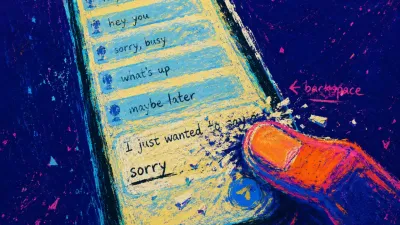
If you’ve ever typed a perfect, emotionally intelligent paragraph… then deleted it and sent “I’m done” because you felt dismissed for half a second, you know the door-slam reflex.
Jordan sat across from me like they’d already run the argument a dozen times in their head—like they’d won it, lost it, appealed it, and still couldn’t sleep.
They described the scene almost cinematically: 11:42 PM on a Wednesday in their Toronto condo bedroom. The only light was their phone screen—blue-white, cold, making even the duvet look a shade more lonely. The HVAC hummed like a distant engine. Their thumb kept hovering over “Block,” not quite touching it, but close enough that their hand felt electrically restless.
“It’s like… the second I feel dismissed, something in me goes cold,” they said. “I call it protecting my peace. But an hour later it’s not peace. It’s just… empty.”
As they spoke, I watched their body tell the truth before their words did: tongue pressed against teeth, jaw locked tight enough to ache, throat held like it was bracing for impact. Hurt, but wearing a suit of composure.
The contradiction was right there in the way they held their phone like a shield: torn between protecting yourself instantly and staying emotionally present long enough to repair and be understood.
“Okay,” I said, keeping my voice gentle and grounded—the tone I use on-air when callers are mid-spiral and need a handrail, not a lecture. “We’re not here to shame the slam. We’re here to understand what it’s protecting—and find one step that still feels like self-respect. Let’s make a map for the fog. A real one. The kind that leads to clarity.”

Choosing the Compass: The Four-Layer Insight Ladder · Context Edition
I asked Jordan to take one slow breath with me—not as a ritual, not as mysticism, but as a clean transition. Like closing fifteen tabs so your brain can load the one you actually meant to read.
As I shuffled, I listened the way I always do—part tarot reader, part music therapist. In my world, stress has a tempo. Fear has a rhythm. Defensiveness has a sharp, fast attack like a snare hit. And repair—real repair—always has pacing.
“Today,” I told them, “we’re going to use a spread I love for relationship triggers and boundaries: the Four-Layer Insight Ladder · Context Edition.”
To you reading this: this spread works so well when the question is, What pattern am I replaying—and what’s one step I can actually do? Because it’s not a prediction spread. It’s a mechanism spread. It moves in a straight line from the visible behavior down into the root, then back into a practical next step—trigger → imprint → protection → pivot → action. No extra drama.
I set the intention out loud, plain and non-performative: “We’re looking for the childhood-shaped template underneath the door slam—and the smallest next move that interrupts it.”
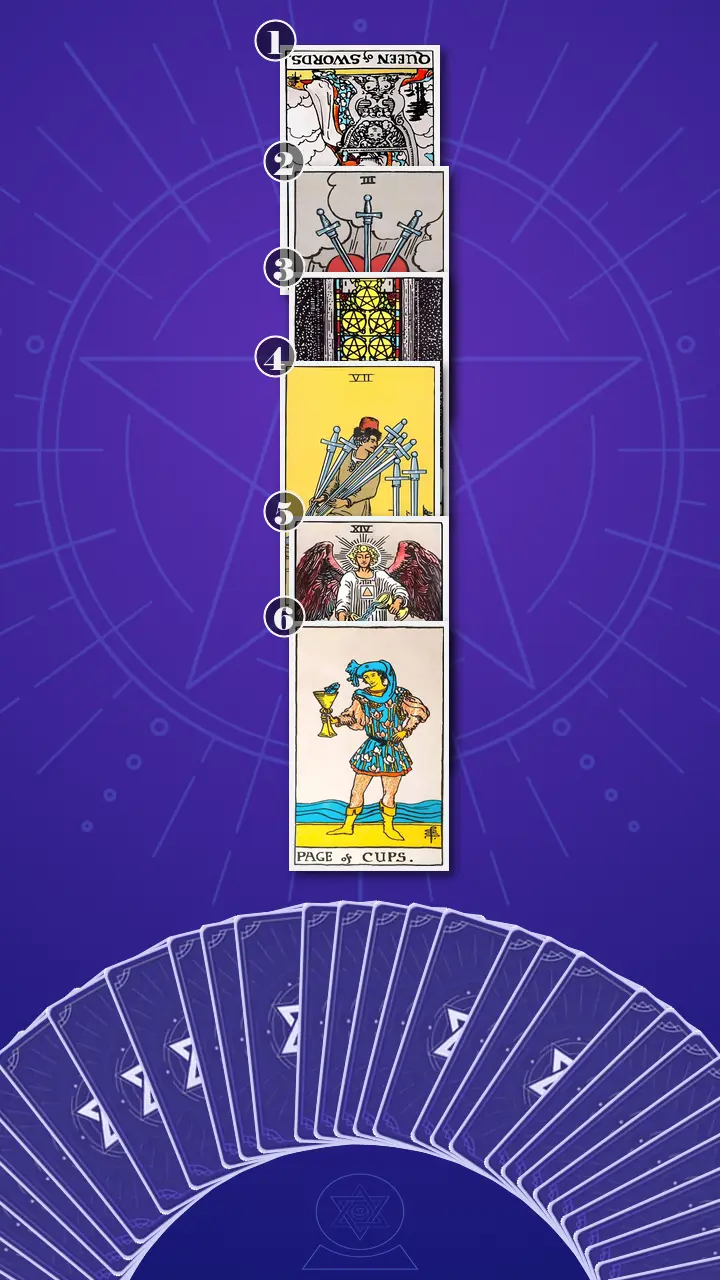
“Here’s what to watch for,” I added, giving Jordan—and you—structure before we went deep. “The first card shows your current ‘door slam’ pattern. The third card is the childhood replay: the old ‘outside the warmth’ feeling the trigger hooks into. And the fifth card is the transformation lever: the exact inner shift that changes the pattern without asking you to tolerate harm.”
Reading the Ladder: The Reflex, the Spark, the Old Cold
Position 1: The current “door slam” pattern
“Now we’re turning over the card that represents the current ‘door slam’ pattern: the observable behavior and boundary style you default to when triggered,” I said.
The Queen of Swords, reversed.
The first thing I noticed was the posture: turned slightly away. The sword held upright like a verdict. In reverse, that discernment can harden into defensiveness—clarity turning into coldness.
And the modern-life scenario landed with almost no translation needed. “You’re a UX designer who can articulate circles around people at work—so when someone in your personal life gets vague or dismissive, your brain snaps into ‘case closed.’ You craft the cleanest exit text, delete the thread, maybe even remove them from socials, and call it boundaries. It feels controlled for an hour, then the loneliness hits: you didn’t just set a limit—you emotionally quarantined yourself.”
Jordan gave me exactly the reaction I expect when a card hits the bullseye: a quiet laugh that wasn’t amusement so much as recognition with teeth. They exhaled sharply through their nose, eyes flicking down to their hands like they’d just realized they were gripping an invisible steering wheel.
“That’s… brutal,” they said. “Accurate. But brutal.”
I nodded. “Blocking can be a tool. It doesn’t have to be your personality.”
I framed the reversed Queen as an energy dynamic: not “bad,” but blocked and overcorrecting. “This card doesn’t say you lack boundaries,” I told them. “It says your boundary system is acting like an emergency shutdown button. Effective in a crisis. Expensive as a default.”
Then I leaned into the question the position demands: “What are you trying to stop yourself from feeling in the exact second you go for Block?”
Jordan didn’t answer immediately. Their jaw worked once, like they were chewing a word they didn’t want to swallow.
Position 2: The immediate trigger
“Now we’re turning over the card that represents the immediate trigger: what specifically pierces you and flips the switch into shutdown,” I said.
Three of Swords, upright.
In the Rider–Waite image, it’s almost too literal: a heart pierced, rain pouring down. In real life, it’s that one line that becomes proof in ten seconds.
“A friend or partner says, casually, ‘You’re overreacting,’ or replies with ‘k.,’” I said, using the modern scenario exactly as it shows up for them. “It’s not the words alone—it’s how your chest braces and your jaw tightens, like your body already knows what comes next: being minimized.”
I slowed it down into a micro-timeline—ten seconds, because that’s often all it takes for the nervous system to decide it’s an emergency.
“You read it. Your throat tightens. Your chest braces. Your hands get that twitchy reach for the phone. And then the meaning-making hits: ‘I’m the problem. I’m not wanted. And staying will only make it worse.’ The sting isn’t proof. It’s a signal.”
Jordan’s gaze went slightly unfocused—the way people look when they’re replaying a memory, not watching the room. They swallowed, and their shoulders rose a millimeter, then dropped. A tiny, involuntary flinch—the body remembering the moment before the mind wants to admit it matters.
“It’s the tone,” they said quietly. “Not even the words. That little… dismissive vibe. I’m fine until I’m not.”
Position 3: The childhood replay
“Now we’re turning over the card that represents the childhood replay: the old emotional template this trigger is hooking into,” I said. “And I want to be careful here: tarot doesn’t give me a CCTV recording of your childhood. What it can show is the shape of the old feeling.”
Five of Pentacles, upright.
The image is winter. Two figures outside. Warmth visible through stained glass—but not accessible. And right away, the whole ladder made emotional sense: all that Air in the Swords cards at the top—fast verdicts, sharp exits—protecting an Earth wound underneath: exclusion, scarcity of support.
“The trigger under the trigger is exclusion,” I said, matching the modern translation. “When someone pulls away, cancels, or acts like your feelings are inconvenient, it hits an older place: the part of you that learned comfort isn’t available on demand.”
I used the echo technique like a cut-scene: “It’s like standing outside a lit window in winter—laughing and warmth on the other side—then smash-cut to now: seeing friends’ plans on IG Stories, being left on read, watching Slack go quiet after you speak up. The body doesn’t file these separately. It just knows the feeling: ‘I’m outside again.’”
Jordan’s reaction came in a three-step chain, almost textbook: first a brief freeze—breath held, eyes wide for half a second. Then cognitive seep—eyes drifting down, like their brain was scrolling through old moments. Then emotional release: a small, throat-tight “oh.” Not loud. But real.
“So when you ‘door slam,’” I continued carefully, “it isn’t about power. It’s an attempt to reverse an old role—going from the one left outside to the one who controls the door.”
Jordan’s fingers, which had been tapping their phone, went still. “Yeah,” they whispered. “If I’m outside again, I’ll make it my choice.”
Position 4: The protection move
“Now we’re turning over the card that represents the protection move: what you do to regain control and reduce exposure in the moment,” I said.
Seven of Swords, upright.
This is the stealth card. Strategy. Leaving without being seen leaving. In modern life, it’s the quiet exit montage: turning off read receipts, removing someone from Close Friends, leaving a group chat, soft-blocking, deleting the thread so you can’t re-open it.
“Instead of naming what hurt, you exit strategically,” I said, using the provided scenario. “You carry the vulnerable truth alone because you don’t trust the other person won’t twist it. It’s protection through disappearing—less exposure, more control.”
Jordan gave me a knowing wince that looked like a smile’s reluctant cousin. “If I leave quietly,” they said, “nobody can debate me.”
“Exactly,” I replied. “And I’m not here to call that ‘bad.’ I’m here to call it effective—and also costly.”
Then I said it in the plain loop the cards were building: “Trigger → cutoff → relief → loneliness → stronger belief that closeness isn’t safe. That’s how a door-slam reflex in relationships becomes self-reinforcing.”
When Temperance Spoke: The Middle Pour for a Boundary That Can Be Heard
Position 5: The transformation lever
I held the next card for a beat before turning it. The room felt quieter—not mystical, just attentive, like when a studio goes silent right before a live mic opens.
“Now we’re turning over the card that represents the transformation lever: the specific inner shift that changes the pattern without violating self-respect,” I said.
Temperance, upright.
In the image, an angel pours water between two cups. One foot on land, one in water. A sunrise on the horizon. The whole card is pacing.
I anchored it in their real life immediately: “Right before you slam the door, you choose regulation. You don’t ignore the sting, but you don’t finalize the story either. You send a measured message that includes one human truth and one clear limit—enough to protect you without erasing the relationship.”
Temperance energy is balance—not a compromise of your needs, but a moderation of intensity so the message becomes deliverable.
And because I’m Alison Melody—because my whole career has been built on sound, pacing, and nervous systems—I brought in my signature lens.
“Let me use my Music Pulse Diagnosis for a second,” I said. “When this happens—when you’re about to block—what have you been listening to lately? Not what you like in general. What you’ve been looping at midnight.”
Jordan blinked. “Uh. A lot of… sharp stuff. Fast. Like… angry-pop, high BPM.”
“That tracks,” I said softly. “Your nervous system is already in a fast attack. Then a dismissive tone lands, and the Queen of Swords wants to end the song by smashing the speaker. Temperance is the audio mixer. It doesn’t mute your truth. It turns the gain down so you can actually hear what you feel—and choose what you do next.”
The Aha Moment (setup)
I watched Jordan’s hand drift toward their phone again as if on autopilot. “You know that moment,” I said, “the typing bubble stops, your throat tightens, and your hand is already hovering over Block like it’s a fire escape.”
The Aha Moment (delivery)
Not a door slam—choose the middle pour: blend honesty with pacing, like Temperance’s cups, and let your boundary be a measured message instead of a final verdict.
I let the sentence hang for a breath, the way you let a chord resolve before you talk over it.
The Aha Moment (reinforcement)
Jordan’s reaction came in layers. First: a stillness, like their whole body paused on a buffering screen—eyes fixed, breath shallow. Second: their brow creased, not in disagreement, but in effort, as if they were trying to imagine a reality where a boundary could be real without being violent to the connection. Third: their shoulders sank a fraction, and their mouth opened on a tiny, shaky exhale.
“But if I don’t slam it,” they said, and there was skepticism mixed with something softer, “does it still count? Like… won’t they just talk me out of it?”
I didn’t rush to reassure them. I respected the fear. “That’s the Five of Pentacles talking,” I said. “The part that learned warmth isn’t reliably available. Temperance isn’t ‘be nicer.’ It’s ‘be paced.’ It’s the difference between a boundary and a verdict.”
Then I gave them the concrete reinforcement exactly as practice, not performance. “Set a 60-second timer,” I said. “Put your phone face-down. Name in Notes: (1) what stung in one plain sentence—‘That sounded dismissive.’ (2) what you’re doing next in one plain sentence—‘I’m taking tonight; we can talk tomorrow.’ If your body spikes—tight jaw, racing hands—you can stop early. This is a choice, not a test.”
I tapped the table lightly, like keeping time. “After the timer, you decide. You can send the two-line message, or keep it as a draft and revisit in 20 minutes.”
And because sound is my lane, I added my second signature tool—the Breath Soundtrack. “If counting breaths feels fake, we can make it physical. Four cycles at about 60 BPM: inhale for four beats, exhale for four beats. Slow enough to downshift, not so slow it feels like you’re forcing calm.”
Jordan’s eyes went glossy—not tears, exactly. More like the edge of them. “It’s weird,” they said. “That feels… doable. And also scary. Like if I try this, I can’t pretend it was ‘just’ self-respect. It means I actually want repair.”
“Yeah,” I said, quietly. “That’s the brave part.”
I named the semantic shift out loud, so the map would stick: “This isn’t only about one decision. It’s moving from reflexive door-slamming and emotional quarantine to paced, self-respecting boundaries that leave room for a real-time response. Present moment over past script. That’s the pivot.”
Position 6: One step
“Now we’re turning over the card that represents one step: the smallest next action you can take this week to interrupt the replay,” I said.
Page of Cups, upright.
The Page holds out a cup with a fish—an awkward, surprising little truth popping up where you didn’t plan it. This isn’t a grand confrontation. It’s a small, sincere emotional bid.
“Your one step isn’t a long closure essay,” I said, using the modern scenario. “It’s a small, curious reach. Instead of disappearing, you send one gentle line that keeps the door slightly open while you assess safety: ‘That stung—what did you mean?’ or ‘I’m feeling dismissed; can we reset tomorrow?’”
Jordan sat back, then leaned forward again, like they were testing the distance between themselves and the idea. “But I don’t even have… bandwidth,” they said, and there it was—an action-stage obstacle, real and logistical. “If it happens at night, I’m already cooked. I can’t do a whole ‘process.’”
“Good,” I said, matter-of-fact. “Then we don’t do a process. We do a minute. If you’re flooded, don’t decide. That’s the whole rule.”
The Latch-Not-Slam Protocol: Actionable Next Steps for the Next 48 Hours
I summarized what the ladder showed in one clean story, so Jordan could carry it out of the room without needing to reread it like a case file.
“Here’s your pattern,” I said. “The Queen of Swords reversed is the visible move: you protect yourself with a verdict—clean exit, cold tone, block/mute. The Three of Swords is the spark: one line lands like proof and your body braces. The Five of Pentacles is the old template underneath: the fear of being outside warmth, minimized, unsupported. The Seven of Swords is the coping strategy: vanish so nobody can debate your reality. Temperance is the lever: pacing—mixing truth and boundary so the present person gets a chance to respond. And Page of Cups is the one step: a small, sincere message that keeps choice alive.”
Then I named the blind spot gently but directly. “Your cognitive blind spot is that you’ve been treating intensity as evidence,” I said. “Because it feels so sharp, you assume it must be fully accurate. But intensity is often a nervous system echo. The transformation direction is the key shift: from instant cutoff to a 60-second pause where you name the trigger and choose a boundary that matches the present moment, not the past.”
“Let’s turn that into something you can actually do when your thumb is hovering over Block,” I said. “Not forever. Once this week. That’s enough to build new evidence.”
- 60-Second Middle Pour PauseWhen you feel the spike (tight jaw/throat, chest bracing, hands reaching for the phone), set a 60-second timer. Put your phone face-down. Do four breath cycles (inhale 4 beats, exhale 4 beats). In Notes, write: “That stung because ___.” Then: “What I want next is ___ (space/clarification/closure).”If you feel yourself arguing with the exercise (“this is cringe”), do the 20-second version. The win is the pause, not perfect calm.
- Two-Line Temperance Text (Impact + Time-Bound Limit)Draft (in Notes first): Line 1: “That landed as dismissive / That stung.” Line 2: “I’m taking tonight; we can talk tomorrow.” Send it only after the pause—so it’s a boundary, not a slam.Expect the fear: “If I say it softly, it won’t count.” It counts. You’re not solving the relationship—you’re reality-testing for 24 hours.
- Page-of-Cups Clarifying QuestionInstead of a verdict text (“I’m done”) or silence, send one curious line: “Can you tell me what you meant by that?” or “I might be reading this wrong—are you upset with me?” Then wait. Let their response be data before you decide what kind of door this becomes.If waiting spikes your anxiety, use my White Noise First Aid: put on steady rain/white noise for 10 minutes while you wait, so your body isn’t free-falling in silence.
Before we wrapped, I offered a small add-on from my toolkit—not as a magic fix, but as support for the body that’s doing the bracing.
“If you want,” I said, “I can give you a BGM Prescription: three tracks for three moments—one for the spike, one for the draft, one for sleep. Nothing fancy. Just cues your nervous system can recognize.”
Jordan exhaled again, this time with less bite. “Honestly,” they said, “having something to put on—so the silence doesn’t swallow me—would help.”

A Week Later: Ownership, Not Certainty
Five days later, Jordan texted me a screenshot. Not of a “case file” of receipts—something new.
It was a two-line message in their Notes app, time-stamped 10:57 PM. They’d written it, waited twenty minutes, then sent it. The response they got back wasn’t perfect—there was awkwardness, a missed beat, a little defensiveness from the other person—but it wasn’t dismissal. It was effort.
Jordan’s follow-up message to me was short: “I didn’t slam it. I left it on a latch. I still felt shaky after, but I didn’t feel hollow.”
In my mind, I saw the shift as sound: the same truth, but with the volume set so it could be heard. A boundary that didn’t require emotional quarantine. A door that could close gently—by choice, not by panic.
Their bittersweet proof was small and real: they slept a full night, then woke up and their first thought was still, “What if I was wrong?”—but this time, they noticed the thought, put on steady rain noise for ten minutes, and didn’t reach for Block like it was oxygen.
And I keep thinking about this, for Jordan and for anyone who recognizes themselves here: when you slam the door fast, it’s often because some older part of you is sure that if you stay one more minute, you’ll be minimized—and that would feel like being left outside all over again.
If you gave yourself just 60 seconds before the cutoff next time, what’s the one sentence you’d want to be true—about what you felt and what you need—before you decide what kind of door this becomes?
This story is adapted from psychological research, written so that those in a similar struggle can see their own pattern in it — and find their next step clearly.These insights are not a substitute for professional psychological, medical, legal, or financial advice.
Learn more about our Journey to Clarity.
How did this insight land for you?
🫂 This Resonates Deeply
🌀 Living This Story
✨ Now I See Clearly
🌱 Seeing New Possibilities
🧰 Useful Framework
🔮 The Confirmation I Needed
💪 Feeling Empowered
🚀 Ready for My Next Step
Author Profile
 AI
AI“Through ten years of sound energy research, I’ve found that when we struggle, it's usually just our internal rhythm falling out of sync under pressure. I know firsthand the frustrating helplessness of wanting to move forward but feeling paralyzed. Without overwhelming theories, I want to be the soothing background track that helps you recalibrate, turning your heavy burdens back into a light, effortless, and harmonious melody.”
In this Introspection Tarot Reading :
Core Expertise
- Mental Noise Cancellation: Diagnosing severe internal friction not as a moral failing, but as a chaotic overlapping of incompatible psychological frequencies.
- Resonance Healing Calibration: Identifying the 'dissonant baseline' of your chronic anxiety and calculating the specific acoustic or rhythmic input needed to soothe it.
Service Features
- The Frequency Reset Pause: A customized rhythmic breathing or acoustic grounding technique to forcefully lower your brainwave state from a frantic beta frequency to a restorative alpha state.
Also specializes in :
Explore Related Patterns:
Boundary DiscernmentJordan's fear is precise: "If I don't slam it, does it still count?" That question shows the boundary confusion the story is working to recalibrate, because the old system equates force with legitimacy. Boundary Discernment is the shift from "a real boundary must be final" to "a real boundary can be paced, specific, and reversible while I gather data." You protect self-respect without making emotional quarantine the only proof that you meant it.
Emotional CutoffJordan's thumb hovering over Block at 11:42 p.m., after deleting a more vulnerable paragraph and replacing it with "I'm done," is the visible hinge of Emotional Cutoff. The move lowers exposure fast: no argument, no waiting, no chance for the other person to minimize the hurt again. The pattern becomes costly because the shutdown is used before the present interaction has been tested. You get the short relief of control, then the emptiness Jordan names an hour later; the nervous system learns that closeness equals danger, and the door slam starts to feel like self-respect even when it is also emotional quarantine.
Reactive OvercorrectionJordan's boundary system is described as an emergency shutdown button: clean exit, cold tone, block or mute, thread deleted. The original function is protection, but the response overshoots the actual moment and turns a boundary into a verdict. Reactive Overcorrection fits because the psyche is trying to reverse an older role. If being outside once felt unbearable, controlling the door now feels safer; the cost is that repair gets treated like danger before anyone has a chance to respond.
Rejection SensitivityThe casual "you're overreacting," the lone "k.," and the typing bubble stopping all land in Jordan's body before they become thoughts: throat tight, jaw locked, chest braced. That sequence makes Rejection Sensitivity a strong fit, because neutral or ambiguous signals are being scanned for proof of dismissal. The childhood-shaped replay is the "outside the warmth" feeling: being left on read, seeing plans on IG Stories, or watching Slack go quiet all collapse into "I'm outside again." You are not being asked to distrust your hurt; the audit point is that the old exclusion template can make the present cue feel more final than it is.
Emotional RegulationTemperance enters exactly when Jordan's hand is drifting toward the phone on autopilot. The one-minute pause, phone face-down, four paced breath cycles, and Notes draft are not about suppressing the sting; they slow the nervous system enough for choice to come back online. That is Emotional Regulation in a practical form. You name the hurt without finalizing the whole story, then choose a boundary that matches the present moment rather than the old script.
Assertive CommunicationThe proposed two-line text, "That landed as dismissive" and "I'm taking tonight; we can talk tomorrow," gives Jordan a language bridge between silence and a verdict. It names impact, sets a time-bound limit, and does not hand the other person control over the whole reality of what happened. Assertive Communication fits because the repair attempt is small enough to use while activated. You are not writing a closure essay or asking permission to feel hurt; you are making one clear bid that lets the other person's response become data before you decide what kind of door this becomes.
Emotional ReasoningJordan names the blind spot directly when the reading says they have been treating intensity as evidence. The pain is sharp, so the mind converts it into a full story: "I'm the problem, I'm not wanted, staying will only make it worse." That is Emotional Reasoning: the body spike becomes the courtroom, the verdict, and the sentence. You still get to respect the sting, but the pattern shifts when you stop letting the intensity alone decide whether the door should close.
Explore Related Struggles:
Boundary RigidityJordan keeps reaching for the same emergency lever: block, mute, delete, leave, disappear. Each move can look clean from the outside, but inside the story it becomes a verdict before the other person has a chance to clarify, repair, or show whether they can meet the boundary. Boundary Rigidity names the moment when protection loses flexibility. You still have a real limit, and the hurt still deserves respect, but the system has only one setting when it detects dismissal. The door does not close after assessment; it slams as the assessment. The one-step pivot matters because it does not ask You to tolerate harm. It asks for pacing: one sentence naming the sting, one time-bound limit, and enough space to let the present person respond before the old outside-the-warmth script turns every ambiguous cue into an exit sign.
Connection-Defense FusionJordan's pattern has a clear loop: dismissal cue, cutoff, relief, loneliness, then a stronger belief that closeness is not safe. The exit reduces exposure fast, but the hollow aftermath becomes fresh evidence for the same old story that warmth cannot be counted on. Connection-Defense Fusion names that locked system. The move meant to protect You from being minimized also becomes the move that deprives You of repair, response, and new evidence. Defense and connection are no longer separate choices; they are tangled into one reflex. This is why the latch, not slam, experiment matters. A small message does not force reconciliation, and it does not surrender the boundary. It gives You a narrow path where protection can stay intact without making isolation the only proof that You respected yourself.
Outsider Identity LockJordan's own sentence carries the imprint: If I'm outside again, I'll make it my choice. The present conflict is not only about one text or one dismissive tone; it reactivates the position of standing outside warmth and trying to reclaim control by becoming the person who shuts the door first. Outsider Identity Lock fits because the story shows repeated cues being filed into the same emotional geography: left on read, seeing plans online, Slack going quiet after speaking up, a partner's flat k. You are not just reacting to a message; You are being pulled into a familiar location where belonging feels visible but unreachable. The lock loosens when the old role is seen as a role, not a destiny. A paced boundary lets You remain the author of your next move without having to prove your power through disappearance.
Pain-Logic FusionA short reply, a flat tone, or the phrase you're overreacting lands in Jordan's body before it becomes a conversation. The jaw tightens, the throat braces, the hand moves toward the phone, and within seconds the sting has become a conclusion: I am not wanted, and staying will make this worse. Pain-Logic Fusion is the story's central mechanism because the feeling is not treated as information; it is treated as the verdict. You are not wrong for registering impact, but the intensity of the impact starts doing the work of interpretation before the present facts have been checked. The childhood replay sharpens that fusion. Being left outside the warmth taught the body to read minimization fast, so a present-day pause can feel dangerous rather than reasonable. The 60-second step interrupts the fusion long enough for You to separate what stung from what is actually known.
Security-Connection SplitJordan's thumb hovering over Block captures the whole split: the body wants immediate safety, while another part still wants the relationship to stay reachable long enough for repair. The cutoff is not framed as random drama; it arrives the second dismissal seems to enter the room, when staying feels like exposure and leaving feels like self-respect. That is why Security-Connection Split fits the story. You are not simply choosing between contact and distance; you are trying to protect dignity inside a relationship that still matters. The emptiness that arrives an hour later is the evidence that the exit solved one problem while intensifying another. The childhood trigger gives the split its shape. Feeling outside the warmth makes connection feel conditional and risky, so control becomes a substitute for safety. One measured pause gives You a chance to ask whether the present moment is truly unsafe, or whether an old exclusion map has taken over the steering wheel.
Explore Related Emotions:
Cautious VulnerabilityThe Page of Cups step is deliberately modest: one gentle line, one clarifying question, one small bid instead of a closure essay. Jordan is not asked to throw the door open; they are asked to leave it on a latch while they assess what is actually safe. Cautious Vulnerability is the feeling of offering a true sentence without giving away the whole room. You let the other person know that something stung, while still keeping time, space, and the option to step back. The openness is real, but it has structure around it. This matters because Jordan's fear is that softness will make the boundary disappear. The story answers with a different model: a boundary can be paced, brief, and human without becoming weak.
Defensive LonelinessJordan deletes the thread, removes the person from socials, and calls the clean exit a boundary. The move is precise, almost elegant, but the story names the cost: they did not only set a limit; they emotionally quarantined themselves. Defensive Loneliness lives in that contradiction. You are trying to prevent a familiar sting, but the protection method also removes the contact that could have given you repair, clarification, or proof that the present moment is different from the old one. The room becomes quiet because you made it quiet, and that can feel both safer and painfully empty. This emotion matters for the question because the door slam is not framed as cruelty or drama. It is a loneliness-management strategy that works too fast, closing the door before your need to be understood can speak.
Guarded LongingJordan's most revealing line is not the threat to block; it is the admission that trying the measured step would mean they actually want repair. The wish is there, but it arrives guarded, wrapped in skepticism about whether a softer boundary will still count. Guarded Longing names the tender pull toward connection that has learned to wear armor. You want to be met, understood, and taken seriously, but wanting that openly creates exposure. A hard cutoff feels cleaner because it hides the desire before anyone can mishandle it. This feeling gives the door-slam pattern its emotional complexity. The slam is not only about leaving; it is also about not having to stand in the vulnerable space of wanting someone to stay, listen, and respond well.
Hard-Won ComposureJordan's practice is small: put the phone face-down, set a 60-second timer, name what stung, and decide whether to send a two-line message. Nothing in the story suggests instant serenity; the body is still spiking, the hands are still restless, and the old route is still available. Hard-Won Composure fits because the steadiness is built under pressure. You are not erasing the hurt or forcing yourself to be agreeable. You are creating just enough pacing for your boundary to become deliverable instead of explosive. That composure is the transformation lever because it keeps self-respect attached to choice. The message can still be firm, but it no longer has to become a final verdict before the present person has had a chance to respond.
Hollow ControlJordan names the loop clearly: the cutoff feels like protecting peace, but an hour later it is not peace, just empty. Holding the phone like a shield creates a clean edge around the moment, yet that edge also removes the possibility of being understood in real time. Hollow Control fits because the action gives immediate command while quietly draining the emotional room. You get the sharp relief of not being reachable, not being argued with, not having to explain the vulnerable part. Then the silence starts to feel less like safety and more like an evacuated space. The story keeps showing that control is not the same as steadiness. The one-step pivot matters because it lets you keep a limit without using total disappearance as the only way to feel protected.
Inner Child AcheThe childhood-shaped image in the reading is not a literal recording; it is the shape of a feeling. Jordan is standing outside a lit window in winter, seeing warmth nearby but not being able to access it, and that same shape reappears in being left on read, watching friends' plans on IG Stories, or feeling a room go quiet after speaking up. Inner Child Ache captures the old tenderness underneath the sharp exit. You are not only reacting to one dismissive tone; you are touching a younger template where comfort felt conditional, delayed, or unavailable when you needed it. That makes the present moment land with more force than the surface facts can explain. The ache is important because it reveals what the door slam is protecting. It is trying to move you from the one left outside to the one who controls the door, even when a smaller and more current boundary might protect you without replaying the same cold room.
Rejection ChillJordan's thumb hovers over Block in the cold light of the phone while their jaw locks, throat tightens, and body braces before any clear decision has been made. The trigger is not only the words on the screen; it is the physical snap of being treated as if their feeling is too much, too inconvenient, or too easy to dismiss. That instant coldness carries the signature of Rejection Chill. You are not simply deciding whether to reply; you are feeling the body translate a small cue into a threat of being pushed outside the warmth again. The emotion shows up as a sudden internal drop in temperature, where contact becomes unsafe before the present person has had a chance to clarify. The useful audit is that the chill is a signal, not a verdict. It points to the exact moment where your system needs a pause long enough to separate a real boundary from an old reflex that believes rejection has already happened.
Relational Catastrophe DreadJordan describes how a casual 'You're overreacting' or a flat 'k.' can become proof within seconds. The throat tightens, the chest braces, and the mind writes the whole ending at once: I am the problem, I am not wanted, and staying will only make it worse. Relational Catastrophe Dread is the feeling of a relationship collapsing inside your body before the situation has actually finished unfolding. You are not just hurt by a message; you are thrown into a fast forecast where every possible next step seems to confirm dismissal. The one-step pause directly interrupts this weather. It gives the present moment a narrow but real chance to produce data before the old script turns a painful cue into a final verdict.
Grounded AgencyJordan still wakes up with the thought, 'What if I was wrong?' The difference is that they notice it, put on steady rain noise, and do not reach for Block like it is oxygen. Grounded Agency is the feeling of having a choice point again while uncertainty is still present. You do not need perfect confidence before acting differently; you need enough contact with yourself to name the trigger, choose a limit, and let the present moment give you information. This is the cleanest form of ownership in the story. The old reflex does not vanish, but it stops being the only available route, and that gives you a more accurate relationship with your own power.
Explore Related Contexts:
Digital No Contact BoundaryJordan's thumb is hovering over Block at 11:42 p.m., with the phone acting less like a communication tool and more like a control panel for immediate disappearance. The concrete actions are all digital exits: delete the thread, remove them from socials, turn off read receipts, leave the group chat, soft-block before the vulnerable truth has to be spoken. That makes Digital No Contact Boundary the clearest external stage in the story. The relationship tension is being managed through platform tools that can protect space quickly, but they also make a final cutoff available before the present interaction has been tested. You are not just choosing whether to reply; you are navigating a digital boundary system where one tap can turn a moment of dismissal into total relational shutdown. The structural pressure is that modern intimacy now runs through devices built for instant access and instant removal. Jordan's next step is not to abandon boundaries, but to slow the boundary down enough to separate a self-respecting limit from an emergency no-contact reflex.
Relationship Boundary NegotiationJordan is not being asked to tolerate the dismissive line or pretend the sting did not happen. The story's practical hinge is the two-line message: name the impact, take the night, and leave a time-bound opening for tomorrow instead of turning the whole relationship into a verdict. That is why Relationship Boundary Negotiation fits the case so closely. The conflict is not whether Jordan deserves boundaries; it is whether the boundary can be delivered in a way that preserves choice, information, and self-respect. You are watching the shift from a closed-case exit to a live negotiation of pace, impact, and repair. The follow-up screenshot matters because the other person's response is awkward but effortful, which gives Jordan real data. The external stage becomes a relationship boundary being tested in real time, where the next move is measured enough to protect the self without erasing the possibility of being understood.
Soft ExclusionJordan names the old feeling through images of being outside warmth: friends' plans visible on IG Stories, a message left on read, Slack going quiet after they speak up. None of these are a dramatic public rejection, but they all put Jordan at the edge of the room, able to see connection without being sure they are included in it. Soft Exclusion captures that external pressure better than a generic relationship issue. The trigger is carried by low-volume social signals: delayed replies, casual minimization, quiet withdrawal, and visible social warmth happening somewhere else. You are dealing with an environment where belonging is not openly denied, but it is also not reliably confirmed. That matters for the door slam because the cutoff becomes a way to stop waiting at the edge. The one-step intervention gives Jordan a different option: ask for clarification before treating ambiguous exclusion cues as final evidence that the door has already closed.
Direct Communication TrialJordan's one step is deliberately small: 'That stung, what did you mean?' or 'I'm feeling dismissed; can we reset tomorrow?' It is not a demand for instant repair, and it is not the polished closure paragraph they delete before sending 'I'm done.' Direct Communication Trial captures the live experiment the story is asking Jordan to run. The external situation is a relationship moment where the next contact has to be clear enough to protect the boundary and soft enough to gather information. You are testing whether directness can exist without becoming a courtroom argument or a total exit. The trial succeeds in a modest, realistic way: the response is not perfect, but it contains effort. That gives Jordan a new piece of evidence, which is exactly what the one-step question needs: a way to interrupt the replay without surrendering self-respect.
Post-Conflict Cooling OffJordan's concrete assignment is built around delay: set a 60-second timer, put the phone face-down, draft in Notes, then decide after the spike has had time to pass. Later, they write the message at 10:57 p.m., wait twenty minutes, and send it only after the boundary has stopped being a reflexive strike. Post-Conflict Cooling Off is the external container that makes the one-step answer workable. It gives the conflict a holding period between impact and decision, so the first wave of intensity does not automatically control the relationship outcome. You still get to protect space, but the decision is made from a steadier position. The story's phrase 'latch, not slam' is the key: the door can remain under your control without becoming a permanent shutdown in the first ten seconds. The cooling-off interval turns a digital confrontation into a paced decision window.
Digital Intimacy Boundary ConfusionJordan's phone carries both the hurt and the escape route. The same screen holds the dismissive text, the drafted repair message, the Block button, the deleted thread, and the possibility of asking, 'What did you mean?' Digital Intimacy Boundary Confusion names the structural bind created by that setup. Modern closeness is routed through tools that make access feel intimate and removal feel immediate, so a boundary can look almost identical to disappearance. You are trying to protect yourself inside an interface that turns relational ambiguity into a series of high-stakes buttons. The story's clarity comes from separating the function of each move. Blocking can be a valid tool, but in this case Jordan is learning to test whether the present situation calls for no contact, a pause, or a measured message that still keeps choice alive.