The 8:47 p.m. Birthday Badge
You’re a late-20s city professional who can ship complex design work all day, but a single birthday reminder turns you into a full-time analyst of tone, timing, and “what this means”—classic texting paralysis.
Jordan said it like she was confessing to a glitch in an otherwise solid system. She’s 28, a UX designer at a fast-paced Toronto tech company, the kind of person who can anticipate edge cases before anyone else even sees the feature request. But when a birthday notification brings one specific person back into her head, her skill turns on her.
She described Tuesday, 8:47 p.m., on her couch in a tiny downtown apartment: the CN Tower a faint glow through the blinds, radiator clicking like it’s keeping time, her phone lighting her face that familiar aquarium-blue. A birthday reminder pops up. She opens Messages, types “Happy birthday!” deletes it, opens Instagram to see if they posted anything, then comes back to Messages like she’s checking a dashboard. Her chest tightens and she realizes she’s been holding her breath—wanting to reach out, terrified that a “seen” with no reply will ruin the whole night.
“I hate that I care this much,” she said, voice flat in the way people get when they’re trying to sound chill while their body is doing something else. “If I text first, I’m basically handing them power. And if they don’t respond… it’s going to ruin my day.”
I watched her shoulders sit a fraction too high, like she was bracing for impact while staying perfectly still. That’s the exact posture of dread: not loud panic, but a quiet, clenched freeze—like standing at a closed door with your hand on the handle, trying to predict what’s on the other side before you turn it.
“This isn’t you being ‘dramatic’—it’s attachment fear trying to negotiate safety with a draft,” I told her. “And we can work with it. Let’s make this a Journey to Clarity—something practical: what’s happening in your nervous system, what’s happening in your meaning-making, and what your next step can be without needing certainty.”

Choosing the Compass: How Tarot Works in a Tight Trigger Loop
I asked Jordan to put both feet on the floor and take one slower exhale than felt natural—nothing mystical, just a clean transition from the “phone glow spiral” into a room where we could actually think. While I shuffled, I told her to hold the question the way you’d hold a delicate object: not squeezing, not dropping it.
“For this, I’m using something I designed for moments exactly like yours: the Transformation Path Grid (6) · Context Edition,” I said.
And for you reading this, here’s why that matters: this isn’t a two-option decision (“text” vs “don’t text”). It’s a trigger-response loop—birthday reminder → attachment fear → freeze. Classic spreads like the Celtic Cross can be brilliant, but they add breadth. Jordan didn’t need breadth; she needed a map from symptom to root to action. This 6-card grid is the minimum structure that still shows the whole mechanism: what happens on your screen, what blocks you, what fear is underneath, what protective move you default to, the pivot that changes your stance, and one doable next step within a week.
In the grid, the top row reads left to right: (1) the surface freeze, (2) the main blockage, (3) the attachment root. Then we drop down to the bottom row: (4) the protective strategy, (5) the key shift, (6) the next step. It’s basically a before-and-after storyboard for a nervous system moment.
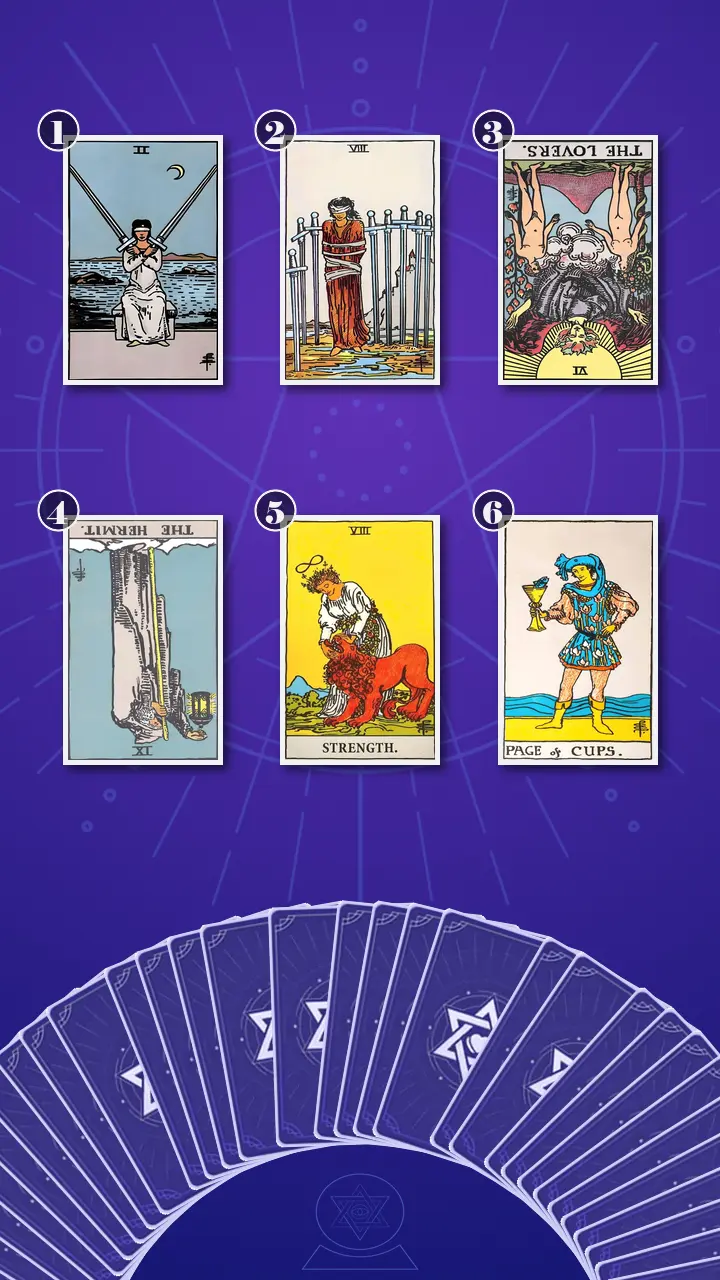
Reading the Grid: Finding Clarity Inside the Draft-and-Delete Loop
Position 1 — Surface freeze: what you do and feel when the reminder hits
“Now we turn over the card representing Surface freeze: what you do and feel in the moment the birthday reminder hits,” I said.
Two of Swords, upright.
I didn’t have to stretch for the modern meaning; Jordan’s life had already illustrated it. “This is you staring at the iMessage text box like it’s a high-stakes decision,” I said. “Drafting ‘Happy birthday!’ three different ways, deleting each one, keeping the thread open while you wait to calm down—except the waiting doesn’t calm you. It loads the message with more meaning.”
The Two of Swords is a stalemate—Air energy locked in place. It looks calm from the outside, but it’s tension dressed up as neutrality: crossed swords over the chest, a blindfold that says, don’t feel it, don’t move. In real life, that’s the held breath. The tight chest. The thumb hovering like the send arrow is a trapdoor.
Jordan made an unexpected sound—one short laugh, sharp at the edges. Then she went still. Then her eyes got watery like she was annoyed at her own body for reacting. “That’s… yeah,” she said. “It’s so accurate it’s kind of mean.”
I nodded. “Accurate can feel mean when it finally stops negotiating with your story. When the birthday reminder hits, what do you do in the first 60 seconds—what app do you open, what do you type, and where in your body do you feel the bracing start?”
Position 2 — Main blockage: what keeps you stuck in the freeze response
“Now we turn over the card representing Main blockage: what keeps you stuck in the freeze response,” I said.
Eight of Swords, upright.
I described it in a “screen recording” voice, because that’s how this card shows up in modern life: Messages → Notes → Instagram → back to Messages. Scroll. Check “active.” Re-read the last thread like it’s UX research. Then the inner monologue loops: too much… too cold… too eager… too late… wait for a sign.
“Your brain creates a rule maze,” I told her. “Don’t text first. Don’t be cringe. Don’t be too eager. Don’t be too late. And you keep checking signals—Story views, online status, mutual posts—like data that will justify the safest option. Until the only option left feels like doing nothing.”
Energetically, this is Air in excess: thinking that’s trying to prevent feeling. The Eight of Swords always looks like an external prison, but the fence has gaps. The blindfold is loose. The exit isn’t a perfect line—it’s reclaiming agency.
I let my voice get a little more direct, coach-style, because Jordan’s pattern was crisp enough to name. “Perfect wording is just outcome-control in a nicer outfit,” I said. “What’s the rule you’re obeying right now—like ‘I can’t text first’ or ‘I have to sound effortless’—and how does that rule shrink your options down to silence?”
Jordan’s jaw worked once, like she was chewing a thought she didn’t want to swallow. “The rule is… if I sound like I care, I’ll look stupid,” she said. “So I keep trying to write something that sounds like I don’t care.”
“And then,” I said gently, “you end up caring alone.”
Position 3 — Attachment root: the fear about closeness, rejection, belonging
“Now we turn over the card representing Attachment root: the underlying fear about closeness, rejection, or belonging that the reminder activates,” I said.
The Lovers, reversed.
“This is where the tiny moment becomes huge,” I told her. “The birthday reminder hits and suddenly this isn’t a text—it’s a values moment. Part of you wants genuine connection. Part of you is terrified that reaching out means you’ll be rejected, or pulled into something that doesn’t feel emotionally safe. You try to solve it with strategy, but what you actually need is alignment: what you’re offering, and what you’re not asking for.”
Reversed, The Lovers often shows misalignment—not because you’re bad at love, but because fear turns connection into performance. The mountain in the card becomes the distance you feel even when you’re one tap away. And the angel above? That’s the part of you that knows your values, even when your body is bracing.
Jordan’s eyes unfocused for a second, like she was watching a memory replay. “I treat the reply like… proof,” she admitted. “If they don’t respond, it means I don’t matter.”
“That,” I said, “is the attachment root: not ‘should I text?’ but ‘what would this prove about me if I’m ignored?’ If you’re brutally honest, what would being left on read ‘prove’ in your mind—and what does that threaten: belonging, dignity, safety?”
She swallowed. “Belonging,” she said, quietly. “Like I’m not really in the circle.”
Position 4 — Protective strategy: the move that feels safer than vulnerability
“Now we turn over the card representing Protective strategy: the self-protective move you default to that feels safer than vulnerability,” I said.
The Hermit, reversed.
“You go quiet and call it being chill,” I said. “Phone face down. You immerse yourself in work or scrolling. You tell yourself you’ll message when you’re ‘clear.’ But the clarity you’re waiting for is really invulnerability—and that never arrives—so isolation becomes the protective move that keeps the freeze alive.”
The Hermit is meant to be inner guidance. Reversed, it becomes hiding: hoarding certainty like a lantern held too close to your chest. In my work as a Jungian psychologist, I see this as the mind trying to complete an impossible task—achieve perfect safety in a relational moment. It’s like trying to design a product that will never get a negative review. The project scope is fantasy.
Jordan’s body answered before her words did: her shoulders rose, her breath caught, then she exhaled in a rush like she’d been underwater. “I do that,” she said. “I tell myself it’s self-care. But it’s… disappearing.”
“Exactly,” I said. “What do you do to feel safer than vulnerability—do you distract, overthink alone, go ‘professional’—and what does it cost you by the end of the day?”
When Strength Put a Hand on the Lion
I turned the next card slowly. The radiator in Jordan’s story felt like it got louder in my imagination—click, click—like the room itself was underlining the moment. “We’re flipping the pivot,” I said. “The one that changes the whole system.”
Position 5 — Key shift: the inner stance that turns fear into workable courage
“Now we turn over the card representing Key shift: the inner stance that turns fear into workable courage,” I said.
Strength, upright.
Setup: It’s 11:38 PM, you’re in bed with the phone glow inches from your face, re-reading old messages like they’re evidence, trying to find the one clue that makes texting feel safe. Your mind is doing future math: if I send this, then they might… and if they might, then I’ll feel… and I can’t afford that.
Delivery:
Not “I need to feel safe before I act,” but “I can act with care while I feel fear,” like Strength calmly closing the lion’s jaws without violence.
Reinforcement: Jordan’s reaction came in a three-beat chain. First: a physical freeze—her lips parted, and she stopped breathing for half a second like her body didn’t know whether to fight or run. Second: a cognitive ripple—her gaze slid off-camera, as if she was seeing every unsent draft lined up like unopened emails. Third: emotion, sharp and honest. Her eyebrows pulled together and she said, suddenly irritated, “But… doesn’t that mean I’ve been doing it wrong? Like I made it all bigger than it needed to be.”
I kept my voice steady. “It means you were trying to protect yourself with the tools you had,” I said. “Strength isn’t a verdict. It’s a different grip.”
Then I brought in my own diagnostic lens—because Strength is a body card as much as a mind card. “I want to name what I’m seeing in your energy,” I said, careful to keep it non-medical. “When the reminder hits, your shoulders climb toward your ears, your neck tightens, and you hold your breath. That’s your system saying: responsibility overload—like this one text is responsible for your worth. That’s not a character flaw. It’s a pattern.”
“On ships, when the sea changed, I’d watch travelers’ bodies do the same thing—chest tight, neck rigid—like the ocean was a test they had to pass,” I added, a small flashback from my years guiding people across long transoceanic nights. “In Venice, we don’t solve water by yelling at it. We restore circulation. That’s what Strength does. It regulates first, then it moves.”
I asked her the question Strength always asks when it’s done with bargaining: “If your only job was to protect your self-respect—not your ego—what would the smallest courageous action look like… even while the dread is still there?”
Jordan’s shoulders dropped a millimeter. “One line,” she said. “Just… a normal line.”
Position 6 — Next step: a small, values-aligned action without demanding certainty
“Now we turn over the card representing Next step: a small, concrete action that honors your values without demanding certainty,” I said.
Page of Cups, upright.
“This is your beginner’s mind,” I told her. “You send a simple birthday wish with no hidden agenda: ‘Happy birthday — hope you have a good one.’ No follow-up question, no bait, no over-explaining. Then you let the sent message be the completion of the task, even if your brain wants to keep checking for a response.”
The Page of Cups is Water moving again—emotion that circulates instead of stagnating. It’s not a five-paragraph essay with disclaimers. It’s the plain-text email. A low-stakes DM that’s not a hidden test—just a human moment.
Jordan exhaled, this time like she meant it. “That sounds relieving and terrifying,” she said.
“Perfect,” I replied. “That’s how we know it’s real. And here’s your permission line: Let your action be the win. Their response is extra credit.”
The Clean Text Protocol: Actionable Advice for the Next 48 Hours
I stitched the whole grid together for her—because tarot is most useful when it becomes a coherent story you can act on, not a vibe you admire. “Here’s the pattern,” I said. “The top row is Air overload: Two of Swords and Eight of Swords. You freeze, then you build a rule maze, and you treat ‘signals’ like data that can save you from feeling exposed. Underneath, The Lovers reversed makes the text a referendum on your worth instead of a values-based choice. Then The Hermit reversed tries to keep you safe by disappearing. Strength changes the operating system: regulate, hold fear gently, act anyway. Page of Cups makes it concrete: one clean line, no bargaining.”
“Your cognitive blind spot,” I continued, “is that you’ve been treating uncertainty like a problem to solve before you act. But in relationships, uncertainty is often just weather. Strength is you learning to walk in light rain without demanding a forecast.”
“Your transformation direction is exactly this,” I said, keeping it simple and direct: “move from outcome-control through perfect timing and wording to a simple, honest, values-aligned action. That’s how you go from dread-driven overanalysis and silent bracing to calm courage, self-respect, and clean communication without needing certainty.”
Then I gave Jordan a plan she could do on a Tuesday night—because insight without next steps is just another kind of avoidance.
- The 60-Second Strength ResetBefore you touch Instagram, put one hand on your chest. Inhale for 4, exhale for 6, for five rounds (about 60 seconds). Let your shoulders drop on the exhale—especially the neck/shoulder brace that shows up when this feels like a “worth test.”Tip: If your throat feels dry or your chest feels tight, that’s your “lion” waking up. You’re not fixing it—you’re containing it. Longer exhale = faster regulation.
- The 7-Minute Courage Timer (Strength-Then-Send)Set a literal 7-minute timer. Open the message thread and write ONE line you can stand behind: “Happy birthday — hope today’s good to you.” When the timer ends, you hit send, even if the line feels a little plain.Tip: Save three “Clean Text” templates in Notes (formal / friendly / warm). When triggered, pick one and only add their name. Two drafts max.
- The No-Hidden-Question Boundary (plus 30-minute no-check)Send the birthday message with no follow-up question that secretly means “reassure me right now.” After sending, set a 30-minute boundary: no checking their active status, no Story-viewing as data, no rereading the thread.Tip: If the urge spikes, do a “commute meditation” version: stand up, walk to the sink, feel your feet on the floor, take one slow exhale. Circulation over stagnation—Venetian Aqua Wisdom.
Jordan blinked at the list the way people blink when something is both obvious and brand-new. “So the task is… sending,” she said, “not getting the reply.”
“Exactly,” I told her. “A clean message isn’t a bid for rescue—it’s a choice you can respect.”

A Week Later: Ownership, Not Certainty
Six days later, Jordan messaged me—not with a long analysis, not with a screenshot spiral. Just: “Did the 7-minute timer. Sent: ‘Happy birthday — hope today’s good to you.’ Didn’t add anything. Put my phone down and made tea. My hands were shaky for like two minutes, then it passed.”
She added, “They replied ‘Thanks!’ like… a normal person. And even if they hadn’t, I think I’d still respect that I didn’t disappear.”
Her proof wasn’t fireworks. It was quieter than that: she slept a full night, then woke up with the old thought—what if I was cringe?—and for the first time, she smiled a little at herself instead of prosecuting herself.
That’s the kind of clarity I trust: not certainty about the other person, but a steadier relationship with your own nervous system. That’s what this 6-card grid is for—naming the freeze response, finding the root, and choosing one values-aligned move you can stand behind.
We’ve all had that moment where your thumb hovers over “send,” your chest goes tight, and you freeze—not because you don’t care, but because caring starts to feel like proof you might not belong.
If you let the point be self-respect—not a guaranteed reply—what’s one small, clean sentence you’d be willing to send (or simply hold) today?
This story is adapted from psychological research, written so that those in a similar struggle can see their own pattern in it — and find their next step clearly.These insights are not a substitute for professional psychological, medical, legal, or financial advice.
Learn more about our Journey to Clarity.
How did this insight land for you?
🫂 This Resonates Deeply
🌀 Living This Story
✨ Now I See Clearly
🌱 Seeing New Possibilities
🧰 Useful Framework
🔮 The Confirmation I Needed
💪 Feeling Empowered
🚀 Ready for My Next Step
Author Profile
 AI
AI“Having traveled across cultures... I've learned that what we often lack isn't a simple answer, but a moment of being truly understood. I use a Jungian psychological lens to help you deconstruct your subconscious patterns—not to prove anything, but to be the gentle companion who helps you unravel your knots, free of judgment, so you can reconnect with your inner wisdom.”
In this Introspection Tarot Reading :
Core Expertise
- Shadow Integration Audit: Objectively mapping suppressed emotions (anger, shame, grief) that are covertly draining your psychological bandwidth.
- Inner-Critic Neutralization: Deconstructing the harsh, subconscious self-judgment loop that masquerades as 'self-discipline'.
Service Features
- The Active Imagination Protocol: A structured psychological journaling technique to safely dialogue with your 'Shadow', turning internal friction into deep self-compassion.
Also specializes in :
Explore Related Patterns:
Anxious AttachmentThe birthday reminder pulls one specific person back into Jordan's mind, and the possibility of a seen message with no reply is enough to tighten her chest and threaten the whole night. A small contact point becomes a belonging test: reaching out offers connection, but it also feels like exposure to rejection, loss of dignity, and loss of control. Anxious Attachment shows up here because the fear is not only whether to send a birthday wish. It is what silence would seem to prove about you. Naming the pattern helps separate the real desire for connection from the reflex that makes another person's response feel like a verdict on whether you belong.
Analysis ParalysisJordan moves from Messages to Notes to Instagram and back again, rereading the thread like it contains the missing requirement spec. The more she audits tone, timing, and possible interpretations, the more the simple birthday wish becomes a complex decision tree. Analysis Paralysis is the cognitive trap underneath that loop. Your mind tries to protect you by generating more options, more rules, and more edge cases, but the extra analysis does not create safety. It shrinks the field until silence feels like the only error-free choice.
Certainty SeekingJordan checks posts, active status, mutual signals, and old messages as if enough data could make the birthday text emotionally risk-free. The hidden demand is not just clarity; it is certainty that the message will not expose her to rejection. Certainty Seeking is the pattern that makes the freeze durable. You keep postponing action until the outcome feels knowable, but relationships do not give that kind of forecast. The shift is learning to act from a clean value while uncertainty is still present, instead of making certainty the entry fee for communication.
Secure VulnerabilityJordan does not wait until the dread disappears before she sends the message. She sends one normal line, puts the phone down, makes tea, and lets the shaky feeling pass instead of turning the response into an emergency. Secure Vulnerability is the pattern of staying connected to yourself while allowing a measured amount of exposure. You are not dumping emotion or pretending not to care. You are letting a small honest action exist without demanding certainty first, which is why the moment becomes about self-respect rather than performance.
Values-Based Decision MakingJordan's next step is deliberately small: one clean birthday line, no hidden question, no bait for reassurance, and no extra explanation. The action is designed to express goodwill without asking the other person to stabilize her worth. Values-Based Decision Making is the healthier operating system that replaces outcome-control. You choose the message because it matches self-respect and genuine care, not because it guarantees a reply. That makes the sent message the completed task, while the response becomes information rather than proof.
Self-SilencingJordan names the rule directly: if she sounds like she cares, she will look stupid. So she tries to write a message that performs indifference, and when that performance cannot be perfected, she goes quiet and calls it being chill. Self-Silencing is the protective strategy inside that move. You hide the need before anyone can judge it, but the cost is that your care has nowhere to go. The clean one-line text matters because it lets you express something real without turning the other person's reply into a rescue mission.
Freeze ResponseJordan's body reacts before the message is even sent: tight chest, held breath, raised shoulders, and a thumb hovering over the send arrow. From the outside it can look like overthinking, but the story shows a nervous-system lock where stillness becomes the safest available move. Freeze Response fits because the pause is not neutral reflection. It is a protective shutdown around relational risk, where not acting feels safer than discovering whether the other person will respond. Seeing the freeze as a body-based defense gives you a practical way in: regulate first, then choose, instead of waiting for fear to vanish.
Rejection SensitivityJordan does not describe a non-reply as disappointing; she describes it as something that could ruin her day and prove she does not matter. The imagined silence arrives already charged with meaning before the other person has done anything. Rejection Sensitivity is the mechanism that turns ambiguity into a personal verdict. You are not simply waiting for a response; you are bracing for a hit to belonging and dignity. Once that pattern is visible, a missing reply can be treated as incomplete information rather than automatic evidence against your worth.
Explore Related Struggles:
Read Receipt Worth LockJordan says the dangerous part out loud: if they do not respond, it will ruin her day. Later, the fear becomes even more precise. Being left on read would not just be disappointing; in her mind, it would prove she does not matter and is not really in the circle. That is why the birthday text grows far beyond its actual size. A tiny digital signal starts carrying the weight of belonging, dignity, and self-worth. The message cannot stay simple because the possible read receipt has been turned into evidence in a private trial. Read Receipt Worth Lock captures the moment where a reply stops being a reply and becomes a verdict. You are not frozen because the sentence is technically hard to write; You are frozen because the outcome has been assigned the power to define what Your care means. The next step is to separate the action from the verdict: send, or choose not to send, from self-respect rather than from the demand for proof.
Vigilance-Connection SplitJordan opens the birthday reminder, writes the simplest possible message, deletes it, checks Instagram, and returns to the thread as if the doorway to connection has become a checkpoint. Her body is already making the conflict visible: tight chest, held breath, shoulders lifted, thumb hovering while the actual action stays suspended. The struggle is not that she lacks words. She has plenty of words. What traps her is that connection and vigilance are firing at the same time, so reaching out feels less like a gesture and more like exposure. You can want the warmth of contact and still brace against the possibility that contact will confirm something painful. Vigilance-Connection Split names that divided posture. The part of You that wants to send a clean birthday wish is sharing space with the part of You scanning for danger, power loss, or rejection. Clarity begins when the text stops being treated as a prediction test and becomes one values-aligned action You can respect, even without control over the reply.
Monitoring-Safety FusionJordan moves from Messages to Instagram and back again, rereading the last thread, checking signals, and treating online status like data that might deliver the safest answer. Each check promises relief, but the loop leaves her with less room to move. The screen becomes a safety device that cannot actually provide safety. More information does not resolve the fear; it multiplies the conditions that must be met before she can act. The longer she monitors, the more the birthday wish stops being a human gesture and starts becoming a controlled experiment. Monitoring-Safety Fusion names that locked exchange: You trade agency for more signals because certainty feels like protection. The way out is not better surveillance. It is reclaiming the boundary between what You can choose and what the other person may or may not do after You choose.
Dignity-Belonging SplitJordan wants to send a birthday wish, but she also says that texting first feels like handing the other person power. She tries to write something that sounds effortless, almost indifferent, even though the entire trigger exists because she cares. The split is sharp: belonging pulls her toward contact, while dignity feels threatened by any visible need for connection. A normal message gets measured by two incompatible standards at once. It has to be warm enough to satisfy her values and detached enough to protect her pride if the response is thin or absent. Dignity-Belonging Split gives language to that double bind. You are not trying to choose between caring and self-respect; You are trying to stop treating them as enemies. A clean sentence matters here because it lets Your care be visible without turning Your dignity over to the other person’s reaction.
Explore Related Emotions:
Cautious VulnerabilityThe next step is one clean line: “Happy birthday - hope today’s good to you.” No hidden question, no bait, no over-explaining, no attempt to make the other person rescue the feeling that comes after you send it. The message stays warm, but it does not ask the reply to carry your self-respect. Cautious Vulnerability captures the kind of openness the story is moving toward. You are not forcing yourself into boldness or pretending the fear is gone; you are letting a small, values-aligned action exist while your body is still catching up. That makes vulnerability workable instead of theatrical.
Conditional Belonging Fear“If they don’t respond, it means I don’t matter” is the hinge of the whole story. The birthday reminder stops being a social cue and becomes a test of whether you are inside the circle, whether your warmth counts, whether being ignored would expose something about your place with this person. Conditional Belonging Fear captures the way a reply becomes evidence instead of information. You are not only deciding whether to text; you are trying to protect yourself from a private conclusion that nonresponse would mean you were never securely included. That is why the moment feels oversized: belonging has been attached to a notification bubble.
Guarded LongingYou want to send a warm birthday message, then immediately start editing that warmth into something that looks less invested. The longing is real, but it has to pass through a protective filter: do not look too eager, do not hand them power, do not let caring show too clearly. Guarded Longing fits because the pull toward connection and the need to hide that pull are happening at the same time. The ache is not only that you want contact; it is that you feel you must disguise wanting it. That double movement leaves you caring alone, with all the feeling redirected into drafts, checks, and silence.
Message DreadAt 8:47 p.m., the birthday reminder lights up the phone, and a plain “Happy birthday!” becomes a charged object: typed, deleted, checked against Instagram, then reopened in Messages. Your chest tightens before anything has happened because the message is no longer just a message; it is carrying the imagined weight of a seen receipt, a delayed reply, and a night that could be handed over to someone else's response. Message Dread fits because the fear lives in the threshold before sending. The dread is not about poor wording on its own; it is the moment where contact feels like exposure, and the send button feels too powerful for such a small sentence. Naming it gives you a cleaner place to intervene: not by perfecting the text, but by noticing when the screen has become a verdict machine.
Performance Freeze“I keep trying to write something that sounds like I don’t care” turns the birthday text into a performance brief. You are not only choosing words; you are trying to produce the exact right version of yourself: warm but not needy, casual but not cold, caring but impossible to embarrass. Performance Freeze names the pressure that locks the action in place. The body goes still because the message is being asked to do too much social labor: protect dignity, hide longing, predict the outcome, and preserve a cool image. Under that standard, even a normal birthday wish starts to feel like stepping onstage without a script.
Rejection ChillThe feared image is precise: a “seen” with no reply, enough to ruin the night before the text has even left the phone. Your body reacts to that possibility as if the rejection has already entered the room: breath held, shoulders high, thumb suspended over a message that should have been simple. Rejection Chill is the cold edge around contact. It is quieter than a dramatic collapse; it shows up as a flat voice, a tightened chest, and the sudden need to stay perfectly still. The emotional logic is clear: if sending creates the possibility of being ignored, the body tries to keep you in the unsent moment where the rejection has not yet become real.
Analysis ParalysisMessages, Notes, Instagram, active status, old threads, possible greetings, and the last conversation all become part of the same private dashboard. Your design-brain skill for anticipating edge cases turns inward, so every wording option generates another risk and every signal demands another interpretation. Analysis Paralysis names the mental weather of being overequipped for a moment that needs one honest line. The loop keeps promising safety through more information, but each check makes the message heavier. The freeze is sustained by the feeling that there must be a perfect read on the situation before you are allowed to move.
Certainty HungerThe old messages, Story views, active status, timing rules, and draft variations all serve the same private demand: find the clue that makes reaching out safe. You keep scanning for enough certainty to remove the emotional risk, but every new data point creates another possible interpretation. Certainty Hunger fits because the craving is not for information itself; it is for a guarantee that the action will not hurt. In the story, the turning point comes when uncertainty is treated as weather rather than a problem to solve before moving. The next step is possible because the action no longer has to wait for a perfect forecast.
Grounded AgencySix days later, the update is simple: she used the seven-minute timer, sent the line, put the phone down, made tea, and felt the shakiness pass. The proof is not fireworks or a perfect response; it is the return of a basic inner sequence where action can begin, end, and belong to you. Grounded Agency is the emotional outcome of refusing to make the reply the whole assignment. You still allow care, uncertainty, and body-level intensity to exist, but they no longer get to run the entire evening. The center of gravity moves back to what you can choose: the sentence, the boundary after sending, and the self-respect of not disappearing.
Explore Related Contexts:
Direct Communication TrialJordan’s eventual action is one plain line: “Happy birthday — hope today’s good to you.” She does not add a hidden question, does not turn the message into a test, and does not keep negotiating the wording after the timer ends. Direct Communication Trial fits because the story’s next step is a live practice of clean contact under relational uncertainty. You are not being asked to solve the entire connection; you are being asked to make one message honest, bounded, and readable. The trial matters because it gives agency a concrete form. Instead of waiting for perfect safety, you create a communication structure that protects self-respect while still allowing warmth to move.
Mixed Signal LimboThe person behind the birthday reminder is important enough to activate Jordan’s fear, but the story does not show a clearly defined agreement, role, or next step between them. That ambiguity makes a birthday text carry more weight than the words on the screen can reasonably hold. Mixed Signal Limbo is the social stage where every small move feels like it might reveal where you stand, because the relationship frame is not settled. You are trying to send a normal message while also asking the situation to answer a larger question about closeness and belonging. The label fits because Jordan treats the reply as proof, not just feedback. The practical next step is to stop forcing one birthday text to resolve the entire relational status and instead make the message match the actual scale of the action: kind, brief, and not loaded with a hidden demand for certainty.
Read Receipt PressureJordan is sitting in her downtown apartment with a birthday notification on her phone, and the risk she names is not the text itself but the possibility of being seen and not answered. The messaging interface turns silence into a public-feeling signal, even though the entire scene is happening privately on her couch. That is the real pressure point: a read receipt, delayed reply, or blank screen becomes a social verdict before the other person has actually done anything. You are watching a tiny digital status marker take on the weight of belonging, dignity, and whether it was safe to reach first. Read Receipt Pressure fits because the external stage is not just internal worry; it is the modern texting environment where visibility, response timing, and silence are built into the platform. The next step has to reclaim agency inside that interface by making the sent message the completed action, rather than letting the reply status define the whole night.
Relationship Hypervigilance LoopJordan moves from Messages to Instagram and back again, treating posts, activity, old threads, and possible reply timing like a dashboard that can tell her whether it is safe to care. A simple birthday greeting becomes a research task, with every signal pulled into the decision. The loop is external because it is built around a real social-media environment that rewards monitoring and makes partial information feel meaningful. You are not just thinking too much in a vacuum; you are operating inside a relationship channel where tiny cues are always available, but never complete enough to settle the question. Relationship Hypervigilance Loop captures the way the platform, the undefined relational stakes, and the fear of exposure keep feeding each other. The next move is not to collect better data; it is to step out of the signal chase long enough to choose one clean action you can respect.
Safe Visibility TrialJordan lets herself become visible through a normal birthday message, then puts the phone down instead of monitoring the aftermath. The visibility is real, but it is bounded: one sentence, no bait, and a no-check window after sending. Safe Visibility Trial fits because the challenge is not maximum vulnerability or total withdrawal. You are practicing a middle path where you can be seen in a small, self-respecting way without handing the whole experience over to the other person’s response. This context directly supports the next step in the story. The action becomes safe enough because it is structured, not because the outcome is guaranteed.
Secure Attachment RehearsalJordan sends the message, puts the phone down, makes tea, and later recognizes that the reply was not the only measure of success. The meaningful change is that she does not disappear from the interaction just to avoid being exposed. Secure Attachment Rehearsal fits because the story shows a small relational practice under real uncertainty. You are rehearsing the ability to express care without turning the other person’s response into proof of your worth or belonging. The context is upright because the external structure becomes workable: a clean line, a time boundary, and a clear definition of completion. The next step is not certainty; it is a repeatable communication move that lets care and self-respect exist at the same time.
Digital Snooping SpiralJordan checks Instagram before returning to Messages, trying to read the room through posts, activity, and indirect traces instead of sending the birthday line. The phone gives her just enough access to keep looking, but not enough clarity to actually resolve what she wants to do. That is the trap of the Digital Snooping Spiral: the external environment makes someone else’s online presence feel searchable, interpretable, and strategically useful. You can keep gathering fragments while the direct action gets postponed, and the search itself starts to feel like preparation. This label fits because the story repeatedly shows social media stepping in as a substitute for contact. The cleanest path out is not more checking; it is reducing the interaction back to one bounded message and letting the platform stop acting like a courtroom for your self-respect.
Algorithmic Memory ExposureThe trigger begins with a birthday badge, not a planned conversation. Jordan is at home in a tiny downtown apartment when the platform brings one specific person back into view and turns an ordinary evening into a social decision point. Algorithmic Memory Exposure fits because the external system is doing part of the emotional scheduling. A notification resurfaces a connection at a specific time, on a specific screen, with a built-in prompt to act, even though you may not have chosen to reopen that door. The context is important because it explains why the freeze feels sudden and disproportionate. The next step is not to treat the notification as a command; it is to notice the platform-generated pressure, decide whether the action matches your values, and keep the message small enough to stay yours.