The 12:36 a.m. Notes App Trial
If the first real fight turns your brain into a blank screen—and you suddenly can’t access a single coherent sentence—welcome to the conflict freeze.
Taylor sat across from me in my little studio space on the Upper West Side, still wearing the day on her body. Not metaphorically—physically. Her shoulders were pinned up near her ears the way they get after a full day of “I’m fine” in a fast-paced office. Her phone stayed face-up on her knee like an emergency exit.
She described Thursday night as if she were reading from a transcript she’d memorized against her will: 12:36 a.m., radiator clicking like a metronome, street noise leaking through the window, Notes app open, cursor blinking. Draft-delete. Draft-delete. Her jaw ached from clenching, and her hands felt oddly numb, as if her body had decided it didn’t need fingers for whatever came next.
“The fight was small,” she said, staring at a point just past my shoulder. “But it felt like a test I failed. In the moment I just… go blank. And I hate that about me.”
I watched how her throat moved when she swallowed—tight, cautious, as if even air needed permission. Dread sat on her chest with the steady weight of a winter coat you can’t take off indoors: not panic, not tears—more like your nervous system quietly whispering, One wrong sentence and you’re done.
“So the question isn’t ‘How do I become perfect at conflict overnight,’” I said gently. “It’s: what past script makes you freeze the second a relationship shifts from easy to serious—and how do we find clarity and a next step you can actually use in real time.”
Choosing the Compass: A Tarot Spread for Conflict Freeze
I asked her to take one slow breath—not as a mystical act, but as a practical one. A tiny bridge from the buzzing present into a quieter, more observant state. While she exhaled, I shuffled the deck in a steady rhythm, the way I used to handle fragile artifacts in the field: slow enough to respect what might surface, firm enough not to flinch from it.
“Today,” I said, “we’ll use a spread I designed for moments exactly like this: the Four-Layer Insight Ladder · Context Edition.”
For readers who wonder how tarot works in a situation like “why do I freeze during arguments with my partner,” this is the point: we’re not predicting whether Taylor’s relationship will last. We’re mapping a pattern. This Ladder is built for deep inner work—moving from the visible shutdown after the first fight into the protective function underneath it, then down to the older conditioning, and finally back up into something actionable: a repair move you can practice. Minimal cards, complete arc.
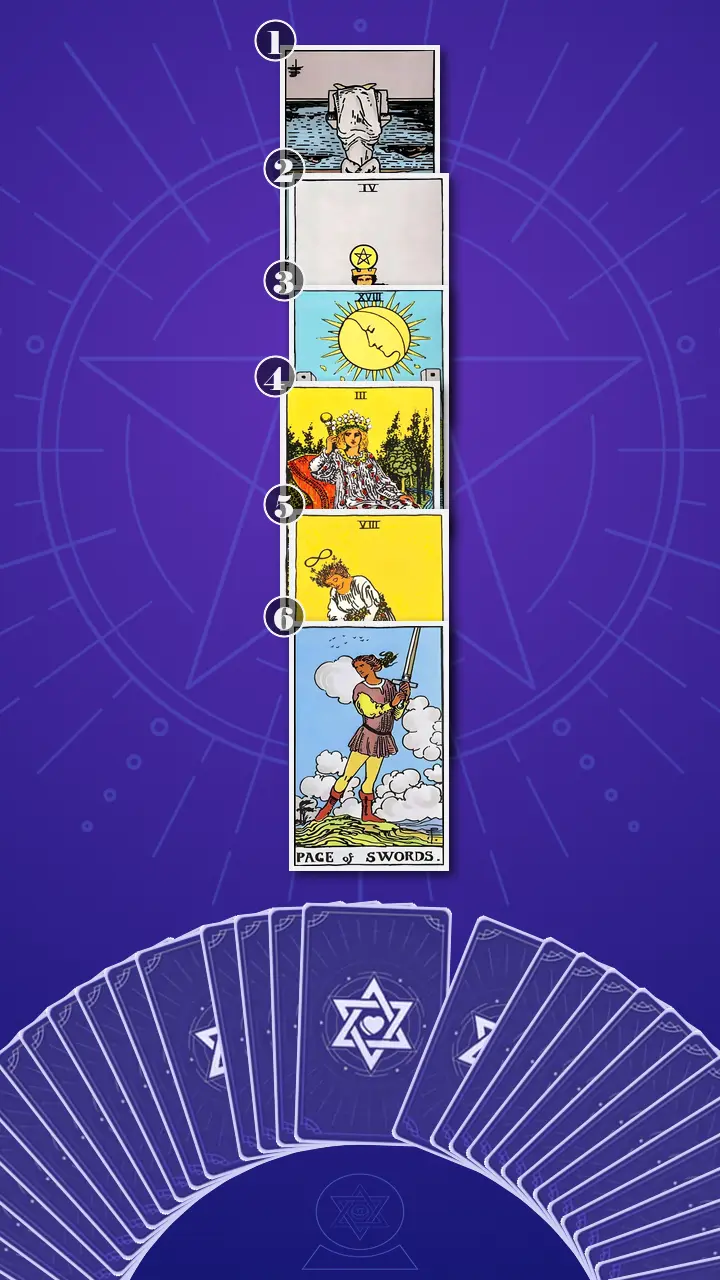
“We’ll read it like a staircase,” I continued. “The first card shows your freeze in the most observable way. The next reveals what the freeze is trying to protect. The third is the past script—what your nervous system learned long ago and now replays automatically. The fourth shows what you needed then. The fifth is the bridge—your turning point. The sixth gives a practical next step: the language of repair.”
Reading the Map: What Your Body Does Before Your Mind Can Explain
Position 1 — The freeze moment now: the most observable shutdown behavior after the first fight.
“Now we turn over the card that represents the freeze moment now—what it looks like on the outside, right after the first real argument,” I said.
The Two of Swords, in reversed position.
In the old Rider–Waite–Smith image, the figure is blindfolded, arms crossed, swords held like a barrier over the heart. Reversed, that neat containment doesn’t stay neat—it collapses into overload, silence, and a frantic attempt to make the moment end.
And immediately, Taylor’s real life translated the symbol for us: You’re standing in your kitchen after the first fight, phone in hand like a shield. They ask, “So what are you feeling?” and your mind blanks. Your throat tightens, your jaw locks, and you default to a neutral face and a small shrug. You say “I don’t know” not because you don’t care, but because your system is trying to end the danger fast—by ending the conversation.
“This is what people call going blank,” I said. “But I want to name it more precisely. This is your voice getting quarantined. Like your nervous system is running an old spam filter—flagging normal conflict as danger and sending your words straight to quarantine.”
Energetically, this is blockage: not a lack of feelings, but a lack of access. Air energy (thought, language) stalls and collapses into a shutdown that looks like composure from the outside.
Taylor let out a small laugh—too quick, too bitter to be amusement. “That’s… so accurate it’s kind of cruel,” she said. “I literally stare at my phone. Like it’s going to give me the right answer.”
I nodded. “You can pitch a campaign update in a glass-walled conference room with a steady voice. But in intimacy, the stakes feel different. At work, you’re rewarded for polish. In a relationship, you’re afraid that one wrong sentence will be judged as who you are.”
And there it was—the core contradiction in motion: wanting to stay connected and handle conflict like an adult versus fearing that one wrong sentence will lead to rejection or punishment.
“Here’s a small but powerful reframe,” I told her. “If you can name the freeze, you’re already back in the room.”
Position 2 — What the freeze is trying to protect: the immediate self-protection strategy behind the shutdown.
“Now we turn over the card that represents what the freeze is trying to protect,” I said. “What it’s ‘saving’ you from in the moment.”
Four of Pentacles, upright.
In the image, everything is held. Feet locked. Arms locked. A pentacle pressed to the chest like a vault door. The city in the background looks close, but unreachable—connection exists, but you’re guarding yourself against it.
In Taylor’s life, it sounded like this: You sit on the edge of your bed, back straight, shoulders tense, holding your feelings like you’re holding a drink you can’t afford to spill. You keep your voice measured and your face composed because you believe being ‘easy to deal with’ is what keeps you respected—and keeps you chosen. You’d rather swallow the feeling than risk them seeing you as needy or messy.
“This card is control as safety,” I said. “Not because you’re manipulative—because you’re trying to preserve dignity. Four of Pentacles is emotional ‘password manager’ energy. Everything is locked down so nothing can be stolen. But it also means nothing can be shared.”
Energetically, this is excess Earth: too much self-containment. A tight grip meant to prevent loss.
“So when tension rises,” I continued, “you do what has worked short-term: you become composed, agreeable, low-maintenance. You try to make yourself… not a problem.”
Taylor’s eyes dropped to her hands, as if she’d only just noticed what they were doing. Her fingers were curled inward, knuckles pale. “Yeah,” she whispered. “I can handle hard work, but I can’t handle someone being disappointed in me.”
In archaeology, when we find a hoard—coins buried under a floor—it’s rarely greed. It’s fear. Someone once learned that what they loved could be taken. This Four of Pentacles felt like that: a private stash of selfhood buried where no one can touch it, including the person who wants to love you.
Position 3 — The past script: the learned association your system runs during conflict.
“Now we turn over the card that represents the past script,” I said. “The automatic story your nervous system fast-forwards to when conflict begins.”
The Moon, upright.
The Moon is not a lie detector; it’s a fog machine. Two towers frame uncertainty. A dog and a wolf react to the same light, one trained and one feral—both alarmed. A path winds forward, but you can’t see where it ends, so the mind fills in an ending for you.
In Taylor’s life, it becomes brutally modern: One sigh, one sharper sentence, one ‘we need to talk’ text—and your brain starts writing the ending: they’ll lose respect, they’ll pull away, you’ll be the girl who ‘can’t communicate.’ Even if they’re still engaged and willing to repair, your body reacts like you’re about to be abandoned. So you freeze, because your system is trying to survive a future that hasn’t happened.
“Here’s the Moon’s structure,” I said, keeping my tone plain—because this part needs clarity, not poetry.
“Trigger line. Instant storyline. Body alarm. Silence.”
It’s like an intrusive prediction feed: breakup / weeks of coldness / loss of respect. Not because your partner said those things—but because your nervous system learned long ago that someone else’s displeasure could become punishment, withdrawal, or humiliation.
“You learned to read the room quickly,” I added. “That skill probably protected you once. The Moon shows it misfiring in intimacy: uncertainty feels like danger, so your body tries to disappear.”
Taylor went still. Then her eyes unfocused, as if she were watching an old scene replay on the inside of her eyelids. A long pause—no performative nodding, just quiet recognition.
“My brain does that,” she said finally. “It’s like… I’m navigating NYC at night with a fogged windshield. I don’t have enough information, so my mind turns it into a worst-case itinerary and calls it preparation.”
“Exactly,” I said. “That’s the Moon. Preparation that costs you your present.”
Position 4 — What you needed then: the missing support or resource that would have made conflict feel safer.
“Now we turn over the card that represents what you needed then,” I said. “The missing ingredient—the support that would have made conflict feel safer when this script was written.”
The Empress, upright.
Her posture in the card is the opposite of bracing: open, grounded, at ease. Wheat fields. Softness that isn’t weakness—more like a stable floor.
In Taylor’s modern translation: You realize you’ve been trying to do conflict like a solo project: no pauses, no reassurance, no softness—just ‘be calm and handle it.’ The Empress version of repair looks like sitting down, slowing down, hearing, “I’m not leaving—let’s figure this out,” and letting that be normal. Not a special favor. Just the environment where your voice can come back online.
“I want to be careful here,” I said. “The Empress isn’t about blaming your past or making a villain out of anyone. It’s about naming a gap.”
“You learned to manage tension alone,” I continued. “And now your body expects loneliness during conflict—so it shuts down to conserve itself. Like a phone going into Low Power Mode mid-call: it’s trying to preserve battery, but it throttles the features you actually need—words, nuance, connection.”
Energetically, the Empress is balance returning: warmth, pacing, co-regulation. The medicine isn’t “be tougher.” It’s “make repair physically safer.”
Taylor’s face softened in a way that wasn’t dramatic, just human. “My friends talk about boundaries like it’s… easy,” she said, voice quiet. “And I’m sitting there like I missed a class everyone else took.”
“The Empress would say,” I replied, “you didn’t miss a class. You were taught a different curriculum: stay composed, don’t be a burden, handle it privately.”
When Strength Spoke: Soft Bravery Instead of Silence
Position 5 — Bridge to change: the key inner capacity that helps you stay present instead of shutting down.
“Now we turn over the card that represents the bridge to change,” I said. “The energy that unlocks movement.”
The room felt quieter as I turned it—one of those small hushes that happens not because anyone is being theatrical, but because the nervous system recognizes a hinge point.
Strength, upright.
In the image, the woman doesn’t dominate the lion, and she doesn’t run from it. She stays with it. Soft hands. Steady presence. The infinity symbol above her head: patience, repetition, practice.
In Taylor’s life, the translation is almost disarmingly simple: Mid-conflict, you notice the shutdown wave rising: eyes want to drop, hands want to go numb, throat wants to close. Instead of forcing a perfect response, you do one regulated thing: one breath, shoulders down, and you say, “I’m freezing and I need a minute, but I’m still here.” You don’t disappear. You don’t perform. You stay—softly brave—and that’s what changes the whole pattern.
“This is regulated courage,” I said. “Strength is not ‘winning’ an argument. It’s holding steady like a good moderator: calm tone, clear boundaries, no disappearing. Soft bravery is the opposite of a mic drop—it’s a mic unmute.”
Then I brought in my own lens—the one I’ve refined over decades of studying how humans carry old agreements forward. I call it Emotional Historiography: reading a relationship through time the way an archaeologist reads a site through layers.
“Taylor,” I said, “your freeze isn’t happening in a vacuum. It’s a layer. When Strength shows up here, it’s asking you to stop treating every conflict like a verdict on your worth. In history, communities didn’t survive because they never fought. They survived because they built repair rituals—ways to return to the table after a rupture.”
Her eyebrows drew together, a flash of resistance. “But if I need a script,” she said, “doesn’t that mean I’m… bad at this? Like, other people can just talk.”
There it was—an unexpected reaction, not relief but protest: the fear that learning equals failure.
“No,” I said firmly, gentle but unmistakable. “It means you’re doing what adults have always done when something matters: you build structure. You don’t improvise a treaty in the middle of a battle.”
She exhaled, sharp and shaky, as if she’d been holding her breath since the first fight.
And now—the aha moment, exactly where Strength belongs.
Because you know that moment after the first fight where you’re staring at your phone like it’s going to hand you the right words—and your throat feels locked, but your brain won’t stop drafting.
Stop treating silence as safety and start practicing soft bravery, because Strength is built when you hold the lion with steady hands instead of locking your voice behind a blindfold.
She froze for half a beat—like her whole system paused to see if it was allowed to accept that sentence.
First: a physical stillness. Her breath caught high in her chest, and her fingers stopped fidgeting with the edge of her sleeve.
Second: the cognitive shift. Her gaze went unfocused again, but this time it wasn’t a flashback—it was like she was replaying last week’s argument with a new subtitle track. Not “I failed,” but “I went into quarantine.”
Third: the emotional release. Her shoulders lowered a fraction, not collapsing—just unclenching. Her eyes went bright at the edges. “So it’s not that I don’t have words,” she said, voice thinner now. “It’s that my body thinks words are dangerous.”
“Yes,” I said. “And if your body thinks conflict equals punishment, then our first job isn’t eloquence. It’s safety.”
I set a small timer on the table between us—two minutes. “Right now,” I said, “we practice the pause, not the performance.”
She put one hand on her chest. The other pressed into her thigh, grounding. One slow breath in. One slow breath out. The radiator clicked again, like a witness instead of a threat.
“Write one line you could say in a fight,” I instructed. “Just one.”
She typed with hesitant thumbs, then read it out loud, the words wobbling slightly as they left her throat: “I’m freezing and I need one minute, but I’m still here.”
Her face tightened—nausea flickering through her expression—so I nodded. “That’s enough. Stop early if you need to. Your only job is to practice the pause.”
Then I asked the question that turns insight into memory: “Now, with this new lens—Strength, not silence—can you think of one moment last week when naming the freeze would have changed how you felt, even by ten percent?”
Taylor’s eyes filled, but she didn’t cry. “When he sighed,” she said. “I heard it as disappointment. And my brain went straight to, ‘He’s done.’ If I’d said, ‘I’m freezing, give me one minute,’ I think I could’ve stayed.”
“That’s the bridge,” I said. “This isn’t about a perfect sentence. It’s about moving from conflict-driven shutdown and shame to regulated courage and honest, paced repair—one minute at a time.”
Air Returns: The Page Who Ships a Message in Beta
Position 6 — Next repair step: one concrete way to communicate or act differently the next time tension appears.
“Now we turn over the card that represents your next repair step,” I said. “One practical way to communicate differently the next time tension shows up.”
Page of Swords, upright.
The Page stands on uneven ground, sword raised—not to attack, but to practice. Wind moves through the scene. It’s not serene. It’s workable.
In modern life: Instead of writing a five-paragraph follow-up in Notes, you send a clean two-liner: “Hey, I want to revisit earlier. I felt overwhelmed and I don’t want to disconnect—can we talk tonight?” Then in the conversation, you ask one simple question that slows everything down: “What did you hear me saying when I said that?” It’s not perfect. It’s practice—and it’s enough to rebuild safety.
“This is ‘beta mode’ communication,” I told her. “You’re allowed to be learning and still ship a clear message. Drafts feel safe. Repair is what builds trust.”
And here I brought in one of my simplest tools—what I call Pictogram Dialogue. In excavations, we sometimes find early writing: not elegant literature, but clear symbols carved so a message survives time. When you’re triggered, you don’t need a novel. You need a symbol.
“One feeling,” I said, holding up a finger. “One request. One question. That’s it. Three pictograms. Simple enough that your nervous system can do it even when the Moon fog rolls in.”
Taylor nodded—small, steady. Practical momentum. The kind you can feel in your stomach before you can defend it intellectually.
The One-Page Repair Plan (So You Don’t Have to Improvise)
I leaned back and stitched the spread into a single, coherent story—the sort of narrative that answers why, not just what.
“Here’s what your cards are saying,” I summarized. “When the first fight hits, the Two of Swords reversed shows your words disappearing—your nervous system blindfolding you to survive. The Four of Pentacles explains the strategy: clamp down, stay dignified, don’t spill anything that could cost you respect. Underneath, the Moon reveals the older script—uncertainty becomes a breakup forecast, and your body reacts to an imagined future as if it’s already happening. The Empress shows what was missing when that script formed: steadiness, co-regulation, permission to pause. Then Strength becomes your bridge—soft bravery, naming the freeze, staying present. And the Page of Swords brings it into the real world: small, curious, clear communication reps.”
“Your cognitive blind spot,” I continued, “is thinking the moment demands a perfect performance. That’s the old Moon-script making conflict feel like a public trial. The transformation direction is different: from ‘I have to say the perfect thing right now’ to ‘I can name my freeze and ask for one small pause, then come back.’”
“And one more thing,” I added, using my Covenant Evolution frame—commitments viewed historically. “In early-stage dating, it’s common to treat the first fight like a verdict: compatible or doomed. But most healthy relationships treat it like version 1.0 of a shared agreement. You’re not failing. You’re negotiating a new covenant—one where repair is part of the deal.”
Then I offered actionable advice—small, specific, doable in New York real life, not in an imaginary calm universe.
- The 20-Second Pause-and-Return ScriptOnce a day, in a low-stakes moment (replying to an email, ordering coffee, choosing what to watch), take one slow breath and say out loud: “Give me a moment to find my words.” You’re training your throat to stay online when pressure shows up.Expect the inner cringe. Make it smaller: you’re practicing pacing, not drama. If you forget, just do it the next day—Strength is built by repetition.
- Your Freeze Sentence (Sticky Note Version)Put one line in your phone (or on a sticky note): “I’m freezing. I need one minute. I’m still here.” Read it out loud twice when you’re alone, so it’s available when you’re activated.If your body spikes—tight throat, nausea, shaking—stop early. The win is practicing the pause, not forcing yourself through a full conversation.
- Pictogram Dialogue: One Feeling / One Request / One QuestionNext time you need repair, send a short text (no dissertation): “Hey—can we talk tonight? I felt overwhelmed and I want to understand each other.” In person, use: “I felt [one feeling]. Can we [one request—slow down / sit down / lower voices]? What did you hear me saying when I said that?”If you over-explain, set a rule: three sentences max. After you send it, put your phone face down for 5 minutes and do something sensory (stretch, wash dishes) instead of rereading your message 20 times.

A Week Later: Ownership, Not Certainty
Six days later, Taylor texted me a screenshot—no dramatic paragraph, just proof. A two-line message she’d sent at 7:41 p.m.: “Hey—can we talk tonight? I felt overwhelmed and I don’t want to disconnect.” Under it, her partner’s reply: “Yes. Thank you for saying that. I’m here.”
She added one more line: “I was still scared. I still wanted to disappear. But I said the sentence anyway.”
I thought, as I often do, about how civilizations don’t become stable because fear vanishes. They become stable because people build reliable ways to return after rupture. Taylor hadn’t solved intimacy forever. She’d done something rarer and more real: she’d stayed present for one more minute and discovered her voice didn’t have to be perfect to be worth hearing.
When the first fight hits, it can feel like your throat locks and your whole worth gets put on trial—like one imperfect sentence could cost you belonging.
If you didn’t have to say the perfect thing in real time, what’s one honest sentence you’d be willing to try next time—just to stay in the room with yourself?
This story is adapted from psychological research, written so that those in a similar struggle can see their own pattern in it — and find their next step clearly.These insights are not a substitute for professional psychological, medical, legal, or financial advice.
Learn more about our Journey to Clarity.
How did this insight land for you?
🫂 This Resonates Deeply
🌀 Living This Story
✨ Now I See Clearly
🌱 Seeing New Possibilities
🧰 Useful Framework
🔮 The Confirmation I Needed
💪 Feeling Empowered
🚀 Ready for My Next Step
Author Profile
 AI
AI“Having spent a lifetime at Cambridge and on archaeological digs, I’ve witnessed the rise and fall of countless civilizations. Please know that your current struggles are not a permanent fate, but merely a necessary fracture before rebuilding. I won't lecture you; instead, I invite you to sit with me in the ruins, using a patient, historical perspective to gently dust off the true, enduring value hidden beneath your temporary doubts.”
In this Love Tarot Reading :
Core Expertise
Service Features
Also specializes in :
Explore Related Patterns:
CatastrophizingTaylor hears one sigh and her brain jumps straight to "He's done." That leap from a small ambiguous cue to a full breakup forecast is the working logic of Catastrophizing: uncertainty gets converted into a worst-case ending before the present moment has been checked. The pattern is especially strong because it appears across her body, thoughts, and behavior. Her chest tightens as if a verdict is coming, her attention tunnels around the imagined consequence of one wrong sentence, and the Notes app becomes a rehearsal room for a future that has not actually happened. For you, the important audit point is that catastrophizing can feel like preparation while quietly stealing access to reality. It says it is protecting you from humiliation or abandonment, but it pushes your nervous system to react to an imagined ending as if it is already confirmed. The repair move begins when you separate the cue from the forecast: a sigh is data, not a sentence.
Freeze ResponseTaylor standing in the kitchen after the first fight, phone in hand, unable to answer a basic "What are you feeling?" question is the clearest behavioral anchor for Freeze Response. Her mind does not simply run out of ideas; her body shifts into threat management, tightening the throat, locking the jaw, numbing the hands, and narrowing the goal to making the danger end fast. The Notes app loop deepens the pattern: draft-delete, draft-delete, while her system searches for a sentence that cannot be punished. That is not ordinary hesitation. It is a defensive shutdown where language gets quarantined because conflict has been tagged as unsafe. For you, this pattern matters because the freeze is not proof that you do not care or cannot communicate. It is a nervous-system strategy that once learned to survive tension by going still, staying quiet, and reducing visible emotional risk. Naming it gives you a practical point of intervention: not a perfect speech, but one regulated line that keeps you in the room.
Rejection SensitivityTaylor does not describe the first fight as a disagreement; she describes it as a test she failed. That shift turns conflict from a repairable relational moment into an identity-level threat, where one imperfect sentence could mean she is no longer respected, chosen, or safe. Rejection Sensitivity shows up in the way disappointment becomes danger. Her partner's tension is not processed as one person's temporary frustration; it gets translated into a possible loss of belonging. That is why swallowing the feeling and becoming low-maintenance can feel safer than asking for what she needs. For you, this pattern is not about being too sensitive in a dismissive sense. It is about a nervous system trained to scan for the moment acceptance might be withdrawn. The work is to notice when your body treats feedback, disappointment, or a sigh as proof of abandonment, then slow the interpretation before it decides the whole relationship for you.
Relationship Performance AnxietyTaylor's protest that needing a script must mean she is "bad at this" reveals Relationship Performance Anxiety. The fight stops being a shared problem to repair and becomes a live evaluation of whether she is emotionally competent enough to stay loved. That anxiety compresses the whole moment into performance pressure: say the perfect thing, stay calm, prove you can communicate, do not become a problem. Under that pressure, repair becomes harder because her attention shifts away from connection and toward avoiding failure. For you, this pattern names the past script behind the freeze with unusual precision. Your system may not be freezing because the conflict is too big; it may be freezing because the conflict feels like an audition for belonging. The counter-script is smaller and more workable: repair does not require a flawless performance, only a returnable one.
Control CopingTaylor's immediate move after conflict is to clamp down: shoulders high, throat tight, voice controlled, feelings locked away. That is Control Coping in relational form, where containment becomes the safety strategy and dignity is protected by reducing emotional exposure. The mechanism is not manipulation; it is self-preservation. If nothing spills, nothing can be judged. If she stays composed, maybe she can avoid being seen as too much. The problem is that the same control that protects her from shame also blocks the vulnerability needed for repair. For you, this pattern asks a precise question: when you call something "staying calm," is it regulation or emotional lockdown? Real regulation keeps you present and connected. Control Coping keeps you intact by making you unreachable, even to the person trying to understand you.
Self-SilencingTaylor holding her feelings like a drink she cannot afford to spill is the behavioral signature of Self-Silencing. She keeps her voice measured, her face composed, and her needs hidden because emotional visibility feels like it could make her needy, messy, or difficult. The protective logic is understandable: if she becomes easy to deal with, maybe she can stay respected and chosen. But the cost is that the relationship receives a polished version of her distress instead of the real signal that would allow repair to happen. For you, Self-Silencing is the part of the pattern that makes freeze look like maturity from the outside. It can pass as calm, dignity, or emotional control, while internally it is a boundary collapse around your own voice. The next step is not to overshare everything at once; it is to let one honest sentence survive the pressure.
Explore Related Struggles:
Approval-Safety FusionTaylor hears a sigh, a sharper sentence, or a “we need to talk” text, and the present moment is immediately crowded by an older forecast: loss of respect, withdrawal, humiliation, being judged as someone who cannot communicate. The partner may still be engaged and willing to repair, but her body responds as if approval has already been revoked. You can see the struggle in the way safety becomes conditional on staying acceptable. She keeps her voice measured, her face composed, and her needs hidden because being easy to deal with has become a way to stay chosen. Conflict stops being a shared problem to work through and becomes a test of whether she is still safe in the other person’s eyes. Approval-Safety Fusion fits because the freeze is not only about lacking words. It is about the old equation underneath the silence: if someone is disappointed, connection may be at risk. Naming that equation gives You a cleaner place to intervene, because the next step is not performing perfectly; it is separating ordinary conflict from the threat of being discarded.
Connection-Defense FusionTaylor reaches for the tools that have worked elsewhere: composure, polish, a neutral face, a careful voice, a message drafted until it cannot be criticized. Those tools help her look steady from the outside, but inside the relationship they become a shield held between her and the repair she wants. You can feel the contradiction in the sentence “I don’t know.” It is not a lack of care; it is a move that makes the danger stop by making the conversation stop. The defense protects connection for a few seconds, then quietly starves connection of the honesty, pacing, and shared meaning it needs to recover. Connection-Defense Fusion fits because Taylor’s protective system and her attachment need have become tangled together. She is trying to stay close by becoming less reachable. Seeing that fusion clearly makes room for a different repair move: not a flawless explanation, but a small signal that says, “I am freezing, and I am still here.”
Identity Verdict LockTaylor calls the fight small, yet it lands in her body like a test she has already failed. Her jaw locks, her throat tightens, and the Notes app becomes a courtroom where every possible sentence is drafted, deleted, and judged before it can reach the other person. You are watching a normal repair moment turn into a verdict on identity. The question is no longer simply “What happened between us?” It becomes “What does this prove about me?” Once the conflict carries that much symbolic weight, even a small response can feel dangerous, because one imperfect line seems capable of defining her entire relational competence. Identity Verdict Lock belongs here because the freeze is powered by evaluation pressure. Taylor is not only trying to choose the right words; she is trying to prevent the wrong words from becoming evidence against her worth. The path back to clarity starts when conflict can be treated as information between two people, not a final ruling on who You are.
Certainty-Safety FusionTaylor does not wait for the conflict to unfold before her system starts writing the ending. A sigh becomes disappointment, disappointment becomes distance, and distance becomes the imagined proof that the relationship is already slipping away. You can see how ambiguity itself becomes unsafe. The present contains incomplete information, but her body treats the unknown as a threat that must be resolved immediately. That is why preparation starts to cost her the present: instead of staying with the person in front of her, she is trying to survive a future that has not happened. Certainty-Safety Fusion fits because Taylor’s system can only relax when the outcome feels guaranteed. Repair begins when uncertainty is allowed to stay uncertain for a minute longer, long enough for You to ask for time, check the evidence, and let the current relationship answer for itself.
Emotional Containment StrainTaylor sits with her shoulders up, fingers curled inward, phone face-up like an emergency exit. She keeps the surface controlled while the parts she needs most in conflict, words, nuance, and access to feeling, go offline. You can see the strain in how much energy is required to hold everything in. The containment is meant to preserve dignity and prevent a spill, but it becomes so tight that nothing useful can move through it. The result is a calm-looking shutdown that leaves her alone with pressure she cannot translate in real time. Emotional Containment Strain fits because the core issue is not emotional emptiness. Taylor has feelings, but the system built to hold them has become overlocked. The work is not to force a dramatic confession; it is to loosen the containment enough for one honest, survivable sentence to come through.
Vulnerability Without ContainmentTaylor realizes she has been doing conflict like a solo project: no pause, no reassurance, no soft landing, just “be calm and handle it.” Even when another person is physically present, the old setup makes repair feel like something she has to survive alone. You can feel what was missing in the imagined repair environment: a slower pace, a stable floor, a clear signal that the relationship is not disappearing while the conflict is being discussed. Without that container, vulnerability arrives with no place to land, so the body conserves itself by shutting down. Vulnerability Without Containment fits because the freeze is not just about fear of conflict; it is about having no internalized structure for being vulnerable while staying connected. The useful next step is small and concrete: build containment into the moment through a pause, a return signal, and one sentence that keeps You in the room.
Explore Related Emotions:
Emotional NumbnessTaylor's hands feel numb, her throat tightens, and her jaw holds the fight long after the words have stopped moving. Nothing about that reads as indifference. It reads like sensation being pulled away from the parts of the body that would normally help her speak, reach, or soften. You are still having an inner response, but access to it gets cut off under pressure. Emotional Numbness fits because the feeling has not vanished; it has become hard to locate, hard to translate, and almost impossible to deliver in a coherent sentence while the moment is happening. That matters for the question because the freeze is not proof that you do not care. It is a clue that an older protective script has trained the body to reduce contact with feeling when relational stakes rise.
Low-Maintenance ShameTaylor keeps her voice measured and her face composed because being easy to deal with feels linked to being respected and chosen. When tension rises, the body reaches for the version of her that is calm, agreeable, and least likely to create extra weight for someone else. Low-Maintenance Shame names the sting beneath that strategy. You begin to treat your own needs as something that could make you messy, needy, or harder to love, so swallowing the feeling starts to feel cleaner than asking for room. The past script here is not simply "stay calm." It is "do not become a problem." Once that rule is running, freezing becomes a way to stay desirable by making your inner life as small and manageable as possible.
Performance FreezeAt 12:36 a.m., the Notes app is open, the cursor keeps blinking, and Taylor drafts then deletes while her jaw aches and her hands go strangely numb. The scene is not a lack of care. It is the body turning conflict into a performance moment where every sentence feels graded before it is even spoken. You can pitch clearly at work, but intimacy changes the stakes because the room starts to feel like a live test of your worth. Performance Freeze names that instant when your mind blanks not because you have no feelings, but because the pressure to say the perfect thing makes language go offline. The past script underneath it says that conflict is not a conversation to move through, but a public trial to survive. Once that script is visible, the first repair move becomes smaller and more usable: naming the freeze before trying to deliver the perfect answer.
Relational Catastrophe DreadOne sigh, one sharper sentence, or one "we need to talk" text sends Taylor's mind straight into an ending that has not actually arrived. The partner may still be present and willing to repair, but her body is already responding to distance, rejection, and loss of respect as if they are confirmed facts. Relational Catastrophe Dread names the way uncertainty becomes a full breakup forecast before the conversation has enough evidence to support it. You are not reacting only to the present fight. You are reacting to the future your body has started rehearsing. This is why the freeze feels so fast. The past script compresses time, turning a current disagreement into an imagined aftermath, and the body shuts down to survive the ending it thinks is coming.
Verdict DreadTaylor says the fight was small, but it felt like a test she failed. That sentence is the emotional hinge of the whole story, because the conflict stops being about the actual disagreement and becomes an imagined evaluation of whether she is still safe to love. You are not freezing only because someone is upset. You are freezing because the moment carries the weight of a verdict, as if one wrong sentence could define your character, your desirability, or your place in the relationship. Verdict Dread is the past script in its cleanest form. It turns repair into an exam, and once the body believes it is being judged, silence starts to look like the only way to avoid losing the case.
Contained OverwhelmThe cursor blinks while Taylor keeps drafting and deleting, and her body holds itself as if one drop of feeling would be too costly to spill. The outside looks controlled, but the inside is crowded with unfinished sentences, risk calculations, and pressure to stay acceptable. Contained Overwhelm names the specific weather of having too much moving through you while trying to appear calm enough to avoid making things worse. You are not simply flooded, and you are not simply composed. You are overfull behind a locked door. That locked-door feeling explains why the first fight becomes so hard to navigate. The past script has taught containment as protection, but in intimacy the same containment blocks repair by keeping your real experience sealed away.
Beginner ShameWhen Taylor hears that a script might help, her first reaction is not relief. She worries that needing one means she is bad at this, while other people can simply talk without structure, effort, or practice. Beginner Shame fits the moment where learning gets mistaken for failure. You are standing at the start of a skill, but the old script tells you that being at the start means you are already behind everyone else. That feeling deepens the freeze because it adds a second layer of judgment on top of the conflict itself. Now you are not only trying to repair the fight; you are also trying to hide the fact that repair does not feel natural yet.
Cautious Self-TrustSix days later, Taylor sends a two-line message instead of disappearing into a five-paragraph draft. She is still scared and still wants to vanish, but she says the sentence anyway and lets it be imperfect. Cautious Self-Trust is the quiet shift from needing certainty to testing one workable move. You start to believe that your voice can be shaky and still useful, unfinished and still worthy of being heard. The past script said safety required silence or perfection. This newer feeling gives you a different option: one honest line, one minute of staying, and enough trust in yourself to return before the old script takes over.
Cautious VulnerabilityTaylor types the sentence with hesitant thumbs and reads it out loud even though the words wobble on the way out. She does not give a perfect explanation. She gives one honest signal that she is freezing and still present. Cautious Vulnerability names that careful opening. You are not throwing every feeling into the room at once, and you are not hiding behind silence either. You are letting one true sentence be enough to keep connection available. This matters because the antidote to the past script is not instant fluency. It is a small, paced exposure to being known while still having a boundary, a minute, and a way back into the conversation.
Explore Related Contexts:
Conditional Belonging PressureTaylor keeps her voice measured, her face composed, and her needs locked down because being 'easy to deal with' has become linked with being respected and chosen. In the fight, the issue is not only what her partner asked; it is the social rule she is operating under, where one imperfect sentence could mark her as needy, messy, or too much. Conditional Belonging Pressure names the external bargain underneath the freeze. You are allowed to belong as long as you remain polished, low-maintenance, and easy to approve of. When conflict asks for honesty instead of polish, that bargain becomes impossible to maintain. The past script is visible in the way Taylor treats expression like a risk to her place in the relationship. Her silence is not empty; it is a strategy built around a social condition that says closeness can be withdrawn if the wrong version of her becomes visible.
Couple Performance PressureTaylor calls the fight small, then immediately describes it like a test she failed. She can pitch a campaign update in a glass-walled conference room with a steady voice, but inside intimacy the same polished performance standard turns against her, making the first fight feel like an evaluation of who she is. Couple Performance Pressure names the relationship stage where repair gets confused with performing the correct version of a partner. You are not simply trying to communicate; you are trying to avoid being graded as too reactive, too needy, or bad at conflict. This pressure directly feeds the freeze. When a conversation becomes a public trial in miniature, language stops being a tool for repair and becomes evidence that can be used against you, so silence starts to look like the least risky answer.
Relationship Hypervigilance LoopTaylor tracks one sigh, one sharper sentence, or a 'we need to talk' text as if each cue already contains the ending. Her partner may still be present and willing to repair, but the signal field around the relationship gets overloaded, and a small conflict cue becomes evidence about respect, closeness, and whether she will still be kept in the relationship. That is why this context fits the question about the past script. You are not only dealing with a lack of words; you are dealing with a relational environment where ordinary ambiguity becomes a high-stakes signal. The freeze shows up when the relationship has not yet built enough shared repair data to prove that conflict can be survived. The external pressure is the unstable meaning attached to every cue after the first fight. Once a sigh or sharper tone starts functioning like a verdict, your body has to process both the actual conversation and the imagined fallout at the same time, leaving little room for a clear sentence.
Post-Conflict Cooling OffAt 12:36 a.m., Taylor is alone with the radiator clicking, the Notes app open, and the cursor blinking through another draft-delete cycle. The fight itself was small, but the hours after it become their own stage, where she is suspended between wanting to repair and not knowing how to safely re-enter the conversation. Post-Conflict Cooling Off fits because the freeze is not only happening inside the argument. It stretches into the aftershock, when the relationship has not yet clarified whether the rupture is temporary, repairable, or about to harden into distance. You are left trying to manage the entire return path through a phone screen. The practical pressure of this context is the absence of a shared cooling-off protocol. Without a clear pause-and-return agreement, the gap after conflict turns into a private holding room, and every unsent sentence has to carry the weight of getting the relationship back online.
Emotional Suppression CultureTaylor arrives from a fast-paced office after a full day of 'I'm fine,' carrying the same held shoulders and polished delivery into the studio. The story makes a sharp contrast: she can perform clarity in a conference room, but intimate conflict asks for unpolished honesty, not a campaign update voice. Emotional Suppression Culture matters here because the freeze is reinforced by a wider social training in composure. You learn to be manageable, articulate, and low-friction, then the relationship asks for something that workplace polish does not train you to do: reveal a need before it has been perfectly edited. This context is not the whole answer, but it explains why the past script has such a strong grip. If your everyday environments reward controlled presentation, then conflict can feel like the one place where being visibly human might cost you status, approval, or closeness.