The 11:40 p.m. Typing Bubble
I met Casey on a late-night video call from her Toronto apartment. The radiator ticked behind her, blue screen light washed over the rumpled duvet, and the phone in her palm looked almost too warm to hold. She worked as a junior UX researcher, spending most of her day listening carefully enough to make strangers feel understood.
“You’re the emotionally articulate friend who listens for a living,” I said, “but at 11:40 p.m., one typing bubble can make your own privacy feel rude.”
Casey gave me a startled half-laugh and turned her phone toward the camera. The first message read, “I don’t really want to talk about it.” Beneath it sat three longer messages containing almost everything she had intended to keep private.
“She asked again,” Casey said. “Then the typing bubble appeared. I thought I’d made it awkward, so I tried to make the no sound reasonable. Somehow I told her the whole story before she’d even replied.”
I watched apprehension draw through her body like a cord being pulled tight inside a hoodie: throat narrowing first, shoulders rising next, stomach braced for a social impact that had not actually happened. She wanted to protect her privacy, but she feared that resisting a close friend’s pressure would weaken the friendship. Warmth returned after she disclosed, yet by morning it had curdled into exposure, resentment, and an hour of rereading punctuation while her coffee went cold.
“The silence after I say no feels worse than the oversharing does in the moment,” she told me. “I keep confusing being fully accessible with being a good friend.”
I did not tell her to become colder, cut anyone off, or find a more convincing explanation. “Your first boundary was already clear,” I said. “Let’s slow the exchange down and map the point where your privacy starts feeling like a threat to belonging. We’re looking for clarity, not a verdict about you or your friend.”

Choosing the Hourglass Map
I invited Casey to put both feet on the floor, take one unforced breath, and hold the question in mind while I shuffled. I use this small transition to gather attention; it is not a test of intuition and does not give the cards authority over anyone’s choices.
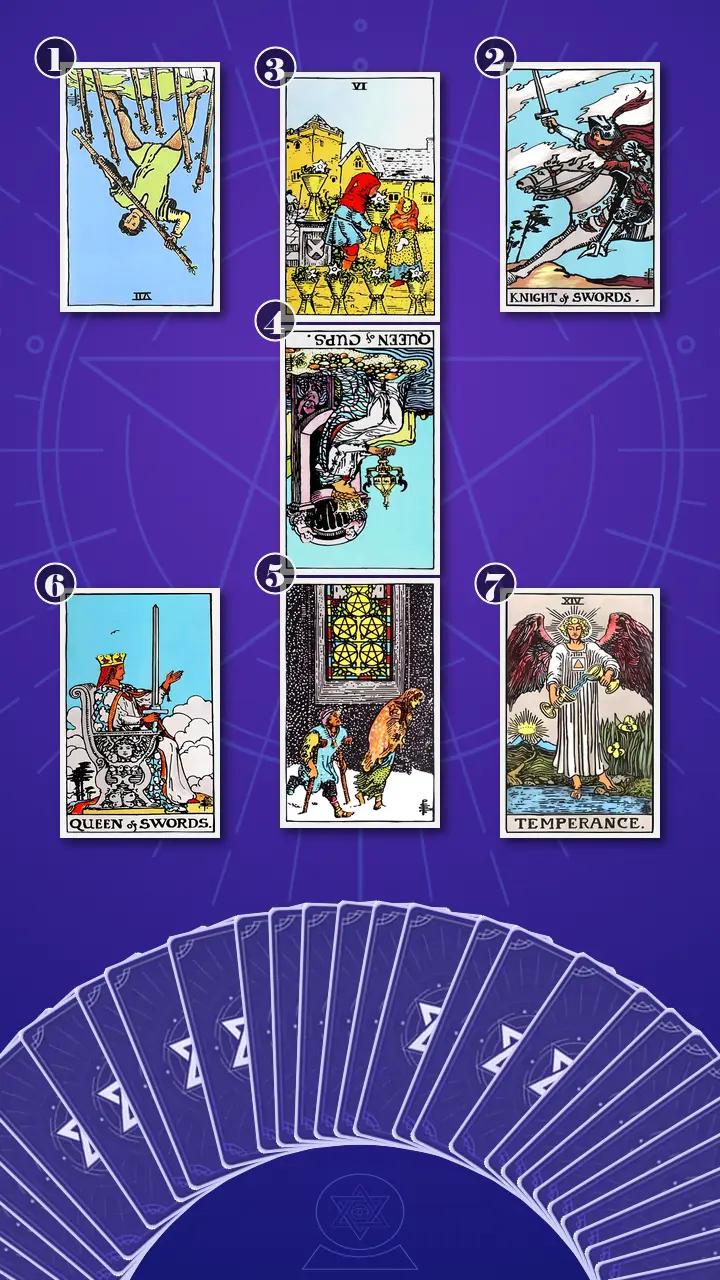
I chose the seven-card Relationship Spread · Context Edition. For friendship boundary pressure and oversharing, this spread is more useful than a broad predictive layout because it separates Casey’s stance from the pressure she experiences, then traces the bond, the repeating interaction, the underlying fear, the available boundary skill, and a healthy integration benchmark.
I placed the first two cards opposite each other, then three cards down the centre and two at the base. The arrangement formed an hourglass. I explained that the upper cards would show where the conversation begins, the central channel would reveal why it narrows, and the final pair would reopen the field into choice. The fifth position would locate the belonging fear beneath the oversharing; the sixth would identify the concrete skill that interrupts it; the seventh would show paced intimacy as a practice, not predict what the friendship must become.
Where the Boundary Loses Its Footing
Position 1: Seven of Wands Reversed and the Second Question
I turned over the card representing the diagnosis-level stuck behaviour: Casey’s boundary stance weakening after a friend repeats or intensifies a personal question. It was the Seven of Wands, reversed.
The upright image shows one figure defending elevated ground while six wands rise from below. Even the mismatched shoes suggest someone caught unprepared. Reversed, the fire of self-assertion is depleted and blocked. The boundary does not become invalid; confidence in the right to hold it collapses under repetition.
I brought the card directly into Casey’s 11:40 p.m. chat. She had begun on reasonable ground with, “I don’t really want to talk about it.” When the question returned, she laughed, apologised, gave one detail, and then added another. Her inner calculation became: “I already made this awkward, so now I need to make the no sound reasonable.” Persistence made one private preference feel like a position she had to defend perfectly, and she surrendered the information when she feared she could not win the debate.
Casey let out a brief, bitter laugh. “That is so accurate it feels a little cruel.” Her fingers tightened around the phone before she set it facedown.
“Then let’s be precise about what the card is doing,” I replied. “It isn’t accusing you of being weak. It is freezing one second of the pattern so you can recognise it. The useful question is not ‘Why can’t I have boundaries?’ It is ‘What happens in my body after the second question?’”
Position 2: The Knight of Swords and a Conversation Moving Too Fast
I turned over the card representing the friend’s pressure as Casey experiences it, with attention on observable speed and persistence rather than assumptions about private motives. It was the Knight of Swords, upright.
The knight charges with the sword already raised while trees bend in the wind. Air is in excess here: communication moves so quickly that reflection struggles to keep its footing. Two follow-up texts arrive before Casey has decided what she wants to share, and momentum begins answering on her behalf.
“This has the tempo of overlapping dialogue in The Bear,” I said. “The next line lands before the previous one has settled. That speed can narrow your sense of choice without proving that your friend consciously intends harm. Impact and intent are different questions.”
I asked Casey what she predicted would happen if she waited. She looked toward the dark window and answered, “If I don’t reply immediately, the pause itself becomes the problem. It looks pointed.”
Her breathing had sped up while she described it. I slowed my own voice. “Someone else’s pause can be uncomfortable without becoming your cue to disclose. The Knight shows urgency, not an actual countdown.”
Position 3: The Six of Cups and the Gift That Became a Rule
I turned over the card representing the relationship’s foundation: the shared history that connects disclosure with loyalty, trust, and being a good friend. It was the Six of Cups, upright.
The card shows one child offering another a flower-filled cup in a sheltered courtyard. Its water is warm and balanced. Casey’s friendship had contained real generosity: long voice notes, difficult stories freely exchanged, and nights when being known brought genuine comfort. The problem was not that this closeness had been false.
“The offered cup is a gift, not an invoice,” I said. “But an old experience of safe sharing can become a default setting. When this friend asks now, you assume giving information is how you keep the bond generous, even when the particular disclosure is not freely chosen.”
Casey rubbed her thumb along the edge of her phone case. “We became close because we told each other things nobody else knew. I think I made that our proof.”
I nodded. “That history matters, but it does not create permanent access. Warmth is not measured by how quickly you surrender context.”
Position 4: The Queen of Cups Reversed and the Unwatched Cup
I turned over the card representing the active, self-reinforcing interaction: Casey noticing possible disappointment, disclosing to restore warmth, and making persistence more effective the next time. It was the Queen of Cups, reversed.
The Queen’s ornate cup is uniquely enclosed. It holds a private inner world at the edge of moving water. Reversed, emotional receptivity has become overextended and containment is blocked. Casey still possesses the cup, but she watches the other person’s expression so closely that she stops checking whether she consents to opening it.
I described the loop as she had lived it: her friend becomes quiet; Casey monitors punctuation, tone, response time, and the iMessage typing bubble; she supplies intimate context to regulate the interaction; warmth returns; relief arrives briefly; then exposure and resentment begin. The phone is still warm when she starts drafting a clarification that would reveal even more.
“The inner sentence sounds like this,” I said. “‘I can feel that she might be disappointed, so my discomfort has to wait.’ Empathy notices another person’s reaction. Responsibility asks whether that reaction is yours to remove. Those are not the same task.”
Casey’s throat moved as she swallowed. Her gaze stayed on the Queen’s closed cup, and one hand settled over her stomach. “I track her reaction so closely that I stop checking what I want,” she said quietly.
I thought of planetary charts I had studied over the previous decade: one body can register another body’s pull without surrendering its entire orbit. Sensitivity is information. It is not an order.
Position 5: The Five of Pentacles and the Imagined Admission Fee
I turned over the card representing the central challenge beneath the oversharing: the fear that privacy will lead to exclusion or weakened belonging. It was the Five of Pentacles, upright.
Two figures move through snow beneath an illuminated window. In Casey’s hidden equation, privacy means standing outside the warmth, while disclosure becomes the admission fee. Earth energy has hardened a possibility into something that feels factual: the chat is quiet, therefore the friendship is in danger.
I carefully separated image from prediction. “This card pictures anticipated scarcity. It does not establish that your friend will withdraw. Your mind moves from ‘she hasn’t replied’ to ‘she thinks I don’t trust her’ to ‘I may lose my place in the friendship.’ Those are three different statements.”
Casey’s breath caught. Her eyes lost focus for a moment, as if she were replaying a row of old message threads. Then she exhaled and said, “It really does feel like I have to keep paying social rent with personal information.”
“That is the narrowest point of the hourglass,” I told her. “The observable fact is a pause. The feared meaning is exile. The urge to disclose is an attempt to close the distance between them before you have evidence that the distance exists.”
When the Queen of Swords Separated Care from Access
Position 6: One Sentence That Does Not Need a Defence
The radiator clicked off as I reached for the sixth card, and the room on Casey’s side of the call became noticeably still. I turned over the card representing the concrete boundary skill that could interrupt the cycle: concise, self-authorised communication without apologetic overexplanation. It was the Queen of Swords, upright.
Her sword stands vertically, separating what is private from what is shareable. Her other hand remains extended. The image does not force Casey to choose between a wall and an emotional spill; clarity and relational presence occupy the same card. Mature air is balanced here. Language is no longer external pressure. It becomes discernment.
I brought Casey back to 11:40 p.m.: the warm phone, the first clear sentence, the typing bubble, and the three messages launched before any reply. In that tiny interval, she had traded tomorrow’s privacy for ten seconds of warmth tonight, convinced that the right explanation could prevent rejection.
You do not have to disclose more to prove closeness; choose one clear sentence and let the Queen of Swords' upright blade separate care from access.
I allowed the silence after the sentence to remain untouched. Then I added, “A boundary is a decision about access, not an argument you have to win. One truthful sentence can protect your privacy while leaving the conversation open.”
I used my Gravity De-linking Analysis, a lens I normally bring to friendships strained by people moving at different emotional speeds or through different life phases. I did not use it to declare that Casey had outgrown her friend; the spread contained no such verdict. I used it to separate two gravitational pulls inside the exchange: her friend’s wish for an immediate answer and Casey’s need to choose the timing of disclosure. Those needs could exist without being forced into instant alignment. Her friend’s disappointment, if it appeared, could remain in the friend’s orbit long enough for Casey to hear her own consent.
“Think of a privacy boundary like an app permission request,” I said. “Declining access to one category does not uninstall the relationship. Friendship can grant collaboration without opening every private folder. The sentence could be: ‘I’d rather keep that private, but I’m happy to stay and talk about something else.’”
Casey stopped breathing for a beat. Her fingers, which had been worrying the cuff of her sweatshirt, went still above her wrist. Then her gaze slipped past the card toward the dark window, as if last week’s messages were replaying in the glass. Her pupils widened; her jaw set rather than softened.
“But doesn’t that mean I’ve been doing friendship wrong this whole time?” she asked, her voice suddenly sharper. “Like I caused this?”
I did not rush to turn the anger into relief. “It means you found a strategy that bought warmth quickly and charged you later,” I said. “That was an adaptation, not a confession of guilt. Now you have another option.”
Her fist loosened one finger at a time. Her eyes shone, but she blinked the moisture back. A breath left her in a thin, unsteady stream; then her shoulders dropped. The release looked real, and so did the brief blankness after it. Clarity had removed the impossible task of earning permission, but it had handed the next choice back to her.
“Now, with this new view, think back to last week,” I invited. “Was there a moment when this insight could have made you feel different?”
Casey remembered a short voice note that had prompted her to record a four-minute explanation while walking beside the grey water at Harbourfront. “I could have said, ‘I’m not getting into that today,’ and kept walking,” she said. “I could have let the wind be louder than the pause.”
I named what had just shifted. This was the first movement from apprehensive overexplaining driven by fear of rejection to calm self-trust and selective, mutual openness. It was not certainty about how another person would respond. It was the discovery that Casey could remain present without opening the whole file.
Position 7: Temperance and the Deliberate Pour
I turned over the final card, representing a non-predictive integration benchmark: paced, consensual disclosure that preserves both warmth and privacy. It was Temperance, upright.
The figure pours a measured stream between two cups, with one foot in water and one on land. Emotional warmth and practical limits remain connected. The energy is balanced, adjustable, and deliberate. Casey does not have to choose between telling the entire story and shutting down every personal conversation.
I translated the card into a familiar digital rhythm. “This is a soft launch, not an archive dump. You share one chosen detail, pause, and decide later whether another detail feels genuinely wanted. Instagram Close Friends, a direct message, and a private archive can all exist at once. Different levels of access do not make the connection fake.”
Casey looked again at the stream between the cups. “I don’t have to release the full archive just because I opened one file,” she said.
“Exactly. Selective openness is still openness. Temperance asks you to control the amount, timing, and context of what you pour. It does not ask you to stop having a cup.”
The Ten-Second Boundary
What the Hourglass Revealed
I gathered the seven cards into one story. The reversed Seven of Wands showed Casey’s original limit losing its footing under challenge. The Knight of Swords showed how conversational speed reduced reflective space. The Six of Cups revealed the sincere history that had linked disclosure with loyalty. The reversed Queen of Cups mapped the active loop: monitoring another person’s possible discomfort so closely that Casey’s own consent disappeared from view. The Five of Pentacles exposed the fear beneath it all: one unanswered question felt like possible exile.
At the narrow point of the hourglass, Casey had been holding a door closed while simultaneously handing over the key. The Queen of Swords reopened the field through one clear sentence, and Temperance turned that sentence into a sustainable rhythm of selective disclosure. The cards did not tell me whether the friend would approve, withdraw, adjust, or ask again. They showed Casey where her own agency entered the sequence.
I identified the cognitive blind spot plainly: Casey had been treating a boundary as valid only after the other person accepted its explanation. That made the friend’s comfort the judge of Casey’s privacy. The transformation was not from warmth to distance. It was from explaining until the limit received approval to stating one truthful limit and allowing a few seconds of discomfort to exist without adding personal information.
“But I know what I’m like at night,” Casey said. “Ten seconds will feel ridiculous. I’ll start typing before I remember there’s a practice.”
I adapted immediately. “Then start with three seconds. Put the phone facedown. The smaller version counts.” I borrowed the smallest movement from my Constellation Release Protocol: not releasing the friendship, but releasing responsibility for the other person’s immediate reaction back into their orbit. Casey did not have to solve the whole relationship during one typing bubble.
- The Queen of Swords PauseOn Tuesday evening, open Notes and save three scripts: “I’d rather keep that private,” “I’m not getting into that tonight,” and “I can talk about X, but not Y.” Before bed, record one script as a voice memo and let a ten-second timer finish without adding an apology, joke, or reason. Practise with an imagined or low-stakes question, not the most emotionally loaded conversation available.If ten seconds makes your body lock up, use three. Treat the thought “That sounds too blunt” as the cue to shorten the script, then put the phone facedown while the timer runs.
- The Temperance Disclosure MapCreate three lines in Notes labelled “okay now,” “maybe later,” and “private for me.” Put one current topic on each line. If someone asks about the “maybe later” topic, say, “I need to think about what I want to share, and I’ll come back to you if I want to.” If you choose to disclose, share one detail, take one full breath, and ask privately, “Do I want to continue, or do I only want the pause to end?”Start with one low-stakes topic. The map is a consent aid, not a permanent policy, and you may stop after any amount of sharing even if you previously expected to say more.
I also gave Casey a repair sentence for the next vulnerability hangover: “I shared more than I meant to. Please keep that private; I don’t want to discuss it further.” No added backstory. No second disclosure disguised as clarification. If a conversation became unsafe or retaliatory, she remained free to leave it; practising a pause was never a requirement to endure pressure.

A Week Later, the Quiet Proof
Six days later, I received a message from Casey. A private question had arrived while she was getting ready for bed. She used the sentence from Notes, set her phone facedown, and watched the timer move through ten seconds while her throat tightened and her stomach braced.
Her friend asked once more. Casey repeated the same sentence instead of producing a better defence. The chat remained quiet for nearly a minute. Then the conversation moved to a work story. Casey did not call the exchange a perfect success; she told me her hands had shaken and she had wanted to send an apology twice.
That night she slept through. Her first thought the next morning was still, “What if she thinks I’m cold?” She made coffee, felt the old urge to clarify, and did not send another message.
I saw the change in that unglamorous detail. The tarot had not protected Casey’s boundary for her, guaranteed the friendship, or erased the pull of an old habit. It had made the loop visible. Casey had supplied the sentence, endured the pause, and kept the choice of what to share next.
That was our Journey to Clarity: not an arrival at perfect confidence, but a move from treating another person’s disappointment as an emergency to recognising privacy as a form of consent. The Queen of Swords gave Casey separation without cruelty. Temperance gave her intimacy without self-erasure. She remained warm, and part of her story remained hers.
When a typing bubble appears and your throat tightens, it can feel as if protecting one private thing might cost you the whole friendship. If your own “no” starts dissolving before anyone has answered, remember the quiet proof Casey created: discomfort can occupy ten seconds without deciding what another person gets to know.
If you let one Queen of Swords sentence stand while the typing bubble comes and goes, what small part of your story might still be yours to pour later, from Temperance’s cup, on your timing?
This story is adapted from psychological research, written so that those in a similar struggle can see their own pattern in it — and find their next step clearly.These insights are not a substitute for professional psychological, medical, legal, or financial advice.
Learn more about our Journey to Clarity.
How did this insight land for you?
🫂 This Resonates Deeply
🌀 Living This Story
✨ Now I See Clearly
🌱 Seeing New Possibilities
🧰 Useful Framework
🔮 The Confirmation I Needed
💪 Feeling Empowered
🚀 Ready for My Next Step
Author Profile
 AI
AI“After a decade of guiding people through the stars, I’ve come to see life much like the orbits of planets: everything has its inevitable cycles. When you feel lost, please don't blame yourself; you might just be in a natural low tide. I’m here to sit under the night sky with you, offering a gentle cosmic perspective to distinguish temporary pain from the beautiful breakthroughs just around the corner.”
In this Friendship Tarot Reading :
Core Expertise
- Orbital Drift Recognition: Objectively mapping how personal cognitive upgrades naturally lead to mismatched frequencies with old friends, removing the guilt of outgrowing them.
- Gravity De-linking Analysis: Identifying the painful friction that occurs when two friends try to force an alignment despite moving into completely different life phases.
Service Features
- The Constellation Release Protocol: A psychological closure technique to peacefully accept the natural fading of a friendship, leaving them in their orbit while you transition to your next.
Also specializes in :
Explore Related Patterns:
Defensive OverexplainingYou began with a clear sentence, saying that you did not really want to talk about it. When the question returned, you laughed, apologized, offered one detail, and then sent three longer messages. The extra context was not simply openness. It functioned as a defense, an attempt to make your no so reasonable that the other person would have no reason to be disappointed. That move buys warmth and removes the immediate pause, but it turns privacy into a case you must prove. The later four-minute explanation and the urge to send another clarification show the same process extending beyond the original exchange. Your language has started serving the other person's approval rather than your own decision about access. Recognizing that the first sentence is already complete gives you a way to stay caring without adding evidence.
Emotional Hyper-ResponsibilityWhen your friend becomes quiet or keeps asking, you do more than notice a reaction. You begin treating that reaction as a problem you must remove, telling yourself that your discomfort has to wait. Supplying intimate context then becomes a form of emotional management, because it seems capable of restoring warmth faster than holding your original limit. The story carefully separates empathy from responsibility. You can register that another person may be disappointed without taking ownership of their disappointment. When their comfort becomes the judge of your privacy, your own consent disappears from the exchange. The later choice to let the silence remain while the conversation moved to a work story shows the boundary returning to its rightful owner.
People-Pleasing Resentment CycleWhen the exchange becomes quiet, you offer more personal information to bring warmth back. The strategy works for a moment, which teaches your nervous system that disclosure is the fastest route out of discomfort. By morning, however, the private material feels exposed and resentment appears because the relief was purchased with information you did not freely choose to release. That short-term reward keeps the cycle available the next time a friend asks again. Your later practice interrupts it at the exact point where the old bargain usually begins. You repeat one sentence, let the pause exist, and allow the conversation to continue without making another person's comfort the price of staying connected.
Rejection SensitivityYou move quickly from an observable pause to the thought that your friend may think you do not trust her, and then to the possibility of losing your place in the friendship. That sequence turns a delayed reply into a forecast of exclusion. Disclosure feels safer because it appears to close the distance before the feared rejection can happen. The key distinction is between the pause and the meaning attached to it. A quiet chat is a fact; exile is a prediction. When the prediction feels certain, giving away private information can seem like a reasonable admission fee rather than a choice made under pressure. Seeing that jump gives you room to wait for evidence without making your privacy carry the burden of proving that you still belong.
Relational HypervigilanceYou track punctuation, tone, response time, and the typing bubble as if each small signal could reveal whether the friendship is still safe. The pause then becomes louder than your first decision, and you disclose before you have evidence that anything has actually changed. Your attention is not failing because you care too much. It is being pulled toward the other person's possible reaction until your own preference falls outside the frame. The same monitoring continues after the exchange through rereading and the urge to clarify. That repetition makes the typing bubble feel like a countdown, even though it is only a sign that someone is composing a message. The later pause practice creates a different sequence by giving your attention a concrete place to land before another person's timing becomes an instruction.
Transactional IntimacyYou remember that the friendship grew through stories nobody else knew, and you have turned that history into proof that full accessibility is what good friendship requires. The old generosity was real, but it has quietly become an invoice. When the friend asks now, private information feels like social rent and withholding it feels like withdrawing from the relationship. This turns intimacy into an exchange where access must continually be renewed through disclosure. The problem is not closeness itself. It is the belief that closeness has a fixed entry price. The later distinction between one chosen detail and the full archive shows that warmth can remain genuine even when access is limited, paced, and subject to your consent.
Boundary DiscernmentYou already had a clear boundary when you wrote that you did not want to talk about it. Six days later, you used the same clarity in a more deliberate form, repeated the sentence after another question, and allowed the chat to remain quiet without adding an apology. You stayed present while deciding that the private material was still yours to manage. That distinction separates care from access. You can offer another topic, share one chosen detail, or stop after opening one file without making the entire archive available. The later conversation moving to a work story is evidence that connection can continue while your boundary remains intact.
Explore Related Struggles:
Access-Belonging FusionCasey says she keeps confusing full accessibility with being a good friend, and she traces that equation to a friendship built through long voice notes and difficult stories. What began as freely offered intimacy has become the proof she believes the bond still requires. Once access and belonging are fused, keeping one subject private can feel larger than the subject itself. You may disclose to preserve your identity as trusted, generous, and close, because withholding information seems capable of rewriting the relationship. The warmth that returns after disclosure reinforces the rule even when exposure and resentment arrive later. The lock is not a lack of care; it is the assumption that care must grant permanent access. Distinguishing the friendship from the information available within it gives you room to remain connected without turning every private detail into social rent.
Boundary CollapseCasey’s first sentence is already clear, yet the second question changes what she does with it. She laughs, apologizes, adds one detail, and then releases the full story while trying to defend the original refusal. The boundary’s content has not changed, but repetition turns it into a debate whose legitimacy appears to depend on the other person’s acceptance. You can become so occupied with proving that your limit is reasonable that the information it protects is gradually used as evidence for the defense. The boundary remains verbally present while losing practical control over access. Six days later, Casey encounters the same pressure and repeats one sentence instead of producing a better explanation. Her physical discomfort remains real, but the scene shows where agency can re-enter: a limit can retain its footing even while another person asks again.
False Responsibility LoopWhen Casey’s friend becomes quiet, Casey monitors punctuation, response time, and the typing bubble before supplying intimate context to restore warmth. She acts on a possible disappointment before the friend has stated what the silence means. The interaction leaves Casey carrying both her own privacy decision and responsibility for regulating the other person’s reaction. You may understand that someone could feel disappointed and still convert that possibility into an urgent task for yourself, postponing your consent until the relational atmosphere has been repaired. Warmth returns quickly, but exposure and resentment arrive later, followed by another urge to clarify. That sequence keeps the responsibility circulating. Recognizing another person’s response as information rather than an assignment allows care to remain present without making your privacy absorb the full cost of the exchange.
Privacy-Belonging SplitCasey says, “I don’t really want to talk about it,” while also predicting that holding that line could weaken a friendship she values. Privacy and belonging therefore occupy opposite sides of the same exchange: protecting one appears to endanger the other. When a quiet chat is interpreted as possible exclusion, you are no longer deciding only how much information to share. You are being made to feel as though you must choose between keeping part of your story and keeping your place in the relationship. Disclosure offers immediate warmth, but it does so by charging privacy as the price of admission. The observable event is a pause after a limit; the feared outcome is losing the bond. Keeping those two facts separate restores room to recognize that closeness can remain present even when one subject remains private.
Privacy-Consent SplitCasey tries to make her refusal sound reasonable and ends up revealing almost everything the refusal was meant to protect. She is still speaking in her own words, but the amount and timing of the disclosure are being determined by the need to end the pause rather than by her willingness to share. That creates a difficult split between verbal participation and genuine consent. You may remain warm, responsive, and articulate while losing contact with the quieter question of whether you actually want the other person to receive this information. The conversation continues, but your authority over access recedes from view. The resentment and exposure Casey feels the next morning mark the cost of that separation. Consent can be checked again after every detail; beginning a disclosure does not require you to release the full story, and a clear limit does not need another person’s approval before it becomes valid.
Relational Pacing StrainTwo follow-up texts arrive before Casey has decided what she wants to disclose, and a visible typing bubble makes the next response feel as though it is already due. A separate voice note has previously drawn a four-minute explanation, showing how quickly a small prompt can expand beyond her intended answer. The strain comes from trying to preserve responsiveness while needing enough time to locate a real preference. When another person’s conversational pace becomes the pace of your decision, you can appear fully engaged while your capacity to choose is falling behind the exchange. A pause is therefore not merely a communication tactic here. It restores the missing interval between receiving a question and granting access, allowing warmth to continue without letting momentum determine the size of the disclosure.
Urgency-Compass FusionAt 11:40 p.m., Casey sees the typing bubble, receives two follow-up messages, and begins disclosing before another reply has even arrived. In an earlier exchange, one short voice note was enough to trigger a four-minute explanation while she walked beside the water. The digital cue starts functioning like a decision signal. You may know that no actual countdown exists while still allowing conversational momentum to answer on your behalf, because immediate disclosure ends the uncertainty faster than waiting for your own preference to become clear. The resulting lock is between urgency and inner direction: the faster signal repeatedly overrides the quieter one. Turning the phone facedown for even three seconds does not guarantee a comfortable response, but it gives your own timing a chance to become part of the decision before the exchange chooses for you.
Explore Related Emotions:
Boundary GuiltCasey treats a simple no as though it has created a problem she is responsible for solving. She laughs, apologises, and supplies personal context because the possibility of her friend's disappointment feels harder to hold than her own wish for privacy. This guilt grows in the gap between care and access. You may still care about someone deeply while feeling as though declining one question makes you less generous, less trustworthy, or less kind. The story offers a more precise distinction: empathy can notice another person's reaction, while consent decides what you disclose. Holding that distinction lets care remain present without making guilt the author of your next message.
Cautious Self-TrustCasey puts both feet on the floor, uses one prepared sentence, and lets the timer move through ten seconds while her throat tightens. She does not need to feel fully settled before she repeats the boundary instead of producing a better defence. That sequence holds a careful form of self-trust. You are not claiming certainty about another person's reaction; you are allowing your own first answer to count while discomfort remains in the room. The next-morning urge to apologise still appears, yet Casey does not send another message. This makes self-trust concrete: a choice can remain yours even when the familiar pull to explain has not vanished.
Conditional Belonging FearCasey describes full accessibility as part of being a good friend, and the friendship's history of intimate sharing has become proof of loyalty in her mind. A quiet chat then expands quickly into the possibility that she may lose her place in the relationship. This is more than wanting a reply. You may feel that closeness has conditions, and that personal information is the price of remaining welcome in the warmth of the bond. The story separates generosity from permanent access. You can value what has been shared while allowing belonging to rest on mutual connection rather than on the immediate release of every private detail.
Emotional HangoverThe phone feels warm after Casey discloses, and the immediate tension in the chat briefly eases. By morning, she is rereading punctuation while her coffee goes cold, caught between exposure, resentment, and the urge to send another explanation. That delayed swing is what gives the experience its hangover quality. The relief belonged to ending the pause; the discomfort belongs to recognising that the disclosure went beyond what she freely chose. You do not need to reinterpret the earlier warmth as false to take the morning feeling seriously. It can be useful evidence that the pace and amount of access did not match your consent.
Grounded AgencyAfter Casey repeats her sentence, the chat remains quiet for nearly a minute and then moves to a work story. The friendship does not require an immediate archive dump in order for conversation to continue. You can choose the amount, timing, and context of what you share while staying relationally present. Selective openness gives intimacy a pace that can be adjusted rather than a single all-or-nothing rule. That is where agency becomes grounded: not in controlling the friend's response, but in retaining authorship over your own access. Your privacy and your warmth can occupy the same relationship.
Hypervigilant AnxietyWhen the second question arrives, Casey's throat narrows, her shoulders lift, and her stomach braces before anyone has actually rejected her. The typing bubble and the quiet around it become signals she feels compelled to read for danger. You can see how this state compresses reflection into urgency. Monitoring punctuation, response time, and possible disappointment makes the next disclosure feel like protection, even though the feared social impact remains unconfirmed. Naming that vigilance creates room to distinguish a pause from proof. Your body can register pressure without being required to hand over more of your story.
Privacy AnxietyCasey's first boundary is clear, yet the friend's follow-up question makes keeping that boundary feel rude. In the silence that follows, privacy stops feeling like a neutral choice and starts to resemble a threat to closeness. You can feel the pressure in the hidden equation: if you do not explain enough, the other person may decide you are distant or untrusting. That makes a private detail seem heavier than the detail itself because it carries the imagined meaning of the whole friendship. A limit does not have to become a commentary on the bond. Seeing the anxiety as an interpretation of the pause helps you keep privacy in the category of consent rather than social punishment.
Self-Betrayal AcheCasey begins with, "I don't really want to talk about it," then adds detail after detail once the friend asks again. Her attention shifts from what she wants to share toward making the other person's discomfort disappear. That exchange can leave a particular ache behind: not simply regret about a message, but the sense that your own first answer was present and still did not receive your protection. The later exposure and resentment show the cost of trading private consent for immediate warmth. You can hold this feeling without turning it into a verdict on yourself. The original limit was information about your preference, and recognising it gives you a place to return to before the next reply is sent.
Social Exclusion DreadA quiet chat leads Casey from "she has not replied" to "she may not trust me" and then to the fear of losing her place in the friendship. Her body braces as if a private preference has already put her outside an illuminated room. You can see how exclusion becomes an anticipated outcome rather than an observed fact. The second question and typing bubble acquire the force of a social threshold, making disclosure feel like the quickest way back into warmth. The feared meaning can be named without being obeyed. Recognising the difference between a pause and exclusion leaves you more room to decide whether closeness needs more information from you at all.
Relational UrgencyTwo follow-up texts arrive before Casey has decided what she wants to disclose, and she experiences the conversation as moving faster than her own consent. The pause feels pointed, so her no begins to sound like something that must be repaired immediately. You can become pulled into the tempo of an exchange where speed itself narrows choice. The urge is not only to answer; it is to restore ease before the other person has time to feel disappointed. Slowing the sequence returns some space to you. A brief delay can hold the conversation open without requiring an instant decision about access.
Explore Related Contexts:
Access as Proof PressureCasey and her friend became close by telling each other things nobody else knew, and Casey later describes full accessibility as part of being a good friend. A history of genuine mutual disclosure has become an informal standard for closeness, so a repeated question can carry pressure to demonstrate that the bond is still generous. When you treat access as proof, a clear private limit can start requiring a defence before it is allowed to stand. The pause after Casey's no becomes a social audit, and she pays for a few seconds of warmth with information she wanted to keep. Seeing that exchange as a relationship rule rather than a personal failure gives you a place to decide what closeness can include.
Conditional Belonging PressureCasey predicts that if she does not reply immediately, the pause itself will look pointed, and she describes privacy as standing outside the warmth while disclosure becomes the admission fee. The friendship's shared history is therefore being measured through continued access to personal information. When belonging is treated as conditional on openness, a private limit can be processed as a threat to membership even without the friend stating that rule aloud. You are left managing the other person's possible disappointment before there is evidence of withdrawal. The useful distinction is between an unanswered message and an actual change in the relationship.
Friendship Boundary CreepCasey starts with a direct limit, but the friend asks again; Casey laughs, apologises, gives one detail, and then tells the whole story before a reply arrives. Six days later, the same private topic returns and the friend asks once more, so the access request is repeated even though Casey's preference has not changed. Repeated questions can make a boundary look negotiable when the person who set it has not changed their answer. You may then spend your energy improving the explanation instead of deciding whether the question deserves an answer. The structure is a moving boundary around a fixed privacy preference, with persistence supplying the pressure.
Friendship Disclosure Pace MismatchCasey writes that she does not really want to talk about the topic, but the friend asks again and two follow-up texts arrive before she has decided what to share. The exchange moves faster than her consent can be checked, and the typing bubble makes a pause look like a pointed act rather than ordinary time. When another person's tempo fills the space where reflection should occur, you can answer momentum instead of answering your own preference. The pressure here does not prove hostile intent; it shows a mismatch between an immediate reply being sought and your need to choose the timing of disclosure. Naming that mismatch keeps a fast conversation from becoming the authority over what you share.
Post-Boundary Reassurance LoopCasey notices the friend becoming quiet, rereads punctuation and response time, and then supplies intimate context to restore warmth. Relief follows, but by morning the disclosure has produced exposure and resentment, and she starts drafting a clarification that could reveal even more. That sequence makes the aftermath part of the friendship exchange rather than a single impulsive message. You can end up using new personal information to repair a silence created by the first limit, teaching the conversation that persistence works. Naming the loop separates the friend's reaction from your responsibility and preserves a pause in which no further access has to be granted.