When a Friend Pulls Away and Your Boundary Moves With Them
Half of Alex's relationships seemed to live inside notification banners. Alex, a 27-year-old non-binary junior product designer in Toronto, appeared in my video window and described the previous Tuesday at 10:40 p.m.: an untouched bowl of pasta on the kitchen counter, the refrigerator humming into the quiet, and a phone growing warm against their palm.
The message on the screen said, “yeah maybe, busy rn.” Alex had already told their friend the week was full. Then they saw that cool reply, opened the gym app, and hovered over the button to cancel the next morning's class. Their foot tapped against the cabinet while they began typing, “I know I said I was unavailable, but I can probably move things around.”
“I can hold a boundary until they seem upset with me,” Alex told me. “Then it feels like I have to fix everything before the distance becomes permanent.”
I could see the conflict clearly: Alex wanted a secure, reciprocal friendship, yet their chest treated every hint of withdrawal as proof that a boundary might make the friend leave. The rejection alarm was like a smoke detector wired directly to a read receipt. Once triggered, it rang through their sternum and fingertips until moving a plan or sending another message seemed like the only way to silence it.
“So the question isn't whether you care enough,” I said. “You clearly do. We're looking at why the friendship starts to feel safest only after you negotiate against your own limits. I won't try to predict whether this person stays or goes. Let's make a map of what happens between the first sign of distance and the moment you leave your own side of the bridge.”
I also made one distinction before touching the cards: wanting closeness was not the same as consenting to unlimited availability. Alex's longing for dependable friendship deserved care. So did the sleep, work, plans, and physical capacity that kept disappearing whenever one person's tone changed.

Choosing a Bridge Instead of Another Theory
I asked Alex to put both feet on the floor and take one ordinary breath. I shuffled slowly while they held one question in mind: “Why do I keep dropping boundaries when a friend pulls away?” The pause was not a mystical performance. It was a way to move attention out of Instagram, iMessage, and imagined future conversations long enough to examine the pattern in front of us.
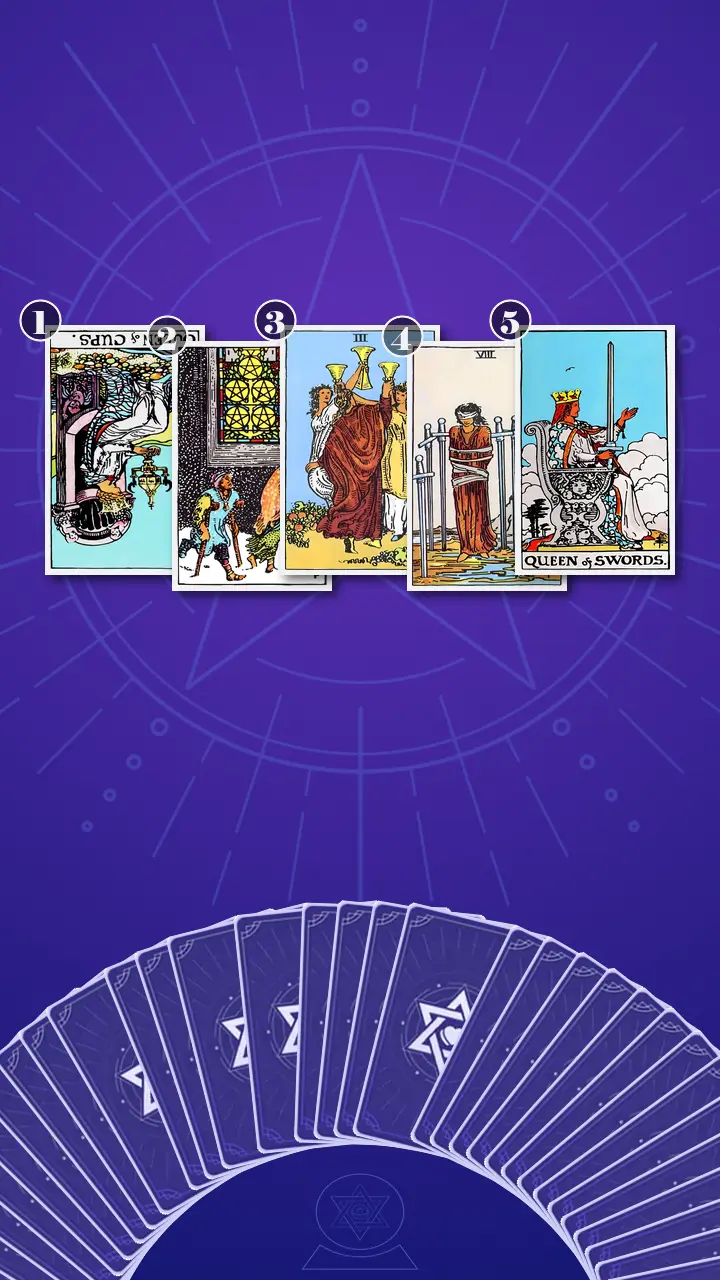
I chose a five-card reading called The Bridge · Context Edition. It is a tarot spread for friendship boundaries and direct communication, designed to follow a reaction from its visible behaviour to the fear beneath it and then toward a response that preserves both honesty and autonomy.
This structure mattered because the problem was not contained in one unanswered message. Position one would show what Alex did when the friendship felt uncertain. Position two would examine how they experienced the friend's withdrawal without pretending the cards could reveal the friend's private motives. The centre card would name what made the bond worth protecting. Position four would expose the rule obstructing connection, and position five would offer the bridge: a way to hold a limit while remaining open to conversation.
That ethical distinction is central to how tarot works in my practice. Cards do not grant access to another person's hidden thoughts, and card meanings in context are not verdicts. They give us a structured surface on which reactions, assumptions, values, and available choices become easier to see.
I laid the five cards in a straight line and angled them toward the camera. The arrangement resembled a narrow footbridge: immediate reaction on the left, belonging at the centre, and clearer action waiting on the right.
Reading the Bridge from the Closed Cup
Position One: The Message That Becomes an Emergency
Now I turned over the card representing Alex's present boundary-dropping response, including the rapid accommodation that followed any sign of uncertainty. It was the Queen of Cups, reversed.
I pointed to the ornate cup held in both hands and the thin strip of land between the Queen's throne and the sea. In Alex's life, that closed cup looked like a sealed chat being studied for hidden meaning. The narrow shore looked like the small amount of stable ground left for dinner, sleep, work, or prior plans once every emotional signal was allowed to wash across the schedule.
“At 10:40 p.m.,” I said, “you read a brief reply as a possible relationship emergency, cancel tomorrow's gym booking, and offer time you already said you did not have. Maybe if you offer one more thing, you can make this feel normal again.”
The reversal showed blocked Water energy: sensitivity was present in abundance, but it had stopped flowing through mutual exchange. Care for the friend had become excessive, while care for Alex's own body and capacity had dropped into deficiency. This did not make their empathy a weakness. It showed empathy being recruited for emotional surveillance and emergency repair.
I asked, “What did your friend actually request in that message?”
“Nothing,” Alex said. They gave a short laugh with a bitter edge, then pressed their lips together. “That's so accurate it feels a little brutal. I offered all of that before they even asked.”
I let the recognition land without turning it into blame. “The card isn't criticising your sensitivity. It's separating caring about the friendship from taking responsibility for every fluctuation in its emotional temperature. Those are different jobs.”
Position Two: The Warm Room Behind the Screen
Now I turned over the card representing how Alex interpreted the friend's withdrawal and what the distance activated in them. It was the Five of Pentacles, upright.
Two figures crossed a frozen street beneath an illuminated stained-glass window. I told Alex that the card did not establish why their friend had become less responsive. It showed what the distance felt like from Alex's side: being close enough to see the warm room while believing they had been shut out of it.
The modern version was painfully familiar. Alex could see that the friend had viewed an Instagram Story, posted drinks with other people, or reacted in the group chat while leaving the private message unanswered. A screen became the glowing window. The observable fact was limited contact; the feared conclusion was, “There is clearly room for other people, so maybe there is no longer room for me.”
Here, Earth energy appeared as deficiency and scarcity. One delayed reply acquired the physical weight of exclusion: a sinking stomach, cold fingers, and shoulders rising toward the ears. Yet the card preserved an important uncertainty. Digital visibility could confirm activity, but it could not confirm motive, permanent rejection, or the final status of the friendship.
“A delayed reply is information you do not have yet, not a boundary you have been ordered to retract,” I said.
Alex's hand stopped moving over the phone beside them. Their eyes shifted from the glowing window in the card to their dark screen. “I don't think I ever leave it as incomplete information,” they said. “I turn it into a membership decision.”
Position Three: The Cups Raised at the Same Height
Now I turned over the card representing the need for belonging and mutual friendship that made restoring the connection feel so urgent. It was the Three of Cups, upright.
Three people stood in a circle with their cups raised at equal height. The card carried balanced Water: affection moving through shared participation rather than one person absorbing all the uncertainty and labour. I asked Alex to remember the friendship at its most mutual: plans initiated from both sides, private jokes that made a hard week lighter, and check-ins that did not have to be chased.
“You're not trying to win attention for its own sake,” I said. “You're trying to return to the version of friendship where both cups were raised. Wanting the friendship is not the problem; making yourself disappear to preserve it is the cost.”
The distinction restored dignity to Alex's desire. Their model of friendship was not emotional detachment. It was closer to the best moments of Broad City: expressive closeness between people whose separate lives remained real. The difficulty began when Alex treated every request as a loyalty test and every last-minute invitation as a rare chance to renew their membership.
The card also carried a practical standard. Reciprocity could be observed. Whose time was protected? Who initiated? Who followed through? Could disappointment be expressed without one person immediately surrendering their capacity?
Alex looked at the equal cups for several seconds. Their jaw loosened before their voice did. “I think I've been trying to preserve the memory of mutuality by doing all the work alone,” they said.
Position Four: The Dropdown Menu with a Missing Option
Now I turned over the card representing the belief that maintaining a limit would cause abandonment and obstruct honest connection. It was the Eight of Swords, upright.
The blindfolded figure appeared surrounded by swords, but the bindings were loose and the enclosure incomplete. I focused on the visible gap. The card showed Air energy in blockage and excess at once: Alex's mind generated constant analysis, yet that analysis kept circling one restrictive conclusion.
I brought them to another scene they had described. At 8:17 a.m. on a packed Line 1 train, they had seen that the friend viewed their Story but had not answered the message above it. The brakes squealed, someone's coffee smelled burnt, and Alex's fingers went cold around the phone. Their mind produced a rigid equation: boundary equals disappointment; disappointment equals distance; distance equals being left.
“That equation is functioning like a broken dropdown menu,” I said. “It displays only two choices: overaccommodate or lose them. The third option, keep the limit and ask directly, has been hidden rather than disproved.”
I thought of an editing timeline from one of my old art projects, where repeating the same cut could make a temporary pause feel like the only possible ending. Alex's rejection-fear algorithm was doing something similar. It kept recommending one explanation, no matter how incomplete the available data was.
“Finish this sentence without polishing it,” I said. “If I keep saying no while they're distant, they will... and that will mean I am...”
Alex inhaled, held the breath, and stared past the camera as if an older conversation had started replaying on the wall. Their fingers curled against their palm. Then the words came out quietly: “They'll stop reaching out, and it will mean I'm replaceable.”
Their shoulders dropped a fraction after they heard the hidden rule spoken aloud. Fear keeps offering two options: abandon the limit or be abandoned. The cards leave a third door open.
I asked Alex to create two headings in their Notes app: What I know and What I am guessing. Under the first, they wrote the exact message and the delayed response. Under the second, they wrote, “They are done with me,” and, “This is my last chance to fix it.”
“I still feel the drop in my stomach,” they said.
“That makes sense,” I replied. “The goal isn't to erase the alarm. It's to stop treating the alarm as confirmation. You can feel afraid without appointing fear as the only person allowed to write the next message.”
When the Queen Raised Her Sword and Opened Her Hand
Position Five: A Limit That Does Not Slam the Door
The rain against Alex's kitchen window softened as I reached the final position. A pale strip of sky appeared between two buildings, almost echoing the clearing clouds on the card I turned toward the camera.
Now I turned over the card representing a boundary-preserving form of communication that could support understanding without requiring Alex to overfunction or decide the friend's position for them. It was the Queen of Swords, upright.
Her sword stood vertically in one hand while the other hand remained extended. I read those symbols together. The sword was the unchanged limit. The open hand was the invitation to honest conversation. Balanced Air transformed repeated speculation into language that another person could actually answer.
This Queen was not asking Alex to become cold, withdraw affection, or use a boundary to make the friend chase them. She represented clear perception, compassionate self-respect, and direct communication without control. In modern life, she sounded like this: “I care about this friendship, but I cannot cancel tonight. I've noticed some distance and would rather ask about it directly than guess. Would you be open to talking this week?”
I told Alex this was where I use what I call my Sidekick Syndrome Diagnosis. The name is playful; the pattern is not. I listen for the restrictive role someone has learned to perform inside a friendship: the on-call therapist, the endlessly flexible planner, the funny one who cannot admit hurt, or the emotional continuity manager responsible for keeping every scene moving.
Through my Clique Power Dynamics lens, I do not begin by accusing anyone of manipulation. I ask smaller, more revealing questions: Whose calendar bends? Whose silence launches an investigation? Who gets to disappoint, and who immediately compensates? Alex had gradually accepted the role of on-call repair person. Every retracted limit rehearsed an implicit hierarchy in which the friend's uncertainty remained protected while Alex's capacity became negotiable.
The Queen of Swords did not tell Alex to resign from the friendship. She invited them to resign from that character. The sword-and-open-hand posture offered a new role: a full participant who could care, name impact, keep a plan, and allow the other person to decide how honestly they were willing to meet them.
I brought Alex back to the cold pasta and cancelled gym booking. They had already said the week was full, but one brief reply had made their own limit feel provisional. The friendship had not become clearer that night; only Alex's availability had changed.
A boundary does not end connection; it reveals whether the connection can make room for both people.
You do not have to trade your limits for closeness; keep the Queen's sword upright by naming one clear need and letting the response provide information.
I left the words alone for a few seconds. Alex's breath stopped first. Their fingers froze above the edge of the table, and their eyes lost focus as if they were replaying the cancelled class, the streetcar apology they had nearly sent, and every “no worries” that had hidden an actual worry. Their pupils widened. Colour rose around their eyes before their face tightened with something sharper than relief.
“But doesn't that mean I've been doing friendship wrong this whole time?” they asked. The anger in their voice was brief but real. “Like I created the exact thing I resented.”
“It means you found a strategy that gave you ten minutes of relief and charged the cost later,” I said. “You used it because uncertainty hurt, not because you were foolish. Seeing the cost now does not invalidate the care underneath it.”
I watched their fist slowly unclench. Their shoulders sank, followed by a shaky breath that sounded almost like a laugh. Relief arrived, but so did the slight dizziness of responsibility: if the limit could remain upright, Alex would have to let the response be real information, even if that information was disappointing.
“Now, with this new perspective, can you think of a moment last week when this insight might have made you feel different?” I asked.
Alex thought about the rainy Friday streetcar. They had been travelling to meet another friend when the distant friend texted, “You around later?” Alex had started drafting an apology to the person already waiting.
“I could have kept the dinner plan,” they said. “I could have said tomorrow worked better. I didn't have to turn one invitation into the last helicopter out.”
I set a ten-minute timer. Alex wrote the boundary they had already stated, then completed three lines: “I observed...”, “I feel...”, and “I would like to ask...” I asked them not to send anything during the exercise. If ten minutes became too activating, the minimum version was simply leaving the original plan unchanged.
I named the crossing we had just reached: from rejection-driven self-abandonment to compassionate self-respect within an uncertain friendship. It was not certainty about the friend's intentions. It was the first piece of internal clarity strong enough to coexist with not knowing.
Finding Clarity with One Limit Still Standing
I read the full line of cards as one story. The reversed Queen of Cups showed Alex directing real sensitivity toward monitoring and overcare. The Five of Pentacles showed incomplete information becoming a felt exile. The Three of Cups restored the legitimate desire beneath the urgency: mutual friendship, not endless reassurance. The Eight of Swords exposed the rule that made every limit feel dangerous. The Queen of Swords replaced that rule with a boundary and an invitation held in the same sentence.
The recent history of the pattern explained why it felt so convincing. Accommodation often produced a warm reaction or a renewed plan, so Alex's body learned that self-abandonment relieved the emergency. The cost arrived later as poor sleep, neglected work, cancelled commitments, and resentment they felt ashamed to express. That delayed cost reinforced the illusion that the friend's silence was the whole problem.
The cognitive blind spot was subtle: Alex believed extra availability was creating clarity, but it was often preventing clarity. If their real limit never remained visible, the friend never had the opportunity to respond to it, and Alex never learned the relationship's actual capacity. They kept leaving their side of the bridge and then wondering why they could not see whether it reached both shores.
The spread contained Water, Earth, and a great deal of Air, but no Fire. Alex did not need another hour of analysis. They needed one small action taken from clarity. I offered two practices, each designed to test the new understanding without turning a boundary into punishment or a communication tactic.
Clarity cannot control the reply, but it can stop uncertainty from making every decision for you.
- The Thirty-Minute Repair PauseThe next time a delayed or cool reply creates urgency, set a 30-minute timer and place the phone face down outside arm's reach. In Notes, write “What I know” and “What I am guessing.” Record the exact words, timing, or cancelled plan in the first section; put feared motives and predicted outcomes in the second. Copy the boundary you already stated, such as “I cannot meet tonight,” and send nothing that contradicts it during the pause.Start with five minutes if thirty feels impossible. Mute only that chat, and stop if watching the timer becomes another form of checking. The aim is enough space to choose, not perfect self-control.
- The Role Resignation ActAt the next last-minute invitation or group-chat moment that casts you as the endlessly available sidekick, keep one existing commitment and resign from the role without resigning from the friendship. During a calm daytime window, send one observation, one feeling, and one request: “I've noticed our replies and plans have been less frequent. I care about this friendship and have felt uncertain about the change. I cannot cancel tonight, but I am free Saturday afternoon. Would you be open to talking this week?” Then return to the plan already on your calendar.Read the message once for accusations or mind-reading, then stop editing. Omit the alternative time if it exceeds your capacity. The open hand invites a response; it does not chase or demand one.
I reminded Alex that neither practice could guarantee warmth, repair, or permanence. Directness might reveal mutual willingness, limited capacity, or an answer they did not want. The purpose was not to engineer the friend into staying. It was to stop buying temporary closeness with choices Alex would resent the next morning.

Six Days Later, the Plan Stayed on the Calendar
Six days later, I received a message from Alex. A last-minute invitation had arrived while they were getting ready for the gym. They felt the familiar drop in their stomach, set a five-minute timer, and left the booking untouched. Then they sent the shorter version of the sword-and-open-hand message.
The friend replied the following afternoon: “Yeah, I've been off lately. Saturday works.” It was not a complete repair or a sweeping declaration of loyalty. It was enough information for one honest conversation, and Alex had reached it without cancelling their own evening.
That night, Alex slept through until morning. Their first thought was still, “What if I've made this worse?” They noticed it, smiled once, and made coffee before opening Instagram.
I did not call that certainty. I called it proof of movement. The fear had not vanished, but it had stopped holding calendar permissions for the rest of Alex's life.
Tarot had not predicted the friend's response or written Alex's future. It had functioned as a storyboard: five images made the old sequence visible, and one empty place in the elemental pattern showed where action belonged. I could hand Alex the pen, but they supplied the missing Fire by keeping the plan, sending the message, and allowing the answer to mean what it actually meant.
When someone we care about goes quiet, many of us know the tight chest and restless hands of trying to hold onto the friendship while quietly letting go of our own plans, limits, and place in it. Noticing that exchange is already a change in the script.
If you let one small limit remain in place without using the next reply to judge whether it was valid, what might the Queen's upright sword and open hand help you become curious enough to notice about the room this friendship can actually make for you?
This story is adapted from psychological research, written so that those in a similar struggle can see their own pattern in it — and find their next step clearly.These insights are not a substitute for professional psychological, medical, legal, or financial advice.
Learn more about our Journey to Clarity.
How did this insight land for you?
🫂 This Resonates Deeply
🌀 Living This Story
✨ Now I See Clearly
🌱 Seeing New Possibilities
🧰 Useful Framework
🔮 The Confirmation I Needed
💪 Feeling Empowered
🚀 Ready for My Next Step
Author Profile
 AI
AI“I’ve always felt our lives are films currently in production. As an artist, I know that when you feel stuck, it’s often because you’ve bravely stayed in a painful scene for just a little too long. I’m not here to coldly analyze you. I want to sit closely with you, look at those difficult moments with profound empathy, and gently hand you the pen so you have the courage to write your next beautiful act.”
In this Friendship Tarot Reading :
Core Expertise
- Clique Power Dynamics: Deconstructing the subtle jealousy, micro-aggressions, and implicit hierarchies hidden within tight-knit friend groups.
- Sidekick Syndrome Diagnosis: Identifying how your friend group has boxed you into a specific, restrictive role (e.g., the clown, the therapist) to maintain their status quo.
Service Features
- The Role Resignation Act: A creative conversational pivot designed to gracefully but firmly refuse your assigned 'character' during your next group interaction.
Also specializes in :
Explore Related Patterns:
Anxious AttachmentAt 10:40 p.m., Alex reads a cool reply, reopens a week they already said was full, and hovers over the button that would cancel the next morning's gym class. Later, a viewed Story without a private reply activates the same equation in which a boundary leads to disappointment, distance, and finally being left. When you operate through this attachment strategy, restoring proximity can feel more urgent than checking whether any repair was requested or whether your own capacity has changed. Retracting the limit briefly quiets the rejection alarm, but that relief teaches your nervous system to seek safety through increased availability, making another person's distance disproportionately powerful over your choices.
Defensive OverfunctioningAlex begins moving plans before the friend has asked for anything and later recognises that they have been trying to preserve the memory of mutuality by doing all the work alone. The role becomes that of an on-call repair person whose calendar bends whenever the friendship's emotional temperature changes. When you overfunction defensively, extra effort creates a temporary sense of agency in a situation you cannot control. Planning, accommodating, monitoring, and repairing can feel safer than waiting for another person to clarify their capacity, but the activity quietly builds an unequal relationship in which their uncertainty is protected and your limits are provisional. The work keeps the interaction moving while preventing you from seeing whether the other person will participate without being carried.
Intermittent ReinforcementAlex's recent history shows that accommodation sometimes produces a warm reaction or a renewed plan. The reward arrives quickly enough to make retracting a boundary feel effective, while the costs of poor sleep, neglected work, cancelled commitments, and resentment appear later. Intermittent rewards can make a behavior unusually persistent because the next attempt might restore closeness even when previous attempts carried a high cost. You are not repeating the response because it works consistently; you may be repeating it because it works unpredictably and offers immediate relief when uncertainty is hardest to tolerate. That timing difference helps explain why the pattern can remain convincing even after you understand its consequences.
Self-AbandonmentThe untouched pasta, the threatened gym booking, and the apology Alex nearly sends to a friend already waiting for dinner show where the cost of repair lands. Nothing in the cool message asks Alex to surrender those commitments, yet their own needs become negotiable before the friend has made a request. When you protect connection by repeatedly removing protection from your time, body, and existing relationships, care turns into self-abandonment. The strategy can produce immediate relief because you feel you are doing something to prevent distance, but the delayed result is poor sleep, neglected work, cancelled plans, and resentment that has nowhere honest to go. The issue is not that you care too much; it is that your care for the bond is being financed by choices made against your own stated capacity.
Black-and-White ThinkingOn the packed Line 1 train, Alex turns a viewed Story and an unanswered message into a rigid chain in which a boundary causes disappointment, disappointment causes distance, and distance means being left. A later invitation feels like "the last helicopter out," as though declining one evening would close every future route back to the friendship. This binary frame hides the option the story eventually makes visible. You can keep the limit and ask directly, care about the relationship and tolerate an incomplete answer, or feel disappointed without deciding the bond is over. Black-and-white thinking makes self-sacrifice feel compulsory by presenting two extreme outcomes as the entire field of choice, even though neither outcome has been established.
Rejection SensitivityThe message saying "yeah maybe, busy rn" contains no request and no explicit rejection, yet Alex's body receives it as a relationship emergency. Seeing the friend active on Instagram or in a group chat while the private message remains unanswered then feels less like incomplete information and more like proof that Alex has been excluded. When you are highly sensitised to rejection cues, small changes in tone, timing, or digital attention can acquire the weight of a social verdict. The resulting urgency is real, but the conclusion remains unverified. The pattern becomes visible when the intensity of your repair response is being set by what the cue might mean rather than by what the other person has actually communicated.
Boundary DiscernmentThe final response keeps two things visible at once. Alex cannot cancel that evening, and Alex remains open to talking on Saturday. Six days later, they enact that distinction by leaving the gym booking untouched and offering a time that fits their actual capacity. Boundary discernment lets you separate wanting closeness from consenting to unlimited availability. A limit can describe what you can offer without functioning as punishment, withdrawal, or a demand that the other person chase you. By holding the limit and leaving the conversational door open, you allow the response to reveal whether the friendship can make room for both people rather than using self-erasure to keep the relationship temporarily calm.
Reality TestingIn the Notes exercise, Alex places the exact message and delayed response under "What I know" and moves "They are done with me" and "This is my last chance to fix it" under "What I am guessing." Six days later, they keep the gym booking, send a bounded message, and allow the friend's actual reply to provide information. Reality testing does not require you to eliminate the stomach drop or convince yourself that everything will be fine. It asks you to keep observable facts, bodily fear, and predicted meaning in separate lanes long enough to choose deliberately. That separation restores clarity because a digital signal can confirm activity, but it cannot by itself confirm motive, permanent rejection, or the final capacity of the friendship.
Explore Related Struggles:
Approval-Safety FusionAlex can hold a boundary until the friend appears upset, at which point a cool reply makes the limit feel dangerous. You can see the friction in the move from "the week is full" to hovering over the cancel button: the practical facts have not changed, but the need to restore approval has acquired control over the decision. When approval becomes the condition for feeling secure, a boundary can register as a threat even when it accurately reflects your capacity. Naming that fusion allows you to separate another person's possible disappointment from the validity of your limit, leaving room for connection without requiring immediate surrender.
Availability-Worth FusionThe friend asks for nothing, but Alex begins offering time they have already said they do not have. Later, the hidden rule becomes explicit: if the limit remains while the friend is distant, they may stop reaching out, and that will mean Alex is replaceable. When availability carries the burden of proving worth, every existing commitment can feel like evidence against belonging. You regain clearer ground by allowing your place in a friendship to be tested through mutual regard rather than through how completely you can abandon your schedule on demand.
Boundary CollapseAt 10:40 p.m., Alex has already said the week is full, yet one brief reply puts the next morning's gym class back on the table. You can locate the collapse in that exact transition: the boundary still exists in words, but it stops governing the calendar as soon as distance appears. Repeated accommodation allows the friendship's changing temperature to overrule sleep, work, exercise, and prior commitments. The core struggle is not caring too much; it is losing a stable place from which your care and your capacity can coexist.
False Responsibility LoopAlex studies the cool message, supplies flexibility before being asked, and sometimes receives a warmer reaction or renewed plan. You can see why the sequence repeats: repair produces immediate relief, while the cost arrives later as lost sleep, neglected work, cancelled commitments, and unspoken resentment. That timing makes every fluctuation appear to be yours to fix, even though your repair work cannot establish the other person's intentions or willingness. Recognizing the loop returns responsibility to its proper scale: you can communicate and care without becoming the sole manager of the friendship's continuity.
Third Path BlindnessOn the packed train, Alex sees that the friend viewed a Story without answering and arrives at a rigid equation: keep the boundary and be left, or overaccommodate and preserve the bond. You are watching incomplete information collapse into a two-option menu before the friend has confirmed either outcome. The trap is structural because both visible options require you to organize your choices around a predicted rejection. The overlooked third path is to keep the limit and ask directly, allowing uncertainty to remain present without letting it erase your autonomy.
Read Receipt Worth LockAlex sees the friend view an Instagram Story, post with other people, or react in the group chat while leaving the private message unanswered. You are given evidence of online activity, but the screen turns that narrow fact into a verdict about whether there is still room for you. Once a read receipt becomes a measure of worth, digital visibility can override the limits of what you actually know and pressure you into proving your place through availability. Separating platform activity from relational meaning lets the response provide information without granting it authority over your value or your calendar.
Reciprocity DeficitAlex remembers a friendship in which both people initiated, followed through, and raised their cups at the same height, yet admits to trying to preserve that mutuality by doing all the work alone. You can see the mismatch whenever one person's silence launches an investigation and only one person's calendar bends. Reciprocity cannot become visible while you continuously compensate for its absence. Letting your actual capacity remain in the relationship creates space to observe whether care, initiation, and adjustment can move in both directions.
Explore Related Emotions:
Conditional Belonging FearAlex reads "yeah maybe, busy rn" after already saying the week is full, then begins negotiating against that limit before the friend has requested anything. When you follow that sequence closely, the boundary is no longer being evaluated according to available time or physical capacity; it is being treated as a test of whether there will still be a place for Alex in the friendship. The warm-room image makes the inner logic visible. You can want closeness and still experience every limit as a risk to your membership, especially when delayed contact is converted into proof that belonging depends on being endlessly accommodating. Conditional Belonging Fear names the resulting inner weather: the sense that connection remains available only while your own needs stay negotiable.
Mutuality HungerAlex remembers plans initiated from both sides, private jokes that made difficult weeks lighter, and check-ins that did not have to be chased. Those memories explain why the friendship matters: the desired experience is not unlimited attention but affection that moves between two full participants. You can long for dependable closeness without consenting to endless availability. Mutuality Hunger names the legitimate emotional need beneath the repair reflex, preserving the dignity of wanting friendship while making reciprocity visible as part of that desire. The feeling points toward equal participation, where both calendars, disappointments, and separate lives are allowed to remain real.
Relational UrgencyAt 10:40 p.m., Alex's pasta remains untouched while their foot taps, the phone warms in their palm, and the gym cancellation screen opens. Nothing in the friend's message asks for a schedule change, yet the body has already converted a cool tone into an emergency requiring immediate action. The speed of that sequence matters. You have almost no room to separate what happened from what you fear it could mean, so accommodation feels less like a considered choice and more like the fastest way to stop the internal alarm. Relational Urgency names this compressed emotional state, where restoring contact appears too time-sensitive to leave an existing boundary intact.
Replaceability DreadThe friend appears in group chats and Instagram posts while Alex's private message remains unanswered, and Alex interprets that contrast as evidence that there is room for other people but perhaps no longer room for them. The story reaches its clearest point when Alex says that if the friend stops reaching out, it will mean they are replaceable. That conclusion gives a delayed reply more than ordinary social weight. You are no longer waiting only for a message; you are waiting for confirmation that your place has not been reassigned. Replaceability Dread captures the deeper subjective threat driving the accommodation: changing the calendar becomes an attempt to prove continued value before the available evidence can support any final conclusion.
Self-Betrayal AcheAlex has already said the week is full, yet one brief reply makes dinner, sleep, work, the gym class, and other commitments feel expendable. The friendship does not become clearer when those limits disappear; only Alex's availability changes. That delayed recognition creates a specific kind of pain. You may gain a short interval of restored contact while losing the experience of standing beside your own stated needs, and the cost becomes visible only after the emergency feeling has passed. Self-Betrayal Ache names the hurt of realizing that an attempt to preserve connection repeatedly required leaving your own side of it.
Cautious Self-TrustSix days later, a last-minute invitation arrives while Alex is preparing for the gym. They feel the familiar drop, set a five-minute timer, leave the booking untouched, and send a shorter message that preserves both the limit and the invitation to talk. The next morning still contains the thought that keeping the boundary may have made things worse, but Alex makes coffee before opening Instagram. Cautious Self-Trust lives in that modest sequence: you do not need complete calm or guaranteed approval before allowing your own decision to remain valid. Trust is beginning to rest on observed capacity rather than the speed or warmth of the next reply.
Hidden ResentmentThe warm reaction produced by accommodation arrives quickly, while the cost appears later as poor sleep, neglected work, cancelled commitments, and resentment Alex feels ashamed to express. Their bitter laugh and brief anger surface when they recognize that they have been protecting the friend's uncertainty by making their own capacity absorb every adjustment. You can say "no worries" and still carry the unspoken impact of a calendar that repeatedly bends in one direction. Hidden Resentment describes the emotional residue left when disagreement is prevented through immediate self-erasure rather than expressed within the relationship. Naming it does not assign all responsibility to either person; it reveals where an apparently smooth interaction has been storing its cost.
Read Receipt AnxietyA viewed Story, a group-chat reaction, and an unanswered private message become a glowing window through which Alex can see activity without knowing its meaning. On the crowded train, that partial digital evidence is accompanied by cold fingers and a sinking stomach, while at home the phone displaces dinner and the next morning's plan. You can verify that someone was online without gaining access to their motive, capacity, or view of the relationship. Read Receipt Anxiety grows inside that gap: the platform supplies constant signs of presence but no reliable answer about connection. The resulting uncertainty keeps the screen emotionally active long after the observable information has run out.
Cautious ReliefAlex's jaw loosens when the restrictive rule is spoken aloud, and later their fist opens around a shaky breath. After keeping the gym booking, they receive a limited but usable reply and sleep through until morning without treating that response as a complete repair. You can feel some pressure release while the friendship remains unresolved. Cautious Relief names a form of easing that does not depend on a sweeping declaration of loyalty: one limit stayed in place, one conversation became possible, and the body gained a little room. Its restraint matters because the available information supports movement, not certainty.
Explore Related Contexts:
Fixer Friend DynamicAlex offers to move the week around before the friend has requested any accommodation. They monitor changes in tone, consider cancelling the gym, nearly apologize to someone already waiting for dinner, and describe a need to fix everything before distance becomes permanent. The repeated job they perform is not simply caring for a friend; it is managing the continuity of the relationship whenever contact becomes uncertain. That assignment creates a Fixer Friend Dynamic. The friend is allowed to be brief, delayed, or unavailable without immediately accounting for the change, while Alex becomes responsible for detecting it, interpreting it, and supplying enough flexibility to restore contact. The unequal element is the distribution of relationship maintenance, not a claim about the friend's private intentions. When you occupy the fixer role, every quiet period can arrive disguised as an urgent task. Recognizing the role lets you ask whether repair work was actually requested, whether it is shared, and whether the friendship can remain connected when you participate as a person with limits rather than as its on-call continuity manager.
Friendship Boundary CreepAt 10:40 p.m., Alex has already said the week is full, yet a brief "yeah maybe, busy rn" reply is enough to put the next morning's gym class at risk and reopen time they had declared unavailable. The same displacement appears when a last-minute invitation nearly overrides dinner with another friend and when disrupted plans, work, sleep, and meals become the delayed cost of restoring contact. The friend does not ask Alex to cancel in the first scene. The structural problem is subtler: reduced contact repeatedly makes Alex's previously stated limits provisional, while the friend's availability remains the fixed point around which the calendar moves. The friendship therefore has more room for one person's uncertainty than for the other person's finite capacity. When you are dealing with Friendship Boundary Creep, the key evidence is not whether the other person intended to pressure you. It is whether your limits remain socially real after they encounter disappointment, distance, or a last-minute request. Keeping one plan visible allows you to see whether the friendship can adapt around two people's lives instead of requiring one person's boundaries to keep moving.
Friendship DriftAlex can identify a concrete change in the friendship: replies and plans have become less frequent, private messages remain unanswered while the friend is active elsewhere, and a direct reply consists of "yeah maybe, busy rn." The friend later confirms only that they have been off lately. Nothing in those facts establishes a motive or a final decision, but the shared rhythm has clearly changed. Friendship Drift is the external stage created by that reduction in contact without a mutually understood explanation. It leaves the relationship active enough to produce occasional invitations and online visibility, but not clear enough for either person to know what level of connection is currently available. Alex is trying to make scheduling decisions inside that unresolved shift. When a friendship is drifting, you do not need to manufacture certainty by becoming more available than your life permits. You can treat the reduced contact as real information while leaving its meaning open until the other person participates in naming what has changed.
Friendship Boundary ResetSix days later, a last-minute invitation arrives while Alex is preparing for the gym. They set a short timer, leave the booking untouched, and send a bounded message instead of reopening the evening. The friend replies the following afternoon, acknowledges having been off lately, and agrees that Saturday works. The reset is visible because Alex's capacity remains part of the exchange from beginning to end. Their existing plan is not used as a threat, and the invitation to talk does not require immediate access. The friend receives an accurate limit and gains the opportunity to respond to the relationship as it actually exists. A Friendship Boundary Reset does not prove that future contact will be consistent or that the wider issue is repaired. It creates a fairer test: you keep one limit socially visible, the other person decides how to meet it, and the response becomes information about the friendship's room for both people.